Exploiting Structure for Event Discovery Using the MDI Algorithm
Martina Naughton
School of Computer Science & Informatics University College Dublin
Ireland
Abstract
Effectively identifying events in unstruc-tured text is a very difficult task. This is largely due to the fact that an individual event can be expressed by several sentences. In this paper, we investigate the use of clus-tering methods for the task of grouping the text spans in a news article that refer to the same event. The key idea is to cluster the sentences, using a novel distance metric that exploits regularities in the sequential struc-ture of events within a document. When this approach is compared to a simple bag of words baseline, a statistically significant increase in performance is observed.
1 Introduction
Accurately identifying events in unstructured text is an important goal for many applications that require natural language understanding. There has been an increased focus on this problem in recent years. The Automatic Content Extraction (ACE) program1 is dedicated to developing methods that automatically infer meaning from language data. Tasks include the detection and characterisation of Entities, Rela-tions, and Events. Extensive research has been ded-icated to entity recognition and binary relation de-tection with significant results (Bikel et al., 1999). However, event extraction is still considered as one of the most challenging tasks because an individual event can be expressed by several sentences (Xu et al., 2006).
In this paper, we primarily focus on techniques for identifying events within a given news article. Specifically, we describe and evaluate clustering
1
http://www.nist.gov/speech/tests/ace/
methods for the task of grouping sentences in a news article that refer to the same event. We generate sentence clusters using three variations of the well-documented Hierarchical Agglomerative Clustering (HAC) (Manning and Sch¨utze, 1999) as a baseline for this task. We provide convincing evidence sug-gesting that inherent structures exist in the manner in which events appear in documents. In Section 3.1, we present an algorithm which uses such structures during the clustering process and as a result a mod-est increase in accuracy is observed.
Developing methods capable of identifying all types of events from free text is challenging for sev-eral reasons. Firstly, different applications consider different types of events and with different levels of granularity. A change in state, a horse winning a race and the race meeting itself can be considered as events. Secondly, interpretation of events can be subjective. How people understand an event can de-pend on their knowledge and perspectives. There-fore in this current work, the type of event to extract is known in advance. As a detailed case study, we investigate event discovery using a corpus of news articles relating to the recent Iraqi War where the tar-get event is the“Death”event type. Figure 1 shows a sample article depicting such events.
The remainder of this paper is organised as fol-lows: We begin with a brief discussion of related work in Section 2. We describe our approach to Event Discovery in Section 3. Our techniques are experimentally evaluated in Section 4. Finally, we conclude with a discussion of experimental observa-tions and opportunities for future work in Section 5.
2 Related Research
The aim of Event Extraction is to identify any in-stance of a particular class of events in a natural
World News
Insurgents Kill 17 in Iraq
In Tikrit, gunmen killed 17 Iraqis as they were heading to work Sunday at a U.S. military facility. Capt. Bill Coppernoll, said insurgents fired at several buses of Iraqis from two cars.
. . . .
Elsewhere, an explosion at a market in Baqubah, about 30 miles north of Baghdad late Thursday. The market was struck by mortar bombs according to U.S. military spokesman Sgt. Danny Martin. . . . .
Figure 1: Sample news article that describes multiple events.
language text, extract the relevant arguments of the event, and represent the extracted information into a structured form (Grishman, 1997). The types of events to extract are known in advance. For exam-ple, “Attack”and“Death”are possible event types to be extracted. Previous work in this area focuses mainly on linguistic and statistical methods to ex-tract the relevant arguments of a event type. Lin-guistic methods attempt to capture linguists knowl-edge in determining constraints for syntax, mor-phology and the disambiguation of both. Statistical methods generate models based in the internal struc-tures of sentences, usually identifying dependency structures using an already annotated corpus of sen-tences. However, since an event can be expressed by several sentences, our approach to event extrac-tion is as follows: First, identify all the sentences in a document that refer to the event in question. Sec-ond, extract event arguments from these sentences and finally represent the extracted information of the event in a structured form.
Particularly, in this paper we focus on clustering methods for grouping sentences in an article that dis-cuss the same event. The task of clustering simi-lar sentences is a problem that has been investigated particularly in the area of text summarisation. In SimFinder (Hatzivassiloglou et al., 2001), a flexible clustering tool for summarisation, the task is defined as finding text units (sentences or paragraphs) that contain information about a specific subject. How-ever, the text features used in their similarity metric are selected using a Machine Learning model.
3 Identifying Events within Articles
We treat the task of grouping together sentences that refer to the same event(s) as a clustering problem.
As a baseline, we generate sentence clusters us-ing average-link, sus-ingle-link and complete-link Hi-erarchical Agglomerative Clustering. HAC initially assigns each data point to a singleton cluster, and repeatedly merges clusters until a specified termi-nation criteria is satisfied (Manning and Sch¨utze, 1999). These methods require a similarity metric between two sentences. We use the standard co-sine metric over a bag-of-words encoding of each sentence. We remove stopwords and stem each re-maining term using the Porter stemming algorithm (Porter, 1997). Our algorithms begin by placing each sentence in its own cluster. At each itera-tion we merge the two closest clusters. A fully-automated approach must use some termination cri-teria to decide when to stop clustering. In exper-iments presented here, we adopt two manually su-pervised methods to set the desired number of clus-ters (k): “correct” k and “best”k. “Correct” setsk to be the actual number of events. This value was obtained during the annotation process (see Section 4.1). “Best” tuneskso as to maximise the quality of the resulting clusters.
3.1 Exploiting Article Structure
The basic idea is to learn a model capable of cap-turing document structure, i.e. the way events are reported. Each document is treated as a sequence of labels (1 label per sentence) where each label repre-sents the event(s) discussed in that sentence. We de-fine four generalised event label types: N, represents a new event sentence; C, represents a continuing event sentence (i.e. it discusses the same event as the preceding sentence); B, represents a back-reference to an earlier event; X, represents a sentence that does not reference an event. This model takes the form of a Finite State Automaton (FSA) where:
• Statescorrespond to event labels.
• Transitions correspond to adjacent sentences that mention the pair of events.
More formally, E = (S, s0, F, L, T) is a model where S is the set of states,s0∈Sis the initial state, F ⊆ S is the set of final states, L is the set of edge labels andT ⊆(S×L)×Sis the set of transitions. We note that it is the responsibility of the learning algorithm to discover the correct number of states.
We treat the task of discovering an event model as that of learning a regular grammar from a set of pos-itive examples. Following Golds research on learn-ing regular languages (Gold, 1967), the problem has received significant attention. In our current experi-ments, we use Thollard et al’s MDI algorithm (Thol-lard et al., 2000) for learning the automaton. MDI has been shown to be effective on a wide range of tasks, but it must be noted that any grammar infer-ence algorithm could be substituted.
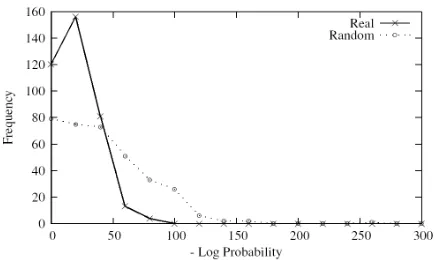
[image:3.612.318.535.57.187.2]To estimate how much sequential structure exists in the sentence labels, the document collection was randomly split into training and test sets. The au-tomaton produced by MDI was learned using the training data, and the probability that each test se-quence was generated by the automaton was calcu-lated. These probabilities were compared with those of a set of random sequences (generated to have the same distribution of length as the test data). The probabilities of event sequences from our dataset and the randomly generated sequences are shown in Figure 2. The test and random sequences are sorted by probability. The vertical axis shows the rank in each sequence and the horizontal axis shows the negative log probability of the sequence at each
Figure 2: Distribution in the probability that actual and random event sequences are generated by the automaton produced by MDI.
rank. The data suggests that the documents are in-deed structured, as real document sequences tend to be much more likely under the trained FSA than ran-domly generated sequences.
We modify our baseline clustering algorithm to utilise the structural information omitted by the au-tomaton as follows: Let L(c1, c2) be a sequence of labels induced by merging two clusters c1 and c2. If P(L(c1, c2))is the probability that sequence L(c1, c2) is accepted by the automaton, and let
cos(c1, c2)be the cosine distance betweenc1andc2. We can measure the similarity betweenc1andc2as:
SIM(c1, c2) = cos(c1, c2)×P(L(c1, c2)) (1)
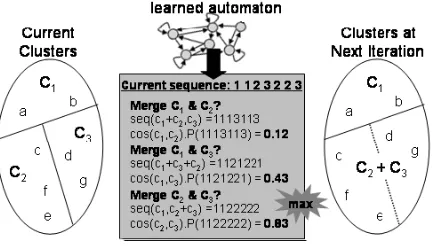
Letrbe the number of clusters remaining. Then there are r(r−2 1) pairs of clusters. For each pair of clustersc1,c2we generate the resulting sequence of labels that would result ifc1 andc2 were merged. We then input each label sequence to our trained FSA to obtain the probability that it is generated by the automaton. At each iteration, the algorithm pro-ceeds by merging the most similar pair according to this metric. Figure 3 illustrates this process in more detail. To terminate the clustering process, we adopt either the “correct”kor “best”khalting criteria de-scribed earlier.
4 Experiments
4.1 Experimental Setup
Figure 3: The sequence-based clustering process.
dataset2. This is an independent public database of media-reported civilian deaths in Iraq resulting di-rectly from military attack by the U.S. forces. Casu-alty figures for each event reported are derived solely from a comprehensive manual survey of online me-dia reports from various news sources. We obtained a portion of their corpus which consists of 342 new articles from 56 news sources. The articles are of varying size (average sentence length per document is 25.96). Most of the articles contain references to multiple events. The average number of events per document is 5.09. Excess HTML (image captions etc.) was removed, and sentence boundaries were identified using the Lingua::EN::Sentence perl mod-ule available from CPAN3.
To evaluate our clustering methods, we use the definition of precision and recall proposed by (Hess and Kushmerick, 2003). We assign each pair of sentences into one of four categories: (i) clustered together (and annotated as referring to the same event);(ii)not clustered together (but annotated as referring to the same event); (iii) incorrectly clus-tered together;(iv)correctly not clustered together. Precision and recall are thus found to be computed asP = a+ac andR= a+ab, andF1 = P2P R+R.
The corpus was annotated by a set of ten vol-unteers. Within each article, events were uniquely identified by integers. These values were then mapped to one of the four label categories, namely “N”, “C”, “X”, and “B”. For instance, sentences de-scribing previously unseen events were assigned a new integer. This value was mapped to the label cat-egory “N” signifying a new event. Similarly,
sen-2http://iraqbodycount.org/ 3
http://cpan.org/
tences referring to events in a preceding sentence were assigned the same integer identifier as that assigned to the preceding sentence and mapped to the label category “C”. Sentences that referenced an event mentioned earlier in the document but not in the preceding sentence were assigned the same inte-ger identifier as that sentence but mapped to the label category “B”. Furthermore, If a sentence did not re-fer to any event, it was assigned the label 0 and was mapped to the label category “X”. Finally, each doc-ument was also annotated with the distinct number of events reported in it.
In order to approximate the level of inter-annotation agreement, two annotators were asked to annotate a disjoint set of 250 documents. Inter-rater agreements were calculated using the kappa statis-tic that was first proposed by (Cohen, 1960). This measure calculates and removes from the agreement rate the amount of agreement expected by chance. Therefore, the results are more informative than a simple agreement average (Cohen, 1960; Carletta, 1996). Some extensions were developed including (Cohen, 1968; Fleiss, 1971; Everitt, 1968; Barlow et al., 1991). In this paper the methodology proposed by (Fleiss, 1981) was implemented. Each sentence in the document set was rated by the two annotators and the assigned values were mapped into one of the four label categories (“N”, “C”, “X”, and “B”). For complete instructions on how kappa was calculated, we refer the reader to (Fleiss, 1981). Using the an-notated data, a kappa score of 0.67 was obtained. This indicates that the annotations are somewhat in-consistent, but nonetheless are useful for producing tentative conclusions.
de-Sentence 1: A suicide attacker set off a bomb that tore through a funeraltentjammed with Shiite mourners Thursday.
Rater 1:label=1.Rater 2:label=1
Sentence 2: The explosion, in a working class neighbourhood ofMosul, destroyedthe tentkillingnearly 50 people.
Rater 1: label=1.Rater 2: label=1. . . . .
Sentence 23: At the hospital of thisnorthern city, doctor Saher Maher said thatat least 47 peoplewere killed.
[image:5.612.76.296.197.271.2]Rater 1:label=1.Rater 2: label=2.
Figure 4: Sample sentences where the raters disagreed.
Algorithm a-link c-link s-link
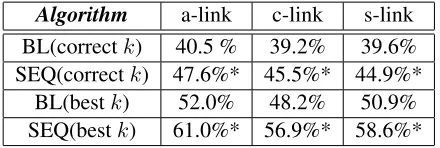
BL(correctk) 40.5 % 39.2% 39.6% SEQ(correctk) 47.6%* 45.5%* 44.9%*
BL(bestk) 52.0% 48.2% 50.9% SEQ(bestk) 61.0%* 56.9%* 58.6%*
Table 1: % F1 achieved using average-link (a-link), complete-link (c-link) and single-link (s-link) varia-tions of the baseline and sequence-based algorithms when the correct and bestkhalting criteria are used. Scores marked with * are statistically significant to a confidence level of 99%.
scribe in sentence 1 and 2, the rater have to resolve that “the northern city” is referring to “Mosul” and that “nearly 50” equates to “at least 47”. These and similar ambiguities in written text make such an an-notation task very difficult.
4.2 Results
We evaluated our clustering algorithms using the F1 metric. Results presented in Table 1 were obtained using 50:50 randomly selected train/test splits aver-aged over 5 runs. For each run, the automaton pro-duced by MDI was generated using the training set and the clustering algorithms were evaluated using the test set. On average, the sequence-based clus-tering approach achieves an 8% increase in F1 when compared to the baseline. Specifically the average-link variation exhibits the highest F1 score, achiev-ing 62% when the “best” k termination method is used.
It is important to note that the inference produced by the automaton depends on two values: the thresh-oldαof the MDI algorithm and the amount of label sequences used for learning. The closerα is to 0, the more general the inferred automaton becomes.
In an attempt to produce a more general automaton, we choseα = 0.1. Intuitively, as more training data is used to train the automaton, more accurate infer-ences are expected. To confirm this we calculated the %F1 achieved by the average-link variation of the method for varying levels of training data. Over-all, an improvement of approx. 5% is observed as the percentage training data used is increased from 10% to 90%.
5 Discussion
crude treatment of the complexity of written text, it will help us to approximate the benefit (if any) of applying clustering-based techniques to this task.
In the future, we hope to further evaluate our methods using a larger dataset containing more event types. We also hope to examine the inter-esting possibility that inherent structures learned from documents originating from one news source (e.g. Aljazeera) differ from structures learned us-ing documents originatus-ing from another source (e.g. Reuters). Finally, a single sentence often contains references to multiple events. For example, consider the sentence “These two bombings have claimed the lives of 23 Iraqi soldiers”. Our algorithms assume that each sentence describes just one event. Future work will focus on developing methods to automati-cally recognise such sentences and techniques to in-corporate them into the clustering process.
Acknowledgements. This research was supported by the Irish Research Council for Science, Engineer-ing & Technology (IRCSET) and IBM under grant RS/2004/IBM/1. The author also wishes to thank Dr. Joe Carthy and Dr. Nicholas Kushmerick for their helpful discussions.
References
W. Barlow, N. Lai, and S. Azen. 1991. A comparison of methods for calculating a stratified kappa. Statistics in Medicine, 10:1465–1472.
Daniel Bikel, Richard Schwartz, and Ralph Weischedel. 1999. An algorithm that learns what’s in a name. Ma-chine Learning, 34(1-3):211–231.
Jean Carletta. 1996. Assessing agreement on classifica-tion tasks: the kappa statistic. Computational Linguis-tics, 22:249–254.
Jacob Cohen. 1960. A coeficient of agreement for nom-inal scales. Educational and Psychological Measure-ment, 20(1):37–46.
Jacob Cohen. 1968. Weighted kappa: Nominal scale agreement with provision for scaled disagreement or partial credit.Psychological Bulletin, 70.
B.S. Everitt. 1968. Moments of the statistics kappa and the weighted kappa. The British Journal of Mathemat-ical and StatistMathemat-ical Psychology, 21:97–103.
J.L. Fleiss. 1971. Measuring nominal scale agreement among many raters. Psychological Bulletin, 76.
J.L. Fleiss, 1981. Statistical methods for rates and pro-portions, pages 212–36. John Wiley & Sons.
E. Mark Gold. 1967. Grammar identification in the limit. Information and Control, 10(5):447–474.
Ralph Grishman. 1997. Information extraction: Tech-niques and challenges. In Proceedings of the sev-enth International Message Understanding Confer-ence, pages 10–27.
Vasileios Hatzivassiloglou, Judith Klavans, Melissa Hol-combe, Regina Barzilay, Min-Yen Kan, and Kathleen McKeown. 2001. SIMFINDER: A flexible clustering tool for summarisation. InProceedings of the NAACL Workshop on Automatic Summarisation, Association for Computational Linguistics, pages 41–49.
Andreas Hess and Nicholas Kushmerick. 2003. Learn-ing to attach semantic metadata to web services. In Proceedings of the International Semantic Web Con-ference (ISWC 2003), pages 258–273. Springer.
Christopher Manning and Hinrich Sch¨utze. 1999. Foun-dations of Statistical Natural Language Processing. MIT Press.
Martina Naughton, Nicholas Kushmerick, and Joseph Carthy. 2006. Event extraction from heterogeneous news sources. InProceedings of the AAAI Workshop Event Extraction and Synthesis, pages 1–6, Boston.
Martin Porter. 1997. An algorithm for suffix stripping. Readings in Information Retrieval, pages 313–316.
Franck Thollard, Pierre Dupont, and Colin de la Higuera. 2000. Probabilistic DFA inference using Kullback-Leibler divergence and minimality. InProceedings of the 17th International Conference on Machine Learn-ing, pages 975–982. Morgan Kaufmann, San Fran-cisco.
Feiyu Xu, Hans Uszkoreit, and Hong Li. 2006. Auto-matic event and relation detection with seeds of vary-ing complexity. InProceedings of the AAAI Workshop Event Extraction and Synthesis, pages 12–17, Boston.