Statistical Models for Unsupervised Prepositional Phrase
Attachment
A d w a i t R a t n a p a r k h i
Dept. of C o m p u t e r and I n f o r m a t i o n Science University of Pennsylvania
200 South 33rd Street Philadelphia, PA 19104-6389 a d w a i t ~ u n a g i , c i s . u p e n n , edu
A b s t r a c t
We present several unsupervised statistical models for the prepositional phrase attachment task that approach the accuracy of the best su- pervised methods for this task. Our unsuper- vised approach uses a heuristic based on at- tachment proximity and trains from raw text that is annotated with only part-of-speech tags and morphological base forms, as opposed to attachment information. It is therefore less resource-intensive and more portable than pre- vious corpus-based algorithm proposed for this task. We present results for prepositional phrase attachment in both English and Span- ish.
1 I n t r o d u c t i o n
Prepositional phrase attachment is the task of deciding, for a given preposition in a sentence, the attachment site that corresponds to the interpretation of the sentence. For example, the task in the following examples is to de- cide whether the preposition
with
modifies the preceding noun phrase (with head wordshirt)
or the preceding verb phrase (with head wordbought
orwashed).
1. I bought the shirt with pockets.
2. I washed the shirt with soap.
In sentence 1,
with
modifies the nounshirt,
sincewith pockets
describes theshirt.
However in sen- tence 2,with
modifies the verbwashed
sincewith
soap
describes how the shirt iswashed.
While this form of attachment ambiguity is usually easy for people to resolve, a computer requires detailed knowledge about words (e.g.,washed
vs.bought)
in order to successfully resolve such ambiguities and predict the correct interpreta- tion.2 P r e v i o u s W o r k
Most of the previous successful approaches to this problem have been statistical or corpus- based, and they consider only prepositions whose attachment is ambiguous between a pre- ceding noun phrase and verb phrase. Previous work has framed the problem as a classification task, in which the goal is to predict N or V, cor- responding to noun or verb attachment, given the head verb v, the head noun n, the preposi- tion p, and optionally, the object of the prepo- sition n2. For example, the
(v, n,p,
n2) tuples corresponding to the example sentences are1. bought shirt with pockets
2. washed shirt with soap
The correct classifications of tuples 1 and 2 are N and V, respectively.
While previous corpus-based methods are highly a c c u r a t e for this task, t h e y are difficult to p o r t to other languages because they re- quire resources t h a t are expensive to construct or simply nonexistent in other languages. We present an unsupervised algorithm for prepo- sitional phrase a t t a c h m e n t in English that re- quires only an part-of-speech tagger and a mor- phology database, and is therefore less resource- intensive and more portable t h a n previous ap- proaches, which have all required either tree- banks or partial parsers.
3 U n s u p e r v i s e d P r e p o s i t i o n a l P h r a s e A t t a c h m e n t
T h e exact task of our algorithm will be to con- struct a classifier
cl
which maps an instance of an ambiguous prepositional phrase (v, n, p, n2) to either N or V, corresponding to noun at- t a c h m e n t or verb a t t a c h m e n t , respectively. In the full n a t u r a l language parsing task, there are more t h a n just two potential a t t a c h m e n t sites, but we limit our task to choosing between a verb v and a n o u n n so t h a t we m a y compare with previous supervised a t t e m p t s on this problem. While we will be given the candidate attach- ment sites during testing, the training proce- dure assumes no a priori information about po- tential a t t a c h m e n t sites.3.1 G e n e r a t i n g Training D a t a F r o m R a w Text
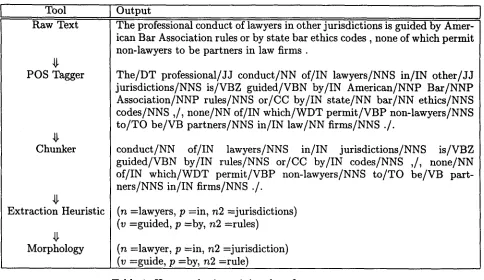
We generate training d a t a from raw text by using a part-of-speech tagger, a simple chun- ker, an e x t r a c t i o n heuristic, and a morphology database. T h e order in which these tools are applied to raw text is shown in Table 1. T h e tagger from (Ratnaparkhi, 1996) first annotates sentences of raw text with a sequence of part- of-speech tags. T h e chunker, implemented with two small regular expressions, t h e n replaces simple n o u n phrases and quantifier phrases with their head words. T h e extraction heuristic then finds head word tuples and their likely attach- ments from the tagged and chunked text. The heuristic relies on the observed fact t h a t in En- glish a n d in languages with similar word order, the a t t a c h m e n t site of a preposition is usually located only a few words to the left of the prepo- sition. Finally, n u m b e r s are replaced by a single token, the text is converted to lower case, and
the morphology database is used to find the base forms of the verbs and nouns.
The extracted head word tuples differ from the training d a t a used in previous supervised at- t e m p t s in an i m p o r t a n t way. In the supervised case, b o t h of the potential sites, n a m e l y the verb v and the n o u n n are known before the attach- ment is resolved. In the unsupervised case dis- cussed here, the extraction heuristic only finds what it thinks are
unambiguous
cases of prepo- sitional phrase a t t a c h m e n t . Therefore, there is only one possible a t t a c h m e n t site for the prepo- sition, and either the verb v or the n o u n n does not exist, in the case of n o u n - a t t a c h e d prepo- sition or a verb-attached preposition, respec- tively. This extraction heuristic loosely resem- bles a step in the b o o t s t r a p p i n g p r o c e d u r e used to get training d a t a for the classifier of (Hindle and Rooth, 1993). In t h a t step, unambiguous a t t a c h m e n t s from the F I D D I T C H parser's out- put are initially used to resolve some of the am- biguous attachments, and the resolved cases are iteratively used to disambiguate the remaining unresolved cases. Our p r o c e d u r e differs criti- cally from (Hindle a n d Rooth, 1993) in t h a t we do not iterate, we extract unambiguous attach- ments from unparsed input sentences, a n d we totally ignore the ambiguous cases. It is the hy- pothesis of this approach t h a t the information injust the unambiguous
a t t a c h m e n t events can resolve theambiguous
a t t a c h m e n t events of t h e test data.3.1.1 H e u r i s t i c E x t r a c t i o n o f U n a m b i g u o u s C a s e s
Given a tagged and chunked sentence, the ex- traction heuristic r e t u r n s head word tuples of the form
(v,p, n2)
or(n,p,
n2), where v is t h e verb, n is the noun, p is the preposition, n2 is the object of the preposition. T h e m a i n idea of the extraction heuristic is t h a t an attach- ment site of a preposition is usually within a few words to the left of the preposition. We extract :(v,p, n2)
if• p is a preposition (p ~
of)
• v is the first verb t h a t occurs within K words to the left of p
• v is not a form of the verb
to be
Tool Output Raw Text
POS Tagger
Chunker
Extraction Heuristic
Morphology
The professional conduct of lawyers in other jurisdictions is guided by Amer- ican Bar Association rules or by state bar ethics codes, none of which permit non-lawyers to be partners in law firms.
T h e / D T professional/JJ conduct/NN of/IN lawyers/NNS in/IN o t h e r / J J jurisdictions/NNS is/VBZ guided/VBN by/IN American/NNP B a r / N N P Association/NNP rules/NNS or/CC by/IN state/NN b a r / N N ethics/NNS codes/NNS ,/, none/NN of/IN which/WDT p e r m i t / V B P non-lawyers/NNS t o / T O be/VB partners/NNS in/IN law/NN firms/NNS ./.
conduct/NN of/IN lawyers/NNS in/IN jurisdictions/NNS is/VBZ guided/VBN by/IN rules/NNS or/CC by/IN codes/NNS ,/, none/NN of/IN which/WDW permit/VBP non-lawyers/NNS t o / T O b e / V S part- ners/NNS in/IN firms/NNS ./.
(n =lawyers, p =in, n2 =jurisdictions) (v =guided, p =by, n2 =rules)
(n =lawyer, p =in, n2 =jurisdiction) (v =guide, p =by, n2 =rule)
Table 1: How to obtain training data from raw text
• n2 is the first noun that occurs within K words to the right of p
• No verb occurs between p and n2
(n,p, n2) if
• p is a preposition (p ~ o f )
• n is the first noun that occurs within K words to the left of p
• No verb occurs within K words to the left of p
• n2 is the first noun that occurs within K words to the right of p
• No verb occurs between p and n2
Table 1 also shows the result of the applying the extraction heuristic to a sample sentence.
The heuristic ignores cases where p = o f ,
since such cases are rarely ambiguous, and we opt to model them deterministically as noun at- tachments. We will report accuracies (in Sec- tion 5) on both cases where p = o f and where
p ~ o f . Also, the heuristic excludes examples with the verb to be from the training set (but not the test set) since we found them to be un- reliable sources of evidence.
3.2 A c c u r a c y o f E x t r a c t i o n H e u r i s t i c Applying the extraction heuristic to 970K unan- notated sentences from the 1988 Wall St. Jour- nal 1 data yields approximately 910K unique head word tuples of the form (v,p, n2) or
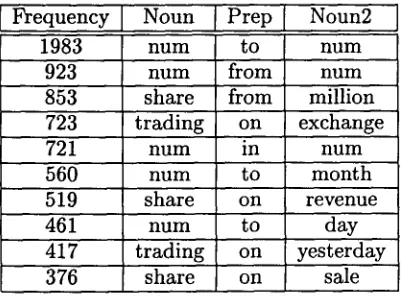
(n,p, n2). The extraction heuristic is far from perfect; when applied to and compared with the annotated Wall St. Journal data of the Penn treebank, only 69% of the extracted head word tuples represent correct attachments. 2 The ex- tracted tuples are meant to be a noisy but abun- dant substitute for the information that one might get from a treebank. Tables 2 and 3 list the most frequent extracted head word tu- ples for unambiguous verb and noun attach- ments, respectively. Many of the frequent noun- attached (n,p, n2) tuples, such as hum to num, 3
are incorrect. The prepositional phrase to hum
is usually attached to a verb such as rise or fall
in the Wall St. Journal domain, e.g., Profits rose ,{6 ~ to 52 million.
1This data is available from the Linguistic Data Con- sortium, http ://www. Idc. apenn, edu
2This accuracy also excludes cases where p -- of. 3Recall the h u m is the token for quantifier phrases
[image:3.612.70.554.80.360.2]F r e q u e n c y Verb
8110 close
1926 reach
1539 rise
1438 compare
1072 fall
970 account
887 value
839 say
680 compare
673 price
] P r e p ] Noun2 at n u m for comment
to num
with num
to hum
for hum
at million in interview with million
at num
Table 2: Most frequent (v,p, n2) tuples Frequency N o u n
1983 num
923 n u m
853 share
723 trading 721 n u m
560 num
519 share
461 h u m 417 trading
376 share
I P r e p [ Noun2
to num
from num
from million on exchange
in num
to m o n t h on revenue
to day
on yesterday
on sale
Table 3: Most frequent (n,p, n2) tuples
4 S t a t i s t i c a l M o d e l s
While the e x t r a c t e d tuples of the form (n, p, n2) and (v, p, n2) represent unambiguous noun and verb a t t a c h m e n t s in which either the verb or noun is known, our eventual goal is to resolve ambiguous a t t a c h m e n t s in the test d a t a of the form (v, n,p, n2), in which both the noun n and verb v are always known. We therefore must use any information in the unambiguous cases to resolve the ambiguous cases. A natural way is to use a classifier that compares the probability of each outcome:
cl(v,n,p, n2) =
N if p = o f
arg maxae{N,V} P r ( v , n , p , a) otherwise
(1)
We do not currently use n2 in the probability model, and we omit it from further discussion.
We can factor P r ( v , n , p , a) as follows:
P r ( v , n , p , a ) = P r ( v ) P r ( n )
Pr(a[v,n) Pr(p[a, v, n)
The terms Pr(n) and Pr(v) are i n d e p e n d e n t of the a t t a c h m e n t a and need not b e c o m p u t e d in d (1), b u t the estimation of Pr(a[v,n) and
Pr(pla, v , n ) is problematic since our training data, i.e., the head words e x t r a c t e d from raw text, occur with either n or v, b u t never b o t h n, v. This leads to make some heuristically mo- tivated approximations. Let the r a n d o m vari- able ¢ range over {true, false}, and let it de- note the presence or absence of any preposition that is u n a m b i g u o u s l y a t t a c h e d to the n o u n or verb in question. T h e n p ( ¢ = true]n) is the conditional probability t h a t a particular noun n in free text has an u n a m b i g u o u s prepositional phrase attachment. (¢ = true will b e w r i t t e n simply as true.) We a p p r o x i m a t e Pr(alv , n) as
follows:
Pr(true[n) Pr(a -- N]v, n)
Z(v,n)
Pr(truelv) Pr(a = VIv ,n)
Z(v,n)
Z ( v , n ) = Pr(true[n) + Pr(trueIv )
The rationale behind this a p p r o x i m a t i o n is t h a t the tendency of a v , n pair towards a n o u n (verb) a t t a c h m e n t is related to the t e n d e n c y of the noun (verb) alone to occur with an unam- biguous prepositional phrase. T h e Z(v, n) t e r m exists only to make the a p p r o x i m a t i o n a well formed probability over a E {N, V}.
We approximate Pr(p[a, v, n) as follows:
Pr(p[a = N, v, n) .~ Pr(p[true, n) Pr(p[a = V,v,n) ~ Pr(pItrue, v)
The rationale behind these a p p r o x i m a t i o n s is that when generating p given a noun (verb) at- tachment, only the counts involving the n o u n (verb) are relevant, assuming also t h a t the noun (verb) has an a t t a c h e d prepositional phrase, i.e.,
d? = true.
We use word statistics from b o t h the tagged corpus and the set of e x t r a c t e d head word tuples to estimate the probability of generating ¢ =
true, p, and n2. Counts from the e x t r a c t e d set of tuples assume that ¢ -- true, while counts from the corpus itself m a y correspond to either
[image:4.612.85.291.80.226.2] [image:4.612.87.289.266.414.2]or verb in question is, or is not, respectively, unambiguously a t t a c h e d to a preposition. 4.1 G e n e r a t e ¢
T h e quantities
Pr(trueln )
andPr(truelv )
de- note t h e conditional probability t h a t n or v will occur with some unambiguously attached preposition, a n d are estimated as follows:{
c(n) > 0
Pr(trueln)
= .5 otherwise> o
Pr(truelv)
= .5 otherwisewhere
c(n)
andc(v) are
counts from the tagged corpus, a n d wherec(n, true)
andc(v, true)
are counts from the e x t r a c t e d head word tuples. 4.2 G e n e r a t e pT h e t e r m s
Pr(p[n, true)
andPr(plv, true)
de- note the conditional probability t h a t a particu- lar preposition p will occur as an unambiguous a t t a c h m e n t to n or v. We present two tech- niques to estimate this probability, one based on b i g r a m counts and another based on an in- terpolation m e t h o d .4.2.1 B i g r a m C o u n t s
This technique uses the bigram counts of the e x t r a c t e d head word tuples, and backs off to the uniform distribution w h e n the denominator is zero.
c(n,p,true)
Pr(pltrue, n) =
~(n,true)
c(n, t r u e )> 0
otherwise c(v,p,true)
Pr(pltrue ,v) =
~(v,tr~,)
c(v, t r u e )> 0
otherwise where ~ is the set of possible prepositions, where all t h e counts c ( . . . ) are from the ex- t r a c t e d head word tuples.
4.2.2
Interpolation
This technique is similar to the one in (Hindle and Rooth, 1993), a n d interpolates between the tendencies of t h e (v,p) a n d
(n,p)
bigrams and the t e n d e n c y of the type of a t t a c h m e n t (e.g., N or V) towards a particular preposition p. First, definecN(p) = ~ n c(n,p, true) as
the n u m b e r of n o u n a t t a c h e d tuples with the prepositionp, and define C N =
~'~pCN(P) as
t h e n u m b e r of noun a t t a c h e d tuples. Analogously, definecy(p) = ~vc(v,p, true)
andcy = ~pcv(p).
T h e counts
c(n,p, true)
andc(v,p, true)
are from the extracted head word tuples. Using the above notation, we can interpolate as follows:Pr(pltrue, n)
Pr(pltrue , v)
c(n,p, true) + c~(p)
CNc(n, true) + 1
c(v,p, true) + cv(P)
c vc(v, true) + 1
5
E v a l u a t i o n in E n g l i s h
Approximately 970K u n a n n o t a t e d sentences from the 1988 Wall St. J o u r n a l were pro- cessed in a m a n n e r identical to the example sen- tence in Table 1. T h e result was approximately 910,000 head word tuples of the form (v,p, n2) or (n,p, n2). Note t h a t while t h e head word tuples represent correct a t t a c h m e n t s only 69% of the time, their q u a n t i t y is a b o u t 45 times greater t h a n the q u a n t i t y of d a t a used in previ- ous supervised approaches. T h e e x t r a c t e d d a t a was used as training material for the three clas- sifters
Clbase , Clinterp,
andClbigram.
E a c h classi- fier is constructed as follows:Clbase
This is the "baseline" classifier t h a t pre- dicts N of p =of,
and V otherwise.Clinterp:
This classifier has the form of equa- tion (1), uses the m e t h o d in section 4.1 to generate ¢, and the m e t h o d in section 4.2.2 to generate p.clbigram:
This classifier has the form of equa- tion (1), uses the m e t h o d in section 4.1 to generate ¢, and the m e t h o d in section 4.2.1 to generate p.Subset
p = o f
Number of Events 925
clbigrarn
917
Clinterp
917
Clbase
917
p ~ o f 2172 1620 1618 1263
Total
3097 2535 2i8081.85% 2537
81.91%
Accuracy
70.39%Table 4: Accuracy of mostly unsupervised classifiers on English Wall St. Journal data Attachment Pr(alv ,n) Pr(p[a,v,n)
Noun(a = N) .02 .24 Verb(a = V) .30 .44
Table 5: The key probabilities for the ambigu- ous example rise hum to hum
Table 5 shows the two probabilities Pr(a[v, n)
and Pr(p[a, v, n), using the same approxima- tions a s
clbigram,
for the ambiguous example risenum to num. (Recall that Pr(v) and Pr(n) are not needed.) While the tuple (num, to, num) is more frequent than (rise, to, num), the condi- tional probabilities prefer a = V, which is the choice that maximizes Pr(v, n,p, a).
Both classifiers Clinter p and dbigram clearly outperform the. baseline, but the classifier
dinterp does not outperform dbigram, even though it interpolates between the less specific evidence (the preposition counts) and more spe- cific evidence (the bigram counts). This may be due to the errors in our extracted training data; supervised classifiers that train from clean data typically benefit greatly by combining less spe- cific evidence with more specific evidence.
Despite the errors in the training data, the performance of the unsupervised classifiers (81.9%) begins to approach the best perfor- mance of the comparable supervised classifiers (84.5%). (Our goal is to replicate the super- vision of a treebank, but not a semantic dictio- nary, so we do not compare against (Stetina and Nagao, 1997).) Furthermore, we do not use the second noun n2, whereas the best supervised methods use this information. Our result shows that the information in imperfect but abundant data from unambiguous attachments, as shown in Tables 2 and 3, is sufficient to resolve ambigu- ous prepositional phrase attachments at accu- racies just under the supervised state-of-the-art accuracy.
6 E v a l u a t i o n i n S p a n i s h
We claim that our approach is portable to lan- guages with similar word order, and we support this claim by demonstrating our approach on the Spanish language. We used the Spanish tagger and morphological analyzer developed at the Xerox Research Centre Europe 4 and we modified the extraction heuristic to account for the new tagset, and to account for the Spanish equivalents of the words of (i.e., de or del) and
to be (i.e., set). Chunking was not performed on the Spanish data. We used 450k sentences of raw text from the Linguistic Data Consor- tium's Spanish News Text Collection to extract a training set, and we used a non-overlapping set of 50k sentences from the collection to create test sets. Three native Spanish speakers were asked to extract and annotate ambiguous in- stances of Spanish prepositional phrase attach- ments. They annotated two sets (using the full sentence context); one set consisted of all am- biguous prepositional phrase attachments of the form (v,n,p, n2), and the other set consisted of cases where p = con. For testing our classifier, we used only those judgments on which all three annotators agreed.
6.1 P e r f o r m a n c e
The performance of the classifiers
Clbigram,
Clinterp, and
Clbase ,
when trained and tested on Spanish language data, are shown in Ta- ble 6. The Spanish test set has fewer ambiguous prepositions than the English test set, as shown by the accuracy ofClbase.
However, the accuracy improvements of Clbigra m o v e r Clbase are statisti-cally significant for both test sets. 5
4These were supplied by Dr. Lauri Kartunnen during his visit to Penn.
[image:6.612.156.457.81.150.2]Test Set All p
Subset
p = delldel
p # delldel
Accuracy
Number of Events 156
116 272
Clbigrarn
154 103 257 94.5%
p = con Total 192 166
Accuracy - 86.4%
clinterp dbase
154 154
97 91
251 245
92.3% 90.1%
1 1 6 0 1 1 5 1 83.3% 78.6%
Table 6: Accuracy of mostly unsupervised classifiers on Spanish News Data
7 C o n c l u s i o n
The unsupervised algorithm for prepositional phrase attachment presented here is the only algorithm in the published literature that can significantly outperform the baseline without using data derived from a treebank or parser. The accuracy of our technique approaches the accuracy of the best supervised methods, and does so with only a tiny fraction of the supervi- sion. Since only a small part of the extraction heuristic is specific to English, and since part- of-speech taggers and morphology databases are widely available in other languages, our ap- proach is far more portable than previous ap- proaches for this problem. We successfully demonstrated the portability of our approach by applying it to the prepositional phrase at- tachment task in the Spanish language.
8 A c k n o w l e d g m e n t s
We thank Dr. Lauri Kartunnen for lending us the Spanish natural language tools, and Mike Collins for helpful discussions on this work.
R e f e r e n c e s
ACL. 1997.
Proceedings of the 35th Annual
Meeting of the A CL, and 8th Conference of
the EACL,
Madrid, Spain, July.Eric Brill and Phil Resnik. 1994. A Rule Based Approach to Prepositional Phrase Attach- ment Disambiguation. In
Proceedings of the
Fifteenth International Conference on Com-
putational Linguistics (COLING).
Michael Collins and James Brooks. 1995. Prepositional Phrase Attachment through a Backed-off Model. In David Yarowsky and Kenneth Church, editors,
Proceedings of the
Third Workshop on Very Large Corpora,
pages 27-38, Cambridge, Massachusetts, June.Alexander Franz. 1997. Independence Assump- tions Considered Harmful. In ACL (ACL,
1997).
Donald Hindle and Mats Rooth. 1993. Struc- tural Ambiguity and Lexical Relations.
Com-
putational Linguistics,
19(1):103-120.Mitchell P. Marcus, Beatrice Santorini, and Mary Ann Marcinkiewicz. 1994. Building a large annotated corpus of English: the Penn Treebank.
Computational Linguistics,
19(2):313-330.Paola Merlo, Matthew W. Crocker, and Cathy Berthouzoz. 1997. Attaching Multiple Prepositional Phrases: Generalized Backed- off Estimation. In Claire Cardie and Ralph Weischedel, editors,
Second Conference on
Empirical Methods in Natural Language Pro-
cessing,
pages 149-155, Providence, R.I., Aug. 1-2.Adwait Ratnaparkhi, Jeff Reynar, and Salim Roukos. 1994. A Maximum Entropy Model for Prepositional Phrase Attachment. In
Pro-
ceedings of the Human Language Technology
Workshop,
pages 250-255, Plalnsboro, N.J. ARPA.Adwait Ratnaparkhi. 1996. A Maximum En- tropy Part of Speech Tagger. In Eric Brill and Kenneth Church, editors,
Conference on
Empirical Methods in Natural Language Pro-
cessing,
University of Pennsylvania, May 17- 18.Jiri Stetina and Makoto Nagao. 1997. Corpus Based PP Attachment Ambiguity Resolution with a Semantic Dictionary. In Jou Zhou and Kenneth Church, editors,
Proceedings of the
Fifth Workshop on Very Large Corpora,
pages 66-80, Beijing and Hong Kong, Aug. 18 - 20. Jakub Zavrel and Walter Daelemans. 1997. [image:7.612.130.477.75.171.2]