The ILSP/ARC submission to the WMT 2016 Bilingual Document
Alignment Shared Task
Vassilis Papavassiliou
Institute for Language and Speech Processing Athena Research and Innovation Center
Athens, Greece
{vpapa, prokopis, spip}@ilsp.gr
Prokopis Prokopidis Stelios Piperidis
Abstract
This paper describes ILSP-ARC-pv42, the Institute for Language and Speech Pro-cessing/Athena Research and Innovation Center submission for the WMT 2016 Bilingual Document Alignment shared task. We describe several document and collection-aware features that our system explored in the context of the task. On the test dataset, our submission achieved a recall of 84.93%, even though it does not make use of any language-specific re-sources like bilingual lexica or MT output. Instead, our system is based on shallow features (including links to documents in the same webdomain, URLs, digits, im-age filenames and HTML structure) that can be easily extracted from web docu-ments. We also present examples to show that when de-duplication issues in the test dataset are properly addressed, our sys-tem reaches a significantly higher recall of 92.5%.
1 Introduction
There is a growing literature on using web-acquired data for constructing various types of lan-guage resources, including monolingual and paral-lel corpora. As shown in, among others, Pecina et al. (2014) and Rubino et al. (2015), such resources can be exploited in training generic or domain-specific machine translation systems. Neverthe-less, compared to the acquisition of monolingual data from the web, construction of parallel re-sources is more challenging. Even though there are many multilingual websites with pairs of doc-uments that are translations of each other, detec-tion of such sites and identificadetec-tion of the docu-ment pairs is far from straightforward. Resnik and
Smith (2003) presented the STRAND system, in which they used a search engine to search for mul-tilingual websites and examined the similarity of the HTML structures of the fetched webpages in order to identify pairs of potentially parallel pages. Espl`a-Gomis and Forcada (2010) developed Bi-textor, a system that combines language identifi-cation with shallow features. Barbosa et al. (2012) crawl the web and examine the HTML DOM tree of visited webpages with the purpose of detect-ing multildetect-ingual websites based on the collation of links that are very likely to point to in-site pages in different languages. Smith et al. (2013) used an extension of the STRAND algorithm to perform large-scale experiments of mining parallel docu-ments from the Common Crawl1dataset.
This paper describes ILSP-ARC-pv42, the In-stitute for Language and Speech Processing/A-thena Research Center submission for the WMT 2016 Bilingual Document Alignment shared task. The task consisted in identifying pairs of English and French documents from collections of doc-uments corresponding to crawls of 203 webdo-mains.
2 System architecture
In this section, we describe the main processing steps in ILSP-ARC-pv42. Our system is based on the document alignment module of the ILSP Focused Crawler (Papavassiliou et al., 2013), an open-source tool2 that integrates all
neces-sary software3 for the creation of high-precision
parallel resources from the web in a language-independent fashion.
1http://commoncrawl.org/
2http://nlp.ilsp.gr/redmine/ilsp-fc/ 3Including modules for metadata extraction, language
identification, boilerplate removal, document clean-up, text classification and sentence alignment
2.1 Pre-processing shared task files
We pre-processed crawled data provided by the or-ganizers as one file per webdomain in the.lett format adapted from Bitextor. This is a plain text format with one line per web document. Each line consists of 6 tab-separated values that include the (automatically detected) language ID ({en, fr}); the mime type (always text/html); the encoding (always charset=utf-8); the URL; the HTML con-tent in Base64 encoding; and the text in Base64 encoding.
For each webdomain, we created a directory where we exported the contents of the 5th field of each entry in a ll-file id.html file, where ll is the two letter language id ({en, fr}) provided in the lett files and file id is an integer unique for each file of a webdomain. Using the URL information, we also store file-to-URL mappings in a separate file.
Apart from training and test data in this format, the organizers also identified spans of FR text for which they produced EN translations using a ma-chine translation system. In an attempt to recre-ate real-life conditions where, at least for our team and for many language pairs, access to reliable MT output is not available, we did not use this infor-mation or any other type of or language-pair-dependent information in our system.
2.2 Boilerplate detection and exporting
Apart from its textual content, a typical web-page also contains boilerplate, i.e. “noisy” el-ements like navigation headers, advertisel-ements, disclaimers etc., which are of only limited or no use for the production of good-quality language resources. We used a modified version of Boil-erpipe4 (Kohlschtter et al, 2010) to identify
boil-erplate in the.htmlfiles. Besides boileplate de-tection, we also identified structural information like title, heading and list item from each web-page. At this stage, text was also segmented into paragraphs on the basis of specific HTML tags like <p>,</br>,<li>etc.
For each .html file, we generated an .xml file where a <body>element contained the con-tent of the document segmented into paragraphs. Apart from normalized text, each paragraph ele-ment was enriched with attributes providing more information about the process outcome. Specif-ically, paragraphs may contain the following
at-4http://code.google.com/p/boilerpipe/
tributes: i)crawlinfowith possible values boiler-plate, meaning that the paragraph has been consid-ered boilerplate; and ii)typewith possible values:
title, headingandlistitem.
2.3 Document pair detection
Following exporting, a document pair detector, which constitutes the core module of our system, applies a set of complementary methods based on the content of the.htmland the.xmlfiles in or-der to identify translation pairs. The module does not exploit any language resources (e.g. lexica or output of MT engines). Instead it is based on shal-low features including links to documents in the same webdomain, URLs, digits, image filenames and HTML structure.
We trivially avoid pairing files that are in the same language. We then examine all links in the .htmlfiles and we extract those that contain the hreflang attribute. Since “hreflang specifies the language and optional geographic restrictions for a document”5, we use this strong indicator to
pair documents, which we subsequently exclude from examination by other downstream methods6.
We also examine links that match a set of patterns for the identification of translation links (e.g. link elements with the attributelang) and we exploit them in the same way.
Next, we focus on URLs that include lan-guage indicators and examine if there are pairs of URLs that match pairs of specific patterns such as/lang1/ and/lang2/, lang1and lang2,=lang1
and =lang2, where lang1 and lang2 are alterna-tive representations of the targeted languages (e.g. en, eng, english, fr, fra, french, francais, etc. in the context of this shared task). Some additional patterns are lang=i, langid=iand lingua=i, where
i∈ {0, ..,5}.
It is worth mentioning that in the past we have complemented the use of the above indicators with examination of features like document length in terms of tokens/paragraphs, in order to decide on document pairness. This was in accordance with our main interest in using the pair detector for the generation of high-quality resources that can be used in improving MT systems. However, in the context of this recall-evaluated shared task, the
5https://en.wikipedia.org/wiki/
Hreflang
6We use this approach for all methods: documents that
system bases its decision on these indicators with-out any further checks.
Then, each.xmlfile is parsed and the follow-ing features are extracted: i) the document lan-guage7; ii) the depth of the original source page,
(e.g. forhttp://domain.org/d1/d2/d3/ page.html, depth is 4); iii) thenumber of para-graphs; iv) the length (in terms of tokens) of the main content, i.e. non-boilerplate text; v) the sequence of digits in the main content; and vi) the fingerprint of the main content, which is a sequence of integers that represent the struc-tural information of the page, with boilerplate con-tent ignored. For instance, in a fingerprint of
[−2,28,145,−4,9,−3,48,740] for a document
of 6 paragraphs, negative numbers−2,−3and−4
denote that thetype attributes of the 1st, 3rd and 4th<p>elements havetitle,headingandlistitem
values, respectively; and positive integers are the lengths of the 6 paragraphs in characters.
At this stage, webpages with a depth difference
>1are not examined as candidate translations of
each other, on the assumption that it is unlikely that translations can be found at very distant levels of the web site tree.
We next extract the filenames of the images from the HTML source and each document is rep-resented as a list of images8. Our assumption at
this stage is that two documents that contain the same or a similar set of images are good candi-dates for pairing. Since it is very likely that some images appear in many webpages, we count the occurrence frequency of each image and we dis-card “common”, i.e. relatively frequent, images (e.g. social media icons, logos etc.) from these lists.
In order to classify images into “critical” or “common” (see Figure 1) we need to calcu-late a threshold. In principle, one should ex-pect that low/high frequencies correspond to “crit-ical”/“common” images. We employ a non-parametric approach for estimating the probabil-ity densprobabil-ity function (Alpaydin, 2010) of the image frequencies using the following formula:
ˆ
p(x) = M h1 PM
t=1
K(x−hxt)
7In the case of the shared task, we replace the output of a
language detection module with the language id provided by the organizers.
8Henceforth, we use the term “image” to mean “image
filenames”. We do not make use of any image features other than their filenames.
where the random variablexdefines the positions (i.e. images frequencies) at which thepˆ(x)will be
estimated,M is the amount of images,xtdenotes
the values of data samples in the region of widthh
around the variablex, andK(·)is the normal
ker-nel that defines the influence of valuesxtin the
es-timation ofpˆ(x). The optimal value forh, i.e. the
optimal bandwidth of the kernel smoothing win-dow, was calculated as described in Bowman and Azzalini (1997).
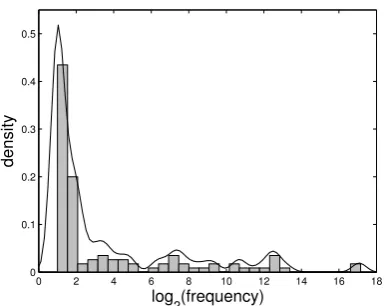
Figure 2 serves as an illustration of the normal-ized histogram of image frequencies in an exam-ple webdomain (that was not part of the shared task datasets) and the estimated probability den-sity function. One can identify a main lobe in the low values, around which ”critical” images are clustered. Thus, the threshold is chosen to be equal to the minimum just after this lobe. The un-derlying assumption is that if a webpage inl1 con-tains image(s), then the webpage with its transla-tion inl2will contain a similar set of images. In case this assumption is not valid for a multilingual webdomain (i.e. if there are only images that ap-pear in all pages, e.g. template icons), then all im-ages will wrongly be assumed to be “critical”. To eliminate this problem, we also discard as “com-mon” all images that appear in more than 10% of the total.htmlfiles of each webdomain.
Following this step, each document is examined against all others on the basis of: a) the Jaccardian similarity coefficient of their image lists b) the re-ciprocal of edit distance of the sequences of digits in their main content c) the ratio of their number of paragraphs and d) the ratio of the number of to-kens in non-boilerplate text. Two documents are considered parallel if (c), (d) and either or both of (a) and (b) are above predefined thresholds.
.. ...
Figure 1: Critical (white) and common (red) images in two documents from the www.
jerome-alquie.com.lettwebdomain.
soft-margin polynomial Support Vector Machine trained with the positive and negative examples collected in the context of previous experiments (Pecina et al., 2012).
0 2 4 6 8 10 12 14 16 18
0 0.1 0.2 0.3 0.4 0.5
log2(frequency)
density
Figure 2: The normalized histogram and the es-timated pdf of image frequencies in an example webdomain
As a final step, we mapped each ll-file id.html
to its URL and we produced a final set of 291,749 proposed pairs for all webdomains of the test data.
3 Evaluation Results
Before submitting our proposed pairs on the shared task test data, we also evaluated our sys-tem on the training data. The latter consisted of a set of 1,624 EN-FR pairs extracted by the orga-nizers from 49 webdomains. The number of pairs per webdomain in the training set varied between 4 and over 230. The simple baseline provided by the organizers is based on URL matching. The baseline implementation iterates through all URLs and strips language identifiers such as /english/
from URLs. It then produces pairs of URLs that have the same stripped representation. Overall, the baseline proposes 143,851 candidate pairs, which are reduced to 119,979 pairs after enforcing the 1-1 rule, which requires that each source URL may be matched with at most one target url and vice-versa. Should a URL occur repeatedly, later occur-rences are ignored. The baseline identifies 1,103 true positives, thus reaching a recall of 67.92%. Our system proposed 160,727 EN-FR pairs from which 1,460 are included in the EN-FR training set pairs, corresponding to a 89.90% recall on the training dataset.
[image:4.595.81.275.487.640.2]it against a set of 2,402 EN-FR pairs from the 203 webdomains comprising the test data. The num-ber of pairs per webdomain in the test data varies between 1 and 357, while the number of EN and FR webpages of each webdomain varies between 5 and circa 99K.
Our system proposed 291,749 pairs that were reduced to 287,860 after enforcing the 1:1 rule. These additional pairs were created because, for certain domains, EN or FR webpages contained translation links pointing to multiple webpages identified by the organizers as FR or EN docu-ments, respectively. Our system identified 2,040 EN-FR pairs out of the 2,402 provided test pairs at a 84.93% recall and was ranked 9th among the 21 submitted systems by the 13 participant groups.
We counted the number of true positive pairs identified via each method, in order to examine each method’s contribution. The top contribut-ing method with 987 (48.38%) of the correctly detected pairs was the one exploiting URL pat-terns. Methods based on the existence of common images and/or similar digit sequences contributed 791 pairs (38.77%) while the in-webdomain links and HTML structure generated 180 (8.82%) and 82 (4.02%) pairs, respectively.
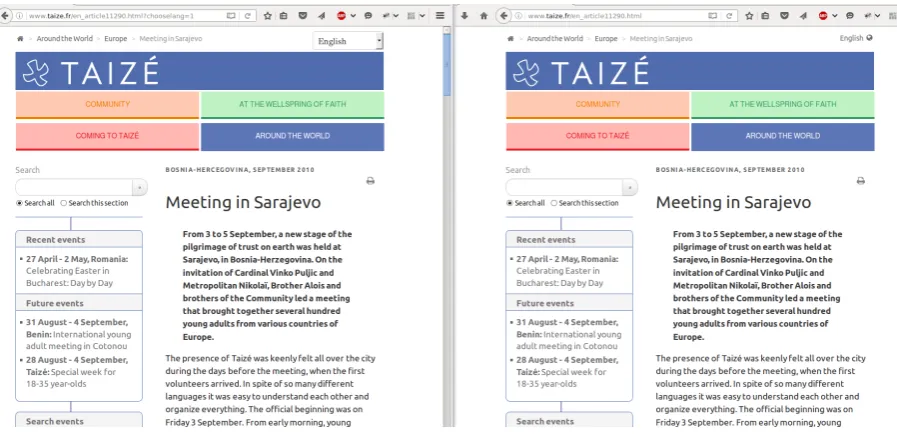
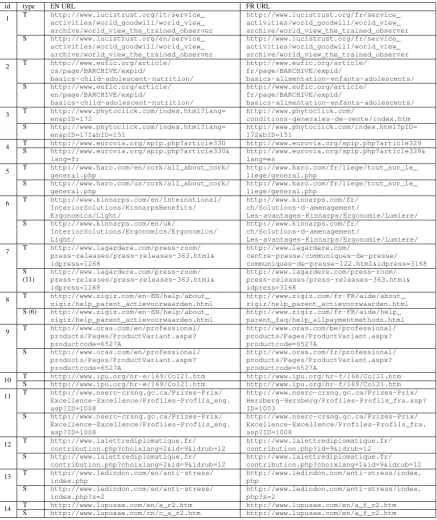
We also examined manually all document pairs missed in our submission in order to gather useful insights that could help us improve our system. A first conclusion is that a major issue in evaluating bilingual document alignment in terms of recall concerns (near) duplicates. We observed that we were scored as missing 182 pairs because the EN and/or FR documents participating in each of these pairs were aligned by our system with documents that contained the same content but originated from different URLs. For example, 50 and 103 test pairs from the www.taize.fr (see Figure 3) and the www.lalettrediplomatique.fr webdomains (where extra attribute-value strings in URLs like choixlang=1, &bouton=1, &bouton=2, etc. do not “influence” the content of the FR webpages) were considered fails due to this issue in the test data. Additional examples of perfectly valid pairs for extracting valuable con-tent for downstream MT applications, which a) have been proposed by our system b) are equiv-alent to test pairs but c) have not been scored as true positives, are presented in Table 1. In particular, the www.lagardere.com and the www.zigiz.com webdomains (rows 7 and 8)
contribute 11 and 6 missed pairs, respectively. If we consider all these pairs as valid for extract-ing data in order to train MT systems, our system reaches a recall of 92.5%.
The majority of the remaining(2402−2040− 182 =) 180of our misses concerned pairs where
for a page A, the method based on structure similarity proposed a wrong document pair with page B. For instance, in the http://www. toucherdubois.ca webdomain, information (concerning learning scenarios and teaching re-sources) is presented in a specific format/template leading to errors during the examination of the structure fingerprint. Other misses were due to the length of the documents since it is very identify pairs of very short documents without using any lexical information.
4 Conclusions
In this paper we described the ILSP/ARC sub-mission for the WMT 2016 Bilingual Document Alignment shared task. We provided details on the document and collection-aware features that our system explores. On the test set, our system reached a recall of 84.93% according to the offi-cial scoring. In the evaluation section of the paper we presented examples in order to show that the recall of our system is significantly higher once de-duplication issues in the test data are addressed.
Acknowledgments
This work was supported by the Abu-MaTran (FP7-People-IAPP, Grant 324414) project and the European Language Resource Coordination effort, CEF Programme. We would like to thank the orga-nizers for preparing the task and answering ques-tions.
References
Ethem Alpaydin. 2010. Introduction to Machine Learning. The MIT Press, 2nd edition.
Luciano Barbosa, Vivek Kumar Rangarajan, Sridhar, Mahsa Yarmohammadi, and Srinivas Bangalore. 2012. Harvesting parallel text in multiple languages with limited supervision. InCOLING, pages 201– 214.
Adrian W. Bowman and Adelchi Azzalini. 1997.
Figure 3: Duplicate EN webpages from www.taize.fr. Proposed pairs including http://
www.taize.fr/en_article11290.html?chooselang=1 (left) – http://www.taize.
fr/fr_article11286.html?chooselang=1 were not considered equivalent to test pairs in-cludinghttp://www.taize.fr/en_article11290.html (right) –http://www.taize. fr/fr_article11286.htmleven though the extra?chooselang=1attribute-value string in the URLs does not influence the textual content that can be extracted from proposed pairs.
Miquel Espl`a-Gomis and Mikel L. Forcada. 2010. Combining content-based and url-based heuristics to harvest aligned bitexts from multilingual sites with bitextor. The Prague Bulletin of Mathemathical Lin-gustics, 93:77–86.
Vassilis Papavassiliou, Prokopis Prokopidis, and Gre-gor Thurmair. 2013. A modular open-source fo-cused crawler for mining monolingual and bilingual corpora from the web. In Proceedings of the Sixth Workshop on Building and Using Comparable Cor-pora, pages 43–51, Sofia, Bulgaria. Association for Computational Linguistics.
Pavel Pecina, Antonio Toral, Vassilis Papavassiliou, Prokopis Prokopidis, and Josef van Genabith. 2012. Domain adaptation of statistical machine translation using web-crawled resources: a case study. In
Pro-ceedings of the 16th Annual Conference of EAMT,
pages 145–152, Trento, Italy.
Pavel Pecina, Antonio Toral, Vassilis Papavassiliou, Prokopis Prokopidis, Aleˇs Tamchyna, Andy Way, and Josef Genabith. 2014. Domain adaptation of statistical machine translation with domain-focused web crawling. Language Resources and Evaluation, 49(1):147–193.
Philip Resnik and Noah A. Smith. 2003. The Web as a parallel corpus. Computational Linguistics, 29:349– 380.
Raphael Rubino, Tommi Pirinen, Miquel Espl`a-Gomis, Nikola Ljubeˇsi´c, Sergio Ortiz Rojas, Vas-silis Papavassiliou, Prokopis Prokopidis, and
Anto-nio Toral. 2015. Abu-matran at wmt 2015 trans-lation task: Morphological segmentation and web crawling. In Proceedings of the Tenth Workshop on Statistical Machine Translation, pages 184–191, Lisbon, Portugal, September. Association for Com-putational Linguistics.
[image:6.595.75.524.61.278.2]id type EN URL FR URL 1 T http://www.lucistrust.org/it/service_activities/world_goodwill/world_view_
archive/world_view_the_trained_observer
http://www.lucistrust.org/fr/service_ activities/world_goodwill/world_view_ archive/world_view_the_trained_observer
S http://www.lucistrust.org/en/service_ activities/world_goodwill/world_view_ archive/world_view_the_trained_observer
http://www.lucistrust.org/fr/service_ activities/world_goodwill/world_view_ archive/world_view_the_trained_observer
2 T http://www.eufic.org/article/cs/page/BARCHIVE/expid/
basics-child-adolescent-nutrition/
http://www.eufic.org/article/ fr/page/BARCHIVE/expid/
basics-alimentation-enfants-adolescents/
S http://www.eufic.org/article/ en/page/BARCHIVE/expid/
basics-child-adolescent-nutrition/
http://www.eufic.org/article/ fr/page/BARCHIVE/expid/
basics-alimentation-enfants-adolescents/
3 T http://www.phytoclick.com/index.html?lang=en&pID=172 http://www.phytoclick.com/conditions-generales-de-vente/index.htm S http://www.phytoclick.com/index.html?lang=
en&pID=172&bID=151
http://www.phytoclick.com/index.html?pID= 172&bID=151
4 TS http://www.eurovia.org/spip.php?article330http://www.eurovia.org/spip.php?article330& http://www.eurovia.org/spip.php?article329
lang=fr
http://www.eurovia.org/spip.php?article329& lang=es
5 T http://www.haro.com/en/cork/all_about_cork/general.php http://www.haro.com/fr/liege/tout_sur_le_liege/general.php S http://www.haro.com/us/cork/all_about_cork/
general.php http://www.haro.com/fr/liege/tout_sur_le_liege/general.php
6 T http://www.kinnarps.com/en/International/InteriorSolutions/KinnarpsBenefits/
Ergonomics/Light/
http://www.kinnarps.com/fr/ ch/Solutions-d-amenagement/
Les-avantages-Kinnarps/Ergonomie/Lumiere/
S http://www.kinnarps.com/en/uk/
InteriorSolutions/Ergonomics/Ergonomics/ Light/
http://www.kinnarps.com/fr/ ch/Solutions-d-amenagement/
Les-avantages-Kinnarps/Ergonomie/Lumiere/
7 T http://www.lagardere.com/press-room/press-releases/press-releases-363.html&
idpress=1268
http://www.lagardere.com/
centre-presse/communiques-de-presse/ communiques-de-presse-122.html&idpress=3168
S
(11) http://www.lagardere.com/press-room/press-releases/press-releases-363.html& idpress=1268
http://www.lagardere.com/press-room/ press-releases/press-releases-363.html& idpress=3168
8 T http://www.zigiz.com/en-EN/help/about_zigiz/help_parent_actievoorwaarden.html http://www.zigiz.com/fr-FR/aide/about_zigiz/help_parent_actievoorwaarden.html S (6) http://www.zigiz.com/en-EN/help/about_
zigiz/help_parent_actievoorwaarden.html
http://www.zigiz.com/fr-FR/aide/help_ parent_faq/help_allpaymentmethods.html
9 T http://www.oras.com/en/professional/products/Pages/ProductVariant.aspx?
productcode=6527A
http://www.oras.com/be/professional/ products/Pages/ProductVariant.aspx? productcode=6527A
S http://www.oras.com/en/professional/ products/Pages/ProductVariant.aspx? productcode=6527A
http://www.oras.com/fr/professional/ products/Pages/ProductVariant.aspx? productcode=6527A
10 TS http://www.ipu.org/hr-e/169/Co121.htmhttp://www.ipu.org/hr-e/169/Co121.htm http://www.ipu.org/hr-f/168/Co121.htmhttp://www.ipu.org/hr-f/169/Co121.htm
11 T http://www.nserc-crsng.gc.ca/Prizes-Prix/Excellence-Excellence/Profiles-Profils_eng.
asp?ID=1008
http://www.nserc-crsng.gc.ca/Prizes-Prix/ Herzberg-Herzberg/Profiles-Profils_fra.asp? ID=1003
S http://www.nserc-crsng.gc.ca/Prizes-Prix/ Excellence-Excellence/Profiles-Profils_eng. asp?ID=1008
http://www.nserc-crsng.gc.ca/Prizes-Prix/ Excellence-Excellence/Profiles-Profils_fra. asp?ID=1008
12 T http://www.lalettrediplomatique.fr/contribution.php?choixlang=2&id=9&idrub=12 http://www.lalettrediplomatique.fr/contribution.php?id=9&idrub=12 S http://www.lalettrediplomatique.fr/
contribution.php?choixlang=2&id=9&idrub=12
http://www.lalettrediplomatique.fr/ contribution.php?choixlang=1&id=9&idrub=12
13 T http://www.ledindon.com/en/anti-stress/index.php http://www.ledindon.com/anti-stress/index.php S http://www.ledindon.com/en/anti-stress/
index.php?s=2
http://www.ledindon.com/anti-stress/index. php?s=2
[image:7.595.74.512.127.648.2]14 TS http://www.lupusae.com/en/a_r2.htmhttp://www.lupusae.com/cn/c_a_r2.htm http://www.lupusae.com/en/a_f_r2.htmhttp://www.lupusae.com/en/a_f_r2.htm