TeaPOT: People Orientated Technology
Conference Papers
Dublin Institute of Technology Year
Patient-Centred Laboratory Validation
Using Software Agents
John McGrory∗ Jane Grimson†
Frank Clarke‡ Peter Gaffney∗∗
∗Dublin Institute of Technology, [email protected]
†Trinity College, [email protected]
‡Dublin Institute of Technology, [email protected]
∗∗Adelaide & Meath Hospital, Incorporating the National Children’s Hospital (AMNCH),
This paper is posted at ARROW@DIT.
— Use Licence —
Attribution-NonCommercial-ShareAlike 1.0
You are free:
• to copy, distribute, display, and perform the work
• to make derivative works
Under the following conditions:
• Attribution.
You must give the original author credit.
• Non-Commercial.
You may not use this work for commercial purposes.
• Share Alike.
If you alter, transform, or build upon this work, you may distribute the resulting work only under a license identical to this one.
For any reuse or distribution, you must make clear to others the license terms of this work. Any of these conditions can be waived if you get permission from the author.
Your fair use and other rights are in no way affected by the above.
This work is licensed under the Creative Commons Attribution-NonCommercial-ShareAlike License. To view a copy of this license, visit:
• URL (human-readable summary):
http://creativecommons.org/licenses/by-nc-sa/1.0/
• URL (legal code):
PATIENT-CENTRED LABORATORY VALIDATION USING
SOFTWARE AGENTS
John McGrory, Frank Clarke
Dublin Institute of Technology, Dublin 8, Ireland[email protected], [email protected]
Jane Grimson
School of Computing, Trinity College Dublin, Dublin 2, Ireland [email protected]
Peter Gaffney
Adelaide & Meath Hospital, Incorporating the National Children's Hospital (AMNCH), Tallaght, Dublin 24, Ireland [email protected]
Keywords: Clinical laboratory validation, patient-centred, patient-focused, agents, computer-interpretable-guideline (CIG), guidelines and protocols.
Abstract: Guidelines are self-contained documents which healthcare professionals reference to obtain knowledge about a specific condition or process. They interface with these documents and apply known facts about specific patients to gain useful supportive information to aid in developing a diagnosis or manage a condition. To automate this process a series of Standard Operating Procedures (SOP) and workflow processes are constructed using the contents of these documents in order to manage the validation flow of a patient sample. These processes decompose the guidelines into workflow plans, which are then called using condition triggers controlled by a centralised management engine. The software BDI agent offers an alternative dynamic which more closely matches the modus operandi of narrative based medical guidelines. An agent’s beliefs capture information attributes, plans capture the deliberative and action attributes, and desire captures the motivational attributes of the guideline in a self-contained autonomous software module. Agents acting on behalf of guidelines which overlap and interweave in similar domains can collaborate and coordinate in a loosely coupled fashion without the need for an all encompassing centralised plan.
1 INTRODUCTION
The primary role of a clinical laboratory is to support frontline healthcare professionals who are licensed to deal with patients (McLoughlin, 2006). Their function is to accept appropriate patient samples, analyse them, and report their findings back to the ordering clinician (Marshall et al., 1995). The reported results are not considered a diagnosis, but used by clinicians to deliver patient specific care. In the majority of cases these results are use to aid in planning treatments, quantifying medication amounts and monitoring patient responses, which could all have a detrimental affect on the patient if incorrect information was used (Witte et al., 1997). Therefore, the single most important activity
performed by the laboratory technologists is to ensure their generated results are valid and plausible for the specific patient from whom the sample was taken.
logic and motivational aspects they deem necessary to adequately describe the domain.
Clinicians and laboratory technologists care for patients not diseases or processes, therefore it is their responsibility to filter through these guidelines acting on a patient’s behalf. They must try interface with these documents, to make use of the maximum decision-making support for healthcare delivery based on the known facts about their individual patient. To automate this process of searching through guidelines on a patient’s behalf, the laboratory technologists in association with the clinicians construct a series of Standard Operating Procedures (SOP), and workflow processes using the contents of these documents in order to manage the validation flow of a patient sample. This is accomplished by decomposing each guideline in to a series of separate workflow activity paths. Then develop a set of centralised management rules to link these activities based on the presented patient data. However, these procedures are not truly patient-centred but process-centred. The guidelines knowledge, logic and motivation can no longer be accessed as a standalone resource, but as a series of workflow triggers managed by a centralised software package, which no longer resembles the author’s guideline. This process is fundamentally different to the true operation of a medical guideline, where guidelines are used to provide supporting information based on their holistic view of the domain, rather than a series of linked activities relating to a process. So is there an alternative approach where the process can be distributed and the guidelines retain logic, knowledge and motivation as a standalone self-contained unit.
Agent oriented architectures operate on similar principles to elements found in human decision-making by combining attributes (beliefs), methods (plans) and desires (goals). The BDI agent approach in particular is based on the principle of a belief capturing the informational attributes, the desire capturing motivational attributes and the intention capturing the deliberative attributes of an agent (Rao et al., 1995). Therefore, agents can be considered self-contained knowledge sources (KS), with a social communication interface and have the ability to act autonomously, or as part of a larger group. In research completed by the authors it was shown that a software agent can successfully capture and be encoded with the knowledge, logic and motivation of a guideline (McGrory_a et al., 2008). In additional research completed by the authors it was shown that although agent communications provide a facility to transmit data between agents, it
is also used to provide a social and collaborative aspect (McGrory_b et al., 2008). This allows the separate agents work in groups and collaborate on shared goals. This later research also demonstrated that agent communication was capable of being adapted to comply with a medical standard for communication (i.e. CEN ENV 13606-4:1999).
The thrust of this paper is to illustrate that software agents offer an alternative approach to reproduce the function of medical guidelines than the more commonly used centralised approaches. This paper also presents an operation of a framework which allows these agents coordinate and collaborate to validate a patient sample in a distributed fashion, without the need for a centralised all encompassing plan.
2
ANALYSIS OF GUIDELINE
REPRESENTATION FORMATS
The traditional approach to combining separate bodies of knowledge (such as guidelines) together is to decompose the knowledge and logic into separate workflow activities and link these activities together using a centralised inference engine. Three commonly used techniques are rule base, direct coupling or blackboard systems.
The rule-base approaches are designed around a nodal tree, where expert knowledge in the form of a workflow activity is the branch, and the selecting of a particular branch at each node is based on patient information or process data. Although selecting rules based on presented facts during execution can be indicative of an illness, the rules which link them directly to a diagnosis do not reflect anything deeper than a casual understanding of human physiology. These systems are centralised and the original guideline knowledge is now absorbed within a labyrinth of rules.
coupling model does not provide a clear representation of the overall problem, and there is nothing more than relationship links used.
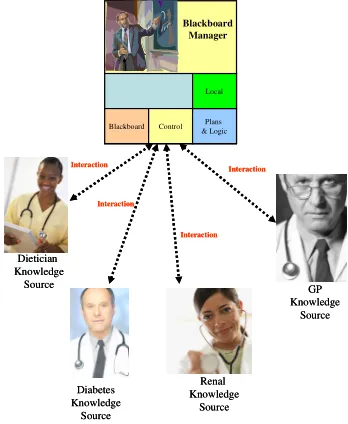
The blackboard model is based around three components: KS, control element and the blackboard (Turban et al., 2005). The KS is an expert at solving specific elements of the overall problem. The blackboard, acts as a central repository for data, partial solutions and control information. The blackboard also acts as a communication medium for the transfer of information, and a KS triggering mechanism. The control element directs the problem-solving process by allowing KS’s to respond to blackboard changes, and it selects the most appropriate KS to be executed next, as shown in Figure 1. After completing a task the KS reports back to the blackboard and returns control to the control element. KS’s are not aware, and cannot communicate with other KS’s directly. They know nothing about the other experts (e.g., what parameters they use, what processes they perform, or what services they provide). The blackboard architecture tends to be a labyrinth of different configurations, levels of abstraction, and partial solutions which are orchestrated to provide a flexible problem solving mechanism. The blackboard system eliminates the communication issues raised by the directly coupled monolithic model, and gives a representation of the problem to be solved to all participants. But the blackboard does not have the capacity to indicate how group members can collaborate to solve a problem, but can only select from partial solutions it already possesses.
Dietician Knowledge Source Diabetes Knowledge Source GP Knowledge Source Renal Knowledge Source Interaction Interaction Interaction Interaction
Blackboard Control & LogicPlans Local Blackboard Manager Dietician Knowledge Source Diabetes Knowledge Source GP Knowledge Source Renal Knowledge Source Interaction Interaction Interaction Interaction
Blackboard Control & LogicPlans Local
[image:5.595.311.520.316.502.2]Blackboard Manager
Figure 1, Blackboard Management Communications
3
DESIGN OF A GUIDELINE
AGENT
The agent approach is based on the principle that each agent can represent a single guideline. It captures all the guidelines knowledge, logic and motivation. In addition to this the agent has a rich communication facility where data and social interaction between separate agents can take place. But how does each agent know what the other is doing since there is no centralised all encompassing plan? If the blackboard is simply a repository of information, although layered to some degree, there is no absolute necessity for it to be in a single location. Therefore, it is possible to replicate a copy of the blackboard within each Autonomous Socialising Knowledge agent (ASK-agent) as shown in Figure 2.
Interaction Blackboard Control KnowledgeSource
BDI Local
Dietician Guidelines AGENT
Blackboard Control KnowledgeSource
BDI Local
GP Guidelines AGENT
Blackboard Control KnowledgeSource
BDI Local
Diabetes Guidelines AGENT
Blackboard Control KnowledgeSource
BDI Local
Renal Guidelines AGENT
Interaction Blackboard Control KnowledgeSource
BDI Local
Dietician Guidelines AGENT
Blackboard Control KnowledgeSource
BDI Local
GP Guidelines AGENT
Blackboard Control KnowledgeSource
BDI Local
Diabetes Guidelines AGENT
Blackboard Control KnowledgeSource
BDI Local
[image:5.595.92.266.485.697.2]Renal Guidelines AGENT
Figure 2, Autonomous Socialising Knowledge agent model
about the individual patient. By providing a framework which allows separate ASK-agent broadcast supportive communications to each other, the agent approach offers the opportunity for the data to be validated in a patient-centred fashion. But how can these separate, autonomous, self-contained ASK-agent modules share data, work in groups or collaborate to solve a problem.
3.1 Agent to agent based activity
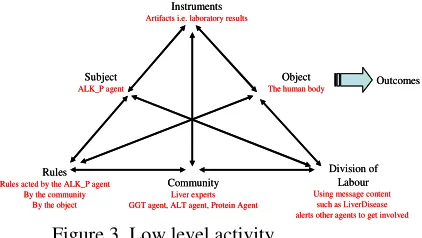
A theory which can aid issues relating to collaborating guidelines is Activity Theory (AT) which emanated through the social sciences. AT focuses on the collaborative nature of separate autonomous systems such as individuals (Engestrom et al., 1999), on which agents are based, and have the capability to perform certain tasks as part of a group. Agents synthesise human decision-making through their goal, plan and belief elements, but do not explicitly detail how they can socialise or collaborate. AT in itself does not provide an output which can be exactly transposed into computer software, but does provide a useful framework based around interfacing interaction and collaboration of software modules. These interfaces can be used to develop an increased sense of interaction and collaboration ability in autonomous modules using a software program independent approach.
The structure of human activity according to Engestrom can be compartmentalised using rules, community, subject, object, division of labour and instruments. AT is an iterative process where an activity is developed from a simple low level activity to a higher level activity.
Instruments
Artifacts i.e. laboratory results
Division of Labour
Using message content such as LiverDisease alerts other agents to get involved
Rules
Rules acted by the ALK_P agent By the community
By the object
Community
Liver experts GGT agent, ALT agent, Protein Agent
Subject
ALK_P agent The human bodyObject Outcomes
Instruments
Artifacts i.e. laboratory results
Division of Labour
Using message content such as LiverDisease alerts other agents to get involved
Rules
Rules acted by the ALK_P agent By the community
By the object
Community
Liver experts GGT agent, ALT agent, Protein Agent
Subject
[image:6.595.311.531.188.313.2]ALK_P agent The human bodyObject Outcomes
Figure 3, Low level activity
In terms of medical guidelines the iterative process dynamic exists by virtue of the design of guidelines and their focus on a condition, disease or organ. Consider for example, a low level implementation activity being the guideline behind the validation of a single analyte result, say Alkaline
Phosphates as shown in Figure 3. A higher level implementation is where the result is combined with some other single analyte results, such as Bilirubin and GGT, to perform and aid in the reporting of a Liver Function Test as shown in Figure 4. The Liver Function Test is then part of a higher level suite of tests for other medical disorder classifications.
Instruments
Artefacts i.e. diagnosis liver dysfunction or indication LiverDisease
Division of Labour
Using message content such as Hepatitis alerts other agents to get involved
Rules
Rules acted by the Liver Expert By the community
By the object
Community
Experts associated with the liver Dietician expert agent, Kidney expert agent
Haematology Expert agent
Subject
Liver Expert agent The human bodyObject Outcomes
Instruments
Artefacts i.e. diagnosis liver dysfunction or indication LiverDisease
Division of Labour
Using message content such as Hepatitis alerts other agents to get involved
Rules
Rules acted by the Liver Expert By the community
By the object
Community
Experts associated with the liver Dietician expert agent, Kidney expert agent
Haematology Expert agent
Subject
[image:6.595.76.287.510.629.2]Liver Expert agent The human bodyObject Outcomes
Figure 4, High level activity
3.2 ASK-agent model
To utilise this overlapping knowledge link a social structure was developed to manage the interfacing between agents. This social interface took the form of a mandatory set of searchable service descriptions, beliefs and actions. The service descriptions (i.e. Name, Type, Ownership, GuidelineReference, InformationNeeded, ValidationType, EndResultType, Ontology and Language) permitted each agent to be located within the agency platform through the Directory Facilitator (DF) (a feature of the Foundation for Intelligent Physical Agents (FIPA) standard offering searchable goldenpages facility to locate agents) (McGrory_a et al., 2008). The beliefs (i.e. CurrentlyValidating, PlausibilityScore and localised blackboard) permit the ASK-agent to interact with other group members. The actions relate to automated responses the ASK-agent must return to other agents when queried (e.g. CurrentlyValidating), and the sending of information to other agents it believes should be reported (e.g. it determined the presence of liver disease during its deliberation). Therefore, each ASK-agent only needs to know its overlapping neighbours, which it can find and interact with using the agent platforms DF and message passing. With access to supportive and overlapping knowledge it is not necessary to have a single all-encompassing rule set to manage the ASK-agents interaction.
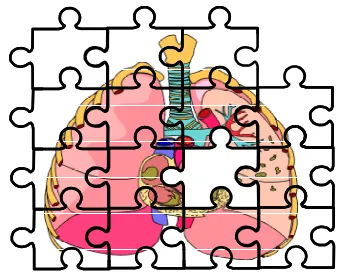
The fundamental concept of the ASK-agent system proposed in this paper is to allow components to collaborate and share supportive information without having to explicitly disclose their position as part of the large encompassing community. An ASK-agent does not need to identify exactly what every other agent is doing; only what its neighbours (i.e. neighbours it interfaces with) are doing. To illustrate this point further and demonstrate some boundaries, consider the example of a jigsaw with 500 pieces. A jigsaw piece has two discrete dimensions: the irregular shaped edge containing four sides, and the image printed on the face. To solve the puzzle, a person directly matches individual jigsaw pieces onto the jigsaw image, say the image shown on the box. Each piece is identified using the image on its face and placed in the appropriate position. This method requires a view of the whole system to be presented before starting, but involves no greater skill than straightforward pattern matching. An alternative approach is to use a combination of the localised image on the face of the
piece and its four corners to match it to a suitable neighbour (i.e. matching the shape of the pieces together). Jigsaw assembly using these interfaces do not require the full picture to be known. Using the jigsaw example as a solution metaphor, the heart and lungs image depicted in Figure 4 is a symbolic representation of the heart and lungs as a whole, not just the image it represents. The agent was not intended to be a large all encompassing structure, but a group of loosely coupled autonomous expert knowledge sources (represented by each jigsaw piece) which could be readily and easily interfaced with as shown in Figure 4. The ASK-agent only needs to know its neighbours (i.e. the expert it interfaces with), in a similar way the jigsaw piece only needs to know another piece with similar edge profile and compatible image, not the whole picture. The ASK-agent does not need to know anything about any other piece of the jigsaw only its interfacing neighbours. The interface can be considered the ontology, overlapping facts, common laboratory results and various viewpoints of the universe of discourse. This is analogous to the jigsaw edge shape profile.
Figure 4, Jigsaw metaphor representing agent components of the heart and lungs
4 CONCLUSION
[image:7.595.329.498.378.516.2]Table 1, Summary of centralised and ASK-agent approach.
The agents can be encoded to reproduce the beliefs, desires and intentions of the narrative guideline and act accurately, faithfully and autonomously on behalf of that document. This body of knowledge and logic can then be interfaced with, whenever that information needs to be accessed. The addition of activity theory and in particular the iteration model concept showed that the guideline documents already contain aspects that link them together. Using these links and the developed social communication the ASK-agents can locate, access, communicate, collaborate and coordinate activities between each other. This allows supportive information exchanges to be completed between separate expert agents about an individual patient, without the need for an all encompassing centralised plan. In cases where there is an inconsistency in held patient specific information, this agent approach offers an advanced, robust and efficient patient centred validation alternative to existing approaches. However, if overlapping knowledge between guidelines is not available the links created using
this approach are not present and the separate guidelines are standalone islands of information. The guidelines knowledge, logic and motivations are still accessible as a standalone entity, but other agents would need to be created to provide the links. Developing a system using the latter approach still permits distributed processing to be accomplished, but not without a source of knowledge to provide the links. A summary of the differences between the centralised and ASK-agent approach are given in Table 1.
REFERENCES
Corkill D., 2003. Collaborating Software Blackboard and
Multi-Agent Systems & the Future. Accessed via
www.cs.umass.edu, Proceedings of the International Lisp Conference published in October 2003.
Engestrom Y., Miettinen R., Punamaki R. Perspectives on
Activity Theory. Published by Cambridge University
Press January 1999. ISBN13: 9780521437301. Kavanagh M., Price S., “The quest for a computerized
guideline standard: The process, its history, and an evaluation of the most common and promising
methods used today”, Capstone Project documentation
2002.
Marshall W.J., Bangert S.K., 1995. Clinical Biochemistry,
Metabolic and Clinical Aspects, ISBN 0 443 043 418,
published in 1995 by Churchill Livingstone.
McGrory_a J., Grimson J., Clarke F., Gaffney P., “Agents
representing medical guidelines”, HEALTHINF 2008
International Conference on Health informatics, Funchal, Madeira, Portugal, January 2008.
McGrory_b J., Grimson J., Clarke F., Gaffney P.,
“Communication of medical information using
agents”, HEALTHINF 2008 International Conference
on Health informatics, Funchal, Madeira, Portugal, January 2008.
McLoughlin V., Millar J., Mattke S., Franca M., Jonsson P., Somekh D. and Bates D., 2006. Selecting indicators for patient safety at the health system level
in OECD countries. International Journal for Quality
in Health Care 2006 18(Supplement 1):14-20. Rao A., Georgeff M., 1995. BDI Agents: From Theory to
Practice, proceedings of the first international
conference on multi agent systems (ICMMAS-95) San Francisco USA 1995.
Turban E., Aronson J.E., Liang TP., Decision Support
Systems and Intelligent Systems. published in 2005 by
Pearson Prentice Hall, Seven Edition, ISBN 0-13-123013-1, Chapter 10, pgs 538-570.
Witte D.L., VanNess S., Angstadt D., and Pennell B.J., 1997. Errors, mistakes, blunders, outliers, or
unacceptable results: how many? Published by
Clinical Chemistry 1997; Vol:43 pgs 1352-1356.
Element Centralised
Approach ASK-Agent
Multi-ontologies No Yes
Processing Centralised Distributed
Requirement for overlapping knowledge
None Required to provide
the links.
Addition, altering or removal of guidelines from the system
Any changes require centralised inference to be recompiled.
Each ASK-agent is independent and loaded separately.
System resilience None Yes, all ASK-agents have a copy of the blackboard.
Independent accessible knowledge
None. All access to information through the centralised engine.
Yes, all ASK-agents are independent. Information accessed via message passing. Clinician having access to specific guideline knowledge
A clinician cannot access knowledge directly.
A clinician can access each ASK-agent via a message and directly access the specific guideline knowledge.
Method of
collaboration Direct links using the centralised engine.