community2vec: Vector representations of online communities encode
semantic relationships
Trevor Martin
Department of Biology, Stanford University Stanford, CA 94035
Abstract
Vector embeddings of words have been shown to encode meaningful semantic re-lationships that enable solving of complex analogies. This vector embedding concept has been extended successfully to many different domains and in this paper we both create and visualize vector represen-tations of an unstructured collection of on-line communities based on user participa-tion. Further, we quantitatively and qual-itatively show that these representations allow solving of semantically meaningful community analogies and also other more general types of relationships. These re-sults could help improve community rec-ommendation engines and also serve as a tool for sociological studies of community relatedness.
1 Introduction
Social media usage and participation in online communities has grown steadily over the last decade (Perrin,2015). As we increasingly live our lives online, it is important to characterize the on-line communities we inhabit and understand the relationships between them. Our expanding re-liance on online communities also represents an exciting opportunity to understand the links be-tween different interests and hobbies, as candid participation across online communities is more immediately and scalably measurable compared to offline communities.
Recent work has shown that vector represen-tations and embeddings of entities are a power-ful tool across a range of applications from words (Mikolov et al., 2013a) to DNA sequences ( As-gari and Mofrad, 2015). In particular, the co-occurrence based embeddings of words in a
cor-pus has been demonstrated to encode meaning-ful semantic relationships between them (Mikolov et al.,2013b). In this paper we extend the concept of vector embeddings to represent an unstructured collection of online communities and show that the co-occurrence of users across online commu-nities also embeds the semantic relations between them. Further downstream applications of these results could include improved community recom-mendation engines and advertisement targeting.
We focus our analysis on the social sharing site Reddit, the 4th most popular website in the US (Alexa, 2017), which has user created and man-aged communities called subreddits.1 Subreddits
are communities centered around particular top-ics and interests where users can post articles and comments while also voting content up or down to make it more or less visible. To our knowledge this paper represents the first use of vector based repre-sentations of such communities to solve analogies and perform semantically meaningful calculations of relationships.
2 Related Work
Reddit is relatively understudied compared to other social networks such as Facebook, but an in-creasing body of work has used its data to look at topics ranging from online user behavior ( Hamil-ton et al.,2017) to user migration across social me-dia platforms (Newell et al.,2016). A map of Red-dit using commenter co-occurrences has also been previously created using a much smaller sample of comment data (Olsen and Neal,2015) by treating the co-occurrence matrix as a weighted graph and extracting the network backbone. Relatedly, there has been interest in developing vector representa-tions of graph structures as shown by techniques
1Subreddits are typically denoted with a leading/r/, for
example/r/dataisbeautiful is the “dataisbeautiful” subreddit.
like DeepWalk (Perozzi et al.,2014) and node2vec (Grover and Leskovec,2016), which we could po-tentially use to create additional vector represen-tations to test below. Reddit communities do not have a built-in explicit graph structure though, as there are not defined links between communities in the same manner as users can be linked by friend-ship requests on sites like Facebook. In this pa-per we show that semantically meaningful maps of communities can be created using the NLP tool-box originally created for mapping the semantic similarity of words, without a need for defining an explicit graph.
3 Method
Our method for uncovering semantic relationships between online communities begins by creating vector representations of each community based on how often users comment across communities using one of the three methods outlined below. Broadly, we follow the general framework ofLevy et al. (2015), where in our modified framework communities take on the role of words and user co-occurrence the role of word co-occurrence. We then simply add and subtract these community vectors to evaluate semantic correctness. Here, we use a publicly available corpus of all Reddit com-ments from January 1st, 2015 through April 30th, 2017 as the input to each technique. This data set consists of roughly 1.8 billion comments across 60,978 subreddit communities.2
3.1 Subreddit Vectors
We first create a symmetric matrix of community-community user co-occurrencesX, whose entries Xijindicate the number of unique users who com-mented 10 times or more in each subreddit.
Explicit: Our explicit subreddit representation first simply subsets the co-occurrence matrix X to include only the subreddits with unique author ranks between 200 and 2,201 as context subred-dits (columns of X). The choice of rank cutoff here is arbitrary but based on the idea that per-formance can be increased by adjusting the num-ber of context tokens (Bullinaria and Levy,2007). We choose the subreddits with the most unique au-thors because these are likely to encode the most useful information and drop the top 200
subred-2Reddit data available at: https://bigquery.
cloud.google.com/table/fh-bigquery: reddit_comments.all_starting_201501
dits because many of these are “default” subred-dits that all Reddit users are subscribed to and thus are unlikely to have as rich co-occurrence in-formation. Then we transform this new matrix X:,201:2200 using the positive pointwise mutual information metric to weigh each count by its in-formativeness, wherep(i, j) is the joint probabil-ity of seeing authors in both subredditsiandjand p(i)andp(j)are the probabilities of seeing an au-thor in each subreddit respectively:
P MI(i, j)≡log p(i, j)
p(i)p(j)
P P MI(i, j) =
(
0, ifP MI(i, j)<0
P MI(i, j), otherwise
The subreddit vectors (rows) of the resulting P P MI matrix are then scaled to unit length. PCA: We also create a dense vector representation of subreddits by calculating the principal com-ponents of the P P MI transformation above ap-plied to the matrixX:,1:5000, which isX subset to the top 5,000 context subreddits by unique au-thor ranks. We extract the top 100 principal com-ponents and scale each subreddit vector to unit length.
GloVe: Finally, we create a second dense vector representation of subreddits by running the GloVe algorithm (Pennington et al.,2014), originally de-veloped to create embeddings for word-word co-occurrence matrices, on the raw co-co-occurrence matrixX. The resulting size 100 GloVe subred-dit vectors are again scaled to unit length.
3.2 Subreddit Algebra
Combinations of subreddit representations (sub-reddit algebra) are performed through standard vector addition and subtraction. The similarity be-tween two subreddits is defined here as thecosine similarity, given by:
cosine similarity(A, ~~ B) = A~·B~
kAkk~ B~k
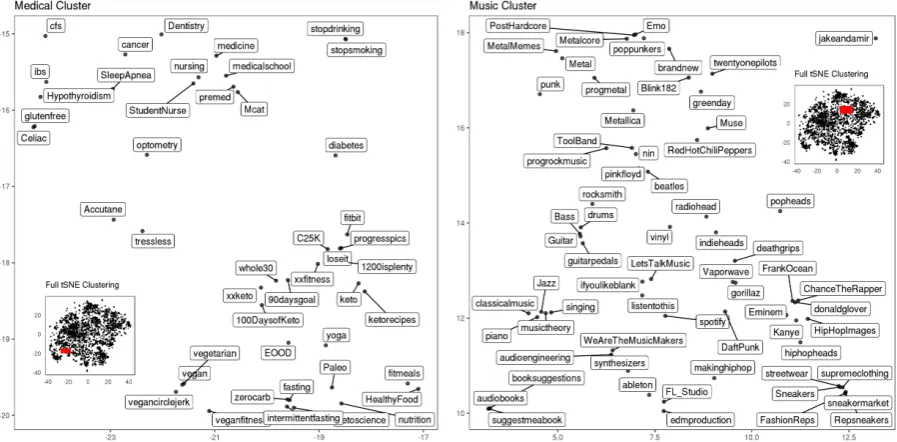
(a) View of subreddits representing medical interests and health
[image:3.595.76.525.65.286.2]conscious lifestyles. (b) View of subreddits representing music genres and perform-ing groups. Figure 1: Examples of semantically meaningful clusters in t-SNE visualization of GloVe subreddit vec-tors. Zoomed-in region of t-SNE visualization indicated in red on figure insets.
4 Evaluation
We quantitatively evaluate the efficacy of subred-dit algebra by assessing its ability to identify lo-cal sports team subreddits from combinations of league and geography subreddits. Additionally, we qualitatively evaluate our the results by iden-tifying specific interesting subreddit relationships and visualizing the subreddit vector space as a whole.
4.1 tSNE Clustering
To check that our vector representations of sub-reddit communities are reasonable, we used t-SNE (Maaten and Hinton, 2008) to project the high-dimensional vector representations of each sub-reddit into two dimensions for visualization. Ex-amples of typical semantically meaningful clusters that we can observe in these t-SNE projections are given in Figure 1. Figure 1a shows that medi-cal and health related subreddits cluster together and Figure1bshows the dense clustering of music and band related subreddits and clustering within this larger group by music genre.3 These natural
groupings suggest that our vector representations are reasonable and are encoding semantically rel-evant information about each subreddit.
3To aid in visualization, we only project the top 5,000 and
2,500 subreddits by unique author count for the medical and music GloVe based clusters respectively.
4.2 Automated Semantic Relationship Test In order to quantitatively evaluate the ability of the subreddit vectors to encode semantic relations, we created a list of subreddit combinations where we have a strong expectation for the outcome subred-dit. Conveniently, sport, location, and team sub-reddits have a natural analogy structure. Specifi-cally, for the NBA, NFL, and NHL sports leagues we created a list of geographic location subreddits (e.g. /r/sanfrancisco) that when combined with a league subreddit (e.g./r/nba) should re-sult in that location’s local league affiliate (e.g.
/r/warriors).4 Performance on this task for
an individual league-location pair is assessed by calculating:
median(SR(~S, ~T), SR(~L, ~T))−SR(~S+~L, ~T)
Where ~S is the league subreddit, ~L is the lo-cation subreddit, and ~T is the target subreddit. SR(A, ~~ B)is the rank of the subreddit B when all subreddits are ordered by decreasing cosine simi-larity to subreddit A.
The decrease in similarity ranking for each sports league across each of the three vector repre-sentations was then evaluated for significance by
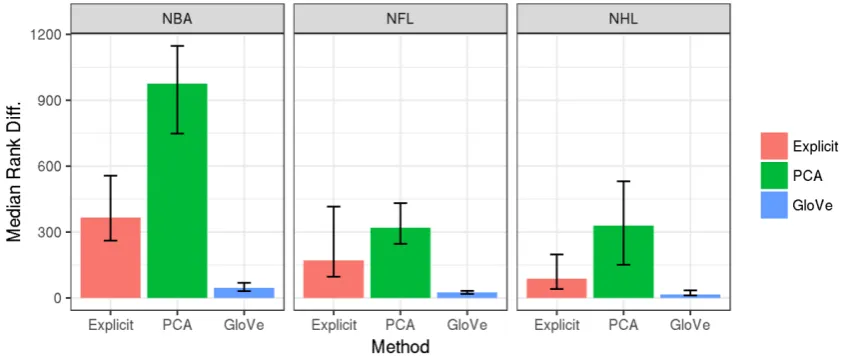
Figure 2: Comparison of different vector representation’s performance for identifying local sports teams in each league.
Method League ~S+~L: ~T Median Rank Median Rank Diff. p-value
Explicit NBANFL 75 365.5170.8 1.9e-98.3e-7
NHL 4 87.5 1.9e-9
PCA NBANFL 21213 976.3320.1 9.3e-104.7e-8
NHL 41.5 330 3.4e-4
GloVe NBANFL 72 46.525 1.8e-61.5e-5
[image:4.595.126.474.297.435.2]NHL 1 16.5 1.8e-6
Table 1: Results of automated testing of subreddit vector representation semantic encodings.
a two-sided Wilcoxon signed-rank test for sym-metry of the rank changes around 0. The me-dian decrease in target subreddit rank between SR(~S+~L, ~T)and median(SR(~S, ~T), SR(~L, ~T))
for each sports league-vector representation pair is shown in Figure2.5 Interestingly, both the explicit
and PCA vector representations appear to perform best, but all three methods show significant perfor-mance on the task as indicated in Table1.
Closer inspection of the results reveals though that while the PCA method has the largest im-provement in target subreddit rank (Median Rank Diff. in Table 1), it also has the highest median subreddit ranks for the target subreddits after per-forming subreddit algebra of the three methods (~S+~L: ~T Median Rank in Table1). This observa-tion suggests that while the PCA representaobserva-tions benefit the most from algebra they also have the least accuracy for identifying the target subreddit
5More specifically the Hodges-Lehmann pseudomedian,
with 95% CI
overall.6 In contrast, for algebra using either the
explicit or GloVe vector representations, the target subreddit is often the most similar result.
4.3 Selected Semantic Examples
In addition to the automated test, we also identi-fied several interesting analogy tasks to run using subreddit algebra.7 Because we do not necessarily
have subreddits for representing concepts such as “man” or “woman” we cannot reproduce exactly classic cases likeking−man+woman=queen, but for the cases where we could form robust analogies the results are encouraging, as shown in Figure3.
Of note is that we can reproduce country:capital relationships similar to those found in word em-beddings using community participation across subreddits and also can reproduce analogies that
6Also, PCA based representations do not necessarily have
the linear substructure seen in GloVe embeddings.
Figure 3: Selected semantic algebra examples.
subtract a component (Chicago) of a whole (Chicago Bulls NBA team) and add a different location (Minnesota) to get that locality’s NBA team (Minnesota Timberwolves). We can also find communities specific to medium-genre combina-tions such as the historical fiction book commu-nity /r/HFnovels. Finally, we see some sur-prising examples, such as subtracting the commu-nity for frugality from the commucommu-nity for man-aging personal finances results in the commu-nity for taking extreme risks on the stock market,
/r/wallstreetbets.
5 Conclusions
Our work here shows that vector representations of communities can encode meaningful analogies and semantic relationships in the same way as has been previously seen for words. Notably, the explicit vector representations perform competi-tively with the GloVe embeddings on the semantic task we tested, suggesting that the semantic mean-ings are present in the raw vectors and are simply preserved through the embedding process. Future directions we are pursuing involve supplementing the vector representations with data on comment voting scores, using posts or views in lieu of or supplementally to comments and looking at di-achronic subreddit embeddings to analyze the pat-terns of subreddit relationships over time.
Acknowledgments
We would like to thank Will Hamilton for his valu-able comments and suggestions on the manuscript.
References
Alexa. 2017. http://www.alexa.com/siteinfo/reddit.com.
Alexa Rankings.
Ehsaneddin Asgari and Mohammad R. K. Mofrad.
2015. Continuous distributed representation
of biological sequences for deep proteomics and genomics. PLOS ONE 10(11):1–15.
https://doi.org/10.1371/journal.pone.0141287.
John A. Bullinaria and Joseph P. Levy. 2007.
Ex-tracting semantic representations from word co-occurrence statistics: A computational study.
Behavior Research Methods 39(3):510–526.
https://doi.org/10.3758/BF03193020.
Aditya Grover and Jure Leskovec. 2016. node2vec:
Scalable feature learning for networks. CoRR abs/1607.00653.http://arxiv.org/abs/1607.00653. William L. Hamilton, Justine Zhang, Cristian
Danescu-Niculescu-Mizil, Dan Jurafsky, and Jure Leskovec.
2017. Loyalty in online communities. CoRR
abs/1703.03386.http://arxiv.org/abs/1703.03386.
Omer Levy, Yoav Goldberg, and Ido Dagan. 2015.
Im-proving distributional similarity with lessons learned from word embeddings. Transactions of the
Asso-ciation for Computational Linguistics 3:211–225.
https://transacl.org/ojs/index.php/tacl/article/view/570. Laurens van der Maaten and Geoffrey Hinton. 2008.
Visualizing data using t-sne. Journal of Machine
Learning Research9(Nov):2579–2605.
Tomas Mikolov, Kai Chen, Greg Corrado, and Jeffrey
Dean. 2013a. Efficient estimation of word
repre-sentations in vector space. CoRR abs/1301.3781.
http://arxiv.org/abs/1301.3781.
Tomas Mikolov, Wen-tau Yih, and Geoffrey Zweig. 2013b. Linguistic regularities in continuous space
word representations. In Hlt-naacl. volume 13,
pages 746–751.
Edward Newell, David Jurgens, Haji Saleem, Hardik Vala, Jad Sassine, Caitrin Armstrong, and Derek Ruths. 2016. User migration in online social net-works: A case study on reddit during a period of community unrest.
Randal Olsen and Zachary Neal. 2015. Navigating the massive world of reddit: using backbone networks to
map user interests in social media. PeerJ Computer
Science.
Jeffrey Pennington, Richard Socher, and
Christo-pher D. Manning. 2014. Glove: Global vectors for
word representation. InEmpirical Methods in Nat-ural Language Processing (EMNLP). pages 1532–
1543.http://www.aclweb.org/anthology/D14-1162.
Bryan Perozzi, Rami Al-Rfou, and Steven Skiena.
2014. Deepwalk: Online learning of
so-cial representations. CoRR abs/1403.6652.
http://arxiv.org/abs/1403.6652.
Andrew Perrin. 2015. Social media usage: 2005-2015.
PewResearchCenter.
A Supplemental Material
All code and league-location-team combina-tions are available athttps://github.com/