SB: mmSystem - Using Decompositional Semantics for Lexical
Simplification
Marilisa Amoia
Department of Applied Linguistics University of Saarland
Massimo Romanelli DFKI GmBH Saarbrcken, Germany
Abstract
In this paper, we describe the system we sub-mitted to the SemEval-2012 Lexical Simplifi-cation Task. Our system (mmSystem) com-bines word frequency with decompositional semantics criteria based on syntactic structure in order to rank candidate substitutes of lexical forms of arbitrary syntactic complexity (one-word, multi-(one-word, etc.) in descending order of (cognitive) simplicity. We believe that the proposed approach might help to shed light on the interplay between linguistic features and lexical complexity in general.
1 Introduction
Lexical simplification is a subtask of the more gen-eral text simplification task which attempts at re-ducing the cognitive complexity of a text so that it can be (better) understood by a larger audience. Text simplification has a wide range of applications which includes applications for the elderly, learners of a second language, children or people with cog-nitive deficiencies, etc.
Works on text simplification mostly focus on re-ducing the syntactic complexity of the text (Sid-dharthan, 2011; Sid(Sid-dharthan, 2006) and only little work has addressed the issue of lexical simplifica-tion (Devlin, 1999; Carroll et al., 1999).
The Lexical Simplification Task (Specia et al., 2012) proposed within the SemEval-2012 is the first attempt to explore the nature of the lexical simpli-fication more systematically. This task requires par-ticipating systems, given a context and a target word, to automatically generate a ranking of substitutes,
i.e. lexical forms conveying similar meanings to the target word, such that cognitively simpler lexi-cal forms are ranked higher than more difficult ones. In this paper, we describe the system we sub-mitted to the SemEval-2012 Lexical Simplification Task. In order to rank the candidate substitutes of a lexical form in descending order of simplicity, our system (mmSystem) combines word frequency with decompositional semantics criteria based on syntac-tic structure. The mmSystem achieved an average ranking if compared with the other participating sys-tems and the baselines. We believe that the approach proposed in this paper might help to shed light on the interplay between linguistic features and cogni-tive complexity in general.
2 The Lexical Simplification Task
The SemEval-2012 Lexical Simplification Task re-quires participating systems to automatically gen-erate a ranking of lexical forms conveying similar meanings on cognitive simplicity criteria and can be defined as follows. Given a short textC called the context and which generally corresponds to a sen-tence, a target word T and a list LS of candidate
substitutes forT, i.e. a list of quasi-synonyms of the target word, the task for a system consists in pro-viding a ranking onLS such that the original list of
substitutes is sorted over simplicity, from the cogni-tively simplest to the cognicogni-tively most difficult lexi-cal form.
As the examples from (1) to (3) show, the Lexical Simplification Task includes substitutes of different syntactic complexity which might vary from simple one-word substitutes as in (1) (the lexical forms that
can function as substitutes include content words, i.e. nouns (n), verbs (v), adjectives (a) and adverbs (r)) to collocations, negated forms as in (2) or even definition-like paraphrases as for instancewindand knock the breath out ofin example (3).
(1)
C: He suggested building an experimental hy-pertext ’web’ for the worldwide.a community of physicists who used CERN and its publica-tions.
T:worldwide.a
LS:worldwide, global, international
(2)
C: Go to hell! she remembers Paul yelling at hershortly.rafter their wedding.
T:shortly.r
LS: soon, a little, just, almost immediately,
shortly, not long
(3)
C: Now however she was falling through that skylight, the strong dark figure that had ap-peared out of nowhere falling through with her, his arms tightly entwined about her, his shoul-der havingwinded.vher.
T:winded.v
LS: knock her breathless, knock the wind out
of, choke, wind, knock the breath out of, knock the air out of
The organizers of the Lexical Simplification Task provide a corpus of 300 trial and 1710 test sentences defining the context of the target word and the as-sociated list of candidate substitutes. To produce a gold standard, 5 human annotators manually ranked the list of substitutes associated to each context. Fi-nally, a scoring algorithm is provided for comput-ing agreement between the output of the system and the manually ranked gold standard. The scoring al-gorithm is based on the Kappa measure for inter-annotator agreement.
3 The mmSystem
Our aim by participating in the SemEval-2012 Lexi-cal Simplification Task (Task 1) was to investigate
the nature of lexical simplicity/complexity and to identify the linguistic features that are responsible for it. The system we have developed is a first step in this direction. The idea behind our framework is the following. We build on previous work (De-vlin, 1999; Carroll et al., 1999) that approximate simplicity with word frequency, such that the cog-nitively simpler lexical form is the one that is more frequent in the language. While this definition might easily apply to one-word substitutes or collocations, it poses some problems in the case of multi-word-expressions or of syntactically more complex lexi-cal forms (e.g. definition like paraphrases) like those proposed in the substitute lists in the SemEval-2012 Task 1.
Our approach builds on the baseline definition of simplicity based on word frequency and integrates it with (de)compositional semantics considerations. Therefore, in order to operationalize the notion of simplicity in our system we adopt different strategies depending on the syntactic complexity of the lexical form that forms the substitute.
• In the case of one-word substitutes or common collocations we use the frequency associated by WordNet (Fellbaum, 1998) to the lexical form as a metric to rank the substitutes, i.e. the substitute with the highest frequency is ranked higher. For instance, the lexical itemintelligent is ranked lower than clever as it has a lower frequency in the language (as defined in Word-Net).
3.1 Implementation
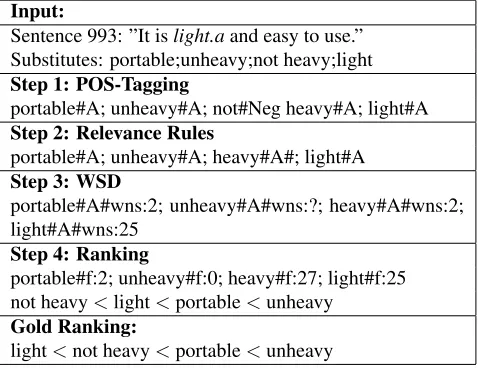
In this section we describe in more details the im-plementation of the mmSystem. The system design can be summarized as follows.
Step 1: POS-TaggingIn the first step, context and
the associated substitutes are parsed1so to ob-tain a flat representation of their syntax. Ba-sically at this level, we collect Part-Of-Speech information for all content words in the context as well as in the substitute list.
Step 2: Relevance RulesIn the second step,
de-pending on the syntactic representation of the substitutes, the system selects a relevance rule that identifies the one-word lexical form that will be used for representing the meaning of the whole substitute.
Step 3: Word Sense Tagging The system
ap-plies word sense tagging and assigns a Word-Net sense to the target words and their can-didate substitutes. In this step, we rely on the SenseRelate::TargetWord package (Pat-wardhan et al., 2005) and use the Lesk algo-rithm (Lesk, 1986) for word sense disambigua-tion.
Step 4: Substitute RankingFollowing (Carroll et
al., 1999) that pointed out that rare words gen-erally have only one sense, in order to associate a frequency index to each candidate substitute (wi), we use the number of senses associated
by WordNet to a lexical item of a given part of speech, as an approximation of its frequency (fi). Further, we extract from WordNet the
fre-quency of the word sense (fwnsi) associated to the lexical itemwiat step 3. Words not found in
WordNet it assigned a null frequency (fi = 0,
fwnsi = 0). Finally, we rank the substitute in the following way:
• iff1 6=f2
w1 < w2,iff1> f2and
w2 < w1otherwise, • else iff1=f2
w1 < w2,iffwns1 > fwns2 and
w2 < w1otherwise.
Input:
Sentence 993: ”It islight.aand easy to use.” Substitutes: portable;unheavy;not heavy;light
Step 1: POS-Tagging
portable#A; unheavy#A; not#Neg heavy#A; light#A
Step 2: Relevance Rules
portable#A; unheavy#A; heavy#A#; light#A
Step 3: WSD
portable#A#wns:2; unheavy#A#wns:?; heavy#A#wns:2; light#A#wns:25
Step 4: Ranking
portable#f:2; unheavy#f:0; heavy#f:27; light#f:25 not heavy<light<portable<unheavy
Gold Ranking:
[image:3.612.311.550.51.235.2]light<not heavy<portable<unheavy
Table 1: Example of mmSystem processing steps.
Table 1 shows an example of data processing.
3.2 Relevance Rules
Relying on previous work on compositional seman-tics of multi-word-expression (Reddy et al., 2011; Venkatapathy and Joshi, 2005; Baldwin et al., 2003) we defined a set of hand-written rules to assign the relevant meaning to a complex substitute. Relevance rules are used to decompose the meaning of a com-plex structure and identify the most relevant word conveying the semantics of the whole, so that the frequency associated to the whole lexical form is ap-proximated by the frequency of this most relevant form:
• a one-word lexical item is mapped to itself, e.g.
run.v→run.v
• a multi-word lexical form including only one content word is mapped to this content word, e.g.not.N eg nice.a→nice.aor
be.Cop able.a→able.a
• in the case of a multi-word lexical item includ-ing more than one content word, we take into account the syntactic structure of the lexical item and apply heuristics to decide which con-tent word is more relevant for the meaning of the whole. The heuristics we used are based on the empirical analysis of the trial data set provided by the Task 1 organizers that contains
1
about 300 contexts. As an example consider a lexical item including a verb construction with structure V1+to+V2 that is mapped by our
rules to the second verb formV2, e.g.try.V1to
escape.V2 →escape.V2.
Table 2 shows some examples of relevance rules de-fined in the mmSystem.
Syntax Example R Form
V + Prep engage for V
Cop + Adj be able Adj
Cop + V be worried V
Adv + V anxiously anticipate Adv Adj+N adnormal growth Adj N1 + N2 death penalty N1 N1 + PrepOf + N2 person of authority N2
V+N take notice N
V1+to+V2 try to escape V2
Table 2: Example of relevance rules.
These relevance rules allow for a preliminary in-vestigation of the nature of lexical complexity. For instance, we found that in many cases, it is the mod-ifying element of a complex expression that is re-sponsible for a shift in lexical complexity:
(4) a. lie<sayfalsely<sayuntruthfully
b. sample<typicalsample <representative
sample
4 Results
The Task 1 overall result can be found in (Specia et al., 2012). The mmSystem achieved an average ranking (score=0.289) if compared with the other participating systems and the baselines that corre-sponds to an absolute inter-annotator agreement be-tween system output and golden-standard around 66%. Interestingly none of the systems achieved an absolute agreement higher than 75% in this task. This confirms that lexical simplification still remains a difficult task and that the nature of the phenomena underlying it should be better explored.
Table 3 shows the performance of our system per syntactic category. The values are a bit higher than in the official results of Task 1 as the system version used for submission was buggy, however the rank-ing of our system with respect to the other partici-pating systems remains the same. Interestingly, the
best score were achieved for adverbs (0.352) and ad-jectives (0.342). This can be explained with the fact that the decompositional semantics of these category is better accounted for by our rules.
The relative low performance achieved by the mmSystem can be explained by the fact that our rules only select one content word and use its fre-quency for ranking. This metric alone is clearly not enough to explain all cases of lexical simplification. As an example of the complexity of this issue, con-sider the interplay of negation and compositional se-mantics: The negation of a very frequent verb form might not be so simple to understand as its antonym, e.g. don’t, not remember/forgetvs. omit to, fail to remember/forget. We believe, that a more system-atic analysis of the lexical semantics involved in lex-ical simplicity might improve the performance of the system.
Noun Verb Adj Adv TOT
cAgr: 0.5 0.5 0.5 0.5 0.5 aAgr: 0.658 0.658 0.671 0.676 0.665 Score: 0.316 0.315 0.342 0.352 0.329
Table 3: mmSystem scores per syntactic category. In the table cAgr represents the agreement by chance, aAgr is the absolute inter-annotator agreement between system output and gold ranking and score is the normalized sys-tem score. These values corresponds to P(A) and P(E) observed in the data.
5 Conclusion
References
Timothy Baldwin, Colin Bannard, Takaaki Tanaka, and Dominic Widdows. 2003. An empirical model of multiword expression decomposability. In Proceed-ings of the ACL 2003 workshop on Multiword expres-sions: analysis, acquisition and treatment - Volume 18, MWE ’03, pages 89–96, Stroudsburg, PA, USA. Asso-ciation for Computational Linguistics.
John Carroll, Guido Minnen, Darren Pearce, Yvonne Canning, Siobhan Devlin, and John Tait. 1999. Sim-plifying text for language-impaired readers. InIn Pro-ceedings of the 9th Conference of the European Chap-ter of the Association for Computational Linguistics (EACL, pages 269–270.
S. Devlin. 1999. Simplifying natural language for apha-sic readers. Ph.D. thesis, University of Sunderland, UK.
Christiane Fellbaum. 1998. WordNet: An Electronic Lexical Database. Cambridge, MA: MIT Press. Dan Klein and Christopher D. Manning. 2003.
Accu-rate unlexicalized parsing. InProceedings of the 41st Meeting of the Association for Computational Linguis-tics, pages 423–430.
M. Lesk. 1986. Automatic sense disambiguation using machine readable dictionaries: How to tell a pine cone from a ice cream cone. In Proceedings of SIGDOV ’86.
Siddharth Patwardhan, Satanjeev Banerjee, and Ted Ped-ersen. 2005. Senserelate::targetword - a generalized framework for word sense disambiguation. In Pro-ceedings of the Demonstration and Interactive Poster Session of the 43rd Annual Meeting of the Association for Computational Linguistics, pages 73–76, Ann Ar-bor, MI.
Siva Reddy, Diana McCarthy, and Suresh Manandhar. 2011. An empirical study on compositionality in com-pound nouns. In Proceedings of the International Joint Conference on Natural Language Processing 2011 (IJCNLP-2011), Thailand.
Advaith Siddharthan. 2006. Syntactic simplification ant text cohesion. Research on Language and Computa-tion, 4(1):77–109.
Advaith Siddharthan. 2011. Text simplification using typed dependencies: A comparision of the robustness of different generation strategies. InProceedings of the 13th European Workshop on NLG.
Lucia Specia, Sujay K. Jauhar, and Rada Mihalcea. 2012. Semeval-2012 task 1: English lexical simplifi-cation. InProceedings of the 6th International Work-shop on Semantic Evaluation (SemEval 2012), Mon-treal, Canada.
Sriram Venkatapathy and Aravind K. Joshi. 2005. Mea-suring the relative compositionality of verb-noun (v-n)