ANNUAL
REPORT
Office of The Director of Corporate Enforcement
Office of the Director of Corporate Enforcement, 16 Parnell Square,
Dublin 1. Tel: 01 858 5800 Lo-call: 1890 315 015 Fax: 01 858 5801 Email: [email protected] Web: www.odce.ie
Copyright and Disclaimer Statement
The contents of this document are the copyright of the Director of Corporate Enforcement. All or part of this publication may be reproduced without further permission, provided the source is acknowledged.
Nothing herein should be construed as a representation by, or on behalf of, the Director of Corporate Enforcement as to his understanding or interpretation of any of the provisions of the Companies Acts 1963 to 2012 or as to the interpretation of any law. Independent legal advice should be sought in relation to the effects of any legal provision. The Director of Corporate Enforcement accepts no responsibility or liability howsoever arising from the contents of this publication or any errors, inaccuracies or omissions in the contents of this document. The Director reserves the right to take action, which may or may not be in accordance with the provisions of this document.
3
TABLE OF CONTENTS
Director’s Introduction
52012 At A Glance
8Chapter 1: Overview Of The ODCE
10Statutory mandate 11
High level goals 11
Resources, organisational structure, governance arrangements & principal workstreams 12
Chapter 2: Promoting A Greater Understanding
17Of Affected Parties’ Rights And Duties Under
Company Law
Introduction 18
Publications and outreach activities 18
Advocating legislative and policy enhancements 20
Managing and developing relationships with external stakeholders 22
Chapter 3: Confronting Unlawful And Irresponsible
26Behaviour Insofar As It Relates To Company Law
Structure of this Chapter 27
EXTERNAL INPUTS 27
Liquidators’ section 56 reports 28
Sectoral distribution of other external inputs (i.e. other than liquidators’ section 56 reports) 31 Complaints 32
Auditors’ indictable offence reports 32
Referrals 33
Professional bodies’ indictable offence reports 33
Liquidators’ reports regarding possible criminality 35
Reports under section 19 of the Criminal Justice Act 2011 35
INTERNAL INPUTS 36
Introduction 36
Dissolved insolvent companies 36
Supervision of liquidators 36
Investigations commenced on own initiative 37
Quantum of internal inputs - 2012 37
4
OUTPUTS 40
Outputs from the section 56 process 40
Outputs of enforcement work 43
Securing voluntary rectification/remediation 43
Securing compliance through the exercise of the Director’s civil powers 43
Referrals to professional and other regulatory bodies 44
Civil enforcement 44
Criminal enforcement 46
Chapter 4: Providing Quality Customer Service To Internal
50And External Stakeholders
Provision of a quality customer service to external stakeholders 51 Provision of a quality customer service to internal stakeholders 54
Customer service standards 55
Compliance with obligations on foot of law, regulation and by virtue of the Office’s status
as a public sector entity established by statute 55
Appendices
57Appendix 1: Allocated vs. actual expenditure – 2010 - 2012 58 Appendix 2: Presentations delivered and exhibitions attended - 2012 59 Appendix 3: Cases where restriction Orders were made by the High Court pursuant to
section 56 of the CLEA 64
Appendix 4: Cases where disqualification Orders were made by the High Court pursuant to
section 56 of the CLEA 73
Appendix 5: Cases where no restriction or disqualification Orders were made by the High
Court pursuant to section 56 of the CLEA 74
DIRECTOR’S
6
DIRECTOR’S INTRODUCTION
Introduction
In accordance with the provisions of section 16(1) of the Company Law Enforcement Act 2001, I am pleased to submit the Office’s 2012 Annual Report to the Minister for Jobs, Enterprise & Innovation, Mr. Richard Bruton, TD.
Upon taking up appointment at the end of August 2012, I set about developing a deeper understanding of the Office’s principal workstreams and the challenges and opportunities that flow therefrom. Through initial discussions with my new colleagues, it quickly became apparent to me that:
•
the Office has a highly committed workforce, many of whom are highly experienced, and possess very high degrees of expertise, in company law and related disciplines;•
the Office’s activities are driven, to a very substantial extent, by inputs from external sources - most notably in the form of liquidators’ statutory reports, in respect of which the Office is required by law to make certain determinations. As such, the allocation of resources to this workstream is non-discretionary; and•
notwithstanding that, based on the investigation files referred to the Director of Public Prosecutions, charges have been preferred against a number of individuals in relation to certain events at the former Anglo Irish Bank Corporation plc, this case continues to be resource intensive from the Office’s perspective for reasons that are further elaborated upon in the body of this Report.As a consequence of the foregoing, the Office has limited latitude within which to address other, more discretionary, workstreams – such as, for example, the examination of complaints received from members of the public, auditors’ and professional bodies’ statutory reports and to proactively seek to address other areas of potential risk. Against that backdrop, regard must also be had to the financial constraints within which the State is currently operating, and to the associated expectation that statutory entities such as the Office do more with less.
Accordingly, we, and our stakeholders, must recognise and acknowledge that we cannot do everything. Rather, having regard to our statutory mandate we must seek to apply our available resources in the most effective manner possible. In order to do this, we need to have regard to a number of important considerations, including:
•
the types of unlawful and irresponsible behaviour in a company law context of which, based on statistical analysis and other available information, there is evidence of significant occurrence;•
the relative extent to which such behaviour has the potential to be injurious to the Office’s stakeholders and to the wider public interest;•
the parameters of our statutory remit and the various tools at our disposal; and•
the likelihood of our being in a position to address such behaviour in an effective manner having regard to considerations such as:the cost effectiveness, and associated opportunity cost, of certain courses of action relative to others;
the relative likely dissuasive effects of the various enforcement options at our disposal; the extent to which, in appropriate circumstances, voluntary rectification can be achieved through positive engagement with/from stakeholders, thereby avoiding the need to seek recourse to more formal, and thereby generally less cost effective, measures;
7 Having regard to those various considerations, we must seek to concentrate our resources in
those areas in which we are likely to have the most impact. Accordingly, these are amongst the principal considerations that are likely to inform the Office’s enforcement strategy over the coming years.
Year under review
As can be seen from the body of this Report, the Office delivered a number of tangible outputs during 2012, the combined effect of which has been to contribute to:
•
assisting stakeholders to comply with their obligations and vindicate their rights respectively under company law; and•
confronting, and dissuading further, irresponsible and non-compliant behaviour.Notable contributions in that regard included:
•
the publication of 10 new guidance and information documents for stakeholders’ benefit;•
the securing of the rectification, on a non-statutory basis, of directors’ loans issues to an aggregate value of approximately €55m;•
successfully securing, in over 200 cases, compliance on the part of a range of parties with their obligations under the Companies Acts through more formal measures;•
the securing of the disqualification of 19 individuals, and the restriction of a further 2, on foot of Court applications made by the Office;•
the restriction of 227 company directors, and the disqualification of a further 15, on foot of liquidators’ applications made to the High Court subsequent to the Office’s having scrutinised the underlying liquidators’ reports;•
the securing of 16 criminal convictions in the District Court for breaches of the Companies Acts; and•
the submission of:further investigation files to the Director of Public Prosecutions concerning alleged offences related to certain events at the former Anglo Irish Bank Corporation plc, on the basis of which the Director of Public Prosecutions directed that a total of 60 charges be preferred against a number of individuals; and
3 other, separate and unrelated, investigation files to the Director of Public Prosecutions on non-Anglo related matters.
Concluding remarks
In conclusion, I would like to thank my colleagues for the welcome that they extended to me upon my taking up this position and for the support that they have continued to afford to me since then. I would also like to pay tribute to my predecessor, Paul Appleby, for his dedication and commitment to the Office and its objectives throughout his tenure as Director and to wish him well in his retirement.
9
1 Relating to non-Anglo matters
Advocacy
•
10 new guidance and information publications issued
•
47 information presentations delivered and 16 exhibitions attended
Enforcement
Sources of our work
•
Almost 2,000 statutory reports received from liquidators, auditors and professional bodies
•
Over 300 complaints received from members of the public
•
Over 170 internally generated inputs
Outputs from our work
•
Following the scrutinising of reports submitted to the Office by liquidators of insolvent companies, 227 company directors restricted and 15 disqualified by the High Court
•
Directors’ loan infringements to the value of approximately €55m rectified on foot of Office actions
•
Compliance with the Companies Acts secured in 210 separate instances through the exercise of the Director’s civil powers
•
Compliance with the Companies Acts
secured in 3 other cases through
successful Court applications made by the Office
•
19 individuals disqualified and a further 2 individuals restricted on foot of applications made by the Office to the High Court
•
16 criminal convictions secured in the District Court, together with an associated disqualification Order
•
3 separate, and unrelated, files1 sent to
the Director of Public Prosecutions for consideration as to whether charges should be preferred on indictment
•
18 separate matters referred to
professional accountancy bodies regarding matters relevant to their members.
Investigation Relating To
The Former Anglo Irish Bank
Corporation PLC
Section 60, Companies Act 1963
•
Further file submitted to the DPP in
February 2012
•
In July 2012, and having considered the files previously submitted by the Office, the DPP directed that a total of 48 charges be preferred against 3 individuals
•
Assistance provided to the DPP in the preparation of the section 60 Books of Evidence
•
Substantial resources devoted to assisting the DPP with meeting the prosecution’s disclosure obligations to the defence
Section 197, Companies Act 1990
•
Further files submitted to the DPP in
March and June 2012 respectively
•
In December 2012, and having considered
the files previously submitted by the Office, the DPP directed that a total of 12 charges be preferred against 1 individual
•
Assistance provided to the DPP in the
preparation of the section 197 Book of Evidence
Transparency (Directive 2004/109/EC) Regulations 2007 / European Communities (Admission to Listing and Miscellaneous Provisions) Regulations 2007
•
File submitted to the DPP in March 2012
Financial
•
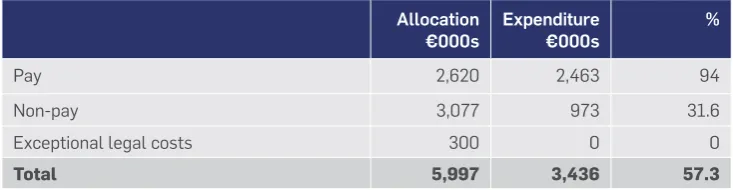
The cost of running the Office during 2012 was €3.43m, some 57% of its allocation for the year.
OvERvIEw
OF ThE ODCE
11
ChAPTER 1
OvERvIEw OF ThE ODCE
Statutory mandate
Office of the Director of Corporate Enforcement
The Company Law Enforcement Act 2001 (“CLEA”)2 provided for the creation of the position
of Director of Corporate Enforcement (“the Director”). The Director, who is appointed by the Minister for Jobs, Enterprise & Innovation (“the Minister”), is assisted in the furtherance of his statutory mandate by:
•
staff assigned by the Minister; and•
members of An Garda Síochána seconded for that purpose.Collectively, the foregoing make up the Office of the Director of Corporate Enforcement (“ODCE”/”the Office”).
Principal functions of the Director
The Director’s principal functions are set out in the CLEA3. They include to:
i. encourage compliance with the Companies Acts;
ii. investigate instances of suspected offences under the Companies Acts;
iii. enforce the Companies Acts, including by the prosecution of offences by way of summary proceedings4;
iv. refer cases, at his discretion, to the Director of Public Prosecutions (“DPP”) where the Director has reasonable grounds for believing that an indictable offence5 under the
Companies Acts has been committed; and
v. exercise, insofar as he feels it necessary or appropriate, a supervisory role over the activity of liquidators and receivers in the discharge of their functions under the Companies Acts.
Independence of the Director
The CLEA6 provides that the Director shall be independent in the performance of his functions.
high level goals
Based on the principal statutory functions as set out above, the ODCE’s high level goals during the year under review were to:
i. Promote a greater understanding of affected parties’ rights and duties under company law;
ii. Confront unlawful and irresponsible behaviour insofar as it relates to company law; and
iii. Provide a quality customer service to internal and external stakeholders.
The strategies and activities pursued and undertaken respectively during the year under review to achieve these goals are elaborated upon in the remainder of this Report as follows:
•
Chapter 2 – Promoting a greater understanding of affected parties’ rights and duties under company law•
Chapter 3 - Confronting unlawful and irresponsible behaviour insofar as it relates to company law•
Chapter 4 - Providing quality customer service to internal and external stakeholders2 Section 7 3 Section 12(1)
4 i.e. before the District Court
5 An indictable offence is an offence capable of being tried on indictment, i.e., before a jury in the Circuit
Court.
12
Resources, organisational structure, governance
arrangements & principal workstreams
Human resources
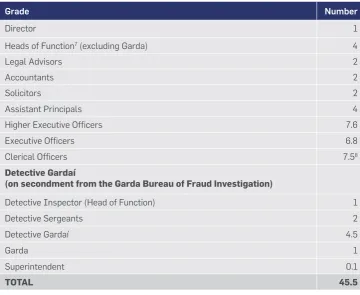
As at 1 January 2012, the Office had an approved staff complement of 52.1 whole time equivalents (“WTE”) and an actual complement of 49.8 WTE. At year end, the Office’s
[image:12.595.157.518.236.531.2]approved staff complement had been reduced by 2.1 as a result of the Incentivised Scheme of Early Retirement and the actual staff complement stood at 44.4 WTE. The composition of the Office’s staff complement as at 31 December, 2012 is set out in the Table below.
Table 1
Analysis of actual staff complement (WTEs) - as at 31 December, 2012
Grade Number
Director 1
Heads of Function7 (excluding Garda) 4
Legal Advisors 2
Accountants 2
Solicitors 2
Assistant Principals 4
Higher Executive Officers 7.6
Executive Officers 6.8
Clerical Officers 7.58
Detective Gardaí
(on secondment from the Garda Bureau of Fraud Investigation)
Detective Inspector (Head of Function) 1
Detective Sergeants 2
Detective Gardaí 4.5
Garda 1
Superintendent 0.1
TOTAL 45.5
13
Financial resources
[image:13.595.73.440.180.275.2]The Office is funded via the Department of Jobs, Enterprise & Innovation’s (“the Department”) Vote (Vote 34). The Table below sets out details of the Office’s 2012 allocation and expenditure respectively.
Table 2
Financial allocation and expenditure - 2012
Allocation €000s
Expenditure €000s
%
Pay 2,620 2,463 94
Non-pay 3,077 973 31.6
Exceptional legal costs 300 0 0
Total 5,997 3,436 57.3
The principal reasons as to why actual expenditure differed from the allocation were as follows:
•
savings on pay, resulting from staff reductions arising from the Incentivised Scheme of Early Retirement; and•
certain legal costs which had been anticipated might arise during the year did not do so. On determination of one case, costs were successfully avoided. In other cases, the issue of costs was deferred as the hearing of those cases remained pending before the Courts at year end.A more detailed analysis of expenditure during the year is set out at Appendix 1 to this Report.
Organisational structure
Following his appointment, the new Director effected certain amendments to the Office’s organisational structure, with those amendments centring largely on the area of Enforcement & Professional Services.
14
ADVOCACY &
ASSESSMENT INSOLVENCY ENFORCEMENT GARDA PRINCIPALSOLICITOR’S OFFICE
ANN KEATING
PRINCIPAL SOLICITOR RAY KAVANAGH
DETECTIVE INSPECTOR KEVIN O’ CONNELL
HEAD OF ENFORCEMENT & PROFESSIONAL SERVICES CONOR O’ MAHONY
HEAD OF INSOLVENCY & CORPORATE SERVICES KEVIN
PRENDERGAST
HEAD OF ADVOCACY & ASSESSMENT
ADVOCACY UNIT
ASSESSMENT UNIT
ADVOCACY
STAFF ASSESSMENT STAFF
INSOLVENCY
UNIT CORPORATE SERVICES
INSOLVENCY UNIT STAFF
CORPORATE SERVICES STAFF
PROFESSIONAL SERVICES ENFORCEMENT
UNIT
ACCOUNTING & LEGAL PROFESSIONALS ENFORCEMENT
STAFF
GARDA UNIT
SOLICITORS’ UNIT
15
Governance arrangements
In conjunction with the amendments effected to the Office’s organisational structure following the appointment of the new Director, certain amendments were made to the Office’s governance structures. As a consequence, a reconfigured Management Board - which comprises of the Director and each Head of Function - meets regularly and discusses issues of Office wide relevance. Issues of key importance from the Management Board’s perspective include organisational performance and risk management.
Principal workstreams
The nature of the Office’s principal workstreams is such that most of them require a multi-disciplinary approach involving ongoing interaction between Units and/or the active collaboration of Units with a view to achieving corporate objectives.
Accordingly, effective communication between Units, and that each Unit take an organisation-wide perspective when performing its functions, is a critical success factor. Accordingly, this is an approach that is both encouraged and facilitated by the Management Board.
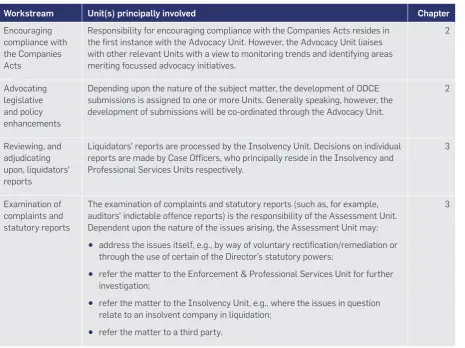
[image:15.595.76.542.348.696.2]The Office’s principal workstreams are set out in the Table below, together with details of where in this Report each workstream is principally dealt with.
Table 3
Principal workstreams
Workstream Unit(s) principally involved Chapter
Encouraging compliance with the Companies Acts
Responsibility for encouraging compliance with the Companies Acts resides in the first instance with the Advocacy Unit. However, the Advocacy Unit liaises with other relevant Units with a view to monitoring trends and identifying areas meriting focussed advocacy initiatives.
2
Advocating legislative and policy enhancements
Depending upon the nature of the subject matter, the development of ODCE submissions is assigned to one or more Units. Generally speaking, however, the development of submissions will be co-ordinated through the Advocacy Unit.
2
Reviewing, and adjudicating upon, liquidators’ reports
Liquidators’ reports are processed by the Insolvency Unit. Decisions on individual reports are made by Case Officers, who principally reside in the Insolvency and Professional Services Units respectively.
3
Examination of complaints and statutory reports
The examination of complaints and statutory reports (such as, for example, auditors’ indictable offence reports) is the responsibility of the Assessment Unit. Dependent upon the nature of the issues arising, the Assessment Unit may:
•
address the issues itself, e.g., by way of voluntary rectification/remediation or through the use of certain of the Director’s statutory powers;•
refer the matter to the Enforcement & Professional Services Unit for further investigation;•
refer the matter to the Insolvency Unit, e.g., where the issues in question relate to an insolvent company in liquidation;•
refer the matter to a third party.16
Workstream Unit(s) principally involved Chapter
Civil enforcement litigation
For the most part, civil enforcement litigation is managed by the Enforcement & Professional Services Unit in conjunction with the Principal Solicitor’s Unit.
Civil litigation, such as seeking the disqualification of directors of companies that have been struck off the Register whilst having undischarged debts, is managed jointly by the Insolvency and Principal Solicitor’s Units.
3
Criminal investigation and
prosecution
The investigation of possible criminal breaches of the Companies Acts is undertaken by the Enforcement & Professional Services Unit in conjunction with the Garda Unit.
Once a decision has been taken to initiate summary criminal proceedings, the prosecution becomes a collaboration between the Enforcement & Professional Services, Garda and Principal Solicitor’s Units.
In circumstances where, having reviewed an investigation file as submitted by the Office, a decision is taken by the DPP to initiate a prosecution on indictment, the provision of subsequent support to the Office of the DPP (for example, regarding disclosure to the defence), is primarily the responsibility of the Enforcement & Professional Services and Garda Units.
3
Supervision of liquidators’ behaviour
Actions taken to supervise liquidators’ behaviour (such as, for example, seeking the production of liquidators’ books and records) is a collaborative effort between the Insolvency and Enforcement & Professional Services Units. In circumstances where such activities result in the necessity to engage in litigation, the Principal Solicitor’s Unit becomes involved.
3
Provision of support services
The provision of support services is the primary responsibility of the Corporate Services Unit.
All Units have a responsibility to assist the Corporate Services Unit in ensuring that the ODCE’s obligations as a publicly funded Office (e.g. in the areas of procurement, tax clearance procedures etc.) are fully complied with.
4
Relationship management and development
Whilst certain Units will, by virtue of the nature of their principal operations, have a greater degree of interface with certain external stakeholders than others, the interlinked nature of the organisation is such that all Units have a role in ongoing relationship management and development.
PROMOTING
A GREATER
UNDERSTANDING OF
AFFECTED PARTIES’
RIGhTS AND DUTIES
UNDER COMPANY LAw
18
ChAPTER 2
PROMOTING A GREATER
UNDERSTANDING OF AFFECTED
PARTIES’ RIGhTS AND DUTIES UNDER
COMPANY LAw
Introduction
This Chapter provides details of the principal strategies pursued, and activities undertaken, by the Office during the year under review in the furtherance of the above stated goal. In summary, those strategies and activities included:
•
the development and promulgation of publications and other guidance material;•
engaging in a range of outreach activities, including the delivery of presentations,
attendance at seminars and exhibitions and dealing with general company law enquiries from members of the public;
•
advocating legislative and policy enhancements; and•
managing and developing relationships with external stakeholders.Publications and outreach activities
Publications
[image:18.595.155.526.513.707.2]The Office, from time to time, develops and publishes information and guidance for stakeholders’ benefit. The publication of such material is typically on foot of the enactment of a new piece of legislation or in response to issues identified though other aspects of the Office’s work (e.g., on aspects of company law that appear to be giving rise to significant levels of non-compliance). During the year, the Office issued 10 new publications (2011: 11). Details of those publications are set out in the Table below.
Table 4
Publications issued - 20129
Date Issued Publication
January 2012 Annual Review: 2011
January 2012 Transactions Involving Directors – A Quick Guide
April 2012 Company Law Handbook on Residential Property Owners’ Management Companies – Handbook (2nd Edition)
April 2012 Management Companies, A Property Owner’s Guide To Company Law April 2012 Section 56 Reports – Information Notice
May 2012 Auditor Reporting – What Happens Next? June 2012 ODCE Annual Report: 2011
August 2012 Companies (Amendment) Act 2012 – Information Notice September 2012 SI10 304 of 2012 – Information Notice
September 2012 SI 308 of 2012 – Information Notice
19 A second edition of the Company Law Handbook on Residential Property Owners’
Management Companies was issued in April 2012. This new edition reflected, in the main, the impact of the Multi-Unit Developments Act 2011, as well as various other legislative developments and amendments that had occurred since the first edition was published in 2008.
The Office issued a further publication in its range of Quick Guides in January 2012. The publication dealt with Transactions Involving Directors, a topic that continues to be amongst the most frequently reported issues by auditors. At year end, a number of further Quick Guides were in the process of being finalised. All such guidance is produced in conjunction with the National Adult Literacy Agency (“NALA”) and, as such, has obtained the Plain English stamp, which signifies a clear, concise and simple writing style allowing the reader to easily understand the message.
As is elaborated upon in Chapter 3 of this Report, auditors are an important source of statutory reports to the Office. That being the case, the Office engages with the profession on an ongoing basis. In that context, a number of documents designed to assist auditors in complying with their statutory reporting obligations have been published. In May 2012, the Office issued a document entitled “Auditor Reporting: What Happens Next?”, which outlines the Office’s internal process following receipt of a report. The Recognised Accountancy Bodies (“RAB”)11 assisted the Office in drafting this publication and in subsequently drawing it to
auditors’ attention.
In April 2012, the Office published details of those instances in which decisions had been taken to relieve liquidators, either permanently or temporarily, of their obligation to take restriction proceedings against the directors of named insolvent companies. Such decisions were taken following review of liquidators’ reports as required under section 56 of the CLEA. Further detail on the section 56 process is set out in Chapter 3 of this Report.
From time to time the Office publishes Information Notices on newly enacted legislation for stakeholders’ benefit. In that context, the Office published three such documents during the year, i.e. on the subjects of:
•
the Companies (Amendment) Act 2012, which amended the Regulations that allow certain parent companies to use US GAAP12 by extending the timeframe to 31 December, 2020;
•
SI 304 of 2012, which increased the Balance Sheet and turnover thresholds allowing private companies to avail of certain disclosure exemptions in their financial statements; and
•
SI 308 of 2012, which increased the Balance Sheet and turnover thresholds allowing private companies to avail of audit exemption.
In addition to the foregoing, the Office issued in excess of 20,000 copies of its various publications during 2012. In particular, the Office’s updated Information Books proved popular, as did the Office’s expanding range of Quick Guides. By agreement with the Office, the Companies Registration Office (“CRO”) issued approximately half of these documents to persons registering new companies13. The remainder were, in the main, issued in response
to public demand, either at events, exhibitions and presentations or as a result of persons contacting the Office directly.
11 There are six RABs, i.e. the:
• Association of Chartered Certified Accountants (ACCA); • Institute of Certified Public Accountants in Ireland (ICPAI); • Institute of Chartered Accountants in England & Wales (ICAEW); • Institute of Chartered Accountants in Ireland (ICAI);
• Institute of Chartered Accountants of Scotland (ICAS); and • Institute of Incorporated Public Accountants (IIPA).
12 Generally Accepted Accounting Principles
13 The CRO typically issues the ODCE Quick Guide on company directors as part of its pack as issued to
20
Seminars and exhibitions
A key element of the Office’s advocacy strategy is its outreach programme. This consists of, amongst other things, the delivery of presentations and speeches to stakeholder groups, as well as attendance at exhibitions and events where the audience is likely to include one or more elements of the Office’s target audience. The Office has identified certain constituencies as being amongst its target audience, including:
•
persons considering incorporation or having recently incorporated businesses;
•
professionals engaged in the provision of advice to companies and company directors, who are well placed to relay the compliance message to clients and so considerably expand the reach of the Office;
•
students currently enrolled in business programmes at undergraduate and postgraduate level, many of whom will ultimately become directors of companies or professional advisors themselves; and
•
the community and voluntary sectors, who by their nature tend to lack a knowledge of company law and, as a result, tend to benefit from guidance.
During the year, Office staff delivered 47 presentations (2011: 53) to a combined audience of almost 1,700 people. Of particular note was that, in the latter part of the year, the Office engaged with a number of City and County Councils for the purpose of outlining the company law and related issues that can arise in the context of the activities they undertake and services they provide respectively through the medium of companies. This engagement is expected to continue into 2013. During the year, the Office was also represented at 16 exhibitions and events (2011: 15). Details of the presentations delivered and exhibitions attended respectively during the year are set out at Appendix 2 to this Report.
Advocating legislative and policy enhancements
Given its mandate of promoting compliance, and enforcing non-compliance, with company law, the Office is well placed to offer an informed perspective on policy discussions and debates that take place at national and EU level regarding company law and associated topics. In that context, the Office made submissions in response to a number of policy proposals during the year. Further details are set out below.
The Companies Bill
During the year, the Department continued its work on the finalisation of the Bill (the primary purpose of which is to consolidate the current body of company law, which, at present, is contained in 16 Acts of the Oireachtas14 as well as numerous SIs and Regulations). The Bill
does, however, also include some proposed amendments and additions to company law as it currently stands.
The second part (or Pillar B) of the draft Bill was published on the Department’s website in May 2012, and, subsequently, Departmental staff engaged in a review of the entirety of the draft legislation in order to facilitate consideration of any issues raised by stakeholders with the draft as published, as well as to reflect any legislative changes in the interim.
The Office engaged, in particular, on suggested revisions to Part 2 of the Bill, which deals with the conversion of private companies to public limited companies, as well as on Part 22, which deals with external companies15. In addition to these specific matters, the Office
also communicated its observations to the Department on those aspects of the Bill dealing with the proposed registration of liquidators. The final draft of the Bill was published by the Department in December 201216.
14 Collective term for the Upper and Lower houses of Parliament
15 External companies are a new concept which will include what are currently defined in the Companies
Acts as branches as well as foreign companies establishing a place of business in the State.
21 EU Commission proposal for a new Accounting Directive
In January 2012, the EU Commission issued a paper proposing certain revisions to two EU Accounting Directives17. In its response, the ODCE issued a general caution in the context of
seeking to use legislative instruments such as Directives to deal with accountancy issues, as, by their nature, such tools are slow to develop and are relatively inflexible should there emerge a need to adapt or change them quickly.
That said, the Office was broadly supportive of proposals designed to alleviate the
administrative burden on small businesses, such as the extension of audit exemption to small groups of companies. However, due to their size and potential impact, the Office suggested it would be inappropriate to extend this exemption to medium sized groups of companies. The Office also made suggestions of a technical nature as to how any proposals would, of necessity, have to interact with current and proposed future accounting standards.
Draft Regulation on proposed requirements regarding statutory audit of Public Interest Entities (“PIEs”) & Draft Directive on statutory audits of annual and consolidated accounts
During the year, and having engaged in a major consultative exercise, the EU Commission issued a package (comprising of a draft Regulation and Directive respectively) of proposed reforms to statutory audit and the audit market within the EU. Whilst the Office supported many of the Commission’s proposed reforms, it did express reservations regarding certain of the proposals. Amongst the proposals supported by the Office were:
•
the introduction of a standard document retention requirement, which the Office suggested should be for a period of six years rather than the proposed five; and
•
the assignment of quality assurance in respect of auditors of PIEs to the relevant Competent Authority.
The Office expressed concerns as regards proposals relating to:
•
the separation of audit and non-audit activities, which may prove impossible to implement on an EU only basis and may act as a disincentive to new entrants; and
•
the proposal for a lesser audit for smaller and medium sized entities, which the Office felt may cause to dilute understanding of what an audit is, and cause confusion as to the work of the auditor.
European Commission Consultation on the future of EU company law
In its response to this broadly themed document, the Office stated its belief that, rather than engage in further work on EU defined corporate structures, the EU Commission should focus on setting out broad parameters to apply EU-wide while allowing sufficient flexibility at Member State level. In relation to a company transferring its registered office, the Office advocated that no such transfers should be allowed where a company has been placed in liquidation or is the subject of insolvency related proceedings.
Legal Services Regulation Bill
In noting the passage of this Bill through its Second Stage in Dáil Éireann18, the Office
expressed the opinion that the Bill, as drafted, would not adequately deal with the issue of the control of legal costs, which are a significant matter for the Office. In particular, the Office noted that proposals made by working groups in 2005 and 2006 respectively to the effect that:
•
costs should be primarily assessed by reference to work actually and appropriately done; and
•
responsibility for taxing costs should be assigned to an Office separate from that which is responsible for regulatory matters,
had not been reflected in the Bill.
22
Proposed extension of Freedom of Information Acts
As currently enacted, the combined effect of Freedom of Information (“FoI”) and company law legislation is such that only the administrative aspects of the Office’s operations are subject to FoI. Government policy is that all State Agencies and Offices should be fully subject to FoI and, in that context, at year end the Office was liaising with the Department and the Department of Public Expenditure & Reform respectively.
Other consultations
During the year, the Office also furnished observations on a number of other consultations, including the Law Reform Commission’s call for submissions regarding the content of its new work programme. The Office’s response to that invitation was, in essence, a recitation of the document previously submitted to the Department of Justice & Law Reform in response to its discussion document entitled “Organised and White Collar Crime”19.
Contribution to Department responses
In addition to issuing a number of responses in its own right, the Office also contributed material to the Department to assist it in formulating its responses on a range of matters, including the EU Draft Prospectus Directive and the Criminal Justice (Corruption) Bill.
Managing and developing relationships with external
stakeholders
In furtherance of its statutory objectives and associated goals, the Office seeks to develop and maintain strong and effective relationships with a range of key stakeholders. In addition to the general public, the Office’s key stakeholders include the Oireachtas, the Minister, the Department, other statutory/regulatory bodies and those providing professional services to companies and company directors and officers. The Office’s interactions during the year with certain of its key stakeholders are summarised below.
Members of the Oireachtas
The Office, from time to time, receives communications from members of the Oireachtas. Typically, these communications constitute expressions of concern as to whether the Companies Acts are being breached by particular parties or relate to cases under review. Whilst the Office is severely constrained in the extent to which it can respond to such communications by virtue of its statutory confidentiality obligations, it endeavours to provide whatever assistance it can to Deputies20 and Senators.
Department of Jobs, Enterprise & Innovation
Office staff continued to liaise with colleagues in the Department throughout the year on matters of mutual interest. The Office has been afforded representation at Departmental management meetings and, outside of those formal structures, there are regular contacts as the need arises.
CRO
As the public repository of information on companies and company officers, the CRO plays a critically important role in supporting the Office in its work. In addition to meeting regularly on matters of mutual interest, CRO staff regularly supply evidence in ODCE proceedings and, where identified, of prima facie breaches of the Companies Acts.
Garda Bureau of Fraud Investigation (“GBFI”)
As referred to in Chapter 1 of this Report, the Office’s staff complement includes a number of Gardaí. These Gardaí are on secondment from the GBFI. The Office’s close relationship with
23 An Garda Síochána, and GBFI in particular, is critical to its criminal enforcement work. In that
context, the Office meets with GBFI management on a regular basis on matters of mutual interest.
Irish Auditing and Accounting Supervisory Authority (“IAASA”)
In accordance with the provisions of the Companies (Auditing and Accounting) Act 2003 (“2003 Act”), the Director is a member of IAASA and has the right to nominate a member to its Board of Directors. The former Director was, until the time of the announcement of his proposed retirement, a member of the Board. At that time, the former Director elected to step down from the Board and to nominate Mr. Conor O’Mahony, the Office’s Head of Insolvency & Corporate Services, to the Board.
Whilst the current Director had, upon his appointment, intended to join the Board, the composition of the Board at that time was such that, by virtue of the provisions of the 2003 Act (which limit the number of accountants that may sit on the Board at any given time), he was precluded from doing so. Under the circumstances, and at the Director’s request, Mr. O’Mahony indicated his willingness to continue to serve on the Board.
During the year, the IAASA Board met on 9 occasions. The ODCE nominee attended 8 of those meetings. IAASA’s 2012 Annual Report will be available on its website21 once it has been laid
before the Oireachtas by the Minister.
In addition to this statutory relationship as outlined above, the Office engaged regularly with IAASA during the year on matters of mutual interest.
Company Law Review Group (“CLRG”)
The CLRG is a statutorily established advisory body to the Minister on matters relating to company law. The Director is a member of the CLRG and the Office is represented at both plenary meetings and at meetings of Committees whose work is pertinent to its remit. During the year, the CLRG completed its 2010-2012 work programme and commenced work on a new programme22. The Office contributed to, amongst others, the following issues as considered
by the CLRG:
The loss of fiduciary taxes arising from the abuse of limited liability
Having considered the matter, the CLRG recommended increasing the current minimum capital requirements applying to companies having directors that have been the subject of restriction orders but considered that the practical implications of an amendment to company law requiring directors to have their tax affairs in order would outweigh the benefits and would give rise to an unnecessary administrative burden.
The adoption of the UNCITRAL23 model on cross border insolvency
The CLRG engaged in a consultation process with interested parties, which gave rise to some technical concerns being raised which were judged to require further examination. Accordingly, the Group asked the Minister to extend consideration of this issue into the CLRG’s next work programme.
The representation of a company before the courts
Having become aware of a case in which this issue had been referred to the Supreme Court, the Group recommended that consideration of this issue be included in its next work programme by the Minister.
Certain offences under the Companies Acts
The CLRG developed criteria for the assessment (and classification by reference to the four grades of penalties as proposed in the Companies Bill) of new offences created under future company law24.
21 www.iaasa.ie
22 A copy of the CLRG’s 2011 Annual Report is available at www.clrg.org 23 United Nations Commission on International Trade Law
24
Suitability of examinership for small companies
The CLRG also commenced work on its 2012-14 work programme during the year and, in that context, the Office contributed to the work of a Committee charged with examining the possibility of introducing less costly and administratively onerous examinership arrangements for small companies. Specifically, the Committee considered the suitability of examinership for use by small companies and recommended that small companies should be permitted to apply directly to the Circuit Court rather than the High Court for examinership. The Committee also outlined a simplified, non-judicial, administrative procedure which could be considered for adoption, subject to further analysis and
deliberation on the policy issues involved and the identification of an appropriate Agency to administer the procedure. It also noted that the recently established Insolvency Service might be a suitable Agency in this regard.
Central Bank
The ODCE and the Central Bank have in place a long standing Memorandum of Understanding which, based on their grounding legislation, allows each body to refer information to the other where they are satisfied that such information is relevant to their counterpart’s remit. This has proven particularly useful in the context of the Office’s ongoing investigation into certain events at the former Anglo Irish Bank Corporation. In addition, formal communications in respect of five separate entities took place during 2012.
During 2012 the Central Bank hosted two meetings of a Regulators’ Forum, where a range of senior officials from various regulatory bodies met to discuss issues of mutual interest. Office staff attended both meetings and it is anticipated that the forum will continue to meet in the future.
Office of the Revenue Commissioners
The Revenue Commissioners are an important partner of the Office in the furtherance of its work, in particular in respect of insolvency related matters. In that context, the two bodies met on a number of occasions during the year. Moreover, the two bodies shared information in respect of 10 separate matters (2011:30). However, the effectiveness of these information sharing arrangements continues to be impacted adversely to a significant extent by a provision included in the Finance Act 2011, which limits the ability of the Office to obtain (and where obtained, use) certain information from the Revenue Commissioners. Whist the Office has, through interactions with the relevant parties, made efforts have this issue remedied, the problem, which per the Office’s understanding requires a legislative solution, continued to prevail at year end.
Accountancy profession
The accountancy profession plays an important role in assisting the work of the Office, through both the mandatory reporting obligation for auditors to report suspected indictable offences under the Companies Acts and the wider support for the Office’s compliance message which its members can deliver to their clients. As such, the Office seeks to work closely with the accountancy bodies to support them in ensuring that their members are fully informed of their statutory reporting obligations and to apprise them of the assistance that the Office can provide to company directors and officers.
Office representatives held two formal meetings with senior members of the accountancy bodies’ management during the year. In addition to these meetings, the Office also worked with the profession through a Technical Liaison Group, where matters of a more technical nature are discussed. In May 2012, this Group concluded work on a publication designed to assist auditors in understanding the Office’s processes upon receipt of an indictable offence report25.
25 Irish Stock Exchange
The Office held one formal meeting with senior staff of the Irish Stock Exchange during 2012. Amongst the matters discussed was the formal transfer of certain regulatory duties from the Stock Exchange to the Central Bank.
Financial Reporting Council – Irish Consultative Committee
This Committee, formerly known as the Auditing Practices Board – Irish Consultative Committee, is an advisory group which responds, and provides input, to proposals from the Financial Reporting Council on auditing matters from an Irish perspective. The Group convened once during 2012 to discuss proposals aimed at improving the content of auditors’ reports on financial statements.
International Association of Insolvency Regulators (“IAIR”)
The IAIR is an international body that brings together the collective experiences and expertise of national insolvency regulators from 26 jurisdictions around the world. The IAIR, of which the Office has been a member since 2003, is a valuable forum for the promotion of liaison and co-operation between its members and for sharing information on areas of common interest and best practice.
Other interested parties
In addition to the stakeholder groups referred to above, the Office also met with and/or worked with a range of other stakeholder groups and interested parties during 2012, including the Irish Small & Medium Enterprises Association, the Small Firms’ Association and the Institute of Directors.
Media
The Office typically deals with hundreds of media queries annually. Whilst the Office is mindful of the important role the media can play in informing the debate on company law, compliance and governance issues generally, and strives where possible to assist the media in dealing with general queries, it must equally take great care in how it does so. The Office is precluded under governing legislation from making any public comment on the conduct of investigations, except in respect of information which has already made its way into the public domain. In addition, the Office is mindful of the rights of individuals and other persons coming before the Courts, and, as such, it does not issue progress reports or any other information on its enforcement activity if it could potentially prejudice any future legal actions.
CONFRONTING
UNLAwFUL AND
IRRESPONSIBLE
BEhAvIOUR INSOFAR
AS IT RELATES TO
COMPANY LAw
27
ChAPTER 3
CONFRONTING UNLAwFUL AND
IRRESPONSIBLE BEhAvIOUR INSOFAR
AS IT RELATES TO COMPANY LAw
Structure of this Chapter
This Chapter is structured in a manner whereby, in the following three Parts, the Office’s inputs, throughputs and outputs respectively are detailed.
PART A: INPUTS
EXTERNAL INPUTS
The Office’s activities in confronting unlawful and irresponsible behaviour are driven to a substantial extent, both directly and indirectly, by inputs received from external sources. This is necessarily so, given that:
•
a number of parties, including liquidators, auditors and certain professional bodies, have statutory reporting obligations to the Office;•
the Office forms part of a broader statutory framework that provides for the referral of, otherwise confidential, information between regulatory and enforcement bodies where such information is considered to be relevant to those other entities’ functions; and•
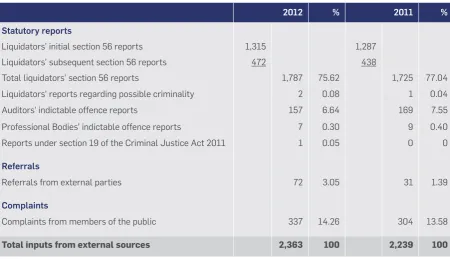
the Office receives a substantial number of complaints from members of the public annually. [image:27.595.78.529.506.765.2]In that context, the principal inputs received from external sources during the year were as follows:
Table 5
Inputs from external sources
2012 % 2011 %
Statutory reports
Liquidators’ initial section 56 reports 1,315 1,287
Liquidators’ subsequent section 56 reports 472 438
Total liquidators’ section 56 reports 1,787 75.62 1,725 77.04
Liquidators’ reports regarding possible criminality 2 0.08 1 0.04
Auditors’ indictable offence reports 157 6.64 169 7.55
Professional Bodies’ indictable offence reports 7 0.30 9 0.40
Reports under section 19 of the Criminal Justice Act 2011 1 0.05 0 0
Referrals
Referrals from external parties 72 3.05 31 1.39
Complaints
Complaints from members of the public 337 14.26 304 13.58
28
The principal external sources of inputs driving the Office’s activities over the year under review are elaborated upon below.
Liquidators’ section 56 reports
Introduction – overview of the liquidator reporting regime
As can be seen from Table 5 above, liquidators’ section 56 reports accounted for in excess of 75% of all external inputs received by the Office during 2012. In summary, liquidators of companies that are in insolvent26 liquidation are required by law27 to report to the Office on
the company’s demise and on the conduct of any person who was a director of the company during the twelve months preceding the entry of the company into liquidation. The liquidator must also proceed to apply to the High Court for the restriction28 of each of the directors,
unless relieved of that obligation by the Office.29
The essential aims of this statutory reporting regime are to:
•
afford the public a degree of protection by ensuring that persons who have been determined as not having acted honestly and/or responsibly in the run up to a company’s entering insolvent liquidation may, in respect of the mandatory five-year period of restriction, only act as directors of other companies that meet minimum capitalisation requirements; and•
ensure that persons who, in the run up to a company’s entering insolvent liquidation, have been judged to have acted honestly and responsibly can continue to engage in entrepreneurial activity through the medium of limited liability companies without sanction or penalty.In discharging its role, the Office expects liquidators to provide it with all of the information which is relevant to the making of an appropriate decision. It also encourages liquidators to make a suitable recommendation on relief by reference to the results of their investigations.
The Office considers granting relief where a liquidator advances an evidence-based justification in support of a claim that a director has acted honestly and responsibly in conducting the company’s affairs. In making its decisions, the Office is anxious to ensure that no director needlessly bears the burden of a High Court hearing where he or she has clearly demonstrated honest and responsible behaviour in the conduct of the affairs of the failed enterprise. In practice, the Office acts as a filter to remove the need for consideration by the High Court of those cases which do not appear to warrant its attention.
It is important to note, however, that ODCE decisions of ‘no relief’ or ‘partial relief’ do not constitute a finding of dishonesty or irresponsibility in respect of the directors concerned, and it would be inappropriate for any such inference or imputation to be drawn. It is solely a matter for the High Court (having heard the submissions of the liquidator and directors respectively) to determine if a restriction declaration should be made in respect of any particular company director.
26 A company is insolvent when it is unable to pay its debts as they fall due 27 Section 56 of the CLEA
28 where an individual is restricted under section 150 of the Companies Act 1990, s/he may only act as
the director or secretary of a company for a period of five years thereafter provided that the company concerned meets certain minimum capitalisation requirements. In the case of a private company, a minimum called up share capital of €63,487 is required. In the case of a public limited company, the corresponding figure is €317,435.
29 The process and scope of liquidator reporting are outlined in three main ODCE publications, Decision
29
Companies entering liquidation
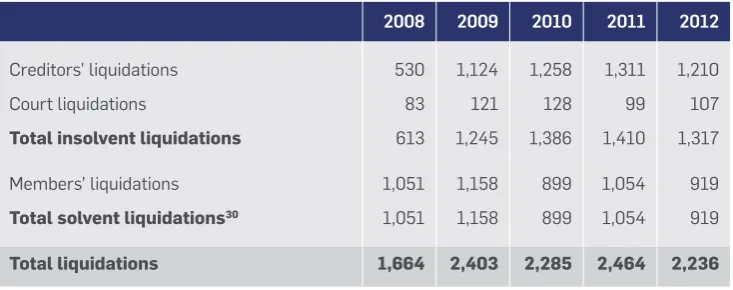
As a result of the severe economic downturn, company failures continued at a high level during 2012. As can be seen from the Table below:
•
during the year, insolvent liquidations (i.e. creditors’ and Court liquidations combined) accounted for 59% of all liquidations;•
2012 was the fourth consecutive year in which the number of insolvent liquidations exceeded 1,200; and [image:29.595.75.442.245.390.2]•
solvent (i.e., members’) liquidations fell by 13% during 2012, from 1,054 to 919.Table 6
Companies entering liquidation: 2008 - 2012
2008 2009 2010 2011 2012
Creditors’ liquidations 530 1,124 1,258 1,311 1,210
Court liquidations 83 121 128 99 107
Total insolvent liquidations 613 1,245 1,386 1,410 1,317
Members’ liquidations 1,051 1,158 899 1,054 919
Total solvent liquidations30 1,051 1,158 899 1,054 919
Total liquidations 1,664 2,403 2,285 2,464 2,236 Liquidator reports received – 2012
As can be seen from Table 5 above, total of 1,787 liquidators’ reports were received during the year (2011: 1,725), of which:
•
1,315 were initial reports (2011: 1,287); and•
472 were subsequent31 reports (2011: 438).This continuing high level of new liquidations reflects the economic conditions that prevailed during the course of the year under review. Of particular note in that context was the fact that a number of the reports received related to large scale entities, the commercial affairs of which are particularly complex.
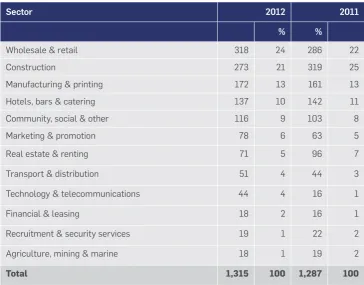
The Table below provides details of the sectoral distribution of companies in respect of which liquidators’ initial reports were received during the year.
30 whilst the Office has no role in solvent (i.e. members’) liquidations, data in respect of same has been
included in the interest of completeness.
31 An initial report is the first report received from a liquidator and is required to be submitted within 6
30
Table 7
Sectoral analysis of liquidators’ initial section 56 reports received - 2012
Sector 2012 2011
% %
Wholesale & retail 318 24 286 22
Construction 273 21 319 25
Manufacturing & printing 172 13 161 13
Hotels, bars & catering 137 10 142 11
Community, social & other 116 9 103 8
Marketing & promotion 78 6 63 5
Real estate & renting 71 5 96 7
Transport & distribution 51 4 44 3
Technology & telecommunications 44 4 16 1
Financial & leasing 18 2 16 1
Recruitment & security services 19 1 22 2
Agriculture, mining & marine 18 1 19 2
Total 1,315 100 1,287 100
Timeliness of liquidators’ reporting
Over the course of the year, the Office issued 198 (2011: 339) notices to 79 separate liquidators advising them that they were in default of their statutory reporting obligations. Many of these defaults were promptly rectified as a result of this action and, as a result, 94% of the first reports due during the year had been received by the end of the year (2011: 95%). However, a small number of liquidators have repeatedly failed to comply with their reporting obligations. Such cases are a particular area of focus for the Office and appropriate enforcement action up to, and including, criminal prosecution may result from such persistent breaches of statutory obligations. In that context, it should be noted that liquidators’
behaviour generally has been identified as an area deserving of greater focus in 2013 and beyond.
Standard of liquidators’ reporting
The standard of liquidators’ reports received during the year was considered to be broadly satisfactory. However, the quality of reporting in certain instances was not of the required standard. Indications would suggest that contributory factors in that regard include:
•
the volume of insolvency assignments being taken on by some firms; and•
as a result of new entrants entering the market, a relative lack of experience of insolvency on the part of certain liquidators. In that context, Table 8 below provides an analysis of the profile of liquidators undertaking insolvency engagements over the period 2008 to 2012.31
Table 8
Profile of liquidators undertaking insolvent liquidations by number of engagements 2008 – 2012
Number of Liquidators Number of Engagements
<3 3-6 7-12 >12 Total
2008 59 11 14 6 90
2009 122 25 18 16 181
2010 169 48 33 26 276
2011 182 57 30 27 296
2012 187 63 37 22 309
Sectoral distribution of other external inputs (i.e. external
inputs other than liquidators’ section 56 reports)
[image:31.595.75.440.381.717.2]As can be seen from Table 5, in aggregate those external inputs other than liquidators’ section 56 reports accounted for just under 25% of total external inputs received during the year. The Table below provides an analysis of the sectoral distribution of those other external inputs.
Table 9
Sectoral distribution of external inputs other than liquidators’ section 56 reports
Sector 2012 2011
% %
Real estate & renting 92 16 85 16
Construction 54 9 49 9
Wholesale & retail 46 8 63 12
Manufacturing 34 6 29 6
Hotels, bars & catering 18 3 20 4
Community, social & personal 26 5 29 6
Finance & leasing 33 6 32 6
Transport & distribution 11 2 10 2
Agriculture, mining & marine 17 3 8 2
Health & social work 16 3 35 7
Technology & telecommunications 22 4 13 3
Marketing & promotion 54 9 35 7
Recruitment & security services 1 0 4 1
Other business sectors 60 10 33 6
Business sector not known 0 0 37 7
Not a company 92 16 32 6
32
Complaints
[image:32.595.157.515.197.423.2]The Office receives substantial numbers of complaints annually from members of the public. During the year a total of 337 complaints were received (2011: 304), which accounted for 14% of all external inputs received. The Table below provides an analysis of the subject matter of complaints received.
Table 10
Complaints received (analysed by character of primary default)
2012 % 2011 %
Allegations of reckless/fraudulent/insolvent trading 77 23 81 27
Annual/Extraordinary General Meeting related 50 15 44 14
Relating to the issue of unpaid debts 37 11 52 17
General shareholder rights issues 33 10 22 7
Relating to companies trading whilst struck off the Register
32 9 9 3
Directors’ conduct 24 7 41 14
Audit/auditor related 17 5 7 2
Allegations of forgery/furnishing of false information 12 4 7 2
Other 55 16 41 14
Total 337 100 304 100
Auditors’ indictable offence reports
Introduction – overview of the auditor reporting regimeWhere, in the course of and by virtue of, their carrying out of an audit, information comes into the possession of a company’s auditors which leads them to form the opinion that there are reasonable grounds for believing that an indictable offence under the Companies Acts32
has been committed by the company, or an officer or agent of the company, the auditors are required to report that opinion to the Office33. The Office has developed and published
guidance to assist auditors in complying with their obligations in this regard34.
Nature of suspected offences reported
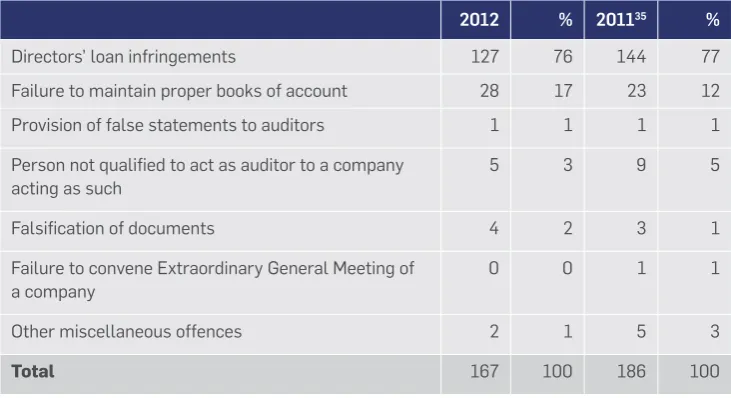
During the year, a total of 157 indictable offence reports were received (2011: 169). The Table below provides an analysis of the nature of suspected offences contained in those reports. It should be noted that the number of reports received does not accord with the number of suspected offences reported as, in a number of instances, reports included more than 1 suspected offence.
32 Other than offences under sections 125(2) and 127(12) of the 1963 Act, as amended
33 Section 194(5) of the Companies Act 1990, as inserted by section 74 of the CLEA and subsequently
amended by section 37 of the 2003 Act and section 73 of the Investment Funds, Companies and Miscellaneous Provisions Act 2005
34 Decision Notice D/2006/2 – Revised Guidance on the Duty of Auditors to Report Suspected Indictable
33
Table 11
Analysis of suspected indictable offences reported by auditors
2012 % 201135 %
Directors’ loan infringements 127 76 144 77
Failure to maintain proper books of account 28 17 23 12
Provision of false statements to auditors 1 1 1 1
Person not qualified to act as auditor to a company acting as such
5 3 9 5
Falsification of documents 4 2 3 1
Failure to convene Extraordinary General Meeting of a company
0 0 1 1
Other miscellaneous offences 2 1 5 3
Total 167 100 186 100
Referrals
As alluded to earlier in this Chapter, the Office forms part of a broader statutory framework that permits the exchange of confidential information between regulatory and enforcement bodies, subject to safeguards and appropriate limitations. In that context, the Office receives referrals from other statutory bodies from time to time. During the year under review, the Office received 72 (2011: 31) such referrals from a variety of sources including:
•
the Registrar of Companies;•
the Revenue Commissioners;•
An Garda Síochána;•
IAASA; and•
the Central BankProfessional bodies’ indictable offence reports
RABsWhere a RAB’s36 Disciplinary Committee or Tribunal has reasonable grounds for believing that
an indictable offence under the Companies Acts may have been committed by a person while that person was a member of the RAB, the RAB is required to report the matter to the Office37.
During the year, a total of 7 reports (2011: 9) were received from RABs. The Table below provides an analysis of the nature of suspected offences contained in those reports.
35 The data as presented in respect of 2011 includes some reclassification from the data as presented in
the 2011 Annual Report for the purpose of facilitating a more granular analysis.
36 A RAB is an accountancy body that is permitted to authorise its members and member firms, subject to
those members having satisfied certain criteria, to act as statutory auditors and audit firms respectively. There are six RABs, i.e., the:
• Association of Chartered Certified Accountants (ACCA) • Institute of Certified Public Accountants (ICPAI)
• Institute of Chartered Accountants in England & Wales (ICAEW) • Institute of Chartered Accountants in Ireland (ICAI)
• Institute of Chartered Accountants of Scotland (ICAS) • Institute of Incorporated Public Accountants (IIPA)
34
Table 12
Analysis of professional bodies’ indictable offence reports – 2012
Suspected offence Statutory Provision Reports
Acting as an auditor whilst not qualified to do so
Section 187, Companies Act 1990
1
Furnishing false information Section 242, Companies Act 1990
2
Acting as an auditor whilst not qualified to do so
Section 187 and 242, Companies Act 1990
1
Failure on the part of a liquidator to convene a General Meeting of a company and its creditors where the liquidation continues for more than 12 months and subsequently furnishing financial statements to the Registrar.
Section 272 Companies Act 1990
3
Total 7
Prescribed Professional Bodies (“PPB”)
Similarly, where the Disciplinary Committee or Tribunal of a PPB finds that a member conducting a liquidation or receivership has not maintained appropriate records, or has reasonable grounds for believing that the member has committed an indictable offence under the Companies Acts during the course of a liquidation or receivership, the PPB concerned is required to report the matter to the Office38.
Pursuant to the Company Law Enforcement Act 2001 (Section 58) Regulations 200239, the
following have been designated as PPBs:
•
Association of Chartered Certified Accountants (ACCA);•
Chartered Institute of Management Accountants (CIMA);•
Institute of Certified Public Accountants in Ireland (ICPAI);•
Institute of Chartered Accountants in Ireland (ICAI);•
Institute of Incorporated Public Accountants (IIPA);•
Irish Tax Institute; and•
Law Society of Ireland.Other than those reports received from RABs as referred to above, no reports were received from PPBs during the year.