© 2019, IRJET | Impact Factor value: 7.211 | ISO 9001:2008 Certified Journal | Page 4392
Production of Powder Compact with the help of Universal
Testing Machine
Prof. R. Daramwar
1, Yash Patil
2, Paresh Patel
3, Omkar Walke
4, Krushna Thorat
51Prof. R. Daramwar (Department of Mechanical Engineering, Dr. D. Y. Patil Institute of Technology, Pune, Maharashtra, India) 2,3,4,5(Department of Mechanical Engineering, Dr. D. Y. Patil Institute of Technology, Pune, Maharashtra, India)
---***---Abstract -Powder Metallurgy is used to prepare pallet
of different metal powder by applying high pressure and sintering process. The objective of the present work is to prepare pallet of copper metal powder with the application of high pressure. Design and development of die and punch is first important step in Powder Metallurgy process. Die and punch design design has number of steps and considerations such as material selection, calculation, heat treatment to die and punch involved before actual manufacturing of both. In this study, material selection, calculation and 3D CAD model for die is given. The Copper powder is compacted at different compaction pressure. The working pressure in this study are 500Mpa, 600Mpa, 700Mpa and 740Mpa. This compaction process is carried out with the help of Universal Testing Machine. Green compact obtained then sintered at 7000C for 1.5 hour in furnace. Compaction
pressure has great influence on the number of pores and their size. When we increase the compaction pressure, porosity decreases because the surface contact area between particles increases.
Key Words: Die Development, Plunger Development,
Design, Calculation, Fabrication, Powder Compaction, Sintering, Green Density, Compaction Pressure.
1. INTRODUCTION
The process that we use to prepare precise metal components from metal powder of different grain size is nothing but powder metallurgy. Powder compaction is the process of forming metal powder compacts of desired shape. The aim of compacting is to consolidate the powder into desired shape close to final dimensions. It also decides the porosity level. Next step that we include in powder metallurgy is sintering in which heat is provided for particular time to the sample obtained from the process of compaction. Temperature in the sintering process is below melting point of metal. Sintering helps in increasing the properties like strength, thermal conductivity, Electrical conductivity and also helps to reduce the porosity. Compaction of metal powder can be done
from both sides as well as from one side. There are of four important steps viz. preparation of metal powder, blending (mixing), compaction of metal powder and sintering. Number of dies has to be fabricate for fabrication of different metal parts. Hence, outcome of die will be of desired shape or nearly desired shape. This will help us to avoid the need of further machining processes. Powder metallurgy has applications in various fields such as aerospace, self-lubricated bearings, actuators, automobile parts, cemented carbides, porous components, electronic industries, etc.
© 2019, IRJET | Impact Factor value: 7.211 | ISO 9001:2008 Certified Journal | Page 4393
2. MATERIAL SELECTION
Development of die and plunger is basic step in powder metallurgy as die and punch plays the key role in compaction process .High carbon, high-chromium, cold-work tool steels (D group) were mainly intended for die work, even though other general applications may be found. AISI D2 is an air-hardening die steel, high in hardness, abrasion resistance, and resistance to deformation. Its machinability is quite good and may still be improved by a slightly greater amount of sulfur within the material makeup. Well-dispersed particles of sulfide considerably improve the material’s machinability and surface finish. Heat treating to a lower hardness positively affects the material’s toughness. D2 steel is frequently used for making all types of dies, be it cutting dies, forging dies, or other die-related tooling. The important properties of AISI D3 oil-hardened steel are that it offers excellent resistance to wear and abrasion. It is immune to deformation and displays a superior compressive strength under a gradually increasing load. Its deep-hardening properties make it an excellent choice where frequent regrinding of tools is necessary. Otherwise it is utilized for blanking and other cutting punches and dies intended for long production runs, and it is recommended wherever a high resistance to wear is required.
Table -1: Composition of D2 tool Steel
[image:2.595.323.540.253.515.2]Table -2: Mechanical Properties of D2 tool Steel
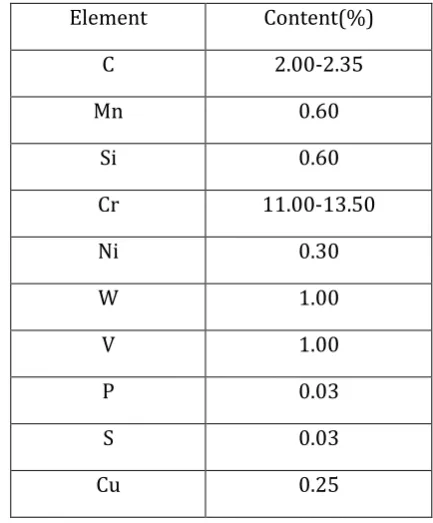
Table -3: Composition of D3 tool Steel
Element Content(%)
C 2.00-2.35
Mn 0.60
Si 0.60
Cr 11.00-13.50
Ni 0.30
W 1.00
V 1.00
P 0.03
S 0.03
Cu 0.25
Table -4: Mechanical Properties of D3 tool Steel
Properties Metric Imperical Density 7.7×10³ kg/m3 0.278 lb/in3
Melting Point 14210C 25900F
3. HEAT TREAMENT
Heat treatment causes the material to change or alter its properties such as mechanical and chemical properties. Heat treatment demands extreme temperature conditions. The main objective of heat treatment is to harden or soften the material as per demand. Heat treatment processconsists of annealing, hardening followed by precipitation strengthening, tempering and quenching. The die was hardened at 900°C and soaked for 20 min and then oil quenched. Element Percentage %
C 1.4-1.6
Mn 0.6
Si 0.6
Co 1.0
Cr 11-13
Mo 0.7-1.2
Fe Balance
Young’s Modulus 210GPa
Density of Material 7.7*1000 kg/cm3
Poisson’s Ratio 0.277
© 2019, IRJET | Impact Factor value: 7.211 | ISO 9001:2008 Certified Journal | Page 4394 The tempering was done for an average time of 45 min
per inch of die thickness at 200°C.
4. EXPERIMENTAL PROCEDURE
In present study, electrolytic Cu with 40 micron average particle size and 99.9% purity is selected as working material. The Cu powder is preheated in a hot air oven at 1500C for one hour. It will remove the
moisture content present in the powder. After cooling to room temperature, the powder is placed in dedicated double acting compaction die. The die have 25 mm inner diameter. Graphite powder and Zinc stearate can be used as die lubricant which facilitates the removal of punch and green compact. Zinc Stearate has better lubricant properties than graphite powder. The compaction is carried in a Universal Tensile Machine with different compaction pressure of 500, 600, 700 and 730 MPa. The compaction is carryout under gradually applied load with 3 minute relaxation time. After confined compaction the Cu powder is bonded with mechanical bonds and forms a Green Compact. The compact after pressing is called a green compact. Five samples are compacted at each compaction pressure. The Green compact forms after pressing possess poor mechanical strength. Sintering is performed to improves the strength of Green Compact. Sintering is carried out at elevated temperatures of 7500C for 1.5 h using a conventional Muffle furnace.
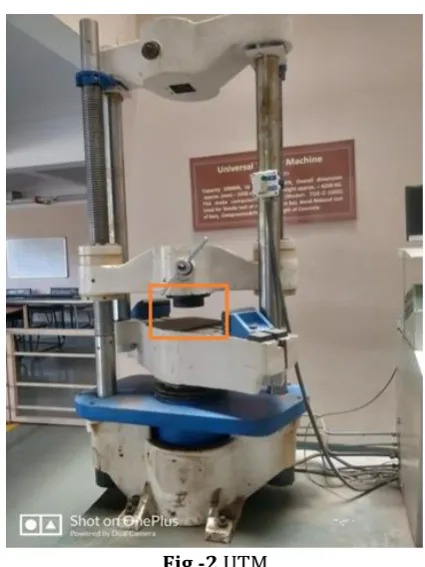
Due to sintering the weak mechanical bonds of green compact are converted into strong metallic bonds. Compaction process of copper powder in die cavity is shown in fig. 1. The whole compaction process carried out with the help of Universal Testing Machine. The space for die set on UTM is shown with the help of orange block in fig. 2.
[image:3.595.326.539.92.376.2]Fig -1 Compaction Process
Fig -2 UTM
5. CALCULATIONS
Dimensions of Die:
Die: 130 mm of Outer diameter, 25 mm of Inner diameter.
Plunger: 25mm of diameter, height of 100 mm.
Die has cylindrical shape. Hence, design of die will be based on stresses induced in it.
There are two types of cylinders
1) Thin cylinder 2) Thick cylinder
If ratio of inner diameter of the cylinder to its wall thickness is greater than 20(i.e. >20) then it is thin cylinder.
If ratio of inner diameter of the cylinder to its wall thickness is less than 20(i.e. 20) then it is thick cylinder.
Present data-
di = 25mm
© 2019, IRJET | Impact Factor value: 7.211 | ISO 9001:2008 Certified Journal | Page 4395 = 0.47
Hence, we consider die as a thick cylinder.
Types of stresses induced in the thick cylinder due to internal pressure:
Sr.
No. Principle Stress Inner Stress Outer Surface
1. Circumferential Stress (σt)
Pi×
2. Radial Stress(σr) -Pi 0
3. Longitudinal Stress(σl)
[image:4.595.103.222.414.554.2]From the above table, it is clear that, the principle stresse are significant at the inner surface as compared to the outer surface of the cylinder. Hence, the design of thick cylinders subjected to internal pressure only is based on the principle stresses at the inner surface.
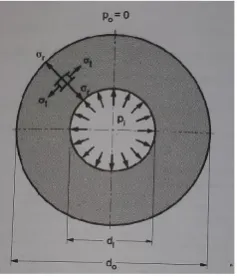
[image:4.595.100.222.591.722.2]Fig -3 Cylinder Subjected to Internal Pressure
Fig -4 Distribution of circumferential and radial
stress
From the above table, consider stresses only at inner surface. It can be seen that, circumferential stresses(σt)
has maximum value. Hence design of cylindrical die will be based on circumferential stress.
σt =Pi×
Working Load= 350kN
Stress Developed in plunger due to applied load of 350kN:-
Area = = = 490.62mm2
Stress (σ1) = = = 713MPa
(i.e., 350kN is the safe load for plunger)
Stress developed due to load applied on plunger in die:-
σ2 = σ1×
= 713× = 767.76Mpa
(i.e. die is also in safe condition)
Ultimate yield strength & ultimate tensile strength of D2 tool steel are 2200MPa & 2000MPa respectively & ultimate yield strength & ultimate tensile strength of D3 tool steel are 1034MPa & 1158MPa respectively. So, the die tends to withstand the given load with ease i.e. 350KN.
6. CONCLUSIONS
Die was designed and fabricated according to the working load. Literature review helps in the selection of material and parameters for processing of the selected material. For die, D-3 tool steel was the material selected for manufacturing. For punch, D-2 tool steel was selected material for manufacturing.
For efficient working of die and punch, lubrication is needed in order to reduce the friction between walls of die and punch. Zinc Stearate or graphite powder has better lubricating properties than others.
© 2019, IRJET | Impact Factor value: 7.211 | ISO 9001:2008 Certified Journal | Page 4396 Heat treatment to die and punch can be done in
order to improve mechanical properties like tensile and yield strength. Hence, heat treatments like annealing, tempering and quenching is done on die as well as punch. For compaction of Copper Powder it doesn’t
require binder. Copper itself act as a binder.
REFERENCES
[1] Kamal Kumar Jangra, Tilak Raj, Neeraj Sharma `Fabrication and Development of Die for Powder Compaction Press’IOSR Journal of Mechanical and Civil Engineering (IOSR-JMCE) e-ISSN: 2278-1684, p-ISSN: 2320-334X. PP 20-23
[2] Manish Dixit1 and Prof. R. K. Srivastava,` Effect of compaction pressure on microstructure, density and hardness of Copper prepared by Powder Metallurgy route’IOP Conf. Series: Materials Science and Engineering 377 (2018) 012209 doi:10.1088/1757-899X/377/1/012209
[3] C. Parswajinana, B. Vijaya Ramnathb, M. Vetrivelc, A. Riyaz Ahmedd, A.S.A. Syed Mohamed Buharie, C. Muthukumaaranf, I. Anish Hilaryg `Design and fabrication of Impact Die for Powder Metallurgy’, Selection and Peer-review under responsibility of International Conference on Processing of Materials, Minerals and Energy (July 29th – 30th) 2016, Ongole, Andhra Pradesh, India.