Annual Pictorial
Issue / December,
1962
PUSH THIS BUTTON ...
and you can send mountoins
of business doto from coost to coost in less time
thon it tokes you to reod your morning newspoper
I
It's Bell System DATA-PHONE service. Enables business machines to talk by tele-phone. Let one of our Communications Consultants show you how this new service can boost efficiency and profits for you. Just call your Bell Telephone Business Office.
..
,"I.
Achphenomenon
S~mewhere between the problem of forming six pencils into four equilateral triangles seeing the solution as a tetrahedron ... Achphenomenon occurs. Call it insight, perception. It is that sudden impulse to think in another direction.' Such impulses have duced Our greatest achievements.IIThe creative efforts of our scientists and engineers effected unique solutions in inertial technology, establishing us as the world's leading producer of. inertial guidance systems for aircraft. We welcome original thinkers with fresh insights for our fields of endeavor: stable platforms, gyros, airborne computers, associated electronic equip-ment. If you have new configurations in mind, send a resume to Mr.
J.
B. Lacy, Manager Professional and Scientific Staffing. You may expect prompt attention from Litton Systems, Inc., an equal opportunity employer, located at 5500 Canoga Avenue, Woodland Hills, California.m
LITTON SYSTEMS, INC.
GUIDANCE AND CONTROL SYSTEMS DIVISIONMean Time to Failure:
2,000 Computer Hours
According to Robert M. Beck, V.
P.-Engineering for Scientific Data Systems, Inc., "it is now logical to expect a full year of 40 to 50 operating hours per week from a digital computer, without failure." Beck's opinion, based on the reliability program for Scientific Data's 900 Series computers, represents "a balanced philosophy going far beyond a component count numbers game."
BECK
Circuit design is critical. According to Beck, "we consider circuit noise as the paramount design consideration with re-spect to computing reliability and there-fore use noise rejection networks at both the input and output of all active circuit elements. Further, our circuits have wide built-in tolerances - for example, volt-ages may vary by as much as 36% with· out affecting computer operation. Silicon transistors allow for operation to 1300
F. to eliminate the need for inherently un-reliable ai r conditioners."
Reduced component count. Beck con-tinued, "once it is established that cir-cuits are reliable and tolerances are wide, reduction of component count be-comes a major factor. At SDS, we use new techniques that reduce component count by a factor of from 3 to 5 with a corresponding increase in reliability." Input/Output reliability. Beck further stated: "Digital liD equipment is unre· liable by its very nature (i.e. the failure ratio between a paper tape punch and a computer is 1,000,000 to 1). Therefore, the computer, with its great inherent re-liability, is the best available entity for detecting and compensating for 110
error. Our 900 Series inputloutput schemes are designed so that the com-puter operates in closed loop synchroni· zation with its liD equipment, automat-ically monitoring every input signal, re-jecting errors and initiating recycling of correct data. In addition, we have made design allowances for input signals with the worst possible noise, amplitude, chatter and timing."
"We are certain that our new 900 Series Computers place a new standard on pre-dictable computing reliability."
FORTRAN
n ...
FAST!
The basic SOS 920 Computer compiles FORTRAN
n
statements at rates in excess of 200/minute. Not only is SDS FORTRAN IT compatible with IBM 7090 FORTRANn,
but it also allows for greater statement flexibility.The SDS 920 is a solid state digital computer with a 4096-word core memory. It has all the speed (16 Ilsec. add - 32 Ilsec. multiply) and operating features found only in much more expensive equipment, plus a comprehensive software package and a complete line of peripheral equipment.
How's that for $98,000?
The SDS 910, a smaller computer, costs only $48,000 (half the price of comparable machines) yet shares the principal features of the 920. The 910 is designed for on-line control and real time systems work, as well as general purpose computing.
r
An IBM STRETCH computer
is being used at the
U. S. Weather Bureau
to study the origin and development
0/ such weather conditions as h1trricanes, blizzards, and tornadoes,
and yes, even S1tnny days.
Story and more pictllTes 011 page 36.
©@CFlFUCQ)[1lnf0"@~~
DECEMBER, 1962
ffi[fi)cQ]
m~~\l~@u-LFUffi\0D(Q)u-u
VOL. XI, NO. 12computers and data processors: construction, applications, and implications, including automation
editor and publisher
EDMUND C. BERKELEY
associate publisher
PATRICK J. MCGDVERN
assistant editors
MOSES M. BERLIN NEIL D. MACDONALD L. LADD LOVETT
production manager
ANN B. BAKER
contributing editors
ANDREW D. BOOTH NED CHAPIN JOHN W. CARR, III ALSTON S. HOUSEHOLDER PETER KUGEL
advisory committee
GEORGE E. FORSYTHE RICHARD W. HAMMING ALSTON S. HOUSEHOLDER HERBERT F. MITCHELL, JR.
sales and service director
ROGER BARNARD, 815 Washington St. Newtonville 60, Mass., DEcatur 2-5453
advertising representatives
Los Angeles 5, WENTWORTH F. GREEN
439 So. Western Ave., DUnkirk 7-8135
San Francisco 5, A. S. BABCOCK 605 Market St., YUkDn 2-3954
Elsewhere, THE PUBLISHER
815 WashingtDn St., DEcatur 2-5453
Newtanville 611, Mass.
In This Issue
1962 PICTORIAL REPORT ON THE COMPUTER FIELD
26 DIGITA~ COMPUTERS
37 ANALOG COMPUTERS
67 COMPUTER INPUT/OUTPUT
74 COMPUTER COMPONENTS
80 DATA TRANSMITTERS AND CONVERTERS
8 A HISTORY OF WRITING COMPILERS, by Donald E. Knuth
20 PROGRAMMING A LARGE REAL·TIME SYSTEM, by Mark Koschmann and R. E. Moir
59 FICTIONAL COMPUTERS AND THEIR THEMES, by Marcia Ascher
U5 INTEGRATED AUTOMATIC CONTROL SYSTEMS - APPLICATIONS AND FRONTIERS, PART 2,
by John R. Moore
In Every Issue
across the editor's desk
44 COMPUTING AND DATA PROCESSING NEWSLETTER
readers' and editor's forum
6 A Clarification
6 Programming for Checkout Workshop
6 A Hyphenated Verse
6 More Light - and a Dead Heat
92 Computers and the Legal Profession
94 Calendar of Coming Events
98 Computer Rummy
reference information
57 Monthly Computer Census
95 New Patents, by Raymond Skolnick
i1Jdex of notices
98 Advertising Index
97 Glossary of Computer Terms
93 Who's Who Entry Form
COMPUTERS AND AUTOMATION IS PUBLISHED MONTHLY AT 815 WASHINGTON ST •• NEWTONVILLE 60. MASS •• BY BERKELEY ENTERPRISES. INC. PRINTED IN U.S.A. SUBSCRIPTION !lATESt UNITED STATES. $15.00 FOR 1 YEAR. $29.00 FOR 2 YEARS. INCWDING THE JUNE DIRECTORY ISSUE; CANADA. ADD SOC A YEAR FOR POSTAGE; FOREIGN. ADD $1.50 A YEAR FOR POSTAGE. ADDRESS ALL EDITORIAL AND SUBSCRIPTION MAIL TO BERKELEY. ENTERPRISES, INC •• 815 WASHINGTON ST •• NEWTONVILLE 60. MASS.
POSTMASTER: PLEASE SEND ALL FORMS 3579 TO BERKELEY ENTERPRISES. INC •• 815 WASHINGTON ST •• NEWTONVILLE 60. MASS. COPYRIGHT. 1962, BY BERKELEY ENTERPIISlS, INC. CIIANGE OF AD· DRESS: IF YOUR ADDRESS CHANGES. PLEASE SEND US BOTH YOUR NEW ADDRESS AND YOUR OLD ADDRESS (AS IT APPEARS ON THE MAGAZINE ADDRESS IMPRINT), AND ALLOW THREE WEEKS FOR THE CHANGE TO BE MADE.
.4;
;'it
o .~
"
;*
' ..
ders'and·
mi
Re a
"Ed
i
to
r
's Fo
ru .
.~
A CLARIFICATION
To the Editor:
I would like to thank Leon Jacobson and Patrick J. McGovern,
.J
r., the authors or" "Comput(:r Simulation of a National Economy" in the August Issue of Com-puters and Automation, for the very good review of my group's work that was included i? the~r article. Of course, like anyone whose work IS revIewed ?y others, I found a few inaccuracies. I would not qUIb-ble about secondary points, but there was one state-ment that I would like to see corrected, lest your readers type me as a person who draws broad conclu-sions from too narrow a set of experiments. On the last page of the article (p. 16) it is stated:"Eight runs in total were made on the computer. . . . Holland states that, on the basis of these eight runs, he was able to graph a sample history of India for a twenty-year period. He could gage the effects of various policies on the exchange rates, on the balance of payments, on the rate of infla-tion, on GNP, on per capita income, and on gross real investment in various sectors."
This is really too much to find out from a -sample history, or even from the eight histories produced by eight runs. The fact is that Gillespie, Tencer, and I made nearly 200 runs, of which about 90 were finally used for analysis-the remainder having been useful only for learning how to use the model. From. the analysis of the 90 runs, we drew a few Co~cluslOns,
which were not particulaFly related to IndIan prob-lems. Probably Messrs. Jacobson and McGovern were misled··bythe small number of runs in the only pres-entation of results that has so far been published-in my article "Simulation of an Economy with. De-velopment and Trade Problems" in the .A m:rzca~
Ecunomic Review for June, 1962. That artIcle IS
pn-marily an exposition of the sim~lation a~proa~h. as applied to a national economy, WIth a few IllustratIve results. The rest of the results and the principal analysis will appear in a book by Robert W. Gillespie and me, which is now being edited for publication some time in 1963.
It is true, as indicated in Jacobson's and McGov-ern's article, that I consider this particular study to have little bearing on Indian policy. At the same time, I wholeheartedly concur in the hope that the art of economic-system simulation will, in the future, help provide more rational foundations for economic policy decisions and will thereby help alleviate ec?-nomic hardship and discontent. These aims are baSIC to the Simulmatics Corporation's project for improv-ing the technique and usimprov-ing it to assist in develop-ment planning and plan evaluation in Latin America.
6
Thanks are due to Computers and Automation for presenting a clear and objective discussion of simula-tion of a nasimula-tional economy.
Yours very truly,
EDWARD P. HOLLAND
The Simulmatics Corp. New York 22, N. Y.
PROGRAMMING FOR CHECKOUT WORKSHOP
The Computer Programming Subcommittee of the Computing Devices Committee of the AlEE is plan-ning a workshop on Programming Languages for Automatic Checkout. Anyone .interested in attending such a workshop is invited to send his name, address, and a short resume of his work in this area to:
Burton H. Went
Battelle Memorial Institute 505 King Avenue
Columbus I, Ohio
A time anq place will be selected, depending on the response, and invitations will be sent.
A HYPHENATED VERSE
To the Editor:
Your article entitled "Hyphen Deletion Causes Missile Demise" (Computers and Automation, Sept., 1962, p. 6) prompts the following:
VENUS TRY FLAP
Beat the drums and blow the whistle Sound the trumpet, send the fife in
First, the anti (hyphen) missile Now, the anti-missile hyphen.
Sincerely,
EDMUND CONTI
Technical Operations Research Bethesda, Maryland
MORE LIGHT-AND A DEAD HEAT
Most readers will recall reading about the recent advances in laser technology, which resulted in the emission of coherent light from a special gallium-arsenide junction by passing an electric current through the semiconductor crystal. This achievement was apparently achieved almost simultaneously at a number of laboratories, and the press releases that followed the achievements had some curious hints of their own phase, err . . . phrase coherency.
(Please turn to page 18 )
any questions?
f
~\
triton
.. -,,; .. ELECTRONICS, Inc.
62-05 30th Avenue Woodside 77, N. Y. Computer Tape Certified SS6 Bib
No question
with Triton Magnetic
ComputerTape ABH-5560
Every reel is boxed with its own individually registered test chart. Certified assurance that your reel has passed the stringent test of
112 million error-free test pulses at 556 bits per inch*. In addition, Triton's exclusive Trionized® process achieves significantly less
oxide shed, less abrasion, and longer life. This assured quality and consistency can be yours tomorrow. Simply write,
wire, or phone today.
TAPE TEST CHART
TAPE NO. ,-IP JI.",~7' CI ~ J) 1/
TESTER NO .
...-LZ _ _ _ _
~__
DATE r...,.)<:.er- 5',I/Jr.2
v:
l .A HISTORY OF WRITING COMPILERS
Donald E. Knuth
California Institute of Technology Pasadena, Calif.
Compilers-their origin, developlll'ent and
opera-tion. The author, the creator of three compilers
himself, includes
(luseflll dose of cOTnpiler
writing "how-to-do-it."
In the field of programming for computers, the time seems to be ripe for a look back at the evolution of techniques used in writing algebraic compilers. People with experience writing translators should profit by some reflection on the historical trends; and people who are more accustomed to using com-pilers than to creating them, will perhaps feel more familiar with compilers if they see how such programs evolved. This article therefore attempts to review briefly the history of techniques for writing a compiler. A great development of compiler languages, of course, has taken place, as well as of techniques for translating them, but we will concern ourselves pri-marily with the techniques.
The first compilers came into being about the same time that I was becoming exposed to computers. You might say that 1 learned computing from reading a listing in the assembly language SOAP I (Symbolic Optimum Assembly Program I) of the first compiler IT (Internal Translator).l An enormous number of compilers have been written since,· then; I cannot, of course, claim to be familiar with even most of them. I am only vaguely aware of the developments in the Soviet Union and in Europe. But I have examined closely the internal workings and machine language of a large number of American compilers produced by various groups all over the coun try, and I hope the ones I have examined represent a good cross-section. Also I have written three compilers (in the summers of 1958, 1960, and 1962) and each of these three looks quite different from the other two, reflecting the changing times. This is the background from which this article is written.
A true history gives dates of events and names of people, but I will not do that. In this field there has been an unusual amount of parallel discovery of the same technique by people working independently. Perhaps you remember the time when three different - people, in the same month, sent in--the same idea for counting binary ones in a computer word to the Com-munications of the ACM. The literature of
compil-ing has many, many accounts of what is essentially the same thing, by people who were obviously unaware that others had made the same discovery. I read some-where recently that the GAT compiler, written at the University of Michigan, was written using an algorithm due to the Soviet Academician A. P. Yershov, and I'll wager this comes as quite a surprise to the people at Michigan who weren't consciously borrowing a Rus-sian compiler algorithm. Other references give credit
(.Hased on a talk given at the Annual Meeting of the Association for Computing Machinery, Syracuse, N. Y., Sept. 4-7, 1962)
8
to H. Kanner's algorithm, or that of A. Oettinger, or B. Arden and R. Graham, or K. Samelson and F. L. Bauer, or H. Huskey and W. H. Wattenburg, etc., etc. I know of several other people who invented the same thing and never published it. The question as to who was really the first to discover a certain technique will probably never be answered, but it is not really im-portant. In fact this latter question has very little meaning, since those I named above and others
dis-covered to a greater or less degree various aspects of a technique, and it has been polished up through the years into a very pretty algorithm which none of the originators fully realized. So I cannot give credit to one without giving it to all; let it suffice to say merely that the compiling art has been advanced by many people with many ingenious ideas. Of course Dr. Alan Perlis and his co-workers at Purdue and Carnegie de-serve credit for showing that compiling is possible in the first place.
Decomposition of Formulas
So much for introductory remarks. Try now for a moment to imagine that nobody has ever written a compiler before, but that somebody has asked you to write one. Chances are that one difficulty will over-shadow all the others in your mind, namely how to translate arithmetic expressions. We all recognize algebraic formulas simply by looking at them and reading them off; but how can this be done by a ma-chine, without asking it to be able to "think" first? Take for example [(Y
*
Z)+
(W*
V)] - X, where"*,, stands for multiplication; we must systematically
begin with the formula and find a way to evaluate it taking one step at a time.
The first solution to this problem, used in the IT compiler, was based on the concept of parenthesis levels. When I learned algebra, we were taught to use parentheses first, then brackets around the paren-theses, then braces, and if we had to go farther, we used extra large parentheses or something. I think the first time I was taught that only parentheses were really necessary was when I learned a compiler lan-guage. (This concept was well known to logicians but I doubt if it was generally known until compiler languages became popular.)
We can draw a kind of "contour map" of an ex-pression, going up one unit for each left parenthesis, and going down one unit for each right parenthesis, and the "altitude" thus achieved is the so-called paren-thesis level. (See Figure 1.) In the IT compiler a maximum parenthesis level of ten was allowed, and the formulas were processed by breaking them into levels. Precedenc.e or rank of operators was not
...
ognized; for example, A
+
BI
C was A+
(BI
C) and:\I
B+
C was AI
(B+
C).y z + w v x
Figure 1. "Contour map" of the expression «Y * Z) + (W * V» -X
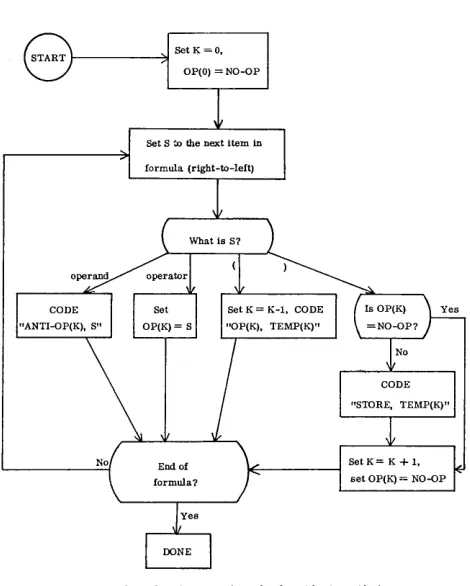
In order to see how a translation algorithm might be organized around the concept of parenthesis level, we can investigate the method shown in Figure 2,
which shows a grossly simplified version of the IT algorithm. It goes something like this: A binary operator has a corresponding so-called anti-operator such that,
[image:9.612.53.290.94.197.2]A op B
=
B anti-op A.Figure 2. Translation based on parenthesis levels, wi !bout considering
precedence of operators
Since A
+
B=
B+
A, plus IS Its own anti-op; andthe anti-op of
"I"
is "inverse divide." Remington Rand computers tend to have only the "inverse di-vide" command, and IBM computers tend to have only the "divide" command in the machine language, but for simplicity we will assume that both commands are on our machine, and that there is even an "inverse subtract" command. We will also think of N O-OP ("no-operation") and LOAD as anti-operators of each other, and if you want some justification for this you should ponder over the formulasLOAD (b)
=
0+
b NO-OP (b)=
b+
O.COMPUTERS and AUTOMATION for December, 1962
The algorithm is roughly:
Take the next item, from right to left in the for-mula.
Then branch four ways, depending on the type of item:
1. For an operand (a variable or constant), out-put machine language code "anti-op (K), op-erand"; the counter K represents the paren-thesis level and it starts out at zero; and there is a ten-place OP table, OP (0) through OP (9).
The meaning of "op (K)" is, "The anti-operator of OP (K)."
2. For an operator, save this operator in position OP (K) of the OP table.
3. For a left paren thesis, decrease K by 1, and then output the machine language code "OP (K), TEMP (K)." TEMP (K) is the Kth temporary storage cell.
4. For a right parenthesis, check first if OP (K)
=
"NO-OP," and if not, output the code "STORE, TEMP (K)." Then increase K by 1, and set OP (K) equal to "NO-OP" for the new value of K.Repeat the above process until the end of the for-mula is reached. This whole process will be clear if we look at a play-by-play account of the method as it acts on the formula "«y*Z)
+
(W*V)) - X." This is given in Figure 3. The interested readel will learn a lot if he tries to revise the method to work from left to right rather than right to left. Right to left was used here because it was dOllc that way ill 1'1'; an equally simplc algorithm which goes ('rom left to right can be given, and it is instructive to discover what changes are necessary.To the basic concept represented by the preceding algorithm, a large amount of material has to be added to handle subscripting, function calls, constants, mixed fixed and floating-point arithmetic, and so on.
Item 01' Table Code Produced
NO-OP
X NO-OP LOAD X
-
-) - NO-OP STORE TEl-1P(O)
)
-
NO-OP NO-OPV - NO-OP NO-OP LOAD V
.
- NO-OP·
W - NO-OP
·
MULTIPLY Ii(
-
NO-OP NO-OP TEMP (I+ - + (note: a NO-Or may be deleted from the code)
)
-
+ NO-OP STORE TEMP (I Z-
+ NO-OP LOIlIl Z.
-
+·
y
-
+·
~ruLTIPLY Y(
-
+ AIlIl TE~II) (I)(
-
SUllTRACT TEMI '(0)~. Itom by itom action produced by the parenthesis-level method in Figure 2 when it Is applied to the formula «Y*Z)+-(W*V»-X. Notice how the
op-table. if tipped on its side and reflected. corresponds to the contour map In Figure 1.
[image:9.612.57.292.293.586.2]Operator Precedence
The lack of operator priority (often called prece-dence or hierarchy) in the IT language was the most frequent single cause of errors by the users of that compiler. So people hunted for ways to supply.the hierarchy automatically. The IT parenthesis-level scheme didn't lend itself to this very readily. An in-genious idea used in t~e first FORTRAN compiler was to surround binary operators with peculiar-look-ing parentheses:
+
and - were replaced by )))+ (
«
and ))) - ( ( ( "" andI
were replaced by ) ) "" ( ( and) )I ( (
"" "" was replaced by ) "" "" (
and then an extra" (
«("
at the left end ")) ) " at the right were tacked on. The resulting formula is prop-erly parenthesized, believe it or not. For example, ifwe consider "(X
+
Y)+
W IZ," we obtain( « (X) ))
+
« (Y) ) ))+
« (W) )I
«Z) )).This is admittedly highly redundant, but extra paren-theses need not affect the resulting machine language code. After the above replacements are made, a paren-thesis-level method can be applied to the resulting formulas.
A close examination of this process later showed that it isn't really necessary to insert the parentheses at all; the same effect can be achieved by merely com-paring adjacent operators, and doing first the opera-tion with higher priority. This led to another ap-proat:h to the translation problem, namely to start moving along the statement until finding something which can be done, then going back and doing it, go-i ng forward to get more, and so on. Thgo-is go-is the go-idea of essentially looking for an inner pair of parentheses, then working outward, rather than the "outside-in" approach of parenthesis levels mentioned earlier. The new idea had the advantage that it could be easily adapted to handle operator hierarchies, and this led directly to the efficient scheme which is used (in so many equivalent guises) nowadays. The modern technique was discovered in several ways; another way to run across it is to write a program to translate from arithmetic statements to expressions in "Polish notation" - a parenthesis-free way to represent for-mulas-and then to write a second program to trans-late from Polish notation to machine language. Each program is rather trivial in itself, and the combina-tion of the two programs gives the same algorithm as discovered in other ways.
Shortly I will discuss the details of the new algo-rithm, bu t first I will list the main "bright ideas" which went into its discovery:
(I) The first bright idea was the realization that information which is saved for further use when trans-lating can be conveniently kept in a stack (which is also known as a nest or push-down or cellar or yo-yo
list or·last-in-first-out or first-in-last-out, etc.; the num-ber of different names indicates the numnum-ber of
differ-en"~ _4iscoverers of the algorithm). A stack is disting-uished from other types of tables by the fact that only the item at the "top" of the stack (i.e., the youngest item, the one placed on most recently) is actually im-portant at any given time. An example of this oc-curred in the parenthesis-level method, where the OP
10
table was really a stack. With the new method, the height of the stack takes the place of the former paren-thesis level.
Emit code for
STACK'''~STACK' ;
Delete STACK'" and STACK' , from STACK
Emit code for
T(I)~
STACK' , STACK'; Delete top two items from STACK
Emit code for
T(I)
--E--STACK'" STACK" STACK'; Delete top three items from STACK
Figure 4. A version of the "modern" translation algorithm. The notation STACK' denotes the top item in STACK, STACK" signifies the next from the top, and so on.
Table 1
Priority
Symbols
0 @
.-
( )1
+2
*
/
+
3
l'
4 ABS
SORT
etc.
(2) The second bright idea was that comparison of adjacent operator priorities provides a valuable cri-terion, and no more than this is needed to properly interpret a formula.
(3) The third bright idea was that parentheses can be treated as operators with priorities, giving a more elegant algori thm.
[image:10.612.320.567.89.648.2] [image:10.612.317.555.409.633.2]Why so many computer users prefer the Control Data 1604/1604-A
... . and five reasons why it will pay you to know!
The Control Data 1604/1604-A Computer, demonstrated a leader in a competitive and demanding field, continues to prove its ability to scientists and engineers as the com-puter to solve their problems, and to management as the computer fo help maintain their profit. Here are the
rea-sons why! .
RELIABILITY-An unusual history of "uptime" that sets a high standard of performance.
SERVICES-Programming Assistance • Programmer and Operator Training • Programming Systems Improve-ment • Installation Check Out • Post Installation Assist-ance • On-Site Customer Engineering.
APPLICATIONS-Real-time, on-line data reduction/data acquisition, large-scale problem-solving, large-scale data processing, biomedical and institutional research, weather prediction, oceanography, petroleum reservoir analysis, and flight simulation.
SOFTWARE-Pert, Cobol*, Codap, Co-op Monitor, Linear Programming, Algol *, Fortran 62, Fortran 63.
*
LOW COST-The Control Data 1604/1604-A is available to-day at an amazingly low cost. With its proven performance, programming systems and services, the Control Datu 1604/1604-A offers the most computer for the least dollars spent.
These are the main reasons why so many computer users prefer the Control Data 1604/ 1604-A. The names
or
these users are available to you. To learn more about how the 1604/1604-A can solve your computing problems now, contact the Control Data representative nearest you. *Available in early 1963Offices: Albuquerque • Beverly Hills • Birmingham • Boston • Chicago
• Cleveland. Dallas. Dayton. Denver
CONTROL DATA
• Detroit. Honolulu • Houston. Ithaca• Kansas City. Minneapolis. Newark
• Norfolk. Orlando. Palo Alto CORPORATION • Philadelphia • San Francisco
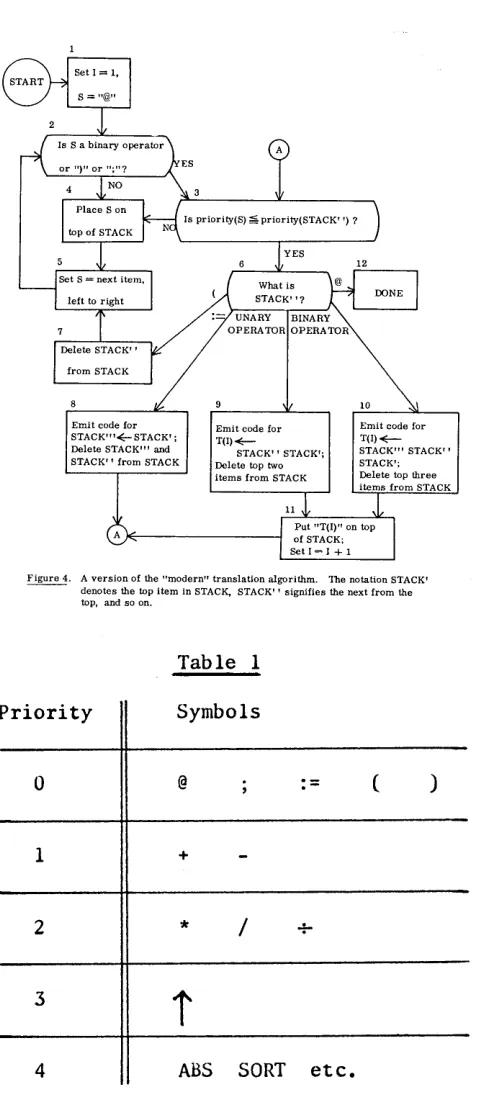
Now we will study the new algorithm, which is given in Figure 4. We start by assigning priority numbers to symbols, according to Table 1. Here
":=" stands for the replacement operation," " for exponentiation, and "-:-" for integer division as in ALGOL. Functions of a single variable are unary operators which have priority 4 in the chart.
A rough description of Figure 4 can be given as fol-lows: We "scan" along the expression (left to right this time) until we find some operation which can be performed regardless of what will occur in the re-mainder of the expression. The actual precise condi-tions for this appear in boxes 2 and 3 of the flow chart. As soon as we see something we can definitely do regardless of future input, we do it; meanwhile we save the unused portion of the formula in STACK. The formula is followed on the right by a semicolon.
Box 1 starts out by setting the counter I to one, and ardficially inserts the character "@" at the left end of the statement to mark the left boundary.
Box 2 tests the item S; if S is a binary arithmetic operator (add, subtract, multiply, divide, integer di-vide, or raise to a power) or a right parenthesis or a semicolon, this may initiate some action. Otherwise S is a variable, a constant, a left parenthesis, the re-placement operator, the symbol @, or a unary op-erator such as ABS or negation, and then we merely go to box 4 to save S on the stack for future action.
Box 3 is the all-important hierarchy test. The sec-ond item from the top of STACK is an operator (if all is working properly), and if it has higher priority in the table than S has, or if they have equal priority, the time has come to initiate compiler action. How-ever, if S has higher priority, we must wait for future· developments, so we merely go to box 4.
'Bbx 4 puts S on top of the STACK to save it for later action.
Box 5 steps along to the next item in the formula.
Box 6 is the entry to various generators; we now branch to the generator for the operator which is sec-ond from the top of STACK.
Box 7~ the left parenthesis generator, merely re-, moves the left parenthesis from the middle of STACK.
. Box 8 is the replacement generator; the top three items of STACK are of the form X := Z. The code for this is now generated, and only Z is left on the STACK.
Box 9 is the generator for a unary operator; the top two items of STACK are of the form OP X, and we compile the code for "T (I) := OP X." T (I) represents the I-th computed result.
Box 10 is the generator for a binary operator; the top three items of STACK are of the form X OP Y, and we compile the code for "T (I) := X OP Y."
Box 1 1 puts the result of the previous computation, T (I), as an operand on STACK, and advances I by I, then returns to the priority test.
Box 12 is the generator for the symbol @ which is entered when the entire statement has been trans-lated.
12
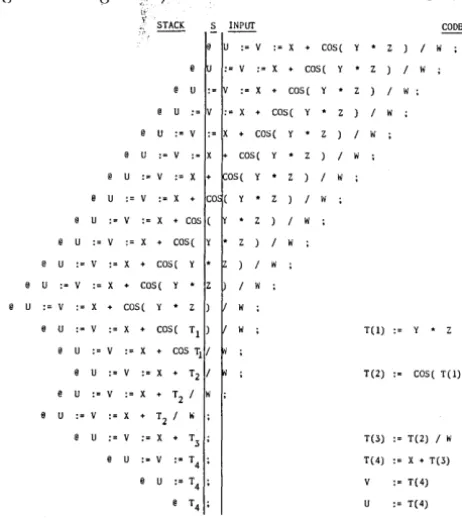
Notice that the algorithm given in Figure 4 handles more complex input than that in Figure 2. While the earlier flow chart applied only to formulas with binary operations and parentheses, the new one can also be used for unary operators, and multiple as-signment statements and it treats operator priorities properly. As an example of the operation of Figure 4, a snapshot description of the method applied to the statement "U : = V := X
+
COS (Y '"' Z) / W;" is given in Figure,,~.) Here COS stands for "cosine of.")"
y. STACK ~ INPllf@ U := y := X + COS ( y * Z ) / w
@ U := Y := X + COSt y * Z ) / W
@ U := y := X + cost y * Z ) / W; @ U := y := X + cost y * Z ) / W @ U := y := X + cost y * Z ) / w
@ U cost y * z ) / w
@ U := Y := X + OS( Y * Z ) / W
@u * Z ) / W
@ U := Y := X + cos ( * Z ) / W @ U := Y := X + COSt Y / W
@ U := Y := X + COS ( Y * ) / w
@ U := y := X + Cost Y / w
@ U := Y := X + cost Y *
@ U := y := X + cost w ; @ U := Y := X + COS Tl/
@ U := Y := X + T2 /
@ U := y := X + T2 / W
@ U := y := X + T2 / ;; ;
@ U := y := X + T3 ;
@ U := Y := T 4 ;
@ U := T 4 ;
@ T 4 ;
T(l) := Y * Z
T(2) := COSt T(l) ) T(3) := T(2) / W
T(4) := X + T(3)
:= T(4)
:= T(4)
Figure 5. Snapshots of the algorithm of Figure 4 applied to the replacement statement "U: = V: = X + COS(Y • Z) I W ;".
With this statement, all of the input gets put onto the STACK until the right parenthesis is sensed. The right parenthesis forces out the multiplication opera-tor, and then it also forces out the matching left parenthesis. Then the "/" symbol causes COS to be computed, and finally the ending semicolon triggers all of the remaining operators.
Once again, it would be a worthwhile exercise for the reader to try to modify the algorithm; this time to make It go from right to left, rather than from left to right. (Hint: the test in box 3 should not branch to box 6 on equality, lest X - Y - Z be translated in-correctly. It will also be convenient to assign the priority" -1" to a left parenthesisl)
The Object Program Produced
Let us turn back now to our original problem; you are supposed to write a compiler, remember? Your first worry, that of how to systematically decompose formulas, has been pretty well settled by now; the next problem is to generate efficient machine language code. The vast majority of the literature on compilers deals with the analysis of algebraic expressions, and comparatively little has ever been written about gen-eration of the object program (which is the really im-_ portant part). Due to all the research which has gone
[image:12.618.320.551.153.413.2]Why so many
Programmers prefer the
Control Data 1604/1604-A
The 1604/1604-A is not only a powerful, reliable, efficient computer, providing more computations per dollar expended, it is a computer that's "programmer designed" ... one that together with its software will simply and quickly serve the needs of the programming personnel who use it. Consider these software packages.
FORTRAN 62 Fortran 62 for the 1604/1604-A has all the ease and efficiency of older Fortran systems, plus featuring rapid compile times. Most significant in this new Fortran system, however, are the input/output statements which allow the programmer to take advantage of the buffering capabilities of a modern computer. For example, the statement BUFFER IN (5,0) (A,n) initiates a transfer of information from peripheral equipment #5, recorded in even parity to a region of common memory, starting with variable A and ending with variable n. Meanwhile, computation can continue. At a later time, this state-ment may be executed IF (UNIT, 5) N I, N2, N3, N4, caus-ing transfer of control to statement N 1 if the information transfer is satisfactorily completed, to N2 if the transfer is not completed, to N3 if an end-of-file mark is en-countered and to N4 if an error is apparent after the transfer is completed. Companion statements, ENCODE and DECODE, may be used in conjunction with the
buffer-ing statements to provide format control over conver-sion of variables.
FORTRAN 63 Control Data's Fortran 63 will be avail-able early in 1963 and will include all Fortran 62 state-ments. It will provide even further extensions to the Fortran language. With Fortran 63 it will be possible to declare variables by type . . . integer, real, double precision, complex and logical. Conditional transfers will be effected on logical as well as arithmetic expressions. Memory allocation at run-time will be accomplished through array dimensions expressed as parameters of subprograms. Compile time will be just as fast. Extensive Do-loop examination during compiling will ensure opti-mum use of index registers. The result will be an object program comparable in efficiency to a hand-coded object program. Storage allocation and buffering capabilities of Fortran 63 make it applicable to a new class of programs previously restricted to machine language.
1604/1604-A COBOL Statements in Control Data's Common Business Oriented Language will closely re-semble an English language statement, and will yield a program which serves as its own documentation. Control Data's Cobal will be ready in early 1963.
ALGOL Control Data will also have an Algol compiler early in 1963. Compiling speed will be fast and it will feature load-and-go operation. It will compile an efficient object code while retaining most of the features of Algol 60.
CODAP Control Data's assembler for the 1604/1604-A is CODAP. It provides a convenient symbolic machine language and enables automatic conversion of decimal and octal constants as they occur within a program.
CO-OP MONITOR co-op MONITOR is a master system which controls input/output, program interrupt and the use of a real-time clock without sacrificing flexibility. All Control Bata compilers and assemblers operate within this system and object programs can be linked together by the loader in the co-op MONITOR system.
PERT Control Data's Program Evaluation and Review Technique provides management with an orderly and rapid planning and evaluation method, having print-out capabilities which keep the user easily in touch with the progress of his project.
CDM2 Control Data's linear iJrogramming system is written in Fortran and uses the Revised Simplex Method.
It includes a master control system with maximum flexi-bility. Operating in single precision, it is considerably faster than competitive linear programming techniques. This is possible because of the 1604jl604-A 48-bit word length and the use of checking features which assure the preservation of significance.
UPWARDS COMPATIBILITY Software systems com-patible with the above are being implemented on the Control Data 3600 Computer, so that programming done for the 1604/1604-A can be used on the 3600 Computer. Additional, proven programming systems (including JOVIAL) are available through the co-op users organization.
Offices: Albuquerque • Beverly Hills • Birmingham. Boston. Chicago • Cleveland. Dallas. Dayton. Denver • Detroit. Honolulu • Houston. Ithaca • Kansas City. Minneapolis. Newark .Norfolk • Orlando. Palo Alto .Philadelphia • San Diego • San Francisco. Washington, D.C.
CONTROL DATA
COR P 0 RAT b 0 'N
into recognItIOn of formulas, this syntactical analysis is today the most trivial part of writing a compiler. A person cannot really begin to write a good compiler until he sits down and takes a good look at the object computer, and figures out exactly what code should come out of it, given each statement. So far we have just discussed the input to the compiler; but as every-one knows, output is the important thing.
The earliest compilers sometimes turned out shock-ingly poor machine code. For example, one compiler
(which I will not name) would compute A=B+C
with the sequence of instructions LOAD B
STORE working-storage-l LOAD C
STORE working-storage-2 LOAD working-storage-l ADD working-storage-2 STORE working-storage-l LOAD working-storage-l STORE A
plus several NO-OP instructions thrown in. This se-quence computes the correct answer all right; but an-other compiler for the same computer later achieved a 7: 1 reduction ratio in the number of instructions compiled in a typical program. This is, of course, an extreme example, but notice that the IT compiler algorithm turned out the instructions LOAD X,
STORE TEMP (0) in Figure 3 and these two in-structions are quite unnecessary. Most of the early compilers would do. this. (The first FORTRAN compiler, on the other hand, took fairly great care to prod uce efficien t code, although the methods used were quite painful.) One of the first attempts to eliminate extraneous instructions was to go ahead and compile them as usual, but later to recognize that they were unnecessary and at that point to "uncom-pile" them, removing them from the code. In this case, the object code was being used as a stack. A fairly elaborate algorithm was used, so that from:
LOAD NEGATIVE ABSOLUTE A
STORE TEMP
LOAD B
MULTIPLY C
ADD TEMP,
the code
LOAD B
MULTIPLY C
SUBTRACT ABSOLUTE A would be produced.
With the "modern" algorithm, however, this sav-ing of temporary storage is accomplished so easily it is virtually a free byproduct of __ the method.
It is interesting to pursue thIS matter further, how-ever, and to' consider the expression
A «< B
+
(C «< D+
E «< F).Suppose we have a fal1cy machine with two accumu-lators; the modern algorithm, adapted in a straight-forward way, would. produce
LOAD 1 A MULT 1 B
14
LOAD 2 C MULT 2 D STORE 2 TEMP LOAD 2 E MULT 2 F ADD 2 TEMP
ADD I ACCUMULA TOR-2.
The STORE in TEMP could have been saved if
A «< B had been computed last; in other words, we
should prefer to wri te
(C «< D
+
E «< F)+
A «< B.Our modern. algorithm was effectively able to re-write "A + B
*
C" as "B*
C + A" but could not make the switch on higher order expressions. This leads to a "generalized modern algorithm" for an n-register machine, which scans formulas until it gets to an expression which cannot be computed with less than n registers before it starts to produce object code. For n = I this gives the former algorithm, and for n>
I it gives some small improvement in mini-mizing temporary storage. The latter method re-quires more structure to its list than a simple push-down stack, however. There is even a generalization to a "zero-register" machine, in which it is immaterial what order is used for calculation. (This would be a machine similar to the Burroughs B-5000 except hav-ing only one fast register at the top of its stack; a Polish-notation machine with n + 1 fast registers would use a temporary storage minimization algo-rithm equivalent to that for a conventional machine with n accumulators for optimum efficiency.)Many refinements can easily be added to the mod-ern algorithm to help produce better code. For ex-ample, a sign can be attached to each operand, so that computed results can be negated and algebraic iden-tities can be employed. COS (A - B
*
C) can be calculated byLOAD B MULT C ADD A
RETURN JUMP COS;
that is, the machine can easily rewrite the expression as COS (B
*
C - A). A similar technique which I haven't seen published yet, although it is fairly old, is to attach an absolute value tag also, so that the ADD ABSOLUTE and similar instructions can be utilized on various object machines. Attaching a type indicator (fixed or floating point) to operands and computed partial results is another obvious extension. A refinement which is only slightly more difficult to add is to treat groups of statements together so that if no labels intervene between statements it is possible to remember what the preceding statement left in the accumulator.A whole series of interesting techniques has been designed to optimize the use of index registers in loops. Most of these require several passes. I must mention briefly the question of many passes vs. one pass. It is well nigh impossible nowadays to define exactly what a "pass" is. Back in the old days the number of passes was the number of times we took the cards out of the punch hopper, put them in the reader, and perhaps changed plugboards. But now
COMPUTERS and AUTOMATION for December, 1962
s
s
(
s
Cl
f
This Control Data J60-A peripheral processing package was successfully demonstrated throughout the week of October 22, J962.
Lower cost, higher off-line output with
Control Data's new peripheral processing package
Many users are searching for an inexpensive method for processing an extremely large, daily volume of card and listing operations-one that does not require two, -three, even four small-scale computer systems. A single desk-size Control Data 160-A Computer is the answer.
BASIC SYSTEM-The Control Data 160-A Computer can function as an off-line control unit in a processing pack-age which operates four printers at a rate of up to 4000 lines/minute while simultaneously performing card-to-tape operations at the maximum rate of the card reader.
With the Control Data 160-A Computer, the entire process is under continuous program control without the need for an operator at the computer console. All tape-to-printer, card-to-printer pairs will operate continuously as determined by their "ready" conditions. If at any time one pair is receiving operator attention (for instance, changing tape, supplying additional cards, loading paper, or maintaining equipment), the remaining pairs continue to operate. In brief, the peripheral processing package will continue to operate at full capability as long as information exists to be processed.
Here's an inexpensive, efficient, high-speed way to accomplish daily listing without tying up the time and capability of your large-scale computer.
This peripheral processing package features:
• Simultaneous, fl;lll-speed operation (up to 4000 lines per minute; single line spacing).
• Operation without console supervision.
• IBM tape format compatibility:
High 556 bits/in. and/or low 200 bits/in. densities.
• Automatic parity checking, automatic re-read on parity error (errors indicated on "hard copy").
• Continuous operations-all equipment operating when-ever data exists and equipment is "ready."
• High "turn around."
• Blocked or unblocked print records.
• Expandability allows up to eight or more tape-to-printer pairs with simultaneous dual card-to-tape or tape-to-card operations.
EXPANDED SYSTEM-An expanded version of the basic
peripheral processing package includes the Control Data 169 Auxiliary Memory Unit. This system allows a combi-nation of any two card-to-tape or tape-to-card operations while driving from one to eight or more tape-to-printer pairs. From a programming point of view, the expanded sys-tem utilizing the auxiliary memory unit can handle blocked print records of any number of lines per print record because of the external buffer channel and additional core storage.
If you need fast, daily servicing of your large-scale computer output, but have been processing this data at the expense of productive computer time, check Control Data's new peripheral processing package. Write today for pUblication #BR9 (11-62) or contact your nearest Control Data representative.
CONTROL DATA
Offices: Albuquerque • Beverly Hills• Birmingham • Boston • Chicago • Cleveland. Dallas. Dayton. Denver • Detroit. Honolulu. Houston. Ithaca • Minneapolis • Newark • Norfolk
• Orlando • Palo Alto • San Diego CORPORATION
• San Francisco .. Washington, D.C.
there are so-called one-pass compilers for sequential machines. How many passes is a load-and-go com-piler?2 Probably zero passes since it takes one less than one pass.
Ignoring the difficulty of defining a pass, however, we can find many arguments pro and con about rela-tive merits. The one-pass compiler is considerably faster because multipass schemes spend a good deal of time physically generating an intermediate language and later translating it back again. But there are on the other hand many things which cannot be done well in one pass, such as checking for common sub-expressions and optimizing loops. Many programmers, however, are not concerned with such refinements; if
they wanted a really good object program they would have it written in machine language by an expert programmer. I can't settle the argument, but I do think it is a valid point that there should not be n passes if the object programs produced are not no-ticeably better than could be done in n -1 passes.
Organization of the Compiler
I have tried to point out that most compilers use essentially the same techniques in different guises for formula translation. The real place where they differ is in their organization and timing of the basic com-ponents; in the structure of their programs. I will dis-cuss briefly the principal types of organization.
A. Symbol Pairs
IT and RUNCIBLE and many other compilers were organized around a symbol pair concept. At the close of each operation, the two symbols Land R
are moved; L R, next character L (right to left scanning). Then the pair LR is looked up in a table, thus giving the entry to a generator program for this case. Any information that was needed for future use was stored in tables. There were several push-down lists (stacks), but nobody realized it at the time. Beyond this the organization was pretty much of a hodgepodge which couldn't be broken into logi-cal parts. These compilers grew like Topsy and were the result of several years of patching. The program was so interwoven that every time something was changed in RUNCIBLE, six other seemingly un-related things would fail. And we had the entire compilation process in just as disorganized a fashion in our minds. We knew it was correct and why, but to explain it to anyone required at least 100 boxes on a horrible flow chart, which actually couldn't be untangled. That was the algorithm, and it worked, and it fitted onto the IBM 650 drum, but it was a mess. For all anybody knew at that time, howevet, that was the only way it could be done.
B. Operator Pairs
A next step is to use operator pairs rather than sym-bol pairs to control the operation. The operands distribute themselves nicely between operators, so an essentially identical plan as the above can be
used, except adjacent operators are used to reference a table of generators. This gives some economy over the previous method, since operands are put into a single class. This type of organization is used in the Neliac compilers and the generator tables are called
16
CO-NO or NO-CO tables by the authors. I under-stand CO-NO tables are especially good for trans-lating input programs written in Hawaiian.
C. Simple Scan
Further improvement can be gained by lumping
operators into classes, as well as operands. Only a few classes of operators are actually necessary; e.g., for FORTRAN, we would have perhaps four classes of operators:
(I) Those which require immediate action when first sensed, e.g., READ, DO.
(2) Those which are placed immediately on the stack when first sensed, e.g., SIN (for "sine of"), ABS (for "absolute value of"), left parenthesis.
(3) Those which are not placed on the stack until their priority is more than the preceding oper-ator, e.g., binary operators.
(4) Those which are never placed on the stack but their priority is used as in (3) to force out previous operators, e.g., comma, semicolon. The main control is along the lines of the modern algorithm given in Figure 4, with an input routine
to condense identifiers and constants into single items. Usually, however, many stacks are used instead of one, for convenience, typically including some of the !ollbwing:
(I) Operand stack
(2) Operator stack (it is quite helpful to separate
I and 2, although not necessary)
(3) Mode stack (this gives the meaning of commas)
(4) Subscript stack (where computed subscripts wait their turn)
(5) Temp storage stack (a list of locations avail-able for temporary storage cells in the object program)
(6) DO stack (tor controlling DO loops) and so on.
D. Recursive Organization
Some recent compilers are written with generators that work recursively. Typically when a construct (part of a formula) is recognized as being of a certain syntactical type, its generator is brought out. Some-how the end of the construct is detected, and this causes the generator to go into action. For example, there might be a generator for variables. If it hap-pens to encounter an array variable, the "expression" generator will be entered for the subscript, and it may call on the variable generator, which may call on the expression generator, etc. Delimiters are used to take generators out of control at the appropriate time. Examples of such compilers are the threaded-list compiler at Carnegie Tech and the B5000 Algol compiler at Burroughs.
E. Syntax-directed Compilers
Another form of recursive compiler is called "syntax-directed," and is. very closely related to the former type. Such a compiler is, theoretically, com-pletely general, since it is built to operate from an arbitrary syntax list (description of the language) and
IBM
asks basic questions in control systems
8How can we keep changes from becoming errors?
Water _ _ _
Crude - - I - - ,
Oil
Crude < t
-Oil
Vapor --+---'----,
PIPE
STILL
I - - - ! - Steam
L - - - i - _ N~~~~~a
I - - - ! - Steam
" - - _ - - + - _ F~,~I t - - - + - - -Ught Gas Oil
This flow diagram shows a data processing systems
engi-neer's analysis
oj the major control problems in a petroleum
distillation process.
As military and business operations grow more co~
plex, they become more difficult to manage._ The dynamics of large-scale operations shift so rapidly that management is often unaware of changes until after they have taken place. To keep complex opera-tions performing properly, IBM is developing fully
automatic systems and man-machine systems which detect variances from prescribed limits and take action on them before serious problems can arise.
Fully automatic closed-loop systems encounter un-usual environmental and diagnostic problems. To prevent bending of large missiles during powered flight, IBM engineers are studying digital filter
techniques which suppress bending-mode vibrations sensed in the attitude control loops. To formulate the mathematical model of the world's largest crude-oil distillation unit, it was necessary for IBM
scien-tists to determine the relationships between 20 in-dependent and 60 constrained variables, and the conditions of the process. Using linear programming techniques, they were then able to establish operat-ing limits which would produce optimum process performance.
Criteria for man-machine systems, in which the computer assists human beings in control and de-cision making, are less easy to define. Operating
1. Reactor heat balance equation:
. s s 5
m1Y1 = ~ qiTi"i -(~ Xi - Y61 Y1 b 1 - 0Z(YI + a) ~ x,. + Os -03 i=l 1=1 ial 1
2. Over·all heat balance equation:
• • • 6 S
o = m1Y1 + mzyz .. ~ qi Tixi - [( ~ Xi - '61 ' lb l + (x6 + Y71yzb zl
1& 1 i= 1
5
+01 Y7 - 0Z(Y1 + al ~ Xi - (0 3 +
°
411=1
3. Over·all coke balance equation:
C: .. Y6 - '7
4. Steady state coke burning equation:
'f? .. (b -
cy.'
x6(cY4 t 1) H + (1 - H) (Zk + cY4 + 1)
~ ~k t 1
These equations are the mathematical model for a catalytic
cracking process. A similar model would be formulated jor
controlling the process at left.
limits, or set points, are seldom predetermined. For example, the design of a military system depends on knowledge of field operations, such as the informa-tion an army commander needs to utilize his forces most efficiently.
In addition, "human elements" add to the empirical nature of man-machine systems. Timely change-of-status reports lose their significance unless human beings can understand them immediately. IBM
systems engineers are conducting extensive studies to establish the most effective ways of conveying in-formation from machines to men. They are analyz-ing the information exchange which makes possible each step in different manufacturing and military operations. Out of their research may come the dynamic, real-time operational control systems of tomorrow.
If you have been searching for an opportunity to make important contributions in control systems, software development, research, machine organiza-tion, or any of the other fields in which IBM
scien-tists and engineers are finding answers to basic questions, please contact us. Manager of Professional Employment, IBM Corporation, Dept. 539Z, 590 Madison Avenue, New York 22, New York. IBM
an arbitrary semantics list (description of the mean-ing of the language in terms of the object computer). These are still in the experimental stages, and with apologies to Ned Irons and the other researchers I must say they appear to be primarily of theoretical interest at the present time. The syntax of a language has to be carefully rewritten in order to produce efficient object code, and the creation of seman tical tables is as cumbersome a job as writing generators for ordinary compilers. Compilers organized along the lines of C or D can be easily modified for all but major language revisions; so no great advantage to syntax-directed compilers has been proved as yet. I certainly do not want to discourage anyone from working on a syntax-directed compiler, for there is good reason to believe that significant strides for-ward in this direction are possible and that syntax-directed compilers will be very important in the future. On the contrary, I hope to stimulate more people towards working in this potentially fruitful area which has as yet been unable to compete with handmade compilers. As we have seen, the recogni-tion of syntax is one of the simpler facets of com-piling; a good deal of research needs yet to ,be done to simplify the real problem of how to produce effi-cient code once the syntax has been recognized.
F. Multi-pass Compilers
A fairly large number of compilers operate in two passes; the first pass is organized something like class C above, and it produces a pseudo-code anal-ogous to the "T (I) :
=
Y ,.. Z" output of Figure 4. The second pass uses this pseudo-code to generate the object program. I would classify such compilers under category C.This last category of compiler organization is rather for those expensive compilers which consist of many separate passes. Such compilers defy simple explanation, and the only way to learn to know them is to spend a good deal of time studying what each pass does and how it fits into the whole scheme. There is usually very little in common between two such compilers, and all I can say is that the well-written ones of this type usually are built around some major modification of a one-pass compiler, de-signed to produce more efficient object programs from a more thorough analysis of the source program.
References
A complete bibliography of the compiler literature is hard to give; actually it would be quite distressing
to try to read many of the articles. This will happen because so many of them are about how that particu-lar author discovered the same thing as other authors (although it may take several hours to realize what he has discovered and what he hasn't). Therefore, I will give only a short bibliography, for use by those inter-ested in pursuing the subject further.
The complexity in the first translators is indicated in two articles:
D. Knuth, "RUNCIBLE-Algebraic Translation on a Limited Computer," Communications of the ACM~
November, 1959. In this article I include a flow chart of a portion of the RUNCIBLE compiler, and also
18
make the untrue statement that such an algorithm may well be the only possible one to 'use on a small computer such as the IBM 650.
Peter Sheridan, "The Arithmetic Translator-Com-piler of the IBlVI Fortran Automatic Coding System,"
Communications of the ACM~ February, 1959. This article is rather heavy reading, but it will at least impress the reader with the complexity of the al-gorithm.
Neliac compilers are discussed as the principal sub-ject of the book "lVlachine Independent Computer Programming" by lVlaurice Halstead, Spartan Books, Washington, D. C., 1962. "NO-CO" is a term used by the authors of Neliac meaning "Next-Operator-Cur-rent-Operator."
Excellent expositions for the beginner of the mod-ern scanning algorithm have been written by Robert Floyd: "An Algorithm for Coding Efficient Arith-metic Operations," Communications of the ACM~
January, ,- 1961, and "A Descriptive Language for Symbol Manipulation," ACM jouTnalJ October, 1961.
Finally, to study the organization of various com-pilers, the entire January 1961 issue of the ACM Communications is recommended. Of special inter-est is "The Internal Organization of the MAD Trans-lator," by B. Arden}" B. Galler, and R. Graham. This is one of the few krticles in the literature which dis-cusses some general methods for generation of the object program without a separate generator for each spefial case.
1 "Internal Translator (IT); A Compiler for the IBM 650," oy H. A. Pertis, ]. W. Smith, and H. R. Van Zoeren, Carnegie In~titute of Technology Computer Center, Pittsburgh, Pa., 1956.
2 A load·an.d·go compiler is one in which a person enters as input some algebraic statements, and the compiler translates these into machine lan-guage and immediately transfers control to ,this new program. Thus with a "load-and-go compiler" the first output consists of the answers.
READERS' AND EDITOR'S FORUM
(Continued fTom page 6)
For example, in an IBM release d.ated November 1, 1962, the following paragraph was contained: "In-coherent light produced from such diodes had previ-ously been observed in a number of laboratories. However, the IBM device is the first known to exhibit laser action."
The same day GE's Research Laboratory released a press packet that contained the paragraph: "The ability of gallium-arsenide junctions to produce infra-red light has been previously observed in several laboratories. The General Electric device is the first to generate coherent light . . . "
So pity the life of the over-worked news editor no longer! If technology, and its heralds, continue to progress with such smooth consistency, the news edi-tor of the future may only have to keep a collection of ink pad stamps carrying leading corporate names on his desk, and be able to run the same "fresh" story four or five times merely by altering the blurb with a few applications of the proper hand stamp. Ah, at last, automatic journalism.