warwick.ac.uk/lib-publications
Original citation:
Akowuah, Enoch, Goodwin, Andrew T., Owens, W. Andrew, Hancock, Helen C., Maier,
Rebecca, Kasim, Adetayo, Mellor, Adrian, Khan, Khalid, Murphy, Gavin and Mason, James.
(2017) Manubrium-limited ministernotomy versus conventional sternotomy for aortic valve
replacement (MAVRIC) : study protocol for a randomised controlled trial. Trials, 18 . 46.
Permanent WRAP URL:
http://wrap.warwick.ac.uk/85715
Copyright and reuse:
The Warwick Research Archive Portal (WRAP) makes this work of researchers of the
University of Warwick available open access under the following conditions.
This article is made available under the Creative Commons Attribution 4.0 International
license (CC BY 4.0) and may be reused according to the conditions of the license. For more
details see:
http://creativecommons.org/licenses/by/4.0/
A note on versions:
The version presented in WRAP is the published version, or, version of record, and may be
cited as it appears here.
S T U D Y P R O T O C O L
Open Access
Manubrium-limited ministernotomy versus
conventional sternotomy for aortic valve
replacement (MAVRIC): study protocol for a
randomised controlled trial
Enoch Akowuah
1, Andrew T. Goodwin
1, W. Andrew Owens
1, Helen C. Hancock
2*, Rebecca Maier
2, Adetayo Kasim
2,
Adrian Mellor
1, Khalid Khan
1, Gavin Murphy
3and James Mason
4Abstract
Background:Aortic valve replacement is one of the most common cardiac surgical procedures performed
worldwide. Conventional aortic valve replacement surgery is performed via a median sternotomy; the sternum is divided completely from the sternal notch to the xiphisternum. Minimally invasive aortic valve replacement, using a new technique called manubrium-limited ministernotomy, divides only the manubrium from the sternal notch to 1 cm below the manubrio-sternal junction.
More than one third of patients undergoing conventional sternotomy develop clinically significant bleeding requiring post-operative red blood cell transfusion. Case series data suggest a potentially clinically significant difference in red blood cell transfusion requirements between the two techniques. Given the implications for National Health Service resources and patient outcomes, a definitive trial is needed.
Methods/design:This is a single-centre, single-blind, randomised controlled trial comparing aortic valve replacement
surgery using manubrium-limited ministernotomy (intervention) and conventional median sternotomy (usual care). Two hundred and seventy patients will be randomised in a 1:1 ratio between the intervention and control arms, stratified by baseline logistic EuroSCORE and haemoglobin value. Patients will be followed for 12 weeks from discharge following their index operation. The primary outcome is the proportion of patients who receive a red blood cell transfusion
post-operatively within 7 days of surgery. Secondary outcomes include red blood cell and blood product transfusions, blood loss, re-operation rates, sternal wound pain, quality of life, markers of inflammatory response, hospital discharge, health care utilisation, cost and cost effectiveness and adverse events.
Discussion:This is the first trial to examine aortic valve replacement via manubrium-limited ministernotomy versus
conventional sternotomy when comparing red blood cell transfusion rates following surgery. Surgical trials present significant challenges; strengths of this trial include a rigorous research design, standardised surgery performed by
experienced consultant cardiothoracic surgeons, an agreed anaesthetic regimen, patient blinding and consultant-led patient recruitment. The MAVRIC trial will demonstrate that complex surgical trials can be delivered to exemplary standards and provide the community with the knowledge required to inform future care for patients requiring aortic valve replacement surgery.
(Continued on next page)
* Correspondence:[email protected]
2Durham Clinical Trials Unit, School of Medicine, Pharmacy and Health,
Durham University, Queen’s Campus, University Boulevard, Thornaby, Stockton-on-Tees TS17 6BH, UK
Full list of author information is available at the end of the article
(Continued from previous page)
Trial registration:International Standard Randomised Controlled Trial Number (ISRCTN) ISRCTN29567910. Registered on 3
February 2014.
Keywords:Aortic valve replacement (AVR), Manubrium-limited ministernotomy, Minimally invasive aortic valve replacement,
Sternotomy, Red blood cell transfusion, Inflammatory response
Background
Aortic valve replacement (AVR)
AVR is one of the most common cardiac surgical proce-dures performed worldwide [1, 2]. Patients suffer symp-toms of chest pain, shortness of breath and dizziness as a result of aortic stenosis or regurgitation. Nearly 10,000 patients undergo AVR surgery in the UK every year [2]. Patient outcomes of AVR performed in the UK from 2004 to 2009 [3] showed a 26% increase in the number of pa-tients undergoing surgery during this period. At The James Cook University Hospital (JCUH) in the North of England, an audit over the same time period confirmed a 24% increase in the number of AVR operations. It is antic-ipated that the number of AVR operations will continue to increase.
Blood transfusion following AVR
There is significant morbidity associated with AVR sur-gery. Consequently, blood loss and the subsequent requirement for transfusion of red blood cells (RBCs) and blood products are key indicators of quality. More than one-third of patients undergoing conventional sternotomy develop clinically significant bleeding and re-quire a post-operative RBC transfusion [4, 5]. Blood transfusion can have adverse clinical effects including post-operative lung injury, organ dysfunction, confusion, and immunosuppression [6]; complications of transfu-sion have been directly linked to prolonged hospital stay and increased mortality after cardiac surgery [5, 7–12]. Additionally, there is a small risk of transmitting viral in-fection from blood donor to recipient [13]. Currently, cardiac surgical procedures use 6% of all donor blood available in the UK [14]. An analysis of patients over 5 years from the Society for Cardiothoracic Surgery in Great Britain and Ireland National Database indicated that of 41,227 patients who underwent AVR surgery, 2342 (6%) required a second operation due to excessive bleeding [3].
Retrospective studies have shown that blood loss and transfusion requirements are significantly less with minimally invasive AVR [15–17]; however, most reported using a fourth space ministernotomy incision rather than a manubrium-limited approach. No study thus far has tested RBC transfusion requirements in a randomised controlled trial using manubrium-limited ministernotomy.
Rationale for choice of comparators'
Surgical techniques in AVR
Usual care: conventional sternotomy
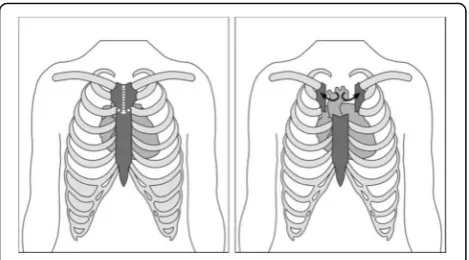
Conventional surgery for AVR is performed via a median sternotomy, in which the sternum is divided completely from the sternal notch to the xiphisternum. The oper-ation includes cardiopulmonary bypass established by siting cannulas in the right atrium and ascending aorta. The heart is stopped and the valve is replaced.
Intervention under study: minimally invasive ministernotomy
The new technique of manubrium-limited ministernotomy divides only the top quarter of the sternum from the sternal notch to 1 cm below the manubrio-sternal junction; this enables access to perform the AVR. Potential benefits may include reductions in bleeding, post-operative pain, inflammatory response, hospital stay and time away from work. The cardiothoracic surgical commu-nity are enthusiastic about the procedure; however, they are clear that definitive benefit needs to be dem-onstrated in a randomised controlled trial before widespread adoption of the technique.
Inflammatory markers
In minimally invasive cardiac surgical procedures, there is less tissue trauma and the right atrium is not directly can-nulated; conversely, cardiopulmonary bypass and aortic cross-clamp times are longer. The mechanism for any ob-served benefits of the minimally invasive approach is un-confirmed, but may be due to a difference in systemic inflammatory response (SIR). SIR can be measured by monitoring the profile of cytokines in plasma.
and acute kidney injury, impair wound healing and re-duce post-operative haemostasis [18].
Trial rationale
Case series data at The JCUH suggest a potentially signifi-cant and clinically important difference in the need for RBC transfusion when comparing patients undergoing conventional and manubrium-limited surgery. Given the implications of transfusion for National Health Service (NHS) resources and patient outcomes, and the potential benefits from this new technique, there is a need for a de-finitive trial. There has been one trial in the UK evaluating the fourth space median (minimally invasive) sternotomy (PB-PG-0408-16296; ISRCTN 58128724); this trial is now closed to recruitment and is in follow-up. Thus far, no randomised trial has compared manubrium-limited minis-ternotomy to conventional sminis-ternotomy for AVR.
The need for AVR is increasing and, with an ageing population, the balance of surgical risk will become less favourable given the greater level of co-morbidity in older populations. Importantly, this new approach also has the potential to reduce the risk of post-operative lung injury, organ dysfunction and immunosuppression, as well as reduce the burden on already overstretched blood transfusion services. A robust trial of the manubrium-limited technique compared with conven-tional surgery is imperative and timely to ensure that ap-propriate surgical strategies deliver improved patient outcomes and efficient use of scarce NHS resources.
The trial will run according to the principles of Inter-national Conference on Harmonisation (ICH)-Good Clinical Practice (GCP) and in accordance with relevant UK legislation and the trial protocol.
Methods/design
Objectives
This trial will investigate whether new manubrium-limited surgery (intervention) reduces RBC transfusion rates compared to conventional cardiac surgery (control) for patients undergoing aortic valve replacement. The null hypothesis is that there will be no difference in the proportion of patients receiving RBC transfusion after manubrium-limited ministernotomy when compared to conventional sternotomy for AVR.
Trial design
This is a single-centre, single-blind, randomised controlled superiority trial comparing patients undergoing AVR via manubrium-limited ministernotomy (intervention under study) or conventional median sternotomy (control arm/ usual care); randomisation will be performed using ran-dom permuted blocks with a 1:1 allocation.
The manubrium-limited ministernotomy versus con-ventional sternotomy for aortic valve replacement
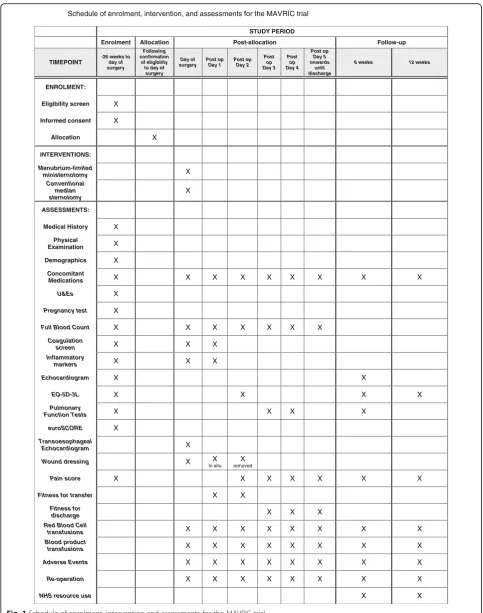
(MAVRIC) trial protocol was written in accordance with the Standard Protocol Items: Recommendations for Inter-ventional Trials (SPIRIT) checklist (see Additional file 1) [19, 20]. The schedule of this trial is shown in Fig. 1.
Trial setting
The study aims to recruit 270 patients in a single NHS Trust in the North of England.
Eligibility criteria
Inclusion criteria
Patients are eligible for the study if they:
1. Are aged 18 years or older at the time of consent 2. Require first-time, non-emergency, isolated AVR;
surgery
3. Are able; and willing to provide written informed consent.
Exclusion criteria
Patients are excluded from entering the study if they:
1. Require concomitant cardiac procedure(s) 2. Have a haemoglobin level <90 g/L
3. Are pregnant; Are unable to stop currently prescribed treatment affecting clotting
4. Have a haematological condition that would affect participation in the trial
5. Have infective endocarditis
6. Are prevented from having RBCs and blood products according to a system of beliefs
7. Have any other medical, psychiatric and or social reason that precludes participation.
Eligibility check
Participants have their eligibility checked and confirmed within the 14 days prior to surgery. Eligibility is con-firmed by one of the three operating cardiac surgeons who are clinical investigators for this trial.
Interventions
Manubrium-limited ministernotomy (intervention)
Schedule of enrolment, intervention, and assessments for the MAVRIC trial
STUDY PERIOD
Enrolment Allocation Post-allocation Follow-up
TIMEPOINT
-26 weeks to day of surgery
Following confirmation
of eligibility to day of
surgery Day of surgery
Post op Day 1
Post op Day 2
Post op Day 3
Post op Day 4
Post op Day 5 onwards
until discharge
6 weeks 12 weeks
ENROLMENT:
Eligibility screen X
Informed consent X
Allocation X
INTERVENTIONS:
Manubrium-limited
ministernotomy X
Conventional median sternotomy
X
ASSESSMENTS:
Medical History X
Physical
Examination X
Demographics X
Concomitant
Medications X X X X X X X X X
U&Es X
Pregnancy test X
Full Blood Count X X X X X X X
Coagulation
screen X X X
Inflammatory
markers X X X
Echocardiogram X X
EQ-5D-3L X X X X
Pulmonary
Function Tests X X X X
euroSCORE X
Transoesophageal
Echocardiogram X
Wound dressing X In situX removedX
Pain score X X X X X X X
Fitness for transfer X X
Fitness for
discharge X X X
Red Blood Cell
transfusions X X X X X X X X
Blood product
transfusions X X X X X X X X
Adverse Events X X X X X X X X
Re-operation X X X X X X X X
NHS resource use X X
[image:5.595.56.540.85.699.2]echocardiography). Vacuum assist is used as necessary to aid venous drainage. Antegrade cardioplegia is used for myocardial protection, and venting is via the pulmonary artery. A transverse aortotomy is performed, followed by standard aortic valve insertion using interrupted nonpled-geted braided sutures. The aortotomy is closed in a single or double layer. One pericardial drain and ventricular pacing wires are placed in all patients. Atrial wires are placed if needed. These steps are performed prior to re-moving the cross-clamp to facilitate the view of the right atrium and ventricle. The sternum is closed with two wires in the manubrium and two wires from the body of the sternum up to the manubrium.
Conventional median sternotomy (control)
For the conventional technique, a standard median sternotomy is performed using systemic normothermia. Cannulation is via the ascending aorta with two-stage right atrial cannulation for venous drainage. Venting of the left ventricle is achieved via the pulmonary artery, and myocardial protection is with cold blood antegrade cardi-oplegia. All valves are inserted using interrupted sutures.
During the trial, both operations are performed in ac-cordance with an agreed and standardised anaesthetic protocol. Patients are given lorazepam as a pre-medication, followed by anaesthesia with propofol, fen-tanyl, rocuronium bromide and morphine. All patients are given a total dose of tranexamic acid (TXA) at 30 mg/kg. Where patients have a pre-surgical creatinine >200 mmol/L, the dose of TXA is halved to 15 mg/kg. Prior to cardiopulmonary bypass, systemic anticoagula-tion is achieved with heparin given at a dose that achieves an activated clotting time (ACT) of greater than 400 seconds. Fresh frozen plasma (FFP) is administered if the target ACT is not reached. During cardiopulmo-nary bypass, haemoglobin (Hb) is kept at 60 g/L or above. Haemofiltration followed by RBC transfusion may be required to achieve this. Following cardiopulmonary bypass (CPB), protamine will be administered to reverse
heparin, according to the dose of heparin given. Blood products may be used intra-operatively in the presence of excessive blood loss. RBC salvage will be used in all patients.
All patients have the new aortic valve assessed at the end of surgery using a transoesophageal echocardiogram (TOE). Details of this, as well as any additional surgical intervention, including conversion to conventional sternotomy from manubrium-limited sternotomy, and any further TOE are recorded.
Post-operative warfarin and aspirin administration
Post-operatively, all patients having a biological pros-thesis begin 75 mg aspirin on the morning of the day following surgery. All patients having a mechanical pros-thesis commence on warfarin on the evening of the day following surgery.
Post-operative assessments and procedures
The post-operative period (and trial protocol in rela-tion to RBC and other blood product transfusions) begins once the patient has been admitted to the Car-diac Intensive Care Unit (CICU). Residual blood after cardiopulmonary bypass that has been bagged may all be given as a transfusion intravenously; the transfu-sion of this residual blood is commenced prior to CICU admission.
Blood and blood product usage following surgery
The post-operative RBC transfusion and blood product transfusion processes for this trial begin from the point of admission to the CICU. All residual blood from the CPB reservoir and cell salvaged blood is returned to the patient; the following transfusion processes are implemented following complete trans-fusion of this blood and continue until a patient is discharged following their index operation.
Trial patients receive a RBC transfusion if at least one of the following criteria is met:
Their Hb is <80 g/L.
A diagnosis of post-operative bleeding is made as defined by≥400 ml/h blood loss or≥100 ml/h for≥ 4 h with Hb≥80 g/L.
Blood loss leading to haemodynamic instability occurs irrespective of thromboelastography (TEG) and clotting profile results.
Trial patients receive a blood product transfusion if both of the following criteria are met:
A diagnosis of post-operative bleeding occurs as de-fined by≥400 ml/h blood loss or≥100 ml/h for≥4 h.
TEG or coagulation guided transfusion is indicated.
[image:6.595.57.292.87.217.2]Clinicians are able to transfuse, or decide not to trans-fuse, in violation of the protocol parameters; their reason for doing so will be recorded.
Outcomes
Primary outcome
The primary outcome is the proportion of patients who receive a RBC transfusion post-operatively and within 7 days of AVR surgery.
Secondary outcomes
Secondary outcomes are:
The proportion of patients who receive a RBC transfusion during the intra-operative period and the entire post-operative hospital stay
The mean number of RBC units transfused during the intra-operative period, post-operative period (within the 7 days following AVR surgery) and the entire post-operative hospital stay
The proportion of patients receiving blood product transfusions during the intra-operative period, within the 7 days following AVR surgery and during the entire hospital stay
The mean number of blood product transfusions received during the intra-operative period, within the 7 days following AVR surgery and during the en-tire hospital stay
Mean post-operative blood loss (millilitres) measured from chest drains at 6 and 12 hours, and at the time of drain removal, following AVR surgery
Operative success as defined by transthoracic echocardiographic assessment of left ventricular function, and degree of aortic regurgitation, within 6 weeks of AVR surgery
Mean post-operative changes in haemoglobin (Hb) within the index hospital stay
Mean post-operative changes in inflammatory markers on admission to CICU and on day 1 following AVR surgery
Proportion of patients reporting moderate or severe post-operative sternal wound pain, measured daily using an 11-point numerical rating scale developed by the trial team, until patient is fit for hospital discharge, and at 6 and 12 weeks following AVR surgery
Rates of re-operation following index AVR surgery until 12 weeks
Rate of conversion to conventional AVR during index surgery
Changes in forced expiratory volume and forced vital capacity on days 3 and 4 and at 6 weeks following AVR surgery
EuroQoL EQ-5D-3L [21] scores, captured at baseline and on day 2, and 6 weeks and 12 weeks
following AVR surgery, will be converted to health status scores using the value set (time trade-off) [22] and provide patient-level quality-adjusted life year (QALY) estimates as a health outcome [23]. The EQ-5D-3L is a validated, self-reported outcome measure consisting of five dimensions: mobility, self-care, usual activity, pain/discomfort, anxiety/depression. Each dimension has three levels of response.
Mean time at which patients are fit for discharge from hospital following AVR surgery
Health care utilisation during hospital stay and following discharge to 12 weeks, from medical note review, GP records and patient reports
Cost and cost effectiveness estimated from QALY estimates and health care utilisation valued using national reference costs to 12 weeks
Rates of related adverse events during the 12 weeks following surgery including severity.
Participant timeline
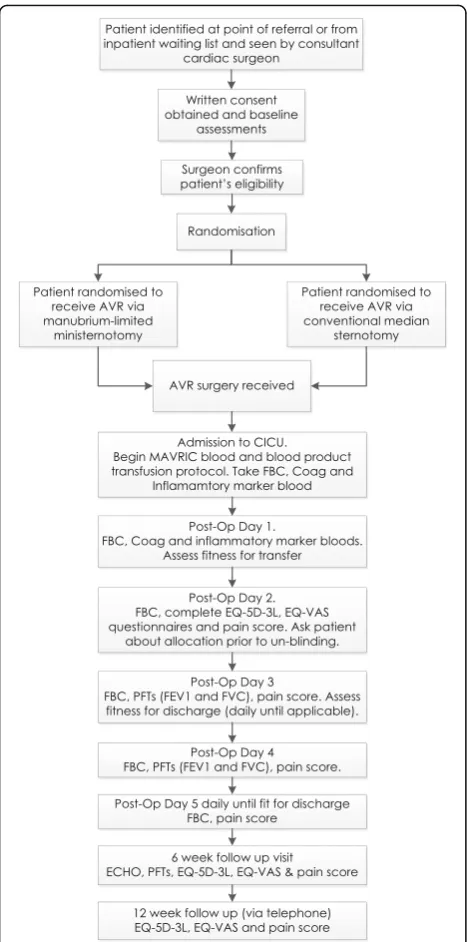
Patients are followed for 12 weeks, with follow-up at 6 weeks and 12 weeks after discharge from hospital fol-lowing their index AVR operation. Figure 3 provides a flow chart of the patient pathway in the MAVRIC trial.
Sample size calculation
This trial will determine if manubrium-limited minister-notomy is an appropriate clinical alternative to the exist-ing operation (conventional sternotomy) in terms of RBC transfusion requirements in the 7 days following index surgery. Currently, there is clinical and policy equipoise with no intention to extend the use of the new procedure until high-quality randomised controlled trial evidence is available.
Using Fisher’s exact test, 90% power, 5% alpha, 260 patients are required to detect a 17% reduction in the proportion of patients requiring RBC transfusion (13% compared with 30%), using a two-sided test. Recruit-ment will continue until the target sample size is reached and 260 patients are contributing to the primary outcome.
Recruitment
Patients undergoing isolated AVR surgery will be identi-fied at the point of referral or from the inpatient waiting list by the clinical team, and will be approached by a member of the research team about participation in MAVRIC. Patients will be consented by a Consultant Cardiothoracic Surgeon or a Surgical Registrar.
Allocation
eligibility. Randomisation is made using a permuted block randomisation, stratified by logistic EuroSCORE [24] (low risk 0–3.50%, moderate risk 3.51–7.5% and high risk >7.5%) and by pre-operative Hb (90–125 g/L, 126–140 g/L, >140 g/L). A web-based randomisation system, managed by Durham Clinical Trials Unit (DCTU), will ensure concealment of allocation.
Blinding
This is a single-blind trial. Patients are not informed of the type of sternotomy they are planned to receive, or do receive, until completion of the pain assessment on
day 2 following their operation. To enable blinding post-operatively, all patients have a trial-specific opaque dress-ing applied to their sternal wound and to their groin.
Measures taken to avoid bias
This trial incorporates a number of methods to avoid bias:
Concealment of allocation will be achieved through a web-based randomisation system, de-scribed above, managed by DCTU. Named clinical research team members enter a minimum data set per patient before individual allocation to type of sternotomy is provided.
Three consultant cardiothoracic surgeons perform all operations as part of this trial. Each is expert in both techniques and does not delegate to other trainee or consultant surgeons.
Criteria for blood and blood product transfusions are detailed in the protocol and followed for all patients. Clinical staff members in all cardiothoracic wards follow this protocol. Where clinical need requires blood to be given outside of the protocol, this is documented and described. The trigger for all transfusions is recorded.
Patients are blind to the sternotomy procedure, both planned and received, for 2 days following their index surgery. All have an opaque dressing applied to both the sternum and the groin to facilitate blinding; these are only removed, and the patient informed, following their day 2 trial assessments unless clinical need requires earlier removal. Sternal wound pain is assessed using an 11-point numerical rating scale, with all analgesic medication taken in the preceding 4 hours recorded.
Fitness for discharge is measured using defined physiotherapy and clinical criteria; these are assessed daily from day 3 by a research team physiotherapist and by the surgical research team. The date that both physiotherapy and clinical criteria are met is defined as the date the patient is fit for discharge. The date of actual discharge is also recorded.
Where patients choose to withdraw from the study prior to 7 days following their index surgery, permission is sought to continue data collection to support analysis of the primary endpoint.
Data collection methods
Baseline assessments
In addition to usual care procedures, baseline assess-ments take place following consent and prior to surgery.
[image:8.595.57.291.86.558.2]Cardiovascular and significant current and past medical history
A full medical history is recorded for each patient at baseline and includes details of all clinically significant past medical conditions and all clinically significant on-going medical conditions including full cardiovascular history.
Physical assessment
A physical assessment of height (measured in centi-metres) and weight (measured in kilograms) determines body mass index.
Current medications
A full list of the generic names of relevant medications taken by the patient is recorded within 14 days before surgery. The information includes frequency and dose. Changes or additions are recorded from baseline until the 12-week follow-up visit.
For patients in both trial arms, pre-operative antiplate-let drugs (including clopidogrel and aspirin) and antico-agulants (including heparin and warfarin) are discontinued 5 days prior to surgery. The exception is aspirin, which is stopped 5 days prior to surgery where possible; however, continuation until the day of surgery does not exclude a patient from the trial, and is re-corded. These drugs may be re-started following surgery at the discretion of the clinical team. Dates for re-starting medications are recorded.
International normalized ratio (INR) checks for patients taking warfarin
Patients on warfarin have their INR checked as part of routine care on admission to hospital for their index sur-gery. Where an INR is≤1.5, the patient proceeds to sur-gery. Where a patient’s INR is >1.5, appropriate treatment may be given and surgery may need to be de-layed. The INR for patients taking warfarin must be≤1.5 prior to surgery.
Demographic information
The following demographic data are recorded:
Age
Gender
Ethnicity.
Blood tests
Blood tests are taken within 14 days prior to surgery and prior to randomisation:
Urea and electrolytes (sodium, potassium, creatinine, urea)
Pregnancy test
Full blood count (haemoglobin, haematocrit, platelets, white cell count)
Coagulation screen (prothrombin time (PT), prothrombin time ratio (PTR), activated partial thromboplastin time (APTT), activated partial thromboplastin time ratio (APTTR)
Inflammatory markers.
Out of normal range blood parameters are assessed by the clinical team to confirm that there are no clinically significant findings that would affect continuation in the trial. The value of haemoglobin taken up to 14 days pre-surgery is used as a stratifying variable for randomisation.
Patients also have blood samples (stored as plasma) taken pre-operatively, on admission to CICU and 24 h post-operatively. These are analysed to explore the fol-lowing null hypotheses:
1. That there will be no difference between peri-operative inflammatory markers (IL-6, IL-8, IL-10) and markers of endothelial inflammation (ICAM-1 or CD62E) between those undergoing AVR via manubrium-limited ministernotomy when compared to AVR via conventional sternotomy
2. That there is no correlation between the number and proportion of patients who receive a RBC transfusion and the number of units transfused and peri-operative inflammatory markers (IL-6, IL-8, IL-10).
Echocardiogram
Results from the latest echocardiogram (echo) pre-surgery are recorded. If an echo has not been done within 39 weeks (9 months) of consent, this is repeated at baseline.
Pulmonary function tests
Pulmonary function tests of forced expiratory volume (FEV1) and forced vital capacity (FVC) are performed at baseline with patients sitting for both assessments. These assessments are repeated on days 3 and 4, and at 6 weeks following discharge from hospital after their index surgery.
EuroSCORE
Quality of life assessment (EuroQoL EQ-5D-3L [22])
Each patient completes the EuroQoL EQ-5D-3L [21] questionnaires at baseline. If the patient is physically un-able to complete the questionnaires, or the assessment is being performed over the telephone, the research team will administer them to the patient, who dictates their answers. The details of who is recording the patient’s re-sponses are noted. Questionnaires are repeated at day 2, 6 weeks and 12 weeks (3 months) following discharge from hospital.
Assessment of pain
Pain is assessed within 14 days prior to index surgery using an 11-point numerical rating scale. Pain is also assessed post-operatively (daily from post-operative day 2 until the patient is deemed ‘fit for discharge’), and at follow-up (6 and 12 weeks following discharge).
Retention of participants
Patients who withdraw have all data collected up until the point of withdrawal included in the study except where withdrawal is due to a related adverse event (AE), in which case the patient is followed until a stable out-come is achieved.
Data management
The study is managed by the Chief Investigator with support from DCTU.
Study data are recorded in each patient’s medical notes before being entered onto electronic Case Report Forms (e-CRFs). Data entered into the e-CRF must be consist-ent with the information in the medical notes. Discrep-ancies are noted and explained. Un-anonymised data are held on site in accordance with local Trust policies. Patients are identified by a unique study number at en-rolment. All data passed to DCTU have patient identi-fiers removed, except date of birth, gender, ethnicity and unique study ID. All data are handled in a confidential manner by DCTU, the research team and by members of the Data Monitoring Committee (DMC) and Trial Steering Committee (TSC).
Statistical methods
The null hypothesis is that there will be no difference in the proportion of patients receiving RBC transfusion after manubrium-limited ministernotomy when com-pared to conventional sternotomy for AVR.
This trial will determine if manubrium-limited minis-ternotomy is an appropriate clinical alternative to the existing operation (conventional sternotomy) in terms of RBC transfusion requirements in the 7 days following index surgery. An analysis of the primary endpoint will be conducted using Fisher’s exact test. A sensitivity ana-lysis will also be performed for the primary endpoint
using a logistic regression model to account for potential confounders and stratification factors. Continuous out-comes will be analysed using general linear models. Cor-relation between repeated measures per patient will be appropriately accounted for in the linear models where applicable. Binary data will be analysed using logistic re-gression where there are no repeated data per patient. Repeated binary data will be analysed using generalised estimating equations. Stratification factors and chance baseline imbalances following randomisation will be ex-plored for the primary and secondary outcomes.
Analysis will follow intention-to-treat principles with patients analysed according to the surgery allocated by randomisation and irrespective of surgery received, sub-sequent management or events [26]. Every effort will be made to retain and include all patients who receive sur-gery as part of the trial.
A prospective economic evaluation is integrated into the trial design and applies an NHS perspective to the inclusion of costs. Mechanisms of missingness within the data will be explored, and multiple imputation methods will be applied to impute missing data and minimise bias. Imputation sets will be used in bivariate analysis of costs and QALYS to generate incremental cost per QALY estimates and credible intervals [27–29]. It is anticipated that incremental costs and benefits will be captured within the trial, although extrapolated economic modelling will be considered if appropriate. Findings will be presented on the incremental cost-effectiveness ratio (ICER) plane and using cost-effectiveness acceptability curves (CEACs).
Governance
The trial is overseen by a TSC, which includes an inde-pendent chair and two other indeinde-pendent members (one of whom is a patient). In addition, the trial has a DMC, which meets 6 monthly, and oversees all ethical and safety issues in accordance with a study-specific DAMO-CLES charter [30] for DMCs. All members are inde-pendent of the study team, although the Trial Manager, Chief Investigator and some other members of the Trial Management Group (TMG) attend the open sessions in order to inform the DMC of trial progress.
Reporting of adverse events
Dissemination
On-going patient and public involvement informs appro-priate methods of dissemination to patients. Feedback will be given to national surgical leads via the Society for Cardiothoracic Surgeons in Great Britain and Ireland, maximising the exposure of findings to cardiac surgeons diagnosing and treating patients requiring AVR.
Findings will be presented at national specialist meet-ings to raise awareness. We will engage directly with surgeons and cardiothoracic units around the country to share results. Data will be presented at the annual meet-ing of the Society for Cardiothoracic Surgeons in Great Britain and Ireland, and we anticipate this to be the main forum for disseminating findings from this study.
Discussion
This is the first trial to examine aortic valve replacement via manubrium-limited ministernotomy versus conven-tional sternotomy when comparing red blood cell trans-fusion rates following surgery. MAVRIC will determine if manubrium-limited ministernotomy should be adopted as best practice for patients requiring AVR surgery.
It was not possible to blind clinicians to the surgical procedure provided, although transfusion decisions are protocol-driven and should not be procedure-related. The inclusion of patient blinding was in response to a funding panel recommendation. It has been possible to implement this through the use of opaque dressing, which means that patient-reported pain scores at 2 days will be blinded. We will assess the effectiveness of blind-ing by invitblind-ing patients to indicate which treatment they think they have received before removing the dressings.
Surgical trials present significant challenges. The strengths of this trial include a rigorous research design, standardised surgery performed by experienced consult-ant cardiothoracic surgeons, an agreed anaesthetic regi-men, patient blinding and consultant-led patient recruitment. Each discipline within the Cardiothoracic Division at JCUH is supporting and collaborating with the Chief Investigator. MAVRIC will demonstrate that complex surgical trials can be delivered to exemplary standards and provide the community with the know-ledge required to inform future care for patients requir-ing aortic valve replacement surgery.
Protocol version
This is approved version 5 of the trial protocol.
Trial status
The trial began recruiting in March 2014; the trial is due to report in 2017.
Additional file
Additional file 1:SPIRIT 2013 checklist. (DOC 121 kb)
Abbreviations
ACT:activated clotting time; AE: adverse event; APTT: activated partial thromboplastin time; APTTR: activated partial thromboplastin time ratio; AVR: Aortic valve replacement; CEACs: cost-effectiveness acceptability curves; CICU: Cardiac Intensive Care Unit; CPB: cardiopulmonary bypass;
DCTU: Durham Clinical Trials Unit; DMC: Data Monitoring Committee; e-CRFs: electronic Case Report Forms; FEV1: forced expiratory volume; FFP: Fresh frozen plasma; FVC: forced vital capacity; GCP: Good Clinical Practice; GP: General Practitioner; Hb: haemoglobin; ICER: incremental cost-effectiveness ratio; ICH: International Conference on Harmonisation; INR: International normalized ratio; JCUH: The James Cook University Hospital; NHS: National Health Service; NIHR: National Institute for Health Research; PT: prothrombin time; PTR: prothrombin time ratio; QALY : quality-adjusted life year; RBC: Red Blood Cell; RfPB: Research for Patient Benefit; SAE: serious adverse events; SIR: systemic inflammatory response; SPIRIT: Standard Protocol Items: Recommendations for Interventional Trials; TEG: Thromboelastography; TMG: Trial Management Group;
TOE: transoesophageal echocardiogram; TSC: Trial Steering Committee; TXA: tranexamic acid
Acknowledgements
This trial would not be possible without the enthusiasm and commitment of clinicians, nurses (notably Heather Robinson), professionals and patients within the Cardiothoracic Division and Research and Development Department at The James Cook University Hospital and the wider cardiothoracic surgical community. Our thanks go to them, and to the full Durham Clinical Trials Unit team.
Funding
The trial is being sponsored by South Tees Hospitals NHS Foundation Trust and is run in collaboration with Durham Clinical Trials Unit at Durham University. Further research nurse and NHS staff support is provided through the NIHR Clinical Research Network [31].
Availability of data and materials
By agreement with South Tees Hospitals NHS Foundation Trust, and with the consent of patients, the data are held by Durham Clinical Trials Unit, Durham University.
Authors’contributions
EA conceived the ideas for the study. All authors (EA, AG, WAO, HH, RM, AK, AM, KK, GM and JM) contributed to the design of the trial and writing of the full MAVRIC protocol. EA, AG and WAO will recruit patients and perform surgery as part of the trial. EA, HH and RM wrote the first draft of this paper; all authors commented and amended drafts of the paper and approved the final version. All authors read and approved the final manuscript.
Competing interests
The authors declare that they have no competing interests.
Consent for publication
The consent form signed by participants includes their consent for publication.
Ethics approval and consent to participate
This protocol and all trial-related documents were originally approved by the National Research Ethics Service Committee, North East - Newcastle & North Tyneside 1 in March 2014 (IRAS Project 137295; REC Reference 14/NE/0005). Since initial approval, three amendments have been made and approved; thus, this is version 5 of the protocol. Written informed consent will be obtained from all participants. The trial will be run according to the principles of ICH-GCP and in accordance with relevant UK legislation and the protocol.
Funder disclaimer
Programme (Grant Reference Number PB-PG-1112-29035). The views expressed are those of the authors and not necessarily those of the NHS, the NIHR or the Department of Health.
Author details
1Cardiothoracic Division, The James Cook University Hospital, South Tees
Hospitals NHS Foundation Trust, Marton Road, Middlesbrough TS4 3BW, UK.
2
Durham Clinical Trials Unit, School of Medicine, Pharmacy and Health, Durham University, Queen’s Campus, University Boulevard, Thornaby, Stockton-on-Tees TS17 6BH, UK.3Department of Cardiovascular Sciences,
University of Leicester, Clinical Sciences Wing, Glenfield General Hospital, Leicester LE3 9QP, UK.4Warwick Medical School, University of Warwick, Coventry CV4 7AL, UK.
Received: 14 March 2016 Accepted: 21 December 2016
References
1. O’Brien SM, Shahian DM, Filardo G, Ferraris VA, Haan CK, Rich JB, Normand SL, DeLong ER, Shewan CM, Dokholyan RS, Peterson ED, Edwards FH, Anderson RP. Society of Thoracic Surgeons Quality Measurement Task Force. The Society of Thoracic Surgeons 2008 cardiac surgery risk models: part 2—isolated valve surgery. Ann Thorac Surg. 2009;88(1 Suppl):S23–42. 2. The society of cardiothoracic surgery of Great Britain and Ireland. 5th
National Adult Cardiac Surgical Database. 2003. www.scts.org/_userfiles/ resources/5thBlueBook2003.pdf. Accessed 11 Mar 2016.
3. Dunning J, Gao H, Chambers J, Moat N, Murphy G, Pagano D, Ray S, Roxburgh J, Bridgewater B. Aortic valve surgery: marked increases in volume and significant decreases in mechanical valve use—an analysis of 41,227 patients over 5 years from the Society for Cardiothoracic Surgery in Great Britain and Ireland National Database. J Thorac Cardiovasc Surg. 2011;142(4): 776–82. e3.
4. Karkouti K. Transfusion and risk of acute kidney injury in cardiac surgery. Br J Anaesth. 2012;109 Suppl 1:i29–38.
5. Murphy GJ, Reeves BC, Rogers CA, Rizvi SI, Culliford L, Angelini GD. Increased mortality, postoperative morbidity, and cost after red blood cell transfusion in patients having cardiac surgery. Circulation. 2007;116(22): 2544–52.
6. Reeves BC, Murphy GJ. Increased mortality, morbidity, and cost associated with red blood cell transfusion after cardiac surgery. Curr Opin Anaesthesiol. 2008;21(5):669–73.
7. Bursi F, Barbieri A, Politi L, Di Girolamo A, Malagoli A, Grimaldi T, Rumolo A, Busani S, Girardis M, Jaffe AS, Modena MG. Perioperative red blood cell transfusion and outcome in stable patients after elective major vascular surgery. Eur J Vasc Endovasc Surg. 2009;37(3):311–8.
8. NHS Blood and Transplant. http://www.blood.co.uk/about-blood/how-blood-is-used. Accessed 11 Mar 2016.
9. Vasques F, Lucenteforte E, Paone R, Mugelli A, Biancari F. Outcome of patients aged≥80 years undergoing combined aortic valve replacement and coronary artery bypass grafting: a systematic review and meta-analysis of 40 studies. Am Heart J. 2012;164(3):410–8.
10. Vlaar AP, Hofstra JJ, Determann RM, Veelo DP, Paulus F, Levi M, Zeerleder S, Vroom MB, Schultz MJ, Juffermans NP. Transfusion-related acute lung injury in cardiac surgery patients is characterized by pulmonary inflammation and coagulopathy: a prospective nested case-control study. Crit Care Med. 2012;40(10):2813–20.
11. Gerber DR. Risks of packed red blood cell transfusion in patients undergoing cardiac surgery. J Crit Care. 2012;27(6):737.
12. Bhaskar B, Dulhunty J, Mullany DV, Fraser JF. Impact of blood product transfusion on short and long-term survival after cardiac surgery: more evidence. Ann Thorac Surg. 2012;94(2):460–7.
13. Engoren MC, Habib RH, Zacharias A, Schwann TA, Riordan CJ, Durham SJ. Effect of blood transfusion on long-term survival after cardiac operation. Ann Thorac Surg. 2002;74(4):1180–6.
14. Gharehbaghian A. An estimate of transfusion-transmitted infection prevalence in general populations. Hepat Mon. 2011;11(12):1002–3. 15. Johnston DR, Atik FA, Rajeswaran J, Blackstone EH, Nowicki ER, Sabik 3rd JF,
Mihaljevic T, Gillinov AM, Lytle BW, Svensson LG. Outcomes of less invasive J-incision approach to aortic valve surgery. J Thorac Cardiovasc Surg. 2012; 144:852–8.
16. You B, Gao F, Li P, Xu Y, Xu LL, Liu S, Li G, Qin GN. Clinical study of minimally invasive versus conventional sternotomy for aortic valve replacement. Zhonghua Yi Xue Za Zhi. 2012;92(40):2859–61.
17. Yilmaz A, Rehman A, Sonker U, Kloppenburg GT. Minimal access aortic valve replacement using a minimal extracorporeal circulatory system. Ann Thorac Surg. 2009;87(3):720–5.
18. Zakkar M, Ascione R, James AF, Angelini GD, Suleiman MS. Inflammation, oxidative stress and postoperative atrial fibrillation in cardiac surgery. Pharmacol Ther. doi:10.1016/j.pharmthera.2015.06.009.
19. Chan A-W, Tetzlaff JM, Altman DG, Laupacis A, Gøtzsche PC, Krleža-JerićK, Hróbjartsson A, Mann H, Dickersin K, Berlin J, Doré C, Parulekar W, Summerskill W, Groves T, Schulz K, Sox H, Rockhold FW, Rennie D, Moher D. SPIRIT 2013 Statement: Defining standard protocol items for clinical trials. Ann Intern Med. 2013;158:200–7.
20. Chan A-W, Tetzlaff JM, Gøtzsche PC, Altman DG, Mann H, Berlin J, Dickersin K, Hróbjartsson A, Schulz KF, Parulekar WR, Krleža-JerićK, Laupacis A, Moher D. SPIRIT 2013 explanation and elaboration: guidance for protocols of clinical trials. BMJ. 2013;346:e7586.
21. EQ-5D-3L http://www.euroqol.org/about-eq-5d.html . Accessed 11 Mar 2016. 22. Szende A, Oppe M, Devlin N. EQ-5D value sets: inventory, comparative
review and user guide. EuroQol Group Monographs. New York: Springer; 2007. ISBN 978-14020-55119.
23. Billingham L, Abrams KR, Jones DR. Methods for the analysis of quality-of-life and survival data in health technology assessment. Health Technol Assess. 1999;3:1–152.
24. Roques F, Michel P, Goldstone AR, Nashef SA. The logistic EuroSCORE. European Heart Journal. 2003;24(9):881–2.
25. Nashef SAM, Roques F, Sharples LD, Nilsson J, Smith C, Goldstone AR, Lockowandt U. EuroSCORE II. European Journal of Cardio-Thoracic Surgery. 2012;41: 734–45.
26. White I, Horton N, Carpenter J, Pocock S. Strategy for intention to treat analysis in randomised trials with missing outcome data. BMJ. 2011;342:d40. 27. Sterne J, et al. Multiple imputation for missing data in epidemiological and
clinical research: potential and pitfalls. BMJ. 2009;338:b2393.
28. Manca A, Hawkins N, Sculpher MJ. Estimating mean QALYs in trial-based cost-effectiveness analysis: the importance of controlling for baseline utility. Health Econ. 2005;14:487–96. doi:10.1002/hec.944.
29. White IR, Royston P, Wood AM. Multiple imputation using chained equations: issues and guidance for practice. Stat Med. 2011;30(4):377–99. 30. DAMOCLES Study Group, NHS Health Technology Assessment Programme.
A proposed charter for clinical trial data monitoring committees: helping them to do their job well. Lancet. 2005;365(9460):711–22.
31. NIHR Clinical Research Network: NIHR Clinical Research Network website. http://www.crncc.nihr.ac.uk. Accessed 11 Mar 2016.
• We accept pre-submission inquiries
• Our selector tool helps you to find the most relevant journal
• We provide round the clock customer support
• Convenient online submission
• Thorough peer review
• Inclusion in PubMed and all major indexing services • Maximum visibility for your research
Submit your manuscript at www.biomedcentral.com/submit