Original citation:
Prangnell, Lee. (2018) Visually lossless coding in HEVC : a high bit depth and 4:4:4 capable JND-based perceptual quantisation technique for HEVC. Signal Processing: Image
Communication .
Permanent WRAP URL:
http://wrap.warwick.ac.uk/91416
Copyright and reuse:
The Warwick Research Archive Portal (WRAP) makes this work by researchers of the University of Warwick available open access under the following conditions. Copyright © and all moral rights to the version of the paper presented here belong to the individual author(s) and/or other copyright owners. To the extent reasonable and practicable the material made available in WRAP has been checked for eligibility before being made available.
Copies of full items can be used for personal research or study, educational, or not-for-profit purposes without prior permission or charge. Provided that the authors, title and full bibliographic details are credited, a hyperlink and/or URL is given for the original metadata page and the content is not changed in any way.
Publisher’s statement:
© 2018, Elsevier. Licensed under the Creative Commons Attribution-NonCommercial-NoDerivatives 4.0 International http://creativecommons.org/licenses/by-nc-nd/4.0/
A note on versions:
The version presented here may differ from the published version or, version of record, if you wish to cite this item you are advised to consult the publisher’s version. Please see the ‘permanent WRAP url’ above for details on accessing the published version and note that access may require a subscription.
Visually Lossless Coding in HEVC: A High Bit Depth and 4:4:4
Capable JND-Based Perceptual Quantisation Technique for HEVC
Lee Prangnell
Department of Computer Science, University of Warwick, England, UK
Abstract — Due to the increasing prevalence of high bit depth and YCbCr 4:4:4 video data, it is
desirable to develop a JND-based visually lossless coding technique which can account for high bit depth 4:4:4 data in addition to standard 8-bit precision chroma subsampled data. In this paper, we propose a Coding Block (CB)-level JND-based luma and chroma perceptual quantisation technique for HEVC named Pixel-PAQ. Pixel-PAQ exploits both luminance masking and chrominance masking to achieve JND-based visually lossless coding; the proposed method is compatible with high bit depth YCbCr 4:4:4 video data of any resolution. When applied to YCbCr 4:4:4 high bit depth video data, Pixel-PAQ can achieve vast bitrate reductions — of up to 75% (68.6% over four QP data points) — compared with a state-of-the-art luma-based JND method for HEVC named IDSQ. Moreover, the participants in the subjective evaluations confirm that visually lossless coding is successfully achieved by Pixel-PAQ (at a PSNR value of 28.04 dB in one test).
1.0 Introduction
With a focused concentration on lossy video coding in the JCT-VC HEVC HM reference codec [12], the video coding algorithms in HEVC HM are based primarily on rate-distortion theory. Consequently, visual quality measurements in HEVC lossy video coding applications are founded upon the Mean Squared Error (MSE) [13]; that is, the MSE of the reconstructed pixel data compared with the raw pixel data. It is a well established fact that the Peak Signal-to-Noise Ratio (PSNR) — which is a logarithmic visual quality metric based on MSE — has a very poor correlation with human visual perception. This is primarily due to the fact that MSE is categorised as a simple statistical risk function; it is often employed in the field of statistics for calculating the average of the squares of the deviations [13]. Therefore, it is considered to be an overly simplistic measuring tool for computing the perceptual quality of compressed video data.
In addition to the primary objective of improving coding efficiency, most lossy video coding algorithms employed in HEVC HM are designed with an emphasis on increasing the PSNR values in the compressed video data. These algorithms include Rate Distortion Optimisation (RDO) [14], RDOQ [15], Deblocking Filter (DF) [16] and Sample Adaptive Offset (SAO) [17]. Note that RDO, RDOQ, DF and SAO are effective methods in terms of increasing PSNR values for the reconstructed video; however, the PSNR-based mathematical reconstruction quality improvement attained by these techniques is perceptually negligible in terms of how the human observer interprets the perceived quality of the compressed video data. For instance, several studies have shown that a compressed video with a PSNR measure of 40 Decibels (dB), or above, typically constitutes visually lossless coding. That is, a coded video with a PSNR ≥ 40 dB is perceptually indistinguishable from the raw video data. Furthermore, using the example of PSNR ≥ 40 dB for visually lossless coding, this also implies that targeting a reconstruction quality of PSNR > 40 dB (e.g., PSNR = 50 dB) is superfluous; i.e., unnecessary bits would be wasted by achieving the superior mathematical reconstruction quality required for the PSNR = 50 dB measurement.
The key difference between JND-based video coding and video coding based on rate-distortion theory is as follows: JND techniques prioritise, above all else, the human observer with respect to assessing the reconstruction quality of a coded video. That is, instead of focusing purely on mathematically-orientated visual quality metrics including PSNR. This is because, in the end, the human observer is the ultimate judge of the visual quality of a compressed video sequence. As such, human subjective quality evaluations are critically important in terms of assessing the reconstruction quality of video sequences coded by JND-based methods. JND techniques are primarily concerned with the following core objective: To reduce bitrates, as much as possible (i.e., reduce the number of bits required to store each pixel), without incurring a perceptually discernible decrease in visual quality in the compressed video data. Note that with JND and visually lossless coding, PSNR measurements are not considered to be important in terms of quantifying the perceptual quality of a reconstructed sequence. In such cases, the PSNR metric is utilised for quantifying the degree to which PSNR values can be decreased before the associated compression-induced distortions in the coded video are perceptually discernible.
1.1 Overview of Related Work
In [21], Ahuma and Peterson devise the first DCT-based JND technique, in which a luminance spatial CSF is incorporated. In [22], Watson expands on Ahuma’s and Peterson’s work by incorporating luminance masking and contrast masking into the spatial CSF (in the frequency domain); note that power functions corresponding to Weber’s law are utilised in this method. Chou and Chen develop a pioneering pixel-wise JND profile in [19], in which luminance masking and contrast masking functions are proposed for utilisation in the spatial domain (8-bit precision luma component); this method is based on average background luminance and also luminance adaptation. The authors further expand on this method in [20] by adding a temporal masking component, in which inter-frame luminance is exploited. Yang et al. in [23] propose a pixel-wise JND contribution to eradicate the overlapping effect between luminance masking and contrast masking effects. This technique also includes a filter for motion-compensated residuals, in which they employ a modified version of Chou’s and Chen’s spatiotemporal domain JND methods. In [24], Jia et al. present a DCT-based JND technique founded upon on a CSF-related temporal masking effect. Wei and Ngan in [25] introduce a novel DCT-based JND method for video coding, in which the authors incorporate luminance masking, contrast masking and temporal masking effects into the technique. The luminance masking component is modelled as a piecewise linear function. The contrast masking aspect is contextualised as edge and texture masking; the temporal masking component quantifies temporal frequency by taking into account motion direction. Chen and Guillemot in [26] propose a spatial domain foveated masking JND technique, which is the first time that image fixation points are taken into account in JND modelling. Moreover, this method also incorporates the luminance masking, contrast masking and temporal masking functions from Chou’s and Chen’s methods in [19, 20]. In [27], Naccari and Mrak propose a JND-based perceptual quantisation method (named IDSQ) which exploits luminance CSF-related spatial masking. IDSQ exploits the decreased perceptual sensitivity of the HVS to quantisation-induced compression artifacts in areas within YCbCr video data that contain high and low luma sample intensities. Y. Zhang et al. in [28] expand on Naccari’s and Mrak’s IDSQ technique by applying it to High Dynamic Range (HDR)-related tone-mapping applications.
As is evident in the overwhelming vast majority of JND contributions that have been previously proposed, the JND of chrominance data is typically neglected. Several JND methods reviewed in the previous paragraph share one or more of the same features including luminance masking, luminance-based contrast masking, luminance-based temporal masking and luminance-based spatial CSF. As such, if the corresponding JND techniques were to be applied to contemporary video coding applications, the JND threshold for chrominance data would be treated as identical to the JND threshold for luminance data. This is a major drawback because chrominance data is considerably different from luminance data; therefore, this leaves room for improvement. It is important and desirable to develop a comprehensive JND method that accounts for both luminance and chrominance data.
Another potential issue with previously proposed JND methods — with the exception of Y. Zhang’s HDR-related tone-mapping extension [28] of Naccari’s and Mrak’s JND-based IDSQ technique — is the fact that they are designed for raw 24-bit YCbCr data (i.e., 8-bits per channel data). This equates to the fact that most of the aforementioned empirical parameters in the luminance masking, contrast masking and temporal masking functions are designed to work with 8-bit precision data only. This may prove to be a significant issue because high bit depth data (i.e., up to 16-bits per channel data) is becoming increasingly popular in current video and image applications. Due to the increasing utilisation of 4:4:4 video data which comprise high bit depth, HD and Ultra HD characteristics, the perceptual video coding of all colour channels in such data is desirable. As per the literature review, there is presently a significant research gap. There is an absence of a JND technique which accounts for: i) Both the luminance channel and the chrominance channels; ii) The bit depth of raw video data — e.g., 8-bit, 10-bit, 12-bit and 16-bit YCbCr data; and iii) Evaluations on full chroma sampling video data (i.e., YCbCr 4:4:4) in addition to chroma subsampled data (i.e., YCbCr 4:2:0 and 4:2:2).
In this paper, a CB-level JND-based luma and chroma perceptual quantisation technique (named Pixel-PAQ) is proposed for HEVC. Pixel-PAQ is designed to perceptually increase the Y QP, the Cb QP and the Cr QP at the CB level in HEVC; this approach facilitates the JND-based perceptual coding of both luma and chroma data. One significant feature of Pixel-PAQ is that it extends Naccari’s and Mrak’s JND-based IDSQ technique in [27]; that is, the JND for chrominance data is accounted for in Pixel-PAQ (as opposed to luminance data only, which is the case with IDSQ). Accordingly, the proposed technique exploits both luminance masking and chrominance masking based on spatial CSF-related luminance adaptation and chrominance adaptation. In relation to the perceptual coding of chroma Cb and Cr data, Pixel-PAQ has the potential to considerably outperform Naccari’s and Mrak’s JND-based IDSQ technique in terms of bitrate reductions. According to the aforementioned chrominance CSF-related functions, Pixel-PAQ is designed to apply coarser levels of quantisation to Cb and Cr data when coding YCbCr 4:4:4 data and also chroma subsampled (4:2:0 and 4:2:2) data. The proposed method is particularly effective when applied to high bit depth YCbCr 4:4:4 video data, primarily because the Cb and Cr channels in high bit depth 4:4:4 data typically contain a considerable amount of perceptual redundancy due to the higher variances in the chroma channels. Moreover, compression artifacts in high variance chroma data are not conspicuous to the HVS. Therefore, the Cb and Cr data in high bit depth YCbCr 4:4:4 video sequences can be compressed much more aggressively than the Y data.
The rest of this paper is organised as follows. Section 2 includes detailed technical information on the proposed Pixel-PAQ method. Section 3 includes the evaluation, results and discussion of the proposed technique. Finally, section 4 concludes the paper.
2.0 Pixel-PAQ: JND-Based Luminance and Chrominance Perceptual Quantisation
0 50 100 150 200 250 300
Average Luma Pixel Intensity (8-Bit)
1 1.5 2 2.5 3 3.5 4 4.5 5 Parabolic Function
Parabolic Curve (8-Bit Data)
0 200 Average Luma Pixel Intensity (10-Bit)400 600 800 1000 1200
1 1.5 2 2.5 3 3.5 4 4.5 5 Parabolic Function
Parabolic Curve (10-Bit Data)
0 500 1000 1500 2000 2500 3000 3500 4000 4500
Average Luma Pixel Intensity (12-Bit)
1 1.5 2 2.5 3 3.5 4 4.5 5 Parabolic Function
Parabolic Curve (12-Bit Data)
0 1 Average Luma Pixel Intensity (16-Bit)2 3 4 5 6 1047 1 1.5 2 2.5 3 3.5 4 4.5 5 Parabolic Function
[image:6.595.93.501.71.379.2]Parabolic Curve (16-Bit Data)
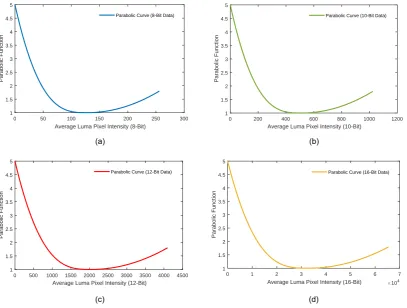
Figure 1. The curves derived from the parabolic function L(μY) in (1). Note that the subfigures are as follows: (a) corresponds to
the parabolic curve when b = 8 (8-bit luma data), (b) b = 10 (10-bit luma data), (c) b = 12 (12-bit luma data) and b = 16 (16-bit luma data). Note that, regardless of the bit depth of the luma data, the integrity of the parabolic curve is preserved.
Naccari’s and Mrak’s JND-based IDSQ method in [27] is founded upon the DCT-based JND technique proposed by X. Zhang et al. in [29]. In [29], X. Zhang et al. conclude that there is an intrinsic relationship between luminance adaptation, background luminance and the corresponding luma data in an image. Concerning luminance adaptation, the authors of [29] assert that the contrast threshold for luminance exhibits a parabolic curve corresponding to CSF-related grey level luminance, from which a parabolic piecewise function is derived. Naccari and Mrak employ this piecewise function and recontextualise it for application in HEVC.
2.1 JND-Based Luminance Perceptual Quantisation
In Pixel-PAQ, the aforementioned parabolic piecewise function, which also constitutes the luma JND visibility threshold, denoted as L(μY), is utilised as a weight to perceptually increase the luma
QStep in HEVC. Function L(μY) is computed in (1):
2 2
1 1, if
2 2
2 1 1, otherwise 2 d b Y Y b Y f Y b a L c (1)
where parameters a, c, d and f are set to values 2, 0.8, 3 and 2, respectively. These parameter values are selected by X. Zhang et al. in [29] to determine the shape of the spatial CSF-related luminance adaptation parabolic curve (see Figure 1).
(a) (b)
In [29], X. Zhang et al. approximate the shape of the parabola, as shown in Figure 1 (a), based on the luminance spatial CSF psychophysical experiments conducted by Ahumada and Peterson in [21]. Somewhat dissimilar to Eq. (1) in [27], we replace value 256 with 2b — where b denotes the bit depth of the data — in (1) to extend the dynamic range capacity. This ensures that Pixel-PAQ is compatible with luma data of any bit depth. Furthermore, the integrity of the parabolic curve, as shown in Figure 1, is preserved regardless of the value of b in (1).
Assuming that value 256 in Eq. (1) in [27] is replaced with 2b in (1), L(μY) can therefore be utilised
in perceptual quantisation techniques for luma data of any bit depth. Furthermore, it is important to note that the mean values for the full range of luma data for any bit depth — i.e., (0+256/2) for 8-bit data, (0+1024/2) for 10-bit data, (0+4096/2) for 12-bit data and (0+65536/2) for 16-bit data — equates to a perceptually identical shade of greyscale colour in the luma component.
In (1), variable μY denotes the mean raw sample value in a luma CB; μY is computed in (2):
2 2 1
1
2 2 n
N N
Y n wY
N N
(2)where 2N×2N denotes the number of sample values in a luma CB and where variable wY refers to
the nth sample value in a luma CB. To reiterate, we compute μY from the original, raw sample
values at the luma CB level.
There is a binary logarithmic relationship between the QP and the QStep in URQ in HEVC; this is the case for both slice-level and CB-level luma and chroma quantisation. In the luminance JND aspect of Pixel-PAQ, the primary objective is to perceptually increase the luma QStep by weighing it with L(μY). In URQ in HEVC, the luma QP (denoted as QPY) and the luma QStep
(denoted as QStepY) are computed in (3) and (4), respectively.
6 log2
4Y Y Y
QP QStep QStep (3)
2 6 4Y
QP
Y Y
QStep QP
(4)
The quantisation-induced error after the reconstruction of the luma data (denoted as qY) is only
perceptually discernible if it exceeds the luma JND visibility threshold L(μY). Visually lossless
coding is therefore achieved if |qY| ≤ L(μY).
To reiterate, the luma QStep that incurs the maximum amount of perceptually indiscernible quantisation-induced distortion is achieved by adaptively weighing QStepY with L(μY). Therefore,
the CB-level JND-based perceptual luma QStep, denoted as PStepY, is quantified in (5).
Y Y Y
PStep QStep L (5)
Accordingly, the CB-level JND-based perceptual luma QP, denoted as PQPY, is computed in (6).
6 log2
4Y Y Y
2.2 JND-Based Chrominance Perceptual Quantisation
In [30], Naccari and Pereira propose a JND-based quantisation matrix technique for the Advanced Video Coding (AVC) standard. In this work, the authors assert that spatial CSF-related perceptual masking is similar for both luma and chroma data; this is based on the assumption that the corresponding spatial CSFs exhibit similar properties. As such, Naccari and Pereira in [30] apply the same JND threshold for luma and chroma perceptual quantisation. Although the luminance spatial CSF and the chrominance spatial CSF share somewhat similar properties [31], there are obvious differences between the two, especially in relation to the comparative sensitivity of the HVS to achromatic data and chromatic data in compressed video data [32, 33].
In Pixel-PAQ, relatively similar piecewise functions to (1) are utilised for the CB-level JND-based perceptual quantisation of chroma Cb and Cr data. The corresponding chrominance piecewise functions, denoted as CCb(μCb) and CCr(μCr), are related to chrominance CSF; i.e., based on the
relationship between luminance adaptation and its impact on chroma Cb and Cr data. The mean values of CCb(μCb) and CCr(μCr) are denoted as μCCb and μCCr, respectively, which are utilised to
perceptually weigh the Cb and Cr QSteps. Functions CCb(μCb) and CCr(μCr), which constitute the
chroma Cb and Cr JND visibility thresholds, are computed in (7) and (8), respectively:
1 if1 if 1
, otherwise
2 1 1
Cb
Cb
Cb Cb Cb
Cb b
g
h h g
C h j
j k j (7)
1 if1 if 1
, otherwise
2 1 1
Cr
Cr
Cr Cr Cr
Cr b
g
h h g
C h j
j k j (8)
where parameters g, h, j and k are set to values 3, 85, 90 and 3, respectively. Similar to the way in which Naccari and Mrak adopt parameter values a, c, d and f in [27] for IDSQ (i.e., based on the psychophysical research conducted by X. Zhang et al. in [29]), the values for parameters g, h, j and k in (7) and (8) are selected based on the chrominance psychophysical experiments conducted by Wang et al. in [32]. In [32], the authors conduct psychophysical experiments regarding the overlapping effect of luminance adaptation in the chrominance Cb and Cr channels, from which the values for g, h, j and k are derived. It is important to note that the data in the chroma Cb and Cr channels share very similar spatial properties [32, 33]; therefore, parameter values g, h, j and k are employed in both (7) and (8). Variables μCb and μCr denote the mean raw chroma sample values in
chroma Cb and Cr CBs, respectively; they are computed in (9) and (10), respectively:
1
1
m
M
Cb M m zCb
(9)1
1
m
M
Cr m sCr
M
Figure 2. The sizes of Y, Cb and Cr CBs in a 2N×2N CU in HEVC: Y (grey), Cb (blue), Cr (red). Each subfigure specifies the size of Cb and Cr CBs for different raw video data: (a) for 4:4:4 YCbCr video data, the CB sizes for Y, Cb and Cr are all 2N×2N, (b) for YCbCr 4:2:2 video data, the CB sizes are as follows: YCB = 2N×2N, CbCB = (2N/2)×2N and CrCB = (2N/2)×2N. (c) for
YCbCr 4:2:0 video data, the CB sizes are as follows: YCB = 2N×2N, CbCB = (2N/2)×(2N/2) and CrCB = (2N/2)×(2N/2).
where M denotes the number of sample values in the chroma Cb and Cr CBs, variable zCb refers to
the mth sample value in a Cb CB and variable sCr refers to the mth sample value in a Cr CB. Unlike
the number of sample values in Y CBs, and also due to potential chroma subsampling, M is not a fixed value. Moreover, note that Cb and Cr CBs are always identical in size regardless of the chroma sampling ratio (e.g., 4:4:4, 4:2:2 or 4:2:0) — see Figure 2. As is the case with QPY and
QStepY in (3) and (4), respectively, in URQ there is a binary logarithmic relationship between the
chroma Cb and Cr QPs (denoted as QPCb and QPCr, respectively) and the chroma Cb and Cr
QSteps (denoted as QStepCb and QStepCr, respectively). Accordingly, QPCb, QStepCb, QPCr and
QStepCr are computed in (11)-(14), respectively:
6 log2
4Cb Cb Cb
QP QStep QStep (11)
2 6 4Cb
QP
Cb Cb
QStep QP
(12)
6 log2
4Cr Cr Cr
QP QStep QStep (13)
2 6 4Cr
QP
Cr Cr
QStep QP
(14)
Recall that the HVS is significantly more sensitive to spatial contrast in luminance data compared with the corresponding spatial contrast sensitivity response to chromatic data. This correlates with the well established fact that the HVS is considerably less sensitive to gradations — including quantisation-induced compression artifacts — in compressed chroma data. This is the main reason why chrominance data can be quantised much more aggressively, especially high variance chroma data. To reiterate, quantisation-induced compression artifacts are vastly more perceptible in reconstructed luma data; this is primarily due to the fact that the luma channel contains all of the fine details in YCbCr pictures [34].
The quantisation-induced errors after the reconstruction of chroma Cb and Cr data, denoted as qCb
and qCr, respectively, are perceptually discernible if they exceed the chroma Cb and Cr JND
visibility thresholds CCb(μCb) and CCr(μCr), respectively. Visually lossless coding is achieved if
|qCb| ≤ CCb(μCb) and |qCr| ≤ CCr(μCr).
2N×2N
2N×2N
2N×2N
(2N/2)×2N
2N×2N
(2N/2)×2N
(2N/2)×(2N/2) (2N/2)×(2N/2)
2N×2N
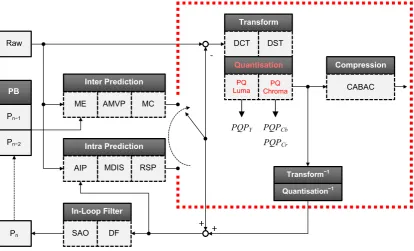
Figure 3. A block diagram which shows the proposed Pixel-PAQ method implemented into the JCT-VC HEVC HM encoder. The red dotted line and the red text indicate the areas within the HEVC coding pipeline in which the proposed method is implemented. Note that variables PQPY, PQPCb and PQPCr denote the perceptually adaptive QPs.
To achieve the JND-based perceptual quantisation of chroma Cb and Cr data, QStepCb and QStepCr
are weighed with μCCb and μCCr, respectively. The chroma perceptual QSteps and QPs, denoted as
PStepCb, PStepCr, PQPCb and PQPCr, are computed in (15)-(18), respectively.
Cb Cb Cb
PStep QStep C (15)
6 log2
4Cb Cb Cb
PQP PStep PStep (16)
Cr Cr Cr
PStep QStep C (17)
6 log2
4Cr Cr Cr
PQP PStep PStep (18)
In relation to the initial QPs utilised to evaluate Pixel-PAQ (i.e., QPs 22, 27, 32 and 37), the proposed method is implemented into HEVC HM by exploiting the CB-level chroma Cb and Cr QP offset signalling mechanism provided by JCT-VC [35, 36]. Therefore, the Cb and Cr QPs are perceptually increased at the CB level by offsetting them against PQPY. These QP and QStep
offsets, denoted as OQPCb, OStepCb, OQPCr and OStepCr, respectively, are quantified in (19)-(22).
3 Cb
Cb Cb Y
OQP C P PQ C (19)
2 36 4Y Cb
PQP C
Cb Cb
OStep C
(20)
3 Cr
Cr Cr Y
OQP C P PQ C (21)
2 36 4Y Cr
PQP C
Cr Cr
OStep C
(22)
Transform
Quantisation Compression
DCT DST
PQ
Luma Chroma PQ CABAC
Transform−1
Quantisation−1
PQPY
Inter Prediction
Intra Prediction
ME
AIP
In-Loop Filter
Raw
AMVP MC
MDIS RSP
SAO DF
PB
Pn
Pn−1
Pn−2
PQPCb
In relation to the aforementioned CB-level chroma Cb and Cr QP offset signalling technique present in the latest versions of JCT-VC HEVC HM [35, 36], this method is also exploited in our previously published perceptual quantisation contribution named FCPQ [37]. That is, we exploit the flexibility provided by JCT-VC in terms of signalling to the decoder — in the Picture Parameter Set (PPS) — chroma QP offsets at the CB level. The signalling of CB-level Cb and Cr QP offsets in the PPS proved to be particularly advantageous for FCPQ, primarily because it allows for a straightforward encoder side implementation (see Figure 3). In essence, by employing this chroma QP offset scheme, all of the CB-level quantisation-related data can be efficiently transmitted to the decoder; this ensures that the perceptually compressed video is correctly decoded and reconstructed. Furthermore, the mean raw Y, Cb and Cr sample values can be accounted for without affecting coding efficiency and computational complexity.
3.0 Evaluation, Results and Discussion
Pixel-PAQ is evaluated and compared with Naccari’s and Mrak’s JND-based IDSQ technique in [27], which has been previously proposed for the HEVC standard. It is important to affirm that IDSQ has been shown to significantly outperform both URQ and RDOQ [27] (i.e., the default scalar quantisation techniques in HEVC); furthermore, RDOQ is disabled in all tests. Pixel-PAQ is implemented into JCT-VC HEVC HM 16.7 and the method is tested on 18 official JCT-VC test sequences; namely, the proposed method is evaluated on the YCbCr 4:2:0, 4:2:2 and 4:4:4 versions of BirdsInCage, DuckAndLegs, Kimono, OldTownCross, ParkScene and Traffic. All of these sequences comprise a spatial resolution of HD 1080p (1920×1080). The 4:4:4 and 4:2:2 versions of these sequences contain a higher dynamic range (i.e., 10-bits per pixel per channel, which equates to 30-bits per pixel), whereas the 4:2:0 versions comprise 8-bits per pixel per channel. In our previously published work in [37], we provide empirical evidence that an absence of chroma subsampling in addition to a higher dynamic range for each colour channel are significantly advantageous for the perceptual quantisation of YCbCr data; this is particularly pertinent to 4:4:4 data. Therefore, this is the primary reason for employing a similar experimental setup to the one conducted in [37].
Objective visual quality evaluations are undertaken which correspond, as closely as possible, to the Common Test Conditions and Software Reference Configurations recommended by JCT-VC [38]; this is a common experimental setup utilised in contemporary HEVC research for lossy coding techniques. This includes testing techniques with four QP data points (i.e., initial QPs 22, 27, 32 and 37) with the All Intra (AI) and Random Access (RA) encoding configurations [38]. In the objective evaluation, the SSIM [39] and PNSR visual quality metrics are employed to assess the mathematical reconstruction quality of the Pixel-PAQ and IDSQ coded videos.
Due to the fact that both Pixel-PAQ and IDSQ are JND-based and HVS-orientated perceptual video coding techniques, it is of paramount importance to undertake extensive subjective visual quality evaluations in addition to the aforementioned objective visual quality evaluation. In essence, the subjective visual quality evaluations are undoubtedly the most important set of experiments in terms of measuring the perceptual quality of a compressed video sequence, especially so for visually lossless coding and JND-based techniques. As such, the United Nations’ ITU-T standardised subjective evaluation procedure entitled Subjective Video Quality Assessment
Methods (ITU-T P.910 [40]) is employed. In the ITU-T P.910 subjective evaluation, the following
conditions are recommended:
Number of participants ≥ 4 and ≤ 40;
Viewing distance: 1-8 × H, where H is the height of the TV/VDU;
Compute Mean Opinion Score (MOS);
3.1 Bitrate Reductions and Objective Visual Quality Evaluations
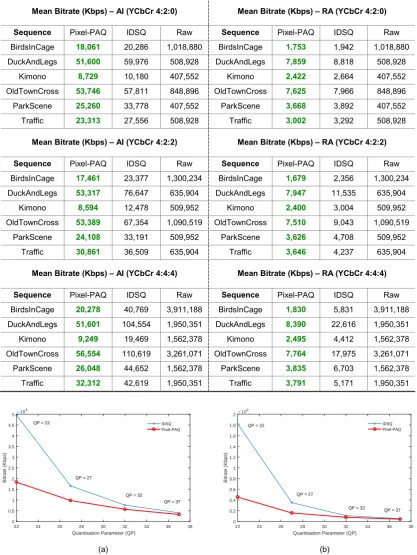
Table 1: The overall bitrate reductions attained, per sequence, for the proposed Pixel-PAQ technique compared with IDSQ and the raw video data. In the Pixel-PAQ and IDSQ tests, the bitrates — in Kbps — are averaged over four QP data points (i.e., initial QPs 22, 27, 37 and 37). The AI results are shown on the left; the RA results are shown on the right. The green text indicates superior results (i.e., lower bitrates).
Mean Bitrate (Kbps) – AI (YCbCr 4:2:0) Mean Bitrate (Kbps) – RA (YCbCr 4:2:0)
Sequence Pixel-PAQ IDSQ Raw Sequence Pixel-PAQ IDSQ Raw
BirdsInCage 18,061 20,286 1,018,880 BirdsInCage 1,753 1,942 1,018,880
DuckAndLegs 51,600 59,976 508,928 DuckAndLegs 7,859 8,818 508,928
Kimono 8,729 10,180 407,552 Kimono 2,422 2,664 407,552
OldTownCross 53,746 57,811 848,896 OldTownCross 7,625 7,966 848,896
ParkScene 25,260 33,778 407,552 ParkScene 3,668 3,892 407,552
Traffic 23,313 27,556 508,928 Traffic 3,002 3,292 508,928
Mean Bitrate (Kbps) – AI (YCbCr 4:2:2) Mean Bitrate (Kbps) – RA (YCbCr 4:2:2)
Sequence Pixel-PAQ IDSQ Raw Sequence Pixel-PAQ IDSQ Raw
BirdsInCage 17,461 23,377 1,300,234 BirdsInCage 1,679 2,356 1,300,234
DuckAndLegs 53,317 76,647 635,904 DuckAndLegs 7,947 11,535 635,904
Kimono 8,594 12,478 509,952 Kimono 2,400 3,004 509,952
OldTownCross 53,389 67,354 1,090,519 OldTownCross 7,510 9,043 1,090,519
ParkScene 24,108 33,191 509,952 ParkScene 3,626 4,708 509,952
Traffic 30,861 36,509 635,904 Traffic 3,646 4,237 635,904
Mean Bitrate (Kbps) – AI (YCbCr 4:4:4) Mean Bitrate (Kbps) – RA (YCbCr 4:4:4)
Sequence Pixel-PAQ IDSQ Raw Sequence Pixel-PAQ IDSQ Raw
BirdsInCage 20,278 40,769 3,911,188 BirdsInCage 1,830 5,831 3,911,188
DuckAndLegs 51,601 104,554 1,950,351 DuckAndLegs 8,390 22,616 1,950,351
Kimono 9,249 19,469 1,562,378 Kimono 2,495 4,412 1,562,378
OldTownCross 56,554 110,619 3,261,071 OldTownCross 7,764 17,975 3,261,071
ParkScene 26,048 44,652 1,562,378 ParkScene 3,835 6,703 1,562,378
Traffic 32,312 42,619 1,950,351 Traffic 3,791 5,171 1,950,351
22 24 26 28 30 32 34 36 38
Quantisation Parameter (QP)
0 0.5 1 1.5 2 2.5 3 3.5 4 4.5 5
Bitrate (Kbps)
104
IDSQ Pixel-PAQ QP = 22
QP = 27
QP = 32
QP = 37
22 24 26 Quantisation Parameter (QP)28 30 32 34 36 38
0 0.2 0.4 0.6 0.8 1 1.2 1.4 1.6 1.8 2
Bitrate (Kbps)
104
IDSQ Pixel-PAQ QP = 22
QP = 27
QP = 32
QP = 37
Figure 4: Two plots which highlight the bitrate reductions attained by Pixel-PAQ compared with IDSQ. The subfigures show the bitrate reductions achieved by IDSQ on the following sequences. Subfigure (a): Kimono 4:4:4 (AI). Subfigure (b): BirdsInCage 4:4:4 (RA).
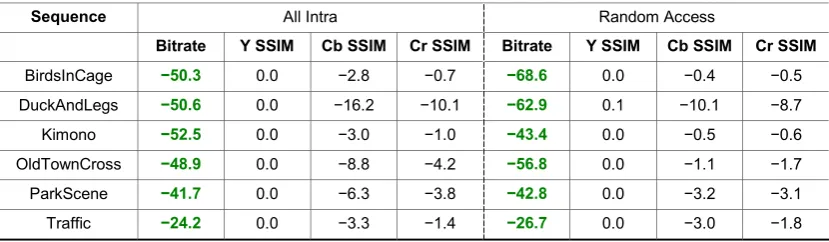
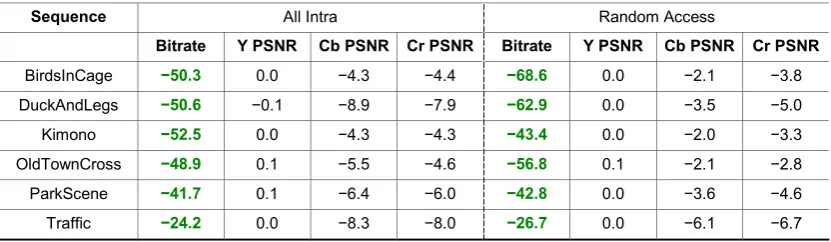
Table 2: The bitrate reduction percentages (in green text), per sequence, attained for the proposed Pixel-PAQ technique compared with IDSQ. In addition, the decreased reconstruction quality (per channel) for sequences coded by Pixel-PAQ, as quantified by SSIM percentage decreases, are tabulated. The bitrate reductions are averaged over four QP data points (i.e., initial QPs 22, 27, 37 and 37). The AI results are shown on the left; the RA results are shown on the right.
Overall Bitrate (%) Per Sequence and SSIM (%) Per Channel: Pixel-PAQ Versus IDSQ (YCbCr 4:2:0)
Sequence All Intra Random Access
Bitrate Y SSIM Cb SSIM Cr SSIM Bitrate Y SSIM Cb SSIM Cr SSIM
BirdsInCage −11.0 0.0 −0.4 −0.3 −9.7 0.0 −0.3 −0.3
DuckAndLegs −14.0 0.0 −4.7 −4.3 −10.9 0.0 −3.5 −3.9
Kimono −14.3 0.0 −0.8 −0.6 −9.1 0.0 −0.4 −0.4
OldTownCross −7.0 0.0 −1.1 −1.2 −4.3 0.0 −0.8 −1.0
ParkScene −8.3 0.0 −2.1 −0.8 −5.7 0.0 −1.7 −0.7
Traffic −11.0 0.0 −1.9 −1.1 −8.8 0.0 −1.6 −1.0
Overall Bitrate (%) Per Sequence and SSIM (%) Per Channel: Pixel-PAQ Versus IDSQ (YCbCr 4:2:2)
Sequence All Intra Random Access
Bitrate Y SSIM Cb SSIM Cr SSIM Bitrate Y SSIM Cb SSIM Cr SSIM
BirdsInCage −25.3 0.0 −1.0 −0.9 −28.7 0.0 −0.4 −0.5
DuckAndLegs −30.4 0.0 −9.6 −7.6 −31.1 0.0 −5.5 −7.1
Kimono −31.1 0.0 −1.6 −0.8 −20.1 0.0 −0.5 −0.5
OldTownCross −20.7 0.0 −3.1 −2.8 −16.9 0.0 −1.1 −1.4
ParkScene −27.4 0.1 −4.7 −2.9 −23.0 0.0 −3.0 −2.4
Traffic −15.5 0.0 −3.4 −1.8 −13.9 0.0 −2.8 −1.5
Overall Bitrate (%) Per Sequence and SSIM (%) Per Channel: Pixel-PAQ Versus IDSQ (YCbCr 4:4:4)
Sequence All Intra Random Access
Bitrate Y SSIM Cb SSIM Cr SSIM Bitrate Y SSIM Cb SSIM Cr SSIM
BirdsInCage −50.3 0.0 −2.8 −0.7 −68.6 0.0 −0.4 −0.5
DuckAndLegs −50.6 0.0 −16.2 −10.1 −62.9 0.1 −10.1 −8.7
Kimono −52.5 0.0 −3.0 −1.0 −43.4 0.0 −0.5 −0.6
OldTownCross −48.9 0.0 −8.8 −4.2 −56.8 0.0 −1.1 −1.7
ParkScene −41.7 0.0 −6.3 −3.8 −42.8 0.0 −3.2 −3.1
Traffic −24.2 0.0 −3.3 −1.4 −26.7 0.0 −3.0 −1.8
[image:13.595.90.505.437.558.2](a) Pixel-PAQ Coded Inter-Frame (RA, QP = 22)
[image:14.595.93.505.72.304.2](b) Raw Data
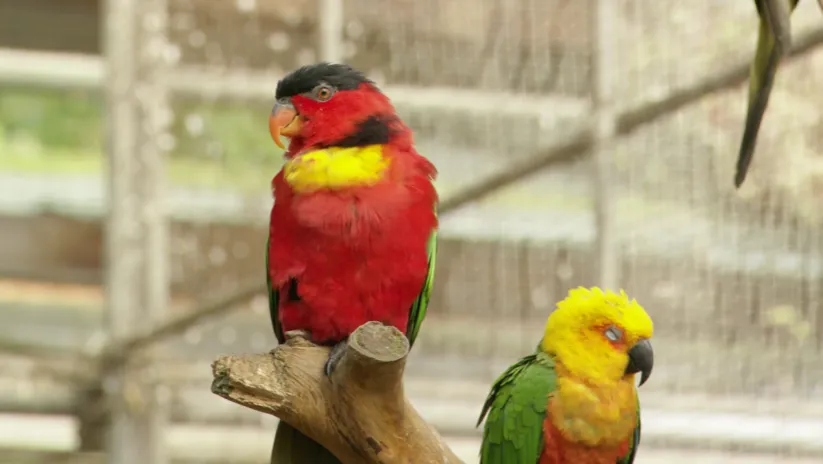
Figure 5: A frame from the BirdsInCage 4:4:4 sequence. Subfigure (a) is a Pixel-PAQ coded inter-frame from this sequence (RA QP = 22 test). Subfigure (b) is the corresponding raw data. In spite of the extremely high bitrate reduction of 75% for this particular test (see Table 1 and Table 2), the Pixel-PAQ coded sequence in (a) is perceptually indistinguishable from the raw data in (b); this is also confirmed in the subjective evaluations.
Table 3: The bitrate reduction percentages (in green text), per sequence, attained for the proposed Pixel-PAQ technique compared with IDSQ. In addition, the decreased reconstruction quality (per channel) for sequences coded by Pixel-PAQ, as quantified by PSNR percentage decreases, are tabulated. The bitrate reductions are averaged over four QP data points (i.e., initial QPs 22, 27, 37 and 37). The AI results are shown on the left; the RA results are shown on the right.
Overall Bitrate (%) Per Sequence and PSNR (%) Per Channel: Pixel-PAQ Versus IDSQ (YCbCr 4:2:0)
Sequence All Intra Random Access
Bitrate Y PSNR Cb PSNR Cr PSNR Bitrate Y PSNR Cb PSNR Cr PSNR
BirdsInCage −11.0 0.0 −4.0 −5.2 −9.7 0.0 −3.2 −4.7
DuckAndLegs −14.0 0.0 −5.7 −5.8 −10.9 0.0 −3.7 −4.5
Kimono −14.3 0.0 −4.5 −4.6 −9.1 0.0 −3.2 −3.0
OldTownCross −7.0 0.0 −3.5 −4.7 −4.3 0.0 −2.7 −3.9
ParkScene −8.3 0.0 −6.1 −4.4 −5.7 0.0 −5.1 −3.7
Traffic −11.0 0.1 −5.8 −5.5 −8.8 −0.1 −4.7 −4.9
Overall Bitrate (%) Per Sequence and PSNR (%) Per Channel: Pixel-PAQ Versus IDSQ (YCbCr 4:2:2)
Sequence All Intra Random Access
Bitrate Y PSNR Cb PSNR Cr PSNR Bitrate Y PSNR Cb PSNR Cr PSNR
BirdsInCage −25.3 0.0 −5.0 −7.0 −28.7 0.0 −3.4 −6.3
DuckAndLegs −30.4 0.0 −7.5 −7.4 −31.1 0.0 −3.8 −5.7
Kimono −31.1 0.0 −5.0 −5.6 −20.1 −0.1 −3.4 −4.3
OldTownCross −20.7 0.1 −4.9 −5.7 −16.9 0.0 −2.8 −4.4
ParkScene −27.4 0.0 −6.8 −6.1 −23.0 0.0 −4.7 −4.8
Traffic −15.5 0.0 −9.2 −8.4 −13.9 0.0 −7.4 −7.1
Overall Bitrate (%) Per Sequence and PSNR (%) Per Channel: Pixel-PAQ Versus IDSQ (YCbCr 4:4:4)
Sequence All Intra Random Access
Bitrate Y PSNR Cb PSNR Cr PSNR Bitrate Y PSNR Cb PSNR Cr PSNR
BirdsInCage −50.3 0.0 −4.3 −4.4 −68.6 0.0 −2.1 −3.8
DuckAndLegs −50.6 −0.1 −8.9 −7.9 −62.9 0.0 −3.5 −5.0
Kimono −52.5 0.0 −4.3 −4.3 −43.4 0.0 −2.0 −3.3
OldTownCross −48.9 0.1 −5.5 −4.6 −56.8 0.1 −2.1 −2.8
ParkScene −41.7 0.1 −6.4 −6.0 −42.8 0.0 −3.6 −4.6
Traffic −24.2 0.0 −8.3 −8.0 −26.7 0.0 −6.1 −6.7
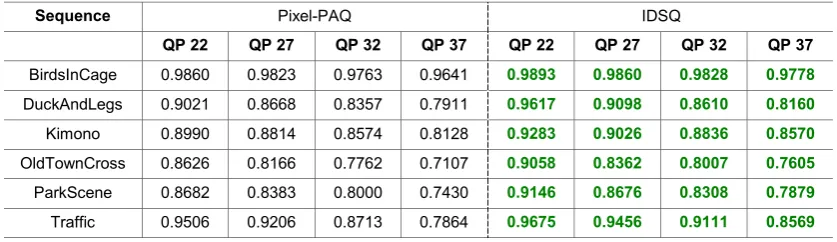
[image:15.595.90.506.437.558.2]Table 4: The ‘per sequence’ SSIM results (AI) for ‘Pixel-PAQ versus the raw data’ compared with ‘IDSQ versus the raw data’ (initial QPs 22, 27, 32 and 37). The superior SSIM results (IDSQ) are shown in green text.
Mean SSIM Values (Per Sequence, Per QP): Pixel-PAQ Versus IDSQ (YCbCr 4:2:0) – All Intra
Sequence Pixel-PAQ IDSQ
QP 22 QP 27 QP 32 QP 37 QP 22 QP 27 QP 32 QP 37
BirdsInCage 0.9884 0.9852 0.9821 0.9768 0.9907 0.9879 0.9850 0.9813
DuckAndLegs 0.9320 0.9005 0.8765 0.8369 0.9613 0.9195 0.8884 0.8509
Kimono 0.9227 0.9069 0.8926 0.8662 0.9396 0.9235 0.9063 0.8853
OldTownCross 0.9015 0.8534 0.8222 0.7811 0.9157 0.8660 0.8337 0.7958
ParkScene 0.9399 0.9138 0.8803 0.8292 0.9555 0.9302 0.8937 0.8463
Traffic 0.9461 0.9226 0.8953 0.8493 0.9615 0.9411 0.9128 0.8754
Mean SSIM Values (Per Sequence, Per QP): Pixel-PAQ Versus IDSQ (YCbCr 4:2:2) – All Intra
Sequence Pixel-PAQ IDSQ
QP 22 QP 27 QP 32 QP 37 QP 22 QP 27 QP 32 QP 37
BirdsInCage 0.9860 0.9823 0.9763 0.9641 0.9893 0.9860 0.9828 0.9778
DuckAndLegs 0.9021 0.8668 0.8357 0.7911 0.9617 0.9098 0.8610 0.8160
Kimono 0.8990 0.8814 0.8574 0.8128 0.9283 0.9026 0.8836 0.8570
OldTownCross 0.8626 0.8166 0.7762 0.7107 0.9058 0.8362 0.8007 0.7605
ParkScene 0.8682 0.8383 0.8000 0.7430 0.9146 0.8676 0.8308 0.7879
Traffic 0.9506 0.9206 0.8713 0.7864 0.9675 0.9456 0.9111 0.8569
Mean SSIM Values (Per Sequence, Per QP): Pixel-PAQ Versus IDSQ (YCbCr 4:4:4) – All Intra
Sequence Pixel-PAQ IDSQ
QP 22 QP 27 QP 32 QP 37 QP 22 QP 27 QP 32 QP 37
BirdsInCage 0.9790 0.9759 0.9717 0.9653 0.9856 0.9803 0.9761 0.9721
DuckAndLegs 0.8897 0.8396 0.8086 0.7697 0.9709 0.9183 0.8479 0.7924
Kimono 0.8792 0.8635 0.8437 0.8156 0.9279 0.8864 0.8642 0.8407
OldTownCross 0.8001 0.7515 0.7205 0.6823 0.9135 0.8122 0.7391 0.6992
ParkScene 0.8554 0.8268 0.7940 0.7527 0.9212 0.8623 0.8197 0.7774
Traffic 0.9535 0.9282 0.8888 0.8271 0.9686 0.9473 0.9157 0.8682
22 24 26 28 30 32 34 36 38
Quantisation Parameter (QP)
0.65 0.7 0.75 0.8 0.85 0.9 0.95
OldTownCross 4:4:4 AI SSIM Value
IDSQ Pixel-PAQ QP = 22
QP = 27
QP = 32
QP = 37
22 24 26 Quantisation Parameter (QP)28 30 32 34 36 38
0.74 0.76 0.78 0.8 0.82 0.84 0.86 0.88 0.9 0.92
DuckAndLegs 4:4:4 RA SSIM Value
IDSQ Pixel-PAQ QP = 22
QP = 27
QP = 32
QP = 37
Figure 6: Two plots which highlight the inferior mathematical reconstruction quality of Pixel-PAQ coded sequences versus IDSQ coded sequences, over four QP data points (i.e., QPs 22, 27, 32 and 37), as quantified by the SSIM metric. Subfigure (a): OldTownCross 4:4:4 (AI). Subfigure (b): DuckAndLegs 4:4:4 (RA).
[image:16.595.91.506.413.704.2](a) Luma Channel
(b) Chroma Cb Channel
[image:17.595.148.449.71.240.2](c) Chroma Cr Channel
(a) Pixel-PAQ Coded Intra-Frame (AI, QP = 22)
[image:18.595.94.507.71.303.2](b) Raw Data
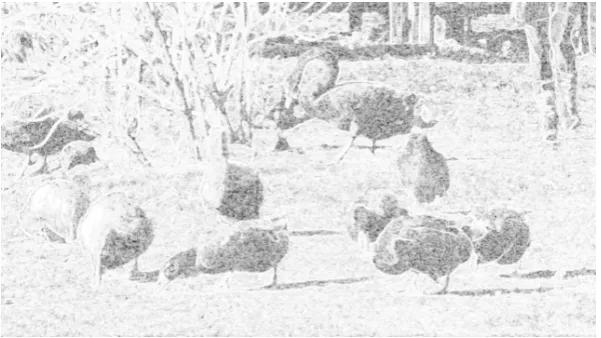
Figure 8: A frame from the DuckAndLegs 4:4:4 sequence. Subfigure (a) is a Pixel-PAQ coded intra-frame from this sequence (AI QP = 22 test). Subfigure (b) is the corresponding raw data. Note that, despite the poor mathematical reconstruction quality of the data in the chroma Cb and Cr channels, as quantified by SSIM (see Figure 7), the Pixel-PAQ coded sequence in (a) is perceptually indistinguishable from the raw data in (b); this is confirmed in the subjective evaluations.
[image:18.595.91.506.333.578.2]Table 5: The ‘per sequence’ SSIM results (RA) for ‘Pixel-PAQ versus the raw data’ compared with ‘IDSQ versus the raw data’ (initial QPs 22, 27, 32 and 37). The superior SSIM results are shown in green text.
Mean SSIM Values (Per Sequence, Per QP): Pixel-PAQ Versus IDSQ (YCbCr 4:2:0) – Random Access
Sequence Pixel-PAQ IDSQ
QP 22 QP 27 QP 32 QP 37 QP 22 QP 27 QP 32 QP 37
BirdsInCage 0.9883 0.9860 0.9832 0.9782 0.9898 0.9882 0.9857 0.9825
DuckAndLegs 0.9060 0.8897 0.8666 0.8250 0.9196 0.9035 0.8770 0.8381
Kimono 0.9136 0.9002 0.8836 0.8584 0.9251 0.9120 0.8947 0.8749
OldTownCross 0.8565 0.8445 0.8275 0.7930 0.8640 0.8543 0.8374 0.8056
ParkScene 0.9361 0.9112 0.8780 0.8284 0.9480 0.9245 0.8909 0.8459
Traffic 0.9463 0.9267 0.9025 0.8602 0.9573 0.9408 0.9167 0.8838
Mean SSIM Values (Per Sequence, Per QP): Pixel-PAQ Versus IDSQ (YCbCr 4:2:2) – Random Access
Sequence Pixel-PAQ IDSQ
QP 22 QP 27 QP 32 QP 37 QP 22 QP 27 QP 32 QP 37
BirdsInCage 0.9856 0.9830 0.9780 0.9673 0.9869 0.9856 0.9831 0.9789
DuckAndLegs 0.8794 0.8591 0.8292 0.7856 0.8954 0.8797 0.8512 0.8065
Kimono 0.8954 0.8766 0.8538 0.8164 0.9016 0.8907 0.8734 0.8492
OldTownCross 0.8171 0.8034 0.7798 0.7324 0.8220 0.8145 0.7977 0.7646
ParkScene 0.8665 0.8421 0.8079 0.7535 0.8816 0.8625 0.8322 0.7919
Traffic 0.9519 0.9276 0.8844 0.8108 0.9634 0.9460 0.9171 0.8693
Mean SSIM Values (Per Sequence, Per QP): Pixel-PAQ Versus IDSQ (YCbCr 4:4:4) – Random Access
Sequence Pixel-PAQ IDSQ
QP 22 QP 27 QP 32 QP 37 QP 22 QP 27 QP 32 QP 37
BirdsInCage 0.9777 0.9759 0.9725 0.9666 0.9783 0.9774 0.9756 0.9724
DuckAndLegs 0.8531 0.8313 0.7998 0.7586 0.9030 0.8514 0.8237 0.7790
Kimono 0.8702 0.8574 0.8386 0.8127 0.8761 0.8673 0.8522 0.8316
OldTownCross 0.7504 0.7398 0.7205 0.6868 0.7492 0.7467 0.7326 0.7035
ParkScene 0.8534 0.8303 0.7994 0.7581 0.8637 0.8473 0.8204 0.7825
Traffic 0.9533 0.9322 0.8983 0.8433 0.9620 0.9458 0.9191 0.8771
22 24 26 28 30 32 34 36 38
Quantisation Parameter (QP)
0 0.5 1 1.5 2 2.5 3 3.5 4 4.5 5
Bitrate (Kbps)
104
IDSQ Pixel-PAQ QP = 22
QP = 27
QP = 32
QP = 37
22 24 26 28 30 32 34 36 38
Quantisation Parameter (QP)
0 0.2 0.4 0.6 0.8 1 1.2 1.4 1.6 1.8 2
Bitrate (Kbps)
104
IDSQ Pixel-PAQ QP = 22
QP = 27
[image:19.595.91.506.408.710.2]QP = 32 QP = 37
Figure 9. Two plots which highlight the bitrate reductions attained by Pixel-PAQ compared with IDSQ. Subfigure (a) shows the bitrate reductions achieved by Pixel-PAQ on the Kimono 4:4:4 sequence using the AI encoding configuration. Subfigure (b) shows the bitrate reductions achieved by Pixel-PAQ on the BirdsInCage 4:4:4 sequence using the RA encoding configuration.
Table 6: The ‘per sequence’ PSNR (dB) results (AI) for ‘Pixel-PAQ versus the raw data’ compared with ‘IDSQ versus the raw data’ (initial QPs 22, 27, 32 and 37). The superior SSIM results are shown in green text.
Mean PSNR (dB) Per Sequence, Per QP: Pixel-PAQ Versus IDSQ (YCbCr 4:2:0) – All Intra
Sequence Pixel-PAQ IDSQ
QP 22 QP 27 QP 32 QP 37 QP 22 QP 27 QP 32 QP 37
BirdsInCage 37.5180 36.0085 34.8799 33.3267 38.8655 37.1534 35.7128 34.2626
DuckAndLegs 31.7584 29.8392 28.6015 26.9424 34.8509 31.3556 29.3250 27.5127
Kimono 35.8659 34.5481 33.5125 31.8994 37.5313 35.9396 34.4053 32.7964
OldTownCross 33.8187 31.8953 30.6139 29.0512 35.0655 32.7264 31.1386 29.5463
ParkScene 34.6698 32.5783 30.7900 28.7431 36.9332 34.0121 31.4805 29.2620
Traffic 35.2647 33.1950 31.5932 29.5243 37.2091 34.8116 32.5567 30.4404
Mean PSNR (dB) Per Sequence, Per QP: Pixel-PAQ Versus IDSQ (YCbCr 4:2:2) – All Intra
Sequence Pixel-PAQ IDSQ
QP 22 QP 27 QP 32 QP 37 QP 22 QP 27 QP 32 QP 37
BirdsInCage 36.6285 35.2130 33.6314 31.6704 38.2948 36.5251 35.1635 33.6036
DuckAndLegs 30.3503 28.6050 27.2242 25.8192 34.5193 30.7285 28.4722 26.6346
Kimono 35.0233 33.7931 32.3663 30.5674 36.7747 35.2219 33.8264 32.1149
OldTownCross 32.5675 30.9991 29.6107 27.9068 34.4299 31.9390 30.5069 28.9463
ParkScene 32.5660 30.8475 29.2602 27.6884 35.2745 32.7290 30.6848 28.8019
Traffic 34.9795 32.4327 29.9572 27.5877 37.6387 34.6954 31.9075 29.2406
Mean PSNR (dB) Per Sequence, Per QP: Pixel-PAQ Versus IDSQ (YCbCr 4:4:4) – All Intra
Sequence Pixel-PAQ IDSQ
QP 22 QP 27 QP 32 QP 37 QP 22 QP 27 QP 32 QP 37
BirdsInCage 34.8927 34.0048 33.0221 31.7821 37.2223 35.1969 33.8851 32.8186
DuckAndLegs 29.5754 27.8507 26.6800 25.4676 35.1345 30.5158 27.9026 26.1863
Kimono 34.3420 33.4135 32.2602 30.8592 36.4072 34.5038 33.3406 31.9085
OldTownCross 30.8036 29.7243 28.7834 27.6085 34.0635 30.8971 29.3628 28.1692
ParkScene 32.5565 30.9406 29.4304 27.9728 35.4066 32.7230 30.7505 28.8994
Traffic 35.3045 32.8423 30.4738 28.2057 37.8411 34.8627 32.1028 29.4800
22 24 26 28 30 32 34 36 38
Quantisation Parameter (QP)
24 26 28 30 32 34 36
DuckAndLegs 4:4:4 AI PSNR (dB)
IDSQ Pixel-PAQ QP = 22
QP = 27
QP = 32
QP = 37
22 24 26 28 30 32 34 36 38
Quantisation Parameter (QP)
24 25 26 27 28 29 30
DuckAndLegs 4:4:4 RA PSNR (dB)
IDSQ Pixel-PAQ
QP = 32 QP = 27
[image:20.595.91.504.410.713.2]QP = 37 QP = 22
Figure 10: Two plots which highlight the inferior mathematical reconstruction quality of Pixel-PAQ coded sequences versus IDSQ coded sequences, over four QP data points (i.e., QPs 22, 27, 32 and 37), using the SSIM metric. Subfigure (a): DuckAndLegs 4:4:4 (AI). Subfigure (b): DuckAndLegs 4:4:4 (RA).
Table 7: The ‘per sequence’ PSNR (dB) results (RA) for ‘Pixel-PAQ versus the raw data’ compared with ‘IDSQ versus the raw data’ (initial QPs 22, 27, 32 and 37). The superior SSIM results are shown in green text.
Mean PSNR (dB) Per Sequence, Per QP: Pixel-PAQ Versus IDSQ (YCbCr 4:2:0) – Random Access
Sequence Pixel-PAQ IDSQ
QP 22 QP 27 QP 32 QP 37 QP 22 QP 27 QP 32 QP 37
BirdsInCage 37.3938 36.3239 35.1878 33.6965 38.1668 37.2331 35.9925 34.6063
DuckAndLegs 30.2049 29.0677 27.8971 26.3244 31.4326 30.0737 28.4649 26.8022
Kimono 35.1974 34.0136 32.6811 31.1212 36.2523 34.8071 33.2019 31.6658
OldTownCross 32.3403 31.6902 30.8602 29.4741 32.8560 32.2676 31.3361 29.9690
ParkScene 34.2629 32.4221 30.7282 28.8326 35.7195 33.4312 31.3018 29.3340
Traffic 34.9042 33.2256 31.7335 29.8033 36.3045 34.3904 32.5393 30.6701
Mean PSNR (dB) Per Sequence, Per QP: Pixel-PAQ Versus IDSQ (YCbCr 4:2:2) – Random Access
Sequence Pixel-PAQ IDSQ
QP 22 QP 27 QP 32 QP 37 QP 22 QP 27 QP 32 QP 37
BirdsInCage 36.4532 35.5006 34.0949 32.1827 36.9894 36.4115 35.3608 33.9560
DuckAndLegs 29.1533 27.9895 26.7018 25.3548 30.2635 29.2285 27.7411 26.0493
Kimono 34.4255 33.2542 31.8061 30.1685 35.2015 34.1193 32.6956 31.1283
OldTownCross 31.4985 30.8881 29.9111 28.5249 31.8896 31.4928 30.6906 29.3754
ParkScene 32.1890 30.8004 29.3647 27.8868 33.4481 32.0739 30.4624 28.7974
Traffic 34.7826 32.6703 30.4097 28.1447 36.4386 34.3156 32.0356 29.5884
Mean PSNR (dB) Per Sequence, Per QP: Pixel-PAQ Versus IDSQ (YCbCr 4:4:4) – Random Access
Sequence Pixel-PAQ IDSQ
QP 22 QP 27 QP 32 QP 37 QP 22 QP 27 QP 32 QP 37
BirdsInCage 34.5736 34.1050 33.2660 32.1066 34.7232 34.4621 33.9179 33.0211
DuckAndLegs 28.0381 27.0870 25.9042 24.6768 29.5056 27.9400 26.7760 25.2985
Kimono 33.7630 32.8515 31.6309 30.2587 34.1753 33.4081 32.2495 30.9117
OldTownCross 30.0597 29.6798 29.0180 28.0228 30.1151 29.9754 29.4715 28.5145
ParkScene 32.1325 30.8363 29.4403 28.0782 32.9975 31.8978 30.4856 28.8733
Traffic 34.8858 32.9088 30.8086 28.6553 36.2828 34.2486 32.0847 29.8005
[image:21.595.88.506.416.537.2]Figure 11: A diagram which illustrates the viewing conditions of the subjective evaluations. This includes the screen size of the TV/VDU, the viewing distance of the participant from the TV/VDU and the environmental illuminance.
3.2 Subjective Visual Quality Evaluations
As regards the subjective evaluations, the main objective is as follows: to ascertain if Pixel-PAQ coded sequences differ from IDSQ coded sequences and the raw video data in terms of subjective perceptual quality; this is quantified by the Mean Opinion Score (MOS). MOS is employed such that each participant rates the comparative reconstruction quality of Pixel-PAQ coded video data according to following MOS values: 5 = Imperceptible (Visually Lossless); 4 = Very Slightly Perceptible; 3 = Moderately Perceptible; 2 = Significantly Perceptible; 1 = Extremely Obvious.
In accordance with the conditions specified in the ITU-R Rec. P.910 [40] subjective evaluation procedures, four individuals participated in all tests; recall that ITU-R Rec. P.910 stipulates a minimum of four participants. Furthermore, the viewing distance of the participants from the TV/VDU is 1.5m in all evaluations (1.5m ≈ 59.1 inch). Therefore, the height H of the TV/VDU is 15.7 inch and the viewing distance is approximately 4 × H. The lighting characteristics in relation to the environmental illumination were ≤ 20 lux (see Figure 11).
The four participants involved in the subjective evaluation procedure consisted of a mean age of approximately 36 years old. In terms of inclusion criteria, it is important to note that self-reported visual acuity was assessed prior to the commencement of the subjective evaluations. This is important because it ensures that the participants are able to reasonably assess the compressed video data without the need to consider visual distortions caused by ophthalmological ailments. As such, each participant involved in the assessment reported normal vision or corrected normal vision (i.e., an absence of severe ophthalmological conditions which typically affect central and peripheral vision including macular degeneration, photophobia, cataracts and glaucoma).
The computer hardware in the experimental setup consists of a desktop PC which contains an Intel Core i7-4770 CPU — 4 cores and 8 threads — running at 3.4 GHz per core. The volatile memory in the PC is as follows: 24 GB of Double Data Rate (Type 3) Synchronous Dynamic Random Access Memory (DDR3 SDRAM) running at a DRAM frequency of 680 MHz. The Graphics Processing Unit (GPU) installed in the PC is an NVIDIA GeForce 750 Ti. Note that the NVIDIA GeForce 750 Ti is an Ultra HD 4K and HDR-capable GPU that can support YCbCr 4:4:4 and RGB data of bit depths up to 12-bits per colour channel (i.e., 36-bits per pixel). Therefore, the higher dynamic ranges and also the lack of chroma subsampling in the raw 4:4:4 sequences are discernible (compared with the subsampled 4:2:0 8-bit sequences). The visual display hardware on which the subjective valuations are conducted is as follows: 1080p HD 32 Inch Samsung F5500
Screen Size = 32 Inch
Viewing Distance = 59.1 Inch
Table 8. The MOS results, rounded to the nearest integer, of four participants in the subjective evaluations for Pixel-PAQ versus IDSQ. The sequences viewed are coded with initial QPs 22, 27, 32 and 37 on the YCbCr 4:2:0, 4:2:2 4:4:4 versions of the following sequences: BirdsInCage, DuckAndLegs Kimono, OldTownCross, ParkScene and Traffic compressed using the AI and RA configurations. The AI results are shown on the left; the RA results are shown on the right.
Rounded Mean Opinion Score (Spatiotemporal Subjective Evaluation) – Pixel-PAQ versus IDSQ
Sequence YCbCr 4:2:0 All Intra YCbCr 4:2:0 Random Access
QP 22 QP 27 QP 32 QP 37 QP 22 QP 27 QP 32 QP 37
BirdsInCage 5 4 4 3 5 5 5 5
DuckAndLegs 5 5 5 5 5 5 5 5
Kimono 5 5 5 4 5 5 5 4
OldTownCross 5 5 4 4 5 5 5 4
ParkScene 5 4 3 2 5 5 5 4
Traffic 5 5 5 4 5 5 5 5
Rounded Mean Opinion Score (Spatiotemporal Subjective Evaluation) – Pixel-PAQ versus IDSQ
Sequence YCbCr 4:2:2 All Intra YCbCr 4:2:2 Random Access
QP 22 QP 27 QP 32 QP 37 QP 22 QP 27 QP 32 QP 37
BirdsInCage 5 5 4 2 5 5 4 3
DuckAndLegs 5 5 4 3 5 5 4 3
Kimono 5 5 4 3 5 5 4 2
OldTownCross 5 4 3 2 5 5 4 3
ParkScene 5 5 3 2 5 5 4 2
Traffic 5 5 3 2 5 5 5 4
Rounded Mean Opinion Score (Spatiotemporal Subjective Evaluation) – Pixel-PAQ versus IDSQ
Sequence YCbCr 4:4:4 All Intra YCbCr 4:4:4 Random Access
QP 22 QP 27 QP 32 QP 37 QP 22 QP 27 QP 32 QP 37
BirdsInCage 5 5 4 3 5 5 5 4
DuckAndLegs 5 5 5 5 5 5 5 5
Kimono 5 5 5 4 5 5 5 4
OldTownCross 5 5 4 4 5 5 4 4
ParkScene 5 5 4 3 5 5 4 4
Traffic 5 5 4 3 5 5 4 4
22 27 32 37
Quantisation Parameter (QP) 0
0.5 1 1.5 2 2.5 3 3.5 4 4.5 5
Mean Opinion Score (MOS)
Pixel-PAQ MOS
22 27Quantisation Parameter (QP)32 37 0
0.5 1 1.5 2 2.5 3 3.5 4 4.5 5
Mean Opinion Score (MOS)
[image:23.595.91.505.443.719.2]Pixel-PAQ MOS
Figure 12. Two bar graphs which show the Mean Opinion Score (MOS) for the proposed technique over four QP data points (i.e., QPs 22, 27, 32 and 37). Subfigure (a) shows the MOS for Pixel-PAQ versus IDSQ on the BirdsInCage 4:4:4 10-bit sequence using the RA configuration. Subfigure (b) shows the MOS for Pixel-PAQ versus the raw video data on the Traffic 4:4:4 10-bit sequence.
Table 9. The MOS results, rounded to the nearest integer, of four participants in the subjective evaluations for Pixel-PAQ versus the raw data. The sequences viewed are coded with initial QPs 22, 27, 32 and 37 on the YCbCr 4:2:0, 4:2:2 4:4:4 versions of the following sequences: BirdsInCage, DuckAndLegs Kimono, OldTownCross, ParkScene and Traffic compressed using the AI and RA configurations. The AI results are shown on the left; the RA results are shown on the right.
Rounded Mean Opinion Score (Spatiotemporal Subjective Evaluation) – Pixel-PAQ versus Raw Data
Sequence YCbCr 4:2:0 All Intra YCbCr 4:2:0 Random Access
QP 22 QP 27 QP 32 QP 37 QP 22 QP 27 QP 32 QP 37
BirdsInCage 4 3 2 2 5 4 4 3
DuckAndLegs 5 4 3 2 5 5 4 4
Kimono 4 4 3 2 5 4 3 2
OldTownCross 5 4 3 2 5 5 4 3
ParkScene 4 3 2 1 4 3 3 2
Traffic 5 5 4 2 5 5 4 4
Rounded Mean Opinion Score (Spatiotemporal Subjective Evaluation) – Pixel-PAQ versus Raw Data
Sequence YCbCr 4:2:2 All Intra YCbCr 4:2:2 Random Access
QP 22 QP 27 QP 32 QP 37 QP 22 QP 27 QP 32 QP 37
BirdsInCage 4 3 2 1 5 4 3 2
DuckAndLegs 5 5 4 3 5 5 4 3
Kimono 5 4 2 1 5 4 3 2
OldTownCross 5 4 2 1 5 4 2 2
ParkScene 5 4 2 1 5 5 4 2
Traffic 5 4 3 2 5 5 4 2
Rounded Mean Opinion Score (Spatiotemporal Subjective Evaluation) – Pixel-PAQ versus Raw Data
Sequence YCbCr 4:4:4 All Intra YCbCr 4:4:4 Random Access
QP 22 QP 27 QP 32 QP 37 QP 22 QP 27 QP 32 QP 37
BirdsInCage 4 3 2 1 5 4 3 2
DuckAndLegs 5 5 4 3 5 5 4 3
Kimono 5 4 3 2 5 5 4 3
OldTownCross 5 4 2 1 5 5 4 3
ParkScene 5 4 3 2 5 4 4 3
Traffic 5 5 4 2 5 5 4 4
The data recorded in Table 9 tabulates the subjective evaluation MOS scores for the Pixel-PAQ coded sequences versus the raw video data. The goal in this set of subjective evaluations is to ascertain if Pixel-PAQ successfully achieves visually lossless coding. The subjective evaluation participants confirm that visually lossless coding is accomplished by Pixel-PAQ in the AI QP = 22 and RA QP = 22 tests in the vast majority of cases and, in some cases, in the AI QP = 27 and the RA QP = 27 tests. Irrespective of the SSIM and PSNR values tabulated in Table 4 to Table 7, the perceptual quality of the sequences coded by Pixel-PAQ using the GOP-based (inter coding) Random Access encoding configuration is considerably superior to those coded using the All Intra (intra-only) encoding configuration. This is especially true according to the tests performed with the higher initial QP values (i.e., QPs 32 and 37). The main reason for this is because intra-only coding is a relatively primitive spatial image coding method that does not employ motion estimation, motion compensation, advanced motion vector prediction and bidirectional inter prediction. Coding with I-frames only does not take into account the temporal redundancies that exist between frames, which constitutes a major shortcoming of All Intra lossy coding. Conversely, motion data with GOP-based inter coding in HEVC can be signalled to the decoder with the utilisation of merge mode or by motion vector differences, picture reference indices and the direction of the inter prediction. With this in mind, in the sequences coded by Pixel-PAQ, the quantisation-induced compression artifacts proved to be vastly more conspicuous in all AI tests, especially so at initial QP = 37. As such, based on the subjective evaluation results, it can be inferred that GOP-based inter coding is considerably more effective than intra-only coding in JND-based lossy video coding applications (and also lossy video coding applications in general).
4.0 Conclusions
A novel CB-level, JND-based luma and chroma perceptual quantisation technique is proposed for HEVC (named Pixel-PAQ). Pixel-PAQ exploits HVS-based perceptual masking, whereby spatial CSF-based luminance masking and chrominance masking are employed to achieve JND-based perceptual quantisation and visually lossless coding. The QPs for the Y CB, the Cb CB and the Cr CB are perceptually increased in order to considerably reduce bitrates without incurring a conspicuous impact on the reconstruction quality of the compressed video data. In the subjective and objective evaluations, Pixel-PAQ is compared with a state-of-the-art JND-based perceptual quantisation technique based on luminance masking (named IDSQ). In comparison with IDSQ, Pixel-PAQ achieves vast bitrate reductions — of up to 75% (68.6% over four QP data points) — on the YCbCr 4:4:4 10-bit version of the BirdsInCage sequence. In addition to this, the subjective evaluations confirmed that visually lossless coding is achieved in almost all cases in which the initial QP = 22 (for both the AI and RA tests). This proved to be the case for the Pixel-PAQ versus IDSQ tests and also the Pixel-PAQ versus raw video data tests. Finally, no significant differences in encoding and decoding runtimes are observed for Pixel-PAQ versus IDSQ; Pixel-PAQ achieved marginal runtime reductions in all tests.
Acknowledgements
The author would like to sincerely thank Shevach Riabtsev — Senior Video Engineer at Beamr — for his valuable feedback. With Shevach’s extensive knowledge and experience in terms of working on state-of-the-art HEVC algorithms in addition to his contributions accepted by JCT-VC during the standardisation of HEVC, the valuable comments provided by Shevach are greatly appreciated by the author.