© 2019, IRJET | Impact Factor value: 7.211 | ISO 9001:2008 Certified Journal | Page 7741
COMPARATIVE STUDY ON PARTIAL REPLACEMENT OF CEMENT
WITH QUARRY DUST AND RICE HUSK ASH
D.Kasimpeera
1, A. Meghana
2, P. Anudeep
3, N. Manohar Reddy
4,
G. Priyanka
5 (Assistant professor)Department of Civil Engineering, Dhanekula Institute of Engineering &Technology, Andhra Pradesh, India
---***---Abstract –
Concrete a composite material made from cement, water, fine aggregate and coarse aggregate. But present researchers are in interest of finding new cement materials by waste materials or waste products produced from industries which are harmful to environment. The present paper deals with partial replacement of cement with quarry dust and rice husk ash.In our project we are conducting a study on strength properties of concrete by partial replacement of cement with quarry dust and rice husk ash of 0%, 5%, 15%, 25%, 35% for M30 grade concrete and comparative study is made on the properties of concrete partially replacing cement with quarry dust and rice husk ash. Tests are conducted to find compressive strength, split tensile test & flexural strength at an age of 7 days and 28 days.
Key Words: Quarry dust, Rice husk ash, Strength properties.
1.INTRODUCTION
Concrete is the most popular building material in construction industry. Cement is the major component of concrete. Production and consumption of cement results in high construction cost and emission of CO2 into the atmosphere promoting global warming. If cement is replaced by waste quarry dust and rice husk ash by specific percentage, it will decrease cement content and thereby reducing the ill effects of cement and thus making concrete manufacturing industry sustainable. So, comparative study is made on the properties of concrete partially replacing cement with quarry dust and rice husk ash to determine Compressive strength, flexural strength and Split
tensile strength at 7 and 28 days for M30 mix design, using Indian standards.
1.1USE OF CONCRETE
Utilization of concrete as a major construction material is a worldwide phenomenon and the concrete industry is the largest user of natural resources in the world. This use of concrete is driving the massive global usage of cement. It is an assemblage of cement, aggregate and water.
1.2 WHY REPLACING?
Construction industries of developing countries are in stress to replace cement in concrete by an alternate material either partially or completely without compromising the quality of concrete. On the other hand, the advantages of utilization of by-products obtained as waste materials are pronounced in the aspects of reduction in environmental load & waste management cost, reduction of production cost as well as augmenting the quality of concrete.
2.MATERIALS USED
2.1Cement 2.2Fine aggregate 2.3Coarse aggregate 2.4Quarry dust 2.5Rice husk ash 2.6Water
2.7Superplasticizer
2.1
CEMENT© 2019, IRJET | Impact Factor value: 7.211 | ISO 9001:2008 Certified Journal | Page 7742 compliance with the Indian standard organization.
Cement can be defined as the bonding material having cohesive & adhesive properties which makes it capable to unite the different construction materials and form the composite assembly.
2.2FINE AGGREGATE
Fine aggregate should consist of natural sand or crushed stone sand. It should be hard, durable and clean and be free from organic matter etc. Fine aggregate should not contain any appreciable amounts of clay balls and harmful impurities such as alkalis, salts, coal, decayed vegetation etc... The silt content should not exceed 4%.
2.3 COARSE AGGREGATE
Coarse aggregate is the portion of aggregates retained on an IS sieve of size 4.75mm. These aggregates are bound together by the cement and fine aggregate in the presence of water to form concrete. Aggregate of essentially the same nominal maximum size and grading will produce concrete of satisfactory workability. The requirements of a good coarse aggregate are given below
.
2.4 QUARRY DUST
In quarrying activities, the rock has been crushed into various sizes; during the process the dust generated is called Quarry dust. Quarry dust is also considered as solid waste material which is abundantly available.
2.5RICE HUSK ASH
Rice husk ash is produced by burning the outer shell of the paddy that comes out as a waste product during the milling of rice. Rice husk ash is the siliceous product that can enhance the durability of concrete
.
2.6WATER
Water is used for mixing of concrete. The water used should be fresh and free from organic and harmful solutions which will lead to deterioration in the properties of mortar. Portable water available in the
laboratory is used for mixing and curing of concrete in this experiment.
2.7 SUPERPLASTICIZERS
MasterRheobuild 920SH:
MasterRheobuild 920SH is composed of synthetic polymers specially designed to impart rheoplastic qualities to concrete. Use of superplasticizers permit the reduction of water to the extent up to 30 per cent without reducing workability in contrast to the possible reduction up to 15 per cent in case of plasticizers.
3. METHODOLOGY
INTRODUCTION
LITERATURE REVIEW
MATERIAL COLLECTION
TESTS ON PROPERTIES OF MATERIALS
MIX DESIGN
CASTING & TESTING OF CONCRETE CUBES
RESULT & DISCUSSION
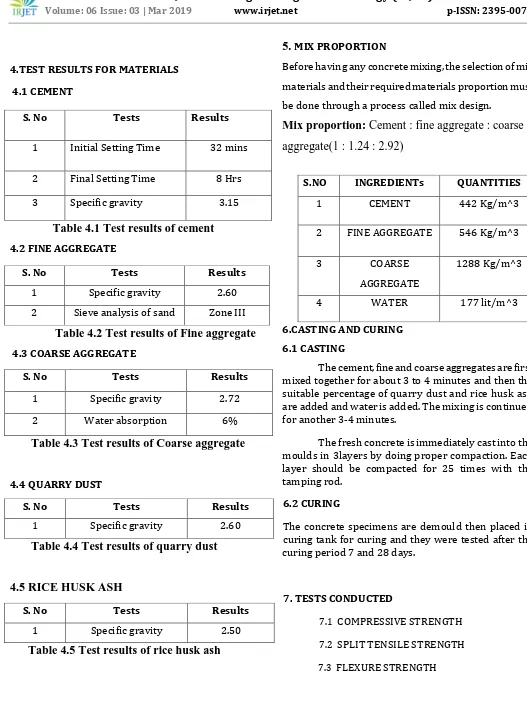
© 2019, IRJET | Impact Factor value: 7.211 | ISO 9001:2008 Certified Journal | Page 7743 4.TEST RESULTS FOR MATERIALS
[image:3.595.26.553.60.773.2]4.1 CEMENT
Table 4.1 Test results of cement
4.2FINE AGGREGATETable 4.2 Test results of Fine aggregate
4.3 COARSE AGGREGATE
Table 4.3 Test results of Coarse aggregate
4.4QUARRY DUST
Table 4.4 Test results of quarry dust
4.5 RICE HUSK ASH
Table 4.5 Test results of rice husk ash
5.
MIX PROPORTIONBefore having any concrete mixing, the selection of mix materials and their required materials proportion must be done through a process called mix design.
Mix proportion:
Cement : fine aggregate : coarse
aggregate(1 : 1.24 : 2.92)
6.CASTING AND CURING 6.1 CASTING
The cement, fine and coarse aggregates are first mixed together for about 3 to 4 minutes and then the suitable percentage of quarry dust and rice husk ash are added and water is added. The mixing is continued for another 3-4 minutes.
The fresh concrete is immediately cast into the moulds in 3layers by doing proper compaction. Each layer should be compacted for 25 times with the tamping rod.
6.2 CURING
The concrete specimens are demould then placed in curing tank for curing and they were tested after the curing period 7 and 28 days.
7. TESTS CONDUCTED
7.1 COMPRESSIVE STRENGTH
7.2 SPLIT TENSILE STRENGTH
7.3 FLEXURE STRENGTH
S. No Tests Results
1 Initial Setting Time 32 mins
2 Final Setting Time 8 Hrs
3 Specific gravity 3.15
S. No Tests Results
1 Specific gravity 2.60
2 Sieve analysis of sand Zone III
S. No Tests Results
1 Specific gravity 2.72
2 Water absorption 6%
S. No Tests Results
1 Specific gravity 2.60
S. No Tests Results
1 Specific gravity 2.50
S.NO INGREDIENTs QUANTITIES
1 CEMENT 442 Kg/m^3
2 FINE AGGREGATE 546 Kg/m^3
3 COARSE
AGGREGATE
1288 Kg/m^3
© 2019, IRJET | Impact Factor value: 7.211 | ISO 9001:2008 Certified Journal | Page 7744 7.1COMPRESSIVE STRENGTH
Table 7.1 Compressive strength of concrete
7.2 SPLIT TENSILE STRENGTH
Table 7.2 Spilt Tensile strength for concrete
[image:4.595.309.561.449.653.2]7.4 FLEXURE STRENGTH
Table 7.3 Flexural strength of concrete
8.TESTS GRAPHS
25.85 26.5 27.53
28.93 23.15 25.85 26.36 27.69 22.82 18.65 0 5 10 15 20 25 30 35
0% 5% 15% 25% 35%
comp re ss iv e stren gth
percentage of replacement COMPRESSIVE STRENGTH OF
CONCRETE (7 DAYS)
quarry dust rice husk ash
Fig 8.1. Graph for compressive strength results (7 Days)
Percenta ge of replacem ent
7Days 28 Days
Quarr y dust (N/m m2)
Rice husk ash (N/m m2)
Quarr y dust (N/m m2)
Rice husk ash (N/m m2)
0%
25.85 25.85 38.25 38.25
5%
26.50 26.36 39.66 38.95
15%
27.53 27.69 41.40 42.54
25%
28.93 22.82 43.53 30.24
35%
23.15 18.65 35.63 25.35
Percent age of replace ment
7Days 28 Days
Quarry dust (N/m m2)
Rice husk ash (N/m m2)
Quar ry dust (N/m m2)
Rice husk ash (N/mm2 )
0%
1.59
1.59
4.36
4.36
5%
1.67
1.35
4.86
4.50
15%
2.65
1.86
5.05
4.68
25%
2.13
0.95
4.73
2.23
35%
2.05
0.88
3.28
1.08
Percentage of
replacemen t
7Days 28 Days
Quarr y dust (N/m m2)
Rice husk ash (N/mm 2) Quarry dust (N/m m2)
Rice husk ash (N/mm2 )
0%
1.05
1.05
2.24
2.24
5%
1.24
1.64
2.60
2.53
15%
1.30
1.36
3.20
2.65
25%
1.42
1.25
3.05
1.04
[image:4.595.34.319.455.705.2]© 2019, IRJET | Impact Factor value: 7.211 | ISO 9001:2008 Certified Journal | Page 7745 38.25 39.66
41.4
43.53
35.63 38.25
38.95
42.54 30.24
25.35
0 50
0% 5% 15% 25% 35%
com
pr
es
si
ve
s
tr
eng
th
percentage of replacement
COMPRESSIVE STRENGTH OF CONCRTE (28 DAYS)
[image:5.595.304.556.53.265.2]quarry dust rice husk ash
Fig 8.2. Graph for compressive strength results (28 Days)
Fig 8.3. Graph for Split Tensile strength results (7Days)
Fig 8.4. Graph for Split Tensile strength results (28Days)
[image:5.595.39.567.57.566.2]Fig 8.6. Graph for Flexural strength results (7Days)
Fig 8.6. Graph for Flexural strength results (28Days)
9. CONCLUSIONS
i. The compressive strength of concrete increase when cement is replaced by quarry dust up to 25%. At 25% replacement, the maximum compressive strength obtained is 43.53 N/mm2.The compressive strength increased by 13.80% when compared to conventional concrete.
[image:5.595.35.568.223.776.2]© 2019, IRJET | Impact Factor value: 7.211 | ISO 9001:2008 Certified Journal | Page 7746 increased by 15.82% when compared to
conventional concrete.
iii. The flexural strength of concrete increased when cement is replaced by quarry dust up to 15% and later the strength gradually decreased when cement is replaced up to 35%. At 15% replacement, the maximum flexural strength obtained is 3.20 N/mm2. The flexural strength increased by 42.85% when compared to conventional concrete.
iv. The compressive strength of concrete increased when cement is replaced by rice husk ash up to 15% and the strength gradually decreased when cement is replaced beyond 15%. The maximum compressive strength obtained is 42.54 N/mm2. The compressive strength increased by 11.21% when compared to conventional concrete.
v. The spilt tensile strength of concrete increased when cement is replaced by rice husk ash up to 10% and the strength gradually decreased when cement is replaced beyond 15%. The maximum split tensile strength obtained is 4.68 N/mm2.The spilt tensile strength increased by7.34 % when compared to conventional concrete.
vi. The flexural strength of concrete increased when cement is replaced by rice husk ash up to 15% and the strength gradually decreased when cement is replaced beyond 15%. The maximum flexural strength obtained is 2.65 N/mm2. The flexural strength increased by 18.30% when compared to conventional concrete.
vii. Results of present study indicates that mechanical properties of concrete are high in which cement is replaced with quarry dust compared to cement is replaced by rice husk ash.
viii. Use of these waste materials in concrete can prove to be economical as it is non useful waste and free of cost.
ix. Use of waste products like quarry dust and rice husk ash in concrete will eradicate the disposal problem and prove to be environment friendly thus paving way for greener concrete.
x. Use of these waste products in concrete as cement replacement materials will reduce production and usage of cement thus reduce the emission of
CO2 and make construction industry sustainable & economical.
10. JOURNALS
Partial Replacement of Cement With Quarry Dust And Rice Husk Ash In Concrete (IRJET) (Volume 5).
Strength Properties of Concrete With Partial Replacement Of Cement By Granite Quarry Dust (IJERT).
Partial Replacement Of Cement By Quarry Dust (IJERT).
A Study On Strength Of Concrete With Partial Replacement Of Cement With Quarry Dust And Metakaolin (IJIRSET).
Experimental Study On Partial Replacement Of Cement With Quarry Dust (IJAERS).
Study On Replacement Of Cement And Fine Aggregate With Quarry Dust (IJESRT).
Effect of Rice husk ash on concrete Use of Rice husk ash as partial replacement with cement in concrete (IJER) (Volume 4).
Optimum replacement of cement by rice husk ash in conventional concrete (IJEDR) (Volume 5).
Partial replacement of cement by rice husk ash (IRJET).
“Experimental Investigation Of Papercrete Concrete" International Journal of Application or Innovation in Engineering & Management (IJAIEM) , Volume 4, Issue 5
" Experimental Investigation Of Using Ceramic Waste As A Coarse Aggregate Making A Light Weight Concrete " , International Journal of Application or Innovation in Engineering & Management (IJAIEM).
© 2019, IRJET | Impact Factor value: 7.211 | ISO 9001:2008 Certified Journal | Page 7747
Stone waste in India for concrete with value creation opportunities, International Journal of Latest Trends in Engineering and Technology (IJLTET), 2(2):113-120.
11.BOOKS AND CODES
Concrete Technology By MS. SHETTY.
IS Code 10262 - 2009 - Recommended Guidelines For Concrete Mix.
IS Code 456 – 2000 – Code of practice for plain and reinforced concrete.
IS Code 12269- 1987 – specification for 53 grade ordinary Portland cement.