Towards fully-facilitated discrete event simulation modelling: Addressing the model
coding stage
N.C. Proudlovea*, S. Bisognob, B.S.S. Onggoc, A. Calabreseb, N. Levialdi Ghironb
aAlliance Manchester Business School, University of Manchester, UK;
bDepartment of Enterprise Engineering, University of Rome "Tor Vergata”, Italy;
cLancaster University Management School, Lancaster University, UK
*Corresponding author’s contact information: Email: [email protected] Phone: +44 (0)161 306 3429
Abstract
The literature suggests that increasing stakeholder engagement has a positive impact on projects
using discrete-event simulation in healthcare. This suggests projects should strive to involve the
stakeholders in as much of the project as possible, through facilitated workshops. A notable gap
in stakeholder involvement is the model coding stage, in which a conceptual model is turned
into a discrete-event simulation model running on a computer. This paper investigates how and
under what circumstances model coding might also be conducted in facilitated workshops, in
particular through the use of the Business Process Model and Notation (BPMN) modelling
standard. This work arose from a series of modelling projects with two hospitals, one in Italy
and the other in the UK.
The paper describes how BPMN can contribute, with a case in which model coding was
achieved in a facilitated workshop and a second in which it was not but which highlights further
barriers to this in some contexts. These barriers arise from the detail necessary for requisite
modelling regarding i) the level of complexity of the model and ii) challenges in data access and
analysis to populate the model. The relationship between the technical capabilities of tools
available and the impact of these barriers is also discussed.
We believe this is the first time that discrete-event simulation model coding in a facilitated
workshop in healthcare has been described, and we provide a clear view of the further barriers.
To indicate when facilitated model coding is currently achievable, we suggest a contextual
matrix.
1. Introduction
Discrete-event simulation (DES) has a long history in healthcare, appearing over half a century ago, and interest in it has been increasing since the 1990s due to the increased availability of computer technology (Pitt, Monks, Crowe, & Vasilakis, 2016; Robinson, Radnor, Burgess, & Worthington, 2012). Objectives in applying simulation in health projects include process cost and time reduction, risk reduction in new or changed processes, and better understanding of healthcare pathways among their stakeholders.
DES in healthcare is particularly challenging since healthcare systems have complex behaviour and involve many stakeholders with a plurality of opinions and objectives (Franco & Montibeller, 2010; Pitt et al., 2016; Proudlove, Black, & Fletcher, 2007; Robinson et al., 2012; Tako & Kotiadis, 2015). The apparent lack of success in implementing simulation studies in healthcare (Pitt et al., 2016) has prompted authors to reflect on domain-specific barriers to DES projects, particularly obtaining and retaining stakeholder engagement (Brailsford, 2005; Taylor, Eldabi, Riley, Paul, & Pidd, 2009). Robinson, Worthington, Burgess, and Radnor (2014) emphasise that, to meet project objectives in the healthcare domain, a simulation project should engage stakeholders
throughout its lifecycle, with the modeller working as or with a group facilitator. They consider the current limits to such ‘fully-facilitated’ DES modelling, which aims to involve stakeholders during all stages of a simulation study (Brailsford, Bolt, Connell, Klein, & Patel, 2009; Robinson et al., 2014). DES generally requires complex models, detailed data and very specialised software, which require specialist modellers and considerable time for the ‘model coding’ stage (computer model generation, data entry and verification (Robinson, 2014)). This hinders stakeholder engagement and so is the classic ‘anathema’ to fully-facilitated modelling.
last gap in achieving fully-facilitated DES. To address this they suggest the possibilities of a seamless software environment suitable to support facilitated process mapping and DES modelling, and building simpler models.
This paper investigates the extent to which Business Process Model and Notation (BPMN) can provide such an environment, and in what problem-complexity contexts. After reviewing the literature (section 2), our first contribution is to propose an approach using BPMN to support model coding during facilitated stakeholder workshops and so with the potential to take DES approaches like PartiSim and SimLean a step closer to being fully facilitated like the ‘soft’ and problem structuring methods end of the Operational Research (OR) ‘spectrum’ (section 3). The second contribution is two case studies (three DES projects) in healthcare (section 4), enabling us to reflect on the advantages and current practical limitations of using BMPN in a DES project (section 5). From this reflection we develop a contextual matrix, with model complexity and data-analysis complexity as two dimensions, to suggest to researchers and practitioners in what problem contexts BPMN currently makes fully facilitated DES a possibility.
2. Simulation modelling in healthcare
Literature reviews (Brailsford, Harper, Patel, & Pitt, 2009; Fone et al., 2003; Katsaliaki & Mustafee, 2011) trace the long history of DES modelling in healthcare, and its potential to help demonstrate and understand problems with patient flow systems and test potential service improvements is well known (Pitt et al., 2016; Proudlove et al., 2007).
greater difficultly in technical aspects (including data collection/access, complex/hard-to-elicit structure, messier problems) and stakeholder engagement (e.g. incentive/resistance to change, resistance to simulation results, limited time) (Tako & Robinson, 2015). Increasing stakeholder engagement has been a particular focus (Brailsford, 2005; Brailsford, Bolt, et al., 2009; Harper & Pitt, 2004; Jahangirian et al., 2015; Taylor et al., 2009) with a growing literature on overcoming barriers to this through facilitated DES modelling.
2.1 Facilitation in DES in healthcare
Franco and Montibeller (2010) contrast expert versus facilitated modes in OR engagements. They point out that modellers are generally more comfortable with the former, working on producing ‘objective’ and ‘optimal’ solutions without the clients/stakeholders present. However, they argue that facilitated modelling can lead to a better quality of model, promote debate and understanding of the possible changes to processes and so, it is hoped, to greater commitment to implementation of the recommendations. Tako and Kotiadis (2012) pick out OR approaches that have particularly strongly adopted this facilitated approach: problem structuring, decision analysis and system dynamics simulation. Many of the real-world-systems which are the subject of healthcare modelling have similar characteristics to those addressed by these techniques, such as of ill-defined problems and systems, multiple objectives and diverse sources of power and influence across stakeholder groups, requiring a high level of engagement and consensus for hope of implementation. Therefore the current trend in the extensive literature on DES in healthcare is to emphasise the importance of striving for a facilitated modelling approach.
The DES community has drawn on the extensive work on facilitation in system dynamics in developing facilitated approaches to DES (Tako & Kotiadis, 2012). The system dynamics literature appears ambiguous on how much of the process is conducted in facilitated mode, in particular the building of a computer model (cf. model coding). Vennix (1999) and others use the term Group Model-Building, defined as “approaches that involve the client in the system dynamics model building process, be it
involved “having the facilitation and modelling team work through the night” (Andersen, Vennix, Richardson, & Rouwette, 2007, p.692), so presumably without the stakeholders and so in expert mode. Having said this, the work on facilitated modelling in system dynamics is significantly ahead of that in DES for two reasons. Firstly, the system dynamics community has de facto standards for developing models, i.e. causal-loop and stock-and-flow diagrams, which provide a common language across the community. Secondly, it is relatively straightforward to transform a stock-and-flow diagram into a set of partial differential equations that can be executed computationally. All leading system dynamics software provides a facility to automate generation of the equations (model code). In DES there is not a corresponding de facto standard, and model coding is more challenging.
Two recent streams of work have proposed facilitated DES modelling approaches in healthcare: the PartiSim framework and the SimLean suite of tools. PartiSim started with a focus on conceptual modelling (Kotiadis, Tako, & Vasilakis, 2014) but now considers the whole project lifecycle with a six-stage conceptual framework that aims to help the modelling team involve stakeholders in facilitated simulation studies through combining DES and soft OR approaches (Tako & Kotiadis, 2015). SimLean uses DES to support facilitated-group, lean-based, improvement projects in healthcare, with three modes: Educate, to illustrate lean principles; Facilitate, for rapid but approximate models to support lean improvement workshops (also known as rapid improvement or kaizen events); and Evaluate, for detailed models built subsequently to predict the consequences of ideas suggested in an improvement workshop (Robinson et al., 2012; Robinson et al., 2014).
In addition Baril, Gascon, Miller, and Côté (2016) used a detailed DES built over three months of a typically-long (e.g. nine-month) lean six sigma project, along with pre-prepared data-analysis, to support evaluation of change ideas during a hospital kaizen event. Neither the process mapping (conducted four months before the event) nor the DES is built in group-facilitation mode, and the process is deliberately only called ‘participatory’. Adamides and Karacapilidis (2006) have prototyped a collaborative software tool for gathering and sharing information from stakeholders, though this is text-based and they don’t suggest that building the process maps or a potential DES model could be done live with stakeholders.
In the model coding stage the conceptual model (i.e. a description of the model) is developed into a DES by means of computer programming, spreadsheets or simulation software (Robinson, 2014). This is typically demanding on time and technical expertise. Though PartiSim encourages reduced data requirements through more social judgement and envisages the possibility of data entry in facilitated mode, model coding is retained as an expert-mode stage conducted away from stakeholders; Tako and Kotiadis (2015) suggest that this does not diminish facilitation overall. The SimLean work, however, has continued to strive for fully-facilitated DES and so has led to a series of suggestions towards addressing the particular challenges of the model coding stage. To this end Robinson et al. (2014) endorse the suggestions of Den Hengst, de Vreede, and Maghnouji (2007): more-stakeholder-friendly DES software, eliciting and using stakeholder-estimated data live in workshops and using pre-built model components. Some use of these have been incorporated in SimLean Facilitate, but Robinson et al. (2014) also call for two other developments towards fully-facilitated DES: i) a mindset change to consider simpler (and rapidly-built) models to facilitate understanding and discussion rather than aiming for predictive accuracy as a default, and ii) a technical solution involving a software environment that enables a facilitator/modeller to capture the conceptual model and perform model coding live with stakeholders. Including model coding in facilitated sessions is also noted as a future challenge by Pessôa, Lins, da Silva, and Fiszman (2015).
The PartiSim framework includes establishing whether a DES study is feasible (Tako & Kotiadis, 2015), whilst discussion of the SimLean work notes the link between defining what can (and cannot) be modelled in a particular problem context and also the feasibility of a technical solution to enable model coding live with stakeholders (Robinson et al., 2014). These two ideas are connected and, in practice, governed by the requirements of problem solving in a particular context. Phillips’ (1982; 1984) term ‘requisite modelling’ is useful here: considering what form of model would be ‘good enough’ to help stakeholders address their problems and how this interacts with the technical demands of model coding and the capabilities of modelling tools.
2.2 BPMN and simulation
stakeholders (OMG, 2011) including healthcare professionals (Yaoa & Kumar, 2013). BPMN is supported by major software vendors such as IBM, Oracle and SAP (Onggo, 2012) so is widely available, including in user-friendly freeware. Software implementations support building hierarchies of processes. BPMN has been receiving high levels of attention in business practice (Recker, 2010). BPMN allows a process map to be directly and quickly imported and exported using common standards (e.g. XPDL) (OMG, 2011; Onggo & Karpat, 2011). Therefore it is an appealing tool for use in conceptual modelling (Onggo & Karpat, 2011).
Another standard, BPSim (WfMC, 2016), enables the automated generation of DES model structure from BPMN process maps. Some tools such as Bizagi (Bizagi, 2016) use BPMN to build process maps and BPSim to run DES in the same software environment, others such as Simul8 and Lanner’s L-SIM simulation server can use BPSim to import BPMN process maps (Onggo & Karpat, 2011; Recker, 2010). The automated production of a DES from a process map written in a business standard such as BPMN narrows the conceptual gap between business process modelling and simulation, which helps non-simulation-specialist stakeholders understand simulation more easily. There are alternatives to BPMN, including UML (Unified Modeling Language), though these other standards are designed with systems analysts in mind rather than stakeholders and business analysts (Onggo, 2011), and BPMN has been argued to be the best of the tool standards available for linking with simulation (Wagner, 2014). Some limited use of BPMN plus DES has been made in healthcare modelling (Bisogno, Calabrese, Gastaldi, & Levialdi Ghiron, 2016).
BPMN plus BPSim have the potential, therefore, to bridge from conceptual maps to DES models through electronic maps and automated translation. Consideration of the capabilities of these standards discussed in the literature suggests that this might be a promising approach to investigate the potential for facilitated-mode model coding and its natural interrelationship with requisite modelling and use of simpler models. This is the last major obstacle to achieving fully-facilitated DES in healthcare, hitherto not addressed in practice in the research literature (Robinson et al., 2014).
3. Methodology
(workshop 2), Model Coding (expert mode), Experimentation (workshop 3), and Implementation (workshop 4). In the literature this interruption in facilitated workshops for the model coding stage is viewed as inevitable. It is suggested it will last for some considerable time (two to three weeks is suggested), during which there is little contact with stakeholders (though some liaison with the project champion for model verification: checking the model is sufficiently accurate (Robinson et al., 2014; Tako & Kotiadis, 2015)).
Our work started in 2013 and was influenced by the early Conceptual Modelling/PartiSim work that focused on project setup and conceptual modelling (Tako & Kotiadis, 2012). Thus we proposed an overall approach very similar to that proposed in the PartiSim framework (Tako & Kotiadis, 2015). The only material difference being incorporating BPMN, which has the potential to increase the scope of facilitation and speed up the conceptual modelling - model coding - experimentation stages and transitions. In particular, the aims of this research are: i) to investigate the extent to which the use of BPMN within a facilitated DES process such as PartiSim can remove or reduce the model coding interruption in facilitated-mode engagement with stakeholders; and ii) what impact the problem-complexity context has.
Our proposed approach was to familiarise the stakeholders with BPMN and the software environment very early in the process (Initiate Study and Define System), use it to capture as much as possible of the Conceptual Model, in particular the flow structure (i.e. a process map) and then (as ‘Model Coding’) use BPSim to generate the DES from the BPMN, ready to populate with parameters and run. Thus we have a proposed project approach whose duration is more dependent on stakeholder availability than the requirement for a substantial break for (expert-mode) model coding, and with the potential to conduct all stages in facilitated mode.
dependent on the quality and assumptions in the automated translation, which should be known to the modeller. The simulation structure created would have the same look and feel as the electronic process map and be ready to populate with data (parameters). This could be done with the stakeholders (in facilitated mode) if data are readily available, derived from stakeholders’ estimates or pre-prepared, contributing to white-box validation.
Depending on data and stakeholder availability, the same or another workshop could proceed with running the model, demonstrating animated trials and statistics generated from batches of trials. Decisions on requisite modelling would also impact what type of validation is required following model coding, in particular traditional statistical comparisons of predictive power between a base model and historical data versus face validation, as more common in system dynamics simulation (Balci, 1998). For black-box validation we propose the former could be done as part of a facilitated workshop, and the later, particularly making use of animation in the DES, requires this facilitated mode. Of course the validation process may reveal the need for changes to the flow structure or data, leading to changes to the computer simulation model. The ability to perform model coding live would be useful here too, since we could avoid significant delay or disruption from detailed technical input from the modeller. Facilitated experimentation with the model(s) would then involve modifying model parameters and/or going back to the BPMN business process diagram to modify the flow structure and generate alternative simulation models. Discussion about implementation and debrief meetings would conclude the project cycle.
For the work described in this paper we used the Bizagi Modeler freeware (Bizagi, 2016), which has a very user-friendly interface and, as well as BPMN, also integrates the BPSim DES standard. The next section describes investigations into the application of this approach.
4. Case studies
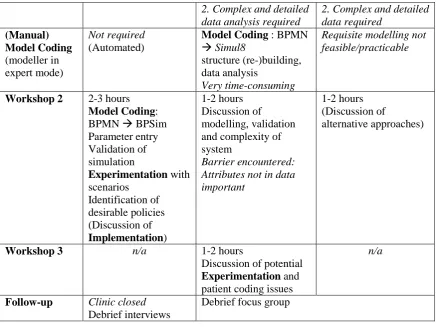
NHS in quality improvement terms, with a relatively large and well-established improvement team with strong senior management support. The researchers acted as the modellers and, for Case A and Case B Project B2, also as facilitator). As researchers we also kept a research logbook of notes and observations from meetings, backed-up by audio recordings and on-going narrative reflections. An overview of the cases is given in Table 1.
Project A B1 B2
Patient flow system
Orthopaedic Outpatient Clinic
Ageing and Complex Medicine (inpatients)
Surgery and
Neurological Theatres Location Italian hospital Salford Royal Salford Royal
Project Start Sept 2013 Feb 2015 May 2015
Project Objectives
Investigate trade-off between staff
utilisation and patient waiting times; of impact appointment scheduling
Investigate how to reduce patient length of stay and so increase capacity
Investigate impact of theatre flow
reconfiguration
Stakeholders Head of clinic (surgeon), surgeon, nurse manager, nurse
2 senior doctors, junior doctor, 3 nurse
managers, 2 Allied Health Professions
3 senior nurse managers
Process-support
Facilitator /modeller Facilitator, modeller, observer/ note-taker, (3 quality improvement managers observing) Facilitator, modeller Project initiation meetings
Establish goals and boundary of system Walkthrough of the process
Discussion of flow mapping and modelling
Demonstration and examples of BPMN and software
Establish potential projects, Champions and stakeholders
Discussion of flow mapping and modelling and demonstration and examples of BPMN and software with improvement team
Meeting with IT/Performance (data) function Establish goals and
boundary of system Walkthrough of the process
Sketch of the flow
Establish goals and boundary of system Walkthrough of the process
Sketch of the flow Potential barriers identified: flow and data complexity Workshop 1 2-3 hours
Conceptual Model Paper process map Prototype BPMN process map Discussion and validation
KPIs agreed, estimated process times and variability captured
2-3 hours
Conceptual Model Paper process map Prototype BPMN process map Discussion and validation
Barriers encountered: 1. BPMN and BPSim not adequate alone
1-2 hours
Conceptual Model Paper process map Prototype BPMN process map Discussion and validation
2. Complex and detailed data analysis required
2. Complex and detailed data required (Manual) Model Coding (modeller in expert mode) Not required (Automated)
Model Coding : BPMN Simul8
structure (re-)building, data analysis
Very time-consuming
Requisite modelling not feasible/practicable
Workshop 2 2-3 hours Model Coding: BPMN BPSim Parameter entry Validation of simulation Experimentation with scenarios Identification of desirable policies (Discussion of Implementation) 1-2 hours Discussion of modelling, validation and complexity of system
Barrier encountered: Attributes not in data important
1-2 hours (Discussion of
alternative approaches)
Workshop 3 n/a 1-2 hours
Discussion of potential Experimentation and patient coding issues
n/a
Follow-up Clinic closed Debrief interviews
[image:12.595.80.517.70.397.2]Debrief focus group
Table 1: Summary of cases and processes followed
4.1. Case A
The process analysed was the patient flow during the pre-operative visit to the Italian hospital’s orthopaedic outpatient clinic prior to a surgical operation being scheduled. The stakeholder team consisted of two surgeons (one being the head of the clinic), the nurse manager and another nurse. With this small group the modeller also acted as the facilitator. The stakeholders were very receptive to mapping and modelling. Prior to our engagement they had done some limited process mapping using
PowerPoint and Excel. They were interested in taking this further, which gave us the opportunity to test our approach.
and end every day empty, and the appropriate timeframe would be an 8-hour day. A second meeting and two two-to-three-hour workshops were scheduled, to fit with the stakeholders’ availability.
The second meeting included a walkthrough of the process to observe it in action, confirming understanding of the flows and that there was little or no competition from other processes for resources used by the orthopaedic outpatient clinic. It was established that there were very little patient-flow-level historical data available, but that the stakeholders would be satisfied with establishing the key areas and direction of change likely to move performance towards their desired improvements. Hence, we could establish what was requisite for the project to achieve the aim. The facilitator led a discussion about how patient flows in the clinic could be modelled and potentially improved, and briefly demonstrated the main features of BPMN and Bizagi, how to use them to map processes and some previous applications in similar contexts.
The first workshop focused on conceptual mapping. The stakeholders described the process and, with the facilitator, sketched a prototype process map of the patient flow on paper. The facilitator/modeller then built the draft process map in BPMN using the Bizagi software with the stakeholders present. Conceptual mapping and BPMN model drawing took less than an hour of workshop time, and produced more discussion and some live corrections, leading to a map the stakeholders agreed was valid. Other information, such as the KPIs, timings of the clinic day, typical process times and variability were elicited from the stakeholders. These were captured on paper (but could have been added to the BPMN as text annotations).
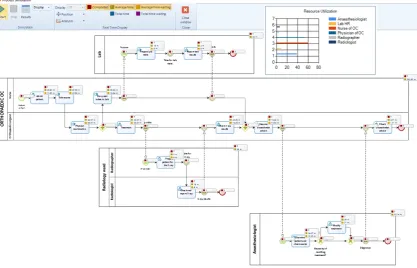
In the second workshop, since BPMN and BPSim are both integrated in the Bizagi
resources. This simple animation enabled us to explain how the simulation works. It was also adequate, together with the results from a batch of 50 trials, to convince the stakeholders that the simulation model behaved like the real system (face validity).
Figure 1: Simulation model example: pre-operative patient flow (Case A)
In the same (second) workshop, the facilitator was then able to experiment with suggested scenarios, again interactively with the stakeholders present. The effects of different booking scenarios and demand levels suggested by the stakeholders were investigated. Types of booking policies to achieve a reasonable trade-off between patient delays and staff utilisation were identified.
A later follow-up meeting with the stakeholders revealed that, though the recommendations from the experimentation had been well-received and considered feasible, major geological risk with the hospital site meant that a board-level decision had been taken to close all inpatient facilities plus associated services such as this orthopaedic outpatient clinic at the hospital, and merge them with those at another hospital site in the group. Hence, implementation had not been possible, but the researchers took the opportunity to conduct debrief interviews with the stakeholders about their perceptions of the approach.
After we succeeded with facilitated-mode model coding in the Italian hospital we wanted to test whether we could replicate it in different healthcare environments.
Our Project Initiation at Salford Royal started with two meetings with senior managers, including a project champion, followed by meetings with senior members of the improvement team. Across the Trust there had been relatively little process mapping activity, and a range of approaches had been used from box-and-arrow charts using
Word and PowerPoint, to Value Stream Mapping using Visio. The improvement team expressed particular interest in identifying a standardised and practically-useful process mapping approach and software tool with the potential to feed through to DES. The senior general managers had a strong interest in analysing particular clinical pathways; one of the directors commented that “it would be very useful to process map and potentially simulate the planned re-organisation; I see the value of simulation to
provide powerful evidence.”
The first meetings with the senior managers and champion discussed potential projects and stakeholders who could be involved. The projects chosen were the Ageing and Complex Medicine emergency/unscheduled pathway and flows through the operating theatre suites in the Surgery and Neurological division. Both these flows tended to work at very high utilisation rates, which is typical in NHS inpatient pathways and can cause blockages to the flow of patients and delay upstream processes. For example, patients might be medically-fit to move to the next stage of their treatment pathway, but have to wait for space, transport or support services, whilst still consuming constrained resources (such as a cubicle or bed). Thus, in modelling terms, there are ‘dead’ states (queues) in which entities continue to consume the resource required by the preceding activity tied to many activities. (Here we call these “back-end queues”). The rest of this section describes these two projects.
4.2.1.Case B - Project B1: Ageing and Complex Medicine patient flow
quality improvement staff (as lead facilitator and observers). The researcher team was a modeller and an observer/note-taker.
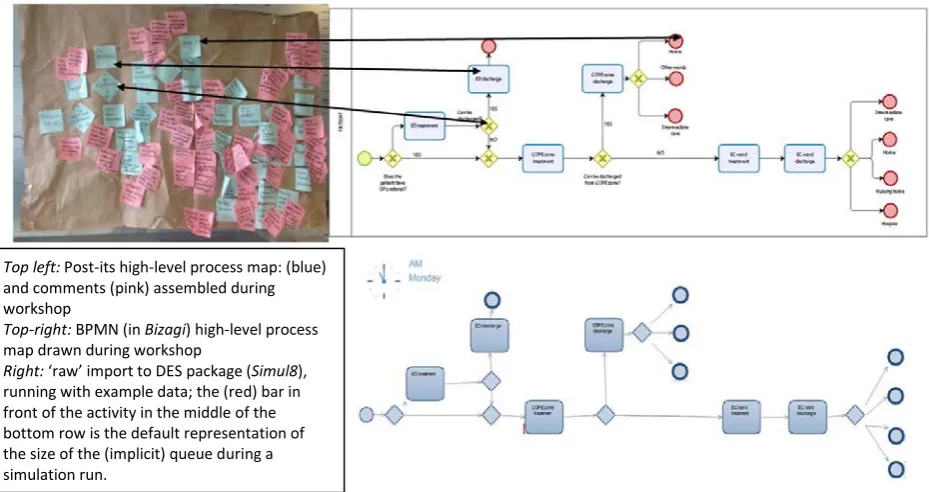
[image:16.595.73.538.424.670.2]In the first workshop the experienced facilitator from the Trust’s quality improvement team led discussion of the system and project aims, and the drawing and exploration of a high-level process map using a ‘basic’ approach very common in the NHS (post-it notes and rolls of brown paper, see Figure 2). The BPMN process map was built and amended in parallel live by the modeller using the Bizagi software. There is a one-to-one correspondence between the flow elements of the paper and BPMN models (a few examples are indicated by the double-headed arrows in Figure 2). However, on the former the process-step post-its are rather obscured by the comments capturing issues and suggestions. (We used differently coloured post-its to differentiate process steps and comments to improve the clarity.) The maps show patients arriving at the hospital via the Emergency Department (ED) or directly to the COPE (elderly care) zone of the Emergency Assessment Unit. From there, they are discharged, transferred to social care, or moved to an inpatient Ageing and Complex Medicine or other specialism ward.
Figure 2: High-level process maps and import to DES (Project B1)
The next step in our approach is converting the process map written in BPMN to a DES. However it became clear that there were features of the flow beyond the capabilities of BPSim. Patient routing was complex and dependent on many
Top left: Post-its high-level process map: (blue)
and comments (pink) assembled during workshop
Top-right: BPMN (in Bizagi) high-level process
map drawn during workshop
Right: ‘raw’ import to DES package (Simul8),
characteristics of the patients. Multiple routing can be represented in BPMN by using different pools or lanes to represent different token (entity) types, but this gets very large and messy for more than a couple of variations; data- (attribute- or label-) based routing is not handled. Also, as an inpatient system, warm-up time was required, but this was not available in BPSim 1.0. (Subsequently BPSim 2.0, which does support warm-up time, was released in July 2016 in beta version.) Further, the back-end queue after many activities were an important feature of the patient flow, whereas queues in BPSim are simple resource-free queues implicitly added in front of each activity drawn in BPMN. Hence, we decided not to use BPSim (and so not to remain in Bizagi) for the simulation but instead to use a ‘full’ DES package. So the structure of the simulation model built as a process map in BPMN (here with Bizagi) was imported into a DES package (in this case Simul8 via the XPDL format). Although the export and import are fast, so could have been done in a workshop as had been planned, we realised that coding important flow features unspecifiable in BPMN (e.g. back-end queue and data-dependent routing) would require a considerable amount of time, and so expert-mode coding was needed. Hence, although the conceptual modelling stage was achieved in facilitated mode, a barrier to continuing this through model coding was encountered in building the DES model structure. This arose from the complexity of the model requisite to represent the real system being greater than the (current) capability of the modelling standards and software.
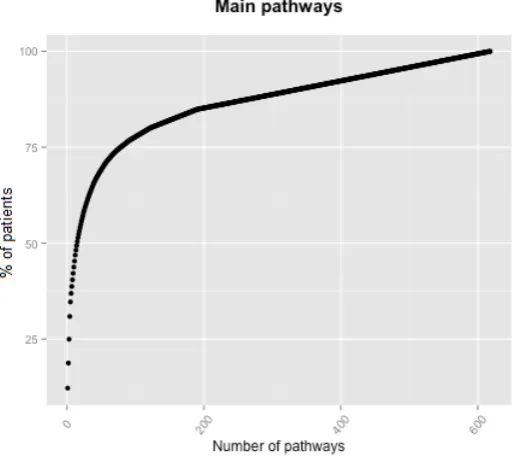
Figure 3: pathways variability (Project B1)
As shown in Figure 3, analysis of the 2,830 patients treated in one year (from April 2014 to May 2015) revealed 618 pathways. When modelling capacity issues in such a high-utilisation situation (e.g. high bed occupancy), and so a very sensitive system, ignoring some of the patients or variation will have a big impact on the results. For example, though 27 pathways would be a large number to consider in simulation modelling, here the most frequent 27 only accounted for 60% of all the patients.
The complexity of data ‘wrangling’ and analysis required considerable time and technical expertise. Consequently the stakeholders could not be involved in this: in this case data-analysis complexity formed a second major barrier to conducting model coding in facilitated mode, here in parallel with the model-complexity barrier.
The time required meant that the second workshop had to be postponed. The final two workshops discussed both the complexity of the pathways and potential experiments to test improvement ideas. It also became clear that there were attributes of patients (condition and care-type before and after inpatient treatment) that were often important in routing but not clearly coded in the available data. This was a further challenge to modelling and validation. The implications of this limitation, and how it might be captured in coding and so data analysis, were also discussed.
facilitated-mode model coding, and in fact limited the practicality of producing requisite results from DES.
4.2.2.Case B - Project B2: Surgery and Neurological patient flow
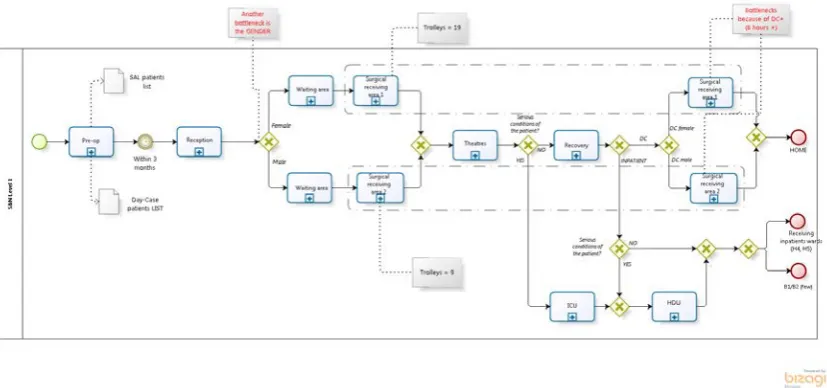
A major re-organisation of resource-configuration and patient flows through the Surgery and Neurological division’s operating theatre suites was being planned. This change was imminent, and senior management wished to understand the impact on capacity. We started a project to potentially support this at the same time as the other project (B1) was at the conceptual modelling stage. We aimed to test facilitated-mode model coding here too. Project Initiation started with a meeting with division managers and a champion for this project. A walkthrough of the process in action revealed that, although apparently simple in terms of numbers of tasks, it was very complex in terms of pathways and bottleneck resources since there was a lot of ad hoc reactive (‘fire-fighting’) action by staff to squeeze patients through the very high-utilisation facilities. Simulation appeared challenging, but we proceeded with a series of small workshops with three key stakeholders (senior nurse managers) to map the process.
Figure 4: Process map of the conceptual model (Case B – Project B2)
The Trust had not done any flow mapping of this system, and staff reacted very positively to the BPMN process mapping. However this conceptual modelling phase confirmed the challenges in requisite simulation of this system. In addition to resource-dependent queues and reconstructing patient routing from the IT system, both similar to the barriers to facilitated-mode model coding that were encountered in the other project (B1), the flow ‘rules’ in Surgery and Neurology were very complex. Although this process showed less variety in the number of pathways, the assembly of the elective booking lists and the micro-level routing around the theatres (particularly through the gender-split receiving areas before and after surgery) were highly contingent on staff behaviour, flexing routing and amount and allocation of resources greatly to cope as best they could with demand. This was complex and unpredictable behaviour, influenced by system state, particular staff on duty etc. So, from experience with the other project (B1), we could clearly expect the same model and data complexity barriers. Therefore, though the conceptual modelling was useful to the staff, we judged that facilitated-mode model coding would not be possible and it would not be practicable with the time and resources available to produce a requisite model. Further, the chaotic nature of the system calls into question whether requisite DES modelling (i.e. to the level of accuracy required) should be attempted at all in a situation like this. The final workshop time was used to discuss alternative approaches such as aggregate capacity planning and templating.
In this section, we provide our reflections from the testing of the approach in the two cases (three projects).
In section 2 we discussed the many barriers to modelling, and in particular DES, in healthcare. In both our cases stakeholders in the Project Initiation meetings with pathway stakeholders (managers and clinicians) we found high levels of interest and cooperation, with support from senior managers. They were actively interested in the potential of modelling tools and interacted well with the facilitator and modeller. Access to reliable data has been noted in the literature as a general barrier (sect 2). In Case A the lack of detailed patient flow data did not conflict with the requirements of requisite modelling (section 4.1). In Case B (Salford Royal) we had excellent cooperation from the IT support function so had good access to the Trust’s relatively powerful IT system. Thus the main general environmental barriers to modelling as frequently described in the literature were absent or weak.
5.1. To what extent can BPMN support facilitated-modemodel coding?
Process mapping is a fundamental technique in understanding and improving operational systems, and a number of paper-based, fairly free-form systems have been developed (Slack, Brandon-Jones, & Johnston, 2013). In healthcare improvement work process mapping is a common starting point for engaging staff working along a patient pathway. These pathways are often long and complex, and a recommendation is to approach mapping these through a hierarchy of processes and sub-processes (NHS Institute for Innovation and Improvement, 2005).
In both our cases BPMN provided a quick and easy-to-use process mapping tool producing straightforward visualisations that the stakeholders could understand intuitively. Hierarchies of processes and sub-processes encourage detailed modelling as and where it is considered worthwhile, and complexities like resource responsibilities can be captured and represented through pools and lanes (e.g. Case A - Figure 1). The stakeholders commented (Case A - translated for this case from Italian):
“The BPMN model is easily readable and more understandable than a
flowchart or an Excel spreadsheet model. In comparison with an Excel
spreadsheet model, the BPMN diagram shows the process flow and
connections between the activities. Also, in comparison with a flowchart, the
BPMN model shows the person responsible for each activity.”
The value of these BPMN capabilities have also been noted in the literature (OMG, 2011; Onggo & Karpat, 2011).
In both our cases the stakeholders preferred to construct the map initially on paper, as is often recommended to practitioners (e.g. Rother and Shook (2003)). It was drawn and edited electronically with BPMN in parallel with this (Project B1) or straight after (A and B2). Some of the rich accompanying information was captured with BPMN text associations (e.g. Figure 4), but the volume of this in B1 (e.g. from the post-its in Figure 2) proved impracticable to capture in BPMN during the workshop, and this information is textual rather than potentially useful to the automated translation to DES.
not run as intended if translated into BPSim.) One of the ambitions of improvement staff at Salford Royal was to widen and standardise the documentation of patient pathways. A library of electronic process maps would be useful for targeting and running both ‘simple’ waste-reduction (e.g. ‘lean’) projects and modelling analyses (e.g. supported by simulation).
We argue, therefore, that using BPMN for process mapping (or full conceptual modelling) provides a natural entry point for stakeholders to DES, addressing the barriers highlighted in the literature of poor awareness of simulation, academics proposing (over-)complex models, the communication gap between simulation and stakeholder groups, and difficulties in understanding and working with simulation (Brailsford, Bolt, et al., 2009; Harper & Pitt, 2004; Jahangirian et al., 2012; Jahangirian et al., 2015; Lowery et al., 1994; Proudlove et al., 2007; Robinson & Pidd, 1998; Robinson et al., 2014). Particularly so when the BPMN process map can then be rapidly ‘coded’ to a DES with the same visual structure:
“… That simulation tool [i.e. BPMN in Bizagi] helps to visually understand the process flow, even for people who do not have a technical background
and it is generally easy to use.” (Case A stakeholder”)
In Case A the integrated use of the BPMN and BPSim standards (in Bizagi) successfully provided the technical solution envisaged by Robinson et al. (2014): an environment for group process mapping and seamless, ‘at the touch of a button’ transition through model coding to DES, all during workshops with stakeholders.
This helped overcome the problem of simulation modelling being a time-consuming activity (Jahangirian et al., 2015; Lowery, 1996; Robinson & Pidd, 1998). This speed of modelling, and without the need for an interruption for expert-mode model coding between workshops, enabled the presence of stakeholders throughout and helped with the common problem of engaging diverse stakeholders over the stages of a project (Brailsford, 2005; Jahangirian et al., 2015; Taylor et al., 2009).
Similarly, in Case A the rapid progress and continuing focus around a constant-format model helped overcome the barrier of failure to meet project objectives and unacceptable results for stakeholders (Harper & Pitt, 2004; Jahangirian et al., 2015; Robinson & Pidd, 1998) by encouraging continuing emphasis on the problem, aims and KPIs. As commented on in a Case A stakeholder debrief interview:
by managers, but also as doctors and nurses we find it useful to see our
utilisation.”
The automated translation from BPMN and stakeholder presence throughout aided model validation and reduced the risk of verification problems.
The capabilities of BPMN and BPSim proved adequate in Case A, so that the issue of accommodating the complexity of healthcare problems (Brailsford, Bolt, et al., 2009; Harper & Pitt, 2004; Jahangirian et al., 2012; Jahangirian et al., 2015) did not become a barrier. However this was not so in Case B: we found that important flow features could not be represented in BPMN, and so BPSim was also inadequate for requisite DES modelling. Though BPSim has straightforward facilities to enter data from or with stakeholders, this is not captured and fed through from the mapping (BPMN) stage, and neither tool directly helps in situations in which detailed data analysis is required. These issues will be discussed in the following sections.
Many software tools support BPMN, including freeware, so overcoming the barrier of high costs of specialised software (Brailsford, 2005; Pitt et al., 2016). BPMN is a standard modelling language that is non-software dependent. Hence, a model represented using BPMN can be used by any simulation software that supports the standard. This provides flexibility for users to choose a simulation package based on their existing knowledge or value-for-money, and reduces training costs because once users are familiar with BPMN, the knowledge is transferrable to any simulation software that supports this standard. In Case B we imported the BPMN model into the
Simul8 DES software, though the capabilities of BPMN to represent flow features left much work to do in Simul8.
Following Case B, the service improvement team at Salford Royal fed back that “BPMN and Bizagi has become the tool of choice for process mapping”, providing some evidence that it can partially address the lack of capability to conduct modelling and simulation projects within health services noted by, for example, Pitt et al. (2016). However, DES knowledge was, as usual, provided by us from outside the organisation and transfer of this more-advanced capability, both technical and conceptual, remains a future challenge, as found by Monks, Robinson, and Kotiadis (2016).
important features of some patient pathways (especially inpatient flows). System (and so model) complexity and requirements for detailed data can remain as barriers.
5.2. Under what circumstances can facilitated-modemodel coding be achieved in DES?
In Case A (section 4.1), we succeeded in achieving model coding in facilitated-mode. We believe it is the first example in healthcare to be reported. This project was a relatively straightforward modelling task involving a fairly standardised pathway and queuing logic, and starting from an empty (cold) state. The simulation model was populated by estimated data provided by stakeholders because there was no available data from the hospital for the process analysed and this was requisite for model validation and utility. This lack of data availability is not an unusual situation in healthcare (Santibáñez, Chow, French, Puterman, & Tyldesley, 2009).
Stakeholders were engaged and committed to pursuing implementation of the changes tested through the simulation project. However, a higher-level decision was imposed to close all inpatient services and the associated orthopaedic outpatient clinic. Thus, failure to carry on to the implementation stage was not due to a stakeholder engagement barrier, but the project being ‘swept away’ by a very major reorganisation. Despite lack of implementation, we have demonstrated that the model-coding gap in facilitated mode stakeholder engagement emphasised in Robinson et al. (2014) can be closed in some circumstances.
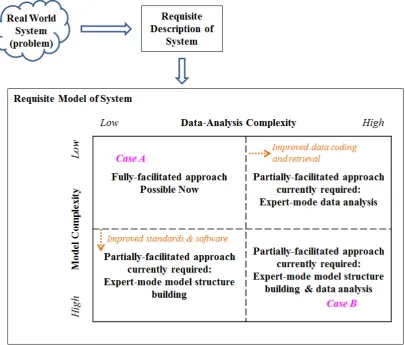
Figure 5: Contextual matrix with barriers (dashed-lines) to fully-facilitated DES
• Model complexity arises from features necessary to represent. Moving a situation towards the high-complexity end of the spectrum would be features such as resource-consuming queues, multiple routing conditions, interacting pathways and non-empty system starting conditions.
• Data-analysis complexity arises from the volume of work necessary to produce the data required by a model. A need to use real historical data (rather than judgements from the stakeholders) would move a project towards the
high-complexity end of the spectrum. Complexity and time delay would be exacerbated
by data extraction from a set of corporate databases and a need to clean, re-code and/or reconstruct pathways from fragments (e.g. series of care episodes).
facilitated-mode model coding (and so fully-facilitated DES) if more capable tools become available (see sections 5.3).
As Figure 5 also indicates, the assumptions about and abstractions from the real world problem involved in conceptual modelling (Robinson, 2014) inform what would be a requisite model (the simplest yet valid, credible and useful model). A complex system does not always require a complex model, and detail should be added parsimoniously (Pidd, 2004). Reflecting on our experience in the cases, and the reminder from Robinson et al. (2014) that the healthcare DES community should consider ‘simple’ models, reinforces the importance of exploring early in a project what modelling is requisite for a particular problem situation.
Successful facilitated-mode model coding in Case A depended on the context: the system (and so model) had relatively low complexity and the stakeholders required only face validity and an understanding of what sort of changes to make, so estimated data were adequate. In Case B Project B1, the deeper understanding we now have of the model and data-analysis complexity barriers could have led us to consider the implications of requisite modelling earlier and more thoroughly and, at minimum, manage expectations and the process differently, realising the constraints of the very considerable expert-mode work required. The barriers made the interruption for model coding (as in PartiSim ((Tako & Kotiadis, 2015)) inevitable. Starting in parallel, part-way through Project B1, Project B2 benefited from this learning. Deeper consideration of what would be requisite led us to realise that model coding in facilitated mode would not be possible and requisite modelling would be impracticable. Bowers, Ghattas, and Mould (2009) encountered this issue of expectations management from longer-than-expected model development, and in one project they found it necessary to build a complex model (which took longer than was available to meet the stakeholders’ objectives) in order to recognise what the critical elements for a simpler model would have been.
5.3 Limitations and Further Work
Both our cases were environments where the general barriers to engagement reported in the literature (sections 2 and 5.1) were very low. Beyond that, the degree of stakeholder engagement achieved leads us to believe that the barriers to implementation specific to healthcare projects also previously reported had been overcome in Case A. This was also the situation in Case B Project B1 until the further barriers, discussed in sections 5.1 and 5.2, became apparent. That the central new contribution to this was BPMN, acting as a way-in to conceptual modelling and a gateway to DES, is apparent from its capabilities and the reactions of the stakeholders (section 5.1). The major academic contribution is showing that this can close the model coding ‘gap’ in fully-facilitated DES emphasised by Robinson et al. (2014) in some situations.
Though the projects described here could be seen as lying towards the extremes on both contextual dimensions that we have identified (Figure 5), we believe they are useful in starting to mark out the territory, and are representative of many such types of situations DES modellers face in healthcare. Replication studies would be valuable to attempt to explore the territory in between these extremes to refine the boundaries of where fully-facilitated DES modelling may be possible under current constraints of software tools and healthcare services’ approaches to data capture and storage.
We argued in section 5.2 that the feasibility of fully-facilitated DES depends on what level of modelling is requisite; then, contingent on this, on the impact of model and data complexity (Figure 5). Whether these form barriers in practice depends on the capabilities of software tools available and the data systems in use.
its capabilities for this type of application. Similarly, we suggest that the capability of BPSim and links to fuller-capability DES engines should be strengthened for greater control of features such as animation and results collection. Such developments are a subject of our continuing work.
On the data-complexity dimension, the convolution of many patient pathways (especially inpatients) in practice is exacerbated by a great variety among hospitals in the organisation of treatment and its description in coding systems, plus fragmented recording in and across data systems. In some projects it may be possible to anticipate data needs, collecting and processing data before (any) workshop interactions (cf. some lean rapid-improvement events such as the DES-supported initiative described by Baril et al. (2016)). However, as in Case B, the full complexity of aspects like routing decisions, and the limitations of information about this recorded in data systems, may only become apparent during workshop discussions. There may also be lessons from the manufacturing DES community in which the ‘input data management’ phase is recognised as a key barrier, though concerns are more about the duration and cost of simulation projects and desire to conduct real-time simulation (Barlas & Heavey, 2016) than about enabling facilitated engagement with stakeholders. Work is underway by academics and practitioners to develop standards and semantics to support integration of DES with manufacturing data systems (e.g. Enterprise Resource Planning systems) or automated data extraction (including via data mining and intermediate databases) (Barlas & Heavey, 2016). Such an intermediate database system exists at Salford Royal, potentially useful for live access to summary statistics during data entry and validation in workshops for low-complexity systems.
easily-accessible tool (technically and financially) to support internally-facilitated process mapping and conceptual modelling could open access to a broad base of users in large and diverse organisations like hospitals, with particular systems picked out or ‘escalated’ to receive support from modellers with various types and levels of specialist skills and tools.
6. Conclusions
This paper describes a DES modelling approach with which we achieved model coding during a facilitated workshop in one healthcare case (Case A) but failed in a second (Case B). This research demonstrates the particular potential of the use of the BPMN business modelling standard, as part of a facilitated-modelling approach, in helping overcome many of the barriers to DES in healthcare reported in the academic literature. In particular we have demonstrated how BPMN can close the model-coding gap in fully-facilitated DES in some situations. The unsuccessful case revealed model complexity and data-analysis complexity as contextual barriers ‘beyond’ the barriers previously literature has focused on. We have used these to propose a contextual matrix (Figure 5) to indicate to academics and practitioners when a fully-facilitated modelling approach can currently be achieved. Reflection on our experience also leads us to propose giving more attention early on in a potential DES project to key features likely to be necessary for requisite modelling. We suggest that this would help direct DES resource and reduce the very large proportion of simulation studies reported in the literature not to reach implementation.
We have added more evidence that BPMN is a process modelling standard that is readily understandable by non-specialists and can help the different groups involved, particularly frontline staff, quality improvement staff and OR analysts, work together. The electronic link from non-software-specific conceptual maps to DES is a very promising direction for engaging stakeholders and closing the model-coding gap. However, we have demonstrated that, having been developed for other purposes, BPMN currently (v2.0) lacks some features to represent complex (but fairly common) features of healthcare pathways. Further, that its links with DES need further development for such situations. These are subjects of our continuing work, which we have started with conceptual recommendations demonstrations (Onggo, Proudlove,
Acknowledgements
We would like to thank the staff at the anonymous Italian hospital, and from the English NHS: Debbie Carr, Dr Emma Donaldson, Dr Jenny Fox, Joe Frost, Joy Furnival, Paul Hughes, Andrew Kent, Jon Lawton and Siobhan Moran. Our thanks also go to the anonymous reviewers for their suggestions on framing the contribution of this paper.
References
Adamides, E. D., & Karacapilidis, N. (2006). A knowledge centred framework for collaborative business process modelling. Business Process Management Journal, 12(5), 557-575. doi: 10.1108/14637150610690993
Andersen, F. D., Vennix, M. J. A., Richardson, P. G., & Rouwette, A. E. A. J. (2007). Group model building: problem structuring, policy simulation and decision support. Journal of the Operational Research Society, 58(5), 691-694. doi: 10.1057/palgrave.jors.2602339
Balci, O. (1998). Verification, validation, and testing. In J. Banks (Ed.), Handbook of simulation: Principles, methodology, advances, applications, and practice (pp. 335-393). Hoboken, NJ: John Wiley & Sons.
Baril, C., Gascon, V., Miller, J., & Côté, N. (2016). Use of a discrete-event simulation in a Kaizen event: A case study in healthcare. European Journal of Operational Research, 249(1), 327-339. doi: 10.1016/j.ejor.2015.08.036
Barlas, P., & Heavey, C. (2016). Automation of input data to discrete event simulation for manufacturing: A review. International Journal of Modeling, Simulation, and Scientific Computing, 7(1), 1-27 doi: 10.1142/S1793962316300016
Bisogno, S., Calabrese, A., Gastaldi, M., & Levialdi Ghiron, N. (2016). Combining modelling and simulation approaches: How to measure performance of business processes. Business Process Management Journal, 22(1), 56-74. doi: 10.1108/BPMJ-02-2015-0021
Bizagi. (2016). Bizagi Modeler Retrieved 14 June 2016, from www.bizagi.com
Bowers, J., Ghattas, M., & Mould, G. (2009). Success and failure in the simulation of an Accident and Emergency department. Journal of Simulation, 3(3), 171-178. doi: 10.1057/jos.2009.5
Brailsford, S. C. (2005). Overcoming the barriers to implementation of operations research simulation models in healthcare. Clinical & Investigative Medicine, 28(6), 312-315.
Brailsford, S. C., Bolt, T., Connell, C., Klein, J. H., & Patel, B. (2009). Stakeholder engagement in health care simulation. In M. D. Rossetti, R. R. Hill, B. Johansson, A. Dunkin & R. G. Ingalls (Eds.), Proceeedings of the 2009 Winter Simulation Conference (WSC '09 ) (pp. 1840-1849). Austin, TX: IEEE.
Brailsford, S. C., Harper, P., Patel, B., & Pitt, M. (2009). An analysis of the academic literature on simulation and modelling in health care. Journal of Simulation, 3(3), 130-140. doi: 10.1057/jos.2009.10
Brailsford, S. C., & Vissers, J. (2011). OR in healthcare: A European perspective.
European Journal of Operational Research, 212(2), 223-234. doi:
10.1016/j.ejor.2010.10.026
Den Hengst, M., de Vreede, G., & Maghnouji, R. (2007). Using soft OR principles for collaborative simulation: a case study in the Dutch airline industry. Journal of
the Operational Research Society, 58(5), 669-682. doi:
10.1057/palgrave.jors.2602353
Fone, D., Hollinghurst, S., Temple, M., Round, A., Lester, N., Weightman, A., . . . Palmer, S. (2003). Systematic review of the use and value of computer simulation modelling in population health and health care delivery. Journal of Public Health Medicine, 25, 325-335. doi: 10.1093/pubmed/fdg075
Franco, L. A., & Montibeller, G. (2010). Facilitated modelling in operational research.
European Journal of Operational Research, 205(3), 489-500. doi:
10.1016/j.ejor.2009.09.030
Harper, P. R., & Pitt, M. A. (2004). On the challenges of healthcare modelling and a proposed lifecycle for successful implementation. Journal of the Operational Research Society, 55(6), 657-661. doi: 10.1057/palgrave.jors.2601719
Jahangirian, M., Naseer, A., Stergioulas, L., Young, T., Eldabi, T., Brailsford, S., . . . Harper, P. (2012). Simulation in health-care: lessons from other sectors.
Operational Research - An International Journal, 12(1), 45-55. doi:
Jahangirian, M., Taylor, S. J. E., Eatock, J., Stergioulas, L. K., & Taylor, P. M. (2015). Causal study of low stakeholder engagement in healthcare simulation projects.
Journal of the Operational Research Society, 66(3), 369-379. doi:
10.1057/jors.2014.1
Katsaliaki, K., & Mustafee, N. (2011). Applications of simulation within the healthcare context. Journal of the Operational Research Society, 62(8), 1431-1451. doi: 10.1057/jors.2010.20
Kotiadis, K., Tako, A. A., & Vasilakis, C. (2014). A participative and facilitative conceptual modelling framework for discrete event simulation studies in healthcare. Journal of the Operational Research Society, 65(2), 197-213. doi: 10.1057/jors.2012.176
Lowery, J. C. (1996). Introduction to simulation in health care. In J. M. Charnes, D. J. Morrice, D. T. Brunner & J. J. Swain (Eds.), Proceedings of the 1996 Winter Simulation Conference (WSC '96) (pp. 78-84 ). Coronado, CA: IEEE.
Lowery, J. C., Hakes, B., Keller, L., Lilegdon, W. R., Mabrouk, K., & McGuire, F. (1994). Barriers to implementing simulation in health care. In J. D. Tew, S. Manivannan, D. A. Sadowski & A. F. Seila (Eds.), Proceedings of the 1994 Winter Simulation Conference (WSC '94) (pp. 868-875). Orlando, FL: IEEE. Mathew, B., & Mansharamani, R. (2012). Simulating business processes – a review of
tools and techniques. International Journal of Modeling and Optimization,, 2(4), 417-421.
Monks, T., Robinson, S., & Kotiadis, K. (2016). Can involving clients in simulation studies help them solve their future problems? A transfer of learning experiment.
European Journal of Operational Research, 249(3), 919-930. doi:
10.1016/j.ejor.2015.08.037
NHS Institute for Innovation and Improvement. (2005). Improvement leaders’ guide: Process mapping, analysis and redesign. Coventry: NHSI.
OMG. (2011). Business Process Model and Notation (BPMN): OMG available specification, version 2.0 Retrieved 14 June 2016, from www.omg.org/spec/BPMN/2.0
Onggo, B. S. S. (2011). Methods for conceptual model representation. In S. Robinson, R. J. Brooks, K. Kotiadis & D.-J. van der Zee (Eds.), Conceptual modelling for
discrete-event simulation (pp. 337-354). Boca Raton, FL, USA: Chapman and
Onggo, B. S. S. (2012). BPMN pattern for agent-based simulation model representation In C. Laroque, J. Himmelspach, R. Pasupathy, O. Rose & A. M. Uhrmacher (Eds.), Proceedings of the 2012 Winter Simulation Conference (WSC '12) (pp. 3657-3666). Berlin: IEEE.
Onggo, B. S. S., & Karpat, O. (2011). Agent-based conceptual model representation using BPMN. In S. Jain, R. R. Creasey, J. Himmelspach, K. P. White & M. Fu (Eds.), Proceedings of the 2011 Winter Simulation Conference (WSC '11) (pp. 671 - 682). Phoenix, AZ: IEEE.
Onggo, B. S. S., Proudlove, N. C., D'Ambrogio, A., Calabrese, A., & Bisogno, S. (in press). A BPMN extension to support discrete-event simulation for healthcare applications: an explicit representation of queues, attributes and data-driven decision points. Journal of the Operational Research Society.
Pessôa, L. A. M., Lins, M. P. E., da Silva, A. C. M., & Fiszman, R. (2015). Integrating soft and hard operational research to improve surgical centre management at a university hospital. European Journal of Operational Research, 245(3), 851-861. doi: 10.1016/j.ejor.2015.04.007
Phillips, L. D. (1982). Requisite decision modelling: A case study. Journal of the Operational Research Society, 33(4), 303-311. doi: 10.1057/jors.1982.71
Phillips, L. D. (1984). A theory of requisite decision models. Acta Psychologica, 56 (1-3), 29-48. doi: 10.1016/0001-6918(84)90005-2
Pidd, M. (2004). Computer simulation in management science (5th ed.). Chichester: John Wiley & Sons.
Pitt, M., Monks, T., Crowe, S., & Vasilakis, C. (2016). Systems modelling and simulation in health service design, delivery and decision making. BMJ Quality & Safety, 25, 38-45. doi: 10.1136/bmjqs-2015-004430
Proudlove, N. C., Black, S., & Fletcher, A. (2007). OR and the challenge to improve the NHS: modelling for insight and improvement in in-patient flows. Journal of the
Operational Research Society, 58(2), 145-158. doi:
10.1057/palgrave.jors.2602252
Recker, J. (2010). Opportunities and constraints: the current struggle with BPMN.
Business Process Management Journal, 16(1), 181-201. doi:
10.1108/14637151011018001
Robinson, S. (2014). Simulation: The practice of model development and use (2nd ed.). Basingstoke, UK: Palgrave Macmillan.
Robinson, S., & Pidd, M. (1998). Provider and Customer Expectations of Successful Simulation Projects. The Journal of the Operational Research Society, 49(3), 200-209.
Robinson, S., Radnor, Z. J., Burgess, N., & Worthington, C. (2012). SimLean: Utilising simulation in the implementation of lean in healthcare. European Journal of Operational Research, 219(1), 188-197. doi: 10.1016/j.ejor.2011.12.029
Robinson, S., Worthington, C., Burgess, N., & Radnor, Z. J. (2014). Facilitated modelling with discrete-event simulation: Reality or myth? European Journal of Operational Research, 234(1), 231-240. doi: 10.1016/j.ejor.2012.12.024
Rother, M., & Shook, J. (2003). Learning to see: value-stream mapping to create value and eliminate muda (v.1.3 ed.). Brookline, MA: The Lean Enterprise Institute. Santibáñez, P., Chow, V., French, J., Puterman, M., & Tyldesley, S. (2009). Reducing
patient wait times and improving resource utilization at British Columbia Cancer Agency’s ambulatory care unit through simulation. Health Care Management Science, 12(4), 392-407. doi: 10.1007/s10729-009-9103-1
Slack, N., Brandon-Jones, A., & Johnston, R. (2013). Operations management (7th ed ed.). Harlow: Pearson Education.
Tako, A. A., & Kotiadis, K. (2012). Facilitated conceptual modelling: Practical issues and reflections. In C. Laroque, J. Himmelspach, R. Pasupathy, O. Rose & A. M. Uhrmacher (Eds.), Proceedings of the 2012 Winter Simulation Conference (WSC '12) (pp. 1-12). Berlin: IEEE.
Tako, A. A., & Kotiadis, K. (2015). PartiSim: A multi-methodology framework to support facilitated simulation modelling in healthcare. European Journal of Operational Research, 244(2), 555-564. doi: 10.1016/j.ejor.2015.01.046
Tako, A. A., & Robinson, S. (2015). Is simulation in health different? Journal of the Operational Research Society, 66(4), 602-614. doi: 10.1057/jors.2014.25
Tunnicliffe Wilson, J. C. (1981). Implementation of computer simulation projects in health care. Journal of the Operational Research Society, 32(9), 825-832. doi: 10.2307/2581399
Vandborg, M. P., Edwards, K., Kragstrup, J., Vedsted, P., Hansen, D. G., & Mogensen, O. D. (2012). A new method for analyzing diagnostic delay in gynecological cancer. International Journal of Gynecological Cancer, 22(4), 712-717. doi: 10.1097/IGC.0b013e31824c6d0e
Vennix, J. A. (1999). Group model-building: Tackling messy problems. System
Dynamics Review, 15(4), 379-401. doi:
10.1002/(SICI)1099-1727(199924)15:4<379::AID-SDR179>3.0.CO;2-E
Wagner, G. (2014). Tutorial: Information and process modeling for simulation. In A. Tolk, S. Y. Diallo, I. O. Ryzhov, L. Yilmaz, S. Buckley & J. A. Miller (Eds.),
Proceedings of the 2014 Winter Simulation Conference (WSC '14) (pp.
103-117). Savannah, GA: IEEE.
WfMC. (2016). BPSim: Business process simulation interchange standard Retrieved 14 June 2016, from www.bpsim.org