Multilingual Dependency Analysis with a Two-Stage Discriminative Parser
Ryan McDonald Kevin Lerman Fernando Pereira
Department of Computer and Information Science University of Pennsylvania
Philadelphia, PA
{ryantm,klerman,pereira}@cis.upenn.edu
Abstract
We present a two-stage multilingual de-pendency parser and evaluate it on 13 diverse languages. The first stage is based on the unlabeled dependency pars-ing models described by McDonald and Pereira (2006) augmented with morpho-logical features for a subset of the lan-guages. The second stage takes the out-put from the first and labels all the edges in the dependency graph with appropri-ate syntactic cappropri-ategories using a globally trained sequence classifier over compo-nents of the graph. We report results on the CoNLL-X shared task (Buchholz et al., 2006) data sets and present an error analysis.
1 Introduction
Often in language processing we require a deep syn-tactic representation of a sentence in order to assist further processing. With the availability of resources such as the Penn WSJ Treebank, much of the fo-cus in the parsing community had been on producing syntactic representations based on phrase-structure. However, recently their has been a revived interest in parsing models that produce dependency graph representations of sentences, which model words and their arguments through directed edges (Hud-son, 1984; Mel0ˇcuk, 1988). This interest has
gener-ally come about due to the computationgener-ally efficient and flexible nature of dependency graphs and their
ability to easily model non-projectivity in freer-word order languages. Nivre (2005) gives an introduction to dependency representations of sentences and re-cent developments in dependency parsing strategies. Dependency graphs also encode much of the deep syntactic information needed for further process-ing. This has been shown through their success-ful use in many standard natural language process-ing tasks, includprocess-ing machine translation (Dprocess-ing and Palmer, 2005), sentence compression (McDonald, 2006), and textual inference (Haghighi et al., 2005). In this paper we describe a two-stage discrimi-native parsing approach consisting of an unlabeled parser and a subsequent edge labeler. We evaluate this parser on a diverse set of 13 languages using data provided by the CoNLL-X shared-task organiz-ers (Buchholz et al., 2006; Hajiˇc et al., 2004; Simov et al., 2005; Simov and Osenova, 2003; Chen et al., 2003; B ¨ohmov´a et al., 2003; Kromann, 2003; van der Beek et al., 2002; Brants et al., 2002; Kawata and Bartels, 2000; Afonso et al., 2002; Dˇzeroski et al., 2006; Civit Torruella and Mart´ı Anton´ın, 2002; Nilsson et al., 2005; Oflazer et al., 2003; Atalay et al., 2003). The results are promising and show the language independence of our system under the as-sumption of a labeled dependency corpus in the tar-get language.
For the remainder of this paper, we denote by
x = x1, . . . xn a sentence with n words and by y a corresponding dependency graph. A
depen-dency graph is represented by a set of ordered pairs
(i, j) ∈ yin whichxj is a dependent andxi is the
corresponding head. Each edge can be assigned a la-bell(i,j)from a finite setLof predefined labels. We
assume that all dependency graphs are trees but may be non-projective, both of which are true in the data sets we use.
2 Stage 1: Unlabeled Parsing
The first stage of our system creates an unlabeled parse y for an input sentence x. This system is
primarily based on the parsing models described by McDonald and Pereira (2006). That work ex-tends the maximum spanning tree dependency pars-ing framework (McDonald et al., 2005a; McDonald et al., 2005b) to incorporate features over multiple edges in the dependency graph. An exact projec-tive and an approximate non-projecprojec-tive parsing al-gorithm are presented, since it is shown that non-projective dependency parsing becomes NP-hard when features are extended beyond a single edge.
That system uses MIRA, an online large-margin learning algorithm, to compute model parameters. Its power lies in the ability to define a rich set of fea-tures over parsing decisions, as well as surface level features relative to these decisions. For instance, the system of McDonald et al. (2005a) incorporates fea-tures over the part of speech of words occurring be-tween and around a possible head-dependent rela-tion. These features are highly important to over-all accuracy since they eliminate unlikely scenarios such as a preposition modifying a noun not directly to its left, or a noun modifying a verb with another verb occurring between them.
We augmented this model to incorporate morpho-logical features derived from each token. Consider a proposed dependency of a dependentxjon the head
xi, each with morphological featuresMjandMi
re-spectively. We then add to the representation of the edge: Mi as head features, Mj as dependent
fea-tures, and also each conjunction of a feature from both sets. These features play the obvious role of explicitly modeling consistencies and commonali-ties between a head and its dependents in terms of attributes like gender, case, or number. Not all data sets in our experiments include morphological fea-tures, so we use them only when available.
3 Stage 2: Label Classification
The second stage takes the output parse yfor
sen-tence x and classifies each edge (i, j) ∈ y with a
particular labell(i,j). Ideally one would like to make all parsing and labeling decisions jointly so that the shared knowledge of both decisions will help resolve any ambiguities. However, the parser is fundamen-tally limited by the scope of local factorizations that make inference tractable. In our case this means we are forced only to consider features over single edges or pairs of edges. However, in a two stage system we can incorporate features over the entire output of the unlabeled parser since that structure is fixed as input. The simplest labeler would be to take as input an edge(i, j) ∈ yfor sentencexand find
the label with highest score,
l(i,j)= arg max
l
s(l,(i, j),y,x)
Doing this for each edge in the tree would pro-duce the final output. Such a model could easily be trained using the provided training data for each lan-guage. However, it might be advantageous to know the labels of other nearby edges. For instance, if we consider a headxi with dependentsxj1, . . . , xjM, it
is often the case that many of these dependencies will have correlated labels. To model this we treat the labeling of the edges(i, j1), . . . ,(i, jM)as a
se-quence labeling problem,
(l(i,j1), . . . , l(i,jM)) = ¯l= arg max
¯
l
s(¯l, i,y,x)
We use a first-order Markov factorization of the score
¯
l= arg max
¯
l
M
X
m=2
s(l(i,jm), l(i,jm
−1), i,y,x)
in which each factor is the score of labeling the adja-cent edges(i, jm)and(i, jm−1)in the treey. We
at-tempted higher-order Markov factorizations but they did not improve performance uniformly across lan-guages and training became significantly slower.
For score functions, we use simple dot products between high dimensional feature representations and a weight vector
s(l(i,jm), l(i,jm
−1), i,y,x)=
w·f(l(i,jm), l(i,jm−1), i,y,x)
online learner to set the weights (Crammer and Singer, 2003; McDonald et al., 2005a) since we found it trained quickly and provide good perfor-mance. Furthermore, it made the system homoge-neous in terms of learning algorithms since that is what is used to train our unlabeled parser (McDon-ald and Pereira, 2006). Of course, we have to define a set of suitable features. We used the following:
• Edge Features: Word/pre-suffix/part-of-speech (POS)/morphological feature identity of the head and the dependent (affix lengths 2 and 3). Does the head and its dependent share a prefix/suffix? Attachment direction. What morphological features do head and dependent have the same value for? Is the dependent the first/last word in the sentence?
• Sibling Features: Word/POS/pre-suffix/morphological feature identity of the dependent’s nearest left/right sib-lings in the tree (sibsib-lings are words with same parent in the tree). Do any of the dependent’s siblings share its POS?
• Context Features: POS tag of each intervening word be-tween head and dependent. Do any of the words bebe-tween the head and the dependent have a parent other than the head? Are any of the words between the head and the de-pendent not a descendant of the head (i.e. non-projective edge)?
• Non-local: How many children does the dependent have? What morphological features do the grandparent and the dependent have identical values? Is this the left/right-most dependent for the head? Is this the first dependent to the left/right of the head?
Various conjunctions of these were included based on performance on held-out data. Note that many of these features are beyond the scope of the edge based factorizations of the unlabeled parser. Thus a joint model of parsing and labeling could not easily include them without some form of re-ranking or approximate parameter estimation.
4 Results
We trained models for all 13 languages provided by the CoNLL organizers (Buchholz et al., 2006). Based on performance from a held-out section of the training data, we used non-projective parsing algo-rithms for Czech, Danish, Dutch, German, Japanese, Portuguese and Slovene, and projective parsing al-gorithms for Arabic, Bulgarian, Chinese, Spanish, Swedish and Turkish. Furthermore, for Arabic and Spanish, we used lemmas instead of inflected word
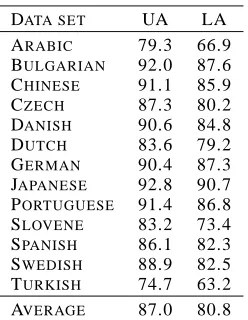
DATA SET UA LA ARABIC 79.3 66.9 BULGARIAN 92.0 87.6 CHINESE 91.1 85.9
CZECH 87.3 80.2
DANISH 90.6 84.8
DUTCH 83.6 79.2
[image:3.612.365.489.55.215.2]GERMAN 90.4 87.3 JAPANESE 92.8 90.7 PORTUGUESE 91.4 86.8 SLOVENE 83.2 73.4 SPANISH 86.1 82.3 SWEDISH 88.9 82.5 TURKISH 74.7 63.2 AVERAGE 87.0 80.8
Table 1: Dependency accuracy on 13 languages. Unlabeled (UA) and Labeled Accuracy (LA).
forms, again based on performance on held-out data1.
Results on the test set are given in Table 1. Per-formance is measured through unlabeled accuracy, which is the percentage of words that modify the correct head in the dependency graph, and labeled accuracy, which is the percentage of words that modify the correct head and label the dependency edge correctly in the graph. These results show that the discriminative spanning tree parsing framework (McDonald et al., 2005b; McDonald and Pereira, 2006) is easily adapted across all these languages. Only Arabic, Turkish and Slovene have parsing ac-curacies significantly below 80%, and these lan-guages have relatively small training sets and/or are highly inflected with little to no word order con-straints. Furthermore, these results show that a two-stage system can achieve a relatively high perfor-mance. In fact, for every language our models per-form significantly higher than the average perfor-mance for all the systems reported in Buchholz et al. (2006).
For the remainder of the paper we provide a gen-eral error analysis across a wide set of languages plus a detailed error analysis of Spanish and Arabic.
5 General Error Analysis
Our system has several components, including the ability to produce non-projective edges, sequential
1
SYSTEM UA LA
N+S+M 86.3 79.7
P+S+M 85.6 79.2
N+S+B 85.5 78.6
N+A+M 86.3 79.4
[image:4.612.132.239.56.125.2]P+A+B 84.8 77.7
Table 2: Error analysis of parser components av-eraged over Arabic, Bulgarian, Danish, Dutch, Japanese, Portuguese, Slovene, Spanish, Swedish and Turkish. N/P: Allow non-projective/Force pro-jective, S/A: Sequential labeling/Atomic labeling, M/B: Include morphology features/No morphology features.
assignment of edge labels instead of individual as-signment, and a rich feature set that incorporates morphological properties when available. The bene-fit of each of these is shown in Table 2. These results report the average labeled and unlabeled precision for the 10 languages with the smallest training sets. This allowed us to train new models quickly.
Table 2 shows that each component of our system does not change performance significantly (rows 2-4 versus row 1). However, if we only allow projec-tive parses, do not use morphological features and label edges with a simple atomic classifier, the over-all drop in performance becomes significant (row 5 versus row 1). Allowing non-projective parses helped with freer word order languages like Dutch (78.8%/74.7%to83.6%/79.2%, unlabeled/labeled accuracy). Including rich morphology features natu-rally helped with highly inflected languages, in par-ticular Spanish, Arabic, Turkish, Slovene and to a lesser extent Dutch and Portuguese. Derived mor-phological features improved accuracy in all these languages by 1-3% absolute.
Sequential classification of labels had very lit-tle effect on overall labeled accuracy (79.4% to
79.7%)2. The major contribution was in helping to distinguish subjects, objects and other dependents of main verbs, which is the most common label-ing error. This is not surprislabel-ing since these edge labels typically are the most correlated (i.e., if you already know which noun dependent is the subject, then it should be easy to find the object). For in-stance, sequential labeling improves the labeling of
2
This difference was much larger for experiments in which gold standard unlabeled dependencies are used.
objects from 81.7%/75.6% to 84.2%/81.3% (la-beled precision/recall) and the labeling of subjects from 86.8%/88.2% to 90.5%/90.4% for Swedish. Similar improvements are common across all lan-guages, though not as dramatic. Even with this im-provement, the labeling of verb dependents remains the highest source of error.
6 Detailed Analysis
6.1 Spanish
Although overall unlabeled accuracy is 86%, most verbs and some conjunctions attach to their head words with much lower accuracy: 69% for main verbs, 75% for the verb ser, and 65% for coor-dinating conjunctions. These words form 17% of the test corpus. Other high-frequency word classes with relatively low attachment accuracy are preposi-tions (80%), adverbs (82%) and subordinating con-junctions (80%), for a total of another 23%of the test corpus. These weaknesses are not surprising, since these decisions encode the more global as-pects of sentence structure: arrangement of clauses and adverbial dependents in multi-clause sentences, and prepositional phrase attachment. In a prelimi-nary test of this hypothesis, we looked at all of the sentences from a development set in which a main verb is incorrectly attached. We confirmed that the main clause is often misidentified in multi-clause sentences, or that one of several conjoined clauses is incorrectly taken as the main clause. To test this further, we added features to count the number of commas and conjunctions between a dependent verb and its candidate head. Unlabeled accuracy for all verbs increases from 71% to 73%and for all con-junctions from 71% to74%. Unfortunately, accu-racy for other word types decreases somewhat, re-sulting in no significant net accuracy change. Nev-ertheless, this very preliminary experiment suggests that wider-range features may be useful in improv-ing the recognition of overall sentence structure.
non-finite forms.
In doing this preliminary analysis, we noticed some inconsistencies in the reference dependency structures. For example, in the test sentence Lo que decia Mae West de si misma podr´ıamos decirlo tambi´en los hombres:..., decia’s head is given as de-cirlo, although the main verbs of relative clauses are normally dependent on what the relative modifies, in this case the article Lo.
6.2 Arabic
A quick look at unlabeled attachment accuracies in-dicate that errors in Arabic parsing are the most common across all languages: prepositions (62%), conjunctions (69%) and to a lesser extent verbs (73%). Similarly, for labeled accuracy, the hard-est edges to label are for dependents of verbs, i.e., subjects, objects and adverbials. Note the differ-ence in error between the unlabeled parser and the edge labeler: the former makes mistakes on edges into prepositions, conjunctions and verbs, and the latter makes mistakes on edges into nouns (sub-ject/objects). Each stage by itself is relatively ac-curate (unlabeled accuracy is79% and labeling ac-curacy3 is also 79%), but since there is very little overlap in the kinds of errors each makes, overall la-beled accuracy drops to67%. This drop is not nearly as significant for other languages.
Another source of potential error is that the aver-age sentence length of Arabic is much higher than other languages (around 37 words/sentence). How-ever, if we only look at performance for sentences of length less than 30, the labeled accuracy is still only71%. The fact that Arabic has only 1500 train-ing instances might also be problematic. For exam-ple if we train on 200, 400, 800 and the full training set, labeled accuracies are54%,60%,62%and67%. Clearly adding more data is improving performance. However, when compared to the performance of Slovene (1500 training instances) and Spanish (3300 instances), it appears that Arabic parsing is lagging.
7 Conclusions
We have presented results showing that the spanning tree dependency parsing framework of McDonald et
3
Labeling accuracy is the percentage of words that correctly label the dependency between the head that they modify, even if the right head was not identified.
al. (McDonald et al., 2005b; McDonald and Pereira, 2006) generalizes well to languages other than En-glish. In the future we plan to extend these mod-els in two ways. First, we plan on examining the performance difference between two-staged depen-dency parsing (as presented here) and joint parsing plus labeling. It is our hypothesis that for languages with fine-grained label sets, joint parsing and label-ing will improve performance. Second, we plan on integrating any available morphological features in a more principled manner. The current system sim-ply includes all morphological bi-gram features. It is our hope that a better morphological feature set will help with both unlabeled parsing and labeling for highly inflected languages.
References
S. Buchholz, E. Marsi, A. Dubey, and Y. Krymolowski. 2006. CoNLL-X shared task on multilingual depen-dency parsing. SIGNLL.
K. Crammer and Y. Singer. 2003. Ultraconservative on-line algorithms for multiclass problems. JMLR.
Y. Ding and M. Palmer. 2005. Machine translation using probabilistic synchronous dependency insertion gram-mars. In Proc. ACL.
A. Haghighi, A. Ng, and C. Manning. 2005. Robust textual inference via graph matching. In Proc. HTL-EMNLP.
R. Hudson. 1984. Word Grammar. Blackwell.
R. McDonald and F. Pereira. 2006. Online learning of approximate dependency parsing algorithms. In Proc. EACL.
R. McDonald, K. Crammer, and F. Pereira. 2005a. On-line large-margin training of dependency parsers. In Proc. ACL.
R. McDonald, F. Pereira, K. Ribarov, and J. Hajiˇc. 2005b. Non-projective dependency parsing using spanning tree algorithms. In Proc. HLT-EMNLP.
R. McDonald. 2006. Discriminative sentence compres-sion with soft syntactic constraints. In Proc. EACL.
I.A. Mel0ˇcuk. 1988. Dependency Syntax: Theory and
Practice. State University of New York Press.