
Proceedings of the 2019 Conference on Empirical Methods in Natural Language Processing and the 9th International Joint Conference on Natural Language Processing, pages 271–281,
271
Learning Dynamic Context Augmentation for Global Entity Linking
Xiyuan Yang1, Xiaotao Gu2, Sheng Lin1, Siliang Tang1∗, Yueting Zhuang1, Fei Wu1, Zhigang Chen3, Guoping Hu3 & Xiang Ren4
1Zhejiang University,2University of Illinois at Urbana Champaign 3iFLYTEK Research,4University of Southern California
{yangxiyuan, shenglin, siliang, yzhuang, wufei}@zju.edu.cn,
[email protected],{zgchen, gphu}@iflytek.com,
Abstract
Despite of the recent success of collective en-tity linking (EL) methods, these “global” in-ference methods may yield sub-optimal results when the “all-mention coherence” assumption breaks, and often suffer from high computa-tional cost at the inference stage, due to the complex search space. In this paper, we pro-pose a simple yet effective solution, called Dynamic Context Augmentation (DCA), for collective EL, which requires only one pass through the mentions in a document. DCA
sequentiallyaccumulates context information to make efficient, collective inference, and can cope with different local EL models as a plug-and-enhance module. We explore both super-vised and reinforcement learning strategies for learning the DCA model. Extensive experi-ments1 show the effectiveness of our model with different learning settings, base models, decision orders and attention mechanisms.
1 Introduction
Linking mentions of entities in text to knowledge base entries (i.e., entity linking, or EL) is critical to understanding and structuring text corpora. In general, EL is approached by first obtaining can-didate entities for each mention, and then idfying the true referent among the candidate enti-ties. Prior distribution and local contexts, either in the form of hand-crafted features (Ratinov et al., 2011;Shen et al.,2015) or dense embeddings (He et al.,2013;Nguyen et al.,2016;Francis-Landau et al.,2016), play key roles in distinguishing dif-ferent candidates. However, in many cases, local features can be too sparse to provide sufficient in-formation for disambiguation.
To alleviate this problem, various collective EL models have been proposed to globally optimize
∗
Corresponding author.
1Code and data is available at https://github.com/YoungXiyuan/DCA
5DZ 'RFXPHQW
$1HZ 0H[LFR QDWLYH PXVLF EDQG FDOOHG%HLUXW ZLOO KROG LWV SHUIRUPDQFH LQ:DVKLQJWRQRQ 7KXUVGD\
New Mexico
1HZ0H[LFR86VWDWH
Beirut %HLUXW EDQG
%HLUXW
/HEDQRQ¶VFDSLWDO
Washington
:DVKLQJWRQ'& :DVKLQJWRQ 86VWDWH
*OREDO0HWKRG
6WHS /LQNLQJ3URFHVV '\QDPLF&RQWH[W
New Mexico
1HZ0H[LFR 86VWDWH
6DQWD)H
1HZ0H[LFR0XVLF
=DFK&RQGRQ
0DQKDWWDQ3URMHFW
:KLWH6DQGV0LVVLOH5DQJH Beirut
%HLUXW EDQG %HLUXW
/HEDQRQ¶VFDSLWDO
Washington
:DVKLQJWRQ '& :DVKLQJWRQ
86VWDWH
7KH$QWKHP
1HZ<RUN
*XODJ2UNHVWDU
2XU0HWKRG
[image:1.595.308.525.248.508.2]Mention &DQGLGDWH (QWLW\ &RKHUHQFH 5HVXOW
Figure 1: An Illustration of the Dynamic Context Augmentation process.A traditional global EL model jointly optimizes the linking configuration after itera-tive calculations over all mentions, which is compu-tationally expensive. In contrast, the DCA process only requires one pass of the document to accumulate knowledge from previously linked mentions to enhance fast future inference.
be made until all mentions in a document have been observed. Also, there usually exists a trade-off between accuracy and efficiency: state-of-the-art collective/global models suffer from high time complexity. From the perspective of computa-tional efficiency, optimal global configuration in-ference is NP-hard. Approximation methods, such as loopy belief propagation (Ganea and Hofmann, 2017) or iterative substitutions (Shen et al.,2015), are still computationally expensive due to the huge hypothesis space, and thus can hardly be scaled to handle large corpus. Many previous works have discussed the urgent needs of more efficient link-ing system for production, both in time complex-ity (Hughes et al., 2014) and memory consump-tion (Blanco et al.,2015).
In this paper, we propose a simple yet effec-tiveDynamicContextAugmentation (DCA) pro-cess to incorporate global signal for EL. As Fig-ure1shows, in contrast to traditional global mod-els, DCA only requires one pass through all men-tions to achieve comparable linking accuracy. The basic idea is to accumulate knowledge from pre-viously linked entities as dynamic context to en-hance later decisions. Such knowledge come from not only the inherent properties (e.g., descrip-tion, attributes) of previously linked entities, but also from their closely related entities, which em-power the model with important associative abil-ities. In real scenarios, some previously linked entities may be irrelevant to the current mention. Some falsely linked entities may even introduce noise. To alleviate error propagation, we fur-ther explore two strategies: (1) soft/hard attention mechanisms that favour the most relevant entities; (2) a reinforcement learning-based ranking model, which proves to be effective as reported in other information extraction tasks.
Contributions. The DCA model forms a new linking strategy from the perspective of data aug-mentation and thus can serve as a plug-and-enhance module of existing linking models. The major contributions of this work are as follows: (1) DCA can introduce topical coherence into lo-cal linking models without reshaping their origi-nal designs or structures; (2) Comparing to global EL models, DCA only requires one pass through all mentions, yielding better efficiency in both training and inference; (3) Extensive experiments show the effectiveness of our model under differ-ent learning settings, base models, decision orders
and attention mechanisms.
2 Background
2.1 Problem Definition
Given a set of entity mentionsM={m1, ..., mT} in corpusD, Entity Linking aims to link each men-tionmtto its corresponding gold entitye∗t. Such a process is usually divided into two steps: Candi-date generationfirst collects a set of possible (can-didate) entitiesEt ={e1t, ..., e
|Et|
t }formt; Candi-date rankingis then applied to rank all candidates by likelihood. The linking system selects the top ranked candidate as the predicted entity eˆt. The key challenge is to capture high-quality features of each entity mention for accurate entity predic-tion, especially when local contexts are too sparse to disambiguate all candidates.
We build our DCA model based on two existing local EL models. In this section, we first introduce the architecture of the base models, then present the proposed DCA model under the standard su-pervised learning framework. Since the DCA pro-cess can be naturally formed as a sequential deci-sion problem, we also explore its effectiveness un-der the Reinforcement Learning framework. De-tailed performance comparison and ablation stud-ies are reported in Section6.
2.2 Local Base Models for Entity Linking
We apply the DCA process in two popular lo-cal models with different styles: the first is a neural attention model named ETHZ-Attn (Ganea and Hofmann, 2017), the other is the Berkeley-CNN (Francis-Landau et al., 2016) model which is made up of multiple convolutional neural net-works (CNN).
ETHZ-Attn. For each mention mt and a can-didate ejt ∈ Et, three local features are con-sidered: (1) Mention-entity Prior Pˆ(ejt|mt) is the empirical distribution estimated from mas-sive corpus (e.g.Wikipedia); (2) Context Simi-larity ΨC(mt, ejt) measures the textual similar-ity between ejt and the local context of mt; (3) Type SimilarityΨT(mt, ejt)considers the similar-ity between the type of ejt and contexts around
predicts the probability distribution over all types (PER, GPE, ORG and UNK) formt, and outputs ΨT(mt, ejt) for each candidate accordingly. All local features are integrated by a two-layer feed-forward neural network with 100 hidden units, as described in (Ganea and Hofmann,2017).
Berkeley-CNN. The only difference between ETHZ-Attn and Berkeley-CNN is that, this model utilizes CNNs at different granularities to capture context similarity ΨC(mt, ejt) between a mention’s context and its target candidate entities.
3 Dynamic Context Augmentation
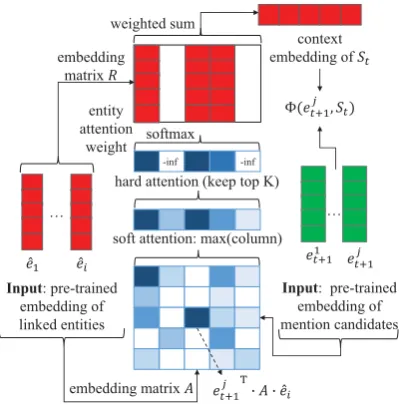
As Figure 1 demonstrates, the basic idea of DCA is to accumulate knowledge from previously linked entities as dynamic context to enhance later decisions. Formally, denote the list of previously linked entities asSt = {ˆe1, ...,ˆet}, where eachˆei is represented as an embedding vector. The aug-mented context can be represented by accumulated features of all previous entities and their neighbors (e.g. by averaging their embeddings, in the sim-plest way). In actual scenarios, some entities inSt are irrelevant, if not harmful, to the linking result ofmt+1. To highlight the importance of relevant
entities while filtering noises, we also try to apply a neural attention mechanism on dynamic contexts (Figure2). For mentionmt+1, candidates that are
more coherent withStare preferred. More specif-ically, we calculate the relevance score for each ˆ
ei∈Stas
u(ˆei) = max ejt+1∈Et+1
ejt+1>·A·eˆi, (1)
whereAis a parameterized diagonal matrix. Top
K entities in Stare left to form dynamic context while the others are pruned. The relevance scores are transformed to attention weights with
a(ˆei) = P exp[u(ˆei)]
ˆ
ej∈Stexp[u(ˆej)]
. (2)
Thus, we can define a weighted coherence score betweenejt+1∈ Et+1andStas
Φ(ejt+1, St) = X
ˆ
ei∈St
a(ˆei)·ejt+1
>
·R·ˆei, (3)
where R is a learnable diagonal matrix. Such a coherence score will be later incorporated in the final representation ofejt+1.
… …
-inf
soft attention: max(column) hard attention (keep top K)
-inf
softmax entity
attention weight embedding matrix ܴ
Input: pre-trained embedding of linked entities
Ƹ݁
ଵ Ƹ݁ ݁௧ାଵ
ଵ
݁௧ାଵ
Input: pre-trained embedding of mention candidates
embedding matrix ܣ ݁௧ାଵ ȉ ܣ ȉ Ƹ݁
weighted sum
context embedding of ܵ௧
[image:3.595.317.517.62.265.2]Ȱሺ݁௧ାଵ ǡ ܵ௧ሻ
Figure 2: Neural attention mechanism on the dynamic context. The soft attention module assigns higher weights to entities that are more relevant to the target mention. The hard attention module only considers top Kentities as dynamic contexts.
To empower the linking model with associative ability, aside from previously linked entities, we also incorporate entities that are closely associated with entities inSt. Specifically, for eacheˆi ∈ St, we collect its neighborhood N(ˆei) consisting of Wikipedia entities that have inlinks pointing toˆei. DenotingSt0 as the union of{N(ˆei)|ˆei ∈St}, we define a similar weighted coherence score between
ejt+1 ∈ Et+1andSt0 as
Φ0(ejt+1, St0) = X
ˆ
ei∈St0
a0(ˆei)·ejt+1>·R0·eˆi, (4)
where a0 is defined similarly to a, and R0
is a learnable diagonal matrix. The final representation h~0(mt+1, ejt+1) is the
concatena-tion of Φ(ejt+1, St), Φ0(ejt+1, St0), ΨT(mt, ejt+1),
ΨC(mt, ejt+1)andlog ˆP(ejt+1|mt+1).
4 Model Learning for DCA
In this section, we explore different learning strategies for the linking model. Specifically, we present a Supervised Learning model, where the model is given all gold entities for training, and a Reinforcement Learning model, where the model explores possible linking results by itself in a long-term planning task.
4.1 Supervised Ranking Method
vectorh~0(mt, ejt)as input, and outputs the proba-bilityPθ(ejt|mt). In this work, we use a two-layer feedforward neural network as the ranking model. We apply the max-margin loss as
Lθ= X
D∈D
X
mt∈D
X
ejt∈Et
gθ(ejt, mt),
gθ(ejt, mt) = max(0, γ−Pθ(et∗|mt) +Pθ(ejt|mt)).
The learning process is to estimate the optimal pa-rameter such thatθ∗ = arg minθLθ.
Note that, in the Supervised Ranking model, dy-namic contexts are provided by previous gold
en-tities: St = {e∗1, ..., e∗t},St0 = t S
i=1
N(e∗i). In the
testing phase, however, we do not have access to gold entities. Wrongly linked entities can intro-duce noisy contexts to future linking steps. To consider such long-term influences, we introduce an alternative Reinforcement Learning model in the next section.
4.2 Reinforcement Learning Method
Naturally, the usage of dynamic context augmen-tation forms a sequential decision problem, as each linking step depends on previous linking de-cisions. Correct linking results provide valuable information for future decisions, while previous mistakes can lead to error accumulation. Rein-forcement Learning (RL) algorithms have proven to be able to alleviate such accumulated noises in the decision sequence in many recent works (Narasimhan et al., 2016; Feng et al., 2018). In this work, we propose an RL ranking model for DCA-enhanced entity linking.
Agent: The Agent is a candidate ranking model that has a similar architecture to (Clark and Man-ning, 2016), aiming to output the action prefer-ence Hθ(St−1, St0−1, A
j
t) of each linking action
Ajt = (mt → ejt). It is a 2-layer feedforward neural network with following components:
Input Layer: For each (mt, ejt) pair, DCA-RL extracts context-dependent features from
St−1, St0−1, and concatenates them with other
context-independent features to produce an I -dimensional input vectorh~0(mt, ejt).
Hidden Layers: LetDrop(~x)be the dropout op-eration (Srivastava et al.,2014) andReLU(~x)be the rectifier nonlinearity (Nair and Hinton,2010). So the output~h1of the hidden layer is defined as:
~h1 =Drop(ReLU(W~1·~h0+~b1)), (5)
whereW~1 is aH1×Iweight matrix.
Output Layers: This scoring layer is also fully connected layer of size 1.
~h2 =W~2·~h1+~b2, (6)
whereW~2is a1×H1weight matrix. In the end, all
action preference would be normalized together using an exponential softmax distribution, getting their action probabilitiesπθ(Ajt|St−1, St0−1):
According to policy approximating methods, the best approximate policy may be stochastic. So we randomly sample the actions based on the soft-max distribution during the training time, whereas deliberately select the actions with the highest ranking score at the test time.
Reward. The reward signals are quite sparse in our framework. For each trajectory, the Agent can only receive a reward signal after it finishes all the linking actions in a given document. There-fore the immediate reward of action t, Rt = 0, where0≤ t < T, andRT = −(|Me|/T), where
T is total number of mentions in the source docu-ment, and|Me|is the number of incorrectly linked mentions. Then the valueGt(expected reward) of each previous stateStcan be retraced back with a discount factorρaccording toRT:
Gt=ρT−tRT (7)
To maximize the expected reward of all trajec-tories, the Agent utilizes the REINFORCE algo-rithm (Sutton and Barto,1998) to compute Monte Carlo policy gradient over all trajectories, and per-form gradient ascent on its parameters:
θ←θ+αX
t
Gt∇θlnπθ(Ajt|St−1, St0−1) (8)
In following sections, to fully investigate the ef-fectiveness of the proposed method, we report and compare the performances of both the Supervised-learning model and the Reinforcement-Supervised-learning model.
5 Analysis of Computational Complexity
Dataset # mention
# doc
Mentions per doc
Gold recall
AIDA-train 18448 946 19.5
-AIDA-A 4791 216 22.1 97.3
AIDA-B 4485 231 19.4 98.3
MSNBC 656 20 32.8 98.5
AQUAINT 727 50 14.5 94.2
ACE2004 257 36 7.1 90.6
CWEB 11154 320 34.8 91.1
[image:5.595.75.292.67.191.2]WIKI 6821 320 21.3 92.4
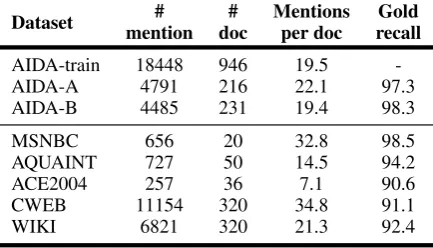
Table 1:Dataset Statistics.Gold recallis the percent-age of mentions for which the candidate entities contain the ground truth entity.
pairwise scores between two arbitrary elements
eixandejysampled independently from candidate setsEiandEj in the given document. It is obvious thatΦis intractable, and the computational com-plexity ofΦgis
O(Φg) =O( T X
i=1
T X
j=1,j6=i
|Ei|
X
eix∈Ei
|Ej|
X
ejy∈Ej
Φ(eix, ejy))
(9) , whereΦ(eix, ejy) is a learnable score function. Thus,O(Φg)is approximate toO(T2× |E|2× I), where|E|is the average number of candidates per mention and I is the unit cost of pairwise func-tion Φ. In order to reduce O(Φg), most previous models (Hoffart et al.,2011;Ganea and Hofmann, 2017;Le and Titov,2018;Fang et al.,2019) have to hard prune their candidates into an extremely small size (e.g. |E|=5). This will reduce the gold recall of candidate sets and also unsuitable for large scale production (e.g. entity disambiguation for dynamic web data like Twitter).
In contrast, the computational complexity of our model isO(T × |E| × I ×K), where K is the key hyper-parameter described in Section3and is usually set to a small number. This indicates the response time of our method grow linearly as a function ofT × |E|.
6 Experiment
6.1 Experiment Setup
Datasets. Following our predecessors, we train and test all models on the public and widely used AIDA CoNLL-YAGO dataset (Hoffart et al., 2011). The target knowledge base is Wikipedia. The corpus consists of 946 documents for training, 216 documents for development and 231 docu-ments for testing (AIDA-train/A/B respectively).
System In-KB acc. (%)
AIDA-light (Nguyen et al.,2014) 84.8
WNED (Guo and Barbosa,2016) 89.0
Global-RNN (Nguyen et al.,2016) 90.7 MulFocal-Att (Globerson et al.,2016) 91.0 Deep-ED (Ganea and Hofmann,2017) 92.22 Ment-Norm (Le and Titov,2018) 93.07
Prior (p(e|m)) (Ganea and Hofmann,2017) 71.51
Berkeley-CNN (Sec.2.2) 84.21
Berkeley-CNN + DCA-SL 92.72±0.3
Berkeley-CNN + DCA-RL 92.37±0.1
ETHZ-Attn (Sec.2.2) 90.88
ETHZ-Attn + DCA-SL 94.64±0.2
ETHZ-Attn + DCA-RL 93.73±0.2
Table 2:In-domain Performance Comparison on the AIDA-B Dataset.For our method we show 95% confi-dence intervals obtained over 5 runs. DCA-based mod-els achieve the best reported scores on this benchmark.
To evaluate the generalization ability of each model, we apply cross-domain experiments fol-lowing the same setting in (Ganea and Hofmann, 2017; Le and Titov, 2018; Yang et al., 2018). Models are trained on AIDA-train, and evaluated on five popular public datasets: AQUAINT (Milne and Witten, 2008), MSNBC (Cucerzan, 2007), ACE2004 (Ratinov et al., 2011), CWEB (Guo and Barbosa,2016) and WIKI (Guo and Barbosa, 2016). The statistics of these datasets are avail-able in Tavail-able1. In the candidate generation step, we directly use the candidates provided by the Ment-Norm system (Le and Titov, 2018)2, and their quality is also listed in Table1.
Compared Methods. We compare our meth-ods with following existing systems that report state-of-the-art results on the test datasets: AIDA-light (Nguyen et al., 2014) uses a kind of two-stage collective mapping algorithm and designs several domain or category related coherence fea-tures. WNED (Guo and Barbosa, 2016) applies random walks on carefully built disambiguation graphs and uses a greedy, iterative and global disambiguation algorithm based on Information Theory. Global-RNN (Nguyen et al., 2016) de-velops a framework based on convolutional neu-ral networks and recurrent neuneu-ral networks to simultaneously model the local and global fea-tures. MulFocal-Att (Globerson et al., 2016) adopts a coherence model with a multi-focal at-tention mechanism. Deep-ED (Ganea and Hof-mann, 2017) leverages learned neural
System MSBNC AQUAINT ACE2004 CWEB WIKI
AIDA (Hoffart et al.,2011) 79 56 80 58.6 63
GLOW (Ratinov et al.,2011) 75 83 82 56.2 67.2
RI (Cheng and Roth,2013) 90 90 86 67.5 73.4
WNED (Guo and Barbosa,2016) 92 87 88 77 84.5
Deep-ED (Ganea and Hofmann,2017) 93.7 88.5 88.5 77.9 77.5
Ment-Norm (Le and Titov,2018) 93.9 88.3 89.9 77.5 78.0
Prior (p(e|m)) (Ganea and Hofmann,2017) 89.3 83.2 84.4 69.8 64.2
Berkeley-CNN (Section2.2) 89.05 80.55 87.32 67.97 60.27
Berkeley-CNN + DCA-SL 93.38±0.2 85.63±0.3 88.73±0.3 71.01±0.1 72.55±0.2
Berkeley-CNN + DCA-RL 93.65±0.2 88.53±0.3 89.73±0.4 72.66±0.4 73.98±0.2
ETHZ-Attn (Section2.2) 91.97 84.06 86.92 70.07 74.37
ETHZ-Attn + DCA-SL 94.57±0.2 87.38±0.5 89.44±0.4 73.47±0.1 78.16±0.1
[image:6.595.75.529.63.249.2]ETHZ-Attn + DCA-RL 93.80±0.0 88.25±0.4 90.14±0.0 75.59±0.3 78.84±0.2
Table 3:Performance Comparison on Cross-domain Datasets using F1 score (%). The best results are in bold. Note that our own results all retain two decimal places. Other results with uncertain amount of decimal places are directly retrieved from their original paper.
tions, and uses a deep learning model combined with a neural attention mechanism and graphical models. Ment-Norm (Le and Titov, 2018) im-proving the Deep-ED model by modeling latent relations between mentions.
For a fair comparison with prior work, we use the same input as the WNED, Deep-EDand Ment-Norm (models proposed after 2016), and report the performance of our model with both Supervised Learning (DCA-SL) and Reinforce-ment Learning (DCA-RL). We won’t compare our models with theRLEL(Fang et al.,2019) which is a deep reinforcement learning based LSTM model. There are two reasons: 1) RLEL uses optimized candidate sets with smaller candidate size and higher gold recall than ours and the listed baselines. 2) RLEL uses additional training set from Wikipedia data. (Fang et al.,2019) doesn’t release either their candidate sets or updated train-ing corpus, so the comparison with their work would be unfair for us.
Hyper-parameter Setting. We coarsely tune the hyper-parameters according to model perfor-mance on AIDA-A. We set the dimensions of word embedding and entity embedding to 300, where the word embedding and entity embedding are publicly released by (Pennington et al.,2014) and (Ganea and Hofmann, 2017) respectively. Hyper-parameters of the best validated model are:
K = 7, I = 5, H1 = 100, and the probability
of dropout is set to 0.2. Besides, the rank margin
γ = 0.01and the discount factorρ= 0.9. We also
System In-KB acc. (%)
SL RL
ETHZ-Attn (Section2.2) 90.88 -ETHZ-Attn + 1-hop DCA 93.69 93.20 ETHZ-Attn + 2-hop DCA 94.47 93.76
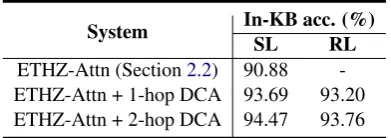
Table 4: Ablation Study on Neighbor Entities. We compare the performance of DCA with or without neighbor entities (i.e., 2-hop vs. 1-hop).
regularize theAgent model as adopted in (Ganea and Hofmann, 2017) by constraining the sum of squares of all weights in the linear layer with
M axN orm = 4. When training the model, we use Adam (Kingma and Ba, 2014) with learning rate of 2e-4 until validation accuracy exceeds 92.8%, afterwards setting it to 5e-5.
6.2 Overall Performance Comparison
Starting with an overview of the end-task perfor-mance, we compare DCA (using SL or RL) with several state-of-the-art systems on in-domain and cross-domain datasets. We follow prior work and report in-KB accuracy for AIDA-B and micro F1 scores for the other test sets.
[image:6.595.319.515.315.384.2]
'&$5/ '&$6/
,Q.%DFF
,QGRPDLQ'DWDVHW
6L]H 2IIVHW
5DQGRP
R
R R
1X
P
EHU
RI
0
HQ
WLRQ
V
1XPEHURI&DQGLGDWHV
$,'$%
'&$5/ '&$6/
0LFUR)VFRUH
&URVVGRPDLQ'DWDVHW
6L]H 2IIVHW 5DQGRP
R
R
R
1X
P
EHU
RI
0
HQ
WLRQV
1XPEHURI&DQGLGDWHV
&:(%
³R´PHDQV
JROGUHFDOO
³R´PHDQV
[image:7.595.82.513.70.320.2]JROGUHFDOO
Figure 3:Ablation Study on Different Decision Orders.We test on both in-domain (AIDA-B) and cross-domain (CWEB) datasets, using ETHZ-Attn as the local model.
8%) and ETHZ-Attn (3.3% on average). Note that, our DCA model outperforms existing global models with the same local model (Global-RNN uses Berkeley-CNN as base model,Deep-EDand Ment-Normuse ETHZ-Attn as the local model).
Table 3 shows the results on the five cross-domain datasets. As shown, none of existing methods can consistently win on all datasets. DCA-based models achieve state-of-the-art per-formance on the MSBNC and the ACE2004 dataset. On remaining datasets, DCA-RL achieves comparable performance with other complex global models. In addition, RL-based models show on average 1.1% improvement on F1 score over the SL-based models across all the cross-domain datasets. At the same time, DCA-based methods are much more efficient, both in time complexity and in resource requirement. Detailed efficiency analysis will be presented in following sections.
6.3 Performance Analysis
1. Impact of decision order. As the DCA model consecutively links and adds all the mentions in a document, the linking order may play a key role in the final performance. In this work, we try three different linking orders: Offsetlinks all mentions by their natural orders in the original document;
System In-KB acc. (%)
SL RL
DCA + Average Sum 94.05 93.56
[image:7.595.319.516.380.447.2]DCA + Soft Attention 94.23 93.69 DCA + Soft&Hard Attention 94.47 93.76
Table 5: Study on Different Attention Mechanisms on the Dynamic Context. Results (using ETHZ-Attn as local model) show that different attention mecha-nisms have similar impact on the performance.
:5:'2
/T1(
GII
G*KIOYOUT2KTMZNZNKT[SHKXULSKTZOUTY 92 82
3KS
UX
_
;
YG
M
K
-(
H:NK4[SHKXUL)GTJOJGZKYVKX3KTZOUT 3KTZ4UXS
*)' *KKV+*
8
[TTOTM
:OSK
S
Y
I:NK4[SHKXUL3KTZOUTY 3KTZ4UXS
*)' *KKV+*
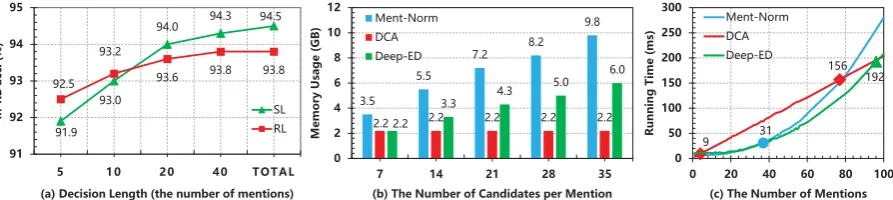
Figure 4: (a)In-KB accuracyas a function of decision length on AIDA-B dataset; (b)Memory usageas a function of the number of candidates on AIDA-B dataset; (c)Runtime cost(at inference time) as a function of the number of mentions. (each dot represents a document of AIDA-B with|E|= 35).
The DCA-RL model, however, still has strong performance on the CWEB dataset, which high-lights its robustness to potential noises.
2. Effect of neighbor entities. In contrast to traditional global models, we include both pre-viously linked entities and their close neighbors for global signal. Table4shows the effectiveness of this strategy. We observe that incorporating these neighbor entities (2-hop) significantly improve the performance (compared to 1-hop) by introducing more related information. And our analysis shows that on average 0.72% and 3.56% relative improvement of 2-hop DCA-(SL/RL) over 1-hop DCA-(SL/RL) or baseline-SL (without DCA) is statistically significant (with P-value <
0.005). This is consistent with our design of DCA.
3. Study of different attention mechanisms. Table 5 shows the performance comparison by replacing the attention module described in Section 3 with different variants. Average Sum treats all previously linked entities equally with a uniform distribution. Soft Attention skips the pruning step for entities with low weight scores. Soft&Hard Attentionstands for the strategy used in our model. It is obvious that the attention mechanism does show positive influence on the linking performance compared withAverage Sum. Hard pruning brings slight further improvement.
4. Impact of decision length. As wrongly linked entities can introduce noise to the model, there exists a trade-off in DCA: involving more previ-ous entities (longer historical trajectory) provides more information, and also more noise. Figure (4.a) shows how the performance of DCA changes with the number of previous entities involved. We observe that longer historical trajectories usually
have a positive influence on the performance of DCA. The reason is that our attention mechanism could effectively assess and select relevant con-texts for each entity mention on the fly, thus re-ducing potential noise.
6.4 Analysis on Time Complexity
As discussed in Sec.5, the running time of a DCA enhanced model may rise linearly when the aver-age number of candidates per mention (i.e., |E|) increases, while the global EL model increases ex-ponentially. To validate the theory we empirically investigate the scalability of DCA, and carefully select two global EL models Ment-Norm (Le and Titov,2018) and Deep-ED (Ganea and Hofmann, 2017) as our baselines. The reason for this choice is that our final model shares the same local model as their models, which excludes other confound-ing factors like implementation details. As Figure (4.c) shows, when|E|increases, the running time of these two global EL models increases shapely, while our DCA model grows linearly. On the other hand, we also observed that the resources required by the DCA model are insensitive to |E|. For example, as shown in Figure (4.b), the memory usage of Ment-Norm and Deep-ED significantly rises as more candidates are considered, while the DCA model remains a relatively low memory us-age all the time. We also measure the power con-sumption of Ment-Norm and DCA models, and we find that the DCA model saves up to 80% of the energy consumption over the Ment-Norm, which is another advantage for large scale production.
7 Related Work
[image:8.595.77.524.62.162.2]per-formance is limited when sparse local contexts fail to provide sufficient disambiguation evidence.
To alleviate this problem, global EL models jointly optimize the entire linking configuration. The key idea is to maximize a global coher-ence/similarity score between all linked entities (Hoffart et al., 2011;Ratinov et al.,2011;Cheng and Roth,2013;Nguyen et al.,2014;Alhelbawy and Gaizauskas,2014;Pershina et al.,2015;Guo and Barbosa,2016;Globerson et al.,2016;Ganea and Hofmann, 2017; Le and Titov, 2018; Yang et al., 2018;Fang et al., 2019;Xue et al., 2019). Despite of its significant improvement in accu-racy, such global methods suffer from high com-plexity. To this end, some works try to relax the assumption of all-mention coherence, e.g. with pairwise coherence, to improve efficiency (Phan et al., 2018), but exact inference remains an NP-hard problem. Approximation methods are hence proposed to achieve reasonably good results with less cost. (Shen et al., 2012) propose the iter-ative substitution method to greedily substitute linking assignment of one mention at a time that can improve the global objective. Another com-mon practice is to use Loopy Belief Propagation for inference (Ganea and Hofmann,2017;Le and Titov,2018). Both approximation methods itera-tively improve the global assignment, but are still computationally expensive with unbounded num-ber of iterations. In contrast, the proposed DCA method only requires one pass through the docu-ment. Global signals are accumulated as dynamic contexts for local decisions, which significantly reduces computational complexity and memory consumption.
8 Conclusions
In this paper we propose Dynamic Context Aug-mentation as a plug-and-enhance module for lo-cal Entity Linking models. In contrast to exist-ing global EL models, DCA only requires one pass through the document. To incorporate global disambiguation signals, DCA accumulates knowl-edge from previously linked entities for fast in-ference. Extensive experiments on several public benchmarks with different learning settings, base models, decision orders and attention mechanisms demonstrate both the effectiveness and efficiency of based models. The scalability of DCA-based models make it possible to handle large-scale data with long documents. Related code and
data has been published and may hopefully benefit the community.
Acknowledgments
This work has been supported in part by National Key Research and Development Program of China
(SQ2018AAA010010), NSFC (No.61751209,
U1611461), Zhejiang University-iFLYTEK Joint Research Center, Zhejiang University-Tongdun Technology Joint Laboratory of Artificial In-telligence, Hikvision-Zhejiang University Joint Research Center, Chinese Knowledge Center of Engineering Science and Technology (CKCEST), Engineering Research Center of Digital Library, Ministry of Education. Xiang Ren’s research has been supported in part by National Science Foundation SMA 18-29268, DARPA MCS and GAILA, IARPA BETTER, Schmidt Family Foun-dation, Amazon Faculty Award, Google Research Award, Snapchat Gift and JP Morgan AI Research Award. Finally, we would like to thank Qi Zhang from Sogou, Inc. and all the collaborators in INK research lab for their constructive feedback on this work.
References
Ayman Alhelbawy and Robert Gaizauskas. 2014. Graph ranking for collective named entity disam-biguation. InProceedings of the 52nd Annual Meet-ing of the Association for Computational LMeet-inguistics (Volume 2: Short Papers), volume 2, pages 75–80.
Roi Blanco, Giuseppe Ottaviano, and Edgar Meij. 2015. Fast and space-efficient entity linking for queries. InProceedings of the Eighth ACM Interna-tional Conference on Web Search and Data Mining, pages 179–188. ACM.
Hui Chen, Baogang Wei, Yonghuai Liu, Yiming Li, Jifang Yu, and Wenhao Zhu. 2017. Bilinear joint learning of word and entity embeddings for entity linking. Neurocomputing.
Xiao Cheng and Dan Roth. 2013. Relational inference for wikification. InProceedings of the 2013 Con-ference on Empirical Methods in Natural Language Processing, pages 1787–1796.
Kevin Clark and Christopher D Manning. 2016. Deep reinforcement learning for mention-ranking coref-erence models. In Proceedings of the 2016 Con-ference on Empirical Methods in Natural Language Processing, pages 2256–2262.
Methods in Natural Language Processing and Com-putational Natural Language Learning (EMNLP-CoNLL).
Zheng Fang, Yanan Cao, Qian Li, Dongjie Zhang, Zhenyu Zhang, and Yanbing Liu. 2019. Joint en-tity linking with deep reinforcement learning. InThe World Wide Web Conference, pages 438–447. ACM.
Jun Feng, Minlie Huang, Yijie Zhang, Yang Yang, and Xiaoyan Zhu. 2018. Relation mention extrac-tion from noisy data with hierarchical reinforcement learning.arXiv preprint arXiv:1811.01237.
Matthew Francis-Landau, Greg Durrett, and Dan Klein. 2016. Capturing semantic similarity for entity linking with convolutional neural networks.
arXiv preprint arXiv:1604.00734.
Octavian-Eugen Ganea and Thomas Hofmann. 2017. Deep joint entity disambiguation with local neural attention. arXiv preprint arXiv:1704.04920.
Amir Globerson, Nevena Lazic, Soumen Chakrabarti, Amarnag Subramanya, Michael Ringaard, and Fer-nando Pereira. 2016. Collective entity resolution with multi-focal attention. In Proceedings of the 54th Annual Meeting of the Association for Compu-tational Linguistics (Volume 1: Long Papers), vol-ume 1, pages 621–631.
Zhaochen Guo and Denilson Barbosa. 2016. Robust named entity disambiguation with random walks.
Semantic Web, (Preprint):1–21.
Zhengyan He, Shujie Liu, Mu Li, Ming Zhou, Longkai Zhang, and Houfeng Wang. 2013. Learning entity representation for entity disambiguation. In Pro-ceedings of the 51st Annual Meeting of the Associa-tion for ComputaAssocia-tional Linguistics (Volume 2: Short Papers), volume 2, pages 30–34.
Johannes Hoffart, Mohamed Amir Yosef, Ilaria Bor-dino, Hagen F¨urstenau, Manfred Pinkal, Marc Span-iol, Bilyana Taneva, Stefan Thater, and Gerhard Weikum. 2011. Robust disambiguation of named entities in text. InProceedings of the Conference on Empirical Methods in Natural Language Process-ing, pages 782–792. Association for Computational Linguistics.
Kristy Hughes, Joel Nothman, and James R Curran. 2014. Trading accuracy for faster named entity link-ing. InProceedings of the Australasian Language Technology Association Workshop 2014, pages 32– 40.
Diederik P Kingma and Jimmy Ba. 2014. Adam: A method for stochastic optimization. arXiv preprint arXiv:1412.6980.
Phong Le and Ivan Titov. 2018. Improving entity link-ing by modellink-ing latent relations between mentions.
arXiv preprint arXiv:1804.10637.
David Milne and Ian H Witten. 2008. Learning to link with wikipedia. In Proceedings of the 17th ACM conference on Information and knowledge manage-ment, pages 509–518. ACM.
Vinod Nair and Geoffrey E Hinton. 2010. Rectified linear units improve restricted boltzmann machines. InProceedings of the 27th international conference on machine learning (ICML-10), pages 807–814.
Karthik Narasimhan, Adam Yala, and Regina Barzilay. 2016. Improving information extraction by acquir-ing external evidence with reinforcement learnacquir-ing.
arXiv preprint arXiv:1603.07954.
Dat Ba Nguyen, Johannes Hoffart, Martin Theobald, and Gerhard Weikum. 2014. Aida-light: High-throughput named-entity disambiguation. LDOW, 1184.
Thien Huu Nguyen, Nicolas Fauceglia, Mariano Ro-driguez Muro, Oktie Hassanzadeh, Alfio Massimil-iano Gliozzo, and Mohammad Sadoghi. 2016. Joint learning of local and global features for entity link-ing via neural networks. InProceedings of COLING 2016, the 26th International Conference on Compu-tational Linguistics: Technical Papers, pages 2310– 2320.
Jeffrey Pennington, Richard Socher, and Christopher Manning. 2014. Glove: Global vectors for word representation. InProceedings of the 2014 confer-ence on empirical methods in natural language pro-cessing (EMNLP), pages 1532–1543.
Maria Pershina, Yifan He, and Ralph Grishman. 2015. Personalized page rank for named entity disam-biguation. InProceedings of the 2015 Conference of the North American Chapter of the Association for Computational Linguistics: Human Language Tech-nologies, pages 238–243.
Minh C Phan, Aixin Sun, Yi Tay, Jialong Han, and Chenliang Li. 2018. Pair-linking for collective en-tity disambiguation: Two could be better than all.
IEEE Transactions on Knowledge and Data Engi-neering.
Jonathan Raiman and Olivier Raiman. 2018. Deep-type: Multilingual entity linking by neural type sys-tem evolution.arXiv preprint arXiv:1802.01021.
Lev Ratinov, Dan Roth, Doug Downey, and Mike Anderson. 2011. Local and global algorithms for disambiguation to wikipedia. In Proceedings of the 49th Annual Meeting of the Association for Computational Linguistics: Human Language Technologies-Volume 1, pages 1375–1384. Associ-ation for ComputAssoci-ational Linguistics.
Wei Shen, Jianyong Wang, Ping Luo, and Min Wang. 2012. Linden: linking named entities with knowl-edge base via semantic knowlknowl-edge. InProceedings of the 21st international conference on World Wide Web, pages 449–458. ACM.
Nitish Srivastava, Geoffrey Hinton, Alex Krizhevsky, Ilya Sutskever, and Ruslan Salakhutdinov. 2014. Dropout: a simple way to prevent neural networks from overfitting. The Journal of Machine Learning Research, 15(1):1929–1958.
Richard S Sutton and Andrew G Barto. 1998. Re-inforcement learning: An introduction, volume 1. MIT press Cambridge.
Peng Xu and Denilson Barbosa. 2018. Neural fine-grained entity type classification with hierarchy-aware loss. north american chapter of the associ-ation for computassoci-ational linguistics, 1:16–25.
Mengge Xue, Weiming Cai, Jinsong Su, Linfeng Song, Yubin Ge, Yubao Liu, and Bin Wang. 2019. Neural collective entity linking based on recurrent random walk network learning. arXiv preprint arXiv:1906.09320.
Ikuya Yamada, Hiroyuki Shindo, Hideaki Takeda, and Yoshiyasu Takefuji. 2016. Joint learning of the em-bedding of words and entities for named entity dis-ambiguation. arXiv preprint arXiv:1601.01343.


![2 Methyl 6 (trifluoromethyl)imidazo[1,2 a]pyridine 3 carbonitrile](data:image/gif;base64,R0lGODlhAQABAIAAAP///wAAACH5BAEAAAAALAAAAAABAAEAAAICRAEAOw==)