Speeding up Reinforcement Learning-based Information Extraction
Training using Asynchronous Methods
Aditya Sharma
Indian Institute of Science Bangalore, India [email protected]
Zarana Parekh∗ DA-IICT Gandhinagar, India [email protected]
Partha Talukdar
Indian Institute of Science Bangalore, India [email protected]
Abstract
RLIE-DQN is a recently proposed Re-inforcement Learning-based Information Extraction (IE) technique which is able to incorporate external evidence during the extraction process. RLIE-DQN trains a single agentsequentially, training on one instance at a time. This results in sig-nificant training slowdown which is unde-sirable. We leverage recent advances in parallel RL training using asynchronous methods and propose A3C. RLIE-A3C trains multiple agents inparalleland is able to achieve upto 6x training speedup over RLIE-DQN, while suffering no loss in average accuracy.
1 Introduction
Extracting information about an event (or entity) involves multiple decisions, as one first needs to identify documents relevant to the event, extract relevant information from those documents, and finally reconcile various values obtained for the same relation of the event from different sources (Ahn, 2006). Search based methods for Infor-mation Extraction have been increasingly investi-gated (West et al., 2014); (Hegde and Talukdar, 2015); (Zhang et al.,2016); (Bing et al.,2017).
(Kanani and McCallum,2012) combine search and Information Extraction (IE) using Reinforce-ment Learning (RL), with the goal of selecting good actions while staying within resource con-straints, but don’t optimze for extraction accuracy. More recently, (Narasimhan et al.,2016) proposed a RL-based approach to model the IE process out-lined above. We shall refer to this approach as RLIE-DQN in this paper. RLIE-DQN trains an RL ∗Research carried out during an internship at the Indian
Institute of Science, Bangalore.
agent using Deep Q-Network (DQN) (Mnih et al., 2015) to select optimal actions to query for docu-ments and also reconcile extracted values.
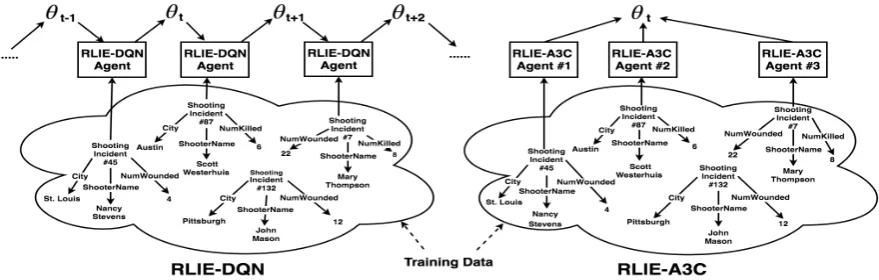
DQN trains a single agent sequentially, up-dating parameters based on one instance at a time. Each such instance is sampled from the en-tire training data, also called the experience re-play. Such sequential experience replay-based training results in slow learning, while requiring high memory and computation resources. In order to overcome this challenge, A3C (Asynchronous Advantage Actor-Critic), an asynchronous deep RL training algorithm, has been proposed recently (Mnih et al.,2016). A3C trains multiple RL agents inparallel, each of which estimates gradients lo-cally, and asynchronously updates globally shared parameters. Recent work has explored applica-tions for A3C in varied domains (Fernando et al., 2017), (Mirowski et al.,2016).
In this paper, we propose RLIE-A3C which uses A3C-based parallel asynchronous agents for train-ing. This is in contrast to the sequential DQN training in RLIE-DQN. Differences between the training regimes of the two methods are shown in Figure1. Through experiments on multiple real-world datasets, we find that RLIE-A3C achieves upto 6x training speedup compared to RLIE-DQN, while suffering no loss in accuracy. To the best of our knowledge, this is the first application of asynchronous deep RL methods in IE (and also in NLP), and we hope this paper will foster fur-ther adoption and research into such methods in the NLP community. RLIE-A3C code is available athttps://github.com/adi-sharma/RLIE A3C
Figure 1: Left: DQN-based sequential learning framework used in RLIE-DQN (Narasimhan et al., 2016), as discussed in Section 2. At each time step, the agent looks at a specific instance from the training data. Right: A3C-basedparallellearning framework in RLIE-A3C (proposed approach). The parallel agents look at different parts of the training data, estimate parameter update statistics locally, and then performasynchronousupdates on the globally shared parameters (θt) at time stept. See Section3 for details. Due to the asynchronous parallel updates, RLIE-A3C achieves significant training speedup without loss in accuracy, as we shall see in Section4.
Figure 2: Sample state transition in the MDP of RLIE-DQN (and also RLIE-A3C). In each transi-tion, two actions are carried out: (1) reconcile new values with current values,; and (2) issue query to retrieve other relevant documents and extract val-ues from those documents. Please see Section 2 for details.
2 RLIE-DQN: Information Extraction using Reinforcement Learning
We first present a brief overview of RLIE-DQN (Narasimhan et al., 2016). Given a document to extract information about an event, RLIE-DQN is-sues a search query to retrieve other documents related to the event, extracts event information from those documents, and finally reconciles val-ues extracted from the documents. If confidence in the extracted values are low, then RLIE-DQN repeats this process with additional queries. This way, RLIE-DQN incorporates evidences from ex-ternal sources to improve information extraction
(IE) from a given source document.
RLIE-DQN models the task as a Markov De-cision Process (MDP) in order to reconcile newly extracted information selectively and dynamically. The MDP describes the environment in which the RL agent learns to make decisions. The MDP is represented using a tuplehS, A, R, Ti, whereSis the set of states,A={ad, aq}is the set of actions,
R(s, a)is the reward for taking actiona∈Afrom states∈S, andT(s0|s,(ad, aq))is the state tran-sition function. Here, ad is the reconciliation ac-tion, while aq is the query action. Based on ad, the agent may accept extracted values for one or all relations, reject all newly extracted values or stop (episode ends).
A sample state transition in RLIE-DQN’s MDP is shown in Figure 2. State representation con-sists of many details such as confidence scores of current and newly extracted relation values, con-text statistics from which the extractions are per-formed, etc. But for better readability, only the set of current and new values are shown for the states in this figure. Each transition consists of two actions: reconcile decision and query. The RL agent uses the reconcile action (ad) to update value of the ShooterName relation from Paul Kiska to
Kevin Wardzala. The agent uses the query ac-tion (aq) to issue a new query (”Cleveland
shoot-ing” + ”injured”) to retrieve other relevant docu-ments and extract new values3and1for relations
[image:2.595.71.293.320.467.2]The reward function at each state, is the cum-mulative difference of current and previous ex-tracted accuracies, summed over all relations. Also, a negative reward per step is added to the reward in order to penalize the agent for longer episodes, since issuing queries to a search engine is expensive.
Deep Q-Learning (DQN): Let Q(s, a) be the measure of long-term cumulative reward obtained by taking action a from state s. The RL agent makes use ofQ(s, a)to select the next action from
afrom state s. Q-learning (Watkins and Dayan, 1992) is a popular technique to estimate this func-tion, in which the function for optimal Q-value is estimated using the Bellman equation (Sutton and Barto, 1998) Qi+1(s, a) = E(s,a)[R(s, a) + γmax
a0 Qi(s
0, a0)|s, a]. Here,R(s, a)is the
imme-diate reward and γ is the discount factor for the value of future rewards.
For high dimensional state spaces, Deep Q-Network (DQN) (Mnih et al.,2013) approximates
Q(s, a)asQ(s, a;θ)using parametersθof a deep network. RLIE-DQN used such a DQN-based agent to learn optimal policy, as shown in Figure1.
3 Proposed Approach: RLIE-A3C
The DQN-based agent used in RLIE-DQN is se-quential, as it moves from one instance to another to update parameters. This can result in signif-icant training time slowdown, especially in large data settings. Instead of using experience replay of the DQN algorithm for stabilizing updates, we consider a framework with multiple asynchronous agents, each of which explore different areas of the environment in parallel.
Asynchronous Advantage Actor-critic (A3C) (Mnih et al.,2016) is a recently proposed deep RL algorithm which makes use of parallel agents for parameter estimation. We replace DQN with A3C in DQN and call the resulting method RLIE-A3C – our proposed approach (See Figure1).
At time instant t, RLIE-A3C poses decision policy πd(ad|st), and query policy πq(aq|st) as probability distributions over candidate actionsad and aq, respectively. RLIE-A3C also calculates the state value function V(st), as an estimate of the cumulative long-term reward obtained starting from statest. Owing to the large continuous state space of the problem, RLIE-A3C approximates each of these three functions using three sepa-rate deep neural networks, which are parametrized
by θd, θq, and θv, as πd(ad|st) ≈ πd(ad|st;θd),
πq(aq|st)≈πq(aq|st;θd)andV(st)≈V(st;θv). These parameters are updated by agents working in parallel. Based on the policies, each agent se-lects the query and decision actions to be per-formed and updates it’s state accordingly. This is repeated up totmaxsteps or until a terminal state is reached.
Local Gradient Calculation: The agents estimate parameter gradients using a local copy of the net-work parameters, and then performasynchronous
updates on the globally shared parametersθd, θq, and θv. Hence, the policy and value functions are jointly estimated. The policy gradient update equations calculated over the local copy of net-work parameters of each parallel RLIE-A3C agent
pare as follows:
dθpx←dθxp+∇θp
xlogπd(axi, s;θxp)A(si, axt;θpv)
+βx∇θpxH(πx(st;θpx)) (1)
where, x∈ {d, q}for decision and query. The ad-vantage functionA(st, at;θv) =Pki=0−1γiRt+i +
γkV(s
t+k;θv)−V(st;θv)above significantly re-duces the variance of the policy gradient, where
γ is the discount factor andkcan vary from state to state and is upper-bounded bytmax. Since the gradient updates are accumulated, training stabil-ity increases. Further, exploration is encouraged by introducing the entropy regularization term
βx∇θpxH(πx(st;θ
p
x))in the equation above. Here,
H is the entropy function and βx controls domi-nance of the entropy term.
The gradient update for the parameters of value functionV is calculated locally by every parallel agentpas follows:
dθp
v ←dθvp+∂(Gt−V(st;θpv))2/∂θpv
whereGt=E(s)[Pk∞=0γkRt+k+1]is the return. Global Parameter Update: The parameters θd,
θq and θv are learnt using stochastic gradient descent with RMSprop (Tieleman and Hinton, 2012). The standard non-centered RMSProp up-date is used by the parallel agentspto update the shared parameters asynchronously using the gra-dients obtained from Equation (1), as follows:
g=αg+ (1−α)(dθpx)2 ; θx←θx−η dθ p x √
g+
Figure 3:Left, Middle Panels: Extraction accuracy of the baseline DQN) and our system (RLIE-A3C) on the Shooting Incidents and Food Adulteration datasets.Right Panel: Training time comparison between RLIE-DQN and RLIE-A3C. Overall, we observe that RLIE-A3C results in upto 6x speedup over RLIE-DQN, without any loss in average extraction accuracy. This is our main result. Please see Section4.1for details.
g is the moving average of element-wise squared gradients. The pseudo-code for RLIE-A3C can be found in the Appendix.
4 Experiments and Results
Setup: We compare A3C against RLIE-DQN using the same protocol and hyperparame-ters as reported in (Narasimhan et al.,2016). Also, we experiment with the same two datasets used in that paper: the Gun Violence Archive1 and the
Foodshield EMA database2. The train, dev and
test datasets contain 372, 146 and 146 source ar-ticles respectively for the Shooting incident cases and 292, 42 and 148 source articles respectively for the food adulteration cases. We used the im-plementation of RLIE-DQN provided by the au-thors of that system. For more details on the dataset and other parameters, we refer the reader to (Narasimhan et al.,2016).
RLIE-A3C: This is our proposed method which is described in Section3. For the sake of fair com-parison, the network, base classifier, and evalua-tion metrics are same as that of RLIE-DQN. Each of the three deep networks in RLIE-A3C, one each forπ(ad|s),π(aq|s) andV(s), is built using two linear layers with 20 hidden units, followed by Re-LUs. MaxEnt classifier is used as the base extrac-tor, and the model is evaluated on the entire test
set for 1.6 million steps. The dev set is used to tune all hyperparameters, which can be found in the Appendix. For RLIE-A3C, the evaluation is carried out 50 times after training and the average accuracy values are taken over the top 5 evalua-tions, as done in (Mnih et al.,2016).
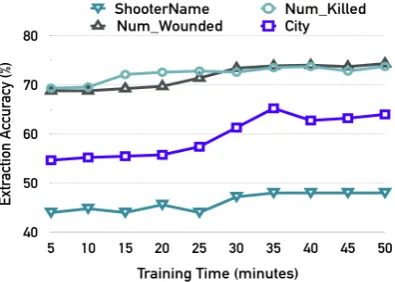
Figure 4: Evolution of accuracy of RLIE-A3C for the four relations ontestset of theShooting Inci-dentsdataset. Please see Section4.1for details.
4.1 Results and Discussion
Extraction Accuracy: Experimental results com-paring extraction accuracies of RLIE-DQN and RLIE-A3C are presented in Figure 33 (left and
middle panels). From this figure, we observe that there is no loss in average accuracy in transition-ing from RLIE-DQN to RLIE-A3C (in fact there is a slight gain in case of the Adulteration dataset). Please note that, improvement in accuracy is not our primary goal in the paper – it is the training time speedup, as discussed next.
Speedup: Training times of RLIE-DQN and RLIE-A3C over both datasets are compared in the right panel of Figure 34. From Figure 3, we find
that RLIE-A3C is able to achieve upto 6x training 1http://www.shootingtracker.com/Main_Page
2http://www.foodshield.org/member/login/
3The tolerance for all the relation accuracy values for RLIE-A3C is within±1%
[image:4.595.311.509.247.388.2]speedup over DQN. In other words, RLIE-A3C is able to achieve significant speedup in train-ing time over RLIE-DQN, without any loss in av-erage accuracy. This is our main result.
While RLIE-DQN was implemented in Torch, RLIE-A3C was implemented in Python using Ten-sorFlow framework. We note that Torch is known to be faster than TensorFlow (Bahrampour et al., 2015). This makes the speedup gains above even more impressive, and outlines the possibility that further gains may be possible with a Torch-based implementation of RLIE-A3C.
Figure 4 shows evolution of test accuracy of RLIE-A3C for the four relations of the Shooting Incidents dataset. For this dataset, state value function of RLIE-A3C converged at 48 minutes. However, from Figure4, we observe that accura-cies converge to the final values much before that.
Why do Asynchronous Methods work? An
asynchronous approach fits more naturally with the training data, since different parallel agents look at different events at the same time (see Fig-ure1), and the model is able to exploit the regu-larities between events in the dataset. The gradi-ent updates to the global network are less biased and the model is not easily distracted by noise in the data. The asynchronous parallel model is able to converge much faster as compared to replay memory based methods like DQN, as also seen in (Mnih et al.,2016).
5 Conclusion
In this paper, we proposed RLIE-A3C, an asyn-chronous deep Reinforcement Learning (RL) al-gorithm for Information Extraction (IE). In con-trast tosequentialtraining in previously proposed RLIE-DQN (Narasimhan et al.,2016), RLIE-A3C employsasynchronous paralleltraining. This re-sults in upto 6x training speedup, without suffer-ing any loss in average accuracy. We hope that this first application of asynchronous deep RL al-gorithms will open up more adoption of such tech-niques in the NLP community.
6 Acknowledgements
We thank members of the MALL Lab, IISc who read drafts of the paper and gave valuable feed-back. We also thank the anonymous reviewers for their insightful comments. Special thanks to Karthik Narasimhan for all the helpful discus-sions. We also gratefully acknowledge support
from a gift from Microsoft Research India.
References
David Ahn. 2006. The stages of event extraction. In Proceedings of the Workshop on Annotating and Reasoning about Time and Events, pages 1–8. As-sociation for Computational Linguistics.
Soheil Bahrampour, Naveen Ramakrishnan, Lukas Schott, and Mohak Shah. 2015. Comparative study of deep learning software frameworks. arXiv preprint arXiv:1511.06435.
Lidong Bing, Zhiming Zhang, Wai Lam, and William W Cohen. 2017. Towards a language-independent solution: Knowledge base completion by searching the web and deriving language pattern. Knowledge-Based Systems, 115:80–86.
Chrisantha Fernando, Dylan Banarse, Charles Blun-dell, Yori Zwols, David Ha, Andrei A Rusu, Alexan-der Pritzel, and Daan Wierstra. 2017. Pathnet: Evo-lution channels gradient descent in super neural net-works. arXiv preprint arXiv:1701.08734.
Manjunath Hegde and Partha P Talukdar. 2015. An entity-centric approach for overcoming knowledge graph sparsity. InEMNLP, pages 530–535.
Pallika H Kanani and Andrew K McCallum. 2012. Selecting actions for resource-bounded information extraction using reinforcement learning. In Pro-ceedings of the fifth ACM international conference on Web search and data mining, pages 253–262. ACM.
Piotr Mirowski, Razvan Pascanu, Fabio Viola, Hubert Soyer, Andy Ballard, Andrea Banino, Misha Denil, Ross Goroshin, Laurent Sifre, Koray Kavukcuoglu, et al. 2016. Learning to navigate in complex envi-ronments. arXiv preprint arXiv:1611.03673.
Volodymyr Mnih, Adria Puigdomenech Badia, Mehdi Mirza, Alex Graves, Timothy P Lillicrap, Tim Harley, David Silver, and Koray Kavukcuoglu. 2016. Asynchronous methods for deep reinforce-ment learning. InInternational Conference on Ma-chine Learning.
Volodymyr Mnih, Koray Kavukcuoglu, David Sil-ver, Alex Graves, Ioannis Antonoglou, Daan Wier-stra, and Martin Riedmiller. 2013. Playing atari with deep reinforcement learning. arXiv preprint arXiv:1312.5602.
Karthik Narasimhan, Adam Yala, and Regina Barzilay. 2016. Improving information extraction by acquir-ing external evidence with reinforcement learnacquir-ing. arXiv preprint arXiv:1603.07954.
Richard S Sutton and Andrew G Barto. 1998. Re-inforcement learning: An introduction, volume 1. MIT press Cambridge.
Tijmen Tieleman and Geoffrey Hinton. 2012. Lecture 6.5-rmsprop: Divide the gradient by a running av-erage of its recent magnitude. COURSERA: Neural networks for machine learning, 4(2).
Christopher JCH Watkins and Peter Dayan. 1992. Q-learning.Machine learning, 8(3-4):279–292. Robert West, Evgeniy Gabrilovich, Kevin Murphy,
Shaohua Sun, Rahul Gupta, and Dekang Lin. 2014. Knowledge base completion via search-based ques-tion answering. In Proceedings of the 23rd inter-national conference on World wide web, pages 515– 526. ACM.