A Structured Learning Approach to Temporal Relation Extraction
Qiang Ning1 and Zhili Feng2 and Dan Roth1,2 1Department of Electrical and Computer Engineering
2Department of Computer Science University of Illinois, Urbana, IL 61801
{qning2,zfeng6,danr}@illinois.edu
Abstract
Identifying temporal relations between events is an essential step towards nat-ural language understanding. However, the temporal relation between two events in a story depends on, and is often dic-tated by, relations among other events. Consequently, effectively identifying tem-poral relations between events is a chal-lenging problem even for human annota-tors. This paper suggests that it is im-portant to take these dependencies into ac-count while learning to identify these re-lations and proposes a structured learning approach to address this challenge. As a byproduct, this provides a new perspective on handling missing relations, a known is-sue that hurts existing methods. As we show, the proposed approach results in sig-nificant improvements on the two com-monly used data sets for this problem. 1 Introduction
Understanding temporal information described in natural language text is a key component of nat-ural language understanding (Mani et al., 2006; Verhagen et al., 2007; Chambers et al., 2007; Bethard and Martin, 2007) and, following a se-ries of TempEval (TE) workshops (Verhagen et al., 2007,2010;UzZaman et al.,2013), it has drawn increased attention. Time-slot filling (Surdeanu, 2013;Ji et al.,2014), storyline construction (Do et al., 2012;Minard et al., 2015), clinical narra-tives processing (Jindal and Roth, 2013; Bethard et al., 2016), and temporal question answering (Llorens et al.,2015) are all explicit examples of temporal processing.
The fundamental tasks in temporal process-ing, as identified in the TE workshops, are 1) time expression (the so-called “timex”) extraction
and normalization and 2) temporal relation (also known as TLINKs (Pustejovsky et al.,2003a)) ex-traction. While the first task has now been well handled by the state-of-the-art systems (Heidel-Time (Str¨otgen and Gertz,2010), SUTime (Chang and Manning, 2012), IllinoisTime (Zhao et al., 2012), NavyTime (Chambers, 2013), UWTime (Lee et al.,2014), etc.) with end-to-endF1scores being around 80%, the second task has long been a challenging one; even the top systems only achievedF1scores of around 35% in the TE work-shops.
The goal of the temporal relation task is to gen-erate adirected temporal graphwhose nodes rep-resent temporal entities (i.e., events or timexes) and edges represent the TLINKs between them. The task is challenging because it often re-quires global considerations – considering the en-tire graph, the TLINK annotation is quadratic in the number of nodes and thus very expensive, and an overwhelming fraction of the temporal relations are missing in human annotation. In this paper, we propose a structured learning approach to tem-poral relation extraction, where local models are updated based on feedback from global inferences. The structured approach also gives rise to a semi-supervised method, making it possible to take ad-vantage of the readily available unlabeled data. As a byproduct, this approach further provides a new, effective perspective on handling those missing re-lations.
In the common formulations, temporal relations are categorized into three types: the E-E TLINKs (those between a pair of events), the T-T TLINKs (those between a pair of timexes), and the E-T TLINKs (those between an event and a timex). While the proposed approach can be generally ap-plied to all three types, this paper focuses on the majority type, i.e., the E-E TLINKs. For exam-ple, consider the following snippet taken from the
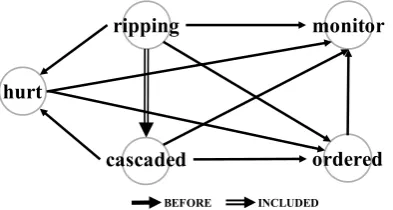
training set provided in the TE3 workshop. We want to construct a temporal graph as in Fig.1for the events in boldface in Ex1.
Ex1 . . . tons of earth cascaded down a hillside, ripping two houses from their foundations. No one washurt, but firefightersorderedthe evacuation of nearby homes and said they’ll monitorthe shifting ground.. . .
cascaded hurt
ripping
ordered monitor
[image:2.595.318.507.61.156.2]BEFORE INCLUDED
Figure 1: The desired event temporal graph for Ex1. Re-verse TLINKs such ashurtisafterrippingare omitted for simplicity.
As discussed in existing work (Verhagen,2004; Bramsen et al.,2006;Mani et al.,2006;Chambers and Jurafsky, 2008), the structure of a temporal graph is constrained by some rather simple rules:
1. Symmetry. For example, ifAisbefore B, then Bmust beafter A.
2. Transitivity. For example, ifAisbefore Band Bisbefore C, thenAmust bebefore C. This particular structure of a temporal graph (es-pecially the transitivity structure) makes its nodes highly interrelated, as can be seen from Fig.1. It is thus very challenging to identify the TLINKs between them, even for human annotators: The inter-annotator agreement on TLINKs is usually about 50%-60% (Mani et al.,2006). Fig.2shows the actual human annotations provided by TE3. Among all the ten possible pairs of nodes, only three TLINKs were annotated. Even if we only look at main events in consecutive sentences and at events in the same sentence, there are still quite a few missing TLINKs, e.g., the one betweenhurt and cascaded and the one between monitor and ordered.
Early attempts byMani et al.(2006);Chambers et al.(2007);Bethard et al.(2007);Verhagen and Pustejovsky(2008) studiedlocalmethods – learn-ing models that make pairwise decisions between each pair of events. State-of-the-art local meth-ods, including ClearTK (Bethard,2013), UTTime
cascaded hurt
ripping
ordered monitor
[image:2.595.84.281.199.304.2]BEFORE INCLUDED BEFORE NO RELATION Figure 2:The human-annotation for Ex1 provided in TE3, where many TLINKs are missing due to the annotation diffi-culty. Solid lines: original human annotations. Dotted lines: TLINKs inferred from solid lines. Dashed lines: missing re-lations.
(Laokulrat et al., 2013), and NavyTime ( Cham-bers,2013), use better designed rules or more fea-tures such as syntactic tree paths and achieve bet-ter results. However, the decisions made by these (local) models are often globally inconsistent (i.e., the symmetry and/or transitivity constraints are not satisfied for the entire temporal graph). Integer linear programming (ILP) methods (Roth and Yih, 2004) were used in this domain to enforce global consistency by several authors including Bram-sen et al.(2006);Chambers and Jurafsky(2008); Do et al. (2012), which formulated TLINK ex-traction as an ILP and showed that it improves over local methods for densely connected graphs. Since these methods perform inference (“I”) on top of pre-trained local classifiers (“L”), they are often referred to asL+I(Punyakanok et al.,2005). In a state-of-the-art method, CAEVO (Chambers et al.,2014), many hand-crafted rules and machine learned classifiers (called sieves therein) form a pipeline. The global consistency is enforced by inferring all possible relations before passing the graph to the next sieve. This best-first architecture is conceptually similar to L+I but the inference is greedy, similar toMani et al.(2007);Verhagen and Pustejovsky(2008).
understanding the effect of global considerations in the learning phase. In difference from exist-ing methods, we also discuss how to effectively use unlabeled data and how to handle the over-whelming fraction of missing relations in a princi-pled way. Our solution targets on these issues and, as we show, achieves significant improvements on two commonly used evaluation sets.
The rest of this paper is organized as follows. Section2clarifies the temporal relation types and the evaluation metric of a temporal graph used in this paper, Section3explains the structured learn-ing approach in detail, and Section4discusses the practical issue of missing relations. We provide experiments and discussion in Section5and con-clusion in Section6.
2 Background
2.1 Temporal Relation Types
Existing corpora for temporal processing often follows the interval representation of events pro-posed inAllen(1984), and makes use of 13 rela-tion types in total. In many systems,vagueornone is also included as another relation type when a TLINK is not clear or missing. However, current systems usually use a reduced set of relation types, mainly due to the following reasons.
1. The non-uniform distribution of all the rela-tion types makes it difficult to separate low-frequency ones from the others (see Table 1 in Mani et al. (2006)). For example, rela-tions such asimmediately beforeor immedi-ately afterbarely exist in a corpus compared tobeforeandafter.
2. Due to the ambiguity in natural language, determining relations like before and imme-diately before can be a difficult task itself (Chambers et al.,2014).
In this work, we follow the reduced set of temporal relation types used in CAEVO (Chambers et al., 2014): before,after, includes,is included,equal, andvague.
2.2 Quality of A Temporal Graph
The most recent evaluation metric in TE3, i.e., the temporal awareness (UzZaman and Allen,2011), is adopted in this work. Specifically, letGsys and
Gtrue be two temporal graphs from the system prediction and the ground truth, respectively. The
precision and recall of temporal awareness are de-fined as follows.
P = |G−sys∩G+true| |G−
sys| , R= |G−
true∩G+sys| |G−
true|
where G+ is the closure of graph G, G− is the
reduction of G, “∩” is the intersection between TLINKs in two graphs, and|G|is the number of TLINKs in G. The temporal awareness metric better captures how “useful” a temporal graph is. For example, if system 1 producesrippingis be-forehurtandhurtisbeforemonitor, and system 2 adds ripping is before monitor on top of sys-tem 1. Since syssys-tem 2 is simply a transitive clo-sure of system 1, they would have the same eval-uation scores. Note that vaguerelations are usu-ally considered as non-existing TLINKs and are not counted during evaluation.
3 A Structured Training Approach As shown in Fig.1, the learning problem in tem-poral relation extraction is global in nature. Even the top local method in TE3, UTTime (Laokulrat et al., 2013), only achieved F1=56.5 when pre-sented with a pair of temporal entities (Task C– relation only (UzZaman et al.,2013)). Since the success of an L+I method strongly relies on the quality of the local classifiers, a poor local classi-fier is obviously a roadblock for L+I methods. Fol-lowing the insights fromPunyakanok et al.(2005), we propose to use a structured learning approach (also called “Inference Based Training” (IBT)).
Unlike the current L+I approach, where local classifiers are trained independently beforehand without knowledge of the predictions on neigh-boring pairs, we train local classifiers with feed-back that accounts for other relations, by perform-ing global inference in each round of the learnperform-ing process. In order to introduce the structured learn-ing algorithm, we first explain its most important component, the global inference step.
3.1 Inference
In a document withnpairs of events, letφi ∈ X ⊆ Rd be the extracted d-dimensional feature and
yi ∈ Y be the temporal relation for thei-th pair of events, i = 1,2, . . . , n, where Y = {rj}6j=1 is the label set for the six temporal relations we use. Moreover, let x = {φ1, . . . , φn} ∈ Xn and
document. Given the weight vector wr of a lin-ear classifier trained for relationr∈ Y(i.e., using the one-vs-all scheme), the global inference step is to solve the following constrained optimization problem:
ˆ
y=arg max
y∈C(Yn)f(x,y), (1)
whereC(Yn)⊆ Ynconstrains the temporal graph to be symmetrically and transitively consistent, andf(x,y)is the scoring function:
f(x,y) = n
X
i=1
fyi(φi) =
n
X
i=1
ewTyiφi P
r∈YewTrφi.
Specifically, fyi(φi) is the probability of the i-th
event pair having relation yi. f(x, y) is simply the sum of these probabilities over all the event pairs in a document, which we think of as the con-fidence of assigningy = {y1, ..., yn}to this doc-ument and therefore, it needs to be maximized in Eq. (1).
Note that when C(Yn) = Yn, Eq. (1) can be solved for each yˆi independently, which is what the so-called local methods do, but the resulting ˆ
ymay not satisfy global consistency in this way. When C(Yn) 6= Yn, Eq. (1) cannot be decou-pled for each yˆi and is usually formulated as an ILP problem (Roth and Yih,2004;Chambers and Jurafsky, 2008;Do et al.,2012). Specifically, let
Ir(ij) ∈ {0,1}be the indicator function of rela-tionrfor eventiand eventjandfr(ij)∈[0,1]be the corresponding soft-max score. Then the ILP objective for global inference is formulated as fol-lows.
ˆ
I=argmax
I P
ij∈EPr∈Yfr(ij)Ir(ij) (2) s.t. ΣrIr(ij) = 1
(uniqueness) , Ir(ij(symmetry)) =I¯r(ji),
Ir1(ij) +Ir2(jk)−ΣNm=1Irm
3 (ik)≤1, (transitivity)
for all distinct events i, j, and k, where E = {ij |sentence dist(i, j)≤1},r¯is the reverse ofr, andN is the number of possible relations for r3 whenr1andr2are true.
Our formulation in Eq. (2) is different from previous work (Chambers and Jurafsky, 2008; Do et al., 2012) in two aspects: 1) We re-strict our event pairs ij to a smaller set E = {ij |sentence dist(i, j)≤1} where pairs that are
0 30 60 90 120 150 180
0 1 2 >=3
#LABELS vs Sentence Distance
[image:4.595.318.515.66.195.2]BEFORE AFTER INCLUDES INCLUDED EQUAL
Figure 3: #TLINKs vs sentence distance on the TE3 Plat-inum dataset. The tail ofequalis due to event coreference and beyond our focus.
more than one sentence away are deleted for com-putational efficiency and (usually) for better per-formance. In fact, to make better use of global constraints, we should have allowed more event pairs in Eq. (2). However, fr(ij) is usually more reliable when i and j are closer in text. Many participating systems in TE3 (UzZaman et al., 2013) have used thispre-filtering strategy to bal-ance the trade-off between confidence in fr(ij) and global constraints. We observe that the strat-egy fits very well to the existing datasets: As shown in Fig. 3, annotated TLINKs barely exist if two events are two sentences away. 2) Previ-ously, transitivity constraints were formulated as
Ir1(ij) +Ir2(jk)− Ir3(ik) ≤1, which is a
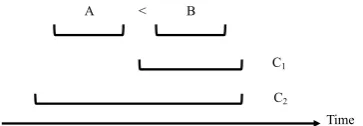
spe-cial case whenN = 1and can be understood as “r1andr2determine a singler3”. However, it was overlooked that, although somer1 andr2 cannot uniquely determiner3, they can still constrain the set of labelsr3 can take. For example, as shown in Fig.4, whenr1=before andr2=is included, r3 is not determined but we know thatr3 ∈ {before, is included}1. This information can be easily
ex-ploited by allowingN >1.
A B
C1
C2
Time <
Figure 4: WhenA is before BandB is included in C,A can either bebefore C1oris included in C2. We propose to
incorporate this via the transitivity constraints for Eq. (2).
With these two differences, the optimization problem (2) can still be efficiently solved us-ing off-the-shelf ILP packages such as GUROBI
1The transitivity table inAllen(1983) shows two more
[image:4.595.325.507.569.632.2](Gurobi Optimization, Inc.,2012).
3.2 Learning
With the inference solver defined above, we pro-pose to use the structured perceptron (Collins, 2002) as a representative for the inference based training (IBT) algorithm to learn those weight vec-torswr. Specifically, letL={xk,yk}Kk=1be the labeled training set of K instances (usually doc-uments). The structured perceptron training algo-rithm for this problem is shown in Algoalgo-rithm 1. The Illinois-SL package (Chang et al.,2010) was used in our experiments for its structured percep-tron component. In terms of the features used in this work, we adopt the same set of features de-signed for E-E TLINKs in Sec. 3.1 of Do et al. (2012).
In Algorithm 1, Line6 is the inference step as in Eq. (1) or (2), which is augmented with a clo-sure operation on yˆ in the following line. In the case in which there is only one pair of events in each instance (thus no structure to take advantage of), Algorithm1reduces to the conventional per-ceptron algorithm and Line6 simply chooses the top scoring label. With a structured instance in-stead, Line6 becomes slower to solve, but it can provide valuable information so that the percep-tron learner is able to look further at other labels rather than an isolated pair. For example in Ex1 and Fig.1, the fact that (ripping,ordered)=beforeis established through two other relations: 1)ripping is an adverbial participle and thusincludedin cas-cadedand 2)cascadedisbeforeordered. If (rip-ping,ordered)=beforeis presented to a local learn-ing algorithm without knowlearn-ing its predictions on (ripping,cascaded) and (cascaded,ordered), then the model either cannot support it or overfits it. In IBT, however, if the classifier was correct in de-ciding (ripping,cascaded) and (cascaded,ordered), then (ripping,ordered) would be correct automat-ically and would not contribute to updating the classifier.
3.3 Semi-supervised Structured Learning
The scarcity of training data and the difficulty in annotation have long been a bottleneck for tempo-ral processing systems. Given the inherent global constraints in temporal graphs, we propose to per-form semi-supervised structured learning using the constraint-driven learning (CoDL) algorithm (Chang et al., 2007, 2012), as shown in Algo-rithm 2, where the function “Learn” in Lines 2 and9 represents any standard learning algorithm
Algorithm 1:Structured perceptron algorithm for temporal relations
Input: Training setL={xk,yk}Kk=1, learning rateλ
1 Perform graph closure on eachyk 2 Initializewr =0,∀r ∈ Y
3 whileconvergence criteria not satisfieddo 4 Shuffle the examples inL
5 foreach(x,y)∈ Ldo 6 yˆ=argmaxy∈Cf(x,y) 7 Perform graph closure onyˆ 8 ifyˆ6=ythen
9 wr =wr+λ(Pi:yi=rφi− P
i:ˆyi=rφi),∀r ∈ Y
10 return{wr}r∈Y
(e.g., perceptron, SVM, or even structured percep-tron; here we used the averaged perceptron ( Fre-und and Schapire,1998)) and subscript “r” means selecting the learned weight vector for relation
r ∈ Y. CoDL improves the model learned from a small amount of labeled data by repeatedly gener-ating feedback through labeling unlabeled exam-ples, which is in fact a semi-supervised version of IBT. Experiments show that this scheme is indeed helpful in this problem.
Algorithm 2:Constraint-driven learning algo-rithm
Input: Labeled setL, unlabeled setU, weighting coefficientγ
1 Perform closure on each graph inL 2 Initializewr =Learn(L)r,∀r ∈ Y 3 whileconvergence criteria not satisfieddo
4 T =∅
5 foreachx∈ Udo
6 yˆ=argmaxy∈Cf(x,y) 7 Perform graph closure onyˆ 8 T =T ∪ {(x,yˆ)}
9 wr=γwr+ (1−γ)Learn(T)r,∀r∈ Y
10 return{wr}r∈Y
4 Missing Annotations
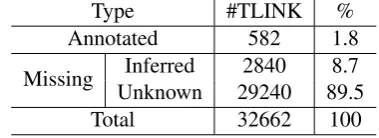
De-spite the existence of denser annotation schemes (e.g.,Cassidy et al.(2014)), the TLINK annotation task is quadratic in the number of nodes, and it is practically infeasible to annotate complete graphs. Therefore, the problem of identifying these un-known relations in training and test is a major is-sue that dramatically hurts existing methods. Table 1: Categories of E-E TLINKs in the TE3 Platinum dataset. Among all pairs of events, 98.2% of them are left unspecified by the annotators. Graph closure can automati-cally add 8.7%, but most of the event pairs are still unknown.
Type #TLINK %
Annotated 582 1.8 Missing UnknownInferred 292402840 89.58.7
Total 32662 100
We could simply use these unknown pairs (or some filtered version of them) to design rules or train classifiers to identify whether a TLINK is vague or not. However, we propose to exclude both the unknown pairs and the vague classifier from the training process – by changing the struc-tured loss function to ignore the inference feed-back onvagueTLINKs (see Line9in Algorithm1 and Line9in Algorithm2). The reasons are dis-cussed below.
First, it is believed that a lot of the unknown pairs are not reallyvaguebut rather pairs that the annotators failed to look at (Bethard et al.,2007; Cassidy et al.,2014;Chambers et al., 2014). For example, (cascaded, monitor) should be annotated as before but is missing in Fig. 2. It is hard to exclude this noise in the data during training. Sec-ond, compared to the overwhelmingly large num-ber of unknown TLINKs (89.5% as shown in Ta-ble 1), the scarcity of non-vague TLINKs makes it hard to learn a good vague classifier. Third, vague is fundamentally different from the other relation types. For example, if a before TLINK can be established given a sentence, then it always holds as beforeregardless of other events around it, but if a TLINK is vague given a sentence, it may still change to other types afterwards if a connection can later be established through other nodes from the context. This distinction empha-sizes thatvagueis a consequence of lack of back-ground/contextual information, rather than a con-crete relation type to be trained on. Fourth, with-out the vague classifier, the predicted temporal graph tends to become more densely connected, thus the global transitivity constraints can be more effective in correcting local mistakes (Chambers
and Jurafsky,2008).
However, excluding the local classifier for vague TLINKs would undesirably assign non-vague TLINKs to every pair of events. To handle this, we take a closer look at the vagueTLINKs. We note that a vague TLINK could arise in two situations if the annotators did not fail to look at it. One is that an annotator looks at this pair of events and decides that multiple relations can exist, and the other one is that two annotators disagree on the relation (similar arguments were also made in Cassidy et al.(2014)). In both situations, the an-notators first try to assign all possible relations to a TLINK, and then change the relation tovagueif more than one can be assigned. This human an-notation process forvagueis different from many existing methods, which either identify the exis-tence of a TLINK first (using rules or machine-learned classifiers) and then classify, or directly includevagueas a classification label along with other non-vague relations.
In this work, however, we propose to mimic this mental process by a post-filtering method2.
Specifically, we take each TLINK produced by ILP and determine whether it is vague using its relative entropy (the Kullback-Leibler divergence) to the uniform distribution. Let{rm}Mm=1 be the set of relations that thei-th pair of events can take, we filter thei-th TLINK given by ILP by:
δi = M
X
m=1
frm(φi) log (Mfrm(φi)),
where frm(φi) is the soft-max score of rm,
ob-tained by the local classifier forrm. We then com-pare δi to a fixed threshold τ to determine the vagueness of this TLINK; we accept its originally predicted label ifδi > τ, or change it tovague oth-erwise. Using relative entropy here is intuitively appealing and empirically useful as shown in the experiments section; better metrics are of course yet to be designed.
5 Experiments
5.1 Datasets
The TempEval3 (TE3) workshop (UzZaman et al., 2013) provided the TimeBank (TB) (Pustejovsky et al.,2003b), AQUAINT (AQ) (Graff,2002), Sil-ver (TE3-SV), and Platinum (TE3-PT) datasets,
2Some systems (e.g., TARSQI (Verhagen and
where TB and AQ are usually for training, and TE3-PT is usually for testing. The TE3-SV dataset is a much larger, machine-annotated and automatically-merged dataset based on multiple systems, with the intention to see if these “silver” standard data can help when included in training (although almost all participating systems saw per-formance drop with TE3-SV included in training). Two popular augmentations on TB are the Verb-Clause temporal relation dataset (VC) and Time-bankDense dataset (TD). The VC dataset has spe-cially annotated event pairs that follow the so-called Verb-Clause structure (Bethard et al.,2007), which is usually beneficial to be included in train-ing (UzZaman et al., 2013). The TD dataset contains 36 documents from TB which were re-annotated using the dense event ordering frame-work proposed inCassidy et al.(2014). The exper-iments included in this paper will involve the TE3 datasets as well as these augmentations. There-fore, some statistics on them are shown in Table2 for the readers’ information.
Table 2: Facts about the datasets used in this paper. The TD dataset is split into train, dev, and test in the same way as inChambers et al.(2014). Note that the column of TLINKs only counts the non-vague TLINKs, from which we can see that the TD dataset has a much higher ratio of #TLINKs to #Events. The TLINK annotations in TE3-SV is not used in this paper and its number is thus not shown.
Dataset Doc Event TLINK Note TB+AQ 256 12K 12K Training VC 132 1.6K 0.9K Training TD 36 1.6K 5.7K Training TD-Train 22 1K 3.8K Training TD-Dev 5 0.2K 0.6K Dev TD-Test 9 0.4K 1.3K Eval TE3-PT 20 0.7K 0.9K Eval TE3-SV 2.5K 81K - Unlabeled
5.2 Baseline Methods
In addition to the state-of-the-art systems, another two baseline methods were also implemented for a better understanding of the proposed ones. The first is the regularized averaged perceptron (AP) (Freund and Schapire, 1998) implemented in the LBJava package (Rizzolo and Roth,2010) and is a local method. On top of the first baseline, we performed global inference in Eq.(2), referred to as the L+I baseline (AP+ILP). Both of them used the same feature set (i.e., as designed inDo et al. (2012)) as in the proposed structured perceptron (SP) and CoDL for fair comparisons. To clarify,
SP and CoDL are training algorithms and their im-mediate outputs are the weight vectors {wr}r∈Y
[image:7.595.324.508.225.311.2]for local classifiers. An ILP inference was per-formed on top of them to yield the final output, and we refer to it as “S+I” (i.e., structured learn-ing+inference) methods.
Table 3:Temporal awareness scores on TE3-PT given gold event pairs. Systems that are significantly better (per McNe-mar’s test withp <0.0005) than the previous rows are under-lined. The last column shows the relative improvement in F1 score over AP-1, which identifies the source of improvement: 5.2% from additional training data, 9.3% (14.5%-5.2%) from constraints, and 10.4% from structured learning.
Method P R F1 %
UTTime 55.6 57.4 56.5 +5.0 AP-1 56.3 51.5 53.8 0 AP-2 58.0 55.3 56.6 +5.2 AP+ILP 62.2 61.1 61.6 +14.5 SP+ILP 69.1 65.5 67.2 +24.9
5.3 Results and Discussion 5.3.1 TE3 Task C - Relation Only
To show the benefit of using structured learn-ing, we first tested one scenario where the gold pairs of events that have a non-vague TLINK were known priori. This setup was a standard task pre-sented in TE3, so that the difficulty of detecting vague TLINKs was ruled out. This setup also helps circumvent the issue that TE3 penalizes sys-tems which assign extra labels that do not exist in the annotated graph, while these extra labels may be actually correct because the annotation itself might be incomplete. UTTime (Laokulrat et al., 2013) was the top system in this task in TE3. Since UTTime is not available to us, and its performance was reported in TE3 in terms of both E-E and E-T TLINKs together, we locally trained an E-T clas-sifier based on Do et al. (2012) and included its prediction only for fair comparison.
Table 4: Temporal awareness scores given gold events but with no gold pairs, which show that the proposed S+I methods outperformed state-of-the-art systems in various settings. The fourth column indicates the annotation sources used, with addi-tional unlabeled dataset in the parentheses. The “Filters” column shows if the pre-filtering method (Sec.3.1) or the proposed post-filtering method (Sec.4) were used. The last column is the relative improvement inF1score compared to baseline systems
on line 1, 7, and 11, respectively. Systems that are significantly better than the “*”-ed systems are underlined (per McNemar’s test withp <0.0005).
No. System Method Anno. (Unlabeled) Testset Filters P R F1 %
1 ClearTK Local TB, AQ, VC, TD TE3-PT pre 37.2 33.1 35.1 0
2 AP* Local TB, AQ, VC, TD TE3-PT pre 35.3 37.1 36.1 +2.8
3 AP+ILP L+I TB, AQ, VC, TD TE3-PT pre 35.7 35.0 35.3 +0.6
4 SP+ILP S+I TB, AQ, VC, TD TE3-PT pre 32.4 45.2 37.7 +7.4
5 SP+ILP S+I TB, AQ, VC, TD TE3-PT pre+post 33.1 49.2 39.6 +12.8 6 CoDL+ILP S+I TB, AQ, VC, TD (TE3-SV) TE3-PT pre+post 35.5 46.5 40.3 +14.8
7 ClearTK* Local TB, VC TE3-PT pre 35.9 38.2 37.0 0
8 SP+ILP S+I TB, VC TE3-PT pre+post 30.7 47.1 37.2 +0.5
9 CoDL+ILP S+I TB, VC (TE3-SV) TE3-PT pre+post 33.9 45.9 39.0 +5.4
10 ClearTK Local TD-Train TD-Test pre 46.04 20.90 28.74
-11 CAEVO* L+I TD-Train TD-Test pre 54.17 39.49 45.68 0
12 SP+ILP S+I TD-Train TD-Test pre+post 45.34 48.68 46.95 +3.0
13 CoDL+ILP S+I TD-Train (TE3-SV) TD-Test pre+post 45.57 51.89 48.53 +6.3
UTTime (“AP-2” in Table 3). On top of AP-2, a global inference step enforcing symmetry and transitivity constraints (“AP+ILP”) can further im-prove the F1 score by 9.3%, which is consistent with previous observations (Chambers and Juraf-sky, 2008;Do et al.,2012). SP+ILP further im-proved the performance in precision, recall, and
F1significantly (per the McNemar’s test (Everitt, 1992;Dietterich,1998) withp <0.0005), reaching anF1 score of 67.2%. This meets our expectation that structured learning can be better when the lo-cal problem is difficult (Punyakanok et al.,2005).
5.3.2 TE3 Task C
In the first scenario, we knew in advance which TLINKs existed or not, so the “pre-filtering” (i.e., ignoring distant pairs as mentioned in Sec.3.1and “post-filtering” methods were not used when gen-erating the results in Table 3. We then tested a more practical scenario, where we only knew the events, but did not know which ones are related. This setup was Task C in TE3 and the top sys-tem was ClearTK (Bethard,2013). Again, for fair comparison, we simply added the E-T TLINKs predicted by ClearTK. Moreover, 10% of the train-ing data was held out for development. Corre-sponding results on the TE3-PT testset are shown in Table4.
From lines 2-4, all systems see significant drops in performance if compared with the same entries in Table 3. It confirms our assertion that how to handle vague TLINKs is a major issue for this temporal relation extraction problem. The im-provement of SP+ILP (line 4) over AP (line 2) was small and AP+ILP (line 3) was even worse than AP, which necessitates the use of a better approach
towards vague TLINKs. By applying the post-filtering method proposed in Sec.4, we were able to achieve better performances using SP+ILP (line 5), which shows the effectiveness of this strat-egy. Finally, by setting U in Algorithm 2 to be the TE3-SV dataset, CoDL+ILP (line 6) achieved the bestF1score with a relative improvement over ClearTK being 14.8%. Note that when using TE3-SV in this paper, we did not use its annotations on TLINKs because of its well-known large noise (UzZaman et al.,2013).
In UzZaman et al. (2013), we notice that the best performance of ClearTK was achieved when trained on TB+VC (line 7 is higher than its re-ported values in TE3 because of later changes in ClearTK), so we retrained the proposed systems on the same training set and results are shown on lines 8-9. In this case, the improvement of S+I over Local was small, which may be due to the lack of training data. Note that line 8 was still significantly different to line 7 per the McNemar’s test, although there was only 0.2% absolute dif-ference inF1, which can be explained from their large differences in precision and recall.
5.3.3 Comparison with CAEVO
were used here, which explains the difference be-tween line 11 in Table4and what was reported in Chambers et al.(2014).
ClearTK was reported to be outperformed by CAEVO on TD-Test (Chambers et al., 2014), but we observe that ClearTK on line 10 was much worse even than itself on line 7 (trained on TB+VC) and on line 1 (trained on TB+AQ+VC+TD) due to the annotation scheme difference between TD and TB/AQ/VC. ClearTK was designed mainly for TE3, aiming for high pre-cision, which is reflected by its high precision on line 10, but it does not have enough flexibility to cope with two very different annotation schemes. Therefore, we have chosen CAEVO as the base-line system to evaluate the significance of the pro-posed ones. On the TD-Test dataset, all systems other than ClearTK had betterF1scores compared to their performances on TE3-PT. This notable dif-ference (i.e., 48.53 vs 40.3) indicates the better quality of the dense annotation scheme that was used to create TD (Cassidy et al.,2014). SP+ILP outperformed CAEVO and if additional unlabeled dataset TE3-SV was used, CoDL+ILP achieved the best score with a relative improvement in F1 score being 6.3%.
We notice that the proposed systems often have higher recall than precision, and that this is less an issue on a densely annotated testset (TD-Test), so their low precision on TE3-PT possibly came from the missing annotations on TE3-PT. It is still under investigation how to control precision and recall in real applications.
6 Conclusion
We develop a structured learning approach to iden-tifying temporal relations in natural language text and show that it captures the global nature of this problem better than state-of-the-art systems do. A new perspective towards vague relations is also proved to gain from fully taking advantage of the structured approach. In addition, the global na-ture of this problem gives rise to a better way of making use of the readily available unlabeled data, which further improves the proposed method. The improved performance on both TE3-PT and TD-Test, two differently annotated datasets, clearly shows the advantage of the proposed method over existing methods. We plan to build on the notable improvements shown here and expand this study to deal with additional temporal reasoning prob-lems in natural language text.
Acknowledgements
We thank all the reviewers for providing useful comments. This research is supported in part by a grant from the Allen Institute for Artificial Intelli-gence (allenai.org); the IBM-ILLINOIS Center for Cognitive Computing Systems Research (C3SR) - a research collaboration as part of the IBM Cognitive Horizon Network; by the US Defense Advanced Research Projects Agency (DARPA) under contract FA8750-13-2-0008; and by the Army Research Laboratory (ARL) under agree-ment W911NF-09-2-0053. The views and conclu-sions contained herein are those of the authors and should not be interpreted as necessarily represent-ing the official policies of the U.S. Government.
References
James F Allen. 1983. Maintaining knowledge about temporal intervals. Communications of the ACM
26(11):832–843.
James F Allen. 1984. Towards a general theory of ac-tion and time.Artificial intelligence 23(2):123–154.
Steven Bethard. 2013. ClearTK-TimeML: A minimal-ist approach to TempEval 2013. In Second Joint Conference on Lexical and Computational Seman-tics (* SEM). volume 2, pages 10–14.
Steven Bethard and James H Martin. 2007. CU-TMP: Temporal relation classification using syntactic and semantic features. InProceedings of the 4th Inter-national Workshop on Semantic Evaluations. Asso-ciation for Computational Linguistics, pages 129– 132.
Steven Bethard, James H Martin, and Sara Klingen-stein. 2007. Timelines from text: Identification of syntactic temporal relations. InSemantic Comput-ing, 2007. ICSC 2007. International Conference on. IEEE, pages 11–18.
Steven Bethard, Guergana Savova, Wei-Te Chen, Leon Derczynski, James Pustejovsky, and Marc Verhagen. 2016. SemEval-2016 Task 12: Clinical TempEval.
Proceedings of SemEval pages 1052–1062.
P. Bramsen, P. Deshpande, Y. K. Lee, and R. Barzi-lay. 2006. Inducing temporal graphs. In Proceed-ings of the Conference on Empirical Methods for Natural Language Processing (EMNLP). Associa-tion for ComputaAssocia-tional Linguistics, Sydney, Aus-tralia, pages 189–198.
N. Chambers and D. Jurafsky. 2008. Jointly combining implicit constraints improves temporal ordering. In
Proceedings of the Conference on Empirical Meth-ods for Natural Language Processing (EMNLP).
Nathanael Chambers. 2013. NavyTime: Event and time ordering from raw text. Technical report, DTIC Document.
Nathanael Chambers, Taylor Cassidy, Bill McDowell, and Steven Bethard. 2014. Dense event ordering with a multi-pass architecture. Transactions of the Association for Computational Linguistics 2:273– 284.
Nathanael Chambers, Shan Wang, and Dan Juraf-sky. 2007. Classifying temporal relations between events. InProceedings of the 45th Annual Meeting of the ACL on Interactive Poster and Demonstra-tion Sessions. Association for Computational Lin-guistics, pages 173–176.
Angel X Chang and Christopher D Manning. 2012. SUTIME: A library for recognizing and normaliz-ing time expressions. InLREC. volume 2012, pages 3735–3740.
M. Chang, L. Ratinov, and D. Roth. 2007. Guiding semi-supervision with constraint-driven learning. In
Proc. of the Annual Meeting of the Association for Computational Linguistics (ACL). Association for Computational Linguistics, Prague, Czech Republic, pages 280–287.
M. Chang, L. Ratinov, and D. Roth. 2012. Structured learning with constrained conditional models. Ma-chine Learning88(3):399–431.
M. Chang, V. Srikumar, D. Goldwasser, and D. Roth. 2010. Structured output learning with indirect su-pervision. InProc. of the International Conference on Machine Learning (ICML).
Michael Collins. 2002. Discriminative training meth-ods for hidden markov models: Theory and experi-ments with perceptron algorithms. InProc. of ACL.
Thomas G Dietterich. 1998. Approximate statistical tests for comparing supervised classification learn-ing algorithms. Neural computation 10(7):1895– 1923.
Q. Do, W. Lu, and D. Roth. 2012. Joint inference for event timeline construction. InProc. of the Con-ference on Empirical Methods in Natural Language Processing (EMNLP).
Brian S Everitt. 1992. The analysis of contingency ta-bles. CRC Press.
Y. Freund and R. Schapire. 1998. Large margin clas-sification using the Perceptron algorithm. In Pro-ceedings of the Annual ACM Workshop on Compu-tational Learning Theory (COLT). pages 209–217.
David Graff. 2002. The AQUAINT corpus of english news text. Linguistic Data Consortium, Philadel-phia.
Gurobi Optimization, Inc. 2012. Gurobi optimizer ref-erence manual.
Heng Ji, Taylor Cassidy, Qi Li, and Suzanne Tamang. 2014. Tackling representation, annotation and clas-sification challenges for temporal knowledge base population. Knowledge and Information Systems
41(3):611–646.
P. Jindal and D. Roth. 2013. Extraction of events and temporal expressions from clinical narratives. Jour-nal of Biomedical Informatics (JBI).
Natsuda Laokulrat, Makoto Miwa, Yoshimasa Tsu-ruoka, and Takashi Chikayama. 2013. UTTime: Temporal relation classification using deep syntac-tic features. InSecond Joint Conference on Lexical and Computational Semantics (* SEM). volume 2, pages 88–92.
Kenton Lee, Yoav Artzi, Jesse Dodge, and Luke Zettle-moyer. 2014. Context-dependent semantic parsing for time expressions. InACL (1). pages 1437–1447.
Tuur Leeuwenberg and Marie-Francine Moens. 2017. Structured learning for temporal relation extraction from clinical records. In Proceedings of the 15th Conference of the European Chapter of the Associa-tion for ComputaAssocia-tional Linguistics.
Hector Llorens, Nathanael Chambers, Naushad UzZa-man, Nasrin Mostafazadeh, James Allen, and James Pustejovsky. 2015. SemEval-2015 Task 5: QA TEMPEVAL - evaluating temporal information un-derstanding with question answering. In Proceed-ings of the 9th International Workshop on Semantic Evaluation (SemEval 2015). pages 792–800.
Inderjeet Mani, Marc Verhagen, Ben Wellner, Chong Min Lee, and James Pustejovsky. 2006. Ma-chine learning of temporal relations. InProceedings of the 21st International Conference on Compu-tational Linguistics and the 44th annual meeting of the Association for Computational Linguistics. Association for Computational Linguistics, pages 753–760.
Inderjeet Mani, Ben Wellner, Marc Verhagen, and James Pustejovsky. 2007. Three approaches to learning TLINKs in TimeML. Technical Report CS-07–268, Computer Science Department.
Anne-Lyse Minard, Manuela Speranza, Eneko Agirre, Itziar Aldabe, Marieke van Erp, Bernardo Magnini, German Rigau, Ruben Urizar, and Fon-dazione Bruno Kessler. 2015. SemEval-2015 Task 4: TimeLine: Cross-document event ordering. In
V. Punyakanok, D. Roth, W. Yih, and D. Zimak. 2005. Learning and inference over constrained output. In
Proc. of the International Joint Conference on Arti-ficial Intelligence (IJCAI). pages 1124–1129. James Pustejovsky, Jos´e M Castano, Robert Ingria,
Roser Sauri, Robert J Gaizauskas, Andrea Set-zer, Graham Katz, and Dragomir R Radev. 2003a. TimeML: Robust specification of event and tempo-ral expressions in text. New directions in question answering 3:28–34.
James Pustejovsky, Patrick Hanks, Roser Sauri, An-drew See, Robert Gaizauskas, Andrea Setzer, Dragomir Radev, Beth Sundheim, David Day, Lisa Ferro, et al. 2003b. The TIMEBANK corpus. In
Corpus linguistics. volume 2003, page 40.
N. Rizzolo and D. Roth. 2010. Learning based java for rapid development of nlp systems. InProc. of the In-ternational Conference on Language Resources and Evaluation (LREC). Valletta, Malta.
D. Roth and W. Yih. 2004. A linear programming formulation for global inference in natural language tasks. In Hwee Tou Ng and Ellen Riloff, editors,
Proc. of the Conference on Computational Natural Language Learning (CoNLL). Association for Com-putational Linguistics, pages 1–8.
Jannik Str¨otgen and Michael Gertz. 2010. HeidelTime: High quality rule-based extraction and normaliza-tion of temporal expressions. InProceedings of the 5th International Workshop on Semantic Evaluation. Association for Computational Linguistics, pages 321–324.
Mihai Surdeanu. 2013. Overview of the TAC2013 knowledge base population evaluation: English slot filling and temporal slot filling. InTAC.
Naushad UzZaman and James F Allen. 2011. Tem-poral evaluation. In Proceedings of the 49th An-nual Meeting of the Association for Computational Linguistics: Human Language Technologies: short papers-Volume 2. Association for Computational Linguistics, pages 351–356.
Naushad UzZaman, Hector Llorens, James Allen, Leon Derczynski, Marc Verhagen, and James Pustejovsky. 2013. Sem2013 Task 1: TEMPEVAL-3: Eval-uating time expressions, events, and temporal rela-tions. Second Joint Conference on Lexical and Com-putational Semantics 2:1–9.
Marc Verhagen. 2004. Times Between The Lines. Ph.D. thesis, Brandeis University.
Marc Verhagen, Robert Gaizauskas, Frank Schilder, Mark Hepple, Graham Katz, and James Pustejovsky. 2007. SemEval-2007 Task 15: TempEval temporal relation identification. InProceedings of the 4th In-ternational Workshop on Semantic Evaluations. As-sociation for Computational Linguistics, pages 75– 80.
Marc Verhagen and James Pustejovsky. 2008. Tem-poral processing with the TARSQI toolkit. In22nd International Conference on on Computational Lin-guistics: Demonstration Papers. Association for Computational Linguistics, pages 189–192. Marc Verhagen, Roser Sauri, Tommaso Caselli, and
James Pustejovsky. 2010. SemEval-2010 Task 13: TempEval-2. InProceedings of the 5th international workshop on semantic evaluation. Association for Computational Linguistics, pages 57–62.