E x p e r i m e n t s in R e u s a b i l i t y of G r a m m a t i c a l R e s o u r c e s
D o u g A r n o l d ° T o n i B a d i a ®, J o s e f v a n G e n a b i t h % S t e l l a M a r k a n t o n a t o u ° S t e f a n M o m m a % L o u i s a S a d l e r ° , P a u l S c h m i d t °
° D e p t of L a n g u a g e a n d L i n g u i s t i c s , U n i v e r s i t y of E s s e x , C o l c h e s t e r C 0 4 3 S Q , U K ° U n i v e r s i t a t P o m p e u F a b r a , L a R a m b a 32, 08002 B a r c e l o n a , S p a i n
° I M S - C L , A z e n b e r g s t r a f l e 12, U n i v e r s i t y of S t u t t g a r t , D - W 7 0 0 0 S t u t t g a r t , G e r m a n y DIAI, M a r t i n - L u t h e r - S t r a i ~ e 14, D - W 6 6 0 0 S a ~ r b r f i c k e n 3, G e r m a n y
d o u g ; m a r k s ; l o u i s a @ e s s e x . a c . u k , t b a d i a @ u p f . e s , s t e f f ; j o s e f @ i m s . u n i - s t u t t g a r t . d e , p a u l @ i a i . u n i - s b . d e
A b s t r a c t 1 I n t r o d u c t i o n Substantial formal grammatical and lex-
ical resources exist in various NLP sys- tems and in the form of textbook speci- fications. In the present paper we report on experimental results obtained in man- ual, semi-antomatic and automatic migra- tion of entire computational or textbook de- scriptions (as opposed to a more informal reuse of ideas or the design of a single "poly- theoretic" representation) from a variety of formalisms into the ALEP formalism. 1 The choice of ALEP (a comparatively lean, typed feature structure formalism based on rewrite rules) was motivated by the as- sumption that the study would be most interesting if the target formalism is rel- atively mainstream without overt ideolog- ical commitments to particular grammat- ical theories. As regards the source for- malisms we have attempted migrations of descriptions in HPSG (which uses fully- typed feature structures and has a strong 'non-derivational' flavour), ETS (an un- typed stratificational formalism which es- sentially uses rewrite rules for feature struc- tures and has run-time non-monotonic de- vices) and LFG (which is an un-typed con- straint and CF-PSG based formalism with extensions such as existential, negative and global well-formedness constraints).
1 The work reported in this paper was
supported
by the CEC as part of the project ET10/52.Reusability of grammatical resources is an important idea. Practically, it has obvious economic benefits in allowing grammars to be developed cheaply; for the- oreticians it is important in allowing new formalisms to be tested out, quickly and in depth, by providing large-scale grammars. It is timely since substantial computational grammatical resources exist in vari- ous NLP systems, and large scale descriptions must be quickly produced if applications are to succeed. Meanwhile, in the CL community, there is a percep- tible paradigm shift towards typed feature structure and constraint based systems and, if successful, mi- gration allows such systems to be equipped with large bodies of descriptions drawn from existing resources. In principle, there are two approaches to achiev- ing the reuse of grammatical and lexical resources. The first involves storing or developing resources in some theory neutral representation language, and is probably impossible in the current state of knowl- edge. In this paper, we focus on reusability through
migration--the transfer of linguistic resources (gram-
matical and lexical descriptions) from one compu- tational formalism into another (a target computa- tional formalism). Migration can be completely man- ual (as when a linguist attempts to encode the analy- ses of a particular linguistic theory in some compu- tationally interpreted formalism), semi-automatic or automatic. The starting resource can be a paper de- scription or an implemented, runnable grammar.
ies explored the expressivity of the different grammar
formalisms (both in the strong mathematical
and
inthe functional sense, i.e. not only which class of string sets can be described, but also what can be stated directly or naturally, as opposed to just being encoded somehow or other), the reduction was not intended to be the basis of migration of descriptions written in the formalisms. In this respect the work described below differs substantially from Shieber's work: our goal has to be to provide grammars in the target formalisms that can be directly used for fur- ther work by linguists, e.g. extending the coverage or restructuring the description to express new insights, etc.
The idea of migration raises some general ques- tions.
• W h a t counts as
successful
migration? (e.g. what properties must the o u t p u t / t a r g e t descrip- tion have and which of these properties are cru- cial for the reuse of the target description?).• How conceptually close must source and target be for migration to be successful?
• How far is it possible to migrate descriptions ex- pressed in a richer formalism (e.g. one that uses m a n y expressive devices) into a poorer formal- ism? For example, which higher level expres- sive devices can be directly expressed in a 'lean' formalism, which ones might be compiled down into a lean formalism, and which ones are truly problematic? Are there any general hints that might be given for any particular class of higher level expressive devices? When should effort be put into finding encodings for richer devices, and
when should the effort go into simply
extending
the target formalism?
• How important is it that the source formalism have a well-defined semantics? How far can difficulties in this area be off-set if the gram- mars/descriptions are well-documented?
• How does the existence of non-monotonic de- vices within a source formalism effect migrata- bility, and is it possible to identify, for a given source grammar, uses of these mechanisms that are not truly non-monotonic in nature and could thus still be modelled inside a monotonic de- scription?
• To what extent are macros and preprocessors a useful tool in a step-wise migration from source to target?
We can provide some answers in advance of ex-
perimentation. In particular,
successful
migrationimplies that the target description must be practi- cally usablc t h a t is, understandable and extensible. There is one exception to this, which is where a large grammatical resource is migrated solely to test the (run-time) capabilities of a target formalism. Practi- cally, usability implies at least I / O equivalence with
the source grammar but should .ideally also imply the preservation of general properties such as modular- ity, compactness and user-friendliness of the specifi- cation.
This paper reports on and derives some lessons from a series of on-going experiments in w h i c h we have attempted automatic, semi-automatic and manual migration of implemented grammatical and lexical resources and of textbook specifications, writ- ten in various 'styles', to the ALEP formalism (see below). The choice of ALEP was motivated by the assumption the study would be most interesting if the target formalism is relatively mainstream. 2 As regards the 'style' and expressivity of source for- malisms, we have carried out migrations from HPSG, which uses fully-typed feature structures and a vari- ety of richly expressive devices, from ETS grammars and lexicons 3 (ETS is an untyped stratificational formalism essentially using rewrite rules for feature structures), and from an LFG grammar 4 (LFG is a standard untyped AVS formalism with some exten- sions, with a CFG backbone).
2 T h e M i g r a t i o n E x p e r i m e n t s
2.1 T h e T a r g e t F o r m a l i s m
The target formalism, ALEP, is a first prototype im- plementation of the formalism specified in the ET- 6 design study (the ET-6 formalism [Alshawi et
al.
1991]). ET-6 was intended to be an efficient, main- stream CL formalism without ideological commit- ments to particular grammatical theories and suit- able for large-scale implementations. It is declara- tive, monotonic and reversible, although in ET-6 and in ALEP it is possible to model certain non-monotonic operations (e.g. getting some treatment of defaults out of parametrised macros). ALEP is CF-PSG rule based and supports feature structures which are typed and simple inheritance between types. Type information and inheritance is effective only at com- pile time. ALEP provides atoms, lists, booleans and terms as basic types. Complex structured types and simple inheritance relations are defined by the user in a type system specification. In addition to standard grammar rules which are effective during a parse (generation) the formalism provides refinement rules which operate on the output of the parser and spec- ify values which are still undefined after parsing by using only unification. Although the core formal- ism is rather conservative, for reasons of efficiency, it is intended to support the eventual inclusion of a periphery including external constraint processing
20f course, for practical purposes one might want to migrate resources to a non-standaxd formalism, provided it is relatively easy to understand.
3Developed at Saaxbrficken, Essex and UMIST during
the EUROTRA project.
4Developed at Stuttgart as part of the EUROTRA
modules. Similarly, it does not (yet) directly provide potentially computationally expensive expressive de- vices such as e.g. set-valued features and operations on sets, functionally dependent vMues, separation of ID and LP statements, multiple inheritance or mem- bership and concatenation constraints on lists. The idea is that such extensions should be provided, prob- ably as external modules, as and when they are found to be necessary. 5
2.2 M a n u a l M i g r a t i o n f r o m H P S G
Although both HPSG and ALEP use typed feature structures and support type inheritance, they dif- fer crucially in that HPSG specifications are con- sciously non-derivational and strongly modularised in terms of sets of principles, immediate dominance schemata and linear precedence statements operat- ing as constraints on typed feature structures. To achieve this, HPSG employs a number of powerful descriptive devices, including list and set operations (often expressed as functionally dependent values), and multiple type inheritance. The focus for the
HPSG , ALEP conversion, then, is to what ex-
tent can the latter, rather lean formalism support in a reasonable way the style of linguistic specification found in HPSG (the source specifications for this ex- eriment was the description of English provided in
ollard & Sag 1992]).
Various approaches to conversion are possible. For example, it would be possible to define a user lan- guage permitting the expression of principles (in much the same way as some formalisms permit fea- ture percolation principles to be separately stated) and a compiler into ALEP allowing their effects to be expanded into the rules. In this spirit, follow- ing the work of Mellish [Mellish 1988] the technique of encoding boolean combinations of atomic feature values so t h a t satisfaction can be checked by unifi- cation is adopted in the ET-6 formalism [Alshawi et al. 1991].
Since there were open questions as what could be directly expressed in ALEP, in this conversion experi- ment we first took a direct approach, essentially em- ploying ALEP as a feature term rewriting system for HPSG specifications. T h e focus of this conversion was mainly on exploring the limits of the expressiv- ity of ALEP and thus identifying which higher level expressive devices could not be treated.
T h e resulting translation is not as perspicuous, modular, compact and maintainable as the original HPSG specification. Migration results in a fragmen- tation and particularisation of the linguistic infor- mation encoded in the original specification. This is because (i) HPSG principles and schemata have to be compiled out into (possibly large) sets of ALEP
S A p a r t f r o m i n v e s t i g a t i n g i s s u e s i n v o l v e d in m i g r a t i o n of descriptions, one motivation for these experiments is to explore just which devices are essential for expressing linguistically motivated grammatical descriptions.
phrase-structure rules; and (ii) some descriptions cast in a richly expressive formalism have to be sim- ulated and can often only be approximated in ALEP. For example, ID-2 and the valence principle as it applies to ID-2, (1) has to be approximated with sets of ALEP rules of the form in (2), because of the lack of the functional constraint v a l _ a p p e n d .
(1) ID-2 and Valence Principle (simplified):
[SYlgSEM [ LOC [ CAT [ COMPS e 1
DRTS l HDTR[ SYNSEN [ L0C l CAT l CONPS v a l _ a p p e n d ( @ 1 , @2) COMPDTRS @2]
( 2 ) A L E P r u l e s for I D 2 :
i d _ 2 _ 0 = s i g n : { . . . . c o m p s => I'] . . . . } - > [ s i g n : { .... c o m p s = > [] .... }] h e a d 1.
i d _ 2 _ 1 = s i g n : { . . . . comps => [ ] . . . . } - > [ s i g n : { . . . . comps => I X ] . . . . } ,
s i g n : { . . . . s y n s e l => X . . . . }] head 1.
id_2_2 = s i g n : { . . . . comps -> [] . . . . } -> [ s i g n : { . . . . c o m p s => I X , Y ] . . . . },
s i g n : { . . . . s y n s e l -> I . . . . },
s i g n : { . . . . s y n s e l => Y . . . . }] h e a d 1 .
i d _ 2 _ 3 = . . . .
Of course, by adopting binary branching trees and altering the ID and Subcategorisation principles it would be possible to avoid some of this verbosity, but for the purposes of our experiment we considered it i m p o r t a n t to investigate the migration of the source formalism as is.
Note t h a t the resulting ALEP specification in (2) is as compact, perspicuous and maintainable as in any rule based g r a m m a r formalism, although it compares badly with HPSG in these terms. While initially it seemed that it was possible to create a usable, ex- tensible and understandable ALEP g r a m m a r on the basis of H P S G specifications, there is one feature of HPSG which remains problematic, t h a t of set-valued features and set operations. T h e difficulty comes in modelling principles such as the H P S G Quantifier Inheritance Principle (QIP), which relies on the op- erations such as set union and complementation.
In ALEP set union can be approximated to a certain extent in terms of list concatenation in a difference list based threading approach. However, since the current implementation of ALEP does not even pro- vide membership constraints on list representations, element and set difference constraints can only be ap- proximated in terms of a multitude of minimally dif- fering rules naming elements in set representations. This approach is only safe if the following two con- ditions hold:
• the sets involved are finite
• elements in the difference list representations of sets are unique
"SYNSEM: [LOC:
[CONTENT:[QUANTS:RETR U HQUANTS]]]
QSTORE:(HQSTORE U QUANTS1 U . . . U Q U A N T S , } - RETR RETRVD:RETRFHDTR:[SYNSEM:[LOC:
[CONTENT:[QUANTS:HQUANTS]]
]]]
DTRS:
I °TRI
IQSTO.]
RE:QuANTSI]
J
LDTR.
[QSTORE:QUANTS,]Figure h Quantifier Inheritance Principle (simplified)
ements in the representation results in an unaccept- able number of rules and associated parse time. In some cases we were able to avoid this problem by relegating e.g. quantifier retrieval to sets of refine- ment rules which operate on parse objects which are effectively underspecified for quantifier scope.
It soon became clear that sets of refinement rules are not a general solution for the modelling of el- ement or set complement constraints in HPSG be-
cause they operate on the output of a parse and
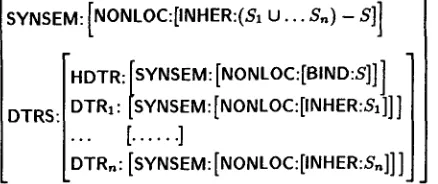
hence cannot decide about the 'phrase' structure of a sign. Introducing and filling gaps, however, is cen- tral to the structure of a sign. The Nonlocal Feature Principle (NFP) which is at the heart of the ttPSG treatment of unbounded dependency constructions (UDCs) ensures that SYNSEM I NONLOC I INHER values are discharged in terms of a set difference specifica- tion which cannot be implemented in terms of sets of refinement rules since it directly decides about the well-formedness of strings in terms of the phrase structure of the sign.
IOTR.: [SYNSEM:[NONtOC:tINHER:Sn]]]
Figure 2: Nonlocal Feature Principle (simplified)
Furthermore, parasitic gap phenomena in English as
in That was the rebel leader who rivals of_ shot _
suggest that at least as far as the NFP is concerned it is problematic to asssume that elements in the dif- ference list representations of sets are unique. This assumption is crucial to modeling set union in terms of list concatenation.
Formally, HPSG principles can either be given the status of proper types or that of typed feature struc- ture templates acting as constraints on other feature structures. In A L E P the first option is not available to us since apart from subtype or supertype infor- mation the type system specification does not allow the specification of a type other than in terms of
its root attributes and the type of their correspond- ing values and more importantly it does not support multiple inheritance required to inherit principles to other types. In order to recapture some of the loss of modularity in compiling out HPSG principles over sets of ALEP rules we thus tried to pursue the sec- ond option using m4 macros to directly state princi- ples. m4 is a standard UNIX facility which allows for parameterised and non-parameterised macros, con- ditional expansions and numeric operations. Macros are expanded externally to ALEP and not during com- pilation time. Each HPSG principle can be rep- resented as a feature structure template which in turn can be specified in terms of a macro defini- tion, or so it seems. The problem here, however, is that since IIPSG principles mutually constrain signs, the conjunction of such principles (at least in simple cases) corresponds to the unification (or merging) of their feature structure template representations (if the conjunction is satisfiable). W h a t standard macro facilities achieve is effectively a simple lexical expan- sion of strings and it is impossible to get the merging effect of unification of template feature structures out of a modular macro specification of such templates.
Basically, three options are available to us:
(i) To get the overlapping effect of unification we integrate different principles into one macro.
(ii) We define extended types with special attributes for each of the relevant HPSG principles which are expanded by modular macro definitions of the principles and get the unification effect from A L E P at compile time through proper coindexa- tion.
phrase{phrase ffi> QS{PHRASE},
hfp ffi> @S{HEAD_FEATURE_PRINC}, sp ~> @S{SEMANTICS_PRINC}, qip -> QS{QUANTIF_INHERIT_PRINC}, valp => GS{VALENCY_PRINC}}
(iii) We use a more powerful 'macro' processor like e.g. Prolog which provides the unification effect and define a map into ALEP.
[image:4.596.136.461.76.164.2] [image:4.596.66.285.450.542.2]sidering the expressivity of the target formalism it- self.
2.3 A u t o m a t i c M i g r a t i o n f r o m E T S B - r u l e s In this section we draw some general conclusions
following from our experience of attempting auto-
matic migration from an untyped rule-based formal- ism. Specifically, the source for this experiment was the structure-building rules of some relatively large ETS grammars. The ETS formalism is "badly be- haved" in that it contains a rich array of devices ad- ditional to the structure-building or B-rules, m a n y of which are non-monotonic, and which apply at run- tim e (they are mainly output filters and various types of feature percolation rules). We have written an au- tomatic compiler in Prolog which calculates a very simple type system and automatically migrates the structure rules and lexical descriptions. With respect to the source formalism in question, the following points are to be noted:
• The run-time non-monotonic devices found in ETS are extremely problematic to take into ac- count in automatic direct migration. We doubt whether it would be possible to write an intelli- gent compiler which directly encoded the effect of these devices in the resultant ALEP rule set. If they are ignored in the migration process, then of course the source and target descriptions are not I / O equivalent.
• The B-rules themselves allow optionality, Kleene closure, positive Kleene closure and disjunction over (sequences of) daughters to any degree of embedding within each other. In A L E P such rules have to be compiled out into a normal form which allows only for optionality over sin- gle daughters and no disjunctions of daughters. The size of the resulting rule set is such that it cannot be reasonably maintained. The size also means t h a t it is impossible for a linguist to manually "correct" an overgenerating grammar resulting from the omission of filters and feature rules above.
• In some cases, it became apparent during the migration process t h a t the intended semantics of the (very complex) phrase structure rules was unclear (e.g. regarding the scope of variables in Kleene starred constituents).
One conclusion is t h a t one of the crucial ingredi- ents is the quality and detail of the documentation
of grammars. With good documentation it is often possible to get around the effects of unclear rule se- mantics, because the rule writers intention can be understood. The lack of such documentation is se- rious, since it means the migrator has to try to in- tuit the intended behaviour by attempting to run the source grammars in the source formalism.
Similarly, so long as the intended interpretation is clear, it m a y be possible to deal with non-monotonic
devices. This is most obvious where the non-
monotonic effects do not persist to run-time (but see also our discussion of the LFG migration below). For example the ALVEY grammar [Carroll 1991] has them, but since there is an object grammar stage in which all this is compiled out, the non-montonic devices can be avoided by taking the object gram- mar as the input to migration. The issue is then whether it is possible to automatically 'recompact' the target grammar in some linguistically useful way, or whether all extension and maintenance should be done in the source formalism.
Note further t h a t even if the grammars resulting from a migration are not linguistically useful (for ex- ample, because the grammar is not maintainable or extensible), they m a y serve some purpose in testing the capacity of the target formalism to operate (ef- ficiently) with very large rule sets (for example, in our experimentation, a rule set of some 1,500 rules derived by automatic migration caused ALEP to fail to compute the link relation).
ETS lexical descriptions are more successfully mi- gratable because their semantics is clear. Simple parameterised macros have been used in a semi- automatic migration process.
2.4 A u t o m a t i c L F G i m p o r t a t i o n i n t o A L E P LFG is an untyped constraint-based linguistic for- realism with rich expressive devices built around a
CFG backbone. The formalism has been imple-
mented in various systems, including XEROX PARC's
Grammar Writer's Workbench, and the CHARON
system developed as part of the accompanying re- search for EUROTRA-D carried out at the University of Stuttgart. Our automatic migration experiment started from grammars written for the latter system. We have written a Prolog program t h a t translates automatically from an LFG notation t h a t is very close to the original specification in [Bresnan 1982]
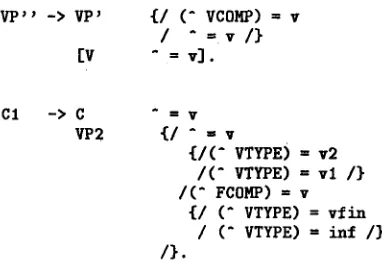
i n t o ALEP. For reasons explained further below, the program cannot succeed in all cases. It is, however, capable of detecting those cases reliably, and gener- ates warnings where the fully automatic translation fails. 6 Examples for typical rules from the source grammar are shown in figure 3. 7
The translation of the rule format illustrated in fig- ure 3 into a PROLOG readable form is performed by a subcomponent of the CHARON system. The auto- matic translation procedure makes use of the output of this precompilation step.
The rule format supports optionality of con- stituents, nested optionalities and Kleene starred rule parts, which have to be expanded in the ALI,~P
translation. ALEP only supports optionality of single
daughters in the RHS of rules. In our case, this part of the expansion is done by the preprocessor. The
eThe program was developed by Dieter Kohl at IMS.
VP'' -> VP'
[ v
{/ (- v c o ~ ) = v
/ = v /}
---- V].
Cl -> C
VP2
= v
{/ " = v
{/(" VTYPE) = v 2
/(" VTYPE) = v l /} [(" FCOMP) = v
{ / (" VTYPE) = v : f i n
/ (" VTYPE) = inf /} /}.
Figure 3: Sample grammar rules from the source de- scription
result of compiling out Kleene starred rules and op- tionalities is that the object grammar quickly reaches a size that can no longer be reasonably maintained and the target description contains elements (in this case auxiliary categories) which are not part of the linguistic intuition of the grammar writer.
The second characteristic feature of rules like the ones shown in figure 3 is the massive use of complex disjunctions over feature structures (indicated by the {\ and \} pairs). Although the ALEP formalism sup- ports disjunctions over complex feature structures, due to problems in the implementation available at the time of the experiment, they had to be multiplied out into a possibly large number of separate rules.
The next example (figure 4) shows a typical lexical entry from the source grammar.
bietet: V, (~ OBJ AGR CAS) = a c c
(" PLIED) = "bieten <(" S U B J ) ( " OBJ)>" (" SUBJ A G E Bq/M) = s g
(" SUBJ AGR CAS = nora (" TENSE) = p r e s e n t (" INF) = -
(" FORM) = c an <---
(" VERBTYPE) = particle.
Figure 4: Sample lexicon entry from the source de- scription
The basic part of the annotations of the LFG rules and lexicon, i.e. the defining equations, are mapped easily into ALEP. The work here is divided between the CHARON preprocessor which converts feature de- scriptions (the equations) into feature terms, and the output routine which maps feature terms into ALEP rules and lexicon entries.
In LFG, path specifications in equations can be variables, as in the (" (v PCASE)) case, where the at- tribute under which the f-structure associated with v is determined by the value of a feature inside v. ALEP does not support variable path expressions, therefore
we have to enumerate all possible paths in a large dis- junction which adds another factor to the multiplica- tive expansion of the rule set. Similar facts hold for the implementation of functional uncertainty, where we have to deal with regular expressions over paths, s LFG permits "special" types of equation besides the standard defining ones. Constraining (=c type) equations in our source grammar typically occur in lexical entries as the one shown in figure 4, where a given form of e.g. a verb has to be distinguished, because it is only used in particular contexts. The equation is then typically a specification of a special subclass of a more general class of verbs (here a verb which can occur with a separable prefix). Where this is the case, in the migrated description the relevant distinction can be made in the type system, ensur- ing that non-membership in the particular subtype is explicitly stated for all (relevant) members of the supertype.
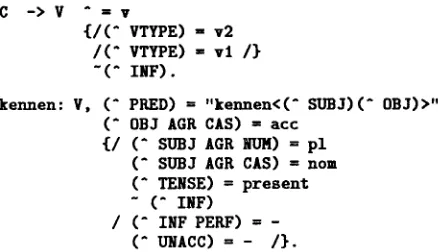
Another, potentially very powerful expressive de- vice in the LFG formalism is the use of existential and negative existential constraints (in the CHARON notation expressed as ! ( " INF) and " ( " INF), re- spectively). Current implementations of LFG delay the evaluation of such constraints, because in gen- eral, they can only be tested at the end of the pro- cessing of a whole utterance. It turns out, however, that quite often existential and negative existential constraints can be disposed of, if a full type sys- tem is available. Careful examination of the source grammars reveals that the prevalent use of such con- straints is exactly to model what feature appropriate- ness conditions in a type system do: they restrict the application of particular rule types to feature struc- tures where a given set of features is either present or absent. To model this by using the type system in- stead, we introduce subtypes of the structure where the path has to or must not exist.
If the source grammar only uses negative existen- tial constraints for atomic valued features, we could easily formulate a proper type system, and do away with ' - ' , and '!' in a rather straightforward manner. Typical uses of e.g. negative existential constraints are shown in the rule and lexical entry in figure 5.
LFG uses set values for collecting e.g. adjuncts which do not have any other distinguishing function on the f-structure level. ALEP does not support the direct expression of sets as values. Given the facts of German word order, generation would seem to re- quire sets of ADJUNCTS as values, rather than lists. Here we do in fact loose some expressivity if we try to model adjuncts in ALEP using lists, because the canonical set operations are not available.
Finally, we have to be able to express the (non-
monotonic) global completeness and coherence con-
[image:6.596.65.256.82.215.2] [image:6.596.66.291.460.545.2]C - > V • V
{ / ( " VTYPE) = v 2 / ( " VTYPE) ffi v l / } " ( " INF).
kennen: V, ( " PRED) ffi " k e n n e n < ( " S U B J ) ( * 0 B J ) > " ( " OBJ AGR CAS) = a c e
( / (" SUBJ AGR ~OM) ffi p l
( " SUBJ AGR CIS) = nora ( " TENSE) -- p r e s e n t
" ( - I ~ F ) / (" INF PEPS) - - -
(" U~ACC) = - / } .
Figure 5: Examples for negative existential con- straints in the rules and the lexicon
straints which help to control subcategorisation. Of these two, the coherence condition can be easily con- trolled by defining types with the appropriate num- ber of features, one for each of the subcategorised functions. T h e introduction of additional syntactic functions which are not subcategorised for is then prevented by the type system. T h e completeness condition, however, which is supposed to guarantee that all syntactic functions in the subcategorisation frame are filled, can not be handled that easily. T h e main problem here is, that while we are able to re- quire that a certain feature be present in a feature structure, we cannot express restrictions on the de- gree of instantiation of the value of t h a t feature.
There is, of course, another option: If we model subcategorisation more explicitly, introducing 'sub- cat lists' as d a t a structures in much the same way as HPSG does, we can add the requirement t h a t PS rules consume elements of the subcat list. Besides the question whether such a modelling is still com- patible with the spirit of LFG theory as it stands, the proposed solution does not solve the problem for a G e r m a n LFG grammar: in order to model the variability of G e r m a n word order, we have to be able to pick arbitrary elements from the subcat list, rather than relying on a fixed order in which ele- ments are picked. Since list operations (or functional constraints in general) are not available in ALEP, this can currently not be modelled perspiciously.
In summary, then, the philosophy of the g r a m m a r can be maintained, and a type system can be pro- vided. To a certain extent, it can express LFG's non-monotonic devices such as existential, negative existential and constraining equations and the global wellformedness constraints of completeness and co- herence. T h e target g r a m m a r is less compact, be- cause generalisations are lost, through the multi- plicatory effect of spelling out optionalities, Kleene stars and variables over attribute names.
2.5 T e c h n i c a l d e s c r i p t i o n o f t h e a u t o m a t i c c o n v e r s i o n p r o c e d u r e
T h e automatic conversion has to accomplish three basic tasks:
• A conversion of the g r a m m a r rules into A L E P format
• A conversion of lexical entries into the A L E P lexicon f o r m a t
• T h e extraction of a certain a m o u n t of type in- formation from the LFG g r a m m a r to be used in the A L E P descriptions. 9
We will not go into details of the CHARON pre- compilation, since the techniques employed are stan- dard (expansion of optionality and Kleene star con- stituents, as well as compilation of feature descrip- tions into feature terms). As regards the extraction of type information from the untyped LFG descrip- tion, more explanation is needed, however.
In the current incarnation of the conversion rou- tine, the following strategies are used:
• each attribute is assigned (at least) one type name
• atomic-valued features and PREDS are used dur- ing compilation to compute value ranges for their corresponding types
• features with complex values have their possi- ble values (and the attributes therein) collected during compilation, and the compiler then de- termines the corresponding types at the end of the compilation.
• the o u t p u t routines take care of the fact t h a t types t h a t represent atomic values or terms are spelt out correctly (i.e. t h a t they do not show up as type definitions, but are inserted directly)
• if we encounter more t h a n one type name for the value of a given attribute, further processing is necessary, because reentrancies are involved or we have an interaction with the e-structure skeleton which has to be handled separately.
In all those cases, where the compilation cannot pro- duce satisfactory results, the intermediate structures are printed out instead, together with a comment saying which steps failed indicating where further hand-tuning is required.
In particular,
• sets are encoded as open ended lists, thus not solving the free order problem mentioned above
• the uniqueness condition is marked through the use of a t e r m for the value of PRED
• for compilation steps which modify the original structure of the g r a m m a r (e.g. turning inequa- tions in finite domains into disjunctions, map- ping constraining equations onto defining ones, if the a u t o m a t i c inference of the proper subtypes
[image:7.596.60.279.78.204.2]is not yet possible, etc.) a warning is issued in the resulting ALEP code in the form of a com- ment
s headness information is selected according to the following heuristics:
- derivation to e have no head information associated (naturally)
- unary-branching nodes have a trivial head - for non-unary-branching rules
* those categories that can rewrite to e are eliminated from the list of head candi- dates (if all daughter nodes are elimi- nated this way, the first daughter is se- lected as the head, and a comment ap- pears with the rule)
* if pure preterminal nodes are among the remaining ones, the first one is selected as the head
. otherwise, all left-recursive nodes are eliminated (with a similar strategy for taking the remaining leftmost node, if all nodes would be eliminated)
. among the remaining nodes, again the leftmost node is selected as the head * if everything is left-recursive, the left-
most node is selected, and a comment is generated accordingly in the output.
Compiling out the rule given in figure 3 yields (among others) the ALEP structure in figure 6, the result of the compilation of the lexical entry from figure 5 is shown in figure 7 (again, only one of the disjuncts is shown).
v p 2 _ v p _ v =
ld: { spec => get_Specifier_t: { },
syn => vp2_Syntax_t: { }, f s => QV_FS v p _ C a t _ t :
{ vcomp -> Vp_I_FS},
pho => phones: { s t r i n g -> Vp_Str, r e s t => R e s t } } ->
[ l d : { syn => vp_Syntax t : { }, f s => Vp_I_FS,
pho => p h o n e s : { s t r i n g => Vp_Str,
rest => V_Str } } ld: { syn => v_Syntax_t: { },
f s => V_FS,
pho => phones: { s t r i n g => V_Str, r e s t => Rest } }] head 2.
Figure 6: Compiled rule from figure 1
3
Conclusion
Our experiments have demonstrated that migrations of various sorts can be performed with a reasonable degree of success.
kennen "
Id: {spec => get_Specifier_t: {}, pho => phones:
{string-> [kennen [ R], rest => R},
syn => v _ S y n t a x _ t : { },
s u b c a t = > [ l d :
{ s y n => alp_Syntax_t: {}, f s => Subj},
l d :
{ syn => dp_Syntax_t: { } , f s => O b j } ] ,
f s => c p l _ C a t _ t :
{ pred -> pred_FS_t:
{semuame => kennen, semargs => s u h j _ o b j } , subj "> @Subj d p _ C a t _ t :
{ p r e d "> _},
obj -> @Obj d p _ C a t _ t : { p r e d => _,
a s r -> agr_FS_t :
{ c a s -> a c e } } ,
inf -> inf_FS_t_kv: {perf => -}, u n a c c => - } } .
Figure 7: Compiled lexical entry from figure 3
As regards the general questions about migration posed at the beginning, we can formulate some (par- tial) answers.
• Successful migration obviously involves more than just I / O equivalence of source and target descriptions. One also looks for similar degrees of 'descriptive adequacy' (i.e. compactness, per- spicuity, maintainability etc.). Clearly reusabil- ity implies usability. However, this is not an ab- solute property, and a small loss of such proper- ties can be acceptable. It is clear, however, that the loss of maintainability t h a t we have experi- enced in some of the migration activities above is unacceptable.
[image:8.596.307.524.88.323.2] [image:8.596.70.299.472.631.2]between formalisms.
• With respect to the migration of descriptions us- ing richer expressive devices, it is clear that it is sometimes possible to dispense with the richer devices, and that some descriptions couched in richer formalims do not use them in any crucial way. The HPSG conversion experiment, how- ever, has clearly shown that for set valued fea- tures, and operations on sets, a naive encoding is simply unacceptable.
• We have seen that the effect of non-monotonic devices in a source formMism can be serious, es- pecially when it is combined with unclear rule semantics (c.f. the ETS conversion experiment). However, the existence of an 'object' formalism where the non-monotonic devices are compiled out (like in the case of the ALVEY grammars) is an asset, and again, good documentation helps. Particularly in the case of the LFG conversion experiment it became clear that often there is a crucial difference between the availability of cer- tain non-monotonic devices and their actuM use. E.g. it was found that existential constraints are often used to express subtype information. If the type system is rich enough, this information can be modelled in the type system specification in the target formalism.
• As expected, we have found macros and pre- processors a useful tool, especially in the semi- automatic migration of lexical resources. In order to approximate a principles based style of linguistic description like in HPSG the tar- get formalism should be extended with an in- tegrated template facility which determines sat- isfiability of templates (principles) in terms of unification.
R e f e r e n c e s
[Alshawi et al. 1991] Hiyan Alshawi, Arnold D J, Backofen It, Carter D M, Lindop J, Netter K, Pulman S G, Tsujii J & Uszkoreit H, (1991), Eu- rotra ETa/l: Rule Formalism and Virtual Ma-
chine Design Study (Final Report), CEC 1991.
[Bresnan 1982] Joan Bresnan (ed.), (1982). The Mental Representation of Grammatical Rela-
tions. MIT Press, Cambridge, Massachusetts,
1982
[Carroll 1991] J. Carroll, E. Briscoe & C. Grover (1991). A Development Environment for Large
Natural Language Grammars, distributed with
the Third Release.
[Meier 1992] Meier, J. (1992). "Eine Grammatik des Deutschen im Formalismus der Lexikaliseh Funktionalen Grammatik unter Beriicksichti- gung funktionaler Kategorien". Iteport, Univer- sit,it Stuttgart.
[Mellish 1988] Chris Mellish (1988) "Implementing Systemic Classification by Unification",
Com-
putational Linguistics,
14, pp 40-51.[Pollard& Sag 1992] Carl Pollard & Ivan Sag, (1992). Head Driven Phrase Structure Gram-
mar, Chicago University Press, forthcoming.
[Shieber 1988] Stuart M. Shieber (1988), "Separat- ing Linguistic Analyses from Linguistic The- ories", in U. Reyle and C. l~hrer Natural Language Parsing and Linguistics Theories,