Proceedings of the 2019 Conference on Empirical Methods in Natural Language Processing 1355
Adversarial Learning with Contextual Embeddings for Zero-resource
Cross-lingual Classification and NER
Phillip Keung, Yichao Lu, Vikas Bhardwaj
Amazon Inc.
{keung, yichaolu, vikab}@amazon.com
Abstract
Contextual word embeddings (e.g. GPT, BERT, ELMo, etc.) have demonstrated state-of-the-art performance on various NLP tasks. Recent work with the multilingual version of BERT has shown that the model performs very well in cross-lingual settings, even when only labeled English data is used to finetune the model. We improve upon multilingual BERT’s zero-resource cross-lingual performance via adversarial learning. We report the magnitude of the improvement on the multilingual ML-Doc text classification and CoNLL 2002/2003 named entity recognition tasks. Furthermore, we show that language-adversarial training en-courages BERT to align the embeddings of En-glish documents and their translations, which may be the cause of the observed performance gains.
1 Introduction
Contextual word embeddings (Devlin et al.,2019;
Peters et al.,2018;Radford et al.,2019) have been successfully applied to various NLP tasks, includ-ing named entity recognition, document classifi-cation, and textual entailment. The multilingual version of BERT (which is trained on Wikipedia articles from 100 languages and equipped with a 110,000 shared wordpiece vocabulary) has also demonstrated the ability to perform ‘zero-resource’ cross-lingual classification on the XNLI dataset (Conneau et al.,2018). Specifically, when multilingual BERT is finetuned for XNLI with En-glish data alone, the model also gains the ability to handle the same task in other languages. We be-lieve that this zero-resource transfer learning can be extended to other multilingual datasets.
In this work, we explore BERT’s1zero-resource
performance on the multilingual MLDoc classi-fication and CoNLL 2002/2003 NER tasks. We
1‘BERT’ hereafter refers to multilingual BERT
find that the baseline zero-resource performance of BERT exceeds the results reported in other work, even though cross-lingual resources (e.g. parallel text, dictionaries, etc.) are not used dur-ing BERT pretraindur-ing or finetundur-ing. We apply adversarial learning to further improve upon this baseline, achieving state-of-the-art zero-resource results.
There are many recent approaches to zero-resource cross-lingual classification and NER, in-cluding adversarial learning (Chen et al., 2019;
Kim et al.,2017;Xie et al.,2018;Joty et al.,2017), using a model pretrained on parallel text (Artetxe and Schwenk,2018;Lu et al.,2018;Lample and Conneau,2019) and self-training (Hajmohammadi et al., 2015). Due to the newness of the sub-ject matter, the definition of ‘zero-resource’ varies somewhat from author to author. For the experi-ments that follow, ‘zero-resource’ means that, dur-ing model traindur-ing, we do not use labels from non-English data, nor do we use human or machine-generated parallel text. Only labeled English text and unlabeled non-English text are used during training, and hyperparameters are selected using English evaluation sets.
Our contributions are the following:
• We demonstrate that the addition of a language-adversarial task during finetuning for multilingual BERT can significantly im-prove the zero-resource cross-lingual transfer performance.
• For both MLDoc classification and CoNLL NER, we find that, even without adversarial training, the baseline multilingual BERT per-formance can exceed previously published results on zero-resource performance.
En-(a) Text classification
[image:2.595.167.474.67.219.2](b) NER
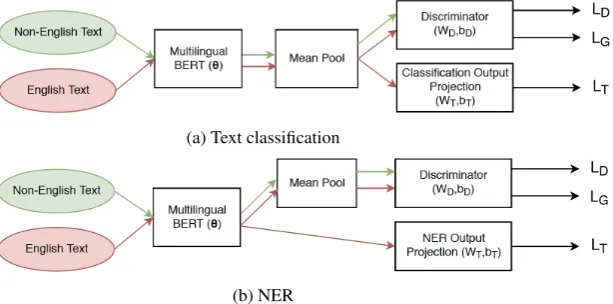
Figure 1: Overview of the adversarial training process for classification and NER. All input text is in the form of a sequence of word pieces.LD, LG, LT refer to the discriminator, generator and task-specific losses. Parameters of each component is in round brackets.
glish documents and their translations. We speculate that this alignment causes the ob-served improvement in zero-resource perfor-mance.
2 Related Work
2.1 Adversarial Learning
Language-adversarial training (Zhang et al.,2017) was proposed for generating bilingual dictionar-ies without parallel data. This idea was extended to zero-resource cross-lingual tasks in NER (Kim et al., 2017;Xie et al., 2018) and text classifica-tion (Chen et al., 2019), where we would expect that language-adversarial techniques induce fea-tures that are language-independent.
2.2 Self-training Techniques
Self-training, where an initial model is used to generate labels on an unlabeled corpus for the pur-pose of domain or cross-lingual adaptation, was studied in the context of text classification ( Haj-mohammadi et al.,2015) and parsing (McClosky et al.,2006;Zeman and Resnik,2008). A similar idea based on expectation-maximization, where the unobserved label is treated as a latent variable, has also been applied to cross-lingual text classifi-cation inRigutini et al.(2005).
2.3 Translation as Pretraining
Artetxe and Schwenk(2018) andLu et al.(2018) use the encoders from machine translation mod-els as a starting point for task-specific finetun-ing, which permits various degrees of multilingual transfer. Lample and Conneau(2019) add an ad-ditional masked translation task to the BERT
pre-training process, and the authors observed an im-provement in the cross-lingual setting over using the monolingual masked text task alone.
3 Experiments
3.1 Model Training
We present an overview of the adversarial training process in Figure1. We used the pretrained cased multilingual BERT model2as the initialization for all of our experiments. Note that the BERT model has 768 units.
We always use the labeled English data of each corpus. We use the non-English text portion (with-out the labels) for the adversarial training.
We formulate the adversarial task as a binary classification problem (i.e. English versus non-English.) We add alanguage discriminator mod-ule which uses the BERT embeddings to classify whether the input sentence was written in English or the non-English language. We also add a gener-atorloss which encourages BERT to produce em-beddings that are difficult for the discriminator to classify correctly. In this way, the BERT model learns to generate embeddings that do not contain language-specific information.
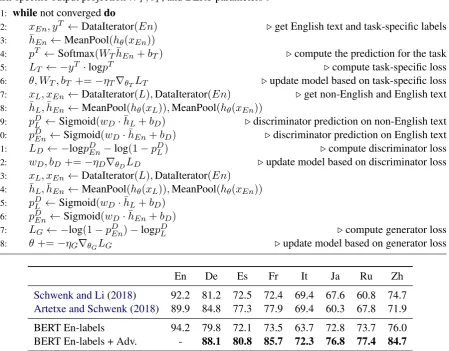
The pseudocode for our procedure can be found in Algorithm1. In the description that follows, we use a batch size of 1 for clarity.
For language-adversarial training for the classi-fication task, we have 3 loss functions: the task-specific loss LT, the generator loss LG, and the
2
discriminator lossLD:
LT(yT;x) = K
X
i=1
−yTi logp(Y =i|x)
p(Y|x) =Softmax(WT¯hθ(x) +bT)
LG(yA;x) =−(1−yA)logp(E= 1|x)
−yAlogp(E = 0|x)
LD(yA;x) =−(1−yA)logp(E= 0|x)
−yAlogp(E = 1|x)
p(E= 1|x) =Sigmoid(wD·¯hθ(x) +bD)
where K is the number of classes for the task,
p(Y|x)(dim: K ×1) is the task-specific predic-tion,p(E = 1|x)(dim: scalar) is the probability that the input is in English,¯hθ(x)(dim: 768×1)
is the mean-pooled BERT output embedding for the input word-pieces x, θ is the BERT param-eters, WT, bT, wD, bD (dim: K ×768, K ×1,
768×1, scalar) are the output projections for the task-specific loss and discriminator respectively,
yT (dim: K ×1) is the one-hot vector represen-tation for the task label andyA(dim: scalar) is the binary label for the adversarial task (i.e. 1 or 0 for English or non-English).
In the case of NER, the task-specific loss has an additional summation over the length of the se-quence:
LT(yT;x) = K
X
i=1 L
X
t=1
−yitTlogp(Yt=i|x)
p(Yt|x) =Softmax(WThθ(x)t+bT)
where p(Yt|x) (dim: K ×1) is the prediction
for thetthword,Lis the number of words in the sentence,yT (dim:K×L) is the matrix of one-hot entity labels, andhθ(x)t (dim: 768×1) refers to
the BERT embedding of thetthword.
The generator and discriminator losses remain the same for NER, and we continue to use the mean-pooled BERT embedding during adversarial training.
We then take the gradients with respect to the 3 losses and the relevant parameter subsets. The parameter subsets are θD = {wD, bD}, θT =
{θ, WT, bT}, and θG = {θ}. We apply the
gra-dient updates sequentially at a 1:1:1 ratio.
During BERT finetuning, the learning rates for the task loss, generator loss and discriminator loss were kept constant; we do not apply a learning rate decay.
All hyperparameters were tuned on the English dev sets only, and we use the Adam optimizer in all experiments. We report results based on the average of 4 training runs.
3.2 MLDoc Classification Results
(a) German test accuracy vs steps taken
[image:3.595.326.506.214.488.2](b) Japanese test accuracy vs steps taken
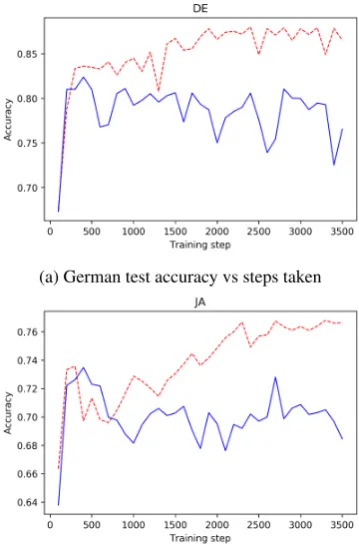
Figure 2: German and Japanese MLDoc test accuracy versus the number of training steps, with and with-out adversarial training. The solid line shows the per-formance of the non-adversarial BERT baseline. The dashed line shows the performance with adversarial training.
Algorithm 1Pseudocode for adversarial training on the multilingual text classification task. The batch size is set at 1 for clarity. The parameter subsets areθD ={wD, bD},θT ={θ, WT, bT}, andθG={θ}. Input:pre-trained BERT modelhθ, data iterators for English and the non-English languageL,
learn-ing rates ηD, ηG, ηT for each loss function, initializations for discriminator output projectionwD, bD,
task-specific output projectionWT, bT, and BERT parametersθ
1: whilenot convergeddo
2: xEn, yT ←DataIterator(En) .get English text and task-specific labels
3: h¯En←MeanPool(hθ(xEn))
4: pT ←Softmax(WT¯hEn+bT) .compute the prediction for the task
5: LT ← −yT ·logpT .compute task-specific loss
6: θ, WT, bT +=−ηT∇θTLT .update model based on task-specific loss
7: xL, xEn←DataIterator(L),DataIterator(En) .get non-English and English text
8: h¯L,h¯En←MeanPool(hθ(xL)),MeanPool(hθ(xEn))
9: pDL ←Sigmoid(wD·h¯L+bD) .discriminator prediction on non-English text
10: pDEn←Sigmoid(wD·h¯En+bD) .discriminator prediction on English text
11: LD ← −logpDEn−log(1−pDL) .compute discriminator loss
12: wD, bD +=−ηD∇θDLD .update model based on discriminator loss
13: xL, xEn←DataIterator(L),DataIterator(En)
14: h¯L,h¯En←MeanPool(hθ(xL)),MeanPool(hθ(xEn))
15: pDL ←Sigmoid(wD·h¯L+bD)
16: pDEn←Sigmoid(wD·h¯En+bD)
17: LG ← −log(1−pEnD )−logpDL .compute generator loss
18: θ+=−ηG∇θGLG .update model based on generator loss
En De Es Fr It Ja Ru Zh
Schwenk and Li(2018) 92.2 81.2 72.5 72.4 69.4 67.6 60.8 74.7
Artetxe and Schwenk(2018) 89.9 84.8 77.3 77.9 69.4 60.3 67.8 71.9
[image:4.595.78.528.128.479.2]BERT En-labels 94.2 79.8 72.1 73.5 63.7 72.8 73.7 76.0 BERT En-labels + Adv. - 88.1 80.8 85.7 72.3 76.8 77.4 84.7
Table 1: Classification accuracy on the MLDoc test sets. We present results for BERT finetuned on labeled English data and BERT finetuned on labeled English data with language-adversarial training. Our results are averaged across 4 training runs, and hyperparameters are tuned on English dev data.
We used a learning rate of2×10−6for the task loss,2×10−8for the generator loss and5×10−5 for the discriminator loss.
In Table1, we report the classification accuracy for all of the languages in MLDoc. Generally, ad-versarial training improves the accuracy across all languages, and the improvement is sometimes dra-matic versus the BERT non-adversarial baseline.
In Figure 2, we plot the zero-resource German and Japanese test set accuracy as a function of the number of steps taken, with and without adversar-ial training. The plot shows that the variation in the test accuracy is reduced with adversarial train-ing, which suggests that the cross-lingual perfor-mance is more consistent when adversarial train-ing is applied. (We note that the batch size and
learning rates are the same for all the languages in MLDoc, so the variation seen in Figure2are not affected by those factors.)
3.3 CoNLL NER Results
We finetuned BERT on the English portion of the CoNLL 2002/2003 NER corpus (Sang and De Meulder,2003). We followed the text prepro-cessing inDevlin et al.(2019).
We used a learning rate of6×10−6for the task loss,6×10−8for the generator loss and5×10−4 for the discriminator loss.
En De Es Nl
Devlin et al.(2019) 92.4 - -
-Mayhew et al.(2017) - 57.5 66.0 64.5
Ni et al.(2017) - 58.5 65.1 65.4
Chen et al.(2019) - 56.0 73.5 72.4
Xie et al.(2018) - 57.8 72.4 71.3
[image:5.595.180.417.62.190.2]BERT En-labels 91.1 68.6 75.0 77.5 BERT En-labels + Adv. - 71.9 74.3 77.6
Table 2: F1 scores on the CoNLL 2002/2003 NER test sets. We present results for BERT finetuned on labeled English data and BERT finetuned on labeled English data with language-adversarial training. Our results are averaged across 4 training runs, and hyperparameters are tuned on English dev data.
non-adversarial baseline, and the scores remained largely the same for Spanish and Dutch. Regard-less, the BERT zero-resource performance far ex-ceeds the results published in previous work.
Mayhew et al.(2017) andNi et al.(2017) do use some cross-lingual resources (like bilingual dic-tionaries) in their experiments, but it appears that BERT with multilingual pretraining performs bet-ter, even though it does not have access to cross-lingual information.
3.4 Alignment of Embeddings for Parallel Documents
Source Target Without Adv. With Adv.
En
De 0.74 0.94
Es 0.72 0.94
Fr 0.73 0.94
It 0.73 0.92
Ja 0.65 0.84
Ru 0.72 0.89
Zh 0.69 0.91
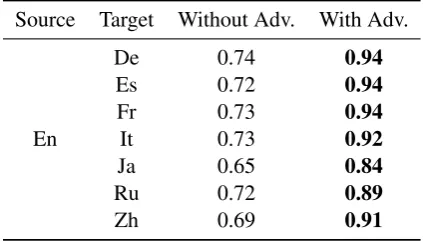
Table 3: Median cosine similarity between the mean-pooled BERT embeddings of MLDoc English documents and their translations, with and without language-adversarial training. The median cosine sim-ilarity increased with adversarial training for every lan-guage pair, which suggests that the adversarial loss en-courages BERT to learn language-independent repre-sentations.
If language-adversarial training encourages language-independent features, then the English documents and their translations should be close in the embedding space. To examine this hypothesis, we take the English documents from the MLDoc training corpus and translate them into German,
Spanish, French, etc. using Amazon Translate. We construct the embeddings for each docu-ment using BERT models finetuned on MLDoc. We mean-pool each document embedding to cre-ate a single vector per document. We then cal-culate the cosine similarity between the embed-dings for the English document and its transla-tion. In Table3, we observe that the median cosine similarity increases dramatically with adversarial training, which suggests that the embeddings be-came more language-independent.
4 Discussion
For many of the languages examined, we were able to improve on BERT’s zero-resource cross-lingual performance on the MLDoc classification and CoNLL NER tasks. Language-adversarial training was generally effective, though the size of the effect appears to depend on the task. We ob-served that adversarial training moves the embed-dings of English text and their non-English trans-lations closer together, which may explain why it improves cross-lingual performance.
Future directions include adding the language-adversarial task during BERT pre-training on the multilingual Wikipedia corpus, which may fur-ther improve zero-resource performance, and find-ing better stoppfind-ing criteria for zero-resource cross-lingual tasks besides using the English dev set.
Acknowledgments
[image:5.595.75.287.443.564.2]References
Mikel Artetxe and Holger Schwenk. 2018. Mas-sively multilingual sentence embeddings for zero-shot cross-lingual transfer and beyond. arXiv preprint arXiv:1812.10464.
Xilun Chen, Ahmed Hassan Awadallah, Hany Has-san, Wei Wang, and Claire Cardie. 2019. Multi-source cross-lingual model transfer: Learning what to share. InProceedings of the Annual Meeting of the Association for Computational Linguistics.
Alexis Conneau, Guillaume Lample, Ruty Rinott, Ad-ina Williams, Samuel R Bowman, Holger Schwenk, and Veselin Stoyanov. 2018. Xnli: Evaluating cross-lingual sentence representations. Proceedings of the Conference on Empirical Methods in Natural Lan-guage Processing.
Jacob Devlin, Ming-Wei Chang, Kenton Lee, and Kristina Toutanova. 2019. Bert: Pre-training of deep bidirectional transformers for language understand-ing. InProceedings of NAACL-HLT.
Mohammad Sadegh Hajmohammadi, Roliana Ibrahim, Ali Selamat, and Hamido Fujita. 2015. Combination of active learning and self-training for cross-lingual sentiment classification with density analysis of un-labelled samples. Information sciences, 317:67–77.
Shafiq Joty, Preslav Nakov, Llu´ıs M`arquez, and Israa Jaradat. 2017. Cross-language learning with adver-sarial neural networks: Application to community question answering. InProceedings of the Confer-ence on Computational Natural Language Learning (CoNLL).
Joo-Kyung Kim, Young-Bum Kim, Ruhi Sarikaya, and Eric Fosler-Lussier. 2017. Cross-lingual transfer learning for pos tagging without cross-lingual re-sources. InProceedings of the Conference on Em-pirical Methods in Natural Language Processing.
Guillaume Lample and Alexis Conneau. 2019. Cross-lingual language model pretraining. arXiv preprint arXiv:1901.07291.
Yichao Lu, Phillip Keung, Faisal Ladhak, Vikas Bhard-waj, Shaonan Zhang, and Jason Sun. 2018. A neural interlingua for multilingual machine translation. In Proceedings of the Conference on Machine Transla-tion (WMT).
Stephen Mayhew, Chen-Tse Tsai, and Dan Roth. 2017. Cheap translation for cross-lingual named entity recognition. In Proceedings of the Conference on Empirical Methods in Natural Language Process-ing.
David McClosky, Eugene Charniak, and Mark John-son. 2006. Effective self-training for parsing. In Proceedings of NAACL-HLT.
Jian Ni, Georgiana Dinu, and Radu Florian. 2017. Weakly supervised cross-lingual named entity
recognition via effective annotation and representa-tion projecrepresenta-tion. InProceedings of the Annual Meet-ing of the Association for Computational LMeet-inguis- Linguis-tics.
Matthew E Peters, Mark Neumann, Mohit Iyyer, Matt Gardner, Christopher Clark, Kenton Lee, and Luke Zettlemoyer. 2018. Deep contextualized word rep-resentations. InProceedings of NAACL-HLT.
Alec Radford, Jeffrey Wu, Rewon Child, David Luan, Dario Amodei, and Ilya Sutskever. 2019. Language models are unsupervised multitask learners. OpenAI Blog, 1:8.
Leonardo Rigutini, Marco Maggini, and Bing Liu. 2005. An em based training algorithm for cross-language text categorization. InProceedings of the 2005 IEEE/WIC/ACM International Conference on Web Intelligence, pages 529–535. IEEE Computer Society.
Erik F Sang and Fien De Meulder. 2003. Intro-duction to the conll-2003 shared task: Language-independent named entity recognition. In Proceed-ings of the Conference on Computational Natural Language Learning (CoNLL).
Holger Schwenk and Xian Li. 2018. A corpus for multilingual document classification in eight lan-guages. InProceedings of the Language Resources and Evaluation Conference (LREC).
Jiateng Xie, Zhilin Yang, Graham Neubig, Noah A Smith, and Jaime Carbonell. 2018. Neural cross-lingual named entity recognition with minimal re-sources. InProceedings of the Conference on Em-pirical Methods in Natural Language Processing.
Daniel Zeman and Philip Resnik. 2008. Cross-language parser adaptation between related lan-guages. In Proceedings of the IJCNLP Workshop on NLP for Less Privileged Languages.