Proceedings of the 2019 Conference on Empirical Methods in Natural Language Processing
3652
A Pilot Study for Chinese SQL Semantic Parsing
Qingkai Min , Yuefeng Shi and Yue Zhang
School of Engineering, Westlake University, China
Institute of Advanced Technology, Westlake Institute for Advanced Study
{minqingkai, shiyuefeng, zhangyue}@westlake.edu.cn
Abstract
The task of semantic parsing is highly use-ful for dialogue and question answering sys-tems. Many datasets have been proposed to map natural language text into SQL, among which the recent Spider dataset provides cross-domain samples with multiple tables and com-plex queries. We build a Spider dataset for Chinese, which is currently a low-resource language in this task area. Interesting research questions arise from the uniqueness of the lan-guage, which requires word segmentation, and also from the fact that SQL keywords and columns of DB tables are typically written in English. We compare character- and word-based encoders for a semantic parser, and dif-ferent embedding schemes. Results show that word-based semantic parser is subject to seg-mentation errors and cross-lingual word em-beddings are useful for text-to-SQL.
1 Introduction
The task of semantic parsing is highly useful for tasks such as dialogue (Chen et al.,2013;Gupta et al.,2018;Einolghozati et al.,2019) and question answering (Gildea and Jurafsky,2002;Yih et al.,
2015;Reddy et al.,2016). Among a wide range of possible semantic representations, SQL offers a standardized interface to knowledge bases across tasks (Astrova, 2009; Xu et al., 2017;Dong and Lapata,2018;Lee et al.,2011). Recently,Yu et al.
(2018b) released a manually labelled dataset for parsing natural language questions into complex SQL, which facilitates related research.
Yu et al.(2018b)’s dataset is exclusive for En-glish questions. Intuitively, the same semantic parsing task can be applied cross-lingual, since SQL is a universal semantic representation and database interface. However, for languages other than English, there can be added difficulties pars-ing into SQL. Take Chinese for example, the addi-tional challenges can be at least two-fold. First,
structures of relational databases, in particular names and column names of DB tables, are typi-cally represented in English. This adds to the chal-lenges to question-to-DB mapping. Second, the basic semantic unit for denoting columns or cells can be words, but word segmentation can be erro-neous. It is also interesting to study the influence of other linguistic characteristics of Chinese, such as zero-pronoun, on its SQL parsing.
We investigate parsing Chinese questions to SQL by creating a first dataset, and empirically evaluating a strong baseline model on the dataset. In particular, we translate the Spider (Yu et al.,
2018b) dataset into Chinese. Using the model of
Yu et al.(2018a), we compare several key model configurations.
Results show that our human-translated dataset is significantly more reliable compared to a dataset composed of machine-translated questions. In addition, the overall accuracy for Chinese SQL semantic parsing can be comparable to that for English. We found that cross-lingual word em-beddings are useful for matching Chinese ques-tions with English table columns and keywords and that language characteristics have a sig-nificant influence on parsing results. We re-lease our dataset named CSpider and code at https://github.com/taolusi/chisp.
2 Related Work
Existing datasets for semantic parsing can be clas-sified into two major categories. The first uses logic for semantic representation, including ATIS (Price, 1990; Dahl et al., 1994) and GeroQuery (Zelle and Mooney, 1996). The second and dominant category of datasets uses SQL, which includes Restaurants (Tang and Mooney, 2001;
Ad-vising (Finegan-Dollak et al., 2018) and the re-cently proposed WikiSQL (Zhong et al., 2017) and Spider (Yu et al.,2018b). One salient differ-ence between Spider and prior work is that Spider uses different databases across domains for train-ing and testtrain-ing, which can verify the generaliza-tion power of a semantic parsing model. Com-pared with WikiSQL, Spider further has multi-ple tables in each database and correspondingly more complex queries. We thus consider Spider for sourcing our dataset. Existing semantic pars-ing datasets for Chinese include a small corpus for assigning semantic roles (Sun and Jurafsky,2004) and SemEval-2016 Task 9 for Chinese semantic dependency parsing (Che et al., 2012), but these data are not related to SQL. To our knowledge, we are the first to release a Chinese SQL semantic parsing dataset.
There has been a line of work improving the model of Yu et al. (2018a) since the release of the Spider dataset (Guo et al.,2019;Bogin et al.,
2019;Lin et al.,2019). At the time of our inves-tigation, however, the models are not published. We thus chose the model ofYu et al. (2018a) as our baseline. The choice of more different neural models is orthogonal to our dataset contribution, but can empirically give more insights about the conclusions.
3 Dataset
We translate all English questions in the Spider dataset into Chinese.1 The work is undertaken by 2 NLP researchers and 1 computer science stu-dent. Each question is first translated by one an-notator, and then cross-checked and corrected by a second annotator. Finally, a third annotator ver-ifies the original and corrected versions. Statistics of the dataset are shown in Table1. There are orig-inally 10181 questions from Spider, but only 9691 for the training and development sets are publicly available. We thus translated these sentences only. Following the database split setting of Yu et al.
(2018b), we make training, development and test sets split in a way that no database overlaps in them as shown in Table1.
The translation work is performed on a database to database basis. For each database, the same translator translates relevant inquiries sentence by
1Note that we do not translate the database schema (i.e.,
column names) into Chinese because in practice databases have English schema and Chinese contents in the industry.
# Q # SQL # DB # Table/DB
English all 10181 5693 200 5.1
Chinese
all 9691 5263 166 5.28
train 6831 3493 99 5.38
dev 954 589 25 4.16
[image:2.595.312.524.185.318.2]test 1906 1193 42 5.69
Table 1: Comparisons between Spider and Chinese Spider datasets.
SQL Tokens
Stack
History Question
LSTM Encoder
characters or words
Relavant Information (KW or COL or NONE)
activate
Pop Push
LSTM Encoder
Attention Attention
Current SQL Tokens
Predicted SQL Tokens
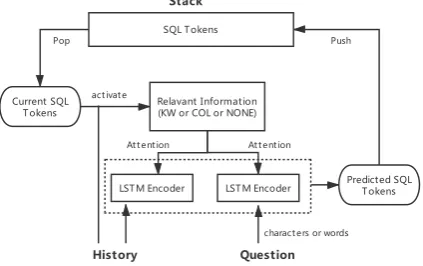
Figure 1: Overall structure of the Model.
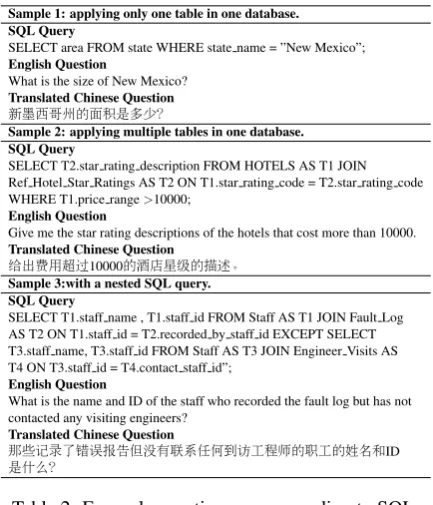
sentence. The translator is asked to read the origi-nal question as well as the SQL query before mak-ing its Chinese translation. If the literal trans-lation is possible, the translator is asked to stick to the original sentence style as much as feasible. For complex questions, the translator is allowed to rephrase the English question, so that the most nat-ural Chinese translation is made. In addition, we keep the diversity of style in the English dataset by matching different English expressions to different Chinese expressions. A sample of our dataset is shown in Table2. Our dataset is named CSpider.
4 Model
Sample 1: applying only one table in one database. SQL Query
SELECT area FROM state WHERE state name = ”New Mexico”;
English Question
What is the size of New Mexico?
Translated Chinese Question
新墨西哥州的面积是多少?
Sample 2: applying multiple tables in one database. SQL Query
SELECT T2.star rating description FROM HOTELS AS T1 JOIN Ref Hotel Star Ratings AS T2 ON T1.star rating code = T2.star rating code WHERE T1.price range>10000;
English Question
Give me the star rating descriptions of the hotels that cost more than 10000.
Translated Chinese Question
给出费用超过10000的酒店星级的描述。
Sample 3:with a nested SQL query. SQL Query
SELECT T1.staff name , T1.staff id FROM Staff AS T1 JOIN Fault Log AS T2 ON T1.staff id = T2.recorded by staff id EXCEPT SELECT T3.staff name, T3.staff id FROM Staff AS T3 JOIN Engineer Visits AS T4 ON T3.staff id = T4.contact staff id”;
English Question
What is the name and ID of the staff who recorded the fault log but has not contacted any visiting engineers?
Translated Chinese Question
那些记录了错误报告但没有联系任何到访工程师的职工的姓名和ID
[image:3.595.73.290.60.313.2]是什么?
Table 2: Example questions corresponding to SQL.
the whole output history is leveraged as a feature for deciding the next term. This method gives the current released state-of-the-art results while sub-mitting this paper. We provide a visualization of the model in Figure1.
5 Experiments
We focus on comparing different word segmenta-tion methods and different embedding representa-tions. As discussed above, column names are se-lected by attention over column embeddings using sentence representation as a key. Hence there must be a link between the embeddings of columns and those of the questions. Since columns are written in English and questions in Chinese, we consider two embedding methods. The first method is to use two separate sets of embeddings for Chinese and English, respectively. We use Glove ( Pen-nington et al.,2014)2 for embeddings of English keywords, column names etc., and Tencent em-beddings (Song et al., 2018)3 for Chinese. The second method is to directly use the cross-lingual word embeddings. To this end, the Tencent multi-lingual embeddings are chosen, which contain both Chinese and English words in a multi-lingual embedding matrix.
Evaluation Metrics. We follow Yu et al.
(2018b), evaluating the results using two major
2
https://nlp.stanford.edu/projects/glove/
3https://ai.tencent.com/ailab/nlp/embedding.html
types of metrics. The first is exact matching accu-racy, namely the percentage of questions that have exactly the same SQL output as its reference. The second is component matching F1, namely the F1 scores for SELECT, WHERE, GROUP BY, ORDER BYand all keywords, respectively.
Hyperparameters. Our hyperparameters are mostly taken from Yu et al. (2018a), but tuned on the Chinese Spider development set. We use character and word embeddings from Tencent em-bedding; both of them are not fine-tuned during model training. Embedding sizes are set to 200 for both characters and words. For the different choices of keywords and column names embed-dings, sizes are set to 200 and 300, respectively. Adam (Kingma and Ba, 2014) is used for opti-mization, with a learning rate of 1e-4. Dropout is used for the output of LSTM with a rate of 0.5.
For word-based models, segmentation is neces-sary. We take two segmentors with different per-formances, including the Jieba segmentor and the model ofYang et al.(2017), which we name Jieba and YZ, respectively. To verify their accuracy, we manually segment the first 100 sentences from the test set. Jieba and YZ give F1 scores of 89.8% and 91.7%, respectively.
5.1 Overall Results
The overall exact matching results are shown in Table 3. In this table, ENG represents the re-sults of Yu et al. (2018a)’s model on their En-glish dataset but under our split. HT and MT de-note human translation and machine translation of questions, respectively. Both HT and MT results are evaluated on human translated questions. C-ML and C-S denote the results of our Chinese models based on characters with multi-lingual em-beddings and monolingual emem-beddings, respec-tively, while WY-ML, WY-S denote the word-based models applying YZ segmentor with multi-lingual embeddings and monomulti-lingual embeddings, respectively. Finally, WJ-ML and WJ-S denote the word model with multi-lingual embeddings and monolingual embeddings with the Jieba segmen-tor, respectively.
Easy Medium Hard Extra Hard All ENG 31.8% 11.3% 9.5% 2.7% 14.1%
HT
C-ML 27.3% 9.9% 7.5% 2.3% 12.1% C-S 23.1% 7.7% 6.2% 1.7% 9.9% WY-ML 21.4% 8.1% 8.0% 1.7% 10.0%
WY-S 20.2% 6.4% 6.7% 2.0% 8.9% WJ-ML 19.8% 8.6% 5.0% 1.3% 9.2% WJ-S 20.1% 5.0% 5.7% 1.7% 8.2%
[image:4.595.73.290.61.160.2]MT C-ML 18.1% 4.6% 5.2% 0.3% 7.9% WY-ML 17.9% 4.7% 4.5% 0.3% 7.6%
Table 3: Accuracy of Exact Matching on test set.
sentences, 42 have translation mistakes such as se-mantic changes (28 sentences) and grammar errors (14 sentences). Both of these facts indicate that data by machine-translation is not reliable for se-mantic parsing research.
Second, comparisons among C-ML, WY-ML and WJ-ML, and among C-S, WY-S and WJ-S show that multi-lingual embeddings give supe-rior results compared to monolingual embeddings, which is likely because they bring a better con-nection between natural language questions and database columns.
Third, comparisons between WY-ML and WJ-ML, and WY-S and WJ-S indicate that better seg-mentation accuracy has a significant influence on question parsing. Word-based methods are subject to segmentation errors.
Moreover, with the current segmentation ac-curacy of 92%, a word-based model underper-forms a character-based model. Intuitively, since words carry more direct semantic information as compared with database columns and keywords, improved segmentation may allow a word-based model to outperform a character-based model.
Finally, for easy questions, the character-based model shows strong advantages over the word-based models. However, for medium to extremely hard questions, the trend becomes less obvious, which is likely because the intrinsic semantic com-plexity overwhelms the encoding differences.
Our best Chinese system gives an overall accu-racy of 12.1%, 4 which is less but comparable to the English results. This shows that Chinese se-mantic parsing may not be significantly more chal-lenging compared to English with text to SQL.
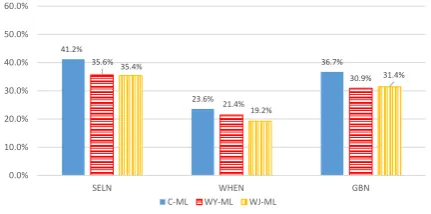
Component matching. Figure 2 shows F1 scores of several typical components, including
SELN (SELECT NO AGGREGATOR), WHEN
4Note that the results are lower than those reported byYu
et al.(2018a) under their split due to different training/test splits. Our split has less training data and more test instances in the “Hard” category and less in “Easy” and “Medium”.
41.2%
23.6%
36.7% 35.6%
21.4%
30.9% 35.4%
19.2%
31.4%
0.0% 10.0% 20.0% 30.0% 40.0% 50.0% 60.0%
SELN WHEN GBN C-ML WY-ML WJ-ML
Figure 2: Component Matching Comparisons.
(WHERE NO OPERATOR) and GBN (GROUP
BY NO HAVING), applying the superior multi-lingual embeddings. The trends are consistent with the overall results.
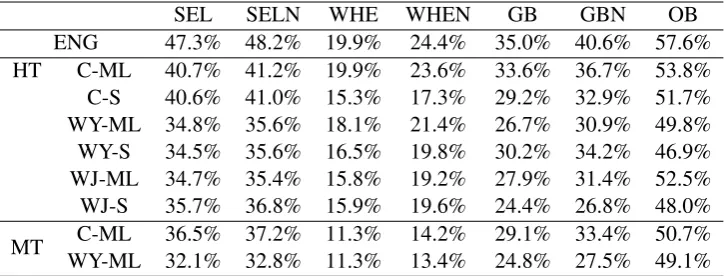
The detailed results are shown in Table 4. Specifically, the char-based methods achieve around 41% on SELN and SEL (SELECT), which are about 5% higher compared to the word-based methods. This result may be due to the fact that word-based models are sensitive to the OOV words (Zhang and Yang, 2018; Li et al., 2019). Unlike other components, SEL and SELN are con-fronted with more severe OOV challenges caused by recognizing the unseen schema during testing.
In addition, the models using multi-lingual embedding overperform the models using sepa-rate embeddings on both WHEN and OB (OR-DERBY), which further demonstrates that embed-dings in the same dimension distribution benefit to strengthen the connection between the question and the schema.
Contrary to the overall result, the models em-ploying the jieba segmentor perform better than those using the YZ segmentor on OB. The reason is that the jieba segmentor has different word seg-mentation results in terms of the superlative of ad-jectives. For example, the word “最高” (the high-est) is segmented as “最”(most) and “高”(high) by YZ segmentor but “最高” in jieba segmentor. This again demonstrates the influence of word segmen-tation. Finally, for GB (GROUPBY) there is not a regular contrast pattern between different models, which can be likely because of the lack of suffi-cient training data.
5.2 Case study
[image:4.595.308.524.65.172.2]SEL SELN WHE WHEN GB GBN OB ENG 47.3% 48.2% 19.9% 24.4% 35.0% 40.6% 57.6% HT C-ML 40.7% 41.2% 19.9% 23.6% 33.6% 36.7% 53.8% C-S 40.6% 41.0% 15.3% 17.3% 29.2% 32.9% 51.7% WY-ML 34.8% 35.6% 18.1% 21.4% 26.7% 30.9% 49.8% WY-S 34.5% 35.6% 16.5% 19.8% 30.2% 34.2% 46.9% WJ-ML 34.7% 35.4% 15.8% 19.2% 27.9% 31.4% 52.5% WJ-S 35.7% 36.8% 15.9% 19.6% 24.4% 26.8% 48.0%
[image:5.595.118.482.62.200.2]MT C-ML 36.5% 37.2% 11.3% 14.2% 29.1% 33.4% 50.7% WY-ML 32.1% 32.8% 11.3% 13.4% 24.8% 27.5% 49.1%
Table 4: F1 scores of Component Matching on test set.
Word segmentation error Predicted query 哪些 商店 的 产品 数量 高于 平
均 水平 ? 把 店 名 给 我 。 Which shops' number products is above the average? Give me the shop names.
SELECT Manager_name FROM shop WHERE Number_products > (SELECT AVG(Number_products) FROM shop)
哪些 商店 的 产品 数量 高于 平均 水平 ? 把 店名 给 我 。 Which shops' number products is above the average? Give me the shop names.
SELECT name FROM shop WHERE Number_products > (SELECT AVG(Number_products) FROM shop)
Figure 3: Word segmentation error.
character “店” (shop) can typically be associated with “店长” (shop manager).
Figure 4 shows the sensitivity of our model to sentence patterns. In particular, the word-based model gives incorrect predictions for many question sentences frequently. As shown in the first row, the word “where” confuses the sys-tem for making a choice between “ORDER BY” and “GROUP BY”. When we manually change the sentence pattern into “List the most com-mon hometown of teachers”, the parser gives the correct keyword. In contrast, the character-based model is less sensitive to question sentences, which is likely because characters are less sparse compared with words. More training data or con-textualized embeddings may alleviate the issue for the word-based method, which we leave for future work.
Figure 5 shows the sensitivity of the model to Chinese linguistic patterns. In particular, the first sentence has a zero pronoun “各党的” (in each party), which is omitted later. As a result, a seman-tic parser cannot tell the correct database columns from the sentence. We manually add the correct entity for the zero pronoun, resulting in the second sentence. The parser can correctly identify both the column name and the table name for this cor-rected sentence. Since zero-pronouns are frequent
Sentence patterns Predicted query 最 常 见 的 教师 的 家乡 是 哪里 ?
What is the most common hometowns for teachers?
SELECT Hometown FROM teacher ORDER BY Age DESC LIMIT 1
列出 最 常 见 的 教师 的 家乡 。 List the most common hometown of teachers.
SELECT Hometown FROM teacher GROUP BY Hometown ORDER BY COUNT(*) DESC LIMIT 1
Figure 4: Sentence pattern.
Chinese zero pronoun Predicted query 代表 的 不同 党派 是 什么 ? 显示
各 党 的 党名 和 代表 人数 。 What are the different parties of representative? Show the party name and the number of representatives.
SELECT Date , COUNT(*) FROM election GROUP BY Seats
代表 的 不同 党派 是 什么 ? 显示 各 党 的 党名 和 各 党 的 代表 人数 。 What are the different parties of representative? Show the party name and the number of representatives in each party.
[image:5.595.305.525.254.481.2]SELECT Party , COUNT(*) FROM representative GROUP BY Party
Figure 5: Chinese zero pronoun.
for Chinese (Chen and Ng,2016), they give added difficulty for its semantic parsing.
6 Conclusion
We constructed a first resource named CSpider for Chinese sentence to SQL, evaluating the perfor-mance of a strong English model on this dataset. Results show that the input representation, embed-ding forms and linguistic factors all have the influ-ence on the Chinese-specific task. Our dataset can serve as a starting point for further research on this task, which can be beneficial to the investigation of Chinese QA and dialogue models.
Acknowledgments
References
Irina Astrova. 2009. Rules for mapping sql relational databases to owl ontologies. Metadata and Seman-tics, pages 415–424.
Ben Bogin, Jonathan Berant, and Matt Gardner. 2019. Representing schema structure with graph neural networks for text-to-SQL parsing. InProceedings of the 57th Annual Meeting of the Association for Com-putational Linguistics, pages 4560–4565, Florence, Italy. Association for Computational Linguistics.
Wanxiang Che, Meishan Zhang, Yanqiu Shao, and Ting Liu. 2012. Semeval-2012 task 5: Chinese semantic dependency parsing. In Proceedings of the First Joint Conference on Lexical and Computa-tional Semantics-Volume 1: Proceedings of the main conference and the shared task, and Volume 2: Pro-ceedings of the Sixth International Workshop on Se-mantic Evaluation, pages 378–384. Association for Computational Linguistics.
Chen Chen and Vincent Ng. 2016. Chinese zero pro-noun resolution with deep neural networks. In Pro-ceedings of the 54th Annual Meeting of the Associa-tion for ComputaAssocia-tional Linguistics (Volume 1: Long Papers), volume 1, pages 778–788.
Yun-Nung Chen, William Yang Wang, and Alexander I Rudnicky. 2013. Unsupervised induction and filling of semantic slots for spoken dialogue systems using frame-semantic parsing. In2013 IEEE Workshop on Automatic Speech Recognition and Understanding, pages 120–125. IEEE.
Deborah A Dahl, Madeleine Bates, Michael Brown, William Fisher, Kate Hunicke-Smith, David Pallett, Christine Pao, Alexander Rudnicky, and Elizabeth Shriberg. 1994. Expanding the scope of the atis task: The atis-3 corpus. InProceedings of the workshop on Human Language Technology, pages 43–48. As-sociation for Computational Linguistics.
Li Dong and Mirella Lapata. 2018. Coarse-to-fine de-coding for neural semantic parsing. In Proceed-ings of the 56th Annual Meeting of the Association for Computational Linguistics (Volume 1: Long Pa-pers), pages 731–742.
Arash Einolghozati, Panupong Pasupat, Sonal Gupta, Rushin Shah, Mrinal Mohit, Mike Lewis, and Luke Zettlemoyer. 2019. Improving semantic parsing for task oriented dialog. arXiv preprint arXiv:1902.06000.
Catherine Finegan-Dollak, Jonathan K Kummerfeld, Li Zhang, Karthik Ramanathan, Sesh Sadasivam, Rui Zhang, and Dragomir Radev. 2018. Improv-ing text-to-sql evaluation methodology. In Proceed-ings of the 56th Annual Meeting of the Association for Computational Linguistics (Volume 1: Long Pa-pers), pages 351–360.
Daniel Gildea and Daniel Jurafsky. 2002. Automatic labeling of semantic roles. Computational linguis-tics, 28(3):245–288.
Jiaqi Guo, Zecheng Zhan, Yan Gao, Yan Xiao, Jian-Guang Lou, Ting Liu, and Dongmei Zhang. 2019. Towards complex text-to-SQL in cross-domain database with intermediate representation. In Proceedings of the 57th Annual Meeting of the Association for Computational Linguistics, pages 4524–4535, Florence, Italy. Association for Compu-tational Linguistics.
Sonal Gupta, Rushin Shah, Mrinal Mohit, Anuj Ku-mar, and Mike Lewis. 2018. Semantic parsing for task oriented dialog using hierarchical representa-tions. In Proceedings of the 2018 Conference on Empirical Methods in Natural Language Processing (EMNLP), pages 2787–2792.
Srinivasan Iyer, Ioannis Konstas, Alvin Cheung, Jayant Krishnamurthy, and Luke Zettlemoyer. 2017. Learning a neural semantic parser from user feed-back. InProceedings of the 55th Annual Meeting of the Association for Computational Linguistics (Vol-ume 1: Long Papers), pages 963–973.
Diederik Kingma and Jimmy Ba. 2014. Adam: A method for stochastic optimization. International Conference on Learning Representations.
Rubao Lee, Tian Luo, Yin Huai, Fusheng Wang, Yongqiang He, and Xiaodong Zhang. 2011. Ys-mart: Yet another sql-to-mapreduce translator. In 2011 31st International Conference on Distributed Computing Systems, pages 25–36. IEEE.
Xiaoya Li, Yuxian Meng, Xiaofei Sun, Qinghong Han, Arianna Yuan, and Jiwei Li. 2019. Is word segmen-tation necessary for deep learning of chinese rep-resentations? In Proceedings of the 57th Confer-ence of the Association for Computational Linguis-tics, pages 3242–3252.
Kevin Lin, Ben Bogin, Mark Neumann, Jonathan Berant, and Matt Gardner. 2019. Grammar-based neural text-to-sql generation. arXiv preprint arXiv:1905.13326.
Jeffrey Pennington, Richard Socher, and Christopher Manning. 2014. Glove: Global vectors for word representation. InProceedings of the 2014 confer-ence on empirical methods in natural language pro-cessing (EMNLP), pages 1532–1543.
Ana-Maria Popescu, Oren Etzioni, and Henry Kautz. 2003. Towards a theory of natural language inter-faces to databases. In Proceedings of the 8th in-ternational conference on Intelligent user interfaces, pages 149–157. ACM.
Patti J Price. 1990. Evaluation of spoken language sys-tems: The atis domain. InSpeech and Natural Lan-guage: Proceedings of a Workshop Held at Hidden Valley, Pennsylvania, June 24-27, 1990.
Transactions of the Association for Computational Linguistics, 4:127–140.
Yan Song, Shuming Shi, Jing Li, and Haisong Zhang. 2018. Directional skip-gram: Explicitly distinguish-ing left and right context for word embedddistinguish-ings. In Proceedings of the 2018 Conference of the North American Chapter of the Association for Computa-tional Linguistics: Human Language Technologies, Volume 2 (Short Papers), volume 2, pages 175–180.
Honglin Sun and Daniel Jurafsky. 2004. Shallow se-mantc parsing of chinese. InProceedings of the Hu-man Language Technology Conference of the North American Chapter of the Association for Computa-tional Linguistics: HLT-NAACL 2004.
Lappoon R Tang and Raymond J Mooney. 2001. Us-ing multiple clause constructors in inductive logic programming for semantic parsing. In European Conference on Machine Learning, pages 466–477. Springer.
Xiaojun Xu, Chang Liu, and Dawn Song. 2017. Sqlnet: Generating structured queries from natural language without reinforcement learning. arXiv preprint arXiv:1711.04436.
Navid Yaghmazadeh, Yuepeng Wang, Isil Dillig, and Thomas Dillig. 2017. Sqlizer: query synthesis from natural language. Proceedings of the ACM on Pro-gramming Languages, 1(OOPSLA):63.
Jie Yang, Yue Zhang, and Fei Dong. 2017. Neural word segmentation with rich pretraining. In Pro-ceedings of the 55th Annual Meeting of the Associa-tion for ComputaAssocia-tional Linguistics (Volume 1: Long Papers), pages 839–849.
Wen-tau Yih, Ming-Wei Chang, Xiaodong He, and Jianfeng Gao. 2015. Semantic parsing via staged query graph generation: Question answering with knowledge base. InProceedings of the 53rd Annual Meeting of the Association for Computational Lin-guistics and the 7th International Joint Conference on Natural Language Processing (Volume 1: Long Papers), volume 1, pages 1321–1331.
Tao Yu, Michihiro Yasunaga, Kai Yang, Rui Zhang, Dongxu Wang, Zifan Li, and Dragomir Radev. 2018a. Syntaxsqlnet: Syntax tree networks for com-plex and cross-domain text-to-sql task. In Proceed-ings of the 2018 Conference on Empirical Methods in Natural Language Processing, pages 1653–1663.
Tao Yu, Rui Zhang, Kai Yang, Michihiro Yasunaga, Dongxu Wang, Zifan Li, James Ma, Irene Li, Qingn-ing Yao, Shanelle Roman, et al. 2018b. Spider: A large-scale human-labeled dataset for complex and cross-domain semantic parsing and text-to-sql task. In Proceedings of the 2018 Conference on Empiri-cal Methods in Natural Language Processing, pages 3911–3921.
John M Zelle and Raymond J Mooney. 1996. Learn-ing to parse database queries usLearn-ing inductive logic programming. In Proceedings of the national con-ference on artificial intelligence, pages 1050–1055.
Yue Zhang and Jie Yang. 2018. Chinese ner using lat-tice lstm. InProceedings of the 56th Annual Meet-ing of the Association for Computational LMeet-inguistics (Volume 1: Long Papers), pages 1554–1564.