Proceedings of the 2019 Conference on Empirical Methods in Natural Language Processing
1803
Towards Knowledge-Based Recommender Dialog System
Qibin Chen1, Junyang Lin2, Yichang Zhang2, Ming Ding1, Yukuo Cen1, Hongxia Yang2, Jie Tang1 1Department of Computer Science and Technology, Tsinghua University
2DAMO Academy, Alibaba Group
{cqb19,dm18,cyk18}@mails.tsinghua.edu.cn
{junyang.ljy,yichang.zyc,yang.yhx}@alibaba-inc.com
Abstract
In this paper, we propose a novel end-to-end framework called KBRD, which stands for Knowledge-Based Recommender Dialog System. It integrates the recommender sys-tem and the dialog generation syssys-tem. The dialog system can enhance the performance of the recommendation system by introducing knowledge-grounded information about users’ preferences, and the recommender system can improve that of the dialog generation system by providing recommendation-aware vocabu-lary bias. Experimental results demonstrate that our proposed model has significant advan-tages over the baselines in both the evaluation of dialog generation and recommendation. A series of analyses show that the two systems can bring mutual benefits to each other, and the introduced knowledge contributes to both their performances.1
1 Introduction
Dialog in e-commerce has great commercial po-tential. In conventional recommender systems, personalized recommendation is highly based on the previous actions of users, including searching, clicking and purchasing. These actions can be re-garded as users’ feedbacks that reflect users’ in-terest. However, due to its implicitness, such feed-back can only reflect a part of users’ interest, caus-ing inaccuracy in recommendation. Another infor-mation source about user preferences is the dialog between users and services. In such dialog, users often provide more information about their pref-erences. They often ask for tips or recommenda-tion in the dialog. In this process, services can guide them to speak out their interests in order to solve users’ problems and meet their require-ments. Compared with the implicit feedback, the
1Code will be available at https://github.com/ qibinc/KBRD.
USER: Hello!
RECOMMENDER: What kind of movies do you like?
USER: I am looking for a movie recom-mendation. When I was younger I really enjoyed theA Nightmare on Elm Street (1984).
BASELINE: Have you seenIt (2017)?
OURS: I like horror movies too! Have your seenHalloween (1978)?
HUMAN: Oh, you like scary movies? I recently watched Happy Death Day (2017).
Table 1:An example of the outputs of recommender dialog systems. The model recommends items (italic) while maintaining the dialog with the user. Compared with the baseline, our dialog system gives a more di-verse and consistent response.
feedback from the dialog is more explicit and more related to users’ preferences. Therefore, a recom-mender dialog system possesses high commercial potential.
A recommender dialog system can be regarded as a combination of a recommender system and a dialog system. A dialog system should re-spond to users’ utterances with informative natu-ral language expressions, and a recommender sys-tem should provide high-quality recommendation based on the content of users’ utterances. We demonstrate an example in Table1. In brief, a rec-ommender dialog system should perform well in both tasks.
qual-ity of recommendation. Besides, the incorporation of external knowledge can strengthen the connec-tions between systems and enhance their perfor-mances. Therefore, driven by the motivations, we propose a novel end-to-end framework that inte-grates the two systems. We name itKBRD, stand-ing for Knowledge-Based Recommender Dialog System.
Specifically, the dialog generation system pro-vides contextual information about items to the recommender system. For instance, for a movie recommendation system, contextual information can be director, actor/actress and genre. Thus, even with no item mentioned in the dialog, the rec-ommender system can still perform high-quality recommendation based on the contextual informa-tion. In return, the recommender system provides recommendation information to promote the di-alog, such as recommendation-aware vocabulary bias. Furthermore, we incorporate external knowl-edge into our framework. The knowlknowl-edge graph helps bridge the gap between systems and en-hances both their performances.
We conduct a series of experiments that demon-strate the effects of our framework in both the eval-uation of recommendation and dialog generation. Moreover, the analyses show that dialog informa-tion effectively tackles the cold-start problem in recommendation, and the recommendation-aware vocabulary bias from the recommender system im-proves the quality of generated dialogs. Also, the biased words can be parts of reasons to explain the system’s decisions for recommendation.
2 Preliminary
Before we introduce our proposed framework, we provide an illustration of the basic framework of the recommender dialog system to show how the recommendation system and the dialog system are organized for end-to-end training.
2.1 Recommender System
Provided with a user’s information, a recom-mender system is aimed at retrieving a subset of items that meet the user’s interest from all the items. In a cold-start setting, the recommender system initially has no knowledge about the user. With the progress of the dialog, the recommender system accumulates user’s information and builds a user profile. Thus, it can provide reasonable recommendation based on the user preferences
re-flected in the conversation.
To implement an effective recommender system in this task, it is available to build a recommender system based on conventional collaborative filter-ing algorithms (Sarwar et al., 2001) or based on neural networks (He et al., 2017). For example, Li et al. (2018) applies a user-based autoencoder (Sedhain et al., 2015) to recommend new items based on previously mentioned items in the dia-log.
2.2 Dialog System
The dialog system in the basic framework is in charge of generating multi-turn dialog with a natural language generation model. The pi-oneering work (Li et al., 2018) on conversa-tional recommendation task adopted Hierarchi-cal Recurrent Encoder Decoder (HRED) (Sordoni et al., 2015b,a; Serban et al., 2016) for this part. The HRED is an encoder-decoder framework for sequence-to-sequence learning (Sutskever et al., 2014). In the framework, an encoder receives the dialog history as input and encodes it to high-level representation, while a decoder generates re-sponses based on the encoded representation. By recursively encoding and decoding the previous information, the system makes utterances in the multi-turn dialog.
2.3 End-to-End System
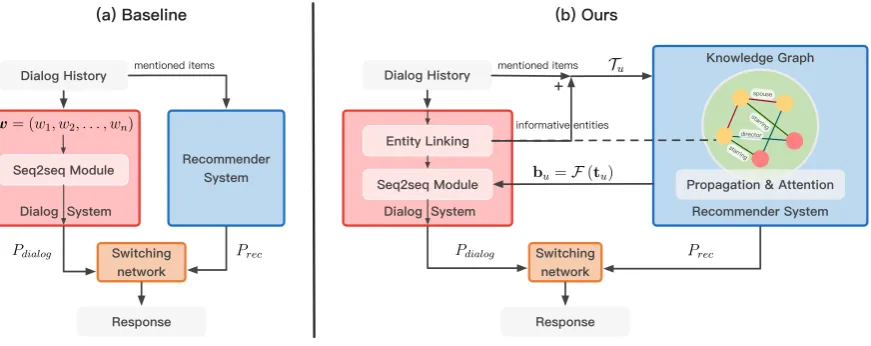
In order to perform end-to-end training, we demonstrate the combination of the recommender system and conversation system. Specifically, the input of the recommender system is constructed based on the dialog history, which is a represen-tation of mentioned items in the dialog. The out-put of the recommender systemPrec, which is a
probability distribution over the item set, can be combined with the output of the dialog system
Pdialog ∈ R|V|, where V refers to the
vocabu-lary. A switching mechanism (Gulcehre et al., 2016) controls the decoder to decide whether it should generate a word from the vocabulary or an item from the recommender output at a certain timestep.
P(w) =psPdialog(w) + (1−ps)Prec(w) (1)
ps=σ(wso+bs) (2)
Figure 1:Comparative illustration on modules of the existing baseline framework and our proposed KBRD framework.(a) The connection between the recommender system and the dialog system in the baseline framework is weak. The dialog system takes the plain text of the dialog history as input and the recommender only considers mentioned items in the dialog. (b) Our framework enables interaction between the two systems. First, informative entities are linked to an external knowledge graph and sent to the recommender besides items. They are propagated on the KG via a relational graph convolutional network, enriching the representation of user interest. Second, the knowledge-enhanced user representation is sent back to the dialog system in the form of vocabulary bias, enabling it to generate responses that are consistent with the user’s interest.
system. ws ∈ Rd andbs ∈ Rare the switcher’s
parameters and σ refers to the sigmoid function. Therefore, the whole system can be trained in an end-to-end fashion.
3 Proposed Model
In this section, we introduce our proposed frame-workKBRDthat integrates the recommender sys-tem and the dialog syssys-tem effectively via knowl-edge propagation. We show how knowlknowl-edge con-nects the two systems and how they bring mutual benefits to each other.
3.1 Dialog-Aware Recommendation with
Knowledge
Recommendation of the basic framework is solely based on the mentioned items in the dialog his-tory. Such recommendation ignores contextual in-formation in dialog that often indicates users’ pref-erences.
Here we propose to make use of the dialog con-tents, including the non-item information, in the process of recommendation. Furthermore, to ef-fectively recommend items from the non-item in-formation, we introduce an external knowledge graph from DBpedia (Lehmann et al.,2015) to our system. The knowledge can build a connection be-tween dialog contents and items.
Incorporating Dialog Contents Specifically,
we have a knowledge graphGconsisting of triples (h, r, t) where h, t ∈ E and r ∈ R. E and R denote the sets of entities and relations in the knowledge graph. We first match each item in the item set to entities in E by name.2 We then per-form entity linking (Daiber et al., 2013) on dia-log contents and thus informative non-item enti-ties appearing in dialog contents are matched to E.3 Therefore, we can represent a user as T
u =
e1, e2,· · · , e|Tu| , where ei ∈ E. To be more
specific, it is a set of mentioned items plus non-item entities extracted from the dialog contents, linked to the knowledge graph.
Relational Graph Propagation Inspired by
Schlichtkrull et al. (2018), we apply Relational Graph Convolutional Networks (R-GCNs) to en-code structural and relational information in the knowledge graph to entity hidden representations. An intuition behind this is that neighboring nodes in knowledge graph may share similar features that are useful for recommendation. For
exam-2For example, a movie item “star wars” is matched
to http://dbpedia.org/resource/Star_Wars_ (film)in the dbpedia knowledge graph.
3Utterance “I like science fiction movies.” is
ple, when a user speaks of his/her preference on an actor/actress, the recommender should provide movies that have a close connection to that per-son. In addition, by taking different relations into consideration, the system models different types of neighbors more accurately.
Formally, at layer 0, we have a trainable em-bedding matrix H(0) ∈ R|E|×d(0)
for nodes (i.e., entities) on the knowledge graph. Then, for each nodevinE at layerl, we compute:
h(vl+1) =σ
X
r∈R
X
w∈Nr v
1
cv,r
Wr(l)h(wl)+W0(l)h(vl)
whereh(vl) ∈Rd
(l)
denotes the hidden representa-tion of nodevat thel-th layer of the graph neural network, andd(l)denotes the dimensionality of the representation at the layer. Nr
v denotes the set of
neighbor indices of nodevunder relationr ∈ R.
Wrlis a learnable relation-specific transformation matrix for vectors from neighboring nodes with re-lation r. W0l is a learnable matrix for transform-ing the nodes’ representation at the current layer.
cv,r is a normalization constant that can either be
learned or chosen in advance (e.g.,cv,r=|Nvr|).
For each node on the graph, it receives and ag-gregates the messages from its neighboring nodes after relation-specific transformation. Then it combines the information with its hidden repre-sentation to form its updated reprerepre-sentation at the next layer.
Finally, at the last layerL, structural and rela-tional information is encoded into the entity rep-resentation h(vL) for eachv ∈ E. We denote the
resulting knowledge-enhanced hidden representa-tion matrix for entities inE asH(L) ∈ R|E|×d(L)
. We omit the(L) in the following paragraphs for simplicity.
Entity Attention The next step is to recommend
items to users based on knowledge-enhanced en-tity representations. While an item corresponds to an entity on the knowledge graph, a user may have interacted with multiple entities. GivenTu, we first look up the knowledge-enhanced repre-sentation of entities inTufromH, and we have:
Hu = (h1, h2,· · · , h|Tu|) (3)
where hi ∈ Rd is the hidden vector of entity ei.
Here our objective is to encode this vector set of variable size to a vector of fixed size so that
we can compute the similarity between user and item. Instead of simply averaging these vectors, we choose a linear combination of the |Tu|
vec-tors. Specifically, we apply self-attention mecha-nism (Lin et al.,2017) that takesHuas input and
outputs a distributionαuover|Tu|vectors:
αu = softmax wa2tanh Wa1HTu
(4)
whereWa1 ∈ Rda×dis a weight matrix and wa2
is a vector of parameters with size da. The final
representation of useruis computed as follows:
tu =αuHu (5)
This enables the recommender system to con-sider the importance of different items and non-item entities in the dialog. Finally, the output of our recommender is computed as follows:
Prec= softmax(mask(tuHT)) (6)
wheremaskis an operation that sets the score of non-item entities to−∞. The masking operation ensures that the recommendations are all items.
3.2 Recommendation-Aware Dialog
Instead of applying HRED, we introduce the Transformer framework to the dialog system in this task. Transformer (Vaswani et al.,2017) can reach significantly better performances in many tasks, such as machine translation (Vaswani et al., 2017;Ott et al., 2018), question answering ( Ra-jpurkar et al.,2016;Yang et al.,2018;Ding et al., 2019) and natural language generation (Liu et al., 2018;Chen et al., 2019). In our preliminary ex-periments, we have found that Transformer can also achieve better performance than HRED in this task, and thus we apply this framework to the dia-log system.
The Transformer is also an encoder-decoder framework for sequence-to-sequence learning. The Transformer encoder consists of an embed-ding layer and multiple encoder layers. Each encoder layer has a self-attention module and a Point-Wise Feed-Forward Network (FFN). The encoder encodes the dialog history x = (x1, x2, . . . , xn)to high-level representationss=
(s1, s2, . . . , sn). Similarly, the Transformer
attention to extract information from the source-side context. The decoder generates a representa-tionoat each decoding time step.
In order to predict a word at each decoding time step, the top layer of the decoder, namely the out-put layer, generates a probability distribution over the vocabulary:
Pdialog= softmax (W o+b) (7)
whereW ∈R|V|×d andb ∈
R|V| are weight and
bias parameters, andV refers to the vocabulary. However, so far the dialog system is completely conditioned on the plain text of the dialog con-tents. By further introducing the recommender system’s knowledge of the items that have ap-peared in dialog, we guide the dialog system to generate responses that are more consistent with the user’s interests. Specifically, we add a vocabu-lary biasbuto the top layer of the decoder inspired
byMichel and Neubig(2018). Different from their work,bu is computed based on the recommender
system’s hidden representation of useru:
bu =F(tu) (8)
whereF : Rd → R|V|represents a feed-forward
neural network andtuis the user representation in
the recommendation context introduced in Equa-tion5.
Therefore, the computation of the top layer of the decoder becomes:
Pdialog = softmax (W o+b+bu) (9)
So far, we have built an end-to-end framework that bridges the recommender system and the di-alog system, which enables mutual benefits be-tween the systems.
4 Experiments
In this section, we provide an introduction to the details of our experiments, including dataset, set-ting, evaluation as well as further analyses.
4.1 Dataset
REcommendations through DIALog (REDIAL) is a dataset for conversational recommendation. Li et al.(2018) collected the dialog data and built the dataset through Amazon Mechanical Turk (AMT). With enough instructions, the workers on the plat-form generated dialogs for recommendation on movies. Furthermore, in order to achieve and
dialog-aware recommendation, besides movies, we introduce the relevant entities, such as director and style, from DBpedia. The number of conver-sations is 10006 and the number of utterances is 182150. The total number of users and movies are 956 and 51699 respectively.
4.2 Setting
We implement the models in PyTorch and train on an NVIDIA 2080Ti. For the recommender, both the entity embedding sized(0)and the hidden rep-resentation sized(l)are set to 128. We choose the number of R-GCN layersL = 1and the normal-ization constantcv,rto 1. For Transformer, all
in-put embedding dimensions and hidden sizes are set to 300. During training, the batch size is set to 64. We use Adam optimizer (Kingma and Ba, 2015) with the settingβ1 = 0.9,β2 = 0.999and
= 1×10⁻⁸. The learning rate is0.003for the recommender and0.001for the Transformer. Gra-dient clipping restricts the norm of the graGra-dients within [0, 0.1].
4.3 Evaluation Metrics
The evaluation of dialog consists of automatic evaluation and human evaluation. The metrics for automatic evaluation are perplexity and distinct n-gram. Perplexity is a measurement for the fluency of natural language. Lower perplexity refers to higher fluency. Distinct n-gram is a measurement for the diversity of natural language. Specifically, we use distinct 3-gram and 4-gram at the sentence level to evaluate the diversity. As to human eval-uation, we collect ten annotators with knowledge in linguistics and require them to score the candi-dates on the consistency with the dialog history. We sample 100 multi-turn dialogs from the test set together with the models’ corresponding re-sponses, and require them to score the consistency of the responses.4 The range of score is 1 to 3.
The evaluation for recommendation is Re-call@K. We evaluate that whether the top-k items selected by the recommender system contain the ground truth recommendation provided by human recommenders. Specifically, we use Recall@1, Recall@10, and Recall@50 for the evaluation.
4
Model R@1 R@10 R@50
REDIAL 2.3±0.2 12.9±0.7 28.7±0.9
KBRD (D) 2.7±0.2 14.0±0.6 30.6±0.7
KBRD (K) 2.6±0.2 14.4±0.9 31.0±1.2
[image:6.595.72.290.63.148.2]KBRD 3.0±0.2 16.3±0.3 33.8±0.7
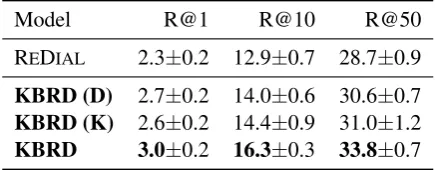
Table 2:Evaluation of the recommender system.We report the results of Recall@1, Recall@10 and Re-call@50 of the models (p0.01).KBRD (D)stands for only incorporating the dialog contents. KBRD (K) stands for only incorporating knowledge. The results demonstrate that both the interaction with the dialog system and the external knowledge are helpful for the improvement of model performance, and our proposed model reaches the best performance on the three met-rics.
4.4 Baselines
The baseline models for the experiments are illus-trated in the following:
• REDIAL This is a basic model for conver-sational recommendation. It basically con-sists of a dialog generation system based on HRED (Sordoni et al., 2015a;Serban et al., 2016), a recommendation system based on autoencoder and a sentiment analysis mod-ule.
• Transformer We name our implemented
baseline model Transformer. It is similar to REDIAL, but its dialog generation system is based on the model Transformer (Vaswani et al., 2017). Except for that, the others re-main the same.
4.5 Results
In the following, we present the results of our ex-periments, including the model performances in recommendation and dialog generation.
Recommendation To evaluate the effects of our
recommendation system, we conduct an evalua-tion of Recall@K. We present the results in Ta-ble 2. From the results, it can be found that our proposed model reaches the best performances in the evaluation of Recall@1, Recall@10 and Recall@50. Furthermore, we also demonstrate an ablation study to observe the contribution of the dialog system and the introduced knowledge. It can be found that either dialog or knowledge can bring improvement to the performance of the
Model PPL Dist-3 Dist-4 CSTC
REDIAL 28.1 0.11 0.13 1.73 Transformer 18.0 0.27 0.39
-KBRD 17.9 0.30 0.45 1.99
Table 3:Automatic and human evaluation of dialog generation.For automatic evaluation, we evaluate the perplexity (PPL) and distinct n-gram (3 and Dist-4 refer to distinct 3-gram and Dist-4-gram respectively) of the generated dialogs. For human evaluation, we ask human annotators to evaluate the consistency (CSTC) of the generated utterances with the dialog history. Our proposed method performs the best in all evaluations compared with the baselines.
recommendation system. Their combination im-proves the performance the most by +0.7 Re-call@1, +3.4 Recall@10 and +5.1 Recall@50, which are advantages of 30.4%, 26.4% and 17.8% respectively. This shows that the information from both sources is contributive. The dialog contains users’ preferred items as well as attributes, such as movie director and movie style, so that the system can find recommendation based on these inputs. The knowledge contains important features of the movie items so that the system can find items with similar features. Further, the combination brings an advantage even greater than sum of the two parts, which proves the effectiveness of our model.
Dialog Table 3 shows the results of the
eval-uation of the baseline models and our proposed method in dialog generation. In the evaluation of perplexity, Transformer has much lower perplex-ity (18.0) compared to REDIAL(28.1), andKBRD
can reach the best performance in perplexity. This demonstrates the power of Transformer in model-ing natural language. In the evaluation of diver-sity, we find that the models based on Transformer significantly outperform REDIAL from the results of distinct 3-gram and 4-gram. Besides, it can be found thatKBRDhas a clear advantage in diver-sity over the baseline Transformer. This shows that our model can generate more diverse contents without decreasing fluency.
As to the human evaluation, we ask human annotators to score the utterances’ consistency with their dialog history. Compared with REDIAL
[image:6.595.307.524.64.129.2]Number of mentioned items
Recall@50
Proportion in test set (%)
0.15 0.2 0.25 0.3 0.35 0.4
0 0.05 0.1 0.15 0.2 0.25 0.3
0 1 2 3 4 5
[image:7.595.78.289.69.194.2]Proportion Baseline Ours (D) Ours (K) Ours
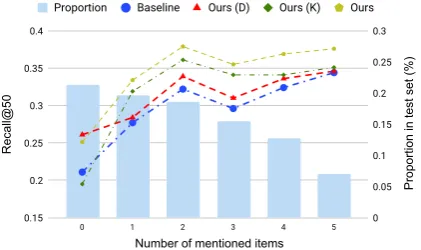
Figure 2: Performance of the recommender system with different numbers of mentioned items. The x-axis refers to the number of mentioned items in the di-alog, the y-axis for the line chart (on the left) refers to the model performance on the Recall@50 evaluation, and the y-axis for the histogram (on the right) refers to proportion in the test set. This shows recommendation is much more difficult with few items mentioned (i.e., at the first few rounds in dialog). Leveraging dialog contents makes a great difference in this situation.
of the two models in this evaluation. To make a consistent response in a dialog, the model should understand the dialog history and better learn the user’s preference. The baseline REDIAL does not have a strong connection between the dialog system and user representation. Instead, in our framework, the recommender system provides the recommendation-aware vocabulary biasbu, which
is based on the user representationtu, to the dialog
system. Thus the dialog system gains knowledge about the user’s preference and generates a consis-tent response.
5 Discussion
In this section, we conduct a series of analyses to observe the effects of our proposed model. We discuss how dialog can improve the recommen-dation performance and how recommenrecommen-dation can enhance the dialog quality.
5.1 Does dialog help recommendation?
We first evaluate whether the dialog contents can benefit the recommendation system. The results of the evaluation are demonstrated in Figure 2. From the histogram in the figure, we observe that most of the dialogs contain only a few mentioned movies. The dialogs with only 0-2 mentioned movies take up a proportion of 62.8% of the whole testing dataset. Therefore, it is important for the system to perform high-quality recommendation with only a small number of mentioned movies.
This also corresponds to the classical problem “cold start” (Schein et al., 2002) in the recom-mender system. In real applications, we also ex-pect that the system can perform high-quality rec-ommendation with fewer rounds. This represents the efficiency of the recommender system, which can save users’ time and efforts.
Specifically, we demonstrate the performances of four systems in Figure 2. They are the basic framework, the one only with the interaction with the dialog system, the one only with the exter-nal knowledge and KBRD with both dialog and knowledge incorporation. From the figure, it can be found that while there is no mentioned item in the dialog, the baseline and the one only with knowledge perform the worst. In contrast, the two models with dialog incorporation perform sig-nificantly better. This shows that the context in the dialog contains much useful non-item infor-mation about users’ preferences, such as director, actor/actress in movie recommendation. There-fore, while there is no mentioned item, the rec-ommender system can still perform high-quality recommendation based on the contextual informa-tion. With the increase of mentioned items, the contribution of knowledge becomes more signifi-cant than the dialog. On average, the system with both information sources performs the best. Dia-log introduces contextual information and knowl-edge introduces movie features and structural con-nection with other movies.
5.2 Does recommendation help dialog?
In Section4.5, we present the performances of the baselines and our modelKBRD in dialog gener-ation. It can be found that the interaction with the recommendation system can enhance the per-formance of the dialog system in both automatic evaluation and human evaluation. Also, an exam-ple of the responses of different models is shown in Table 1. With the dialog history, the baseline REDIAL simply uses a generic response with a recommended movie. Instead, KBRD has more concern about the mentioned items apart from the plain text of dialog history. The user representa-tion from our recommender system contains such information, which is sent to the dialog system to form a vocabulary bias. With such information,
Movie 1 2 3 4 5 6 7 8
Star Wars space alien sci-fi star sci robot smith harry The Shining creepy stephen gory horror scary psychological haunted thriller The Avengers (2012) marvel superhero super dc wait batman thor take Beauty and the Beast cute disney animated live music child robin kids
Table 4:Examples of top 8 vocabulary bias. Given a mentioned movie, we visualize words with high probability based on the recommendation-aware vocabulary bias. The examples show that the biased words have strong connections with their corresponding movies. While the vocabulary bias benefits the dialog system to generate responses that are more consistent with user interest, they also contribute to the explainability of recommendation.
To further study the effects of the recommender system on dialog generation, we display the top biased words from the vocabulary bias. Note that inKBRDa connection between the recommender system and dialog system is the recommendation-aware vocabulary biasbu. To be specific, we
com-pute the recommendation-aware biasbu in dialog
and select the components with the top-8 largest values.5 Then we record the corresponding words and observe whether these words are related to the mentioned movies. We present several examples in Table 4. From the table, we observe that the words are highly related to the mentioned movies. For example, when “The Shining” is mentioned, some of the top biased words are “creepy”, “gory” and “scary”, which are consistent with the style of the horror movie, and “stephen”, who is the origi-nal creator of the movie. Therefore, it can be sug-gested that the recommendation system conveys important information to the dialog system in the form of a vocabulary bias. Furthermore, these bi-ased words can also serve as explicit explanation to recommendation results. From this perspective, this shows the interpretability of our model.
6 Related Work
Recommender systems aim to find a small set of items that meet users’ interest based on users’ historical interactions. Traditional recommender systems rely on collaborative filtering (Resnick et al., 1994; Sarwar et al., 2001), and recent ad-vances in this field rely much on neural networks (Wang et al., 2015; He et al., 2017; Ying et al., 2018). To deal with the cold-start problem and the sparsity of user-item interactions which these methods usually suffer, researchers have proposed methods to incorporate external information, such as heterogeneous information networks (Yu et al., 2014), knowledge bases (Zhang et al.,2016;Wang et al., 2018a) and social networks (Jamali and
5After stop words filtering.
Ester, 2010). Besides accuracy, explainability is also an important aspect when evaluating recom-mender systems (Zhang et al., 2014;Zhang and Chen,2018;Wang et al.,2018b).
End-to-end dialog systems based on neural networks have shown promising performance in open-ended settings (Vinyals and Le, 2015; Sor-doni et al., 2015b; Dodge et al., 2016; Wen et al., 2015) and goal-oriented applications ( Bor-des et al., 2017). Recent literature also explores the intersection of end-to-end dialog systems with other intelligence systems and creates new tasks such as visual dialog (Das et al., 2017;De Vries et al., 2017), conversational recommendation (Li et al.,2018). In particular,Li et al.(2018) collects a dataset of conversations focused on providing movie recommendations and proposes a baseline model for end-to-end training of recommender and dialog systems. Earlier studies in this field fo-cus on different tasks such as minimizing the num-ber of user queries (Christakopoulou et al.,2016), training the dialog agent to ask for facet values for recommendation (Sun and Zhang,2018). Related literature can also be found in Thompson et al. (2004),Mahmood and Ricci(2009),Chen and Pu (2012), Widyantoro and Baizal (2014) and Liao et al.(2019).
7 Conclusion
significantly. Information from the recommender system that contains the user preference and the relevant knowledge can enhance the consistency and diversity of the generated dialogs.
Acknowledgements
The work is supported by NSFC for Distinguished Young Scholar (61825602), NSFC (61836013), and a research fund supported by Alibaba. The au-thors would like to thank Lei Li and Chang Zhou for their insightful feedback, and responsible re-viewers of EMNLP-IJCNLP 2019 for their valu-able suggestions. Jie Tang is the corresponding author.
References
Antoine Bordes, Y.-Lan Boureau, and Jason Weston. 2017. Learning end-to-end goal-oriented dialog. In
5th International Conference on Learning Represen-tations, ICLR 2017, Toulon, France, April 24-26, 2017, Conference Track Proceedings.
Li Chen and Pearl Pu. 2012. Critiquing-based recom-menders: survey and emerging trends. User Mod-eling and User-Adapted Interaction, 22(1-2):125– 150.
Qibin Chen, Junyang Lin, Yichang Zhang, Hongxia Yang, Jingren Zhou, and Jie Tang. 2019. To-wards knowledge-based personalized product de-scription generation in e-commerce. arXiv preprint arXiv:1903.12457.
Konstantina Christakopoulou, Filip Radlinski, and Katja Hofmann. 2016. Towards conversational rec-ommender systems. In Proceedings of the 22nd ACM SIGKDD international conference on knowl-edge discovery and data mining, pages 815–824. ACM.
Joachim Daiber, Max Jakob, Chris Hokamp, and Pablo N Mendes. 2013. Improving efficiency and accuracy in multilingual entity extraction. In Pro-ceedings of the 9th International Conference on Se-mantic Systems, pages 121–124. ACM.
Abhishek Das, Satwik Kottur, Khushi Gupta, Avi Singh, Deshraj Yadav, Jos´e MF Moura, Devi Parikh, and Dhruv Batra. 2017. Visual dialog. In Proceed-ings of the IEEE Conference on Computer Vision and Pattern Recognition, pages 326–335.
Harm De Vries, Florian Strub, Sarath Chandar, Olivier Pietquin, Hugo Larochelle, and Aaron Courville. 2017. Guesswhat?! visual object discovery through multi-modal dialogue. In Proceedings of the IEEE Conference on Computer Vision and Pattern Recog-nition, pages 5503–5512.
Ming Ding, Chang Zhou, Qibin Chen, Hongxia Yang, and Jie Tang. 2019. Cognitive graph for multi-hop reading comprehension at scale. InACL (1), pages 2694–2703. Association for Computational Linguis-tics.
Jesse Dodge, Andreea Gane, Xiang Zhang, Antoine Bordes, Sumit Chopra, Alexander H. Miller, Arthur Szlam, and Jason Weston. 2016. Evaluating prereq-uisite qualities for learning end-to-end dialog sys-tems. In4th International Conference on Learning Representations, ICLR 2016, San Juan, Puerto Rico, May 2-4, 2016, Conference Track Proceedings.
Caglar Gulcehre, Sungjin Ahn, Ramesh Nallapati, Bowen Zhou, and Yoshua Bengio. 2016. Pointing the unknown words. InProceedings of the 54th An-nual Meeting of the Association for Computational Linguistics (Volume 1: Long Papers), volume 1, pages 140–149.
Xiangnan He, Lizi Liao, Hanwang Zhang, Liqiang Nie, Xia Hu, and Tat-Seng Chua. 2017. Neural collabo-rative filtering. InProceedings of the 26th Interna-tional Conference on World Wide Web, pages 173– 182. International World Wide Web Conferences Steering Committee.
Mohsen Jamali and Martin Ester. 2010. A matrix fac-torization technique with trust propagation for rec-ommendation in social networks. In Proceedings of the 2010 ACM Conference on Recommender Sys-tems, RecSys 2010, Barcelona, Spain, September 26-30, 2010, pages 135–142. ACM.
Diederik P. Kingma and Jimmy Ba. 2015. Adam: A method for stochastic optimization. In 3rd Inter-national Conference on Learning Representations, ICLR 2015.
Jens Lehmann, Robert Isele, Max Jakob, Anja Jentzsch, Dimitris Kontokostas, Pablo N Mendes, Sebastian Hellmann, Mohamed Morsey, Patrick Van Kleef, S¨oren Auer, et al. 2015. Dbpedia–a large-scale, multilingual knowledge base extracted from wikipedia. Semantic Web, 6(2):167–195.
Raymond Li, Samira Ebrahimi Kahou, Hannes Schulz, Vincent Michalski, Laurent Charlin, and Chris Pal. 2018. Towards deep conversational recommenda-tions. InAdvances in Neural Information Process-ing Systems 31: Annual Conference on Neural In-formation Processing Systems 2018, NeurIPS 2018., pages 9748–9758.
Lizi Liao, Ryuichi Takanobu, Yunshan Ma, Xun Yang, Minlie Huang, and Tat-Seng Chua. 2019. Deep conversational recommender in travel. CoRR, abs/1907.00710.
Peter J. Liu, Mohammad Saleh, Etienne Pot, Ben Goodrich, Ryan Sepassi, Lukasz Kaiser, and Noam Shazeer. 2018. Generating wikipedia by summariz-ing long sequences. In6th International Conference on Learning Representations, ICLR 2018.
Tariq Mahmood and Francesco Ricci. 2009. Improv-ing recommender systems with adaptive conversa-tional strategies. InProceedings of the 20th ACM conference on Hypertext and hypermedia, pages 73– 82. ACM.
Paul Michel and Graham Neubig. 2018. Extreme adap-tation for personalized neural machine translation. InProceedings of the 56th Annual Meeting of the As-sociation for Computational Linguistics, ACL 2018, pages 312–318.
Myle Ott, Sergey Edunov, David Grangier, and Michael Auli. 2018. Scaling neural machine trans-lation. In Proceedings of the Third Conference on Machine Translation: Research Papers, WMT 2018, pages 1–9.
Pranav Rajpurkar, Jian Zhang, Konstantin Lopyrev, and Percy Liang. 2016. Squad: 100, 000+ questions for machine comprehension of text. InEMNLP, pages 2383–2392. The Association for Computational Lin-guistics.
Paul Resnick, Neophytos Iacovou, Mitesh Suchak, Pe-ter Bergstrom, and John Riedl. 1994. Grouplens: An open architecture for collaborative filtering of netnews. In CSCW ’94, Proceedings of the Con-ference on Computer Supported Cooperative Work, Chapel Hill, NC, USA, October 22-26, 1994, pages 175–186. ACM.
Badrul Sarwar, George Karypis, Joseph Konstan, and John Riedl. 2001. Item-based collaborative filtering recommendation algorithms. In WWW’01, pages 285–295.
Andrew I Schein, Alexandrin Popescul, Lyle H Ungar, and David M Pennock. 2002. Methods and metrics for cold-start recommendations. In Proceedings of the 25th annual international ACM SIGIR confer-ence on Research and development in information retrieval, pages 253–260. ACM.
Michael Schlichtkrull, Thomas N Kipf, Peter Bloem, Rianne Van Den Berg, Ivan Titov, and Max Welling. 2018. Modeling relational data with graph convolu-tional networks. InEuropean Semantic Web Confer-ence, pages 593–607. Springer.
Suvash Sedhain, Aditya Krishna Menon, Scott Sanner, and Lexing Xie. 2015. Autorec: Autoencoders meet collaborative filtering. In Proceedings of the 24th International Conference on World Wide Web Com-panion, WWW 2015, pages 111–112.
Iulian Vlad Serban, Alessandro Sordoni, Yoshua Ben-gio, Aaron C. Courville, and Joelle Pineau. 2016.
Building end-to-end dialogue systems using gener-ative hierarchical neural network models. In Pro-ceedings of the Thirtieth AAAI Conference on Artifi-cial Intelligence, pages 3776–3784.
Alessandro Sordoni, Yoshua Bengio, Hossein Vahabi, Christina Lioma, Jakob Grue Simonsen, and Jian-Yun Nie. 2015a. A hierarchical recurrent encoder-decoder for generative context-aware query sugges-tion. InProceedings of the 24th ACM International Conference on Information and Knowledge Man-agement, CIKM 2015, pages 553–562.
Alessandro Sordoni, Michel Galley, Michael Auli, Chris Brockett, Yangfeng Ji, Margaret Mitchell, Jian-Yun Nie, Jianfeng Gao, and Bill Dolan. 2015b. A neural network approach to context-sensitive gen-eration of conversational responses. InNAACL HLT 2015, The 2015 Conference of the North Ameri-can Chapter of the Association for Computational Linguistics: Human Language Technologies, pages 196–205.
Yueming Sun and Yi Zhang. 2018. Conversational rec-ommender system. InThe 41st International ACM SIGIR Conference on Research & Development in Information Retrieval, pages 235–244. ACM.
Ilya Sutskever, Oriol Vinyals, and Quoc V. Le. 2014. Sequence to sequence learning with neural net-works. InAdvances in Neural Information Process-ing Systems 27: Annual Conference on Neural Infor-mation Processing Systems 2014, pages 3104–3112.
Cynthia A Thompson, Mehmet H Goker, and Pat Lang-ley. 2004. A personalized system for conversational recommendations. Journal of Artificial Intelligence Research, 21:393–428.
Ashish Vaswani, Noam Shazeer, Niki Parmar, Jakob Uszkoreit, Llion Jones, Aidan N. Gomez, Lukasz Kaiser, and Illia Polosukhin. 2017. Attention is all you need. InAdvances in Neural Information Pro-cessing Systems 30: Annual Conference on Neural Information Processing Systems 2017, pages 6000– 6010.
Oriol Vinyals and Quoc Le. 2015. A neural conversa-tional model. arXiv preprint arXiv:1506.05869.
Hao Wang, Naiyan Wang, and Dit-Yan Yeung. 2015. Collaborative deep learning for recommender sys-tems. In Proceedings of the 21th ACM SIGKDD International Conference on Knowledge Discovery and Data Mining, pages 1235–1244.
Xiting Wang, Yiru Chen, Jie Yang, Le Wu, Zhengtao Wu, and Xing Xie. 2018b. A reinforcement learn-ing framework for explainable recommendation. In
2018 IEEE International Conference on Data Min-ing (ICDM), pages 587–596. IEEE.
Tsung-Hsien Wen, Milica Gasic, Nikola Mrkˇsi´c, Pei-Hao Su, David Vandyke, and Steve Young. 2015. Semantically conditioned lstm-based natural lan-guage generation for spoken dialogue systems. In
Proceedings of the 2015 Conference on Empirical Methods in Natural Language Processing, pages 1711–1721.
Dwi H Widyantoro and ZKA Baizal. 2014. A frame-work of conversational recommender system based on user functional requirements. In2014 2nd inter-national conference on information and communi-cation technology (ICoICT), pages 160–165. IEEE.
Zhilin Yang, Peng Qi, Saizheng Zhang, Yoshua Ben-gio, William W. Cohen, Ruslan Salakhutdinov, and Christopher D. Manning. 2018. Hotpotqa: A dataset for diverse, explainable multi-hop question answer-ing. InEMNLP, pages 2369–2380. Association for Computational Linguistics.
Rex Ying, Ruining He, Kaifeng Chen, Pong Eksombat-chai, William L Hamilton, and Jure Leskovec. 2018. Graph convolutional neural networks for web-scale recommender systems. In Proceedings of the 24th ACM SIGKDD International Conference on Knowl-edge Discovery & Data Mining, pages 974–983. ACM.
Xiao Yu, Xiang Ren, Yizhou Sun, Quanquan Gu, Bradley Sturt, Urvashi Khandelwal, Brandon Norick, and Jiawei Han. 2014. Personalized entity recommendation: A heterogeneous information net-work approach. InProceedings of the 7th ACM in-ternational conference on Web search and data min-ing, pages 283–292. ACM.
Fuzheng Zhang, Nicholas Jing Yuan, Defu Lian, Xing Xie, and Wei-Ying Ma. 2016. Collaborative knowl-edge base embedding for recommender systems. In
Proceedings of the 22nd ACM SIGKDD interna-tional conference on knowledge discovery and data mining, pages 353–362. ACM.
Yongfeng Zhang and Xu Chen. 2018. Explainable recommendation: A survey and new perspectives.
arXiv preprint arXiv:1804.11192.