DISTRIBUTION RESTRICTION: Approved for public release; distribution is unlimited.
FM 34-45
Tactics, Techniques, and Procedures
ELECTRONIC ATTACK
Field Manual
Headquarters
No. 34-45 Department of the
Army
Washington, DC, 9 June 2000
TACTICS, TECHNIQUES, AND PROCEDURES
FOR ELECTRONIC ATTACK
Contents
Page
PREFACE ... iv
Chapter 1 OPERATIONS AND ELECTRONIC WARFARE... 1-1 The Potential... 1-1
Methodology... 1-2
The Environment... 1-2
Electronic Warfare ... 1-2
Tactical Electronic Attack... 1-4
Current and Future Threat Electronic Warfare Capabilities... 1-4
Chapter 2 ELECTRONIC ATTACK IN INFORMATION OPERATIONS... 2-1 Information Operations ... 2-1
Information Superiority... 2-1
Chapter 3 ELECTRONIC ATTACK IN TARGETING: KEY PERSONNEL,
ORGANIZATIONS, AND COORDINATION... 3-1 Electronic Attack in The Targeting Methodology ... 3-1
Key Electronic Attack Personnel and Organizations ... 3-3
Key Electronic Attack Coordination ... 3-8
Chapter 4 DECIDE... 4-1 Intelligence Preparation of the Battlefield ... 4-2
Target Development ... 4-3
Requirements Management ... 4-7
Page
Mission Management... 4-8
Asset Management ... 4-12
Chapter 5 DETECT... 5-1 Electronic Support Data ... 5-1
Deploy Electronic Support and Electronic Attack Assets ... 5-1
Collect Electronic Support Data ... 5-13
Collection for Database Development ... 5-15
Search Techniques ... 5-15
Cross Cue ... 5-16
Process Signals Intelligence Data ... 5-17
Situation Development... 5-17
Electronic Attack Effectiveness... 5-18
Chapter 6 DELIVER... 6-1 Tactical Decisions ... 6-1
Technical Decisions ... 6-1
Conduct Electronic Attack... 6-2
Jumping EA Assets After EA Missions ... 6-5
Report Electronic Attack Results ... 6-6
Summarize Status of Electronic Attack Results ... 6-8
Chapter 7 ASSESS ... 7-1 Operator Evaluation ... 7-1
Unit Combat Assessment ... 7-3
Reattack Recommendation... 7-5
Appendix A THE ELECTROMAGNETIC ENVIRONMENT... A-1 Military Electromagnetic Spectrum ... A-1
Military Operations and Electromagnetic Environment... A-1
Principal Electronic Warfare Activities ... A-3
Appendix B SIGNAL-TO-NOISE RATIO REFERENCE ... B-1 Ratio Formula ... B-1
Future Trends ... B-2
Appendix C ELECTRONIC DECEPTION... C-1 Types of Electronic Deception ... C-1
Page
Electronic Deception Techniques ... C-4
Appendix D MESSAGE FORMATS... D-1
Appendix E EXAMPLE FORMATS AND TARGET REPORT... E-1 General ... E-1
High-Payoff Target List ... E-1
Target Selection Standards ... E-2
Attack Guidance Matrix... E-2
Sensor or Attack Matrix... E-3
Optional High-Payoff Target List and Attack Guidance Matrix ... E-4
Target Sheets ... E-6 Electronic Warfare Annex ... E-7
Appendix F DIRECT SUPPORT TO THE BRIGADE... F-1 Task Organization... F-1 Organization and Operations ... F-2
Appendix G MILITARY OPERATIONS ON URBANIZED TERRAIN... G-1
Appendix H BRIGADE COMBAT TEAM...H-1 Organization...H-1
Operations ...H-1
Glossary... Glossary-1
Bibliography... Bibliography-1
The purpose of this manual is to
• Address the deployment and employment of electronic attack (EA) assets at division and brigade.
• Discuss concepts and principles unique to EA.
• Describe how to integrate EA into the targeting effort.
• Address specific tactics, techniques, and procedures (TTP) when applicable. This manual is a guide for Army commanders, staffs, and operators who plan and/or execute EA. It applies equally to the Active Component (AC), US Army Reserve (USAR), and Army National Guard (ARNG).
This manual complies with FM 34-1 and is consistent with current joint doctrine. It assumes the user has a fundamental understanding of the doctrine in FM 100-5, FM 101-5, FM 34-1, FM 6-20-10, and FM 34-130.
The proponent for this publication is Headquarters, US Army Training and Doctrine Command (TRADOC). Send comments and recommendations on DA Form 2028 directly to Commander, US Army Intelligence Center and Ft Huachuca, ATTN: ATZS-FDC-D, Ft Huachuca, AZ 85613-6000.
Chapter 1
Operations and Electronic Warfare
Division targeting teams and electronic warfare (EW) personnel work
together to ensure that EW is integrated into targeting, is thoroughly
planned, and is vigorously executed. The use of standard EW targets
without thorough analysis and planning significantly limits the potential
of EW as a true combat multiplier. Inadequate planning leads to the
uncoordinated use of EW and limits the effects of both EW and fire
support (FS) as a whole. On the other hand, if EW is adequately staffed,
trained, integrated into targeting, planned, and executed, it helps the
commander reach his targeting objectives by dominating the
electromagnetic environment (EME).
EW can attack the threat when it is most vulnerable through a quick,
accurate, timely, and responsive means that can also provide a fast
assessment of the operation. Additionally, EW is important because it is
a responsive tool to perform suppression of enemy air defenses (SEAD); it
is also one of the integrated tools used to conduct information operations
(IO). However, EW is effective only when the commander decides there is
more value in conducting EA (for a specific high-payoff target [HPT] at a
specific point) than performing additional collection in order to produce
more intelligence.
THE POTENTIAL
1-1. The potential for EA is unlimited especially within the information age.
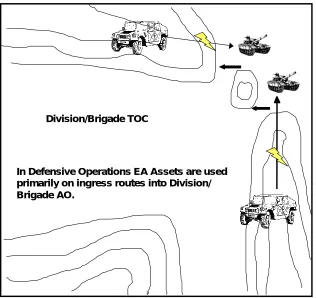
• Defensive operations, conducted with the immediate purpose of causing an enemy attack to fail, often allow the friendly force to close off areas and create devastating engagement areas while denying the threat critical information. EA assets cover constricted terrain areas along the threat avenue of approach (AA). The engineers erect obstacles in order for maneuver and artillery units to create an engagement area. EA assets begin their mission as soon as the threat enters the area and no longer has direct contact with other units. At this time units engage with artillery and destroy threat forces. Because the threat has no communications, the engagement will be swift, with high casualties and lost momentum, thus ending the threat attack. EA also will be used in counterreconnaissance to deny threat scouts the ability to pass vital intelligence back to their commander.
METHODOLOGY
1-2. There is not a separate methodology to conduct EW. The best way to conduct EW is to effectively integrate EW within the targeting methodology and TTP. This manual and the flow of products are in accordance with FM 6-20-10. They provide a clear and relatively simple framework, terminology, and TTP to plan and conduct EA as a subset of EW. The framework begins with the targeting functions of DECIDE, DETECT, DELIVER, and ASSESS.
THE ENVIRONMENT
1-3. Operations are executed in an increasingly complex EME. Almost all military units use electromagnetic (EM) devices for communications, navigation, sensing, information storage, and processing. The increasing mobility and affordability of sophisticated EM equipment guarantees that the environment will become even more complex in the future. This environment creates vulnerabilities to and opportunities for EW for both friendly and threat forces. The threat and the friendly commanders depend on this flow of information to make informed decisions. EW can exploit this dependence. Appendix A further describes this environment.
1-4. The need to control the EM spectrum and the type of EW actions that can be used to control that spectrum depend on the operational environment. During peacetime, government bodies and international treaties and conventions control the use of the EM spectrum. However, standing rules of engagement (ROE) give joint commanders the authority in peacetime to take appropriate and necessary action to protect their forces. The type and level of EW actions appropriate to a particular operation depend on threat capabilities, threat vulnerabilities, and operational objectives.
ELECTRONIC WARFARE
• Secure and maintain effective control and use of the spectrum for friendly forces.
• Attack the threat and to deny the use of the spectrum through damage, destruction, disruption, and deception.
ELECTRONIC PROTECTION
1-6. EP involves actions taken to protect personnel, facilities, and equipment from any effects of friendly or enemy employment of EW that degrade, neutralize, or destroy friendly combat capability. This manual contains very little discussion of this subdivision of EW.
ELECTRONIC WARFARE SUPPORT
1-7. ES involves the search for, intercepts, identification, and location of sources of radiated EM energy (intentional and unintentional) in order to recognize and collect information on the threat. ES provides information necessary for immediate decisions involving EW operations and other tactical actions. Both EA and ES are critical and mutually supportive components.
ELECTRONIC ATTACK
1-8. EA involves the use of EM, directed energy (DE), or anti-radiation weapons to attack personnel, facilities, or equipment with the intent of degrading, neutralizing, or destroying enemy combat capability and is considered to be a form of fires. EA includes—
• Taking actions to prevent or reduce an enemy’s effective use of the EM spectrum (for example, jamming and EM deception).
• Employing weapons that use either EM or DE to destroy EM equipment (for example, lasers, radio frequency [RF] weapons, or particle beams).
First Recorded Instance of Deliberate Radio Jamming
The first recorded instance of deliberate radio jamming took place in September 1901 in the US. Interestingly, it was aimed at securing commercial gain rather than military advantage. As now, there was considerable public interest in the America’s Cup yacht races, and the newspaper first to reach the stands carrying each result stood to reap a large profit.... A third company...failed to get a sponsor but...used a transmitter more powerful than its competitors, and one of its engineers, John Pickard, worked out a method which allowed him to jam signals from the other companies while at the same time to report on the progress of the race from his boat.
TACTICAL ELECTRONIC ATTACK
1-9. EA is best used as a combat multiplier in conjunction with other fires into an engagement area. Used alone, EA is only a delaying or disrupting fireits effects are reduced. Additionally, the technique of using EA fires independently of other fires provides the enemy time and training to overcome the effects of future EA. While EA operations within a theater or joint task force area of operation (AO) are often complicated, tactical EA operations (to include division operations) are relatively simple.
1-10. The scope of tactical EA operations are limited by doctrine, organic and supporting capabilities, and realistic unit standing operating procedures (SOPs). However, when a tactical echelon lacks adequate organic or supporting capabilities, it can request support from a higher echelon. Sometimes a tactical echelon might not even know of an existing capability at a higher echelon. The US Air Force (USAF), US Marine Corps (USMC), and US Navy (USN) have the EA equipment for the SEAD. With the Army’s dependence on aviation assets, the request for support from echelons above corps (EAC) in the joint arena for SEAD support will remain constant.
CURRENT AND FUTURE THREAT ELECTRONIC WARFARE
CAPABILITIES
1-11. While allied forces are able to conduct EA, many threats, using off-the-shelf equipment, have the ability to conduct EA with greater distance and against targets conventionally safe against EA. The current communications environment provides many potential threats with a rich environment to conduct EW and exploit friendly communications. The more a unit relies on communications, the more vulnerable that unit is to threat ES and EA. In general, many threats currently have the capability to
• Detect and locate friendly units because of our use of EM equipment. • Monitor and exploit friendly unit’s communications to include
collecting information on a unit’s mission, combat strength, logistics, morale, weakness, and other critical information.
• Deny a friendly unit's use of the EM spectrum, thereby degrading that unit’s ability to plan operations, execute C2, receive and process intelligence, and execute operations.
1-12. The future communications environment will provide threats with a target-rich environment for EW. In general, future threats will be able to
• Detect, locate, and jam low probability of intercept (LPI) signals. The Army currently uses many types of LPIs (for example, Single-Channel Ground and Airborne Radio System [SINCGARS]).
• Use DE to destroy computer networks by using electromagnetic pulses (EMPs) to destroy silicon chips inside equipment.
Chapter 2
Electronic Attack in Information Operations
IO are actions taken to affect adversaries and to influence other
audiences’ military decisionmaking policies (MDMPs), information, and
information systems, and defend friendly MDMPs, information, and
information systems. EW is an integral part of IO; consequently, EA is
closely tied to IO planning, integration, and execution.
INFORMATION OPERATIONS
2-1. IO consist of two supporting elements: offensive IO and defensive IO.
OFFENSIVE OPERATIONS
2-2. Offensive IO are the integrated use of assigned and supporting capabilities and activities, mutually supported by intelligence, to affect adversary decisionmakers or to influence neutral audiences to achieve or promote specific objectives. The capabilities and activities include, but are not limited to, operations security (OPSEC), military deception, psychological operations (PSYOP), EW, physical destruction, special information operations, and computer network attack (CNA).
DEFENSIVE OPERATIONS
2-3. Defensive IO are the integration and coordination of policies and procedures, operations, personnel, and technology to protect and defend friendly information and information systems. Defensive IO are conducted through information assurance, physical security, OPSEC, counter-deception, counter-propaganda, counterintelligence, EW, and special IO.
2-4. Defensive IO ensure timely, accurate, and relevant information access while denying adversaries the opportunity to exploit friendly information and information systems for their own purpose. Although they are not integral components of IO, public affairs and civil affairs are enabling activities that may contribute in the execution of IO tasks and promote attaining specific IO objectives.
INFORMATION SUPERIORITY
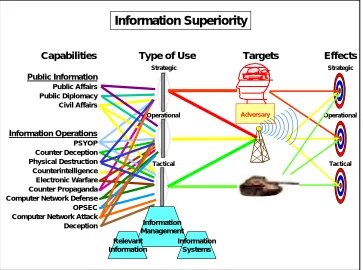
information systems to collect, process, store, display, and disseminate data and information. (See Figure 2-1.)
[image:11.612.144.507.297.567.2]2-6. One of the friendly commander’s IO instruments to achieve or promote specific objectives is EW. EA is a valuable offensive IO tool. When planned, coordinated, synchronized, and integrated with the friendly FS plan, EA becomes a combat multiplier. EA can effectively confuse the threat and disrupt the threat commander’s operation. The only difference between traditional EA planning and EA in support of IO involves the specific IO objectives and targets. Specific IO objectives may differ significantly from tactical military objectives. Additionally, the commander may use EA in support of IO and/or solely to complement supporting activities of IO. IO targets may include, but are not limited to, adversary perceptions, knowledge, personnel, equipment, information systems networks, or population.
Figure 2-1. Information Superiority
2-7. The planning, coordination, and execution of electronic fires remains consistent with the same methodology (Decide, Detect, Deliver, and Assess) described in FM 6-20-10. During the DECIDE phase, the IO cell brings unique IO HVTs into the wargaming process. This results in unique IO HPTs that are integrated with all HPTs into the attack guidance matrix (AGM). The electronic warfare officer (EWO) provides the IO cell feedback on the outcome of EA, so that the IO cell can decide whether or not to nominate the target for reattack. Due to the nature of IO, however, feedback may not
Public Information
Public Affairs Public Diplomacy Civil Affairs
Information Operations
PSYOP Counter Deception Physical Destruction Counterintelligence Electronic Warfare Counter Propaganda Computer Network Defense OPSEC Computer Network Attack Deception
Targets Effects Type of Use
Capabilities
Strategic
Tactical Operational
Strategic
Operational
Tactical
Information Management Relevant
Information
Information Systems
Information Superiority
be immediate and it may require a significantly longer period to make an assessment.
Chapter 3
Electronic Attack in Targeting: Key Personnel,
Organizations, and Coordination
Targeting is the process of selecting targets and matching the appropriate
response to them on the basis of operational requirements and
capabilities. The DECIDE, DETECT, DELIVER, and ASSESS
methodology directs friendly forces to attack the right target with the
right asset at the right time.
The targeting process provides an effective method for matching the
friendly force capabilities against a threat's targets. Another important
part of the targeting process is to identify potential fratricide situations
and perform the coordination necessary to positively manage and control
the targeting effort. The targeting team and staff incorporate these
measures into the coordinating instructions and appropriate annexes of
the operations plans (OPLANs) and/or operations orders (OPORDs).
Targeting is a dynamic process; it must keep up with the changing face of
the battlefield. The staff must continually update the tools and products
described in this manual based on changing plans, situation development,
and combat assessment. As a participant in the staff targeting process,
the EWO ensures that EA is thoroughly integrated within targeting. This
includes integrating EA into all the appropriate annexes and products.
ELECTRONIC ATTACK IN THE TARGETING METHODOLOGY
3-1. The modern battlefield presents many targets with different vulnerabilities exceeding the number of resources available to acquire and attack them. The commander must determine which targets are most important to the threat and, of those targets, which ones he must acquire and attack to accomplish his mission. Then as the operation unfolds friendly forces must identify, track, engage, and assess the results on priority threat targets.
DECIDE
destruction. However, as the process continues these targets are passed through intelligence organizations and further planned using collection management (CM) procedures. The EA plan (from DECIDE) is integrated into the standard targeting products (graphic or text-based). Some of the most critical products that involve EA are the
• High-payoff target list (HPTL).
• AGM.
• EW annex.
3-3. Different personnel and organizations perform five processes as part of or in conjunction with the MDMP in order to plan EA:
• Intelligence Preparation of the Battlefield (IPB). • Target Development.
• Requirements Management (RM). • Mission Management (MM). • Asset Management (AM). DETECT
3-4. DETECT is a critical function in the targeting process. ES and EA assets deploy to detect HPTs (based on what the targeting team identified as HPTs during DECIDE). The intelligence operating system cross-queues assets based on a collection plan and the threat situation. It is critical that ES assets are deployed and work closely with EA assets. In order for EA assets to effectively perform EA, they need critical data like the location, signal strength, and frequency of the HPT. ES assets will find the “weak link” (with the support of the target assessment and signals intelligence [SIGINT] teams) in threat communications that the EA asset can attack.
DELIVER
3-5. DELIVER is the execution of EA against the targets identified in the HPTL, AGM, and EW annex once friendly forces identify, locate, and track HPTs. EA assets must satisfy the attack guidance developed during DECIDE. Executing EA requires close coordination between ES and EA assets when the EA asset is jamming the HPT. Recommend EA assets use maximum power based on mission, enemy, terrain and weather, troops, and time available-civilians (METT-TC). The commander makes the ultimate decision on how much power EA assets will use to accomplish the mission. Essential to this is the synchronization of lethal fires and nonlethal fires (EA). This synchronization is accomplished through AGMs, intelligence synchronization matrixes (ISMs), and EW annexes.
ASSESS
3-6. Combat assessment (CA) is the determination of the effectiveness of force employment during military operations. CA is composed of three elements:
• Battle damage assessment (BDA). • Reattack recommendations.
3-7. MEA and BDA (when combined by the staff) inform the commander of effects against targets and target sets. Based on this information, the G2 continually analyzes the threat's ability to conduct and sustain operations (sometimes expressed in terms of the threat’s centers of gravity). The bottomline is to either recommend reattack or not. The specific assessment of EA involves all three of the elements of CA as an integrated part of the targeting effort. One unique part of MEA for EA is the close coordination between ES and EA assets necessary to perform an operator evaluation (based upon the jamming effectiveness).
3-8. BDA is the timely and accurate estimate of damage resulting from the application of military force (either lethal or nonlethal) against a target. BDA in the targeting process pertains to the results of any attack. Producing BDA is primarily an intelligence responsibility, but requires coordination with operational elements to be effective. BDA requirements may be translated into priority intelligence requirements (PIR) or information requirements (IR) if it is linked to the commander's decisions. The G2 answers BDA requirements by providing the commander a series of timely and accurate “snapshots” of the effects on the threat. The “snapshots” include an estimate of the threat's combat effectiveness, capabilities, and intentions. This helps the commander determine if their targeting effort is accomplishing their objectives and if reattack is necessary.
KEY ELECTRONIC ATTACK PERSONNEL AND ORGANIZATIONS
Figure 3-1. Key EA Personnel and Organizations
THE COMMANDER
3-10. The commander issues guidance on the concept of operations for close, deep, and rear operations as well as for future operations. He defines the mission, the concept of operations, his intent, and supporting tasks. His intent and targeting objectives guide the actions of the targeting team.
TARGETING TEAM
3-11. The targeting team is an ad hoc organization, which is driven by mission. Generally, the team will consist of the Deputy Fire Support Coordinator (FSCOORD), Air Liaison Officer (ALO), EWO, and representatives from the G2, G3, Air Defense Artillery (ADA), Engineers, and Army Airspace Command and Control (A2C2) element. The G3 adds additional members as necessary (for example, Deception, PSYOP, Civil Affairs, or IO).
3-12. Targeting team members go through the target list and decide (with the guidance of the G3 representative) which targets to attack and with what
MI Bn Cdr/AM MI Bn Operations
Center
ES Teams EA Teams
GS MI Co
C&J Plt Ldr Collection
Manager/RM
SIGINT Team/MM G2 Plans
Officer EWO
ACE
LEGEND:
Formal planning
Relationship planning collaboration
Targeting Team (FAIO Support)
type of fire (lethal and nonlethal). This task includes requesting support from higher echelons (for example, coordinating USAF support through the Battlefield Coordination Detachment (BCD) at the Air Operations Center [AOC]). The chief of staff is responsible for supervising the targeting processes, chairing targeting meetings, and leading the targeting team. The targeting team
• Develops HPTs from the high-value targets (HVTs). • Works with the G2 to perform target development. • Develops the HPTL, AGM, and BDA requirements. • Updates these products as the situation changes.
3-13. The Deputy FSCOORD is a key player in the targeting team. He provides the latest status of FS resources and plans their use in support of the operation. Specifically, he
• Coordinates the functions of the targeting team. • Recommends methods of attack for HPTs.
• Develops timelines and accuracy guidelines for the target selection standards (TSSs) (in coordination with the G2 section).
• Monitors changes in the situation and reassesses the HPTL, AGM, TSSs, and BDA requirements.
• Coordinates subordinate units' attack requirements.
• Receives BDA and determines if the desired effects were achieved or if additional attacks are required (with the G2 and G3).
• Ensures the air tasking order (ATO) supports target nomination in accordance with SOPs.
G2 PLANS OFFICER
3-14. The G2 Plans Officer
• Maintains HVTs (with the targeting team analysis and control element [ACE] and field artillery intelligence officer [FAIO]).
• Uses the targeting team ACE to template potential HPTs.
• Recommends named areas of interest (NAIs) and target areas of interest (TAIs) to the G2 to support targeting.
• Coordinates with the collection manager to ensure adequate intelligence collection to support the targeting plan.
ELECTRONIC WARFARE OFFICER 3-15. The EWO
• Helps the targeting team determine EA requirements against specific HPTs.
• Coordinates with the SIGINT team (ACE) through the collection manager to satisfy ES and EA requirements.
• Prepares the EW annex.
• Provides EA MM for the division.
• Prepares and coordinates the EW annex for OPLANs and OPORDs. • Determines and requests EAC EA support.
• Recommends to the G3/G2 whether a target should be engaged with EA.
• Expedites meaconing, intrusion, jamming, and interference (MIJI) reports to the ACE for targeting.
ANALYSIS AND CONTROL ELEMENT
3-16. The ACE provides support for EA missions through the collection manager, SIGINT team, targeting team, all-source team, and FAIO. This organization fuses intelligence to identify the best target inside a target set.
COLLECTION MANAGEMENT TEAM (ACE) 3-17. This team
• Passes specific information requirements (SIR) that support EW to the SIGINT team.
• Works with the EWO, MI battalion, and SIGINT team to ensure that the collection plan and ISM are synchchronized with the AGM and EW annex.
• Either develops EW tasking for organic or supporting EW assets or requests EW support from a higher echelon (with the EWO and SIGINT team).
TARGETING TEAM (ACE)
3-18. This team
• Interacts with the G2 Plans Officer, the FAIO, and the EWO to support EA as an integrated part of target development and targeting.
• Produces and compares target overlays to IPB products and current intelligence. (NOTE: This is a critical part of critical nodes analysis.) • Nominates HPTs in support of the G2 Plans Officer.
FAIO
3-19. The FAIO
• Collocates with the ACE specifically near the targeting team (ACE), collection management team, and all-source team.
• Supports the G2 Plans Officer (as necessary). • Supports the targeting team (as necessary).
• Is the threat artillery expert in the ACE.
• Provides feedback to the ACE, the targeting team, and artillery BDA via the division artillery S2.
SIGINT TEAM
3-20. This team
• Identifies and tracks targets (to include EA targets).
• Performs MM and controls EA to include tasking EA and ES assets. • Provides technical data to the ES and EA assets.
• Provides graphic depictions of line of sight (LOS) and threat target emitters.
DIVISIONAL MI BATTALION
3-21. The divisional MI battalion is responsible for conducting EW operations within the framework of the division commander's intent. To facilitate its mission, the G2 section provides the MI battalion the HPTL, AGM, EW annex, and the collection plan. The MI battalion is responsible to deploy the ES and EA assets and to provide training, maintenance, logistics, and AM. These ES and EA assets normally operate in general support (GS) to the division.
MI BATTALION COMMANDER
3-22. The MI battalion commander plans and directs the employment of his subordinate intelligence and intelligence and electronic warfare (IEW) assets. The commander
• Coordinates with the G2, G3, and collection manager.
• Acts as the asset manager. Employs assets in accordance with the OPORD (to include the EW annex).
GS MI COMPANY COMMANDER
3-23. The company commander directs the employment of his ES and EA assets. The commander
• Coordinates with the collection manager for the deployment of ES and EA assets for preplanned missions.
• Provides service support to ES and EA teams.
• Ensures the training of ES, EA, and target assessment teams.
• Conducts signals intelligence/electronic warfare (SIGINT/EW) operations in accordance with tasking.
• Performs rapid SIGINT analysis of collected data to determine which position will conduct tasking.
PLATOON OPERATIONS CENTER
• Transcription and analysis (TA) team.
• Collection and jamming (C&J) platoon leader.
3-25. The POC is collocated with the brigade analysis and control team (ACT) and will assist the ACT in maintaining the enemy situation picture, MM, and AM of ES and EA.
C&J PLATOON LEADER
3-26. The C&J platoon leader is responsible for his ES and EA assets. The C&J platoon leader
• Coordinates with the G2 and the G3 for movement and secure routes in a GS role. While in a direct support (DS) role coordinates with the commander and/or S2.
• Runs the POC which contains the TA team.
• Ensures that teams are resupplied and that their service support requirements are met.
EA TEAM
3-27. EA teams provide operators and equipment to perform the actual EA mission. They
• Orient on targets and conduct EA.
• Monitor targets when tasked by the SIGINT team. ES TEAM
3-28. ES teams provide operators and equipment to perform ES mission. They
• Cue EA systems to targets. • Develop targets for EA.
• Perform direction finding (DF) of targets for orientation of EA systems.
KEY ELECTRONIC ATTACK COORDINATION
3-29. The EWO coordinates with the following key staff members in order to plan and execute EA.
3-30. The G6
• Performs spectrum management to include deconflicting EA (in the form of the restricted frequency list [RFL]).
• Coordinates closely with the Chief of Staff, G3, and other targeting team members to help develop the targeting plan.
DEEP OPERATIONS COORDINATION CELL
efforts of several personnel (FSCOORD, G3 plans, G2, and aviation officer). Additional assistance from other staff agencies (Deputy FSCOORD, EWO, ADA officer, ALO, G3 air, and PSYOP) are included as required. The chief of staff directs the DOCC and approves all deep operations. The DOCC, which has robust communication links
• Acts as the deep operations C2 node in order to support the successful execution of deep operations.
• Stays abreast of the status of close and rear operations and continually assesses its relationship with deep operations.
• Is responsible to confirm and validate the original DECIDE criteria for a deep operation target.
• Allocates and controls the attack resource to engage the target.
3-32. With the DOCC in place, the C2 process is continuous and interactive. The DOCC ensures the commander's intent, missions, and events drive the process.
3-33. The G3
• Ensures the HPTL, AGM, and BDA requirements are integrated with the decision support template (DST) (by coordinating with the targeting team).
• Ensures the plan to include targeting reflects the commander's concept of operation.
• Determines if the desired effects were achieved or if reattack is required (with the Deputy FSCOORD and G2).
3-34. The G3 Air
• Supervises the A2C2 element.
Chapter 4
Decide
DECIDE, as the first step in the targeting process, provides the overall
focus and sets priorities for fires (to include EA) and a portion of
intelligence collection. Many key personnel and organizations are
involved in DECIDE. They perform a number of structured processes
against the framework of the MDMP to plan the use of lethal and
nonlethal fires for each phase of the operation.
Based on targeting priorities, the targeting team and other organizations
will produce graphics and text tools to maintain focus on the process and
synchronize the effects. Planning EA within the MDMP framework as a
portion of DECIDE is comprised of five interrelated processes as shown in
Figure 4-1.
Figure 4-1. Planning EA.
Initial
IPB
Receipt of
Mission
Mission
Analysis
COA
Development
COA
Analysis
COA
Comparison
COA
Approval
Orders
Production
Target
Development
Requirement
Management
Mission
Management
Asset
Management
INTELLIGENCE PREPARATION OF THE BATTLEFIELD
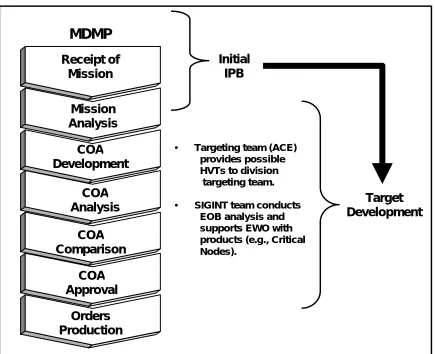
[image:23.612.81.516.209.563.2]4-1. The initial IPB, as a subordinate step to mission analysis (the second step of the MDMP), starts the important analysis that eventually leads to EA planning. In terms of EA planning, the two most important products out of the IPB process (and into target development) are HVTs and EW analysis products. Figure 4-2 illustrates how IPB fits into EA planning.
Figure 4-2. IPB in EA Planning.
HIGH-VALUE TARGETS
4-2. An important part of step 3 of the IPB process (evaluate the threat) is creating or updating threat models. A component of the threat model is generic HVTs. As the G2 Plans Officer provides the framework for the initial IPB (in order to support operational planning), the different portions of the ACE support the production of threat courses of action (COAs) and other IPB products. As the ACE develops threat COAs, the targeting team (ACE) analyzes the generic HVTs. Then they capture the most important HVTs for that particular threat COA into an HVTL. The targeting team (to include the
Receipt of
Mission
Mission
Analysis
COA
Development
COA
Analysis
COA
Comparison
COA
Approval
Orders
Production
• Targeting team (ACE) provides possible HVTs to division targeting team.
• SIGINT team conducts EOB analysis and supports EWO with products (e.g., Critical Nodes).
MDMP
Initial
IPB
EWO) uses the HVTL to help develop HPTs after the wargame. HVTs are not specific or unique to EW; they support the entire targeting process.
EW ANALYSIS PRODUCTS
4-3. The SIGINT team, as part of both ongoing situation development and analytical support to IPB, uses the threat order of battle (OB) and HVTs (from the targeting team) to prepare net diagrams and other graphic planning and execution products. These products help the EWO identify critical communications nodes. These critical nodes are essential to the threat in order to use the EM spectrum. The EWO depends on assistance from the SIGINT team (through the collection manager) to ensure all HVT net diagrams are further broken down to show unique nodes that will disrupt the entire net if “jammed.” These nodes become the initial candidates for EA targets.
TARGET DEVELOPMENT
4-4. During COA analysis (wargaming), threat COAs are analyzed in terms of their impact on friendly COAs. The wargame takes place using an action or reaction technique. The entire staff identifies the enemy battlefield functions that must be attacked. The commander and his staff analyze the criticality of friendly operating systems in the context of a specific COA. The G3 identifies the best places to attack HPTs in relation to the friendly COA; these places are designated TAIs. TAIs are points or areas where the friendly commander can influence the action by lethal or nonlethal fires and/or maneuvers. This manual discusses only those aspects that are most important to describing EA planning. FM 6-20-10 and FM 34-130 provide comprehensive doctrine for target development.
Figure 4-3. Target Development in EA Planning.
HIGH-PAYOFF TARGETS
4-6. Through wargaming the staff identifies the HPTs that must be acquired and attacked for the friendly mission to succeed. During COA analysis, the targeting team develops the HPTL, the targeting portion of the DST, and BOS synchronization matrixes. (This provides times for EA (non-lethal fire.)) For example, during the close fight, enemy artillery could be the priority for lethal and nonlethal fires. From this target set, specific HPTs (for example, an artillery battalion fire direction center [FDC]) is designated for lethal and nonlethal attack for a synergistic effect. The battalion FDC would be engaged with EA to disrupt coordination of fires by causing critical delays during the battle and would eventually be engaged by lethal attack (in accordance with the HPTL, AGM, and the TSS) for destruction. (For a more detailed discussion of the wargaming process, see FM 101-5.)
• Targeting Team and staff develop HPTL and AGM -- both are
critical to collection management.
• HPTL and AGM help the CM team synchronize collection to
targeting (to include ES and EA).
Receipt of
Mission
Mission
Analysis
COA
Development
COA
Analysis
COA
Comparison
COA
Approval
Orders
Production
MDMP
Requirements
Management
• EWO provides EW annex to the SIGINT team through the collection manager.
ATTACK GUIDANCE AND DAMAGE CRITERIA
4-7. Knowing target vulnerabilities and the effect an attack will have on enemy operations allows a staff to propose the most efficient available attack option. The commander provides critical guidance by stating that he wants to disrupt, delay, limit, damage, or destroy the threat.
4-8. The FSCOORD will provide the EWO with a desired level of damage or degradation. The EWO determines if current EA assets are able to range the target and achieve the mission, and how the mission will take place to achieve the desired effect.
EFFECTS OF FIRE
4-9. On the basis of the targeting team’s guidance, the EWO recommends how each EA target should be engaged in terms of the effects of fire and attack options to use. The effects of fire can be to deny, disrupt, delay, and divert the target. The unique nature of EA, a non-lethal fire, and subjective use of these terms means the EWO must clearly communicate the intent of the terminology to both the targeting team and the collection manager. When applied to EA, these terms differ from when applied to describe physical destruction as defined in FM 6-20-10. The following criteria are captured in the AGM and EW annex.
Disrupt
4-10. Disrupt is designed to fragment the target’s nets. This disruption will in turn cause the flow of information to slow, and in some cases stop the flow, until the net control stations can reinitiate the net and its users. When the enemy will attack, this tactic is effective as they move to LD. This tactic is simple to initiate and requires little coordination.
Delay
4-11. Delay is designed to fragment movements and deny the threat the ability to communicate in order to change routes. This tactic will necessitate the use of alternate forms of communication to continue movement (for example, hand-and-arm signals, runners). This effort will cause significant delays to the threat’s movement, especially if tied in with obstacles. Denying the threat the ability to warn other units of obstacles will cause all follow-on units the same delay and could force the lead element to clear the obstacles without engineer support.
Divert
Deny
4-13. Deny is designed to control the EM spectrum and prevent the threat’s use of that spectrum for any communications (whether voice or digital). This nonlethal fire is used at surge periods to act as a battlefield multiplier. The success of this fire denies the threat’s ability to receive intelligence and to pass guidance. These actions in turn place a “stress” on EA assets and cannot be maintained for long periods.
EW TARGETS
4-14. The EWO helps develop the EW targets as an integrated portion of the HPTL. The three categories these targets fall intoplanned, as acquired, and immediateare discussed below.
Planned
4-15. For EW the actual target is the specific communication emitters that are critical to that target set during a specific military operation. The AGM as well as the BOS synchronization matrix will have these targets listed.
As Acquired
4-16. EA teams will engage these targets of opportunity upon detection.
Immediate
4-17. Targets (in the form of specific voice and data communications) are targets that the EWO did not or could not plan but that the targeting team identifies during the conduct of the operation and that require immediate EA.
ADDITIONAL ANALYSIS
4-18. The EWO then analyzes these requirements (in terms of effects and category) to further plan the EA necessary to service the target. He must determine the rough plan based on—
• Target vulnerability (in coordination with the SIGINT team). The EWO and SIGINT analysts use the electronic order of battle (EOB) to determine targets and use the electronic template to designate specific targets inside the target system. These targets will take into account redundant lines of communication (LOCs) and the advisability of engaging other communication links. An SA-8 battery may be identified as a critical target for EA, but due to its redundant communications and short link distance to its subordinate transporter or erector launchers, one can count on knocking out or degrading only one of its communications link. Therefore, the communication links would be "green" for targeting but the overall system would be "red" because it would still function despite the EA.
• System capability (in coordination with the SIGINT team).
• ROE. With the increasing technology of EW and dominance, the monitoring of ethical and humane issues is critical to ensure we do not deprive the local populace of critical casualty care, humanitarian support, and other life support through essential electronic communications.
4-19. The EWO analyzes whether organic assets can perform the mission. If not, the EWO requests support from higher through G3 and FS channels. He must also notify the collection manager when he requests support from higher in order to keep ES and EA synchronized between echelons.
TARGETING PRODUCTS (WITH EA FULLY INTEGRATED)
4-20. The EWO prepares documentation for the missions: • EA targets on the HPTL.
• EA lines of the AGMs.
• The EA portion of the BOS synchronization matrix.
4-21. The EWO must prepare these documents to ensure the synchronization of lethal and nonlethal fires and the synchronization of EA with CM (this includes all three subprocesses—RM, MM, and AM). The end product of this process is the EW annex.
REQUIREMENTS MANAGEMENT
4-22. After target development, the most important products that flow into RM and MM are the HPTL and AGM. The most important products that flow out of RM into MM are the SIR (that the collection manager designates for ES) that support EA. Figure 4-4 illustrates how RM fits into EA planning.
4-23. During RM the collection manager performs a critical role by—
• Focusing the initial collection planning (as described in FM 34-2) to include synchronizing ES requirements to support EA tasks. This synchronization is accomplished when the CM team passes SIR to the SIGINT team.
Figure 4-4. Requirements Management in EA Planning.
4-24. During wargaming the commander and entire staff determine decision points (DPs). When tied to targeting, the DPs ensure the decision to engage (or not to engage) occurs at the proper time. DPs and TAIs are recorded on the DST and are included in the intelligence collection plan. Wargaming helps finalize, among other products, the
• Individual staff estimates.
• Scheme of maneuver and FS plan. • DST and BOS synchronization matrix. • PIR.
• Collection Manager provides SIR to SIGINT team.
• EWO passes AGM and EW annex to the SIGINT team through the collection manager.
Receipt of
Mission
Mission
Analysis
COA
Development
COA
Analysis
COA
Comparison
COA
Approval
Orders
Production
MDMP
Requirements
Management
• The SIR, AGM, and initial EW annex are the focal point for the SIGINT team to perform MM of ES and EA assets.
PRIORITY INTELLIGENCE REQUIREMENTS
4-25. The commander designates his PIR following the wargame. Generally, a PIR should support each HPT or TAI (if the staff plans to engage multiple HPTs within a TAI). This rule ensures that the commander prioritizes collection against HPTs. A latest time intelligence is of value (LTIOV) is a critical part of every PIR. This time (or event in certain circumstances) ensures that friendly collection does not occur after the point when that intelligence is not of use to the commander and friendly forces.
SPECIFIC INFORMATION REQUIREMENTS
4-26. The collection manager initially combines, validates, and prioritizes PIR and IR and prioritizes these sets of requirements. He then he refines these requirements into SIR that are clear, concise, and a “collectible” subset of the larger requirement. The collection manager takes the time to cross-check the HPT-related PIR against the SIR that support these HPTs. He ensures that there are adequate SIR (especially related to ES) to support the EA as captured on the AGM. The SIGINT team helps the collection manager perform this step because of their expertise in EW. Then the collection manager hands the ES-related SIR over to the SIGINT team. At the same time, the collection manager is capturing ES collection on the ISM.
MISSION MANAGEMENT
Figure 4-5. Mission Management in EA Planning.
REEVALUATE TARGET ANALYSIS AND IDENTIFY ADDITIONAL ES COLLECTION REQUIREMENTS
4-28. The G2 Plans Officer initially develops the sensor attack matrix, which is further developed during wargaming. The final signal attack matrix, which is developed by the SIGINT team, is used to determine the sensor to detect and locate targets. This matrix will also determine if the resources are available to detect, locate, and engage a specific target. The collection manager will use this matrix to task intelligence assets in locating targets. 4-29. The SIGINT team examines the analysis performed during target development and reevaluates if any subsequent analysis is necessary against the target. (NOTE: The SIGINT team continually provides intelligence in an easy-to-use format to ensure the EWO chooses valid EA targets during target development.)
4-30. The SIGINT team identifies (and later tasks) ES collection based on the SIR. In order to identify and track the critical communications nodes, the
• Collection Manager performs informal planning collaboration with the MI BOC.
• This collaboration ensures that ES and EA are quickly and efficiently planned without any conflicts.
• Most important output: SIGINT team provides tasking (through an MATM) and technical data to individual ES and EA teams.
Receipt of
Mission
Mission
Analysis
COA
Development
COA
Analysis
COA
Comparison
COA
Approval
Orders
Production
MDMP
MM
(ES and EA)
SIGINT team uses its EW analysis (using All-Source Analysis System [ASAS] workstations) and the latest OB and situation development intelligence from the all-source team.
DETERMINE EA VIABILITY
4-31. The SIGINT team ensures that organic assets can perform the mission. If not, the EWO requests support from higher through G3 and FS channels. Additionally, the SIGINT team reviews the AGM, SIR, any guidance from the EWO, and the EWO’s initial development of the EW annex. The EWO checks for any fragmentary orders (FRAGOs) that may have changed EA or ES missions. There are two important substeps to determine the viability of EA:
• Calculate EA effectiveness. The SIGINT team uses the signal-to-noise ratio (see Appendix B) to determine the effect of EA on targets at different ranges. ASAS provides a function to visualize electronic LOS. These two tools help the SIGINT team ensure that the EA targets are viable. (NOTE: The EWO, who is a subject matter expert on EW, knows the general ranges and capabilities of systems to ensure that the targeting team does not choose a target that EA could not service.) • Assess technical data. The SIGINT team determines if sufficient data
is available. This data will comprise operating frequencies, power output, distance between emitters and receivers, retransmission sites, and any historical information on threat reactions to EA. Additionally, the SIGINT team identifies (and later tasks) possible jump frequencies. The SIGINT team will task ES collection on these frequencies upon initiating EA.
ASSESS EA SYSTEM AVAILABILITY
4-32. The determination of availability is based upon three basic sets of information:
• Current mission tasking. The SIGINT team weighs each asset's current missions, alternate targets, and targets of opportunity against the EW targets and ES collection (in the form of SIR) to determine if the asset can add any missions to its current load.
• Current asset status. This step is based upon system performance. Performance is defined by the asset location (if the location is above targets with good LOS), sufficient power to achieve desired effect, and if the system can hit targets accurately.
• System performance (mechanical [the vehicle system] and technical [system and crew operations]). The SIGINT team maintains an informal record that indicates which systems require a higher degree of maintenance to remain operational.
DETERMINE ATTACK RESOURCES AND SELECT POINT OF ATTACK
perform missions (they will task these assets later). With guidance from the EWO, the SIGINT team prioritizes all missions and targets.
4-34. The SIGINT team creates alternate targets (at least one to each primary target). The SIGINT team designates the number of assets used on each target and any time coverage is necessary to jump assets forward. At this point, main targets are “locked in” while alternate targets are “plotted in” to ensure the mission is feasible.
EM SPECTRUM DECONFLICTION
4-35. The EWO and SIGINT team perform several actions with the support of the G6 to ensure that EA missions do not adversely affect friendly forces' use of the EM spectrum. The SIGINT team gathers data on higher and adjacent units' EW targets and assesses what impact (if any) these actions will have on organic missions and vice versa. This same step is performed with the tasking for EA. The SIGINT team will use the RFL to capture any conflicts between friendly communications and EA missions. Finally, the SIGINT team will determine if any interference will occur, taking into effect the harmonics from the EA mission and, if interference does occur, which task is the priority.
ESTABLISH JAMMING CONTROLS
4-36. The SIGINT team establishes both positive and negative controls on EA assets. It establishes a “stop jam” frequency and states procedures for “stop jam” in case of a loss of communications. The SIGINT team also ensures that the communication frequency is not in the harmonics of the target frequency (if using single channel).
TASK ES AND EA ASSETS
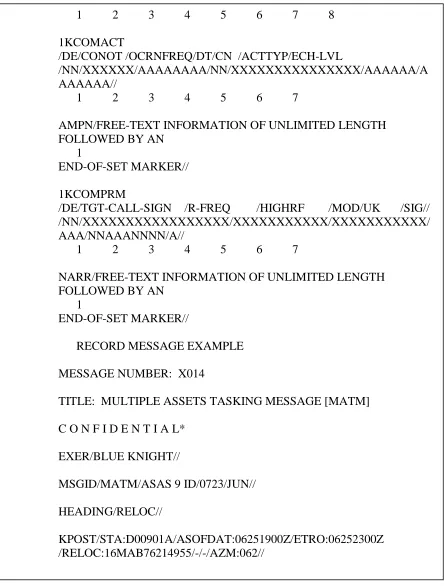
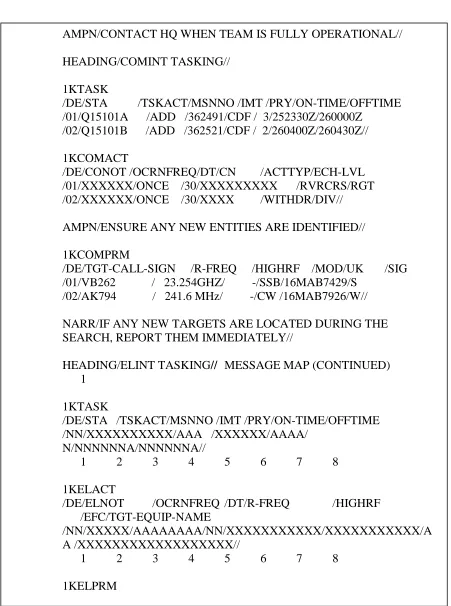
4-37. The SIGINT team tasks ES and EA assets through the multiple assets tasking message (MATM), which is sent digitally or by voice if the asset does not have the capability to receive digital tasking. The MATM for EA assets will contain technical and mission data necessary to accomplish the mission. Technical data will include callsigns, jargon, jump callsigns, signal strength (in Watts), stop jam frequency, and radio procedures to include threat procedures to follow in case of jamming. Mission data will include primary target, time of attack, alternate targets, and targets of opportunity. The MATM for ES assets will include technical data and mission data. The technical data for ES assets will mirror that for EA. Mission data for EA will include SIR, PIR, and the specific EA systems to cue on targets in accordance with the times detailed in the ISM.
ASSET MANAGEMENT
Figure 4-6. Asset Management in EA Planning.
4-39. The MI battalion commander and his Battalion Operations Center (BOC) (coordinating with the collection manager) task organizes EA and ES assets and coordinates the movement of EA and ES systems in order to support EA and ES tasking as developed by the SIGINT team during MM. This task includes planning to provide continuous coverage on the targets while other EA and ES systems move.
• MI BOC performs informal planning collaboration with the collection manager.
• MI Battalion deploys and sustains trained and ready systems to conduct ES and EA in GS or DS role.
• Most important outputs: MI Battalion OPORD, GS MI Company OPORD, and C&J Platoon OPORD.
Receipt of
Mission
Mission
Analysis
COA
Development
COA
Analysis
COA
Comparison
COA
Approval
Orders
Production
MDMP
Chapter 5
Detect
This chapter discusses the deployment of ES systems and the collection
and dissemination of ES data in support of EA. For EA to be successful
on the battlefield, the commander must understand the role of ES and
how to coordinate the ES effort in support of EA.
ELECTRONIC SUPPORT DATA
5-1. ES assets collect information for three purposes: • To provide intelligence.
• To develop the database in the SIGINT team to aid the DECIDE function.
• To cue the EA assets to active targets.
5-2. Currently database development relies heavily on exploiting signal internals, which include what is said that specifically identifies the target and gives target intent. Future ES systems, like PROPHET, will detect and collect signal externals. Signal externals only identify that an emitter is active and is located at a specific grid coordinate. If the ES system is designed to identify what kind of unit is associated with the peculiar characteristics of the emitter, then you will know a little about the unit but not the specifics of its purpose, capabilities, and intent. More detailed analysis, often at echelons higher than that supporting the EA asset, is required to provide this information.
5-3. DETECT is composed of three functions: • Deploy ES and EA assets.
• Collect ES data. • Process SIGINT data.
DEPLOY ELECTRONIC SUPPORT AND ELECTRONIC ATTACK
ASSETS
5-4. Deploying assets is naturally divided into the three basic categories of platforms:
5-5. ES assets are not deployed in the same manner as EA systems. ES systems deploy in various formations to create a baseline which will provide area coverage for specific missions. For example, the "Lazy W" configuration is used for a wide coverage along a front where enemy positions are unknown. Systems will deploy to high ground for best LOS, while still remaining in proximity to adjacent systems in order to maintain system parameters and good baseline for DF and cueing operations. Targets from the HPTL will be found, identified, located, and targeted for a predesignated mission. In the defensive, ES assets are used primarily to identify targets on AAs into the AO.
5-6. EA assets deploy to cover specific areas in response to targeting requirements. EA assets will move to high ground to achieve optimal LOS; generally valleys, passes, roads, and bridges are ideal target areas because they create choke points in which EA is most effective. EA assets will not deploy in the same area unless a high number of targets require two systems or more to cover them.
GROUND AND AIR ASSETS CAPABILITIES
5-7. Air and ground assets have unique capabilities to consider when employing. Employ air and ground assets to complement their capabilities. The collection manager must ensure that the ISM is configured to efficiently fulfill the requirements. Use of EAC assets should never be the sole source of ES. Because EAC ES assets are not organic to the ground commander, they lack the responsiveness and flexibility to collect within a specific area and cross-cue other sensors.
Ground Capabilities
• Advantages:
§ Ability to continue long-term collection and EA regardless of the weather.
§ Can quickly respond to changes in requirements. • Disadvantages:
§ Assets limited in LOS considerations will shut down to jump forward in battle.
§ Terrain limited. Air Capabilities
• Advantages:
§ Ability to overcome the LOS problems encountered by ground assets.
§ Has a standoff capability.
§ Has minimized terrain interference. • Disadvantages:
§ Air assets are extremely weather dependent and are easily found with DF when using EA.
AIRBORNE PLATFORMS
5-8. Airborne deployment falls into three functions. These assets are heavy maintenance items and are generally used during specified periods to provide EA capability on targets not in range of ground assets.
Select Restricted Operation Zone (ROZ)
5-9. The ROZ determines the flight path from which the airborne platform will perform its mission. This function has five steps:
• Step 1. Determine target LOS. This step entails the analysis of LOS by the pilot, the senior operator, and the MI battalion S3. They will analyze the LOS and choose the best possible ROZ to hit the target considering elevation, range, terrain (for example, mountains, bodies of water).
• Step 2. Determine communications LOS. This step, which is performed after the selection of the primary ROZ, ensures communications with the ACE.
• Step 3. Determine area coverage. This step outlines the possible areas of effects for EA. During this step possible ROZs are identified and each is countered against terrain masking. Those ROZs with a high degree of terrain masking are eliminated.
• Step 4. Determine cover and concealment. During this step the pilots will determine the altitude of their aircraft in correspondence to the nearest cover (for example, mountains, ridgelines) for quick evasion of threat’s air defense.
• Step 5. Determine ingress and egress routes. This step provides entry into the ROZ and exit points out of the ROZ for coordination with the BCD. This step is continuously updated as intelligence from the MI battalion S2 brings to light new air threats.
Coordinate ROZ Selection
5-10. This function covers the coordination for air space with the BCD. Pilots will request a ROZ with the MI battalion S3. This request will specify the air space and request it 72 hours in advance. The S3 will then coordinate the request with the Joint Forces Air Component Commander (JFLAC)/A2C2 for the ROZ. This JFLAC/A2C2 at the Corps will then pass the request onto the BCD. The BCD will coordinate with air space managers who decide whether this request is acceptable or if an alternate ROZ is granted due to air space limitations.
Review Air Threat Report
high threat. New intelligence and requirements update steps 2 and 3 continuously.
GROUND MANPACK PLATFORMS
5-12. Manpack collection teams can be deployed alone or in conjunction with other elements. Independently deployed assets will have the additional responsibility of team security and added supply considerations.
Ground Manpack System
5-13. Manpack collection systems provide the commander with unique capabilities when conducting initial entry, stability operations, and support operations. Found in both light and special operations forces (SOF) units, manpack systems have characteristics not found in vehicle systems. Manpack systems are characterized by the following:
• Deployable in areas that are normally not accessible or usable. This access can be constrained by threat forces and/or routes to site. The manpack allows the commander to place teams in areas where vehicle-mounted equipment would present too large of a footprint and terrain is too restrictive for air assets. Due to this, manpack systems are often close to or past the forward line of own troops (FLOT).
• Manpack systems also have a lower battlefield signature due to placement and equipment. Thus they can be used in more low-profile operations and are especially helpful in urban situations.
5-14. Limitations of manpack systems: • Very limited mobility of collection teams.
• Teams may have to rely on outside assets (airlift in most cases) to deploy on the battlefield.
• Manpackable systems are usually not netted, so DF will be limited to lines of bearing (LOBs) from each system.
• Collection teams will be limited on mission duration (normally 3 to 5 days) and METT-TC dependent.
• Current reporting may be limited to voice communications or short data bursts depending on equipment.
• Limited communication link, high security requirements, difficult resupply, and deployment asset.
Special Considerations
extract points fully detailed. If contact is made, team members will move as a group or as individuals back to the predesignated points.
GROUND PLATFORMS
5-16. Current ground systems have to completely shut down in order to change position. The commander must decide on how much of the baseline he is willing to lose for the duration of the movement. A commander can move all or part of the assets. Jumping a part of the baseline at a time allows the commander to maintain coverage of the targets, but this is a slow process. 5-17. In the case of the "Lazy W" configuration, a commander can start movement by jumping the two rear operating systems. Once these systems are in place and operational, the commander would then jump the other three systems. The other option is to move all systems at the same time. The commander can negate the loss of target coverage by coordinating with other assets.
Ground Systems Augmented With Air Assets
5-18. The commander must carefully plan and coordinate for the use of organic aerial assets. The aerial assets add tremendous flexibility to the baseline. Aerial assets
• Can extend the width and depth of the ES ground baseline.
• Can provide coverage on targets while part or all of the ground systems are in movement.
• Provide the commander with on-the-move capability. This becomes the critical issue when the battlefield tempo exceeds the movement capability of the ground systems.
5-19. Deploying ground platforms consists of three interrelated functions:
• Coordinate ES and EA position selection. • Select ES and EA operational sites. • Occupy and prepare selected ES sites.
5-20. Coordinate ES and EA Position Selection. This function is comprised of three actions:
• Select general deployment areas (GDAs). This step consist of five sequential tasks to determine possible sites and their overall advantages and disadvantages.
example, attached security force such as a fire team, collocation of ES and EA assets, or providing your own security with internal assets).
§ Conduct map reconnaissance. In this task the team leader and the POC leader assess possible site locations and routes to and from the sites. The POC leader will indicate each team TAI to ensure focus on each particular AO.
§ Select potential operational sites. From the map reconnaissance the team leader, with input from the POC leader and input from the IPB process, will select the best sites from the potential site list. Elevation, multiple egress routes, LOS of surrounding areas, and minimal terrain masking to surrounding areas are essential for EA/ES.
§ Confirm current security in AO. In this task the team leader coordinates with the POC to ensure that the site selected is secure. The POC will determine if there are indications of enemy activity in the AO, or if there are electronic signatures of enemy transmitters at the potential sites as indicated by DF results collected by friendly ES assets. The POC will ensure the site is not expected to have threat movement through the area or to have strategic importance to the threat.
§ Conduct site reconnaissance. In this task the team leader performs a site reconnaissance on the ground. Several sites will be reconnoitered for use as primary, secondary, or alternate sites. With the rapid flow of the battlefield, there may only be the opportunity to do this only initially or during a defensive phase of the operation. In an early entry force this step will not be performed, and IPB and map reconnaissance will give the best possible site. Under these circumstances OPSEC is paramount. • Coordinate with maneuver unit commander. This step is
composed of five tasks which are sequential in nature. These tasks outline the process of coordinating instructions (the fourth paragraph in the OPORD).
§ Coordinate times and routes for deployment. This task is conducted by the POC leader, who coordinates with the MI battalion S3 (who then coordinates with the G3) through the GS MI company commander for movement and routes. If a POC leader is part of the DS company, he should coordinate through the DS company commander with the S2 and S3 of the unit that owns the terrain (usually a maneuver brigade) and inform the MI battalion S3. This information is passed to the team leader in a FRAGO from the POC leader.
orders process and at the highest level possible. It is not uncommon for conflicts to arise with signal, mortars, scouts, and EWassets all vying for the same piece of ground. The POC leader must ensure these steps have been performed before teams move to these sites.
§ Coordinate security. This task is performed by both the MI company commander and MI battalion S3 who coordinate security for EW assets. The team leader and the POC noncommissioned officer in charge (NCOIC) make the coordination between the ES or EA asset and the maneuver asset that will provide security en route to the predetermined ES or EA site. For example, an ES or EA asset would deploy with scouts who are conducting a reconnaissance mission. Upon reaching the ES or EA site, the scouts will continue with their reconnaissance mission. A security force will not always accompany assets during movement, but it is desirable if possible.
§ Coordinate communications procedures. This task is performed by the team leader during the POC leader's OPORD. The team leader will receive procedures and frequencies during the OPORD, which he will disseminate to the team before movement.
§ Coordinate CSS requirements. The team leader at this point will coordinate any service support requirements for the systems, vehicles, and radios.
• Obtain approval of general deployment area. This step is composed of three tasks to obtain approval for ES and EA systems.
§ Integrate ES mission with host maneuver unit. This task is initiated by the GS MI company commander to ensure the movement and mission of ES and EA assets remain synchronized with the maneuver element.
§ Gain clearance for ES and EA operational areas and sites. The POC will gain clearance from the company commander for operational sites for ES and EA. Some considerations will be the possible duplication of efforts from adjacent units and required baselines for collection. The required baselines will make the ES site selection difficult since the sites must fit into an overall scheme while also having good LOS at each site. EA considerations are units in the line of electronic fire that may experience a communication loss during EA missions. Examples of four possible ES baseline configurations are listed below.
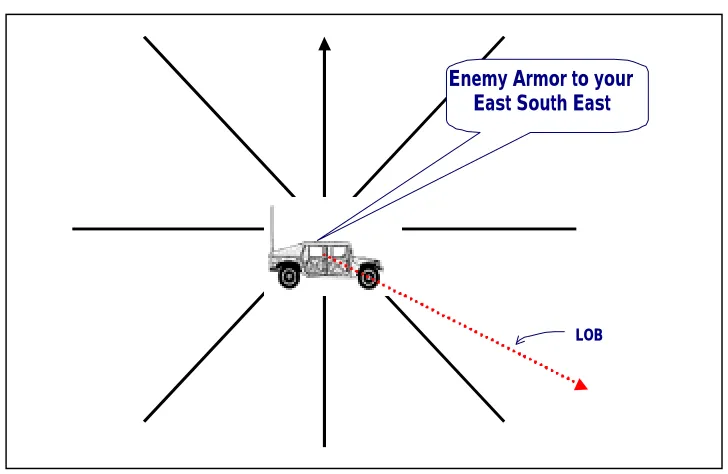
- Standalone, which provides an LOB from the ES asset to the target (Figure 5-1).
- Convex, which provides good LOBs against targets that are located to the sides of the baseline of systems (Figure 5-2). - Concave, which is best, is used when the targets are straight in
- "Lazy-W," which is the most often used configuration because it offers good DF when the target's location in relation to the baseline is unknown (Figure 5-4).
[image:42.612.141.505.216.453.2]§ Gain clearance for ES and EA systems movements. This task is the final coordination done with maneuver element before the asset pushes out to its site. This final clearance will give team leaders a green or red status for movement along predetermined routes.
Figure 5-1. Stand Alone Operations
5-21. Select ES and EA Operational Sites. This function identifies primary, alternate, and supplementary sites as well as provides for preparing site sketches. Communication, target LOS, and range of targets are essential to operations and are part of site selection. Range will always be dependent upon terrain, vegetation, emitter power, distance between receiver and collector, and numerous other factors. The SIGINT team will use the signal-to-noise ratio to ensure EA systems are within range of their respective targets. Also considerations for baselines are imperative in choosing these sites. All possible sites must provide support for the baseline to effect