Extending the Entity-based Coherence Model with Multiple Ranks
Vanessa Wei Feng
Department of Computer Science University of Toronto Toronto, ON, M5S 3G4, Canada
Graeme Hirst
Department of Computer Science University of Toronto Toronto, ON, M5S 3G4, Canada
Abstract
We extend the original entity-based coher-ence model (Barzilay and Lapata, 2008) by learning from more fine-grained coher-ence prefercoher-ences in training data. We asso-ciate multiple ranks with the set of permuta-tions originating from the same source doc-ument, as opposed to the original pairwise rankings. We also study the effect of the permutations used in training, and the effect of the coreference component used in en-tity extraction. With no additional manual annotations required, our extended model is able to outperform the original model on
two tasks:sentence orderingandsummary
coherence rating.
1 Introduction
Coherence is important in a well-written docu-ment; it helps make the text semantically
mean-ingful and interpretable. Automatic evaluation
of coherence is an essential component of vari-ous natural language applications. Therefore, the study of coherence models has recently become an active research area. A particularly popular coherence model is the entity-based local coher-ence model of Barzilay and Lapata (B&L) (2005;
2008). This model represents local coherence
by transitions, from one sentence to the next, in the grammatical role of references to entities. It learns a pairwise ranking preference between al-ternative renderings of a document based on the probability distribution of those transitions. In particular, B&L associated a lower rank with au-tomatically created permutations of a source doc-ument, and learned a model to discriminate an original text from its permutations (see Section
3.1 below). However, coherence is matter of de-gree rather than a binary distinction, so a model based only on such pairwise rankings is insuffi -ciently fine-grained and cannot capture the sub-tle differences in coherence between the permuted documents.
Since the first appearance of B&L’s model, several extensions have been proposed (see Sec-tion 2.3 below), primarily focusing on modify-ing or enrichmodify-ing the original feature set by incor-porating other document information. By con-trast, we wish to refine the learning procedure in a way such that the resulting model will be able to evaluate coherence on a more fine-grained level. Specifically, we propose a concise exten-sion to the standard entity-based coherence model by learning not only from the original docu-ment and its corresponding permutations but also from ranking preferences among the permutations themselves.
We show that this can be done by assigning a suitable objective score for each permutation indi-cating its dissimilarity from the original one. We call this amultiple-rank modelsince we train our model on a multiple-rank basis, rather than tak-ing the original pairwise ranktak-ing approach. This extension can also be easily combined with other extensions by incorporating their enriched feature sets. We show that our multiple-rank model out-performs B&L’s basic model on two tasks, sen-tence ordering and summary coherence rating, evaluated on the same datasets as in Barzilay and Lapata (2008).
In sentence ordering, we experiment with different approaches to assigning dissimilarity scores and ranks (Section 5.1.1). We also exper-iment with different entity extraction approaches
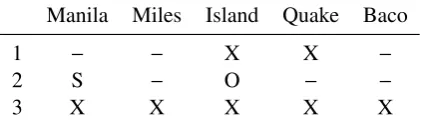
Manila Miles Island Quake Baco
1 − − X X −
2 S − O − −
[image:2.595.75.287.71.134.2]3 X X X X X
Table 1: A fragment of an entity grid for five entities across three sentences.
(Section 5.1.2) and different distributions of per-mutations used in training (Section 5.1.3). We show that these two aspects are crucial, depend-ing on the characteristics of the dataset.
2 Entity-based Coherence Model
2.1 Document Representation
The original entity-based coherence model is based on the assumption that a document makes repeated reference to elements of a set of entities that are central to its topic. For a documentd, an entity grid is constructed, in which the columns represent the entities referred to in d, and rows represent the sentences. Each cell corresponds to the grammatical role of an entity in the corre-sponding sentence: subject (S), object (O),
nei-ther (X), or nothing (−). An example fragment
of an entity grid is shown in Table 1; it shows the representation of three sentences from a text
on a Philippine earthquake. B&L define a
lo-cal transition as a sequence {S,O,X,−}n, repre-senting the occurrence and grammatical roles of
an entity in n adjacent sentences. Such
transi-tion sequences can be extracted from the entity grid as continuous subsequences in each column. For example, the entity “Manila” in Table 1 has a bigram transition {S,X} from sentence 2 to 3. The entity grid is then encoded as a feature vector
Φ(d) = (p1(d),p2(d), . . . ,pm(d)), where pt(d) is
the probability of the transitiontin the entity grid, andmis the number of transitions with length no more than a predefined optimal transition length k. pt(d) is computed as the number of occurrences
oftin the entity grid of document d, divided by the total number of transitions of the same length in the entity grid.
For entity extraction, Barzilay and Lapata
(2008) had two conditions: Coreference+ and
Coreference−. InCoreference+, entity corefer-ence relations in the document were resolved by an automatic coreference resolution tool (Ng and
Cardie, 2002), whereas in Coreference−, nouns
are simply clustered by string matching.
2.2 Evaluation Tasks
Two evaluation tasks for Barzilay and Lapata
(2008)’s entity-based model are sentence
order-ingandsummary coherence rating.
In sentence ordering, a set of random permu-tations is created for each source document, and the learning procedure is conducted on this syn-thetic mixture of coherent and incoherent docu-ments. Barzilay and Lapata (2008) experimented on two datasets: news articles on the topic of earthquakes (Earthquakes) and narratives on the topic of aviation accidents (Accidents). A train-ing data instance is constructed as a pair con-sisting of a source document and one of its ran-dom permutations, and the permuted document is always considered to be less coherent than the source document. The entity transition features are then used to train a support vector machine ranker (Joachims, 2002) to rank the source docu-ments higher than the permutations. The model is tested on a different set of source documents and their permutations, and the performance is evalu-ated as the fraction of correct pairwise rankings in the test set.
In summary coherence rating, a similar exper-imental framework is adopted. However, in this task, rather than training and evaluating on a set of synthetic data, system-generated summaries and human-composed reference summaries from the Document Understanding Conference (DUC 2003) were used. Human annotators were asked to give a coherence score on a seven-point scale for each item. The pairwise ranking preferences between summaries generated from the same in-put document cluster (excluding the pairs consist-ing of two human-written summaries) are used by a support vector machine ranker to learn a dis-criminant function to rank each pair according to their coherence scores.
2.3 Extended Models
their paper described their approach to extending pairwise rankings to longer rankings, by supply-ing the learner with ranksupply-ings of all rendersupply-ings as
computed by Kendall’s τ, which is one of our
extensions considered in this paper. Although
Filippova and Strube simply discarded this idea because it hurt accuracies when tested on their data, we found it a promising direction for further
exploration. Cheung and Penn (2010) adapted
the standard entity-based coherence model to the same German corpus, but replaced the original linguistic dimension used by Barzilay and Lap-ata (2008) — grammatical role — with topologi-cal field information, and showed that for German text, such a modification improves accuracy.
For English text, two extensions have been pro-posed recently. Elsner and Charniak (2011) aug-mented the original features used in the standard entity-based coherence model with a large num-ber of entity-specific features, and their extension significantly outperformed the standard model
on two tasks: document discrimination (another
name forsentence ordering), andsentence inser-tion. Lin et al. (2011) adapted the entity grid rep-resentation in the standard model into a discourse role matrix, where additional discourse informa-tion about the document was encoded. Their ex-tended model significantly improved ranking ac-curacies on the same two datasets used by Barzi-lay and Lapata (2008) as well as on theWall Street Journalcorpus.
However, while enriching or modifying the original features used in the standard model is cer-tainly a direction for refinement of the model, it usually requires more training data or a more so-phisticated feature representation. In this paper, we instead modify the learning approach and pro-pose a concise and highly adaptive extension that can be easily combined with other extended fea-tures or applied to different languages.
3 Experimental Design
Following Barzilay and Lapata (2008), we wish to train a discriminative model to give the cor-rect ranking preference between two documents in terms of their degree of coherence. We experi-ment on the same two tasks as in their work: sen-tence orderingandsummary coherence rating.
3.1 Sentence Ordering
In the standard entity-based model, a discrimina-tive system is trained on the pairwise rankings be-tween source documents and their permutations (see Section 2.2). However, a model learned from these pairwise rankings is not sufficiently fine-grained, since the subtle differences between the permutations are not learned. Our major contribu-tion is to further differentiate among the permuta-tions generated from the same source documents, rather than simply treating them all as being of the same degree of coherence.
Our fundamental assumption is that there exists a canonical ordering for the sentences of a doc-ument; therefore we can approximate the degree of coherence of a document by the similarity be-tween its actual sentence ordering and that canon-ical sentence ordering. Practcanon-ically, we automati-cally assign an objective score for each permuta-tion to estimate its dissimilarity from the source document (see Section 4). By learning from all the pairs across a source document and its per-mutations, the effective size of the training data is increased while no further manual annotation is required, which is favorable in real applica-tions when available samples with manually an-notated coherence scores are usually limited. For
rsource documents each withmrandom
permuta-tions, the number of training instances in the stan-dard entity-based model is thereforer×m, while in our multiple-rank model learning process, it is r×m2+1≈ 12r×m2 >r×m, whenm>2.
3.2 Summary Coherence Rating
Compared to the standard entity-based coherence model, our major contribution in this task is to show that by automatically assigning an objective score for each machine-generated summary to es-timate its dissimilarity from the human-generated summary from the same input document cluster, we are able to achieve performance competitive with, or even superior to, that of B&L’s model without knowing the true coherence score given by human judges.
4 Dissimilarity Metrics
As mentioned previously, the subtle differences among the permutations of the same source docu-ment can be used to refine the model learning
pro-cess. Considering an original documentdand one
of its permutations, we callσ = (1,2, . . . ,N) the reference ordering, which is the sentence order-ing in d, andπ = (o1,o2, . . . ,oN) thetest
order-ing, which is the sentence ordering in that
permu-tation, whereN is the number of sentences being
rendered in both documents.
In order to approximate different degrees of co-herence among the set of permutations which bear the same content, we need a suitable metric to quantify the dissimilarity between the test order-ingπand the reference orderingσ. Such a metric needs to satisfy the following criteria: (1) It can be automatically computed while being highly corre-lated with human judgments of coherence, since additional manual annotation is certainly undesir-able. (2) It depends on the particular sentence ordering in a permutation while remaining inde-pendent of the entities within the sentences; oth-erwise our multiple-rank model might be trained to fit particular probability distributions of entity transitions rather than true coherence preferences.
In our work we use three different metrics:
Kendall’sτdistance,average continuity, andedit distance.
Kendall’s τ distance: This metric has been widely used in evaluation of sentence ordering (Lapata, 2003; Lapata, 2006; Bollegala et al.,
2006; Madnani et al., 2007)1. It measures the
disagreement between two orderingsσ andπin
terms of the number of inversions of adjacent sen-tences necessary to convert one ordering into an-other. Kendall’sτdistance is defined as
τ= 2m
N(N−1),
wheremis the number of sentence inversions
nec-essary to convertσtoπ.
Average continuity (AC): Following Zhang (2011), we use average continuity as the
sec-ond dissimilarity metric. It was first proposed
1Filippova and Strube (2007) found that their
perfor-mance dropped when using this metric for longer rankings; but they were using data in a different language and with manual annotations, so its effect on our datasets is worth try-ing nonetheless.
by Bollegala et al. (2006). This metric
esti-mates the quality of a particular sentence order-ing by the number of correctly arranged contin-uous sentences, compared to the reference order-ing. For example, if π = (. . . ,3,4,5,7, . . . ,oN),
then {3,4,5} is considered as continuous while
{3,4,5,7}is not. Average continuity is calculated as
AC=exp
1 n−1
n X
i=2
log (Pi+α) ,
where n = min(4,N) is the maximum number
of continuous sentences to be considered, and
α= 0.01. Pi is the proportion of continuous
sen-tences of lengthiinπthat are also continuous in the reference ordering σ. To represent the dis -similarity between the two orderingsπandσ, we
use its complementAC0 = 1−AC, such that the
larger AC0 is, the more dissimilar two orderings are2.
Edit distance (ED): Edit distance is a com-monly used metric in information theory to mea-sure the difference between two sequences. Given a test orderingπ, its edit distance is defined as the minimum number of edits (i.e., insertions, dele-tions, and substitutions) needed to transform it into the reference orderingσ. For permutations, the edits are essentially movements, which can be considered as equal numbers of insertions and deletions.
5 Experiments
5.1 Sentence Ordering
Our first set of experiments is on sentence order-ing. Following Barzilay and Lapata (2008), we use all transitions of length≤3 for feature extrac-tion. In addition, we explore three specific aspects in our experiments: rank assignment, entity ex-traction, and permutation generation.
5.1.1 Rank Assignment
In our multiple-rank model, pairwise rankings between a source document and its permutations are extended into a longer ranking with multiple ranks. We assign a rank to a particular permuta-tion, based on the result of applying a chosen dis-similarity metric from Section 4 (τ,AC, orED) to the sentence ordering in that permutation.
We experiment with two different approaches
to assigning ranks to permutations, while each
2We will refer toAC0
source document is always assigned a zero (the highest) rank.
In therawoption, we rank the permutations di-rectly by their dissimilarity scores to form a full ranking for the set of permutations generated from the same source document.
Since a full ranking might be too sensitive to noise in training, we also experiment with the
stratifiedoption, in whichCranks are assigned to the permutations generated from the same source document. The permutation with the smallest dis-similarity score is assigned the same (zero, the highest) rank as the source document, and the one with the largest score is assigned the lowest (C−1) rank; then ranks of other permutations are uni-formly distributed in this range according to their raw dissimilarity scores. We experiment with 3
to 6 ranks (the case whereC = 2 reduces to the
standard entity-based model).
5.1.2 Entity Extraction
Barzilay and Lapata (2008)’s best results were achieved by employing an automatic coreference resolution tool (Ng and Cardie, 2002) for ex-tracting entities from a source document, and the permutations were generated only afterwards — entity extraction from a permuted document de-pends on knowing the correct sentence order and the oracular entity information from the source document — since resolving coreference relations in permuted documents is too unreliable for an au-tomatic tool.
We implement our multiple-rank model with full coreference resolution using Ng and Cardie’s coreference resolution system, and entity
extrac-tion approach as described above — the
Coref-erence+ condition. However, as argued by El-sner and Charniak (2011), to better simulate the real situations that human readers might en-counter in machine-generated documents, such oracular information should not be taken into ac-count. Therefore we also employ two alterna-tive approaches for entity extraction: (1) use the same automatic coreference resolution tool on
permuted documents — we call it the
Corefer-ence± condition; (2) use no coreference
reso-lution, i.e., group head noun clusters by simple
string matching — B&L’s Coreference−
condi-tion.
5.1.3 Permutation Generation
The quality of the model learned depends on the set of permutations used in training. We are not aware of how B&L’s permutations were gen-erated, but we assume they are generated in a per-fectly random fashion.
However, in reality, the probabilities of seeing documents with different degrees of coherence are not equal. For example, in an essay scoring task, if the target group is (near-) native speakers with sufficient education, we should expect their essays to be less incoherent — most of the essays will be coherent in most parts, with only a few minor problems regarding discourse coherence. In such a setting, the performance of a model trained from permutations generated from a uniform distribu-tion may suffer some accuracy loss.
Therefore, in addition to the set of permutations
used by Barzilay and Lapata (2008) (PSBL), we
create another set of permutations for each source document (PSM) by assigning most of the
proba-bility mass to permutations which are mostly sim-ilar to the original source document. Besides its capability of better approximating real-life situ-ations, training our model on permutations gen-erated in this way has another benefit: in the standard entity-based model, all permuted doc-uments are treated as incoherent; thus there are many more incoherent training instances than co-herent ones (typically the proportion is 20:1). In contrast, in our multiple-rank model, permuted
documents are assigned different ranks to
fur-ther differentiate the different degrees of coher-ence within them. By doing so, our model will be able to learn the characteristics of a coherent document from those near-coherent documents as well, and therefore the problem of lacking coher-ent instances can be mitigated.
Our permutation generation algorithm is shown
in Algorithm 1, where α = 0.05, β = 5.0,
MAX NUM= 50, and KandK0are two normal-ization factors to make p(swap num) and p(i,j) proper probability distributions. For each source document, we create the same number of permu-tations asPSBL.
5.2 Summary Coherence Rating
Algorithm 1Permutation Generation.
Input: S1,S2, . . . ,SN;σ=(1,2, . . . ,N)
Choose a number of sentence swaps
swap numwith probabilitye−α×swap num/K
fori=1→swap numdo
Swap a pair of sentence (Si,Sj)
with probabilityp(i, j)=e−β×|i−j|/K0
end for
Output: π=(o1,o2, . . . ,oN)
a simple binary distinction among the summaries generated from the same input document clus-ter; rather, they had human judges give scores for each summary based on its degree of coherence (see Section 3.2). Therefore, it seems that the
subtle differences among incoherent documents
(system-generated summaries in this case) have already been learned by their model.
But we wish to see if we can replace hu-man judgments by our computed dissimilarity scores so that the original supervised learning is converted into unsupervised learning and yet
re-tain competitive performance. However, given
a summary, computing its dissimilarity score is a bit involved, due to the fact that we do not know its correct sentence order. To tackle this problem, we employ a simple sentence align-ment between a system-generated summary and a human-written summary originating from the same input document cluster. Given a system-generated summaryDs = (Ss1,Ss2, . . . ,Ssn) and
its corresponding human-written summary Dh =
(Sh1,Sh2, . . . ,ShN) (here it is possible that n ,
N), we treat the sentence ordering (1,2, . . . ,N) in Dh as σ (the original sentence ordering), and
compute π = (o1,o2, . . . ,on) based on Ds. To
compute each oi in π, we find the most similar
sentenceSh j, j∈[1,N] inDhby computing their
cosine similarity over all tokens in Sh j and Ssi;
if all sentences in Dh have zero cosine similarity
withSsi, we assign−1 tooi.
Onceπis known, we can compute its
“dissimi-larity” fromσusing a chosen metric. But because
nowπis not guaranteed to be a permutation ofσ
(there may be repetition or missing values, i.e.,
−1, inπ), Kendall’sτcannot be used, and we use only average continuityandedit distance as dis-similarity metrics in this experiment.
The remaining experimental configuration is the same as that of Barzilay and Lapata (2008),
with the optimal transition length set to≤2.
6 Results
6.1 Sentence Ordering
In this task, we use the same two sets of source
documents (EarthquakesandAccidents, see
Sec-tion 3.1) as Barzilay and Lapata (2008). Each contains 200 source documents, equally divided between training and test sets, with up to 20
per-mutations per document. We conduct
experi-ments on these two domains separately. For each domain, we accompany each source document with two different sets of permutations: the one used by B&L (PSBL), and the one generated from
our model described in Section 5.1.3 (PSM). We
train our multiple-rank model and B&L’s standard two-rank model on each set of permutations using
theSVMrankpackage (Joachims, 2006), and
eval-uate both systems on their test sets. Accuracy is measured as the fraction of correct pairwise rank-ings for the test set.
6.1.1 Full Coreference Resolution with Oracular Information
In this experiment, we implement B&L’s fully-fledged standard entity-based coherence model, and extract entities from permuted documents us-ing oracular information from the source docu-ments (see Section 5.1.2).
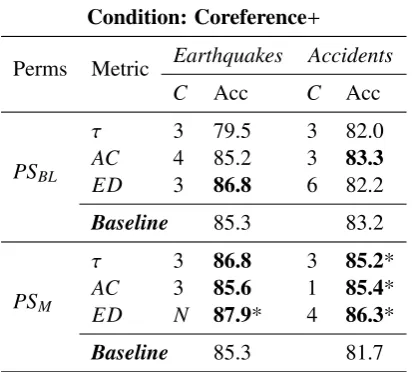
Results are shown in Table 2. For each test sit-uation, we list the best accuracy (inAcccolumns) for each chosen dissimilarity metric, with the
cor-responding rank assignment approach. C
repre-sents the number of ranks used in stratifying raw scores (“N” if usingraw configuration, see Sec-tion 5.1.1 for details). Baselines are accuracies trained using the standard entity-based coherence model3.
Our model outperforms the standard entity-based model on both permutation sets for both
datasets. The improvement is not significant
when trained on the permutation set PSBL, and
is achieved only with one of the three metrics;
3There are discrepancies between our reported accuracies
Condition: Coreference+
Perms Metric Earthquakes Accidents
C Acc C Acc
PSBL
τ 3 79.5 3 82.0
AC 4 85.2 3 83.3
ED 3 86.8 6 82.2
Baseline 85.3 83.2
PSM
τ 3 86.8 3 85.2*
AC 3 85.6 1 85.4*
ED N 87.9* 4 86.3*
[image:7.595.78.285.70.256.2]Baseline 85.3 81.7
Table 2: Accuracies (%) of extending the
stan-dard entity-based coherence model with multiple-rank learning in sentence ordering usingCoreference+ op-tion. Accuracies which are significantly better than the baseline (p< .05) are indicated by *.
but when trained onPSM(the set of permutations
generated from our biased model), our model’s performance significantly exceeds B&L’s4for all three metrics, especially as their model’s perfor-mance drops for datasetAccidents.
From these results, we see that in the ideal sit-uation where we extract entities and resolve their coreference relations based on the oracular infor-mation from the source document, our model is effective in terms of improving ranking accura-cies, especially when trained on our more realistic permutation setsPSM.
6.1.2 Full Coreference Resolution without Oracular Information
In this experiment, we apply the same auto-matic coreference resolution tool (Ng and Cardie, 2002) on not only the source documents but also their permutations. We want to see how removing the oracular component in the original model af-fects the performance of our multiple-rank model and the standard model. Results are shown in Ta-ble 3.
First we can see when trained on PSM,
run-ning full coreference resolution significantly hurts performance for both models. This suggests that, in real-life applications, where the distribution of training instances with different degrees of co-herence is skewed (as in the set of permutations
4Following Elsner and Charniak (2011), we use the
Wilcoxon Sign-rank test for significance.
Condition: Coreference±
Perms Metric Earthquakes Accidents
C Acc C Acc
PSBL
τ 3 71.0 3 73.3
AC 3 *76.8 3 74.5
ED 4 *77.4 6 74.4
Baseline 71.7 73.8
PSM
τ 3 55.9 3 51.5
AC 4 53.9 6 49.0
ED 4 53.9 5 52.3
Baseline 49.2 53.2
Table 3: Accuracies (%) of extending the
stan-dard entity-based coherence model with multiple-rank learning in sentence ordering usingCoreference± op-tion. Accuracies which are significantly better than the baseline (p< .05) are indicated by *.
generated from our model), running full corefer-ence resolution is not a good option, since it al-most makes the accuracies no better than random guessing (50%).
Moreover, considering training using PSBL,
running full coreference resolution has a different influence for the two datasets. ForEarthquakes, our model significantly outperforms B&L’s while
the improvement is insignificant for Accidents.
This is most probably due to the different way that entities are realized in these two datasets. As an-alyzed by Barzilay and Lapata (2008), in dataset Earthquakes, entities tend to be referred to by pro-nouns in subsequent mentions, while in dataset Accidents, literal string repetition is more com-mon.
Given a balanced permutation distribution as
we assumed inPSBL, switching distant sentence
pairs inAccidentsmay result in very similar en-tity distribution with the situation of switching closer sentence pairs, as recognized by the
auto-matic tool. Therefore, compared toEarthquakes,
our multiple-rank model may be less powerful in indicating the dissimilarity between the sentence orderings in a permutation and its source docu-ment, and therefore can improve on the baseline only by a small margin.
6.1.3 No Coreference Resolution
[image:7.595.308.513.71.256.2]Condition: Coreference−
Perms Metric Earthquakes Accidents
C Acc C Acc
PSBL
τ 4 82.8 N 82.0
AC 3 78.0 3 **84.2
ED N 78.2 3 *82.7
Baseline 83.7 80.1
PSM
τ 3 **86.4 N **85.7
AC 4 *84.4 N **86.6
ED 5 **86.7 N **84.6
[image:8.595.304.518.68.174.2]Baseline 82.6 77.5
Table 4: Accuracies (%) of extending the
stan-dard entity-based coherence model with multiple-rank learning in sentence ordering usingCoreference− op-tion. Accuracies which are significantly better than the baseline are indicated by * (p< .05) and ** (p< .01).
[image:8.595.75.287.70.256.2]nouns by string matching. Results are shown in Table 4.
Even with such a coarse approximation of coreference resolution, our model is able to achieve around 85% accuracy in most test cases, except for datasetEarthquakes, training on PSBL
gives poorer performance than the standard model
by a small margin. But such inferior
perfor-mance should be expected, because as explained above, coreference resolution is crucial to this dataset, since entities tend to be realized through pronouns; simple string matching introduces too much noise into training, especially when our model wants to train a more fine-grained discrim-inative system than B&L’s. However, we can see from the result of training on PSM, if the
per-mutations used in training do not involve swap-ping sentences which are too far away, the result-ing noise is reduced, and our model outperforms
theirs. And for dataset Accidents, our model
consistently outperforms the baseline model by a large margin (with significance test at p< .01).
6.1.4 Conclusions for Sentence Ordering
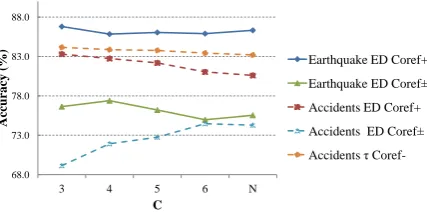
Considering the particular dissimilarity metric used in training, we find thatedit distanceusually stands out from the other two metrics.Kendall’sτ distanceproves to be a fairly weak metric, which is consistent with the findings of Filippova and Strube (2007) (see Section 2.3). Figure 1 plots the testing accuracies as a function of different
68.0 73.0 78.0 83.0 88.0
3 4 5 6 N
Acc
u
racy
(%
)
C
Earthquake ED Coref+
Earthquake ED Coref±
Accidents ED Coref+
Accidents ED Coref±
Accidents τ Coref-
Figure 1: Effect ofCon testing accuracies in selected
sentence orderingexperimental configurations.
choices ofC’s with the configurations where our model outperforms the baseline model. In each configuration, we choose the dissimilarity metric which achieves the best accuracy reported in
Ta-bles 2 to 4 and the PSBL permutation set. We
can see that the dependency of accuracies on the particular choice ofC is not consistent across all experimental configurations, which suggests that this free parameterCneeds careful tuning in dif-ferent experimental setups.
Combining our multiple-rank model with sim-ple string matching for entity extraction is a ro-bust option for coherence evaluation, regardless of the particular distribution of permutations used in training, and it significantly outperforms the baseline in most conditions.
6.2 Summary Coherence Rating
As explained in Section 3.2, we employ a simple sentence alignment between a system-generated summary and its corresponding human-written summary to construct a test orderingπand calcu-late its dissimilarity between the reference
order-ingσ from the human-written summary. In this
way, we convert B&L’s supervised learning model into a fully unsupervised model, since human an-notations for coherence scores are not required. We use the same dataset as Barzilay and Lap-ata (2008), which includes multi-document sum-maries from 16 input document clusters generated by five systems, along with reference summaries composed by humans.
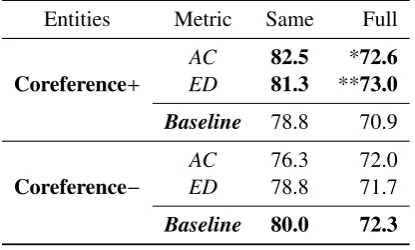
In this experiment, we consider only average
continuity (AC)andedit distance (ED)as dissimi-larity metrics, withrawconfiguration for rank as-signment, and compare our multiple-rank model with the standard entity-based model using ei-ther full coreference resolution5 or no resolution
Entities Metric Same Full
Coreference+
AC 82.5 *72.6
ED 81.3 **73.0
Baseline 78.8 70.9
Coreference−
AC 76.3 72.0
ED 78.8 71.7
[image:9.595.77.285.69.194.2]Baseline 80.0 72.3
Table 5: Accuracies (%) of extending the
stan-dard entity-based coherence model with multiple-rank learning in summary rating. Baselines are results of standard entity-based coherence model. Accuracies which are significantly better than the corresponding baseline are indicated by * (p< .05) and ** (p< .01).
for entity extraction. We train both models on the ranking preferences (144 in all) among sum-maries originating from the same input document
cluster using the SVMrank package (Joachims,
2006), and test on two different test sets: same-cluster test andfull test. Same-cluster test is the one used by Barzilay and Lapata (2008), in which only the pairwise rankings (80 in all) between summaries originating from the same input doc-ument cluster are tested; we also experiment with full test, in which pairwise rankings (1520 in all) between all summary pairs excluding two human-written summaries are tested.
Results are shown in Table 5. Coreference+
and Coreference− denote the configuration of using full coreference resolution or no resolu-tion separately. First, clearly for both models,
performance on full test is inferior to that on
same-cluster test, but our model is still able to achieve performance competitive with the stan-dard model, even if our fundamental assumption about the existence of canonical sentence order-ing in documents with same content may break down on those test pairs not originating from the same input document cluster. Secondly, for the
baseline model, using theCoreference−
configu-ration yields better accuracy in this task (80.0%
vs. 78.8% on same-cluster test, and 72.3% vs.
70.9% on full test), which is consistent with the findings of Barzilay and Lapata (2008). But our
multiple-rank model seems to favor the
Corefer-ence+ configuration, and our best accuracy even
exceeds B&L’s best when tested on the same set:
82.5% vs. 80.0% onsame-cluster test, and 73.0%
vs. 72.3% onfull test.
When our model performs poorer than the baseline (usingCoreference−configuration), the difference is not significant, which suggests that our multiple-rank model with unsupervised score assignment via simple cosine matching can re-main competitive with the standard model, which requires human annotations to obtain a more fine-grained coherence spectrum. This observation is consistent with Banko and Vanderwende (2004)’s discovery that human-generated summaries look quite extractive.
7 Conclusions
In this paper, we have extended the popular co-herence model of Barzilay and Lapata (2008) by adopting a multiple-rank learning approach. This is inherently different from other extensions to this model, in which the focus is on enriching the set of features for entity-grid construction, whereas we simply keep their original feature set intact, and manipulate only their learning method-ology. We show that this concise extension is effective and able to outperform B&L’s standard model in various experimental setups, especially when experimental configurations are most suit-able considering certain dataset properties (see discussion in Section 6.1.4).
We experimented with two tasks: sentence
or-deringandsummary coherence rating, following B&L’s original framework. In sentence ordering, we also explored the influence of removing the oracular component in their original model and dealing with permutations generated from diff er-ent distributions, showing that our model is robust for different experimental situations. In summary coherence rating, we further extended their model such that their original supervised learning is con-verted into unsupervised learning with competi-tive or even superior performance.
Our multiple-rank learning model can be easily adapted into other extended entity-based coher-ence models with their enriched feature sets, and further improvement in ranking accuracies should be expected.
Acknowledgments
References
Michele Banko and Lucy Vanderwende. 2004. Us-ing n-grams to understand the nature of summaries. In Proceedings of Human Language Technologies and North American Association for Computational Linguistics 2004: Short Papers, pages 1–4.
Regina Barzilay and Mirella Lapata. 2005. Modeling local coherence: An entity-based approach. In Pro-ceedings of the 42rd Annual Meeting of the Asso-ciation for Computational Linguistics (ACL 2005), pages 141–148.
Regina Barzilay and Mirella Lapata. 2008. Modeling local coherence: an entity-based approach. Compu-tational Linguistics, 34(1):1–34.
Danushka Bollegala, Naoaki Okazaki, and Mitsuru
Ishizuka. 2006. A bottom-up approach to
sen-tence ordering for multi-document summarization. In Proceedings of the 21st International Confer-ence on Computational Linguistics and 44th Annual Meeting of the Association for Computational Lin-guistics, pages 385–392.
Jackie Chi Kit Cheung and Gerald Penn. 2010. Entity-based local coherence modelling using topological
fields. In Proceedings of the 48th Annual
Meet-ing of the Association for Computational LMeet-inguis- Linguis-tics (ACL 2010), pages 186–195.
Marie-Catherine de Marneffe, Bill MacCartney, and
Christopher D. Manning. 2006. Generating typed dependency parses from phrase structure parses. In
Proceedings of the 5th International Conference on Language Resources and Evaluation (LREC 2006). Micha Elsner and Eugene Charniak. 2011. Extending the entity grid with entity-specific features. In Pro-ceedings of the 49th Annual Meeting of the Asso-ciation for Computational Linguistics (ACL 2011), pages 125–129.
Katja Filippova and Michael Strube. 2007. Extend-ing the entity-grid coherence model to semantically related entities. InProceedings of the Eleventh Eu-ropean Workshop on Natural Language Generation (ENLG 2007), pages 139–142.
Thorsten Joachims. 2002. Optimizing search
en-gines using clickthrough data. In Proceedings of
the 8th ACM SIGKDD International Conference on Knowledge Discovery and Data Mining (KDD 2002), pages 133–142.
Thorsten Joachims. 2006. Training linear SVMs
in linear time. In Proceedings of the 12th ACM
SIGKDD International Conference on Knowledge Discovery and Data Mining (KDD 2006), pages 217–226.
Mirella Lapata. 2003. Probabilistic text structuring:
Experiments with sentence ordering. In
Proceed-ings of the 41st Annual Meeting of the Association for Computational Linguistics (ACL 2003), pages 545–552.
Mirella Lapata. 2006. Automatic evaluation of
in-formation ordering: Kendall’s tau. Computational
Linguistics, 32(4):471–484.
Ziheng Lin, Hwee Tou Ng, and Min-Yen Kan. 2011. Automatically evaluating text coherence using dis-course relations. InProceedings of the 49th Annual Meeting of the Association for Computational Lin-guistics (ACL 2011), pages 997–1006.
Nitin Madnani, Rebecca Passonneau, Necip Fazil Ayan, John M. Conroy, Bonnie J. Dorr, Ju-dith L. Klavans, Dianne P. O’Leary, and JuJu-dith D. Schlesinger. 2007. Measuring variability in
sen-tence ordering for news summarization. In
Pro-ceedings of the Eleventh European Workshop on Natural Language Generation (ENLG 2007), pages 81–88.
Vincent Ng and Claire Cardie. 2002. Improving ma-chine learning approaches to coreference resolution. InProceedings of the 40th Annual Meeting on Asso-ciation for Computational Linguistics (ACL 2002), pages 104–111.
Michael Strube and Simone Paolo Ponzetto. 2006.
Wikirelate! Computing semantic relatedness using
Wikipedia. In Proceedings of the 21st National
Conference on Artificial Intelligence, pages 1219– 1224.