Proceedings of the Third Conference on Machine Translation (WMT), Volume 2: Shared Task Papers, pages 860–866
STACC, OOV Density and N-gram Saturation: Vicomtech’s Participation
in the WMT 2018 Shared Task on Parallel Corpus Filtering
Andoni Azpeitia and Thierry Etchegoyhen and Eva Mart´ınez Garcia
Vicomtech Mikeletegi Pasalekua, 57
Donostia / San Sebasti´an, Gipuzkoa, Spain
{tetchegoyhen, aazpeitia, emartinez}@vicomtech.org
Abstract
We describe Vicomtech’s participation in the WMT 2018 Shared Task on parallel corpus filtering. We aimed to evaluate a simple ap-proach to the task, which can efficiently pro-cess large volumes of data and can be eas-ily deployed for new datasets in different lan-guage pairs and domains. We based our ap-proach on STACC, an efficient and portable method for parallel sentence identification in comparable corpora. To address the specifics of the corpus filtering task, which features significant volumes of noisy data, the core method was expanded with a penalty based on the amount of unknown words in sentence pairs. Additionally, we experimented with a complementary data saturation method based on source sentence n-grams, with the goal of demoting parallel sentence pairs that do not contribute significant amounts of yet unob-served n-grams. Our approach requires no prior training and is highly efficient on the type of large datasets featured in the corpus filtering task. We achieved competitive results with this simple and portable method, ranking in the top half among competing systems overall.
1 Introduction
Data-driven approaches to Machine Translation (MT) have been the dominant paradigm in the last two decades, with the development of Statistical Machine Translation (SMT) (Brown et al.,1990), and, more recently, of Neural Machine Transla-tion (NMT) (Bahdanau et al., 2015). These ap-proaches require large volumes of parallel sen-tences to properly model translation in a given lan-guage pair. However, large quality parallel cor-pora based on human translations are scarce across language pairs, and there is a strong need to build clean corpora from different sources.
The World Wide Web is a rich source of mul-tilingual data, from which parallel corpora can
be automatically created under appropriate condi-tions of use (Forcada et al.,2016). However, cor-pora created via crawling, with automated docu-ment and sentence aligndocu-ment, tend to exhibit sig-nificant volumes of noisy data, which can be detri-mental to the training ofMTsystems (Khadivi and
Ney,2005;Khayrallah and Koehn,2018a). The task of cleaning noisy data from parallel corpora has been tackled by various researchers over the years. In (Munteanu and Marcu, 2005), noise removal is performed via a maximum en-tropy model trained on observations of clean and noisy data. Espl´a-Gomis and Forcada(2009) in-clude sentence alignment scores in BiTextor, a tool that performs the complete chain of corpus creation from web data, to filter dubious sen-tence pairs. In (Khadivi and Ney,2005), two ap-proaches are evaluated, based on length and on lexical translation likelihood, showing statistically significant improvements in translation quality us-ing the filtered corpus. An unsupervised filter-ing method based on outlier detection is proposed in (Taghipour et al., 2011), who also report im-provements in translation quality from their fil-tered corpus. In (Cui et al., 2013), the approach to data filtering is based on graph-based random walks, with improvements observed for Chine-English machine translation. Recently, Xu and Koehn(2017) introduced Zipporah, a fast data se-lection system for noisy parallel corpora, which is shown to result in improvedSMTsystem quality.
The WMT 2018 task on parallel corpus filter-ing offers the possibility to compare different ap-proaches to the task, evaluating their impact on bothSMTandNMTsystems on several test sets in different domains. Our participation in the task aimed to evaluate a simple and portable approach, based on the efficient STACC system for paral-lel sentence extraction from comparable corpora (Etchegoyhen and Azpeitia, 2016). We extended
the original approach with a simple method based on the number of unknown words, to tackle the significant amounts of noise featured in the corpus filtering task. Additionally, we experimented with a simple approach to data redundancy, based on n-gram saturation. Our contribution centred on pro-viding a sound method that can be easily deployed, does not require prior training, and can efficiently process large volumes of data.
2 Approach
Our approach to the task is based on STACC, a portable and efficient method for the identifica-tion of parallel sentences in comparable corpora (Etchegoyhen and Azpeitia,2016) which obtained the best results for all language pairs in theBUCC shared tasks (Azpeitia et al.,2017,2018). As the method assigns an alignment score to source and target sentence pairs, it can be directly applied to parallel corpus filtering as well, with a simple ex-tension for this specific task. We describe the com-ponents of our approach in the next sub-sections.
2.1 STACC
The STACC approach has been described and ex-plored in detail in (Etchegoyhen and Azpeitia, 2016), and we briefly summarise below how simi-larity is computed with this method.
Let si and sj be two tokenised and truecased
sentences in languagesl1 andl2, respectively, Si
the set of tokens insi,Sjthe set of tokens insj,Tij
the set of lexical translations intol2for all tokens inSi, andTjithe set of lexical translations intol1 for all tokens inSj.1
Lexical translations are initially computed from sentencessi andsj by retaining thek-best
trans-lations for each word, if any, as determined by the ranking obtained from the lexical translation prob-abilities computed withIBMword alignment mod-els (Brown et al.,1990). The setsTij andTji that
comprise thesek-best lexical translations are then
expanded by means of two operations:
1. For each elementxin the set differenceTij0 =
Tij −Sj (respectivelyTji0 = Tji −Si), and
each elementy inSj (respectivelySi), if x
and y share a common prefix of more than ncharacters, the prefix is added to both Tij
1As in the original approach, we use sets rather than
mul-tisets, i.e. without repeated elements. The termtokensrefers to the components of the tokenised sentences, and repeated tokens are thus only represented once in the sets.
andSj(respectivelyTjiandSi). This longest
common prefix matching strategy is meant to capture morphological variation via minimal computation.
2. Numbers and capitalised truecased tokens not found in the translation tables are added to the expanded translation sets Tij and Tji. This operation addresses named entities,
which are strong indicators of potential align-ment given their low relative frequency and are likely to be missing from translation ta-bles trained on different domains.
With source and target sets as defined here, the STACC similarity score is then computed as in Equation1:
stacc(si, sj) =
|Tij∩Sj|
|Tij∪Sj|+
|Tji∩Si|
|Tji∪Si|
2 (1)
Similarity for the core metric is thus defined as the average of the Jaccard similarity coeffi-cients obtained between sentence token sets and expanded lexical translations in both directions.
The STACC approach has been extended in (Azpeitia et al., 2017, 2018), notably via a word weighting scheme that led to significant improve-ments in the parallel sentence extraction task. In this work, we used the original weightless ap-proach, as it performed slightly better in prelim-inary experiments on the noisy web data of the WMT 2018 task.
2.2 OOV Density
The corpus for the WMT 2018 shared task on parallel corpus filtering features significant vol-umes of noise, as is typical with parallel cor-pora gathered via web crawling that targets recall. (Khayrallah and Koehn, 2018b) manually exam-ined a sample of data generated by the Paracrawl project,2 of the type used in this shared task,
and identified as noise misaligned sentences, con-tent in the wrong languages, untranslated sen-tences, random byte or HTML markup sequences. The latter four types can be notably characterised as displaying significant percentages of out-of-vocabulary (OOV) words, assuming a out-of-vocabulary extracted from a separate parallel corpus with lim-ited amounts of noisy data.
As previously described, the STACC approach, which constitutes the core of our method, is geared
towards computing alignment scores in compara-ble corpora, with lower volumes of noise, notably allowing OOV words to contribute to the score if they are capitalised words in truecased sentences or numbers. This enables the capture of surface-defined named entities, which are a decisive fac-tor for parallel sentence identification in compara-ble datasets (Azpeitia et al.,2018). However, this approach can be weaker in highly noisy datasets, where, for instance, random sequences of numbers may lead to an unwarranted high alignment score. Since we aimed to avoid adding task-specific cleanup heuristics, such as performing time-consuming language identification or filtering se-quences in an ad-hoc manner, we experimented with a penalty based on the number of unknown words in the corpus to be filtered, determined from the separate parallel corpus used to extract lexical translations. The penalty is computed as follows for each sentences, source or target, where|oov|
is the number of unknown words in the sentence and|s|is the sentence length, in number of words:
p(s) = 1−|oov|
|s| (2)
The STACC.OOValignment score for each sen-tence pair (si,sj) is then computed as follows:
stacc.oov(si, sj) =stacc(si, sj)·
p(si) +p(sj)
2
(3) Thus, sentences with a small amount of OOV words, of interest to extend MT coverage, will be assigned a score close to the originalSTACCscore, whereas the score for dubious sentences with large numbers of unknown words will tend to zero. Our primary submission was based on the metric in Equation 3, as the initial goal of the task was to assign an absolute alignment quality score.
2.3 N-gram Saturation
The organisers of the shared task had allowed the use of metrics that did not score sentences in iso-lation. That is, sentence pairs could be scored by considering their redundancy with regards to higher scoring pairs. This aspect enables the de-sign of methods that select the n-best sentence pairs to train machine translation models.
To experiment with data redundancy, we imple-mented a simple method based on n-gram cover-age, similar in spirit to the n-gram coverage and
saturation methods ofEck et al.(2005) andLewis and Eetemadi (2013). The method can also be related to the Feature Decay approach proposed in (Bic¸ici and Yuret, 2011), originally applied to SMT models and recently evaluated on NMT as well (Poncelas et al.,2018).
We compute n-gram saturation by first sorting the corpus according to the STACC.OOV scores, from high to low scores. We then process the sorted corpus by extracting n-grams (up to a spe-cific order n) from each source sentence, storing
the collected n-grams in a Patricia trie T (
Mor-rison,1968) for fast retrieval, and computing the amount of new n-grams for each sentence. The steps for a given sentencesare described below:
1. Retrieve all n-grams ins.
2. Determine all new n-grams from step 1, i.e. n-grams not found in the trieT.
3. Compute the ratio of new to existing n-grams insas in Equation4, for each n-gramngup
to orderk:
ngsat(s) =
k
P
n=1
ngn∈/ T
k
P
n=1
ngn∈T
(4)
4. Add all new n-grams to the trieT.
Finally, we compute the score of the STACC.OOV.NGSAT variant for each sentence pair by multiplying the pair’s existing score in the sorted corpus, computed as in Equation3, by
its ngsat score. Thus, pairs that provide no new
n-grams would get an overall score of zero, while pairs with a large amount of new n-grams would get a score close to the existing score.
MT SYSTEM AVG RANK NEWS IWSLT ACQUIS EMEA GLOBAL KDE
SMT10M BEST 24.58 1/48 29.59 22.16 21.45 28.28 22.67 25.51
SMT10M STACC.OOV 23.25 16/48 27,48 20.42 19.33 26.51 21.20 24.55
SMT10M STACC.OOV.NGSAT 23.29 13/48 27,52 19.80 19.33 26.84 21.12 25.14
SMT100M BEST 26.50 1/48 31.35 23.17 22.51 31.45 24.00 26.93
SMT100M STACC.OOV 25.91 24/48 30.47 22.47 22.16 30.30 23.43 26.63 SMT100M STACC.OOV.NGSAT 25.80 29/48 30.17 22.39 22.12 30.03 23.36 26.70
NMT10M BEST 28.62 1/48 36.04 25.23 25.30 32.72 26.72 28.25
NMT10M STACC.OOV 26.35 13/48 32.33 22.57 22.55 28.96 24.28 27.39
NMT10M STACC.OOV.NGSAT 25.64 17/48 31.25 21.81 20.67 29.09 23.48 27.56
NMT100M BEST 32.06 1/48 39.85 27.43 28.36 36.70 29.26 30.79
[image:4.595.177.421.225.340.2]NMT100M STACC.OOV 30.40 27/48 37.08 26.35 26.81 34.54 27.74 29.89 NMT100M STACC.OOV.NGSAT 24.91 40/48 27.23 22.44 23.15 26.92 22.94 26.76
Table 1: Results on the WMT 2018 test sets
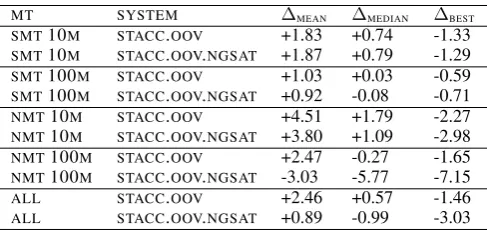
MT SYSTEM ∆MEAN ∆MEDIAN ∆BEST
SMT10M STACC.OOV +1.83 +0.74 -1.33 SMT10M STACC.OOV.NGSAT +1.87 +0.79 -1.29 SMT100M STACC.OOV +1.03 +0.03 -0.59
SMT100M STACC.OOV.NGSAT +0.92 -0.08 -0.71
NMT10M STACC.OOV +4.51 +1.79 -2.27 NMT10M STACC.OOV.NGSAT +3.80 +1.09 -2.98 NMT100M STACC.OOV +2.47 -0.27 -1.65
NMT100M STACC.OOV.NGSAT -3.03 -5.77 -7.15
ALL STACC.OOV +2.46 +0.57 -1.46
ALL STACC.OOV.NGSAT +0.89 -0.99 -3.03
Table 2: Scoring differences on core statistics
and also assume the initial ordering provided by theSTACC.OOVscores. Finally, our approach dif-fers from the Feature Decay method in (Bic¸ici and Yuret,2011) on several aspects, as it is not based on rate of decay and n-gram saturation scores are computed in a single pass on the corpus to be fil-tered, without referring to source test features.
Our goal in experimenting with n-gram satu-ration was mainly to include a low complexity method that could account for data redundancy in a simple way. The scope of the experiments was also reduced to only cover n-grams on the source side, as we meant to evaluate the impact of data redundancy in terms of source context coverage. This evidently excludes cases where a saturated source context can be translated differently in the target language, which can impact the number of learned translation options and subsequently affect evaluation scores. We leave further evaluations of such cases for future research. In the next sections, we evaluate theSTACC.OOV.NGSATvariant as our secondary submission to the WMT 2018 task.
3 Experimental Setup
Our approach implies only minimal deployment settings. We ran STACC with the following two hyper-parameters: minimal prefix length was set to4 and k-best translation lists limited to5
can-didates. For the STACC.OOV.NGSAT variant, the n-gram order was set to3.
For the lexical translation tables needed by the STACC algorithm, we trained IBM2 models with the FASTALIGN toolkit (Dyer et al., 2013), on corpora made available for the WMT 2018 news translation task. The corpora thus included
Eu-roparl v7, Common Crawl, NewsCommentary,
and the Rapid corpus of EU press releases. The
Paracrawlcorpus was excluded from the training
data in order to extract reliable lexical translation tables from less noisy bilingual corpora. After du-plicates removal, the training corpus amounted to
5,623,721parallel sentences.
The corpus was processed on an in-house server, using 64 threads. The total processing time for the 104 million sentence pairs of the corpus was around 57 minutes with theSTACC.OOV vari-ant, consuming a maximum of 11.3GB of RAM. With the STACC.OOV.NGSAT variant, processing time was approximately 5 times slower, with an order of magnitude larger consumption of RAM, mainly due to our online trie computation.
no-tably experimented with the variant in (Azpeitia et al.,2017), where the STACCscore is computed via frequency-based lexical weighting that favours content words, and the variant in (Azpeitia et al., 2018), which features a scoring penalty that pro-motes named-entity matching. Although the dif-ferences were minor, the originalSTACCapproach performed better overall and was thus selected as the core of the metric for our final submissions.
4 Results
The results of our approach on the WMT 2018 test sets are shown in Table1.3 Overall, our
pri-mary submission,STACC.OOVperformed well on the task, ranking in the top third forSMT10Mand NMT10M, and as a mid-performing system in the other two scenarios. Given the simplicity and ef-ficiency of our approach, and the relatively minor differences with the top performing systems, we view these results as quite satisfactory.
The ranking was relatively uniform between test sets, with the notable exception of theKDEtest set for which our approach was among the top 10 sub-missions in 3 out of 4 scenarios, and ranked 20th in the fourth case. This may be due to the fact that our scores are assigned purely in terms of align-ment and not geared towards selecting sentence pairs that may be more informative for the news domain or similar, for instance. Thus, short sen-tence pairs with technical content that are correct translations will receive high scores although they may not be the most relevant pairs for the other test sets that feature less technical language.
Both systems performed similarly for SMTand NMTin terms of rankings obtained on the 10M and 100M versions. The variant of our approach that includes n-gram saturation performed similarly to our primary submission overall forSMT, but worse for NMT. Given these results and the fact that computing n-gram saturation is more resource-consuming, our primary submission was the op-timal option of the two. A more detailed anal-ysis would be needed to evaluate the causes for the drop caused by n-gram saturation forNMT. It could be conjectured thatNMTtraining is optimal
3For ease of presentation, we only indicate the official
re-sults in terms ofC-BLEUscores, as provided by the shared
task organisers. Along with the results of our systems, we also indicate the scores of the best system for each test set. The columnAVGindicates the average score across all test
sets andRANKdenotes the ranking of the system among all
participants according to the average score.
with the largest number of contextual variants in the training data, variants which would tend to be demoted via n-gram saturation. Phrase-basedSMT can be considered less sensitive to contextual vari-ants, given its core phrase-independence transla-tion assumptransla-tion. We leave a more precise analysis of these aspects for future research.4
To further compare our systems to the other submissions, we computed the core statistics on the average scores of all systems. In Table 2we indicate the differences between our submission scores and the mean (∆MEAN), median (∆MEDIAN)
and best (∆BEST) scores. In the last two rows of
the table, we indicate the average differences for all scenarios in each category.
Our system performed better than the mean, in particular for NMT, with improvements of 4.51
and 2.47 for the primary submission. The one
exception is the n-gram saturation variant, whose performance dropped significantly forNMT100M, which may be explained under the aforementioned conjecture. The results in terms of the median are in line with the rather similar results obtained by a large number of participating systems.
Another notable aspect illustrated by this view of the results is the relatively higher differences with respect to the best performing system when consideringNMTresults, with a 1BLEUpoint ference on average. Determining whether this dif-ference reflects a systematic tendency would re-quire a larger set of experiments with different cor-pora and language pairs. On average, our primary submission was1.46 BLEUpoints below the best system and2.46points above the mean.
Consider-ing also the high efficiency of the approach, which 4As pointed out by one of the reviewers, an alternative
explanation could be formulated.SMTsystems are more
sen-sitive to missing n-grams, contrary to NMT models, which
rely on word embeddings and are thus less sensitive to spe-cific words or n-grams. Thus, rather thanNMTneeding more contextual variants, the results could reflect thatSMT bene-fits more from the additional n-grams provided via the satu-ration method, whereasNMTsuffers from the imbalance in the training data that results from n-gram saturation filter-ing. Although this explanation has its merits, it would also warrant further examination. First, our results did not actu-ally improve when using n-gram saturation forSMT, overall, which would tend to show that the additional n-grams col-lected via saturation did not have a significant impact in these experiments; onlyNMTsystems were negatively impacted by
the saturation method. Secondly, the suggested data imbal-ance could actually be viewed as a reduction in contextual variants, as we hypothesised, which could impact the compu-tation of both embeddings and context vectors in attention-basedNMT. Whether data imbalance could be viewed
can process the104M parallel sentences in under an hour without the need for language-dependent tools nor any prior training, we view our method as a practical and reliable alternative to filter large noisy parallel corpora.
5 Conclusions
We have described our participation in the WMT 2018 shared task on parallel corpus filtering. Our approach was based on the STACCsystem, which only requires lexical translation tables to assign alignment quality scores. For this task, the core system was augmented with a simple penalty based on the number of unknown words in the sentences, to account for the significant volumes of noise in the corpus. Additionally, we experi-mented with a simple n-gram saturation scheme to evaluate the impact of demoting redundant data.
The results were satisfactory for such a sim-ple and computationally efficient approach, which does not require prior training, sophisticated set-ups, language-dependent analysers, complex fea-ture sets or extensive computational resources. In fact, our approach only requires pre-trainedIBM2 lexical translation tables, which can be efficiently computed with generic off-the-shelf tools. We achieved competitive results overall, ranking in the top half among competing systems overall, with scores above the mean and less than1.5BLEU points below the top performing systems on aver-age. The n-gram saturation variant did not provide significant improvements and actually performed significantly worse in one scenario, while also consuming more computational resources. The simpler primary variant of the system thus proved optimal for the task and more research would be needed to better account for data redundancy within our core approach.
The system we submitted is also quite efficient, being able to process the 104M sentence pairs in the task corpus in under an hour. Overall, we view our approach as a portable and efficient method to filter noisy data from parallel corpora. In future work, we will evaluate variants of the approach, exploring in particular the specifics of the data fea-tured in different domains.
Acknowledgements We wish to thank the anonymous WMT 2018 reviewers for their de-tailed and helpful reviews of this work. Opinions, errors and omissions are our own.
References
Andoni Azpeitia, Thierry Etchegoyhen, and Eva Mart´ınez Garcia. 2017. Weighted Set-Theoretic Alignment of Comparable Sentences. In Proceed-ings of the Tenth Workshop on Building and Using Comparable Corpora, pages 41–45.
Andoni Azpeitia, Thierry Etchegoyhen, and Eva Mart´ınez Garcia. 2018. Extracting Parallel Sen-tences from Comparable Corpora with STACC Vari-ants. In Proceedings of the Eleventh Workshop on Building and Using Comparable Corpora, pages 48–52.
Dzmitry Bahdanau, Kyunghyun Cho, and Yoshua Ben-gio. 2015. Neural machine translation by jointly learning to align and translate. In Proceedings of the International Conference on Learning Represen-tations.
Ergun Bic¸ici and Deniz Yuret. 2011. Instance Selec-tion for Machine TranslaSelec-tion using Feature Decay Algorithms. In Proceedings of the Sixth Workshop on Statistical Machine Translation, pages 272–283. Peter F Brown, John Cocke, Stephen A Della Pietra,
Vincent J Della Pietra, Fredrick Jelinek, John D Laf-ferty, Robert L Mercer, and Paul S Roossin. 1990. A Statistical Approach to Machine Translation. Com-putational linguistics, 16(2):79–85.
Lei Cui, Dongdong Zhang, Shujie Liu, Mu Li, and Ming Zhou. 2013. Bilingual data cleaning for SMT using graph-based random walk. InProceedings of the 51st Annual Meeting of the Association for Com-putational Linguistics, volume 2, pages 340–345. Chris Dyer, Victor Chahuneau, and Noah A. Smith.
2013. A simple, Fast, and Effective Reparameteri-zation of IBM Model 2. InProceedings of The 2013 Conference of the North American Chapter of the Association for Computational Linguistics: Human Language Technologies.
Matthias Eck, Stephan Vogel, and Alex Waibel. 2005. Low cost portability for statistical machine transla-tion based on n-gram coverage. In Proceedings of MTSummit X.
Miquel Espl´a-Gomis and Mikel L Forcada. 2009. Bi-textor, a free/open-source software to harvest trans-lation memories from multilingual websites. Pro-ceedings of MT Summit XII.
Thierry Etchegoyhen and Andoni Azpeitia. 2016. Set-Theoretic Alignment for Comparable Corpora. In
Proceedings of the 54th Annual Meeting of the As-sociation for Computational Linguistics, volume 1: Long Papers, pages 2009–2018.
Shahram Khadivi and Hermann Ney. 2005. Automatic filtering of bilingual corpora for statistical machine translation. In International Conference on Appli-cation of Natural Language to Information Systems, pages 263–274. Springer.
Huda Khayrallah and Philipp Koehn. 2018a. On the impact of various types of noise on neural machine translation. CoRR, abs/1805.12282.
Huda Khayrallah and Philipp Koehn. 2018b. On the impact of various types of noise on neural machine translation. arXiv preprint arXiv:1805.12282.
William Lewis and Sauleh Eetemadi. 2013. Dramati-cally reducing training data size through vocabulary saturation. InProceedings of the Eight Workshop on Statistical Machine Translation, pages 281–291.
Donald R Morrison. 1968. Patricia practical algo-rithm to retrieve information coded in alphanumeric.
Journal of the ACM (JACM), 15(4):514–534.
Dragos Stefan Munteanu and Daniel Marcu. 2005. Im-proving machine translation performance by exploit-ing non-parallel corpora. Computational Linguis-tics, 31(4):477–504.
Alberto Poncelas, Gideon Maillette de Buy Wenniger, and Andy Way. 2018. Feature decay algorithms for neural machine translation.
Kaveh Taghipour, Shahram Khadivi, and Jia Xu. 2011. Parallel corpus refinement as an outlier detection al-gorithm. Proceedings of the 13th Machine Transla-tion Summit (MT Summit XIII), pages 414–421.