The Inside-Outside Recursive Neural Network model for
Dependency Parsing
Phong Le and Willem Zuidema Institute for Logic, Language, and Computation
University of Amsterdam, the Netherlands
{p.le,zuidema}@uva.nl
Abstract
We propose the first implementation of an infinite-order generative dependency model. The model is based on a new recursive neural network architecture, the Inside-Outside Recursive Neural Network. This architecture allows information to flow not only bottom-up, as in traditional recursive neural networks, but also top-down. This is achieved by computing content as well as context representations for any constituent, and letting these rep-resentations interact. Experimental re-sults on the English section of the Uni-versal Dependency Treebank show that the infinite-order model achieves a per-plexity seven times lower than the tradi-tional third-order model using counting, and tends to choose more accurate parses ink-best lists. In addition, reranking with this model achieves state-of-the-art unla-belled attachment scores and unlaunla-belled exact match scores.
1 Introduction
Estimating probability distributions is the core is-sue in modern, data-driven natural language pro-cessing methods. Because of the traditional defi-nition of discrete probability
P r(A)≡ the number of times A occursthe size of event space
countinghas become a standard method to tackle the problem. When data are sparse, smoothing techniques are needed to adjust counts for non-observed or rare events. However, successful use of those techniques has turned out to be an art. For instance, much skill and expertise is required to create reasonable reduction lists for back-off, and to avoid impractically large count tables, which store events and their counts.
An alternative to counting for estimating prob-ability distributions is to use neural networks. Thanks to recent advances in deep learning, this approach has recently started to look very promis-ing again, with state-of-the-art results in senti-ment analysis (Socher et al., 2013), language mod-elling (Mikolov et al., 2010), and other tasks. The Mikolov et al. (2010) work, in particular, demon-strates the advantage of neural-network-based ap-proaches over counting-based apap-proaches in lan-guage modelling: it shows that recurrent neu-ral networks are capable of capturing long histo-ries efficiently and surpass standardn-gram tech-niques (e.g., Kneser-Ney smoothed 5-gram).
In this paper, keeping in mind the success of these models, we compare the two approaches. Complementing recent work that focused on such a comparison for the case of finding appropriate word vectors (Baroni et al., 2014), we focus here on models that involve more complex, hierarchical structures. Starting with existing generative mod-els that use counting to estimate probability distri-butions over constituency and dependency parses (e.g., Eisner (1996b), Collins (2003)), we develop an alternative based on recursive neural networks. This is a non-trivial task because, to our knowl-edge, no existing neural network architecture can be used in this way. For instance, classic recur-rent neural networks (Elman, 1990) unfold to left-branching trees, and are not able to process ar-bitrarily shaped parse trees that the counting ap-proaches are applied to. Recursive neural net-works (Socher et al., 2010) and extensions (Socher et al., 2012; Le et al., 2013), on the other hand, do work with trees of arbitrary shape, but pro-cess them in a bottom-up manner. The probabil-ities we need to estimate are, in contrast, defined by top-down generative models, or by models that require information flows in both directions (e.g., the probability of generating a node depends on the whole fragment rooted at its just-generated
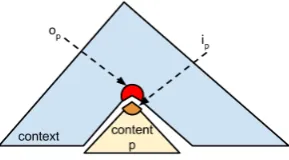
Figure 1: Inner (ip) and outer (op) representations at the node that covers constituentp. They are vec-torial representations of p’s content and context, respectively.
ter).
To tackle this problem, we propose a new ar-chitecture: the Inside-Outside Recursive Neural Network (IORNN) in which information can flow not only bottom-up but also top-down, inward and outward. The crucial innovation in our architec-ture is that every node in a hierarchical strucarchitec-ture is associated with two vectors: one vector, the in-ner representation, representing the content under that node, and another vector, theouter represen-tation, representing its context (see Figure 1). In-ner representations can be computed bottom-up; outer representations, in turn, can be computed top-down. This allows information to flow in any direction, depending on the application, and makes the IORNN a natural tool for estimating probabilities in tree-based generative models.
We demonstrate the use of the IORNN by ap-plying it to an ∞-order generative dependency model which is impractical for counting due to the problem of data sparsity. Counting, instead, is used to estimate a third-order generative model as in Sangati et al. (2009) and Hayashi et al. (2011). Our experimental results show that our new model not only achieves a seven times lower perplex-ity than the third-order model, but also tends to choose more accurate candidates ink-best lists. In addition, reranking with this model achieves state-of-the-art scores on the task of supervised depen-dency parsing.
The outline of the paper is following. Firstly, we give an introduction to Eisner’s generative model in Section 2. Then, we present the third-order model using counting in Section 3, and propose the IORNN in Section 4. Finally, in Section 5 we show our experimental results.
2 Eisner’s Generative Model
Eisner (1996b) proposed a generative model for
dependency parsing. The generation process is top-down: starting at the ROOT, it generates left dependents and then right dependents for the ROOT. After that, it generates left dependents and right dependents for each of ROOT’s dependents. The process recursively continues until there is no further dependent to generate. The whole process is captured in the following formula
P(T(H)) =YL
l=1
PHL l |CHL
l
P T(HL l )
×
R
Y
r=1
PHR r|CHrR
P T(HR r )
(1)
whereHis the current head,T(N)is the fragment of the dependency parse rooted inN, and CN is the context in whichN is generated. HL, HRare respectivelyH’s left dependents and right depen-dents, plusEOC(End-Of-Children), a special to-ken to indicate that there are no more dependents to generate. Thus, P(T(ROOT)) is the proba-bility of generating the entire dependency struc-ture T. We refer to hHL
l ,CHL l i, hH
R
r,CHrRi as
“events”, andhCHL
l i,hCHrRias “conditioning
con-texts”.
In order to avoid the problem of data sparsity, the conditioning context in which a dependentD
is generated should capture only part of the frag-ment generated so far. Based on the amount of information that contexts hold, we can define the order of a generative model (see Hayashi et al. (2011, Table 3) for examples)
• first-order:C1
D contains the headH,
• second-order: C2
D contains H and the just-generated siblingS,
• third-order:C3
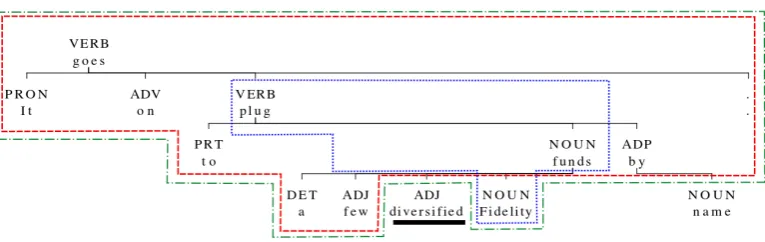
D containsH,S, the siblingS0 beforeS(tri-sibling); orH,Sand the grand-head G (the head of H) (grandsibling) (the fragment enclosed in the blue doted contour in Figure 2),
• ∞-order: C∞
D contains all of D’s ancestors, theirs siblings, and its generated siblings (the fragment enclosed in the red dashed contour in Figure 2).
In the original models (Eisner, 1996a), each de-pendentDis a 4-tuplehdist, w, c, ti
Figure 2: Example of different orders of context of “diversified”. The blue dotted shape corresponds to the third-order outward context, while the red dashed shape corresponds to the∞-order left-to-right context. The green dot-dashed shape corresponds to the context to compute the outer representation.
• word(D)the lowercase version of the word ofD,
• cap(D)the capitalisation feature of the word ofD(all letters are lowercase, all letters are uppercase, the first letter is uppercase, the first letter is lowercase),
• tag(D)the POS-tag ofD,
Here, to make the dependency complete,
deprel(D), the dependency relation of D (e.g., SBJ, DEP), is also taken into account.
3 Third-order Model with Counting
The third-order model we suggest is similar to the grandsibling model proposed by Sangati et al. (2009) and Hayashi et al. (2011). It defines the probability of generating a dependent D = hdist, d, w, c, ti as the product of the distance-based probability and the probabilities of gener-ating each of its components (d, t, w, c, denoting dependency relation, POS-tag, word and capitali-sation feature, respectively). Each of these prob-abilities is smoothed using back-off according to the given reduction lists (as explained below).
P(D|CD)
=P(dist(H, D), dwct(D)|H, S, G, dir) =P(d(D)|H, S, G, dir)
reduction list:
tw(H), tw(S), tw(G), dir tw(H), tw(S), t(G), dir
tw(H), t(S), t(G), dir t(H), tw(S), t(G), dir t(H), t(S), t(G), dir ×P(t(D)|d(D), H, S, G, dir)
reduction list: dd((DD)), dtw, d(H()H, t)(, tS)(, dirS), dir d(D), d(D), dir
×P(w(D)|dt(D), H, S, G, dir)
reduction list: dtwdt(H(H), t), t(S()S, dir), dir ×P(c(D)|dtw(D), H, S, G, dir)
reduction list: twtw((DD)), d, dir(H), dir
×P(dist(H, D)|dtwc(D), H, S, G, dir) (2) reduction list: dtwdt(D(D), dt), dt(H(H), t), t(S()S, dir), dir
The reason for generating the dependency tion first is based on the similarity between rela-tion/dependent and role/filler: we generate a role and then choose a filler for that role.
Back-off The back-off parameters are identi-cal to Eisner (1996b). To estimate the proba-bility P(A|context) given a reduction list L = (l1, l2, ..., ln)ofcontext, let
pi =
( count(A,l i)+0.005
count(li)+0.5 ifi=n
count(A,li)+3pi+1
count(li)+3 otherwise
thenP(A|context) =p1.
4 The Inside-Outside Recursive Neural Network
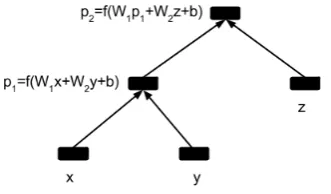
Figure 3: Recursive Neural Network (RNN).
a tree; we assume an independently given parser is available to assign a syntactic structure, or multi-ple candidate structures, to an input string.
4.1 Recursive Neural Network
The architecture we propose can best be under-stood as an extension of the Recursive Neural Net-works (RNNs) proposed by Socher et al. (2010), that we mentioned above. In order to see how an RNN works, consider the following example. Assume that there is a constituent with parse tree
(p2 (p1 x y) z)(Figure 3), and thatx,y,z ∈Rn are the (inner) representations of the three words
x,yandz, respectively. We use a neural network which consists of a weight matrixW1 ∈Rn×nfor left children and a weight matrixW2∈Rn×nfor right children to compute the vector for a parent node in a bottom up manner. Thus, we compute
p1as follows
p1 =f(W1x+W2y+b)
where b is a bias vector and f is an activation function (e.g.,tanhorlogistic). Having computed
p1, we can then move one level up in the hierarchy and computep2:
p2 =f(W1p1+W2z+b)
This process is continued until we reach the root node. The RNN thus computes a single vector for each nodep in the tree, representing the con-tentunder that node. It has in common with log-ical semantics that representations for compounds (herexyz) are computed by recursively applying a composition function to meaning representations of the parts. It is difficult to characterise the ex-pressivity of the resulting system in logical terms, but recent work suggests it is surprisingly power-ful (e.g., Kanerva (2009)).
Figure 4: Inside-Outside Recursive Neural Net-work (IORNN). Black rectangles correspond to in-ner representations, white rectangles correspond to outer representations.
4.2 IORNN
We extend the RNN-architecture by adding a sec-ond vector to each node, representing thecontext of the node, shown as white rectangles in figure 4. The job of this second vector, the outer represen-tation, is to summarize all information about the context of nodepso that we can either predict its content (i.e., predict an inner representation), or pass on this information to the daughters ofp(i.e., compute outer representations of these daughters). Outer representations thus allow information to flow top-down.
We explain the operation of the resulting Inside-Outside Recursive Neural Networkin terms of the same example parse tree(p2 (p1 x y)z)(see Fig-ure 4). Each nodeu in the syntactic tree carries two vectorsouandiu, the outer representation and inner representation of the constituent that is cov-ered by the node.
Computing inner representations Inner repre-sentations are computed from the bottom up. We assume for every word wan inner representation iw ∈ Rn. The inner representation of a non-terminal node, sayp1, is given by
ip1 =f(Wi1ix+Wi2iy+bi)
where Wi
1,Wi2 are n×n real matrices, bi is a bias vector, and f is an activation function, e.g.
tanh. (This is the same as the computation of non-terminal vectors in the RNNs.) The inner rep-resentation of a parent node is thus a function of the inner representations of its children.
[image:4.595.337.490.68.163.2]repre-sentation is given by
op1 =g(Wo1op2+Wo2iz+bo) where Wo
1,Wo2 aren×n real matrices, bo is a bias vector, and g is an activation function. The outer representation of a node is thus a function of the outer representation of its parent and the inner representation of its sisters.
If there is information about the external context of the utterance that is being processed, this infor-mation determines the outer representation of the root nodeoroot. In our first experiments reported here, no such information was assumed to be avail-able. In this case, a random valueo∅ is chosen at
initialisation and assigned to the root nodes of all utterances; this value is then adjusted by the learn-ing process discussed below.
Training Training the IORNN is to minimise an objective functionJ(θ)which depends on the pur-pose of usage whereθis the set of parameters. To do so, we compute the gradient ∂J/∂θ and ap-ply the gradient descent method. The gradient is effectively computed thanks to back-propagation through structure (Goller and K¨uchler, 1996). Fol-lowing Socher et al. (2013), we use AdaGrad (Duchi et al., 2011) to update the parameters.
4.3 The∞-order Model with IORNN
The RNN and IORNN are defined for context-free trees. To apply the IORNN architecture to dependency parses we need to adapt the defini-tions somewhat. In particular, in the generative dependency model, every step in the generative story involves the decision to generate a specific word while the span of the subtree that this word will dominate only becomes clear when all depen-dents are generated. We therefore introduce par-tial outer representationas a representation of the current context of a word in the generative pro-cess, and compute the final outer representation only when all its siblings have been generated.
Consider an example of head h and its depen-dentsx, y(we ignore directions for simplicity) in Figure 5. Assume that we are in the state in the generative process where the generation of h is complete, i.e. we know its inner and outer rep-resentationsihandoh. Now, when generatingh’s first dependent x (see Figure 5-a), we first com-putex’spartialouter representation (representing its context at this stage in the process), which is a function of the outer representation of the head
(representing the head’s context) and the inner rep-resentation of the head (representing the content of the head word):
¯
o1=f(Whiih+Whooh+bo)
whereWhi,Whoaren×nreal matrices,bois a bias vector,fis an activation function.
With the context of the first dependent deter-mined, we can proceed and generate its content. For this purpose, we assume a separate weight ma-trixW, trained (as explained below) to predict a specific word given a (partial) outer representa-tion. To compute a proper probability for word
x, we use the softmax function:
softmax(x,o¯1) = e u(x,¯o1)
P
w∈V eu(w,¯o1)
whereu(w1,o¯1), ..., u(w|V|,¯o1)T =W¯o1+b andV is the set of all possible dependents.
Note that since oh, the outer representation of
h, represents the entire dependency structure gen-erated up to that point,¯o1 is a vectorial represen-tation of the∞-order context generating the first dependent (like the fragment enclosed in the red dashed contour in Figure 2). The softmax func-tion thus estimates the probabilityP(D=x|C∞
D). The next step, now that x is generated, is to compute the partial outer representation for the second dependent (see Figure 5-b)
¯
o2 =f(Whiih+Whooh+Wdr(x)ix+bo) whereWdr(x) is a n×nreal matrix specific for the dependency relation ofxwithh.
Nextyis generated (using the softmax function above), and the partial outer representation for the third dependent (see Figure 5-c) is computed:
¯
o3=f(Whiih+Whooh+
1
2 Wdr(x)ix+Wdr(y)iy
+bo)
Since the third dependent is the End-of-Children symbol (EOC), the process of generat-ing dependents for h stops. We can then return to x and y to replace the partial outer represen-tations with complete outer represenrepresen-tations1 (see
1According to the IORNN architecture, to compute the
Figure 5: Example of applying IORNN to dependency parsing. Black, grey, white boxes are respectively inner, partial outer, and outer representations. For simplicity, only links related to the current computation are drawn (see text).
Figure 5-d,e):
ox=f(Whiih+Whooh+Wdr(y)iy+bo) oy =f(Whiih+Whooh+Wdr(x)ix+bo) In general, ifuis the first dependent ofhthen
¯
ou =f(Whiih+Whooh+bo) otherwise
¯
ou =f(Whiih+Whooh+bo+
1 |S(¯ u)|
X
v∈S¯(u)
Wdr(v)iv)
whereS(¯ u)is the set ofu’s sisters generated be-fore it. And, ifu is the only dependent ofh (ig-noringEOC) then
ou =f(Whiih+Whooh+bo) otherwise
ou =f(Whiih+Whooh+bo+
1 |S(u)|
X
v∈S(u)
Wdr(v)iv)
whereS(u)is the set ofu’s sisters.
We then continue this process to generate de-pendents forxandyuntil the process stops.
Inner Representations In the calculation of the probability of generating a word, described above, we assumed inner representations of all possible words to be given. These are, in fact, themselves a function of vector representations for the words (in our case, the word vectors are initially borrowed from Collobert et al. (2011)), the POS-tags and capitalisation features. That is, the inner represen-tation at a nodehis given by:
ih =f(Wwwh+Wpph+Wcch) where Ww ∈ Rn×dw, Wp ∈ Rn×dp, Wc ∈
Rn×dc,whis the word vector ofh, andph,chare
respectively binary vectors representing the POS-tag and capitalisation feature ofh.
Training Training this IORNN is to minimise the following objective function which is the reg-ularised cross-entropy
J(θ) =− 1 m
X
T∈D
X
w∈T
log(P(w|¯ow))
+1
2 λWkθWk2+λLkθLk2
whereDis the set of training dependency parses,
m is the number of dependents; θW, θL are the weight matrix set and the word embeddings (θ = (θW, θL));λW, λLare regularisation hyper-parameters.
Implementation We decompose a dependentD
into four features: dependency relation, POS-tag, lowercase version of word, capitalisation feature of word. We then factoriseP(D|C∞
D)similarly to Section 3, where each component is estimated by a softmax function.
5 Experiments
In our experiments, we convert the Penn Treebank to dependencies using the Universal dependency annotation (McDonald et al., 2013)2; this yields a dependency tree corpus we label PTB-U. In or-der to compare with other systems, we also ex-periment with an alternative conversion using the head rules of Yamada and Matsumoto (2003)3; this yields a dependency tree corpus we label PTB-YM. Sections 2-21 are used for training, section 22 for development, and section 23 for testing. For the PTB-U, the gold POS-tags are used. For the PTB-YM, the development and test sets are tagged by the Stanford POS-tagger4trained on the whole
2https://code.google.com/p/uni-dep-tb/ 3http://stp.lingfil.uu.se/˜nivre/
research/Penn2Malt.html
4http://nlp.stanford.edu/software/
Perplexity 3rd-order model 1736.73
[image:7.595.305.529.61.145.2]∞-order model 236.58
Table 1: Perplexities of the two models on PTB-U-22.
training data, whereas 10-way jackknifing is used to generate tags for the training set.
The vocabulary for both models, the third-order model and the ∞-order model, is taken as a list of words occurring more than two times in the training data. All other words are labelled ‘UN-KNOWN’ and every digit is replaced by ‘0’. For the IORNN used by the ∞-order model, we set
n= 200, and definef as thetanhactivation func-tion. We initialise it with the 50-dim word embed-dings from Collobert et al. (2011) and train it with the learning rate0.1,λW = 10−4, λL= 10−10.
5.1 Perplexity
We firstly evaluate the two models on PTB-U-22 using the perplexity-per-word metric
ppl(P) = 2−N1
P
T∈Dlog2P(T)
where Dis a set of dependency parses, N is the total number of words. It is worth noting that, the betterP estimates the true distribution P∗ of
D, the lower its perplexity is. Because Eisner’s model with the dist(H, D) feature (Equation 2) is leaky (the model allocates some probability to events that can never legally arise), this feature is discarded (only in this experiment).
Table 1 shows results. The perplexity of the third-order model is more than seven times higher than the∞-order model. This reflects the fact that data sparsity is more problematic for counting than for the IORNN.
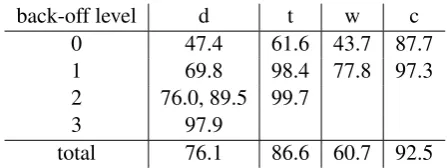
To investigate why the perplexity of the third-order model is so high, we compute the percent-ages of events extracted from the development set appearing more than twice in the training set. Events are grouped according to the reduction lists in Equation 2 (see Table 2). We can see that ductions at level 0 (the finest) for dependency re-lations and words seriously suffer from data spar-sity: more than half of the events occur less than three times, or not at all, in the training data. We thus conclude that counting-based models heavily rely on carefully designed reduction lists for back-off.
back-off level d t w c
0 47.4 61.6 43.7 87.7
1 69.8 98.4 77.8 97.3
2 76.0, 89.5 99.7
3 97.9
total 76.1 86.6 60.7 92.5
Table 2: Percentages of events extracted from PTB-U-22 appearing more than twice in the train-ing set. Events are grouped accordtrain-ing to the reduc-tion lists in Equareduc-tion 2. d, t, w, cstand for depen-dency relation, POS-tag, word, and capitalisation feature.
5.2 Reranking
In the second experiment, we evaluate the two models in the reranking framework proposed by Sangati et al. (2009) on PTB-U. We used the MST-Parser (with the 2nd-order feature mode) (McDon-ald et al., 2005) to generate k-best lists. Two evaluation metrics are labelled attachment score (LAS) and unlabelled attachment score (UAS), in-cludingpunctuation.
Rerankers Given D(S), a k-best list of parses of a sentenceS, we define thegenerativereranker
T∗ = arg max
T∈D(S) P(T(ROOT))
which is identical to Sangati et al. (2009). Moreover, as in many mixture-model-based ap-proaches, we define themixturereranker as a com-bination of the generative model and the MST dis-criminative model (Hayashi et al., 2011)
T∗= arg max
T∈D(S) αlogP(T(ROOT))+(1−α)s(S, T)
where s(S, T) is the score given by the MST-Parser, andα∈[0,1].
Figure 6: Performance of the generative reranker on PTB-U-22.
Figure 7: Performance of the mixture reranker on PTB-U-22. For eachk,αwas optimized with the step-size 0.005.
LAS UAS
MSTParser 89.97 91.99
Oracle (k= 10) 93.73 96.24 Generative reranker with
3rd-order (k= 3) 90.27 (+0.30) 92.27 (+0.28)
∞-order (k= 6) 90.76 (+0.79) 92.83 (+0.84) Mixture reranker with
3rd-order (k= 6) 90.62 (+0.65) 92.62 (+0.63)
∞-order (k= 9) 91.02 (+1.05) 93.08 (+1.09)
Table 3: Comparison based on reranking on PTB-U-23. The numbers in the brackets are improve-ments over the MSTParser.
generative reranker as the mixture reranker can combine the advantages of the two models.
[image:8.595.93.271.63.188.2]Table 3 shows scores of the two rerankers on the test set with the parameters tuned on the develop-ment set. Both the rerankers, either using third-order or ∞-order models, outperform the MST-Parser. The fact that both gain higher improve-ments with the ∞-order model suggests that the IORNN surpasses counting.
Figure 9: F1-scores of binned HEAD distance (PTB-U-23).
5.3 Comparison with other systems
We first compare the mixture reranker using the
∞-order model against the state-of-the-art depen-dency parser TurboParser (with the full mode) (Martins et al., 2013) on PTB-U-23. Table 4 shows LASs and UASs. When taking labels into account, the TurboParser outperforms the reranker. But without counting labels, the two systems perform comparably, and when ignoring punctuation the reranker even outperforms the TurboParser. This pattern is also observed when the exact match met-rics are used (see Table 4). This is due to the fact that the TurboParser performs significantly better than the MSTParser, which generates k-best lists for the reranker, in labelling: the former achieves 96.03% label accuracy score whereas the latter achieves 94.92%.
One remarkable point is that reranking with the ∞-order model helps to improve the exact match scores 4% - 6.4% (see Table 4). Because the exact match scores correlate with the ability to handle global structures, we conclude that the IORNN is able to capture∞-order contexts. Fig-ure 8 shows distributions of correct-head accuracy over CPOS-tags and Figure 9 shows F1-scores of binned HEAD distance. Reranking with the ∞ -order model is clearly helpful for all CPOS-tags and dependent-to-head distances, except a minor decrease on PRT.
[image:8.595.92.272.248.371.2]LAS (w/o punc) UAS (w/o punc) LEM (w/o punc) UEM (w/o punc) MSTParser 89.97 (90.54) 91.99 (92.82) 32.37 (34.19) 42.80 (45.24) w.∞-order (k= 9) 91.02 (91.51) 93.08(93.84) 37.58 (39.16) 49.17(51.53) TurboParser 91.56(92.02) 93.05 (93.70) 40.65(41.72) 48.05 (49.83) Table 4: Comparison with the TurboParser on PTB-U-23. LEM and UEM are respectively the labelled exact match score and unlabelled exact match score metrics. The numbers in brackets are scores com-puted excluding punctuation.
Figure 8: Distributions of correct-head accuracy over CPOS-tags (PTB-U-23).
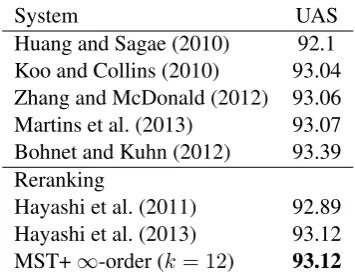
System UAS
Huang and Sagae (2010) 92.1 Koo and Collins (2010) 93.04 Zhang and McDonald (2012) 93.06 Martins et al. (2013) 93.07 Bohnet and Kuhn (2012) 93.39 Reranking
Hayashi et al. (2011) 92.89 Hayashi et al. (2013) 93.12 MST+∞-order (k= 12) 93.12
Table 5: Comparison with other systems on PTB-YM-23 (excluding punctuation).
on the fly; performs equally with Hayashi et al. (2013) which is a discriminative reranker using the stacked technique; and slightly worse than Bohnet and Kuhn (2012), who develop a hybrid transition-based and graphical-transition-based approach.
6 Related Work
Using neural networks to process trees was first proposed by Pollack (1990) in the Recursive Au-toassociative Memory model which was used for unsupervised learning. Socher et al. (2010) later introduced the Recursive Neural Network archi-tecture for supervised learning tasks such as syn-tactic parsing and sentiment analysis (Socher et al., 2013). Our IORNN is an extension of the RNN: the former can process trees not only
bottom-up like the latter but also top-down. Elman (1990) invented the simple recurrent neural network (SRNN) architecture which is ca-pable of capturing very long histories. Mikolov et al. (2010) then applied it to language mod-elling and gained state-of-the-art results, outper-forming the the standardn-gram techniques such as Kneser-Ney smoothed 5-gram. Our IORNN architecture for dependency parsing bears a re-semblance to the SRNN in the sense that it can also capture long ‘histories’ in context represen-tations (i.e., outer represenrepresen-tations in our terminol-ogy). Moreover, the IORNN can be seen as a gen-eralization of the SRNN since a left-branching tree is equivalent to a chain and vice versa.
The idea of letting parsing decisions depend on arbitrarily long derivation histories is also ex-plored in Borensztajn and Zuidema (2011) and is related to parsing frameworks that allow arbi-trarily large elementary trees (e.g., Scha (1990), O’Donnell et al. (2009), Sangati and Zuidema (2011), and van Cranenburgh and Bod (2013)).
Titov and Henderson (2007) were the first proposing to use deep networks for dependency parsing. They introduced a transition-based gen-erative dependency model using incremental sig-moid belief networks and applied beam pruning for searching best trees. Differing from them, our work uses the IORNN architecture to rescore
[image:9.595.92.270.349.487.2]graph-based parser, namely the MSTParser. Reranking k-best lists was introduced by Collins and Koo (2005) and Charniak and Johnson (2005). Their rerankers are discriminative and for constituent parsing. Sangati et al. (2009) proposed to use a third-order generative model for reranking
k-best lists of dependency parses. Hayashi et al. (2011) then followed this idea but combined gen-erative models with a variational model learnt on the fly to rerank forests. In this paper, we also followed Sangati et al. (2009)’s idea but used an
∞-order generative model, which has never been used before.
7 Conclusion
In this paper, we proposed a new neural network architecture, the Inside-Outside Recursive Neural Network, that can process trees both bottom-up and top-down. The key idea is to extend the RNN such that every node in the tree has two vectors associated with it: an inner representation for its content, and an outer representation for its context. Inner and outer representations of any constituent can be computed simultaneously and interact with each other. This way, information can flow top-down, bottom-up, inward and outward. Thanks to this property, by applying the IORNN to depen-dency parses, we have shown that using an ∞ -order generative model for dependency parsing, which has never been done before, is practical.
Our experimental results on the English section of the Universal Dependency Treebanks show that the ∞-order generative model approximates the true dependency distribution better than the tradi-tional third-order model using counting, and tends to choose more accurate parses in k-best lists. In addition, reranking with this model even out-performs the state-of-the-art TurboParser on unla-belled score metrics.
Our source code is available at: github. com/lephong/iornn-depparse.
Acknowledgments
We thank Remko Scha and three anonymous re-viewers for helpful comments.
References
Marco Baroni, Georgiana Dinu, and Germ´an Kruszewski. 2014. Don’t count, predict! a systematic comparison of context-counting vs. context-predicting semantic vectors. InProceedings
of the 52nd Annual Meeting of the Association for Computational Linguistics, volume 1.
Bernd Bohnet and Jonas Kuhn. 2012. The best of both worlds: a graph-based completion model for transition-based parsers. InProceedings of the 13th Conference of the European Chapter of the Associ-ation for ComputAssoci-ational Linguistics, pages 77–87. Association for Computational Linguistics.
Gideon Borensztajn and Willem Zuidema. 2011. Episodic grammar: a computational model of the interaction between episodic and semantic memory in language processing. InProceedings of the 33d Annual Conference of the Cognitive Science Soci-ety (CogSci’11), pages 507–512. Lawrence Erlbaum Associates.
Eugene Charniak and Mark Johnson. 2005. Coarse-to-fine n-best parsing and maxent discriminative reranking. InProceedings of the 43rd Annual Meet-ing of the Association for Computational LMeet-inguistics (ACL’05), pages 173–180.
Michael Collins and Terry Koo. 2005. Discriminative reranking for natural language parsing. Computa-tional Linguistics, 31(1):25–66.
Michael Collins. 2003. Head-driven statistical mod-els for natural language parsing.Computational lin-guistics, 29(4):589–637.
Ronan Collobert, Jason Weston, L´eon Bottou, Michael Karlen, Koray Kavukcuoglu, and Pavel Kuksa. 2011. Natural language processing (almost) from scratch. The Journal of Machine Learning Re-search, 12:2493–2537.
John Duchi, Elad Hazan, and Yoram Singer. 2011. Adaptive subgradient methods for online learning and stochastic optimization. The Journal of Ma-chine Learning Research, pages 2121–2159. Jason M. Eisner. 1996a. An empirical comparison of
probability models for dependency grammar. Tech-nical report, University of Pennsylvania Institute for Research in Cognitive Science.
Jason M Eisner. 1996b. Three new probabilistic mod-els for dependency parsing: An exploration. In Pro-ceedings of the 16th conference on Computational linguistics-Volume 1, pages 340–345. Association for Computational Linguistics.
Jeffrey L. Elman. 1990. Finding structure in time. Cognitive science, 14(2):179–211.
Christoph Goller and Andreas K¨uchler. 1996. Learn-ing task-dependent distributed representations by backpropagation through structure. InInternational Conference on Neural Networks. IEEE.
forests. InProceedings of the Conference on Em-pirical Methods in Natural Language Processing, pages 1479–1488. Association for Computational Linguistics.
Katsuhiko Hayashi, Shuhei Kondo, and Yuji Mat-sumoto. 2013. Efficient stacked dependency pars-ing by forest rerankpars-ing. Transactions of the Associ-ation for ComputAssoci-ational Linguistics, 1(1):139–150. Liang Huang and Kenji Sagae. 2010. Dynamic
pro-gramming for linear-time incremental parsing. In Proceedings of the 48th Annual Meeting of the Asso-ciation for Computational Linguistics, pages 1077– 1086. Association for Computational Linguistics. Pentti Kanerva. 2009. Hyperdimensional
comput-ing: An introduction to computing in distributed rep-resentation with high-dimensional random vectors. Cognitive Computation, 1(2):139–159.
Terry Koo and Michael Collins. 2010. Efficient third-order dependency parsers. In Proceedings of the 48th Annual Meeting of the Association for Com-putational Linguistics, pages 1–11. Association for Computational Linguistics.
Phong Le, Willem Zuidema, and Remko Scha. 2013. Learning from errors: Using vector-based composi-tional semantics for parse reranking. InProceedings Workshop on Continuous Vector Space Models and their Compositionality (at ACL 2013). Association for Computational Linguistics.
Andre Martins, Miguel Almeida, and Noah A. Smith. 2013. Turning on the turbo: Fast third-order non-projective turbo parsers. InProceedings of the 51st Annual Meeting of the Association for Computa-tional Linguistics (Volume 2: Short Papers), pages 617–622, Sofia, Bulgaria, August. Association for Computational Linguistics.
Ryan McDonald, Koby Crammer, and Fernando Pereira. 2005. Online large-margin training of dependency parsers. In Proceedings of the 43rd Annual Meeting on Association for Computational Linguistics, pages 91–98. Association for Computa-tional Linguistics.
Ryan McDonald, Joakim Nivre, Yvonne Quirmbach-Brundage, Yoav Goldberg, Dipanjan Das, Kuzman Ganchev, Keith Hall, Slav Petrov, Hao Zhang, Os-car T¨ackstr¨om, et al. 2013. Universal dependency annotation for multilingual parsing. Proceedings of ACL, Sofia, Bulgaria.
Tomas Mikolov, Martin Karafi´at, Lukas Burget, Jan Cernock`y, and Sanjeev Khudanpur. 2010. Recur-rent neural network based language model. In IN-TERSPEECH, pages 1045–1048.
Timothy J O’Donnell, Noah D Goodman, and Joshua B Tenenbaum. 2009. Fragment grammar: Exploring reuse in hierarchical generative processes. Techni-cal report, TechniTechni-cal Report MIT-CSAIL-TR-2009-013, MIT.
Jordan B. Pollack. 1990. Recursive distributed repre-sentations.Artificial Intelligence, 46(1):77105. Federico Sangati and Willem Zuidema. 2011.
Ac-curate parsing with compact tree-substitution gram-mars: Double-DOP. In Proceedings of the Con-ference on Empirical Methods in Natural Language Processing (EMLNP’11), pages 84–95. Association for Computational Linguistics.
Federico Sangati, Willem Zuidema, and Rens Bod. 2009. A generative re-ranking model for depen-dency parsing. In Proceedings of the 11th Inter-national Conference on Parsing Technologies, pages 238–241.
Remko Scha. 1990. Taaltheorie en taaltechnolo-gie; competence en performance. In R. de Kort and G.L.J. Leerdam, editors, Computertoepassin-gen in de Neerlandistiek, pages 7–22. LVVN, Almere, the Netherlands. English translation at http://iaaa.nl/rs/LeerdamE.html.
Richard Socher, Christopher D. Manning, and An-drew Y. Ng. 2010. Learning continuous phrase representations and syntactic parsing with recursive neural networks. InProceedings of the NIPS-2010 Deep Learning and Unsupervised Feature Learning Workshop.
Richard Socher, Brody Huval, Christopher D. Man-ning, and Andrew Y. Ng. 2012. Semantic composi-tionality through recursive matrix-vector spaces. In Proceedings of the 2012 Joint Conference on Empir-ical Methods in Natural Language Processing and Computational Natural Language Learning. Richard Socher, Alex Perelygin, Jean Wu, Jason
Chuang, Christopher D. Manning, Andrew Ng, and Christopher Potts. 2013. Recursive deep models for semantic compositionality over a sentiment tree-bank. In Proceedings of the 2013 Conference on Empirical Methods in Natural Language Process-ing, Seattle, Washington, USA, October.
Ivan Titov and James Henderson. 2007. A latent vari-able model for generative dependency parsing. In Proceedings of the 10th International Conference on Parsing Technologies, pages 144–155.
Andreas van Cranenburgh and Rens Bod. 2013. Dis-continuous parsing with an efficient and accurate DOP model. In Proceedings of the International Conference on Parsing Technologies (IWPT’13). Hiroyasu Yamada and Yuji Matsumoto. 2003.
Statis-tical dependency analysis with support vector ma-chines. InProceedings of International Conference on Parsing Technologies (IWPT), pages 195–206. Hao Zhang and Ryan McDonald. 2012. Generalized