Event Role Extraction using Domain-Relevant Word Representations
Emanuela Boros¸†‡ Romaric Besanc¸on† Olivier Ferret† Brigitte Grau‡∗ †CEA, LIST, Vision and Content Engineering Laboratory, F-91191, Gif-sur-Yvette, France
‡LIMSI, rue John von Neumann, Campus Universitaire d’Orsay, F-91405 Orsay cedex ∗ENSIIE, 1 square de la r´esistance F-91025 ´Evry cedex
[email protected] [email protected]
Abstract
The efficiency of Information Extraction systems is known to be heavily influenced by domain-specific knowledge but the cost of developing such systems is consider-ably high. In this article, we consider the problem of event extraction and show that learning word representations from unla-beled domain-specific data and using them for representing event roles enable to out-perform previous state-of-the-art event ex-traction models on the MUC-4 data set.
1 Introduction
In the Information Extraction (IE) field, event ex-traction constitutes a challenging task. An event is described by a set of participants (i.e. at-tributes or roles) whose values are text excerpts. The event extraction task is related to several sub-tasks: event mention detection, candidate role-filler extraction, relation extraction and event tem-plate filling. The problem we address here is the detection of role-filler candidates and their associ-ation with specific roles in event templates. For this task, IE systems adopt various ways of ex-tracting patterns or generating rules based on the surrounding context, local context and global con-text (Patwardhan and Riloff, 2009). Current ap-proaches for learning such patterns include boot-strapping techniques (Huang and Riloff, 2012a; Yangarber et al., 2000), weakly supervised learn-ing algorithms (Huang and Riloff, 2011; Sudo et al., 2003; Surdeanu et al., 2006), fully supervised learning approaches (Chieu et al., 2003; Freitag, 1998; Bunescu and Mooney, 2004; Patwardhan and Riloff, 2009) and other variations. All these methods rely on substantial amounts of manually annotated corpora and use a large body of lin-guistic knowledge. The performance of these ap-proaches is related to the amount of knowledge
engineering deployed and a good choice of fea-tures and classifiers. Furthermore, the efficiency of the system relies on the a priori knowledge of the applicative domain (the nature of the events) and it is generally difficult to apply a system on a different domain with less annotated data with-out reconsidering the design of the features used. An important step forwards is TIERlight (Huang
and Riloff, 2012a) that targeted the minimization of human supervision with a bootstrapping tech-nique for event roles detection. Also, PIPER (Pat-wardhan and Riloff, 2007; Pat(Pat-wardhan, 2010) dis-tinguishes between relevant and irrelevant regions and learns domain-relevant extraction patterns us-ing a semantic affinity measure. Another possi-ble approach for dealing with this propossi-blem is to combine the use a restricted set of manually anno-tated data with a much larger set of data extracted in an unsupervised way from a corpus. This ap-proach was experimented for relations in the con-text of Open Information Extraction (Soderland et al., 2010) but not for extracting events and their participants to our knowledge.
In this paper, we propose to approach the task of labeling text spans with event roles by auto-matically learning relevant features that requires limited prior knowledge, using a neural model to induce semantic word representations (commonly referred asword embeddings) in an unsupervised fashion, as in (Bengio et al., 2006; Collobert and Weston, 2008). We exploit these word embed-dings as features for a supervised event role (mul-ticlass) classifier. This type of approach has been proved efficient for numerous tasks in natural lan-guage processing, including named entity recog-nition (Turian et al., 2010), semantic role label-ing (Collobert et al., 2011), machine translation (Schwenk and Koehn, 2008; Lambert et al., 2012), word sense disambiguation (Bordes et al., 2012) or sentiment analysis (Glorot et al., 2011; Socher et al., 2011) but has never been used, to our
edge, for an event extraction task. Our goal is two-fold: (1) to prove that using as only features word vector representations makes the approach com-petitive in the event extraction task; (2) to show that these word representations are scalable and robust when varying the size of the training data. Focusing on the data provided in MUC-4 (Lehnert et al., 1992), we prove the relevance of our ap-proach by outperforming state-of-the-art methods, in the same evaluation environment as in previous works.
2 Approach
In this work, we approach the event extraction task by learning word representations from a domain-specific data set and by using these representa-tions to identify the event roles. This idea relies on the assumption that the different words used for a given event role in the text share some se-mantic properties, related to their context of use and that these similarities can be captured by spe-cific representations that can be automatically in-duced from the text, in an unsupervised way. We then propose to rely only on these word repre-sentations to detect the event roles whereas, in most works (Riloff, 1996; Patwardhan and Riloff, 2007; Huang and Riloff, 2012a; Huang and Riloff, 2012b), the role fillers are represented by a set of different features (raw words, their parts-of-speech, syntactic or semantic roles in the sen-tence).
Furthermore, we propose two additional contri-butions to the construction of the word representa-tions. The first one is to exploit limited knowledge about the event types (seed words) to improve the learning procedure by better selecting the dictio-nary. The second one is to use amaxoperation1on
the word vector representations in order to build noun phrase representations (since slot fillers are generally noun phrases), which represents a better way of aggregating the semantic information born by the word representations.
2.1 Inducing Domain-Relevant Word Representations
In order to induce the domain-specific word rep-resentations, we project the words into a 50-dimensional word space. We chose a single 1This max operation consists in taking, for each
compo-nent of the vector, the max value of this compocompo-nent for each word vector representation.
layer neural network (NN) architecture that avoids strongly engineered features, assumes little prior knowledge about the task, but is powerful enough to capture relevant domain information. Follow-ing (Collobert et al., 2011), we use an NN which learns to predict whether a given text sequence (short word window) exists naturally in the consid-ered domain. We represent an input sequence ofn
words ashwii = hwi−(n/2). . . , wi, . . . wi+(n/2)i. The main idea is that each sequence of words in the training set should receive a higher score than a sequence in which one word is replaced with a random one. We call the sequence with a ran-dom wordcorrupted(hw¯ii) and denote ascorrect
(hwii) all the sequences of words from the data
set. The goal of the training step is then to min-imize the following loss function for a word wi
in the dictionaryD: Cwi =
P
wi∈Dmax(0,1−
g(hwii)+g( ¯hwii)), whereg(·)is the scoring
domain-oriented order leads to better performance for the task than the order by frequency.
2.2 Using Word Representations to Identify Event Roles
After having generated for each word their vec-tor representation, we use them as features for the annotated data to classify event roles. However, event role fillers are not generally single words but noun phrases that can be, in some cases, identi-fied as named entities. For identifying the event roles, we therefore apply a two-step strategy. First, we extract the noun chunks using SENNA2parser
(Collobert et al., 2011; Collobert, 2011) and we build a representation for these chunks defined as the maximum, per column, of the vector represen-tations of the words it contains. Second, we use a statistical classifier to recognize the slot fillers, using this representation as features. We chose the extra-trees ensemble classifier (Geurts et al., 2006), which is a meta estimator that fits a num-ber of randomized decision trees (extra-trees) on various sub-samples of the data set and use averag-ing to improve the predictive accuracy and control over-fitting.
3 Experiments and Results 3.1 Task Description
We conducted the experiments on the official MUC-4 training corpus that consists of 1,700 uments and instantiated templates for each doc-ument. The task consists in extracting informa-tion about terrorist events in Latin America from news articles. We classically considered the fol-lowing 4 types of events: attack, bombing, kid-nappingandarson. These are represented by tem-plates containing various slots for each piece of information that should be extracted from the doc-ument (perpetrators, human targets, physical tar-gets, etc). Following previous works (Huang and Riloff, 2011; Huang and Riloff, 2012a), we only consider the “String Slots” in this work (other slots need different treatments) and we group certain slots to finally consider the five slot typesPerpInd (individual perpetrator), PerpOrg (organizational perpetrator), Target (physical target), Victim (hu-man target name or description) and Weapon (in-strument id or type). We used 1,300 documents (DEV) for training, 200 documents (TST1+TST2) 2Code and resources can be found at http://ml.
nec-labs.com/senna/
for tuning, and 200 documents (TST3+TST4) as the blind test set. To compare with similar works, we do not evaluate the template construction and only focus on the identification of the slot fillers: for each answer key in a reference template, we check if we find it correctly with our extraction method, using head noun matching (e.g., the vic-timher mother Martha Lopez Orozco de Lopezis considered to match Matha Lopez), and merging duplicate extractions (so that different extracted slot fillers sharing the same head noun are counted only once). We also took into account the answer keys with multiple values in the reference, deal-ing with conjunctions (when several victims are named, we need to find all of them) and disjunc-tions (when several names for the same organiza-tion are possible, we need to find any of them). Our results are reported as Precision/Recall/F1-score for each event role separately and averaged on all roles.
3.2 Experiments
In all the experiments involving our model, we es-tablished the following stable choices of parame-ters: 50-dimensional vectors obtained by training on sequences of 5 words, which is consistent with previous studies (Turian et al., 2010; Collobert and Weston, 2008). All the hyper-parameters of our model (e.g. learning rate, size of the hidden layer, size of the word vectors) have been chosen by finetuning our event extraction system on the TST1+TST2 data set. ForDRVR-50andW2V-50, the embeddings were built from the whole training corpus (1,300 documents) and the dictionary was made of all the words of this corpus under their inflected form.
We used the extra-trees ensemble classifier im-plemented in (Pedregosa et al., 2011), with hyper-parameters optimized on the validation data: for-est of 500 trees and the maximum number of features to consider when looking for the best split is √number features. We present a 3-fold evaluation: first, we compare our system with state-of-the-art systems on the same task, then we compare our domain-relevant vector representa-tions (DRVR-50) to more generic word embed-dings (C&W50,HLBL-50)3and finally to another
3C&W-50 are described in (Collobert and Weston,
2008), HLBL-50 are the Hierarchical log-bilinear embed-dings (Mnih and Hinton, 2007), provided by (Turian et al., 2010), available at http://metaoptimize.com/
State-of-the-art systems
PerpInd PerpOrg Target Victim Weapon Average
(Riloff, 1996) 33/49/40 53/33/41 54/59/56 49/54/51 38/44/41 45/48/46
(Patwardhan and Riloff, 2007) 39/48/43 55/31/40 37/60/46 44/46/45 47/47/47 44/36/40 (Patwardhan and Riloff, 2009) 51/58/54 34/45/38 43/72/53 55/58/56 57/53/55 48/57/52 (Huang and Riloff, 2011) 48/57/52 46/53/50 51/73/60 56/60/58 53/64/58 51/62/56 (Huang and Riloff, 2012a) 47/51/47 60/39/47 37/65/47 39/53/45 53/55/54 47/53/50 (Huang and Riloff, 2012b) 54/57/56 55/49/51 55/68/61 63/59/61 62/64/63 58/60/59
Models based on word embeddings
C&W-50 80/55/65 64/65/64 76/72/74 53/63/57 85/64/73 68/63/65
HLBL-50 81/53/64 63/67/65 78/72/75 53/63/58 93/64/75 69/62/66
W2V-50 79/57/66 88/71/79 74/72/73 69/75/71 97/65/78 77/68/72
[image:4.595.74.530.61.242.2]DRVR-50 79/57/66 91/74/81 79/57/66 77/75/76 92/58/81 80/67/73
Table 1: Accuracy of “String Slots” on the TST3 + TST4 test set P/R/F1 (Precision/Recall/F1-Score)
word representation construction on the domain-specific data (W2V-50)4.
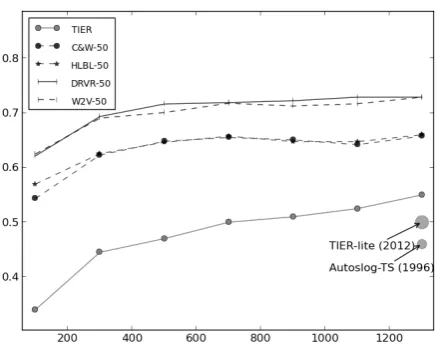
Figure 1: F1-score results for event role labeling on MUC-4 data, for different size of training data, of “String Slots” on the TST3+TST4 with differ-ent parameters, compared to the learning curve of TIER (Huang and Riloff, 2012a). The grey points represent the performances of other IE systems.
Figure 1 presents the average F1-score results, computed over the slots PerpInd, PerpOrg, Tar-get, Victim and Weapon. We observe that mod-els relying on word embeddings globally outper-form the state-of-the-art results, which demon-strates that the word embeddings capture enough semantic information to perform the task of event newswire corpus
4W2V-50 are the embeddings induced from the MUC4
data set using the negative sampling training algorithm (Mikolov et al., 2013a; Mikolov et al., 2013b; Mikolov et al., 2013c), available athttps://code.google.com/ p/word2vec/
[image:4.595.72.291.321.496.2]role labeling on “String Slots” without using any additional hand-engineered features. Moreover, our representations (DRVR-50) clearly surpass the models based on generic embeddings (C&W-50 and HLBL-50) and obtain better results than W2V-50, based the competitive model of (Mikolov et al., 2013a), even if the difference is small. We can also note that the performance of our model is good even with a small amount of training data, which makes it a good candidate to easily develop an event extraction system on a new domain.
4 Conclusions and Perspectives
We presented in this paper a new approach for event extraction by reducing the features to only use unsupervised word representations and a small set of seed words. The word embeddings induced from a domain-specific corpus bring improvement over state-of-art models on the standard MUC-4 corpus and demonstrate a good scalability on different sizes of training data sets. Therefore, our proposal offers a promising path towards eas-ier and faster domain adaptation. We also prove that using a domain-specific corpus leads to bet-ter word vector representations for this task than using other publicly-available word embeddings (even if they are induced from a larger corpus).
As future work, we will reconsider the archi-tecture of the neural network and we will refo-cus on creating a deep learning model while tak-ing advantage of a larger set of types of infor-mation such as syntactic inforinfor-mation, following (Levy and Goldberg, 2014), or semantic informa-tion, following (Yu and Dredze, 2014).
References
Yoshua Bengio, Rejean Ducharme, and Pascal Vincent. 2003. A neural probabilistic language model. Jour-nal of Machine Learning Research, 3:1137–1155. Yoshua Bengio, Holger Schwenk, Jean-S´ebastian
Sen´ecal, Fr´ederic Morin, and Jean-Luc Gauvain. 2006. Neural probabilistic language models. In DawnE. Holmes and LakhmiC. Jain, editors, Inno-vations in Machine Learning, volume 194 ofStudies in Fuzziness and Soft Computing, pages 138–186. Springer Berlin Heidelberg.
Yoshua Bengio. 2009. Learning deep architectures for AI. Foundations and trends in Machine Learning, 2(1).
Antoine Bordes, Xavier Glorot, Jason Weston, and Yoshua Bengio. 2012. Joint learning of words and meaning representations for open-text seman-tic parsing. In Fifteenth International Conference on Artificial Intelligence and Statistics (AISTATS 2012), pages 127–135.
Razvan Bunescu and Raymond J Mooney. 2004. Collective information extraction with relational markov networks. In42nd Annual Meeting on As-sociation for Computational Linguistics (ACL-04), pages 438–445.
Hai Leong Chieu, Hwee Tou Ng, and Yoong Keok Lee. 2003. Closing the gap: Learning-based information extraction rivaling knowledge-engineering methods. In41st international Annual Meeting on Association
for Computational Linguistics (ACL-2003), pages 216–223.
Ronan Collobert and Jason Weston. 2008. A unified architecture for natural language processing: Deep neural networks with multitask learning. In25th In-ternational Conference of Machine learning (ICML-08), pages 160–167. ACM.
Ronan Collobert, Jason Weston, L´eon Battou, Michael Karlen, Koray Kavukcuoglu, and Pavel Kuksa. 2011. Natural language processing (almost) from scratch. Journal of Machine Learning Research, 12:2493–2537.
Ronan Collobert. 2011. Deep learning for efficient discriminative parsing. In 14th International Con-ference on Artificial Intelligence and Statistics (AIS-TATS 2011).
Dayne Freitag. 1998. Information extraction from HTML: Application of a general machine learning approach. InAAAI’98, pages 517–523.
Pierre Geurts, Damien Ernst, and Louis Wehenkel. 2006. Extremely randomized trees. Machine Learn-ing, 63(1):3–42.
Xavier Glorot, Antoine Bordes, and Yoshua Bengio. 2011. Domain adaptation for large-scale senti-ment classification: A deep learning approach. In
28th International Conference on Machine Learning (ICML-11), pages 513–520.
Ruihong Huang and Ellen Riloff. 2011. Peeling back the layers: Detecting event role fillers in secondary contexts. InACL 2011, pages 1137–1147.
Ruihong Huang and Ellen Riloff. 2012a. Bootstrapped training of event extraction classifiers. In13th Con-ference of the European Chapter of the Association for Computational Linguistics (EACL 2012), pages 286–295.
Ruihong Huang and Ellen Riloff. 2012b. Modeling textual cohesion for event extraction. In26th Con-ference on Artificial Intelligence (AAAI 2012).
Patrik Lambert, Holger Schwenk, and Fr´ed´eric Blain. 2012. Automatic translation of scientific documents in the hal archive. InLREC 2012, pages 3933–3936.
Claudia Leacock and Martin Chodorow. 1998. Com-bining local context and Wordnet similarity for word sense identification. In Christiane Fellbaum, edi-tor,WordNet: An electronic lexical database., pages 265–283. MIT Press.
Omer Levy and Yoav Goldberg. 2014. Dependency-based word embeddings. In 52nd Annual Meet-ing of the Association for Computational LMeet-inguis- Linguis-tics (ACL 2014), Short Papers, pages 302–308, Bal-timore, Maryland, June.
Tomas Mikolov, Kai Chen, Greg Corrado, and Jeffrey Dean. 2013a. Efficient estimation of word represen-tations in vector space. InInternational Conference on Learning Representations (ICLR 20013), work-shop track.
Tomas Mikolov, Ilya Sutskever, Kai Chen, Greg S Cor-rado, and Jeff Dean. 2013b. Distributed representa-tions of words and phrases and their compositional-ity. InAdvances in Neural Information Processing Systems 26 (NIPS 2013), pages 3111–3119. Tomas Mikolov, Wen-tau Yih, and Geoffrey Zweig.
2013c. Linguistic regularities in continuous space word representations. InNAACL-HLT 2013, pages 746–751.
Andriy Mnih and Geoffrey Hinton. 2007. Three new graphical models for statistical modelling. In
24th International Conference of Machine learning (ICML 2007), pages 641–648. ACM.
Siddharth Patwardhan and Ellen Riloff. 2007. Ef-fective information extraction with semantic affinity patterns and relevant regions. In 2007 Joint Con-ference on Empirical Methods in Natural Language Processing and Computational Natural Language Learning (EMNLP-CoNLL 2007), pages 717–727. Siddharth Patwardhan and Ellen Riloff. 2009. A
uni-fied model of phrasal and sentential evidence for in-formation extraction. In 2009 Conference on Em-pirical Methods in Natural Language Processing (EMNLP 2009), pages 151–160.
Siddharth Patwardhan. 2010. Widening the field of view of information extraction through sentential event recognition. Ph.D. thesis, University of Utah. F. Pedregosa, G. Varoquaux, A. Gramfort, V. Michel,
B. Thirion, O. Grisel, M. Blondel, P. Pretten-hofer, R. Weiss, V. Dubourg, J. Vanderplas, A. Pas-sos, D. Cournapeau, M. Brucher, M. Perrot, and E. Duchesnay. 2011. Scikit-learn: Machine learn-ing in Python. Journal of Machine Learning Re-search, 12:2825–2830.
Ellen Riloff. 1996. Automatically generating extrac-tion patterns from untagged text. InAAAI’96, pages 1044–1049.
Holger Schwenk and Philipp Koehn. 2008. Large and diverse language models for statistical machine translation. InIJCNLP 2008, pages 661–666. Richard Socher, Cliff C Lin, Chris Manning, and
An-drew Y Ng. 2011. Parsing natural scenes and nat-ural language with recursive nenat-ural networks. In
28th International Conference on Machine Learning (ICML-11), pages 129–136.
Stephen Soderland, Brendan Roof, Bo Qin, Shi Xu, Mausam, and Oren Etzioni. 2010. Adapting open information extraction to domain-specific relations.
AI Magazine, 31(3):93–102.
Kiyoshi Sudo, Satoshi Sekine, and Ralph Grishman. 2003. An improved extraction pattern representa-tion model for automatic ie pattern acquisirepresenta-tion. In
41st Annual Meeting on Association for Computa-tional Linguistics (ACL-03), pages 224–231. Mihai Surdeanu, Jordi Turmo, and Alicia Ageno.
2006. A hybrid approach for the acquisition of information extraction patterns. In EACL-2006 Workshop on Adaptive Text Extraction and Mining (ATEM 2006), pages 48–55.
Joseph Turian, Lev Ratinov, and Yoshua Bengio. 2010. Word representations: a simple and general method for semi-supervised learning. In48th international Annual Meeting on Association for Computational Linguistics (ACL 2010), pages 384–394.
Roman Yangarber, Ralph Grishman, Pasi Tapanainen, and Silja Huttunen. 2000. Automatic acquisition of domain knowledge for information extraction. In
18th Internation Conference on Computational Lin-guistics (COLING 2000), pages 940–946.