Jointly Learning Word Representations and Composition Functions
Using Predicate-Argument Structures
Kazuma Hashimoto†, Pontus Stenetorp†, Makoto Miwa‡, and Yoshimasa Tsuruoka† †The University of Tokyo, 3-7-1 Hongo, Bunkyo-ku, Tokyo, Japan
{hassy,pontus,tsuruoka}@logos.t.u-tokyo.ac.jp
‡Toyota Technological Institute, 2-12-1 Hisakata, Tempaku-ku, Nagoya, Japan
Abstract
We introduce a novel compositional lan-guage model that works on Predicate-Argument Structures (PASs). Our model jointly learns word representations and their composition functions using bag-of-words and dependency-based con-texts. Unlike previous word-sequence-based models, our PAS-word-sequence-based model com-poses arguments into predicates by using the category information from the PAS. This enables our model to capture long-range dependencies between words and to better handle constructs such as verb-object and subject-verb-verb-object relations. We verify this experimentally using two phrase similarity datasets and achieve re-sults comparable to or higher than the pre-vious best results. Our system achieves these results without the need for pre-trained word vectors and using a much smaller training corpus; despite this, for the subject-verb-object dataset our model improves upon the state of the art by as much as∼10%in relative performance.
1 Introduction
Studies on embedding single words in a vector space have made notable successes in capturing their syntactic and semantic properties (Turney and Pantel, 2010). These embeddings have also been found to be a useful component for Natural Language Processing (NLP) systems; for exam-ple, Turian et al. (2010) and Collobert et al. (2011) demonstrated how low-dimensional word vectors learned by Neural Network Language Models (NNLMs) are beneficial for a wide range of NLP tasks.
Recently, the main focus of research on vector space representation is shifting from word repre-sentations to phrase reprerepre-sentations (Baroni and Zamparelli, 2010; Grefenstette and Sadrzadeh, 2011; Mitchell and Lapata, 2010; Socher et al., 2012). Combining the ideas of NNLMs and se-mantic composition, Tsubaki et al. (2013) intro-duced a novel NNLM incorporating verb-object dependencies. More recently, Levy and Goldberg (2014) presented a NNLM that integrated syntac-tic dependencies. However, to the best of our knowledge, there is no previous work on integrat-ing a variety of syntactic and semantic dependen-cies into NNLMs in order to learn composition
functions as well as word representations. The
fol-lowing question thus arises naturally:
Can a variety of dependencies be used to jointly learn both stand-alone word vectors and their compositions, embedding them in the same vector space?
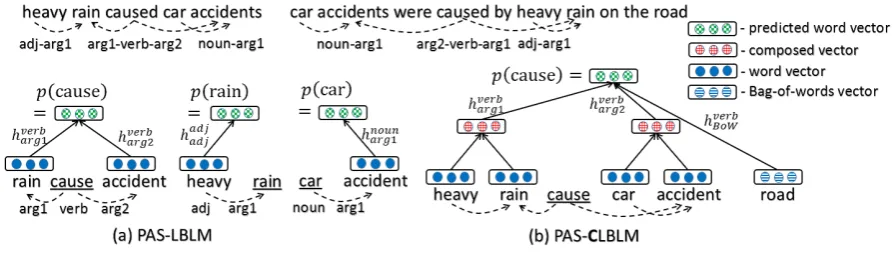
In this work, we bridge the gap between purely context-based (Levy and Goldberg, 2014; Mikolov et al., 2013b; Mnih and Kavukcuoglu, 2013) and compositional (Tsubaki et al., 2013) NNLMs by using the flexible set of categories from Predicate-Argument-Structures (PASs). More specifically, we propose a Compositional Log-Bilinear Language Model using PASs (PAS-CLBLM), an overview of which is shown in Figure 1. The model is trained by maximizing the accuracy of predicting target words from their bag-of-words and dependency-based context, which provides information about selectional preference. As shown in Figure 1 (b), one of the advantages of the PAS-CLBLM is that the model can treat not only word vectors but also composed vectors as contexts. Since the composed vectors
Figure 1: An overview of the proposed model: PAS-CLBLM. (a) The PAS-LBLM predicts target words from their bag-of-words and dependency-based context words. (b) The PAS-CLBLM predicts target words using not only context words but also composed vector representations derived from another level of predicate-argument structures. Underlined words are target words and we only depict the bag-of-words vector for the PAS-CLBLM.
are treated as input to the language model in the same way as word vectors, these composed vectors are expected to become similar to word vectors for words with similar meanings.
Our empirical results demonstrate that the pro-posed model has the ability to learn meaning-ful representations for adjective-noun, noun-noun, and (subject-) verb-object dependencies. On three tasks of measuring the semantic similarity be-tween short phrases (adjective-noun, noun-noun, and verb-object), the learned composed vectors achieve scores (Spearman’s rank correlation ρ) comparable to or higher than those of previ-ous models. On a task involving more complex phrases (subject-verb-object), our learned com-posed vectors achieve state-of-the-art performance (ρ = 0.50) with a training corpus that is an order of magnitude smaller than that used by previous work (Tsubaki et al., 2013; Van de Cruys et al., 2013). Moreover, the proposed model does not require any pre-trained word vectors produced by external models, but rather induces word vectors jointly while training.
2 Related Work
There is a large body of work on how to represent the meaning of a word in a vector space. Distri-butional approaches assume that the meaning of a word is determined by the contexts in which it appears (Firth, 1957). The context of a word is of-ten defined as the words appearing in a window of fixed-length (bag-of-words) and a simple ap-proach is to treat the co-occurrence statistics of a wordwas a vector representation forw(Mitchell
and Lapata, 2008; Mitchell and Lapata, 2010); al-ternatively, dependencies between words can be used to define contexts (Goyal et al., 2013; Erk and Pad´o, 2008; Thater et al., 2010).
In contrast to distributional representations, NNLMs represent words in a low-dimensional vector space (Bengio et al., 2003; Collobert et al., 2011). Recently, Mikolov et al. (2013b) and Mnih and Kavukcuoglu (2013) proposed highly scalable models to learn high-dimensional word vectors. Levy and Goldberg (2014) extended the model of Mikolov et al. (2013b) by treating syntactic depen-dencies as contexts.
Mitchell and Lapata (2008) investigated a vari-ety of compositional operators to combine word vectors into phrasal representations. Among these operators, simple element-wise addition and mul-tiplication are now widely used to represent short phrases (Mitchell and Lapata, 2010; Blacoe and Lapata, 2012). The obvious limitation with these simple approaches is that information about word order and syntactic relations is lost.
To incorporate syntactic information into com-position functions, a variety of comcom-positional models have been proposed. These include recur-sive neural networks using phrase-structure trees (Socher et al., 2012; Socher et al., 2013b) and models in which words have a specific form of parameters according to their syntactic roles and composition functions are syntactically dependent on the relations of input words (Baroni and Zam-parelli, 2010; Grefenstette and Sadrzadeh, 2011; Hashimoto et al., 2013; Hermann and Blunsom, 2013; Socher et al., 2013a).
compositional models have been proposed (Pa-perno et al., 2014; Socher et al., 2014; Tsub-aki et al., 2013). One of the advantages of these models is that they are less restricted by word or-der. Among these, Tsubaki et al. (2013) intro-duced a novel compositional NNLM mainly fo-cusing on verb-object dependencies and achieved state-of-the-art performance for the task of mea-suring the semantic similarity between subject-verb-object phrases.
3 PAS-CLBLM: A Compositional Log-Bilinear Language Model Using Predicate-Argument Structures
In some recent studies on representing words as vectors, word vectors are learned by solving word prediction tasks (Mikolov et al., 2013a; Mnih and Kavukcuoglu, 2013). More specifically, given tar-get words and their context words, the basic idea is to train classifiers to discriminate between each target word and artificially induced negative tar-get words. The feature vector of the classifiers are calculated using the context word vectors whose values are optimized during training. As a result, vectors of words in similar contexts become simi-lar to each other.
Following these studies, we propose a novel model to jointly learn representations for words and their compositions by training word predic-tion classifiers using PASs. In this secpredic-tion, we first describe the predicate-argument structures as they serve as the basis of our model. We then introduce a Log-Bilinear Language Model us-ing Predicate-Argument Structures (PAS-LBLM) to learn word representations using both bag-of-words and dependency-based contexts. Finally, we propose integrating compositions of words into the model. Figure 1 (b) shows the overview of the proposed model.
3.1 Predicate-Argument Structures
Due to advances in deep parsing technologies, syntactic parsers that can produce predicate-argument structures are becoming accurate and fast enough to be used for practical applications. In this work, we use the probabilistic HPSG parser Enju (Miyao and Tsujii, 2008) to obtain the predicate-argument structures of individual sen-tences. In its grammar, each word in a sentence is treated as a predicate of a certain category with zero or more arguments. Table 1 shows some
ex-Category predicate arg1 arg2 adj arg1 heavy rain
noun arg1 car accident
verb arg12 cause rain accident prep arg12 at eat restaurant
Table 1: Examples of predicates of different cate-gories from the grammar of the Enju parser. arg1 and arg2 denote the first and second arguments.
amples of predicates of different categories.1 For example, a predicate of the category verb arg12 expresses a verb with two arguments. A graph can be constructed by connecting words in predicate-argument structures in a sentence; in general, these graphs are acyclic.
One of the merits of using predicate-argument structures is that they can capture dependencies between more than two words, while standard syn-tactic dependency structures are limited to depen-dencies between two words. For example, one of the predicates in the phrase “heavy rain caused car accidents” is the verb “cause”, and it has two ar-guments (“rain” and “accident”). Furthermore, ex-actly the same predicate-argument structure (pred-icate: cause, first argument: rain, second argu-ment: accident) is extracted from the passive form of the above phrase: “car accidents were caused by heavy rain”. This is helpful when capturing semantic dependencies between predicates and ar-guments, and in extracting facts or relations de-scribed in a sentence, such as who did what to
whom.
3.2 A Log-Bilinear Language Model Using Predicate-Argument Structures
3.2.1 PAS-based Word Prediction
The PAS-LBLM predicts a target word given its PAS-based context. We assume that each word
w in the vocabulary V is represented with a d -dimensional vector v(w). When a predicate of categorycis extracted from a sentence, the PAS-LBLM computes the predictedd-dimensional vec-tor p(wt) for the target word wtfrom its context wordsw1, w2, . . . , wm:
p(wt) =f ( m
∑
i=1 hc
i ⊙v(wi) )
, (1)
1The categories of the predicates in the Enju parser are
summarized athttp://kmcs.nii.ac.jp/˜yusuke/
where hci ∈ Rd×1 are category-specific weight vectors and ⊙ denotes element-wise multiplica-tion. f is a non-linearity function; in this work we definef astanh.
As an example following Figure 1 (a), when the predicate “cause” is extracted with its first and second arguments “rain” and “accident”, the PAS-LBLM computes p(cause) ∈ Rd following Eq. (1):
p(cause) =f(hverb arg12arg1 ⊙v(rain)+
hverb arg12arg2 ⊙v(accident)). (2)
In Eq. (2), the predicate is treated as the target word, and its arguments are treated as the con-text words. In the same way, an argument can be treated as a target word:
p(rain) =f(hverb arg12verb ⊙v(cause)+
hverb arg12arg2 ⊙v(accident)). (3)
Relationship to previous work. If we omit the the category-specific weight vectorshci in Eq. (1), our model is similar to the CBOW model in Mikolov et al. (2013a). CBOW predicts a tar-get word given its surrounding bag-of-words con-text, while our model uses its PAS-based context. To incorporate the PAS information in our model more efficiently, we use category-specific weight vectors. Similarly, the vLBL model of Mnih and Kavukcuoglu (2013) uses different weight vec-tors depending on the position relative to the tar-get word. As with previous neural network lan-guage models (Collobert et al., 2011; Huang et al., 2012), our model and vLBL can use weight ma-trices rather than weight vectors. However, as dis-cussed by Mnih and Teh (2012), using weight vec-tors makes the training significantly faster than us-ing weight matrices. Despite the simple formula-tion of the element-wise operaformula-tions, the category-specific weight vectors efficiently propagate PAS-based context information as explained next.
3.2.2 Training Word Vectors
To train the PAS-LBLM, we use a scoring function to evaluate how well the target word wt fits the given context:
s(wt, p(wt)) = ˜v(wt)Tp(wt), (4)
where˜v(wt) ∈Rd×1 is the scoring weight vector for wt. Thus, the model parameters in the PAS-LBLM are (V,V , H˜ ). V is the set of word
vec-torsv(w), andV˜ is the set of scoring weight vec-torsv˜(w). H is the set of the predicate-category-specific weight vectorshci.
Based on the objective in the model of Collobert et al. (2011), the model parameters are learned by minimizing the following hinge loss:
N ∑
n=1
max(1−s(wt, p(wt)) +s(wn, p(wt)),0),
(5) where the negative samplewnis a randomly sam-pled word other than wt, and N is the number of negative samples. In our experiments we set
N = 1. Following Mikolov et al. (2013b), nega-tive samples were drawn from the distribution over unigrams that we raise to the power0.75and then normalize to once again attain a probability distri-bution. We minimize the loss function in Eq. (5) using AdaGrad (Duchi et al., 2011). For further training details, see Section 4.5.
Relationship to softmax regression models. The model parameters can be learned by maximiz-ing the log probability of the target wordwtbased on the softmax function:
p(wt|context) = ∑|exp(V| s(wt, p(wt))) i=1exp(s(wi, p(wt)))
. (6)
This is equivalent to a softmax regression model. However, when the vocabulary V is large, com-puting the softmax function in Eq. (6) is compu-tationally expensive. If we do not need probabil-ity distributions over words, we are not necessar-ily restricted to using the probabilistic expressions. Recently, several methods have been proposed to efficiently learn word representations rather than accurate language models (Collobert et al., 2011; Mikolov et al., 2013b; Mnih and Kavukcuoglu, 2013), and our objective follows the work of Col-lobert et al. (2011). Mikolov et al. (2013b) and Mnih and Kavukcuoglu (2013) trained their mod-els using word-dependent scoring weight vectors which are the arguments of our scoring function in Eq. (4). During development we also trained our model using the negative sampling technique of Mikolov et al. (2013b); however, we did not ob-serve any significant performance difference.
decent step. The category-specific weight vectors provide the PAS information for context word vec-tors which we would like to learn. During train-ing, context word vectors having the same PAS-based syntactic roles are updated similarly. The word-dependent scoring weight vectors propagate the information on which words should, or should not, be predicted. In effect, context word vectors making similar contributions to word predictions are updated similarly. The non-linear function f provides context words with information on the other context words in the same PAS. In this way, word vectors are expected to be learned efficiently by the PAS-LBLM.
3.3 Learning Composition Functions
As explained in Section 3.1, predicate-argument structures inherently form graphs whose nodes are words in a sentence. Using the graphs, we can in-tegrate relationships between multiple predicate-argument structures into our model.
When the context wordwiin Eq. (1), excluding predicate words, has another predicate-argument of categoryc′ as a dependency, we replace v(wi) with the vector produced by the composition func-tion for the predicate category c′. For example, as shown in Figure 1 (b), when the first argument “rain” of the predicate “cause” is also the argu-ment of the predicate “heavy”, we first compute thed-dimensional composed vector representation for “heavy” and “rain”:
gc′(v(heavy), v(rain)), (7)
wherec′is the category adj arg1, andgc′is a func-tion to combine input vectors for the predicate-category c′. We can use any composition func-tion that produces a representafunc-tion of the same dimensionality as its inputs, such as element-wise addition/multiplication (Mitchell and Lap-ata, 2008) or neural networks (Socher et al., 2012). We then replace v(rain)in Eq. (2) with
gc′(v(heavy), v(rain)). When the second argu-ment “accident” in Eq. (2) is also the arguargu-ment of the predicate “car”, v(accident) is replaced with gc′′(v(car), v(accident)). c′′ is the predi-cate predi-category noun arg1. These multiple relation-ships of predicate-argument structures should pro-vide richer context information. We refer to the LBLM with composition functions as PAS-CLBLM.
3.4 Bag-of-Words Sensitive PAS-CLBLM
Both the PAS-LBLM and PAS-CLBLM can take meaningful relationships between words into ac-count. However, at times, the number of context words can be limited and the ability of other mod-els to take ten or more words from a fixed con-text in a bag-of-words (BoW) fashion could com-pensate for this sparseness. Huang et al. (2012) combined local and global contexts in their neural network language models, and motivated by their work, we integrate bag-of-words vectors into our models. Concretely, we add an additional input term to Eq. (1):
p(wt) =f ( m
∑
i=1
hci ⊙v(wi) +hcBoW⊙v(BoW)
)
,
(8) where hcBoW ∈ Rd×1 are additional weight vec-tors, and v(BoW) ∈ Rd×1 is the average of the word vectors in the same sentence. To construct the v(BoW) for each sentence, we average the word vectors of nouns and verbs in the same sen-tence, excluding the target and context words.
4 Experimental Settings
4.1 Training Corpus
We used the British National Corpus (BNC) as our training corpus, extracted 6 million sentences from the original BNC files, and parsed them using the Enju parser described in Section 3.1.
4.2 Word Sense Disambiguation Using Part-of-Speech Tags
In general, words can have multiple syntactic us-ages. For example, the word cause can be a noun or a verb depending on its context. Most of the previous work on learning word vectors ignores this ambiguity since word sense disam-biguation could potentially be performed after the word vectors have been trained (Huang et al., 2012; Kartsaklis and Sadrzadeh, 2013). Some re-cent work explicitly assigns an independent vec-tor for each word usage according to its part-of-speech (POS) tag (Hashimoto et al., 2013; Kart-saklis and Sadrzadeh, 2013). Alternatively, Baroni and Zamparelli (2010) assigned different forms of parameters to adjectives and nouns.
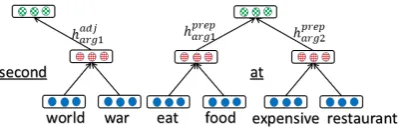
Figure 2: Two PAS-CLBLM training samples.
the surface-forms, and used the first two charac-ters of the POS tags. For example, VB, VBP,
VBZ, VBG, VBD, VBN were all mapped to VB.
This resulted in two kinds of cause: cause NN and
cause VB and we used the 100,000 most frequent
lowercased word-POS pairs in the BNC.
4.3 Selection of Training Samples Based on Categories of Predicates
To train the PAS-LBLM and PAS-CLBLM, we could use all predicate categories. However, our preliminary experiments showed that these cate-gories covered many training samples which are not directly relevant to our experimental setting, such as determiner-noun dependencies. We thus manually selected the categories used in our ex-periments. The selected predicates are listed in Table 1: adj arg1, noun arg1, prep arg12, and
verb arg12. These categories should provide meaningful information on selectional preference. For example, the prep arg12 denotes prepositions with two arguments, such as “eat at restaurant” which means that the verb “eat” is related to the noun “restaurant” by the preposition “at”. Prepo-sitions are one of the predicates whose arguments can be verbs, and thus prepositions are important in training the composition functions for (subject-) verb-object dependencies as described in the next paragraph.
Another point we had to consider was how to construct the training samples for the PAS-CLBLM. We constructed compositional training samples as explained in Section 3.3 when c′ was
adj arg1, noun arg1, or verb arg12. Figure 2 shows two examples in addition to the example in Figure 1 (b). Using such training samples, the PAS-CLBLM could, for example, recognize from the two predicate-argument structures, “eat food” and “eat at restaurant”, that eating foods is an ac-tion that occurs at restaurants.
Model Composition Function Addl v(w1) +v(w2) Addnl tanh(v(w1) +v(w2))
Waddl mcadj⊙v(w1) +mcarg1⊙v(w2) Waddnl tanh(mcadj⊙v(w1)+mcarg1⊙v(w2))
Table 2: Composition functions used in this work. The examples are shown as the adjective-noun de-pendency betweenw1 =“heavy” andw2 =“rain”.
4.4 Selection of Composition Functions
As described in Section 3.3, we are free to se-lect any composition functions in Eq. (7). To maintain the fast training speed of the PAS-LBLM, we avoid dense matrix-vector multiplica-tion in our composimultiplica-tion funcmultiplica-tions. In Table 2, we list the composition functions used for the PAS-CLBLM. Addlis element-wise addition and Addnl is element-wise addition with the non-linear functiontanh. The subscriptslandnl de-note the words linear and non-linear. Similarly, Waddl is element-wise weighted addition and Waddnl is element-wise weighted addition with the non-linear function tanh. The weight vec-torsmci ∈Rd×1in Table 2 are predicate-category-specific parameters which are learned during train-ing. We investigate the effects of the non-linear function tanh for these composition functions. In the formulations of the backpropagation algo-rithm, non-linear functions allow the input vectors to weakly interact with each other.
4.5 Initialization and Optimization of Model Parameters
We assigned a 50-dimensional vector for each word-POS pair described in Section 4.2 and ini-tialized the vectors and the scoring weight vec-tors using small random values. In part inspired by the initialization method of the weight matrices in Socher et al. (2013a), we initialized all values in the compositional weight vectors of the Waddl and Waddnl as 1.0. The context weight vectors were initialized using small random values.
The mini-batch size was32 and the learning rate was 0.05 for each experiment, and no regulariza-tion was used. To verify the semantics captured by the proposed models during training and to tune the hyperparameters, we used the WordSim-3532 word similarity data set (Finkelstein et al., 2001).
5 Evaluation on Phrase Similarity Tasks
5.1 Evaluation Settings
The learned models were evaluated on four tasks of measuring the semantic similarity between short phrases. We performed evaluation using the three tasks (AN, NN, and VO) in the dataset3
pro-vided by Mitchell and Lapata (2010), and the SVO task in the dataset4 provided by Grefenstette and Sadrzadeh (2011).
The datasets include pairs of short phrases ex-tracted from the BNC. AN, NN, and VO con-tain 108 phrase pairs of adjective-noun, noun-noun, and verb-object. SVO contains 200 pairs of subject-verb-object phrases. Each phrase pair has multiple human-ratings: the higher the rating is, the more semantically similar the phrases. For ex-ample, the subject-verb-object phrase pair of “stu-dent write name” and “stu“stu-dent spell name” has a high rating. The pair “people try door” and “peo-ple judge door” has a low rating.
For evaluation we used the Spearman’s rank correlation ρ between the human-ratings and the cosine similarity between the composed vector pairs. We mainly used non-averaged human-ratings for each pair, and as described in Section 5.3, we also used averaged human-ratings for the SVO task. Each phrase pair in the datasets was an-notated by more than two annotators. In the case of averaged human ratings, we averaged multiple human-ratings for each phrase pair, and in the case of non-averaged human-ratings, we treated each human-rating as a separate annotation.
With the PAS-CLBLM, we represented each phrase using the composition functions listed in Table 2. When there was no composition present, we represented the phrase using element-wise ad-dition. For example, when we trained the PAS-CLBLM with the composition function Waddnl,
2
http://www.cs.technion.ac.il/˜gabr/ resources/data/wordsim353/
3
http://homepages.inf.ed.ac.uk/ s0453356/share
4http://www.cs.ox.ac.uk/activities/
compdistmeaning/GS2011data.txt
Model AN NN VO
PAS-CLBLM (Addl) 0.52 0.44 0.35 PAS-CLBLM (Addnl) 0.52 0.46 0.45 PAS-CLBLM (Waddl) 0.48 0.39 0.34 PAS-CLBLM (Waddnl) 0.48 0.40 0.39 PAS-LBLM 0.41 0.44 0.39 word2vec 0.52 0.48 0.42 BL w/ BNC 0.48 0.50 0.35 HB w/ BNC 0.41 0.44 0.34 KS w/ ukWaC n/a n/a 0.45
K w/ BNC n/a n/a 0.41
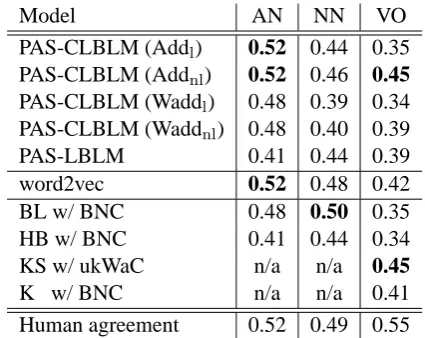
[image:7.595.309.522.61.230.2]Human agreement 0.52 0.49 0.55
Table 3: Spearman’s rank correlation scoresρfor the three tasks: AN, NN, and VO.
the composed vector for each phrase was com-puted using the Waddnl function, and when we trained the PAS-LBLM, we used the element-wise addition function. To compute the composed vec-tors using the Waddl and Waddnl functions, we used the categories of the predicates adj arg1,
noun arg1, and verb arg12 listed in Table 1.
As a strong baseline, we trained the Skip-gram model of Mikolov et al. (2013b) using the pub-licly available word2vec5 software. We fed the POS-tagged BNC into word2vec since our models utilize POS tags and trained 50-dimensional word vectors using word2vec. For each phrase we then computed the representation using vector addition.
5.2 AN, NN, and VO Tasks
Table 3 shows the correlation scoresρfor the AN, NN, and VO tasks. Human agreement denotes the inter-annotator agreement. The word2vec baseline achieves unexpectedly high scores for these three tasks. Previously these kinds of models (Mikolov et al., 2013b; Mnih and Kavukcuoglu, 2013) have mainly been evaluated for word analogy tasks and, to date, there has been no work using these word vectors for the task of measuring the semantic sim-ilarity between phrases. However, this experimen-tal result suggests that word2vec can serve as a strong baseline for these kinds of tasks, in addi-tion to word analogy tasks.
In Table 3, BL, HB, KS, and K denote the work of Blacoe and Lapata (2012), Hermann and Blun-som (2013), Kartsaklis and Sadrzadeh (2013), and Kartsaklis et al. (2013) respectively. Among these,
Averaged Non-averaged
Model Corpus SVO-SVO SVO-V SVO-SVO SVO-V
PAS-CLBLM (Addl) 0.29 0.34 0.24 0.28
PAS-CLBLM (Addnl) 0.27 0.32 0.24 0.28
PAS-CLBLM (Waddl) BNC 0.25 0.26 0.21 0.23
PAS-CLBLM (Waddnl) 0.42 0.50 0.34 0.41
PAS-LBLM 0.21 0.06 0.18 0.08
word2vec BNC 0.12 0.32 0.12 0.28
Grefenstette and Sadrzadeh (2011) BNC n/a n/a 0.21 n/a
Tsubaki et al. (2013) ukWaC n/a 0.47 n/a n/a
Van de Cruys et al. (2013) ukWaC n/a n/a 0.32 0.37
[image:8.595.89.515.63.231.2]Human agreement 0.75 0.62
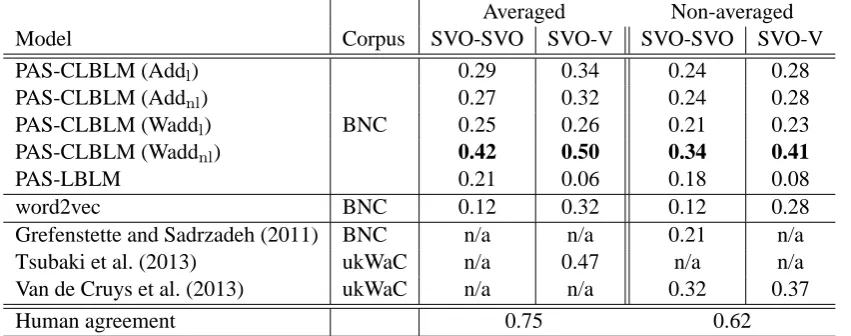
Table 4: Spearman’s rank correlation scoresρfor the SVO task. Averaged denotes the ρcalculated by averaged human ratings, and Non-averaged denotes theρcalculated by non-averaged human ratings.
only Kartsaklis and Sadrzadeh (2013) used the ukWaC corpus (Baroni et al., 2009) which is an or-der of magnitude larger than the BNC. As we can see in Table 3, the PAS-CLBLM (Addnl) achieves scores comparable to and higher than those of the baseline and the previous state-of-the-art results. In relation to these results, the Waddland Waddnl variants of the PAS-CLBLM do not achieve great improvements in performance. This indicates that simple word vector addition can be sufficient to compose representations for phrases consisting of word pairs.
5.3 SVO Task
Table 4 shows the correlation scoresρfor the SVO task. The scores ρ for this task are reported for both averaged and non-averaged human ratings. This is due to a disagreement in previous work regarding which metric to use when reporting re-sults. Hence, we report the scores for both settings in Table 4. Another point we should consider is that some previous work reported scores based on the similarity between composed representations (Grefenstette and Sadrzadeh, 2011; Van de Cruys et al., 2013), and others reported scores based on the similarity between composed representations and word representations of landmark verbs from the dataset (Tsubaki et al., 2013; Van de Cruys et al., 2013). For completeness, we report the scores for both settings: SVO-SVO and SVO-V in Table 4. The results show that the weighted addition model with the non-linear function tanh (PAS-CLBLM (Waddnl)) is effective for the more com-plex phrase task. While simple vector addition is sufficient for phrases consisting of word pairs, it is
clear from our experimental results that they fall short for more complex structures such as those involved in the SVO task.
Our PAS-CLBLM (Waddnl) model outperforms the previous state-of-the-art scores for the SVO task as reported by Tsubaki et al. (2013) and Van de Cruys et al. (2013). As such, there are three key points that we would like to emphasize:
(1) the difference of the training corpus size,
(2) the necessity of the pre-trained word vectors,
(3) the modularity of deep learning models.
Tsubaki et al. (2013) and Van de Cruys et al. (2013) used the ukWaC corpus. This means our model works better, despite using a considerably smaller corpora. It should also be noted that, like us, Grefenstette and Sadrzadeh (2011) used the BNC corpus.
The model of Tsubaki et al. (2013) is based on neural network language models which use syn-tactic dependencies between verbs and their ob-jects. While their novel model, which incorpo-rates the idea of co-compositionality, works well with pre-trained word vectors produced by exter-nal models, it is not clear whether the pre-trained vectors are required to achieve high scores. In contrast, we have achieved state-of-the-art results without the use of pre-trained word vectors.
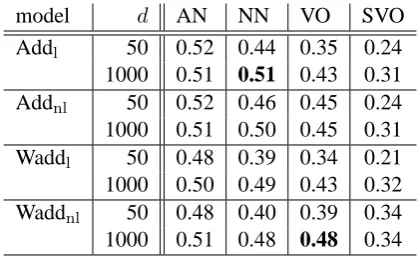
model d AN NN VO SVO Addl 50 0.52 0.44 0.35 0.24 1000 0.51 0.51 0.43 0.31 Addnl 50 0.52 0.46 0.45 0.24 1000 0.51 0.50 0.45 0.31 Waddl 50 0.48 0.39 0.34 0.21 1000 0.50 0.49 0.43 0.32 Waddnl 50 0.48 0.40 0.39 0.34 1000 0.51 0.48 0.48 0.34
Table 5: Comparison of the PAS-CLBLM between
d= 50andd= 1000.
This maintains the possibility to incorporate re-cently developed deep learning composition func-tions into our models, such as recursive neural tensor networks (Socher et al., 2013b) and co-compositional neural networks (Tsubaki et al., 2013). While such complex composition functions slow down the training of compositional models, richer information could be captured during train-ing.
5.4 Effects of the Dimensionality
To see how the dimensionality of the word vectors affects the scores, we trained the PAS-CLBLM for each setting using 1,000-dimensional word vectors and set the learning rate to 0.01. Table 5 shows the scores for all four tasks. Note that we only re-port the scores for the setting non-averaged
SVO-SVO here. As shown in Table 5, the scores
consis-tently improved with a few exceptions. The scores
ρ = 0.51 for the NN task and ρ = 0.48 for the VO task are the best results to date. However, the scoreρ = 0.34for the SVO task did not improve by increasing the dimensionality. This means that simply increasing the dimensionality of the word vectors does not necessarily lead to better results for complex phrases.
5.5 Effects of Bag-of-Words Contexts
Lastly, we trained the PAS-CLBLM without the bag-of-words contexts described in Section 3.4 and used 50-dimensional word vectors. As can be seen in Table 6, large score improvements were observed only for the VO and SVO tasks by in-cluding the bag-of-words contexts and the non-linearity function. It is likely that the results de-pend on how the bag-of-words contexts are con-structed. However, we leave this line of analysis as future work. Both adjective-noun and
noun-model BoW AN NN VO SVO
Addl w/ 0.52 0.44 0.35 0.24 w/o 0.48 0.46 0.38 0.23 Addnl w/ 0.52 0.46 0.45 0.24 w/o 0.50 0.47 0.41 0.15 Waddl w/ 0.48 0.39 0.34 0.21 w/o 0.47 0.39 0.38 0.21 Waddnl w/ 0.48 0.40 0.39 0.34 w/o 0.52 0.42 0.33 0.26
Table 6: Scores of the PAS-CLBLM with and without BoW contexts.
noun phrase are noun phrases, and (subject-) verb-object phrases can be regarded as complete sen-tences. Therefore, different kinds of context infor-mation might be required for both groups.
6 Qualitative Analysis on Composed Vectors
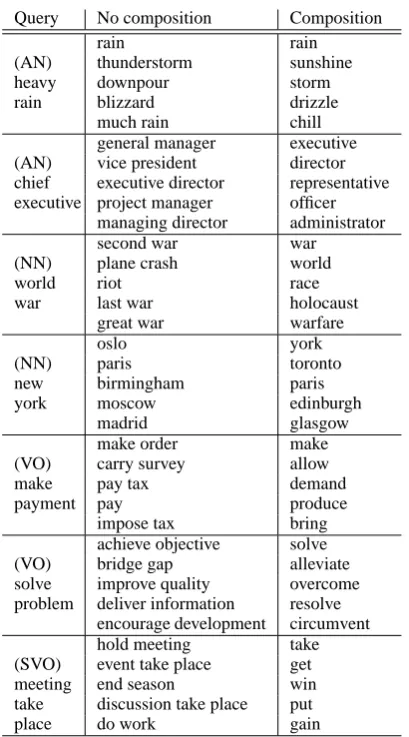
An open question that remains is to what ex-tent composition affects the representations pro-duced by our PAS-CLBLM model. To evalu-ate this we assigned a vector for each composed representation. For example, the adjective-noun dependency “heavy rain” would be assigned an independent vector. We added the most fre-quent 100,000 adjective-noun, noun-noun, and (subject-) verb-object tuples to the vocabulary and the resulting vocabulary contained 400,000 to-kens (100,000+3×100,000). A similar method for treating frequent neighboring words as single words was introduced by Mikolov et al. (2013b). However, some dependencies, such as (subject-) verb-object phrases, are not always captured when considering only neighboring words.
Query No composition Composition
rain rain
(AN) thunderstorm sunshine
heavy downpour storm
rain blizzard drizzle
much rain chill
general manager executive (AN) vice president director chief executive director representative executive project manager officer
managing director administrator
second war war
(NN) plane crash world
world riot race
war last war holocaust
great war warfare
oslo york
(NN) paris toronto
new birmingham paris
york moscow edinburgh
madrid glasgow
make order make
(VO) carry survey allow
make pay tax demand
payment pay produce
impose tax bring
achieve objective solve
(VO) bridge gap alleviate
solve improve quality overcome problem deliver information resolve
encourage development circumvent
hold meeting take
(SVO) event take place get
meeting end season win
take discussion take place put
[image:10.595.79.284.58.427.2]place do work gain
Table 7: Nearest neighbor vectors for multiple words. POS-tags are not shown for simplicity.
category predicate arg1 arg2 adj arg1 2.38 6.55 -noun arg1 3.37 5.60 -verb arg12 6.78 2.57 2.18
Table 8: L2-norms of the 50-dimensional weight vectors of the composition function Waddnl.
functions since the composition layers receive the same error signal via backpropagation.
We then trained the PAS-CLBLM using Waddnl to learn composition functions. Table 7
(Compo-sition) shows the nearest neighbor words for each
composed vector, and as we can see, the learned composition function emphasizes the head words and captures some sort of semantic similarity. We then inspected the L2-norms of the weight vectors of the composition function. As shown in Table 8, head words are strongly emphasized. Emphasiz-ing head words is helpful in representEmphasiz-ing com-posed meanings, but in the case of verbs it may
not always be sufficient. This can be observed in Table 3 and Table 4, which demonstrates that verb-related tasks are more difficult than noun-phrase tasks.
While No composition captures the seman-tic similarity well using independent parameters, there is the issue of data sparseness. As the size of the vocabulary increases, the number of tuples of word dependencies increases rapidly. In this ex-periment, we used only the 300,000 most frequent tuples. In contrast to this, the learned composi-tion funccomposi-tions can capture similar informacomposi-tion us-ing only word vectors and a small set of predicate categories.
7 Conclusion and Future Work
We have presented a compositional log-bilinear language model using predicate-argument struc-tures that incorporates both bag-of-words and dependency-based contexts. In our experiments the learned composed vectors achieve state-of-the-art scores for the task of measuring the semantic similarity between short phrases. For the subject-verb-object phrase task, the result is achieved without any pre-trained word vectors using a cor-pus an order of magnitude smaller than that of the previous state of the art. For future work, we will investigate how our models and the resulting vec-tor representations can be helpful for other unsu-pervised and/or suunsu-pervised tasks.
Acknowledgments
We thank the anonymous reviewers for their help-ful comments and suggestions. This work was supported by JSPS KAKENHI Grant Number 13F03041.
References
Marco Baroni and Roberto Zamparelli. 2010. Nouns are vectors, adjectives are matrices: Representing adjective-noun constructions in semantic space. In Proceedings of the 2010 Conference on Empirical Methods in Natural Language Processing, pages 1183–1193.
Marco Baroni, Silvia Bernardini, Adriano Ferraresi, and Eros Zanchetta. 2009. The WaCky Wide Web: A Collection of Very Large Linguistically Processed Web-Crawled Corpora. Language Resources and Evaluation, 43(3):209–226.
[image:10.595.93.270.466.525.2]Lan-guage Model. Journal of Machine Learning Re-search, 3:1137–1155.
William Blacoe and Mirella Lapata. 2012. A Com-parison of Vector-based Representations for Seman-tic Composition. In Proceedings of the 2012 Joint Conference on Empirical Methods in Natural guage Processing and Computational Natural Lan-guage Learning, pages 546–556.
Ronan Collobert, Jason Weston, L´eon Bottou, Michael Karlen, Koray Kavukcuoglu, and Pavel Kuksa. 2011. Natural Language Processing (Almost) from Scratch. Journal of Machine Learning Research, 12:2493–2537.
John Duchi, Elad Hazan, and Yoram Singer. 2011. Adaptive Subgradient Methods for Online Learning and Stochastic Optimization. Journal of Machine Learning Research, 12:2121–2159.
Katrin Erk and Sebastian Pad´o. 2008. A Structured Vector Space Model for Word Meaning in Context. In Proceedings of the 2008 Conference on Empiri-cal Methods in Natural Language Processing, pages 897–906.
Lev Finkelstein, Gabrilovich Evgenly, Matias Yossi, Rivlin Ehud, Solan Zach, Wolfman Gadi, and Rup-pin Eytan. 2001. Placing Search in Context: The Concept Revisited. In Proceedings of the Tenth In-ternational World Wide Web Conference.
John Rupert Firth. 1957. A synopsis of linguistic theory 1930-55. In Studies in Linguistic Analysis, pages 1–32.
Kartik Goyal, Sujay Kumar Jauhar, Huiying Li, Mrin-maya Sachan, Shashank Srivastava, and Eduard Hovy. 2013. A Structured Distributional Seman-tic Model : Integrating Structure with SemanSeman-tics. In Proceedings of the Workshop on Continuous Vector Space Models and their Compositionality, pages 20– 29.
Edward Grefenstette and Mehrnoosh Sadrzadeh. 2011. Experimental Support for a Categorical Composi-tional DistribuComposi-tional Model of Meaning. In Pro-ceedings of the 2011 Conference on Empirical Meth-ods in Natural Language Processing, pages 1394– 1404.
Kazuma Hashimoto, Makoto Miwa, Yoshimasa Tsu-ruoka, and Takashi Chikayama. 2013. Simple Cus-tomization of Recursive Neural Networks for Se-mantic Relation Classification. In Proceedings of the 2013 Conference on Empirical Methods in Nat-ural Language Processing, pages 1372–1376.
Karl Moritz Hermann and Phil Blunsom. 2013. The Role of Syntax in Vector Space Models of Composi-tional Semantics. In Proceedings of the 51st Annual Meeting of the Association for Computational Lin-guistics (Volume 1: Long Papers), pages 894–904.
Eric Huang, Richard Socher, Christopher Manning, and Andrew Ng. 2012. Improving Word Represen-tations via Global Context and Multiple Word Proto-types. In Proceedings of the 50th Annual Meeting of the Association for Computational Linguistics (Vol-ume 1: Long Papers), pages 873–882.
Dimitri Kartsaklis and Mehrnoosh Sadrzadeh. 2013. Prior Disambiguation of Word Tensors for Con-structing Sentence Vectors. In Proceedings of the 2013 Conference on Empirical Methods in Natural Language Processing, pages 1590–1601.
Dimitri Kartsaklis, Mehrnoosh Sadrzadeh, and Stephen Pulman. 2013. Separating Disambiguation from Composition in Distributional Semantics. In Pro-ceedings of 17th Conference on Natural Language Learning (CoNLL), pages 114–123.
Omer Levy and Yoav Goldberg. 2014. Dependency-Based Word Embeddings. In Proceedings of the 52nd Annual Meeting of the Association for Compu-tational Linguistics (Volume 2: Short Papers), pages 302–308.
Tomas Mikolov, Kai Chen, Greg Corrado, and Jeffrey Dean. 2013a. Efficient Estimation of Word Repre-sentations in Vector Space. In Proceedings of Work-shop at the International Conference on Learning Representations.
Tomas Mikolov, Ilya Sutskever, Kai Chen, Greg S Cor-rado, and Jeff Dean. 2013b. Distributed Represen-tations of Words and Phrases and their Composition-ality. In Advances in Neural Information Processing Systems 26, pages 3111–3119.
Jeff Mitchell and Mirella Lapata. 2008. Vector-based models of semantic composition. In Proceedings of 46th Annual Meeting of the Association for Com-putational Linguistics: Human Language Technolo-gies, pages 236–244.
Jeff Mitchell and Mirella Lapata. 2010. Composition in Distributional Models of Semantics. Cognitive Science, 34(8):1388–1439.
Yusuke Miyao and Jun’ichi Tsujii. 2008. Feature for-est models for probabilistic HPSG parsing. Compu-tational Linguistics, 34(1):35–80.
Andriy Mnih and Koray Kavukcuoglu. 2013. Learning word embeddings efficiently with noise-contrastive estimation. In Advances in Neural Information Pro-cessing Systems 26, pages 2265–2273.
Andriy Mnih and Yee Whye Teh. 2012. A fast and simple algorithm for training neural probabilis-tic language models. In John Langford and Joelle Pineau, editors, Proceedings of the 29th Interna-tional Conference on Machine Learning (ICML-12), ICML ’12, pages 1751–1758.
Proceedings of the 52nd Annual Meeting of the As-sociation for Computational Linguistics (Volume 1: Long Papers), pages 90–99.
Richard Socher, Brody Huval, Christopher D. Man-ning, and Andrew Y. Ng. 2012. Semantic Compo-sitionality through Recursive Matrix-Vector Spaces. In Proceedings of the 2012 Joint Conference on Empirical Methods in Natural Language Process-ing and Computational Natural Language LearnProcess-ing, pages 1201–1211.
Richard Socher, John Bauer, Christopher D. Manning, and Ng Andrew Y. 2013a. Parsing with Compo-sitional Vector Grammars. In Proceedings of the 51st Annual Meeting of the Association for Compu-tational Linguistics (Volume 1: Long Papers), pages 455–465.
Richard Socher, Alex Perelygin, Jean Wu, Jason Chuang, Christopher D. Manning, Andrew Ng, and Christopher Potts. 2013b. Recursive Deep Mod-els for Semantic Compositionality Over a Sentiment Treebank. In Proceedings of the 2013 Conference on Empirical Methods in Natural Language Pro-cessing, pages 1631–1642.
Richard Socher, Quoc V. Le, Christopher D. Manning, and Andrew Y. Ng. 2014. Grounded Compositional Semantics for Finding and Describing Images with Sentences. Transactions of the Association for Com-putational Linguistics, 2:207–218.
Stefan Thater, Hagen F¨urstenau, and Manfred Pinkal. 2010. Contextualizing Semantic Representations Using Syntactically Enriched Vector Models. In Proceedings of the 48th Annual Meeting of the As-sociation for Computational Linguistics, pages 948– 957.
Masashi Tsubaki, Kevin Duh, Masashi Shimbo, and Yuji Matsumoto. 2013. Modeling and Learning Se-mantic Co-Compositionality through Prototype Pro-jections and Neural Networks. In Proceedings of the 2013 Conference on Empirical Methods in Natural Language Processing, pages 130–140.
Joseph Turian, Lev-Arie Ratinov, and Yoshua Bengio. 2010. Word Representations: A Simple and General Method for Semi-Supervised Learning. In Proceed-ings of the 48th Annual Meeting of the Association for Computational Linguistics, pages 384–394.
Peter D. Turney and Patrick Pantel. 2010. From Fre-quency to Meaning: Vector Space Models of Se-mantics. Journal of Artificial Intelligence Research, 37(1):141–188.