Incremental Semantic Role Labeling with Tree Adjoining Grammar
Ioannis Konstas?, Frank Keller?, Vera Demberg†andMirella Lapata?
?: Institute for Language, Cognition and Computation School of Informatics, University of Edinburgh
{ikonstas,keller,mlap}@inf.ed.ac.uk
†: Cluster of Excellence Multimodal Computing and Interaction, Saarland University
Abstract
We introduce the task of incremental mantic role labeling (iSRL), in which se-mantic roles are assigned to incomplete input (sentence prefixes). iSRL is the semantic equivalent of incremental pars-ing, and is useful for language model-ing, sentence completion, machine trans-lation, and psycholinguistic modeling. We propose an iSRL system that combines an incremental TAG parser with a seman-tically enriched lexicon, a role propaga-tion algorithm, and a cascade of classi-fiers. Our approach achieves an SRL F-score of 78.38% on the standard CoNLL 2009 dataset. It substantially outper-forms a strong baseline that combines gold-standard syntactic dependencies with heuristic role assignment, as well as a baseline based on Nivre’s incremental de-pendency parser.
1 Introduction
Humans are able to assign semantic roles such as agent, patient, and theme to an incoming sentence before it is complete, i.e., they incrementally build up a partial semantic representation of a sentence prefix. As an example, consider:
(1) The athlete realized [her
goals]PATIENT/THEMEwere out of reach.
When reaching the noun phraseher goals, the hu-man language processor is faced with a sehu-mantic role ambiguity: her goals can either be the PA -TIENTof the verbrealize, or it can be theTHEME of a subsequent verb that has not been encoun-tered yet. Experimental evidence shows that the human language processor initially prefers thePA -TIENT role, but switches its preference to the
theme role when it reaches the subordinate verb
were. Such semantic garden paths occur because
human language processing occurs word-by-word, and are well attested in the psycholinguistic litera-ture (e.g., Pickering et al., 2000).
Computational systems for performing seman-tic role labeling (SRL), on the other hand, proceed non-incrementally. They require the whole sen-tence (typically together with its complete syntac-tic structure) as input and assign all semansyntac-tic roles at once. The reason for this is that most features used by current SRL systems are defined globally, and cannot be computed on sentence prefixes.
In this paper, we propose incremental SRL (iSRL) as a new computational task that mimics human semantic role assignment. The aim of an iSRL system is to determine semantic roles while the input unfolds: given a sentence prefix and its partial syntactic structure (typically generated by an incremental parser), we need to (a) identify which words in the input participate in the seman-tic roles as arguments and predicates (the task of
role identification), and (b) assign correct seman-tic labels to these predicate/argument pairs (the task ofrole labeling). Performing these two tasks incrementally is substantially harder than doing it non-incrementally, as the processor needs to com-mit to a role assignment on the basis of incom-plete syntactic and semantic information. As an example, take (1): on reachingathlete, the proces-sor should assign this word theAGENT role, even though it has not seen the corresponding predicate yet. Similarly, upon reaching realized, the pro-cessor can complete theAGENTrole, but it should also predict that this verb also has aPATIENTrole, even though it has not yet encountered the argu-ment that fills this role. A system that performs SRL in a fully incremental fashion therefore needs to be able to assign incomplete semantic roles,
unlike existing full-sentence SRL models.
The uses of incremental SRL mirror the applica-tions of incremental parsing: iSRL models can be used in language modeling to assign better string probabilities, in sentence completion systems to
provide semantically informed completions, in any real time application systems, such as dia-log processing, and to incrementalize applications such as machine translation (e.g., in speech-to-speech MT). Crucially, any comprehensive model of human language understanding needs to com-bine an incremental parser with an incremental se-mantic processor (Pad´o et al., 2009; Keller, 2010). The present work takes inspiration from the psycholinguistic modeling literature by proposing an iSRL system that is built on top of a cogni-tively motivated incremental parser, viz., the Psy-cholinguistically Motivated Tree Adjoining Gram-mar parser of Demberg et al. (2013). This parser includes a predictive component, i.e., it predicts syntactic structure for upcoming input during in-cremental processing. This makes PLTAG par-ticularly suitable for iSRL, allowing it to predict incomplete semantic roles as the input string un-folds. Competing approaches, such as iSRL based on an incremental dependency parser, do not share this advantage, as we will discuss in Section 4.3.
2 Related Work
Most SRL systems to date conceptualize seman-tic role labeling as a supervised learning prob-lem and rely on role-annotated data for model training. Existing models often implement a two-stage architecture in which role identification and role labeling are performed in sequence. Su-pervised methods deliver reasonably good perfor-mance with F-scores in the low eighties on stan-dard test collections for English (M`arquez et al., 2008; Bj¨orkelund et al., 2009).
Current approaches rely primarily on syntactic features (such as path features) in order to iden-tify and label roles. This has been a mixed bless-ing as the path from an argument to the predi-cate can be very informative but is often quite complicated, and depends on the syntactic formal-ism used. Many paths through the parse tree are likely to occur infrequently (or not at all), result-ing in very sparse information for the classifier to learn from. Moreover, as we will discuss in Sec-tion 4.4, such path informaSec-tion is not always avail-able when the input is processed incrementally. There is previous SRL work employing Tree Ad-joining Grammar, albeit in a non-incremental set-ting, as a means to reduce the sparsity of syntax-based features. Liu and Sarkar (2007) extract a rich feature set from TAG derivations and demon-strate that this improves SRL performance.
In contrast to incremental parsing, incremental
semantic role labeling is a novel task. Our model builds on an incremental Tree Adjoining Gram-mar parser (Demberg et al., 2013) which predicts the syntactic structure of upcoming input. This al-lows us to perform incremental parsing and incre-mental SRL in tandem, exploiting the predictive component of the parser to assign (potentially in-complete) semantic roles on a word-by-word ba-sis. Similar to work on incremental parsing that evaluates incomplete trees (Sangati and Keller, 2013), we evaluate the incomplete semantic struc-tures produced by our model.
3 Psycholinguistically Motivated TAG
Demberg et al. (2013) introduce Psycholin-guistically Motivated Tree Adjoining Grammar (PLTAG), a grammar formalism that extends stan-dard TAG (Joshi and Schabes, 1992) in order to enable incremental parsing. Standard TAG as-sumes a lexicon of elementary trees, each of which contains at least one lexical item as an an-chor and at most one leaf node as a foot node,
marked withA∗. All other leaves are marked with
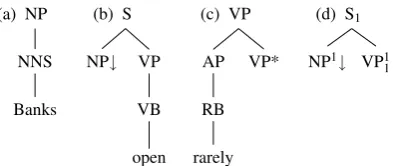
A↓and are calledsubstitution nodes.Elementary trees that contain a foot node are calledauxiliary trees; those that do not are calledinitial trees. Ex-amples for TAG elementary trees are given in Fig-ure 1a–c.
To derive a TAG parse for a sentence, we start with the elementary tree of the head of the sen-tence and integrate the elementary trees of the other lexical items of the sentence using two oper-ations:adjunctionat an internal node and substi-tutionat a substitution node (the node at which the operation applies is theintegration point). Stan-dard TAG derivations are not guaranteed to be in-cremental, as adjunction can happen anywhere in a sentence, possibly violating left-to-right process-ing order. PLTAG addresses this limitation by in-troducingprediction trees,elementary trees with-out a lexical anchor. These can be used to predict syntactic structure anchored by words that appear later in an incremental derivation. The use of pre-diction trees ensures that fully connected prefix treescan be built for every prefix of the input sen-tence.
Each node in a prediction tree carries mark-ersto indicate that this node was predicted, rather than being anchored by the current sentence pre-fix. An example is Figure 1d, which contains a prediction tree with marker “1”. In PLTAG, mark-ers are eliminated through a new operation called
(a) NP NNS Banks
(b) S VP VB open NP↓
(c) VP VP* AP RB rarely
(d) S1
VP1 1
[image:3.595.84.281.62.145.2]NP1↓
Figure 1: PLTAG lexicon entries: (a) and (b) ini-tial trees, (c) auxiliary tree, (d) prediction tree.
a S
B↓ C↓ a
S
B C↓
b
a S
B↓ C
c
(a) valid (b) invalid
Figure 3: The current fringe (dashed line) indi-cates where valid substitutions can occur. Other substitutions result in an invalid prefix tree.
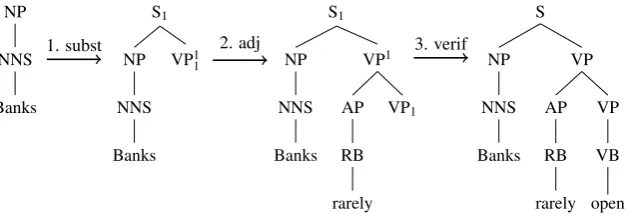
of non-predictive elementary trees. An example of a PLTAG derivation is given in Figure 2. In step 1, a prediction tree is introduced through sub-stitution, which then allows the adjunction of an adverb in step 2. Step 3 involves the verification of the marker introduced by the prediction tree against the elementary tree foropen.
In order to efficiently parse PLTAG, Demberg et al. (2013) introduce the concept of fringes. Fringes capture the fact that in an incremental derivation, a prefix tree can only be combined with an elementary tree at a limited set of nodes. For instance, the prefix tree in Figure 3 has two substi-tution nodes, forBandC. However, only substi-tution intoBleads to a valid new prefix tree; if we substitute intoC, we obtain the tree in Figure 3b, which is not a valid prefix tree (i.e., it represents a non-incremental derivation).
The parsing algorithm proposed by Demberg et al. (2013) exploits fringes to tabulate interme-diate results. It manipulates a chart in which each cell(i,f) contains all the prefix trees whose first
i leaves are the first i words and whose current fringe is f. To extend the prefix trees for i to the prefix trees for i+1, the algorithm retrieves all current fringes f such that the chart has entries in the cell (i,f). For each such fringe, it needs to determine the elementary trees in the lexicon that can be combined with f using substitution or adjunction. In spite of the large size of a typi-cal TAG lexicon, this can be done efficiently, as it only requires matching the current fringes. For each match, the parser then computes the new
pre-Banks refused to open today
A0 A1 A1
A1 AM-TMP
nsbj aux
xcomp
tmod
hA0,Banks,refusedi hA1,to,refusedi hA1,Banks,openi hAM-TMP,today,openi
Figure 4: Syntactic dependency graph with mantic role annotation and the accompanying se-mantic triples, forBanks refused to open today.
fix trees and its new current fringe f0and enters it into cell(i+1,f0).
Demberg et al. (2013) convert the Penn Tree-bank (Marcus et al., 1993) into TAG for-mat by enriching it with head inforfor-mation and argument/modifier information from Propbank (Palmer et al., 2005). This makes it possible to decompose the Treebank trees into elementary trees as proposed by Xia et al. (2000). Predic-tion trees can be learned from the converted Tree-bank by calculating the connection path (Mazzei et al., 2007) at each word in a tree. Intuitively, a prediction tree for word wn contains the
struc-ture that is necessary to connect wn to the prefix
treew1...wn−1, but is not part of any of the
ele-mentary trees ofw1...wn−1. Using this lexicon, a
probabilistic model over PLTAG operations can be estimated following Chiang (2000).
4 Model
4.1 Problem Formulation
In a typical semantic role labeling scenario, the goal is to first identify words that are predicates in the sentence and then identify and label all the arguments for each predicate. This translates into spotting specific words in a sentence that resent the predicate’s arguments, and assigning pre-defined semantic role labels to them. Note that in this work we focus on verb predicates only. The output of a semantic role labeler is a set of seman-tic dependency triples hl,a,pi, with l∈
R
, anda,p∈w, where
R
is a set of semantic role labels denoting a specific relationship between a predi-cate and an argument (e.g.,ARG0,ARG1, ARGM in Propbank),wis the list of words in the sentence,ldenotes a specific role label,athe argument, and
[image:3.595.314.522.66.144.2]NP NNS Banks
S1
VP1 1
NP NNS Banks
S1
VP1
VP1
AP RB rarely NP NNS Banks
S VP
VP VB open AP RB rarely NP NNS Banks
[image:4.595.144.459.63.172.2]1. subst 2. adj 3. verif
Figure 2: Incremental parse forBanks rarely openusing the operations substitution (with a prediction tree), adjunction, and verification.
we want to produce a set of (potentially incom-plete) semantic dependency triples for each prefix of the input sentence. Note that not every word is an argument to a predicate, therefore the set of triples will not necessarily change at every input word. Furthermore, the triples themselves may be incomplete, as either the predicate or the argu-ment may not have been observed yet ( predicate-incompleteorargument-incompletetriples).
Our iSRL system relies on PLTAG, using a se-mantically augmented lexicon. We parse an put sentence incrementally, applying a novel in-cremental role propagation algorithm (IRPA) that creates or updates existing semantic triple candi-dates whenever an elementary (or prediction) tree containing role information is attached to the ex-isting prefix tree. As soon as a triple is completed we apply a two-stage classification process, that first identifies whether the predicate/argument pair is a good candidate, and then disambiguates role labels in case there is more than one candidate.
4.2 Semantic Role Lexicon
Recall that Propbank is used to construct the PLTAG treebank, in order to distinguish between arguments and modifiers, which result in elemen-tary trees with substitution nodes, and auxiliary trees, i.e., trees with a foot node, respectively (see Figure 1). Conveniently, we can use the same in-formation to also enrich the extracted lexicon with the semantic role annotations, following the pro-cess described by Sayeed and Demberg (2013).1
For arguments, annotations are retained on the substitution node in the parental tree, while for modifiers, the role annotation is displayed on the foot node of the auxiliary tree. Note that we dis-play role annotation on traces that are leaf nodes,
1Contrary to Sayeed and Demberg (2013) we put role
la-bel annotations for PPs on the preposition rather than their NP child, following of the CoNLL 2005 shared task (Carreras and M`arquez, 2005).
which enables us to recover long-range dependen-cies (third and fifth tree in Figure 5a). Likewise, we annotate prediction trees with semantic roles, which enables our system to predict upcoming in-complete triples.
Our annotation procedure unavoidably intro-duces some role ambiguity, especially for fre-quently occurring trees. This can give rise to two problems when we generate semantic triples incre-mentally: IRPA tends to create many spurious can-didate semantic triples for elementary trees that correspond to high frequency words (e.g., preposi-tions or modals). Secondly, a semantic triple may be identified correctly but is assigned several role labels. (See the elementary tree forrefuse in Fig-ure 5a.) We address these issues by applying clas-sifiers for role label disambiguation at every pars-ing operation (substitution, adjunction, or verifica-tion), as detailed in Section 4.4.
4.3 Incremental Role Propagation Algorithm
The main idea behind IRPA is to create or up-date existing semantic triples as soon as there is available role information during parsing. Our al-gorithm (lines 1–6 in Alal-gorithm 1) is applied af-ter every PLTAG parsing operation, i.e., when an elementary or prediction tree
T
is adjoined to a particular integration point nodeπip of the prefixtree of the sentence, via substitution or adjunction (lines 3–4).2 In case an elementary tree
Tv
verifiesa prediction tree
Tpr
(lines 5–6), the same method-ology applies, the only difference being that we have to tackle multiple integration point nodesTpr
,ip, one for each prediction marker ofTpr
thatmatches the corresponding nodes in
Tv
.For simplicity of presentation, we will use a concrete example, see Figure 5. Figure 5a shows the lexicon entries for the words of the sentence
2Prediction treeTprin our algorithm is only used during
Banks refused to open. Naturally, some nodes in the lexicon trees might have multiple candidate role labels. For example, the substitution NP node of the second tree takes two labels, namely A0 and A1. These stem from different rolesignatures
when the same elementary tree occurs in differ-ent contexts during training (A1 only on the NP; A0 on the NP and A1 on S). For simplicity’s sake, we collapse different signatures, and let a classi-fier labeller to disambiguate such cases (see Sec-tion 4.4).
Algorithm 1Incremental Role Propagation Alg. 1: procedureIRPA(πip,T,Tpr)
2: Σ←∅ .Σis a dictionary of (πip,hl,a,pi) pairs 3: ifparser operation is substitution or adjunctionthen 4: CREATE-TRIPLES(πip,T)
5: else ifparser operation is verificationthen 6: CREATE-TRIPLES-VERIF(πip,T,Tpr)
returnset of tripleshl,a,pifor prefix treeπ
7: procedureCREATE-TRIPLES(πip,T) 8: ifHAS-ROLES(πip)then 9: UPDATE-TRIPLE(πip,T) 10: else ifHAS-ROLES(T)then
11: Tip←substitution or foot node ofT 12: ADD-TRIPLE(πip,Tip,T)
13: for allremaining nodesn∈T with rolesdo 14: ADD-TRIPLE(πip,n,T) .incomplete triples 15: procedureCREATE-TRIPLES-VERIF(πip,Tv,Tpr) 16: ifHAS-ROLES(Tv)then
17: anchor←lexeme ofTv
18: for allTip←node inTvwith roledo 19: Tpr,ip←matching node ofTipinTpr 20: CREATE-TRIPLES(Tpr,ip,Tv)
.Process the rest of covered nodes inTprwith roles 21: for allremainingTpr,ip←node inTprwith roledo 22: UPDATE-TRIPLE(Tpr,ip,Tpr)
23: functionUPDATE-TRIPLE(πip,T) 24: dep←FIND-INCOMPLETE(Σ,Tip) 25: anchor←lexeme ofT
26: ifanchorofT is predicatethen 27: SET-PREDICATE(dep,anchor) 28: else ifanchorofT is argumentthen 29: SET-ARGUMENT(dep,anchor)
returndep
30: procedureADD-TRIPLE(πip,Tip,T) 31: dep← h[rolesofTip], nil, nili 32: anchor←lexeme ofT
33: ifanchorofT is predicatethen 34: SET-PREDICATE(dep,anchor)
35: SET-ARGUMENT(dep, head ofπip) 36: else ifanchorofT is argumentthen
37: ifTis auxiliarythen .adjunction 38: SET-ARGUMENT(dep,anchor)
39: else .substitution: arg is head of prefix tree 40: SET-ARGUMENT(dep, head ofTip)
41: pred←finddep∈Σwith matchingπip 42: SET-PREDICATE(dep,pred)
43: Σ←(πip,dep)
Once we processBanks, the prefix tree becomes the lexical entry for this word, see the first col-umn of Figure 5b. Next, we process refused:
the parser substitutes the prefix tree into the ele-mentary tree
T
ofrefused;3 the integration pointπip on the prefix tree is the topmost NP. Since
the operation is a substitution (line 3), we create triples between
T
and πip via CREATE-TRIPLES(lines 7–12). πip does not have any role
infor-mation (line 8), so we proceed to add a new se-mantic triple between the role-labeled integration point
Tip
, i.e., substitution NP node ofT
, andπip,via ADD-TRIPLE (lines 30–43). First, we create an incomplete semantic triple with all roles from
Tip
(line 31). Then we set the predicate to the an-chor ofT
to be the word refused, and the argu-ment to be the head word of the prefix tree,Banks(lines 34–35). Note that predicate identification is a trivial task based on part-of-speech information in the elementary tree.4
Then, we add the pair (NP→ h{A0,A1},Banks, refusedi) to a dictionary (line 43). Storing the in-tegration point along with the semantic triple is essential, to be able to recover incomplete triples in later stages of the algorithm. Finally, we re-peat this process for all remaining nodes on
T
that have roles, in our example the substitution node S (lines 13–14). This outputs an incomplete triple, h{A1},nil,refusedi.Next, the parser decides to substitute a predic-tion tree (third tree in Figure 5a) into the substitu-tion node S of the prefix tree. Since the integrasubstitu-tion point is on the prefix tree and has role information (line 8), the corresponding triple should already be present in our dictionary. Upon retrieving it, we set the nil argument to the anchor of the incoming tree. Since it is a prediction tree, we set it to the root of the tree, namelyS2(phrase labels in triples
are denoted by italics), but mark the triple as yet incomplete. This distinction allows us to fill in the correct lexical information once it becomes avail-able, i.e, when the tree gets verified. We also add an incomplete triple for the tracet in the subject position of the prediction tree, as described above. Note that this triple contains multiple roles; this is expected given that prediction trees are unlexical-ized and occur in a wide variety of contexts.
When the next verb arrives, the parser success-fully verifies it against the embedded prediction
3PLTAG parsing operations can occur in two ways: An
elementary tree can be substituted into the substitution node of the prefix tree, or the prefix tree can be substituted into a node of an elementary tree. The same holds for adjunction.
4Most predicates can be identified as anchors of
IRPA MaltParser
Banks – –
refusedh{A0,A1},Banks,refusedi, hA1,S2,refusedi,
h{A0,A1,A2},t,nili
hA0,Banks,refusedi
to – –
open hA1,to,refusedi,
hA1,Banks,openi hhA1,to,refusedA0,Banks,openi,i
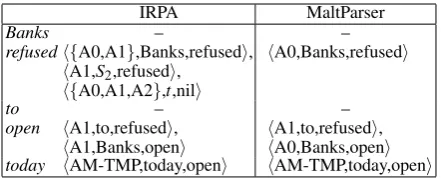
[image:6.595.71.292.61.150.2]today hAM-TMP,today,openi hAM-TMP,today,openi Table 1: Complete and incomplete semantic triple generation, comparing IRPA and a system that maps gold-standard role labels onto MaltParser in-cremental dependencies for Figure 4.
tree within the prefix tree (last step of Figure 5b). Our algorithm first cycles through all nodes that match between the verification tree
Tv
and the pre-diction treeTpr
and will complete or create new triples via CREATE-TRIPLES (lines 18–20). In our example, the second semantic triple gets com-pleted by replacing S2 with the head of thesub-tree rooted in S. Normally, this would be the verb
open, but in this case the verb is followed by the infinitive marker to, hence we heuristically set it to be the argument of the triple instead, following Carreras and M`arquez (2005). For the last triple, we set the predicate to the anchor of
Tv
open, and now are able to remove the excess role labels A0 and A2. This illustrated how the lexicalized veri-fication tree disambiguates the semantic informa-tion stored in the predicinforma-tion tree. Finally, tracetis set to the closest NP head that is below the same phrase subtree, in this caseBanks. Note thatBanksis part of two triples as shown in the last tree of Figure 5b: it is either an A0 or an A1 forrefused
and an A1 foropen.
We are able to create incomplete semantic triples after the prediction of the upcoming verb at step 2, as shown in Figure 5b. This is not possible using an incremental dependency parser such as MaltParser (Nivre et al., 2007) that lacks a predic-tive component. Table 1 illustrates this by compar-ing the output of IRPA for Figure 5b with the out-put of a baseline system that maps role labels onto the syntactic dependencies in Figure 4, generated incrementally by MaltParser (see Section 5.3 for a description of the MaltParser baseline). Malt-Parser has to wait for the verb open before out-putting the relevant semantic triples. In contrast, IRPA outputs incomplete triples as soon as the in-formation is available, and later on updates its de-cision. (MaltParser also incorrectly assigns A0 for theBanks–openpair.)
4.4 Argument Identification and Role Label Disambiguation
IRPA produces semantic triples for every role an-notation present in the lexicon entries, which will often overgenerate role information. Furthermore, some triples have more than one role label at-tached to them. During verification, we are able to filter out the majority of labels in the correspond-ing prediction trees; However, most triples are cre-ated via substitution and adjunction.
In order to address these problems we adhere to the following classification and ranking strategy: after each semantic triple gets completed, we per-form a binary classification that evaluates its suit-ability as a whole, given bilexical and syntactic in-formation. If the triple is identified as a good can-didate, then we perform multi-class classification over role labels: we feed the same bilexical and syntactic information to a logistic classifier, and get a ranked list of labels. We then use this list to re-rank the existing ambiguous role labels in the semantic triple, and output the top scoring ones.
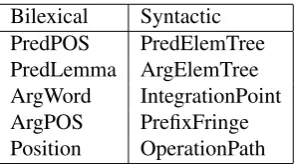
The identifier is a binary L2-loss support vec-tor classifier, and the role disambiguavec-tor an L2-regularized logistic regression classifier, both im-plemented using the efficient LIBLINEAR frame-work of Fan et al. (2008). The features used are based on Bj¨orkelund et al. (2009) and Liu and Sarkar (2007), and are listed in Table 2.
pre-NP NNS Banks
S VP
S↓ {A1} VP
VBD refused NP↓
{A0,A1}
S2
VP2 2
VB2 2
NP2 1
t1 1 {A0,A1,A2}
VP VP∗ TO
to
S VP VB open NP
t
{A1}
(a) Lexicon entries NP
NNS Banks
S VP
S↓ {A1} VP
VBD refused NP
NNS Banks {A0,A1}
S
VP
S2{A1}
VP2 2
VB2 2
NP2 1
t1 1 {A0,A1,A2} VP
VBD refused NP
NNS Banks {A0,A1}
S
VP
S2{A1}
VP2
VP2
VB2 2
TO to NP2
1
t1 1 {A0,A1,A2} VP
VBD refused NP
NNS Banks {A0,A1}
S
VP S
VP VP VB open TO
to {A1} NP
t
VP VBD refused NP
NNS Banks {A0,A1}/{A1}
1. subst 2. subst 3. adj
4. verif
1. NP→ h{A0,A1},Banks,refusedi S→ hA1,nil,refusedi 2. NP→ h{A0,A1},Banks,refusedi
S→ hA1,S2,refusedi
NP→ h{A0,A1,A2},t,nili
3. —
4. NP→ h{A0,A1},Banks,refusedi S→ hA1,to,refusedi
NP→ hA1,Banks,openi
[image:7.595.80.522.60.452.2](b) Incremental parsing using PLTAG and incremental propagation of roles
Figure 5: Incremental Role Propagation Algorithm application for the sentenceBanks refused to open.
Bilexical Syntactic PredPOS PredElemTree PredLemma ArgElemTree ArgWord IntegrationPoint ArgPOS PrefixFringe Position OperationPath
Table 2: Features for argument identification and role label disambiguation.
fix tree. We also store the series of operations ap-plied by our parser between argument and predi-cate, in an effort to emulate the effect of recover-ing longer-range patterns.
5 Experimental Design
5.1 PLTAG and Classifier Training
We extracted the semantically-enriched lexicon and trained the PLTAG parser by converting the Wall Street Journal part of Penn Treebank to PLTAG format. We used Propbank to retrieve semantic role annotation, as described in Sec-tion 4.2. We trained the PLTAG parser according to Demberg et al. (2013) and evaluated the parser on section 23, on sentences with 40 words or less, given gold POS tags for each word, and achieved a labeled bracket F1score of 79.41.
[image:7.595.108.256.512.594.2]Nugues (2007), accompanied by semantic role la-bel annotation for every argument pair. The latter is converted from Propbank based on Carreras and M`arquez (2005). We extracted the bilexical fea-tures for the classifiers directly from the gold stan-dard annotation of the training set. The syntactic features were obtained as follows: for every sen-tence in the training set we applied IRPA using the trained PLTAG parser, with gold standard lexicon entries for each word of the input sentence. This ensures near perfect parsing accuracy. Then for each semantic triple predicted incrementally, we extracted the relevant syntactic information in or-der to construct training vectors. If the identified predicate-argument pair was in the gold standard then we assigned a positive label for the identifi-cation classifier, otherwise we flagged it as nega-tive. For those pairs that are not identified by IRPA but exist in the gold standard (false negatives), we extracted syntactic information from already iden-tified similar triples, as follows: We first look for correctly identified arguments, wrongly attached to a different predicate and re-create the triple with correct predicate/argument information. If no ar-gument is found, we then pick the arar-gument in the list of identified arguments for a correct predicate with the same POS-tag as the gold-standard argu-ment. In the case of the role label disambigua-tion classifier we just assign the gold label for ev-ery correctly identified pair, and ignore the (possi-bly ambiguous) predicted one. After tuning on the development set, the argument identifier achieved an accuracy of 92.18%, and the role label disam-biguation classifier, 82.37%.
5.2 Evaluation
The focus of this paper is to build a system that is able to output semantic role labels for predicate-argument pairs incrementally, as soon as they be-come available. In order to properly evaluate such a system, we need to measure its performance in-crementally. We propose two different cumulative scores for assessing the (possibly incomplete) se-mantic triples that have been created so far, as the input is processed from left to right,per word.The first metric is called Unlabeled Prediction Score (UPS) and gets updated for every identified argu-ment or predicate, even if the corresponding se-mantic triple is incomplete. Note that UPS does not take into account the role label, it only mea-sures predicate and argument identification. In this respect it is analogous to unlabeled dependency accuracy reported in the parsing literature. We
ex-pect a model that is able to predict semantic roles to achieve an improved UPS result compared to a system that does not do prediction, as illustrated in Table 1. Our second score, Combined Incremental SRL Score (CISS), measures the identification of complete semantic role triples (i.e., correct predi-cate, predicate sense, argument, and role label) per word; by the end of the sentence, CISS coincides with standard combined SRL accuracy, as reported in CoNLL 2009 SRL-only task. This score is anal-ogous to labeled dependency accuracy in parsing.
Note that conventional SRL systems such as Bj¨orkelund et al. (2009) typically assume gold standard syntactic information. In order to emu-late this, we give our parser gold standard lexicon entries for each word in the test set; these contain all possible roles observed in the training set for a given elementary tree (and all possible senses for each predicate). This way the parser achieves a syntactic parsing F1 score of 94.24, thus
ensur-ing the errors of our system can be attributed to IRPA and the classifiers. Also note that we evalu-ate on verb predicevalu-ates only, therefore trivially re-ducing the task of predicate identification to the simple heuristic of looking for words in the sen-tence with a verb-related POS tag and excluding auxiliaries and modals. Likewise, predicate sense disambiguation on verbs presumably is trivial, as we observed almost no ambiguity of senses among lexicon entries of the same verb (we adhered to a simple majority baseline, by picking the most fre-quent sense, given the lexeme of the verb, in the few ambiguous cases). It seems that the syntactic information held in the elementary trees discrimi-nates well among different senses.
5.3 System Comparison
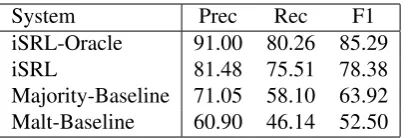
System Prec Rec F1 iSRL-Oracle 91.00 80.26 85.29
iSRL 81.48 75.51 78.38
[image:9.595.81.286.61.130.2]Majority-Baseline 71.05 58.10 63.92 Malt-Baseline 60.90 46.14 52.50
Table 3: Full-sentence combined SRL score
This gives the baseline a considerable advantage especially in case of longer range dependencies. The third configuration (iSRL-Oracle), is identical to iSRL, but uses the gold standard roles for each PLTAG lexicon entry, and thus provides an upper-bound for our methodology. Finally, we evalu-ated against Malt-Baseline, a variant of Majority-Baseline that uses the MaltParser of Nivre et al. (2007) to provide labeled syntactic dependencies MaltParser is a state-of-the-art shift-reduce depen-dency parser which uses an incremental algorithm. Following Beuck et al. (2011), we modified the parser to provide intermediate output at each word by emitting the current state of the dependency graph before each shift step. We trained Malt-Parser using the arc-eager algorithm (which out-performed the other parsing algorithms available with MaltParser) on the CoNLL dataset, achiev-ing a labeled dependency accuracy of 89.66% on section 23.
6 Results
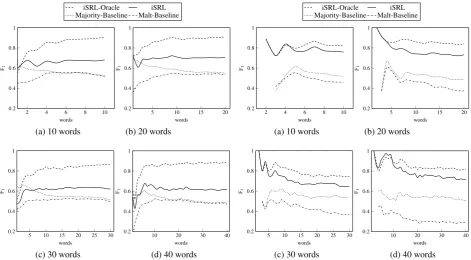
Figures 6 and 7 show the results on the incremen-tal SRL task. We plot the F1for Unlabeled
Predic-tion Score (UPS) and Combined Incremental SRL Score (CISS) per word, separately for sentences of lengths 10, 20, 30, and 40 words. The task gets harder with increasing sentence length, hence we can only meaningfully compare the average scores for sentence of the same length. (This approach was proposed by Sangati and Keller 2013 for eval-uating the performance of incremental parsers.)
The UPS results in Figure 6 clearly show that our system (iSRL) outperforms both baselines on unlabeled argument and predicate prediction, across all four sentence lengths. Furthermore, we note that the iSRL system achieves a near-constant performance for all sentence prefixes. Our PLTAG-based prediction/verification archi-tecture allows us to correctly predict incomplete semantic role triples, even at the beginning of the sentence. Both baselines perform worse than the iSRL system in general. Moreover, the Malt-Baseline performs badly on the initial sentence
prefixes (up to word 10), presumably as it does not benefit from syntactic prediction, and thus can-not generate incomplete triples early in the sen-tence, as illustrated in Table 1. The Majority-Baseline also does not do prediction, but it has ac-cess to gold-standard syntactic dependencies, and thus outperforms the Malt-Baseline on initial sen-tence prefixes. Note that due to prediction, our system tends to over-generate incomplete triples in the beginning of sentences, compared to non-incremental output, which may inflate UPS for the first words. However, this cancels out later in the sentence if triples are correctly completed; failure to do so would decrease UPS. The near-constant performance of our output illustrates this phenomenon. Finally, the iSRL-Oracle outper-forms all other systems, as it benefits from correct role labels and correct PLTAG syntax, thus provid-ing an upper limit on performance.
The CISS results in Figure 7 present a simi-lar picture. Again, the iSRL system outperforms both baselines at all sentence lengths. In addition, it shows particularly strong performance (almost at the level of the iSRL-Oracle) at the beginning of the sentence. This presumably is due to the fact that our system uses prediction and is able to identify correct semantic role triples earlier in the sentence. The baselines also show higher perfor-mance early in the sentence, but to a lesser degree. Table 3 reports traditional combined SRL scores for full sentences over all sentence lengths, as defined for the CoNLL task. Our iSRL system outperforms the Majority-Baseline by almost 15 points, and the Malt-Baseline by 25 points. It re-mains seven points below the iSRL-Oracle upper limit.
2 4 6 8 10 0.2
0.4 0.6 0.8 1
words F1
(a) 10 words
5 10 15 20 0.2
0.4 0.6 0.8 1
words F1
iSRL-Oracle iSRL
Majority-Baseline Malt-Baseline
(b) 20 words
5 10 15 20 25 30 0.2
0.4 0.6 0.8 1
words F1
(c) 30 words
10 20 30 40 0.2
0.4 0.6 0.8 1
words F1
[image:10.595.62.534.60.320.2](d) 40 words Figure 6: Unlabeled Prediction Score (UPS)
2 4 6 8 10 0.2
0.4 0.6 0.8 1
words F1
(a) 10 words
5 10 15 20 0.2
0.4 0.6 0.8 1
words F1
iSRL-Oracle iSRL
Majority-Baseline Malt-Baseline
(b) 20 words
5 10 15 20 25 30 0.2
0.4 0.6 0.8 1
words F1
(c) 30 words
10 20 30 40 0.2
0.4 0.6 0.8 1
words F1
(d) 40 words Figure 7: Combined iSRL Score (CISS)
7 Conclusions
In this paper, we introduced the new task of incre-mental semantic role labeling and proposed a sys-tem that solves this task by combining an incre-mental TAG parser with a semantically enriched lexicon, a role propagation algorithm, and a cas-cade of classifiers. This system achieved a full-sentence SRL F-score of 78.38% on the standard CoNLL dataset. Not only is the full-sentence score considerably higher than the Majority-Baseline (which is a strong baseline, as it uses gold-standard syntactic dependencies), but we also observe that our iSRL system performs well incrementally, i.e., it predicts both complete and incomplete semantic role triples correctly early on in the sentence. We attributed this to the fact that our TAG-based architecture makes it possible to predict upcoming syntactic structure together with the corresponding semantic roles.
Acknowledgments
EPSRC support through grant EP/I032916/1 “An integrated model of syntactic and semantic predic-tion in human language processing” to FK and ML is gratefully acknowledged.
References
Beuck, Niels, Arne Khn, and Wolfgang Menzel. 2011. Incremental parsing and the evaluation
of partial dependency analyses. InProceedings of the 1st International Conference on Depen-dency Linguistics. Depling 2011.
Bj¨orkelund, Anders, Love Hafdell, and Pierre Nugues. 2009. Multilingual semantic role la-beling. In Proceedings of the Thirteenth Con-ference on Computational Natural Language Learning: Shared Task. Association for Com-putational Linguistics, Stroudsburg, PA, USA, CoNLL ’09, pages 43–48.
Carreras, Xavier and Llu´ıs M`arquez. 2005. Intro-duction to the conll-2005 shared task: Semantic role labeling. InProceedings of the Ninth Con-ference on Computational Natural Language Learning. Association for Computational Lin-guistics, Stroudsburg, PA, USA, CONLL ’05, pages 152–164.
Chiang, David. 2000. Statistical parsing with an automatically-extracted tree adjoining gram-mar. InProceedings of the 38th Annual Meeting on Association for Computational Linguistics. pages 456–463.
Demberg, Vera, Frank Keller, and Alexander Koller. 2013. Incremental, predictive pars-ing with psycholpars-inguistically motivated tree-adjoining grammar. Computational Linguistics
39(4):1025–1066.
Li-blinear: A library for large linear classification.
Journal of Machine Learning Research9:1871– 1874.
Hajiˇc, Jan, Massimiliano Ciaramita, Richard Jo-hansson, Daisuke Kawahara, Maria Ant`onia Mart´ı, Llu´ıs M`arquez, Adam Meyers, Joakim Nivre, Sebastian Pad´o, Jan ˇStˇep´anek, Pavel Straˇn´ak, Mihai Surdeanu, Nianwen Xue, and Yi Zhang. 2009. The CoNLL-2009 shared task: Syntactic and semantic dependencies in multi-ple languages. InProceedings of the 13th Con-ference on Computational Natural Language Learning (CoNLL-2009), June 4-5. Boulder, Colorado, USA.
Johansson, Richard and Pierre Nugues. 2007. Ex-tended constituent-to-dependency conversion for english. In Joakim Nivre, Heiki-Jaan Kalep, Kadri Muischnek, and Mare Koit, edi-tors,NODALIDA 2007 Proceedings. University of Tartu, pages 105–112.
Joshi, Aravind K. and Yves Schabes. 1992. Tree adjoining grammars and lexicalized grammars. In Maurice Nivat and Andreas Podelski, editors,
Tree Automata and Languages, North-Holland, Amsterdam, pages 409–432.
Keller, Frank. 2010. Cognitively plausible models of human language processing. InProceedings of the 48th Annual Meeting of the Association for Computational Linguistics, Companion Vol-ume: Short Papers. Uppsala, pages 60–67. Lang, Joel and Mirella Lapata. 2014.
Similarity-driven semantic role induction via graph par-titioning. Computational Linguistics Accepted
pages 1–62. To appear.
Liu, Yudong and Anoop Sarkar. 2007. Experimen-tal evaluation of LTAG-based features for se-mantic role labeling. InProceedings of the 2007 Joint Conference on Empirical Methods in Nat-ural Language Processing and Computational Natural Language Learning (EMNLP-CoNLL). Prague, Czech Republic, pages 590–599. Marcus, Mitchell P., Mary Ann Marcinkiewicz,
and Beatrice Santorini. 1993. Building a large annotated corpus of english: The penn treebank.
Computational Linguistics19(2):313–330. M`arquez, Llu´ıs, Xavier Carreras, Kenneth C.
Litkowski, and Suzanne Stevenson. 2008. Se-mantic Role Labeling: An Introduction to the Special Issue. Computational Linguistics
34(2):145–159.
Mazzei, Alessandro, Vincenzo Lombardo, and Patrick Sturt. 2007. Dynamic TAG and lexi-cal dependencies. Research on Language and Computation5:309–332.
Nivre, Joakim, Johan Hall, Jens Nilsson, Atanas Chanev, G¨ulsen Eryigit, Sandra K¨ubler, Sve-toslav Marinov, and Erwin Marsi. 2007. Malt-parser: A language-independent system for data-driven dependency parsing. Natural Lan-guage Engineering13:95–135.
Pad´o, Ulrike, Matthew W. Crocker, and Frank Keller. 2009. A probabilistic model of semantic plausibility in sentence processing. Cognitive Science33(5):794–838.
Palmer, Martha, Daniel Gildea, and Paul Kings-bury. 2005. The proposition bank: An anno-tated corpus of semantic roles. Computational Linguistics31(1):71–106.
Pickering, Martin J., Matthew J. Traxler, and Matthew W. Crocker. 2000. Ambiguity reso-lution in sentence processing: Evidence against frequency-based accounts. Journal of Memory and Language43(3):447–475.
Sangati, Federico and Frank Keller. 2013. In-cremental tree substitution grammar for pars-ing and word prediction. Transactions of the Association for Computational Linguistics
1(May):111–124.
Sayeed, Asad and Vera Demberg. 2013. The se-mantic augmentation of a psycholinguistically-motivated syntactic formalism. In Proceed-ings of the Fourth Annual Workshop on Cog-nitive Modeling and Computational Linguistics (CMCL). Association for Computational Lin-guistics, Sofia, Bulgaria, pages 57–65.
Surdeanu, Mihai, Richard Johansson, Adam Mey-ers, Llu´ıs M`arquez, and Joakim Nivre. 2008. The CoNLL-2008 shared task on joint pars-ing of syntactic and semantic dependencies. In
Proceedings of the 12th Conference on Compu-tational Natural Language Learning (CoNLL-2008).
Witten, Ian H. and Timothy C. Bell. 1991. The zero-frequency problem: estimating the proba-bilities of novel events in adaptive text compres-sion. Information Theory, IEEE Transactions on37(4):1085–1094.