Interactive Visualization and Manipulation of
Attention-based Neural Machine Translation
Jaesong Lee and Joong-Hwi Shin and Jun-Seok Kim NAVER Corp.
{jaesong.lee,joonghwi.shin,jun.seok}@navercorp.com
Abstract
While neural machine translation (NMT) provides high-quality translation, it is still hard to interpret and analyze its behav-ior. We present an interactive interface for visualizing and intervening behavior of NMT, specifically concentrating on the be-havior of beam search mechanism and at-tention component. The tool (1) visualizes search tree and attention and (2) provides interface to adjust search tree and atten-tion weight (manually or automatically) at real-time. We show the tool help users un-derstand NMT in various ways.
1 Introduction
Recent advances in neural machine translation (NMT) (Sutskever et al.,2014) have changed the direction of machine translation community. Com-pared to traditional phrase-based statistical ma-chine translation (SMT) (Koehn,2010), NMT pro-vides more accurate and fluent translation results. Companies also have started to adopt NMT for their machine translation service.
However, it is still challenging to analyze trans-lation behavior of NMT. While SMT provides in-terpretable features (like phrase table), NMT di-rectly learns complex features which are obscure to human. This is especially problematic in the case of wrong translation, since it is even hard to understand why the system generated such sen-tences.
To help the analysis, we propose a tool for vi-sualizing and intervening NMT behavior, concen-trated on beam search decoder and attention. The features can be grouped by two categories:
[image:1.595.314.521.219.317.2]• Visualizing decoder result, including how decoder assigns probability to each token
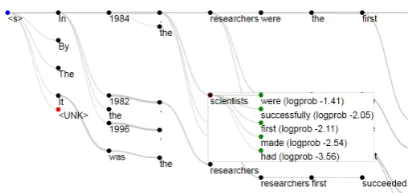
Figure 1: Beam search tree interface. Beam search result is shown as a tree (section3.1). By hovering mouse over node, its corresponding output candi-dates can be seen. User may click the candidate to expand node which are discarded during search (section3.3).
(word, sub-word, etc.), how beam search maintains and discards intermediate hypothe-ses, and how attention layer assigns attention weight. This enables detailed observation of decoder behavior.
• Intervening in decoder behavior, including manually expanding hypothesis discarded during search and adjusting attention weight. This helps understanding how the compo-nents affect translation quality.
We show the mechanism of visualization (Sec-tion 3.1 and 3.2) and manipulation (Section 3.3
and3.4) and its usefulness with examples.
2 Related Work
There have been various methods proposed for vi-sualizing and intervening neural models for NLP. (Li et al., 2015) provides a concise literature re-view.
Visualization and manipulation of NMT could be grouped into three parts: RNN (of encoder and decoder), attention (of decoder), and beam search (of decoder).
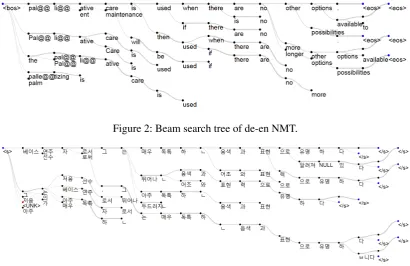
Figure 2: Beam search tree of de-en NMT.
Figure 3: Beam search tree of en-ko NMT. Input sentence is: “As a bass player, he is known for his highly distinctive tone and phrasing.”
RNNplays a central role in recognizing source sentences and generating target sentences. Al-though we here treat RNN as a black-box, there exists various methods to understand RNNs, e.g. by observing intermediate values (Strobelt et al.,
2016;Karpathy et al.,2015;Li et al.,2015) or by removing some parts of them (Goh,2016;Li et al.,
2016).
Attention(Bahdanau et al.,2014;Luong et al.,
2015) is an important component for improving NMT quality. Since the component behaves like alignment in traditional SMT, it has been proposed to utilize attention during training (Cheng et al.,
2015; Tu et al., 2016b) or during decoding (Wu et al., 2016). In this work, we propose a way to manipulate attention and to understand the behav-ior.
[image:2.595.95.502.62.168.2]Beam search is known to improve quality of NMT translation output. However, it is also known that larger beam size does not always helps but rather hurts the quality (Tu et al., 2016a). There-fore it is important to understand how beam search affects quality. (Wu et al., 2016;Freitag and Al-Onaizan,2017) proposed several penalty functions and pruning methods for beam search. We directly visualize beam search result as a tree and manually explore hypotheses discarded by decoder.
Figure 4: Diagram of NMT decoder step. Search tree visualization (Figure2) shows input and out-put tokens as a tree.
3 Interactive Beam Search
We propose an interactive tool for visualizing and manipulating NMT decoder behavior. The sys-tem consists of two parts: back-end NMT server and front-end web interface. NMT server is re-sponsible for NMT computation. Web interface is responsible for requesting computation to NMT server and showing results at real time.
For back-end implementation, we use two NMT models. For English-Korean (en-ko), we use a model used in Naver Papago (Lee et al.,2016) ser-vice1 ported to TensorFlow. For German-English
(de-en), we adopted Nematus2 and pretrained
models provided by (Sennrich et al., 2016). For front-end we implemented JavaScript-based web
1https://papago.naver.com/
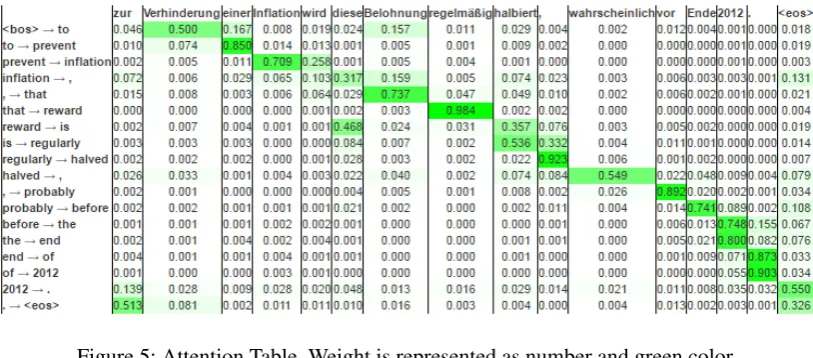
[image:2.595.316.520.391.447.2]Figure 5: Attention Table. Weight is represented as number and green color.
Figure 6: Attention Graph Dialog. Weight is represented as red color.
page with d3.js3.
3.1 Search Tree Visualization
To understand how beam search decoder selects and discards intermediate hypothesis, we first plot all hypotheses as a tree (Figure2,3). For each in-put token (word or sub-word) and decoder (RNN) state vector, the decoder computes output prob-ability of all possible output token, then beam search routine selects token based on its probabil-ity value (Figure 4). We plot each input and out-put token as tree node, and inout-put-outout-put relation as edge. If a node is mouse-hovered, it shows its next possible tokens with highest probability, in-cluding pruned ones (Figure1). We also visualize output probability of node using edge thickness; thicker edge means higher probability.
3.2 Attention Visualization
We show the attention weight of (partially) gen-erated sentence as table (Figure 5) and as graph (Figure6). Table interface provides detailed infor-mation, and graph interface provides more concise view therefore better for long sentences.
3.3 Search Tree Manipulation
We implemented an interface to manually expand nodes which are discarded during beam search. In search tree visualization (Figure7) or attention manipulation dialog (Figure 9), a user can click one of output candidate (green node) then the sys-tem computes its next outputs and extends the tree.
3https://d3js.org/
Figure 7: Manual expansion of nodes not explored at Figure2. For the partial sentence “the Pal@@ li@@ ative Care is”, new subtree “. . . used when there . . . ” are created.
This enables exploration of hypotheses not cov-ered by decoder but worth to analyze.
3.4 Attention Manipulation
We are interested in understanding attention layer of (Bahdanau et al.,2014;Luong et al.,2015), es-pecially the role and effect of attention weights. To achieve it, we modified NMT decoder to ac-cept arbitrary attention weight instead of what the decoder computes (Figure8).
3.4.1 Manual Adjustment of Attention Weight
For given memory cells (encoder outputs)
(m1,· · ·, mn) and decoder internal state h, the
attention layer first computes relevance score of memory cell si = f(mi, h)and attention weight
Figure 8: Diagram of attention manipulation mechanism. The dashed components are origi-nal component of NMT decoder. Here “attention weight” is replaced by “custom attention weight” which is given by user or computed to maximize probability of output token.
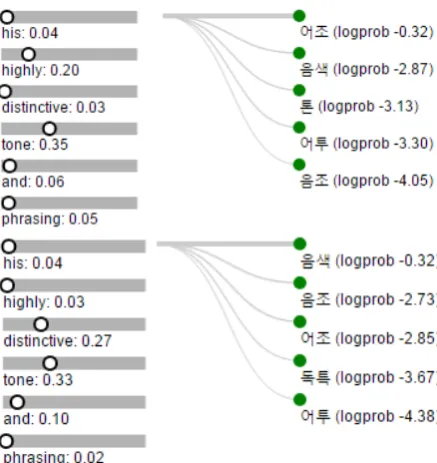
Figure 9: Result of attention manipulation for two output tokens “어조” and “음색”.
are summarized into one fixed vector (m˜) via weighted sum: m˜ = Piwimi. The summarized
vector is fed to next layer to compute output token probabilities:p(yj) =g( ˜m, h)j.
We modified the decoder to accept custom weightw0 = (w0
1,· · ·wn0)instead of original ones
w, when w0 is provided by user. We also
im-plemented front-end interface to adjust custom weight (Figure9). If user drags circle on the bar, the weights are adjusted and the system computes new output probabilities using the weight. It helps to understand what is encoded in memory cell and how decoder utilizes the attended memorym˜. For example, user may increase or decrease weight of specific memory cell and observe its effect.
Figure9shows an illustrative example that how adjusting attention weight could change output probability distribution. When weight of “highly” and “tone” are high, NMT puts high probability to “어조” (“tone of voice”). When weight of “dis-tinctive” is high, NMT recognizes “tone” in cur-rent context (musical instrument) and puts high probability to “음색” (“timbre”).
3.4.2 Automatic Adjustment of Attention Weight
We also implemented a method to find attention weight maximizing output probability of a specific token. For attention weightwand tokeny, we see this problem as a constrained optimization: maxi-mizelogp(y|w,· · ·)s.t.wi ≥0,Piwi = 1. Since
the toolkits we use (TensorFlow4 and Theano5)
provide unconstrained gradient descent optimizer, we cast the original problem to unconstrained op-timization: instead of weightw, we optimize un-normalized scores before softmax, initialized as si = logwi. The method can be used to
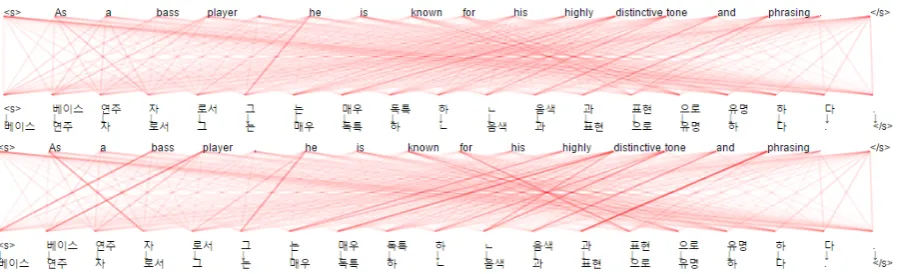
opti-mize weight for specific time step (Figure 9) or for whole sentence (Figure10).
For English-Korean, this technique is particu-larly useful because the original attention weight is sometimes hard to interpret. Due to ordering differences between two languages, en-ko NMTs tend to generate diverse sentences and they have very different orderings among each other. In Figure 3, input sentence is “As a bass player,
he is . . . ”. NMT puts high probability to output sentences starting with either “베이스” (“bass”)
or “그” (“he”), since both are valid. Therefore,
4https://www.tensorflow.org/
5http://deeplearning.net/software/
[image:4.595.75.294.441.673.2]Figure 10: Two attention graphs of en-ko NMT. The first one shows attention weights from NMT. The second one shows attention weights adjusted to maximize target sentence. It reveals clearer and more interpretable relation than original attention.
corresponding source words have high attention weights (0.14 for “bass” and 0.07 for “he”). Since output token is chosen after attention, the atten-tion weights do not necessarily look like alignment between source and output sentences, but rather look like amixtureof alignments of possible out-put sentences.
Once output token is chosen, we can find new attention weight which increases probability of output token, which would be more interpretable than the original weight. An example of such ad-justment is shown at Figure10.
4 Conclusion
We propose a web-based interface for visualiz-ing, investigating and understanding neural ma-chine translation (NMT). The tool provides sev-eral methods to understand beam search and at-tention mechanism in an interactive way, by visu-alizing search tree and attention, expanding search tree manually, and changing attention weight ei-ther manually or automatically. We show the vi-sualization and manipulation helps understanding NMT behavior.
References
Dzmitry Bahdanau, Kyunghyun Cho, and Yoshua Ben-gio. 2014. Neural machine translation by jointly learning to align and translate. In Proceedings of the International Conference on Learning Represen-tations.
Yong Cheng, Shiqi Shen, Zhongjun He, Wei He, Hua Wu, Maosong Sun, and Yang Liu. 2015. Agreement-based joint training for bidirectional attention-based neural machine translation. CoRR, abs/1512.04650.
Markus Freitag and Yaser Al-Onaizan. 2017. Beam search strategies for neural machine translation.
CoRR, abs/1702.01806.
Gabriel Goh. 2016. Decoding the thought vector. Andrej Karpathy, Justin Johnson, and Li Fei-Fei. 2015.
Visualizing and understanding recurrent networks.
arXiv preprint arXiv:1506.02078.
Philipp Koehn. 2010. Statistical Machine Translation, 1st edition. Cambridge University Press, New York, NY, USA.
Hyoung-Gyu Lee, Jun-Seok Kim, Joong-Hwi Shin, Jaesong Lee, Ying-Xiu Quan, and Young-Seob Jeong. 2016. papago: A machine translation service with word sense disambiguation and currency con-version. InProceedings of COLING 2016, the 26th International Conference on Computational Lin-guistics: System Demonstrations, pages 185–188, Osaka, Japan. The COLING 2016 Organizing Com-mittee.
Jiwei Li, Xinlei Chen, Eduard Hovy, and Dan Jurafsky. 2015. Visualizing and understanding neural models in nlp. arXiv preprint arXiv:1506.01066.
Jiwei Li, Will Monroe, and Dan Jurafsky. 2016. Un-derstanding neural networks through representation erasure. CoRR, abs/1612.08220.
Minh-Thang Luong, Hieu Pham, and Christopher D. Manning. 2015. Effective approaches to attention-based neural machine translation. InProceedings of the 2015 Conference on Empirical Methods in Nat-ural Language Processing, pages 1412–1421, Lis-bon, Portugal. Association for Computational Lin-guistics.
Hendrik Strobelt, Sebastian Gehrmann, Bernd Huber, Hanspeter Pfister, and Alexander M. Rush. 2016. Visual analysis of hidden state dynamics in recurrent neural networks.CoRR, abs/1606.07461.
Ilya Sutskever, Oriol Vinyals, and Quoc V Le. 2014. Sequence to sequence learning with neural net-works. InAdvances in neural information process-ing systems, pages 3104–3112.
Zhaopeng Tu, Yang Liu, Lifeng Shang, Xiaohua Liu, and Hang Li. 2016a. Neural machine translation with reconstruction.CoRR, abs/1611.01874. Zhaopeng Tu, Zhengdong Lu, Yang Liu, Xiaohua Liu,
and Hang Li. 2016b. Coverage-based neural ma-chine translation.CoRR, abs/1601.04811.