Latent Variable Dialogue Models and their Diversity
Kris Cao and Stephen Clark Computer Laboratory University of Cambridge
United Kingdom
{kc391, sc609}@cam.ac.uk
Abstract
We present a dialogue generation model that directly captures the variability in pos-sible responses to a given input, which reduces the ‘boring output’ issue of de-terministic dialogue models. Experiments show that our model generates more di-verse outputs than baseline models, and also generates more consistently accept-able output than sampling from a deter-ministic encoder-decoder model.
1 Introduction
The task of open-domain dialogue generation is an area of active development, with neural sequence-to-sequence models dominating the recently pub-lished literature (Shang et al., 2015; Vinyals and Le, 2015; Li et al., 2016b,a; Serban et al., 2016). Most previously published models train to min-imise the negative log-likelihood of the training data, and then at generation time either perform beam search to find the outputY which maximises
P(Y|input)(Shang et al., 2015; Vinyals and Le, 2015; Serban et al., 2016) (ML decoding), or sam-ple from the resulting distribution (Serban et al., 2016).
A notorious issue with ML decoding is that this tends to generate short, boring responses to a wide range of inputs, such as “I don’t know”. These responses are common in the training data, and can be replies to a wide range of inputs (Li et al., 2016a; Serban et al., 2016). In addition, shorter responses typically have higher likelihoods, and so wide beam sizes often result in very short re-sponses (Tu et al., 2017; Belz, 2007). To resolve this problem, Li et al. (2016a) propose instead us-ing maximum mutual information with a length boost as a decoding objective, and report more in-teresting generated responses.
Further, natural dialogue is not deterministic; for example, the replies to“What’s your name and where do you come from?” will vary from person to person. Li et al. (2016b) have proposed learning representations of personas to account for inter-person variation, but there can be variation even among a single person’s responses to certain ques-tions.
Recently, Serban et al. (2017) have introduced latent variables to the dialogue modelling frame-work, to model the underlying distribution over possible responses directly. These models have the benefit that, at generation time, we can sample a response from the distribution by first sampling an assignment of the latent variables, and then de-coding deterministically. In this way, we introduce stochasticity without resorting to sampling from the decoder, which can lead to incoherent output – see Table 1 for examples.
In this paper, we present a latent variable model for one-shot dialogue response, and investigate what kinds of diversity the latent variables capture. Our experiments show that our model has higher lexical as well as sentential diversity than base-line models. We also show that our model gener-ates more acceptable diverse output than sampling from a deterministic decoder. We end by noting that all three methods proposed above to combat the ‘maximum likelihood response’ are ways of decreasing the probability of the generated out-put, and report some preliminary results for how response probability interacts with grammaticality and interestingness.
2 A Latent Variable Dialogue Model 2.1 Model Description
Our task is to model the true probability of a re-sponseY given an inputX. We denote our model distribution by P(Y|X). We introduce a latent
Prompt DIAL-LV Sampling (τ= 1.0)
the infection’s spreading. he’s dead.nothing but no more. he was lee .leave it a way.
i know what you’re doing there’s something going on in the phone rickshaw and put the afloat continuously...
we only have fourteen hours to save the earth!
i’ve got no choice . can i win? and then there’s something that’s what it’s like. go peacekeeper go.
well, we need the help of what’s happening. go to say hello again in this conversation.
why don’t i do some research and send you an email?
[image:2.595.309.525.215.419.2]well, we’re gonna have to make it. no disrespect team. because i know how much it is. excuse me. because it ’s not right. because i’m hotel.
Table 1: 3 random outputs for 3 random prompts from the dataset from our proposed model (DIAL-LV) and naively sampling from the decoder of a deterministic encoder-decoder.
variable z with a standard Gaussian prior – i.e.
P(z) =N(0, In)– and factorP(Y|X)as:
P(Y|X) =
Z
zP(Y|z, X)P(z)dz (1)
To motivate this model, we point out that ex-isting encoder-decoder models encode an inputX
as a single fixed representation. Hence, all of the possible replies toXmust be stored within the de-coder’s probability distributionP(Y|X), and dur-ing decoddur-ing it is hard to disentangle these possi-ble replies.
However, our model contains a stochastic com-ponent z in the decoder P(Y|z, X), and so by sampling differentzand then performing ML de-coding on P(Y|z, X), we hope to tease apart the replies stored in the probability distribution
P(Y|X), without resorting to sampling from the decoder. This has the benefit that we use the de-coder at generation time in a similar way to how we train it, making it more likely that the output of our model is grammatical and coherent. Further, as we do not marginalize out z when decoding, we no longer perform exact maximum likelihood search for a replyY, and so we hope to avoid the boring reply problem.
At training time, we follow the variational au-toencoder framework (Kingma and Welling, 2014; Kingma et al., 2014; Sohn et al., 2015; Miao et al., 2016) , and approximate the posteriorP(z|X, Y) with a proposal distributionQ(z|X, Y), which in our case is a diagonal Gaussian whose parame-ters depend on X andY. We thus have the fol-lowing evidence lower bound (ELBO) for the log-likelihood of the data:
logP(Y|X)≥ −KL(Q(z|X, Y)||P(z)) +Ez∼QlogP(Y|z, X) (2)
Note that this loss decomposes into two parts: the KL divergence between the approximate
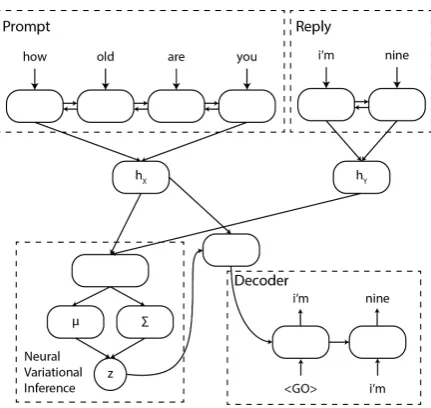
pos-Figure 1: A schematic of how our model is imple-mented. Please see the text for full details.
terior and the prior, and the cross-entropy loss be-tween the model distribution and the data distri-bution. If the model can encode useful informa-tion intoz, then the KL divergence term will be non-zero (Bowman et al., 2016). As our model decoder is given a deterministic representation of
X already, z will then encode information about the variation in replies toX.
2.2 Model Implementation
Given an input sentenceX and a responseY, we run two separate bidirectional RNNs over their word embeddingsxi andyi. We concatenate the
final states of each and pass them through a sin-gle nonlinear layer to obtain our representations
hxandhyofXandY. We use GRUs (Cho et al.,
2014) as our RNN cell as a compromise between expressive power and computational cost.
We calculate the mean and variance ofQas:
µ=Wµ[hxhy] +bµ
where[a b]denotes the concatenation ofaandb, anddiagdenotes inserting along the diagonal of a matrix.
We take a single sample z from Q using the reparametrization trick (Kingma and Welling, 2014), concatenatehxandz, and initialize the
hid-den state of the decoder GRU with[hxz]. We then
train the decoder GRU to minimize the negative log-likelihood of the responseY.
While training this model, we noted the same difficulties as Bowman et al. (2016) – as RNNs are powerful density estimators, the model will prefer to ignore the latent variables and instead optimize the data reconstruction term of the ELBO, while forcing the KL term to 0. We overcome this using similar techniques by gradually annealing the KL term weight over the course of model training and using word dropout in the decoder with a drop rate of0.5.
3 Experiments
We compare our model, DIAL-LV, to three base-lines. The first is an encoder-decoder dialogue model with ML decoding (DIAL-MLE). The sec-ond baseline model implements the anti-LM de-coder of Li et al. (2016a) (DIAL-MMI) on top of the encoder-decoder, with no length normaliza-tion. For these models, we use beam search with a width of 2 to find the sentenceY which maximises the decoding objective (either ML or MMI).
The final baseline uses the encoder-decoder model, but instead samples from the decoder to findY (DIAL-SAMP). We found that naively sam-pling from the decoder resulted in meaningless jumbles of words. To solve this, we introduced a temperature parameterτ ∈ (0,1], which scales the probability of each word of the decoder as
pw 7→ p1w/τ. This parameter serves to sharpen
the word distribution of the decoder. We found
τ = 0.35to be a reasonable balance between pre-serving stochasticity while also improving the co-herence of the generated output.
We used the OpenSubtitles dataset of movie subtitles to train our models (Tiedemann, 2012). We took a random sample of 100K files from the full dataset to train our models on, and then pruned this of repeated files to leave roughly 95K files and capped sentence length to 50. The total size of the resulting corpus was around 731M tokens. Please see the supplementary material for model hyper-parameters and training details.
Model Zipf parameter NLL Unique %
DIAL-LV 1.39 15.54 76
DIAL-MLE 1.43 12.15 35
DIAL-MMI 1.60 15.12 62
DIAL-SAMP 1.53 16.66 78
Table 2: Some statistics pertaining to the re-sponses generated by the models.
As seeds for our replies, we used list of 50 prompts: 150 lines from the OpenSubtitles dataset outside of our training set which we judged to make sense as independent sentences and 50 ques-tions chosen from a list of suggested conversation starters1.
3.1 Reply statistics
Previous work (e.g. Li et al. (2016a)) used type-token ratio (TTR) to measure the diversity of the generated output. However, as language follows a Zipf distribution, TTR is affected by the length of the generated replies (Mitchell, 2015). Hence, we use the estimated parameter of a Zipf distribution fitted to our replies as a proxy for the lexical diver-sity of generated output, with more diverse output having smaller scores. As ML decoding is known to give the same few replies repeatedly, we also re-port the percentage of unique replies, as a coarser measure of sentential diversity compared to lexi-cal diversity. Further, we give the negative log-likelihood (NLL) as predicted by the deterministic encoder-decoder model, to see what regions of the probability space the replies occupy. We present these statistics in Table 2.
We note that DIAL-LV generates more diverse replies than the other deterministic models, mea-sured in terms of percentage of unique responses. Interestingly, the lexical diversity of DIAL-LV is almost identical to DIAL-MLE, suggesting that the latent variables help DIAL-LV avoid the bor-ing output problem and generate more diverse out-puts. We note that LV even rivals DIAL-SAMP in terms of sentential diversity, and beats DIAL-SAMP in terms of lexical diversity. This could be because DIAL-SAMP chooses words greedily, and so is biased towards choosing high-probability words at each timestep. This suggests that maintaining a beam of hypotheses while sam-pling could help samsam-pling-based methods escape
1Obtained from
Model µ σ NLL Zipf Unique % DIAL-LV 1.183 0.402 15.51 1.32 76.4 DIAL-SAMP 1.196 0.577 16.91 1.56 73.6
Table 3: Mean and std. dev. of average number of acceptable replies generated by each model.
Shell radius Zipf parameter NLL Unique %
0 1.49 13.12 7
4 1.62 14.02 42.1
8 1.59 15.72 63.1
12 1.56 17.65 67.7
16 1.78 18.16 67.1
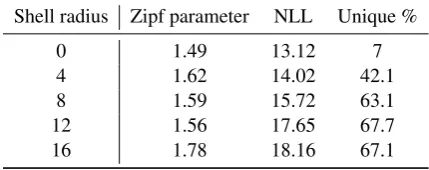
Table 4: Statistics of responses generated from the DIAL-LV model from different regions of the hid-den state space.
the trap of having to make near-greedy local deci-sions.
3.2 Human acceptability judgments
We also tested whether DIAL-LV could gener-ate a gregener-ater number of acceptable replies to a prompt than DIAL-SAMP. We randomly selected 50 prompts from our list of 200, and generated 5 replies at random to each one using both models. We then asked human annotators2 to judge how
many replies were appropriate replies, taking into account grammaticality, coherence and relevance. The results are shown in Table 3.
Interestingly, even though DIAL-LV has a lower NLL score, both models generate roughly the same number of acceptable replies. DIAL-LV also has less variance in the number of acceptable replies, suggesting that the outputs it generates are more consistent than responses from DIAL-SAMP. Finally, we note that DIAL-LV generates more di-verse output than DIAL-SAMP in this scenario, even thought its replies are judged equally accept-able, suggesting that it is managing to produce a wide range of coherent, fluent and appropriate out-put.
3.3 Sampling from the latent variable space We next explored the effect of sampling from dif-ferent regions of the latent space. For each prompt in the test set, we took 5 uniform samples from shells of radius 0 (which collapses to
determinis-2We used 50 in total, 25 for each model
tic decoding), 4, 8, 12 and 16 in the latent space3
by sampling fromP(z) = N(0, I)and then scal-ing the samplez by the appropriate amount. We then generated a response to the prompt using each value of z, and measured some statistics of the replies. The results are shown in Table 4.
As expected, samples with small radius show less diversity in terms of unique outputs. Further, we see a consistent trend that samples with greater radius have a higher NLL score, showing the in-fluence of the prior in Eqn. 1. However, at the highest radius, we observe the highest NLLs, but also the lowest lexical diversities, suggesting that it manages to combine the words it produces in many different ways.
4 Discussion
Taken together, our experiments show that ML de-coding does not seem to be the best objective for generating diverse dialogue, and so corroborates the inadequacy of perplexity as an evaluation met-ric for dialogue models (Liu et al., 2016). Indeed, all three models which show a diversity gain over the vanilla encoder-decoder with MLE decoding try to instead sample responses from a lower-probability region of the response space. However, if the response probability is too low, it runs the risk of being nonsensical. Hence, there appears to be a ‘Goldilocks’ region of the probability space, where the responses are interesting and coherent. Finding ways of concentrating model samples to this region is thus a potentially promising area of research for open-domain dialogue agents.
We also note that our proposed model can be combined with MMI decoding or temperature-based sampling to get the benefits of both worlds. While we did not do this in our experiments in or-der to isolate the impact of our model, doing so im-proves the diversity of our generated output even more.
5 Conclusion
In this paper, we present a latent variable model to generate responses to input utterances. We inves-tigate the diversity of output generated from this model, and show that it improces both lexical and sentential diversity. It also generates more con-sistently acceptable output as judged by humans compared to sampling from a decoder.
Acknowledgements
KC is supported by an EPSRC doctoral award. SC is supported by ERC Starting Grant DisCo-Tex (306920) and ERC Proof of Concept Grant GroundForce (693579). The authors would like to thank everyone who helped prototype the human evaluation experiments. The authors would also like to thank the anonymous reviewers for all their insightful comments.
References
Anja Belz. Probabilistic generation of weather forecast texts. In Human Language Tech-nologies 2007: The Conference of the North American Chapter of the Associa-tion for ComputaAssocia-tional Linguistics; Pro-ceedings of the Main Conference, pages 164–171, Rochester, New York, April 2007. Association for Computational Linguis-tics. URL http://www.aclweb.org/ anthology/N/N07/N07-1021.
Samuel R. Bowman, Luke Vilnis, Oriol Vinyals, Andrew Dai, Rafal Jozefowicz, and Samy Ben-gio. Generating sentences from a continuous space. In Proceedings of The 20th SIGNLL Conference on Computational Natural Lan-guage Learning, pages 10–21, Berlin, Germany, August 2016. Association for Computational Linguistics. URL http://www.aclweb. org/anthology/K16-1002.
Kyunghyun Cho, Bart van Merrienboer, Dzmitry Bahdanau, and Yoshua Bengio. On the prop-erties of neural machine translation: Encoder-decoder approaches. Eighth Workshop on Syntax, Semantics and Structure in Statistical Translation, 2014.
Franois Chollet. Keras. https://github. com/fchollet/keras, 2015.
Diederik P. Kingma and Max Welling. Auto-encoding variational Bayes. ICLR, 2014. Diederik P. Kingma, Danilo Jimenez Rezende,
Shakir Mohamed, and Max Welling. Semi-supervised learning with deep generative mod-els. NIPS, 2014.
Jiwei Li, Michel Galley, Chris Brockett, Jianfeng Gao, and Bill Dolan. A diversity-promoting ob-jective function for neural conversation models. In Proceedings of the 2016 Conference of the North American Chapter of the Association for
Computational Linguistics: Human Language Technologies, pages 110–119, San Diego, Cal-ifornia, June 2016a. Association for Compu-tational Linguistics. URL http://www. aclweb.org/anthology/N16-1014. Jiwei Li, Michel Galley, Chris Brockett, Georgios
Spithourakis, Jianfeng Gao, and Bill Dolan. A persona-based neural conversation model. In
Proceedings of the 54th Annual Meeting of the Association for Computational Linguistics (Vol-ume 1: Long Papers), pages 994–1003, Berlin, Germany, August 2016b. Association for Com-putational Linguistics. URL http://www. aclweb.org/anthology/P16-1094. Chia-Wei Liu, Ryan Lowe, Iulian Serban,
Mike Noseworthy, Laurent Charlin, and Joelle Pineau. How not to evaluate your dialogue sys-tem: An empirical study of unsupervised evalu-ation metrics for dialogue response generevalu-ation. InProceedings of the 2016 Conference on Em-pirical Methods in Natural Language Process-ing, pages 2122–2132, Austin, Texas, Novem-ber 2016. Association for Computational Lin-guistics. URL https://aclweb.org/ anthology/D16-1230.
Yishu Miao, Lei Yu, and Phil Blunsom. Neural variational inference for text processing.ICML, 2016.
David Mitchell. Type-token models: a compara-tive study. Journal of Quantitative Linguistics, 2015.
Frederic Morin and Yoshua Bengio. Hierarchical probabilistic neural network language model.
Tenth International Workshop on Artificial In-telligence and Statistics, 2005.
Iulian V. Serban, Alessandro Sordoni, Yoshua Bengio, Aaron Courville, and Joelle Pineau. Building end-to-end dialogue systems using generative hierarchical neural network models.
AAAI, 2016.
Iulian Vlad Serban, Alessandro Sordoni, Ryan Lowe, Laurent Charlin, Joelle Pineau, Aaron Courville, and Yoshua Bengio. A hierarchical latent variable encoder-decoder model for gen-erating dialogues. InAAAI, 2017.
Lin-guistics and the 7th International Joint Con-ference on Natural Language Processing (Vol-ume 1: Long Papers), pages 1577–1586, Bei-jing, China, July 2015. Association for Com-putational Linguistics. URL http://www. aclweb.org/anthology/P15-1152. Kihyuk Sohn, Honglak Lee, and Xinchen Yan.
Learning structured output representation using deep conditional generative models. In NIPS, 2015.
Theano Development Team. Theano: A Python framework for fast computation of mathematical expressions. arXiv preprints, abs/1605.02688, 2016. URL http:// arxiv.org/abs/1605.02688.
J¨org Tiedemann. Parallel data, tools and interfaces in opus. In Nicoletta Calzolari, Khalid Choukri, Thierry Declerck, Mehmet U˘gur Do˘gan, Bente Maegaard, Joseph Mariani, Jan Odijk, and Stelios Piperidis, editors, Proceedings of the Eighth International Conference on Language Resources and Evaluation (LREC-2012), pages 2214–2218, Istanbul, Turkey, May 2012. Euro-pean Language Resources Association (ELRA). ISBN 978-2-9517408-7-7. URL http:// www.lrec-conf.org/proceedings/ lrec2012/pdf/463_Paper.pdf. ACL Anthology Identifier: L12-1246.
Zhaopeng Tu, Yang Liu, Lifeng Shang, Xiaohua Liu, and Yang Liu. Neural machine translation with reconstruction. InAAAI, 2017.
Orial Vinyals and Quoc V. Le. A neural conversa-tion model. ICML, 2015.
Matthew D. Zeiler. ADADELTA: an adaptive learning rate method. CoRR, abs/1212.5701, 2012. URL http://arxiv.org/abs/ 1212.5701.
A Model training information
We implemented all of our models using Keras (Chollet, 2015) running on Theano (Theano De-velopment Team, 2016). As vocabulary, we took all words appearing at least 1000 times in the whole corpus. As this amounted to∼30K words, we used a 2-level hierarchical approximation to the full softmax to speed up model training (Morin and Bengio, 2005), with random clustering. We trained all our models for 3 epochs using the
Adadelta optimizer (Zeiler, 2012), with default values for the optimizer parameters.
We used 512 dimensional word embeddings and encoder hidden state sizes across all of our mod-els. We used 64 latent dimensional latent vari-ables, and so the decoder RNN for the DIAL-LV model had hidden state size 574. The decoder RNN for the DIAL-MLE model also had hidden state size 574, to keep the capacity of the de-coder comparable across the two models. We used tanh non-linearities throughout our model. For training the vanilla encoder-decoder, we also used word dropout on the decoder input with a drop rate of0.5to prevent overfitting. Each epoch took roughly 4 days on a Titan Black.