862
©IJRASET: All Rights are Reserved
A New Approach for Getting Optimality of
Assignment Problems
Bhavika M Patel1, Mitali J. Doshi2 1, 2
Department of Mathematics, Dharmsinh Desai University, Nadiad, India
Abstract: This article is devoted to present a new approach of zero suffix method (NAZS), which is different from existing zero suffix methods for solving assignment problem. The assignment problem is one of the fundamental combinatorial optimization problems which arise from diverse situation in real life where we have to find an optimal way to allocate m-resources to n-activity in an injective ways.
The results of computational experiments shows that the proposed approach of solving assignment problem is free from degeneracy, which gives better approximation to reach optimality and hence helps in making decision for taking appropriate action while handling assignment problems. Also the proposed approach is quite simple, easy to understand, apply and different from the existing approaches for solving assignment problem.
In this article we solve some real life problem numerically and find its optimal solution by using the proposed NAZS method and compare the result with the Hungarian method to prove the validity of proposed approach.
Keywords:Assignment problem, optimal solution, zero suffix method, Hungarian method and NAZS.
I. INTRODUCTION
The assignment problem arises due to the deviation between the available resources and the degree of the productiveness for performing different types of activity.
Assignment problem is one of the earliest application and special case of linear programming problem, which deals with allocation of various resources to various activities on one to one basis.
Assignment problem is visualized by its two aspects; the assignment represents the fundamental combinatorial structure, while the objective function reflects the desire to be optimized.
Nonetheless the inquisition is’ How to carry out an assignment with the aim of optimality and simultaneously satisfy all the related constraints? ‘To answer the above question, different methods are available, such as Enumeration method, Transportation model, Simplex method, Hungarian method. It does in such a way that the total cost / time involved in the process is minimized whereas profit/ sales are maximized.
The assignment model gives a simple approach for solving these types of problems.
The most popular and basic combinatorial method for assignment problem is developed and published by Kuhn [1] which is known as the Hungarian method.
Abdur [2] proposed a new approach to solve an unbalanced assignment problem by converting it to balanced one. Ahmed and Ahmad [3], Dutta and Pal [4] have developed modified versions of Hungarian method. Basirzadeh [5] introduced Hungarian-like method, called Ones Assignment Method and Ghadle and Muley [6] introduced Revised Ones assignment method by taking a simple modification on Ones Assignment Method which can be applied for assignment problems. Singh et al. [7] has done comparative analysis between Hungarian and MOA method. Sadeghi [8] introduced new algorithm for Transportation problem. Sharma et al. [9] introduced modified approach of zero suffix method for Transportation problem. Sudha and Vanisri [10] has developed an improved zero suffix method for optimal solution of an assignment problem.
In this article we develop a modified approach of zero suffix method which is different from the present methods of solving assignment problem. Our method is based on find the suffix value of zeroes which is obtained by row and column reduction in cost matrix. Assign the resource to that activity that has maximum suffix value. The main concept of assignment problem is to find optimal allocation of activity to an equal number of resources. An assignment problem is optimal if it optimizes the total cost or effectiveness of doing all the jobs.
863
©IJRASET: All Rights are Reserved
II. MATHEMATICALFORMULATIONOFASSIGNMENTPROBLEM:
As the assignment problem is a particular case of the transportation problem, it can be formulated as a linear programming problem (LPP). Suppose there are
n
activities to be performed by usingn
resources. Each task must be performed by using one and only one resource and each resource is used to perform one and only one activity.Optimize
n i n j ij ijx c W 1 1
Subject to the constraints
n jij i n
x 1 ..., ,... 3 , 2 , 1 , 1
n iij j n
x 1 ..., ,... 3 , 2 , 1 , 1 Where, otherwise activity j to asssigned is resource i if x th th ij , 0 , 1
Associated to each assignment problem there exist one matrix called cost matrix, namely[cij] , which is always a square matrix
and is defined as follow
nn n n n n ijc
c
c
c
c
c
c
c
c
c
...
...
|
|
|
|
|
|
...
...
...
...
]
[
2 1 2 22 21 1 12 11Where,
c
ij = cost of effectiveness of assigning ith resources to jth activity.III.ANEWAPPROACHFORSOLVINGASSIGNMENTPROBLEM:
The algorithm of NAZS method for finding an optimal solution of assignment problem consists of following steps: 1) Step 1: Construct the assignment problem (Minimization problem).
2) Step 2 Row Reduction: Find minimum element of each row and then subtract that row minimum element from every element of corresponding row of cost matrix.
3) Step 3 Column Reduction: Find minimum element of each column and then subtract that column minimum element from every element of corresponding column of cost matrix. From step 2 and step 3 we obtain reduced estimated cost matrix say[dij ].
4) Step 4 In matrix [dij ]there will be at least one zero in each row and column. Find suffix value of all the zeros denoted as
Z
Susing below formula,
ij ij ij S
b
of
No
a
of
No
a
of
sum
Z
.
.
Where,
a
ij
non zero entries in thi row and th
j column of [dij ]
bij zero entries in
i
throw and thj column of [dij ]
5) Step 5 Select the maximum value of
Z
S from all the suffix values. If it has unique maximum suffix value then assign thatresource to corresponding activity. Once allocation is done delete that row and corresponding column from[dij ] , which
generate new reduced estimated cost matrix. Next check whether there exist at least one zero in each row and column in new reduced estimated cost matrix. If not, then apply row / column reduction as in steps 2 and 3 whichever is applicable. Now find
S
864
©IJRASET: All Rights are Reserved
6) Step 6: If there are more than on maximum value of
Z
S then for breaking up the tie for allocation we use following procedure:Observe the suffix position for the resources for which tie occurs and consider the cost entries from the original cost matrix
]
[cij corresponding to that suffix position. Now take the cost difference of maximum and minimum entry from suffix positions in
] [cij
Alternatively,
C
.
D
[
R
(
i
)]
Max
CS
Min
CSWhere C.D[R(i)]= Cost difference for resource i,
CS
Max
= Maximum cost value corresponding to suffix position andCS
Min
= Minimum cost value corresponding to suffix position.Next consider maximum value from all C.D[R(i)]to allocate ith resource to jth activity.
7) Step 7: While performing Step 6, if more than one maximum value of C.D[R(i)]exist then for tie breaking situation we consider
minimum cost value from the cost values corresponding to those suffix positions. Then allocate the resource having minimum cost value to the corresponding activity.
8) Step 8: Repeat Step 2 to Step 7 until all the resources are allocated to differentactivities.
a) Author’s Remark: The above algorithm can be applied to maximization assignment problems also by converting them to minimization problem by subtraction all the entries of the cost matrix from the maximum cost entry.
Certain illustrations of assignment problem are solved on the basis of above algorithm.
IV.NUMERICALEXAMPLE
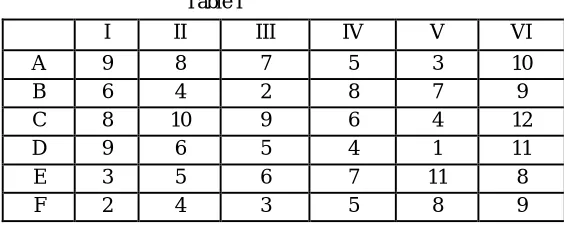
1) Illustration 1: There are six resources to be allocated to six activities. Only one resource can be assigned to one activity. The amount of time\ cost in hours required for the resource per activity are given in the following matrix.
Table I
[Cij]
[image:3.612.164.446.398.512.2]Solution: On applying row reduction we get
TABLE II
I II III IV V VI
A 9 8 7 5 3 10
B 6 4 2 8 7 9
C 8 10 9 6 4 12
D 9 6 5 4 1 11
E 3 5 6 7 11 8
F 2 4 3 5 8 9
I II III IV V VI
A 6 5 4 2 0 7
B 4 2 0 6 5 7
C 4 6 5 2 0 8
D 8 5 4 3 0 10
E 0 2 3 4 8 5
865
©IJRASET: All Rights are Reserved
On applying column reduction we get
TABLE III
Now find the suffix value for those positions whose value is zero & the suffix value is mentioned in the bracket [ ]. The suffix value is calculated by using above formula
Z
S.
TABLE IV
From all of the above suffix value, 1.78 is the maximum so assign the resource B to activity III. Next delete the 2nd row and 3rd
column from the
[
d
ij]
and apply the same process.Table V
I II III IV V VI
A 6 3 4 0 0 2
B 4 0 0 4 5 2
C 4 4 5 0 0 3
D 8 3 4 1 0 5
E 0 0 3 2 8 0
F 0 0 1 1 6 2
]
[
d
ijI II III IV V VI
A 6 3 4 0 [0.96] 0 [1.21] 2
B 4 0 [0.89] 0 [1.78] 4 5 2
C 4 4 5 0 [1.00] 0 [1.25] 3
D 8 3 4 1 0 [1.67] 5
E 0 [1.25] 0 [0.77] 3 2 8 0 [1.13]
F 0 [1.33] 0 [0.71] 1 1 6 2
I II IV V VI
A 6 3 0 [0.83] 0 [1.25] 2
C 4 4 0 [0.83] 0 [1.25] 3
D 8 3 1 0 [1.72] 5
E 0
[1.40]
0 [1.00] 2 8 0 [1.22]
F 0
[1.50]
866
©IJRASET: All Rights are Reserved
From all of the above suffix value, 1.72 is the maximum so assign the resource D to the activity V. Next delete the 3nd row and 4th column from the table 5 and apply the same process.
TABLE VI
In table 6 there are more than one maximum value of
Z
S =1.40. So for breaking up the tie we use5 0 5 )]
( [
.D R A MaxCS MinCS
C
6 0 6 )]
( [
.D R C MaxCS MinCS
C
6 } )] ( [ . , )] ( [ .
{C D R A C D R C
Max
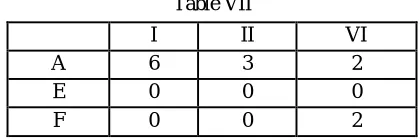
So, we allocate resource C to activity IV. Next delete the 2nd row and 3rd column from the table VI we get
Table VII
Inthe first row of table VII there is no zero so apply row reduction and then same process
Table VIII
From all of the above suffix, 1.17 is the maximum so assign the resource A to the activity VI. Next delete the 1st row and 3rd column from the above table VIII and apply the same process.
Table IX
In table ( ix) all the suffix values are same so for breaking up the tie we use
2 3 5 )]
( [
.D R E MaxCS MinCS
C
2 2 4 )]
( [
.D R F MaxCS MinCS
C
2 } )] ( [ . , )] ( [ .
{CD R E C D R F
Max
The same value appears for both the resources. Hence for breaking such tie we consider minimum cost value from the cost values corresponding to those suffix positions. Then allocate the resource having minimum cost value to the corresponding activity. i.e Min{C51,C52,C61,C62}Min{3,5,2,4}2
Therefore resource F is allocated to the activity I. Hence resource E is a allocated to the activity II.
I II IV VI
A 6 3 0 [1.40] 2
C 4 4 0 [1.40] 3
E 0 [1.00] 0 [0.75] 2 0 [0.75]
F 0 [1.08] 0 [0.83] 1 2
I II VI
A 6 3 2
E 0 0 0
F 0 0 2
I II VI
A 4 1 0 [1.17]
E 0 [1.00] 0 [0.25] 0 [0.50]
F 0 [1.00] 0 [0.50] 2
I II
E 0 [0] 0 [0]
[image:5.612.200.410.309.379.2]867
©IJRASET: All Rights are Reserved
Final allocations are as follows AIV,BIII,CIV,DV,EI,FII
& the minimum assignment cost = Rs (10 + 2 + 6 + 1 +3 +4) = Rs 26
Next we consider maximization problem and its optimal solution.
2) Illustration 2: An marketing firm have five sales person, and five products have to be sold. Sales done by each of the sales person is given in the effectiveness matrix. The problem is to maximize the sales.
TABLE X
Convert the above maximization problem to minimization problem by subtracting all the values of the cost matrix from the maximum cost value. Here maximum cost value is 41.
Table XI
On applying row and column reduction we get
Table XII
Now find the suffix value for those positions whose value is zero & the suffix value is mentioned in the bracket [ ]. The suffix value is calculated by using the above formula for ZS
TABLE XIII
[dij]
I II III IV V
A 32 38 40 28 40
B 40 24 28 21 36
C 41 27 33 30 37
D 22 38 41 36 36
E 29 33 40 35 39
I II III IV V
A 9 3 1 13 1
B 1 17 13 20 5
C 0 14 8 11 4
D 19 3 0 5 5
E 12 8 1 6 2
I II III IV V
A 8 0 0 7 0
B 0 14 12 14 4
C 0 12 8 6 4
D 19 1 0 0 5
E 11 5 0 0 1
I II III IV V
A 8 0 [2.61] 0 [1.75] 7 0 [1.61]
B 0 [5.85] 14 12 14 4
C 0 [4.85] 12 8 6 4
D 19 1 0 [2.25] 0 [2.89] 5
868
©IJRASET: All Rights are Reserved
From all of the above suffix value, 5.85 is the maximum so assign the resource B to activity I. Next delete the 2nd row and 1st column from the [ ]
ij
d and apply the same process.
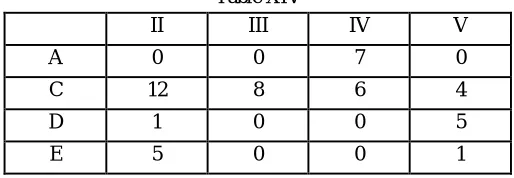
Table XIV
Inthe second row of table XIV there is no zero so apply row reduction in that row and then same process
Table XV
From all of the above suffix value, 2.00 is the maximum so assign the resource C to the activity V. Next delete the 2nd row and 4th column from the table. XV and apply the same process.
TABLE XVI
From all of the above suffix value, 2.16 is the maximum so assign the resource A to the activity II. Next delete the 1st row and 1st column from the table XVI and apply the same process.
TABLE XVII
In table XVII all the suffix values are same so for breaking up the tie we use
C.D[R(D)]MaxCS MinCS 505
C.D[R(E)]MaxCS MinCS 615
Max{C.D[R(D)],C.D[R(E)]}5
The same value appears for both the resources. Hence for breaking such tie we consider minimum cost value from the cost values corresponding to those suffix positions. Then allocate the resource having minimum cost value to the corresponding activity.
II III IV V
A 0 0 7 0
C 12 8 6 4
D 1 0 0 5
E 5 0 0 1
II III IV V
A 0 [1.75] 0 [1.10] 7 0 [1.08]
C 8 4 2 0 [2.00]
D 1 0 [0.83] 0 [1.25] 5
E 5 0 [0.83] 0 [1.25] 1
II III IV
A 0 [2.16] 0 [1.75] 7
D 1 0 [0.25] 0 [1.33]
E 5 0 [1.25] 0 [2.00]
III IV
D 0 [0] 0 [0]
[image:7.612.177.434.116.205.2]869
©IJRASET: All Rights are Reserved
0 } 6 , 1 , 5 , 0 { } , , ,
{C43 C44 C53 C54 Min
Min
.
Therefore resource D is allocated to the activity III. Hence resource E is a allocated to the activity IV. Final allocations are as follows AII,BI,CV,DIII,EIV
& the maximum sale = Rs (38+40+37+41+35) = Rs 191
V. COMPARATIVEANALYSISOF NAZSWITHHUNGARIANMETHOD Table XVIII
VI.CONCLUSION
In this article, a new method is introduced for solving assignment problems. The NAZS method can be used for both maximization
as well as minimization type of problems. Here, we have developed a new approach for finding value of zero suffix and solving assignment problems which give optimal solution. Moreover the optimal solution obtained from our method is same as that of optimal solution obtained by Hungarian method.
Thus the proposed method is easy to understand and apply. Also it has different approach from existing methods. Hence it will help in having precise decisions while dealing with real world problems.
REFERENCES
[1] Kuhn HW ,The Hungarian method for the assignment problem, Neval Research Logistics.1955; 2: 83-97.
[2] Abdur R, An Alternative Approach for Solving Unbalanced Assignment Problems , Jahangirnagar University Journal of Science. 2017; 40( 2): 45-56.
[3] Ahmed A1, Ahmad A, A New Method for Finding an Optimal Solution of Assignment Problem ,International Journal of Modern Mathematical Sciences.
2014; 12(1): 10-15.
[4] Dutta J, Pal SC, A note on Hungarian method for solving Assignment problem, Journal of Information and Optimization Science. 2015; 36(5): 451-459.
[5] Basirzadeh, H, Ones Assignment Method for solving assignment problems, Applied Mathematical Sciences. 2012; 6(47): 2345-2355.
[6] Ghadle KP, Muley YM, Revised Ones Assignment Method for solving assignment problem, Journal of Statistics and Mathematics. 2013; 4: 147-150.
[7] Singh S, Dubey GC, Shrivastava R, A Comparative Analysis of Assignment Problem, Journal of Engineering. 2012; 2(8): 01-15.
[8] Sadeghi J ,A Method for Solving the Transportation Problem, Journal of Statistics and Management System. 2018; 21(5): 817-837 .
[9] Sharma S, Shanker Rama, Shanker Ravi, A Modified Zero Suffix Method for Finding an Optimal Solution for Transportation Problems, European Journal of
Scientific Research. 2013; 104( 4): 673-676
[10] Sudha S, Dr.Vanisri D, Finding an Optimal Solution of an Assignment Problem by Improved Zero Suffix Method, International Journal for Research in
Applied Science & Engineering Technology. 2015; 3(XI): 502 – 507.
NAZS Method Hungarian Method Optimum
Illustration 1 26 26 26