A Framework f o r Comparing Language Experiences (with p a r t i c u l a r emphasis on
The Effect of Audience on Discourse Models) Andee Rubin
Bolt Beranek and Newman Inc. Cambridge, Massachusetts
Those of u s who have been involved i n the study of languagq have often thrown UQ our
hands i n dismay a t the complexity of the pro~lem ( a t l e a s t I have, almost d a i l y ) and t r i e d somewhat desperately t o find some facet of the many-faced gem we confront which appears manageable. T h i s deskre t o focus
-
t o t r a i n the f l a s h l i g h t s we use t o illuminate the problem on a well-circumscribed area-
l e d , for example, t o the early transformational grammarians' separation of syntax from the rest, of language, Many researchers have since discarded t h a t p a r t i c u l a r focus and attempzed t o i n t e g r a t e syntax, semantics and pragmatics i n a s i n g l e theory. Yet, e w n they end up focusing on a particular kind of l i n g u i s t i c interaction. Many s t u d y o r a l conversations, some.
ldok a t computer-person dialogues, some s t u d y newspaper a r t i c l e s . These l i m i t a t i o n si n
scope a r e often not e x p l i c i t , b u t a r e reflected i n the examples they choose and dlscuss. Very few people study more than one communicative situation and even i f they do, they do not usually analyze the s i m i l a r i t i e s and differences among them.J u s t as the early transformatlonal focus on syntax resulted I n a model which missed many c r u c i a l insights about language, so does our current research r i s k formulating incomplete and even inaccurate models by focusing on c e r t a i n communicative s i t u a t i o n s without adequate i n s i g h t l n t o t h e i r r e l a t i o n s h i p t o others. My own focus in an attempt t o polnt out what such a narrow view might miss, and t o provide a framework i n which %o -examine a wide variety of language experiences and discover what e f f e c t the differences among them have on theories of language. T h i s paper f i r s t p r e s e m the framework, then examines f u r t h e r one dimension of language experience
--
the audience for an utterance--
as an example of the k i n d of considerations such an analysis suggests.1 . Building the Space of Language Jixperlences Consider f i r s t two language experiences commonly studied b4 present-daj ~ n v e s t l g a t o r s :
face-todace opal conversations and
computer-per-n dialogues. These two
s i t u a t i o n s d i f f e r
i n
a t l e a s t two ways: themodality of the i n t e r a c t i o n (current computer-person dialogues a r e written) and t h e lack of p o s s i b i l i t y of communicating with e x t r a - l i n g u i s t i c devices such a s gestures and f a c i a l expressions. The kinds of questions we want t o be able t o address are:
wnat \are the e f f e c t s o f these two d i s t i n c t i o n s on tne language used i n each of these s l t u a t i o n s ? What a r e the e f f e c t s on t h e models of language llse which we thereby
formulate?
In order t o capture these kinds of differences In a way which w i l l enable us co approach these questions, I have used t h e metaphor of a multi-dimensional space, Each language experience l i e s a t a point i r t h e space defined by i t s pos5'ition along aeveval dimensions of the l i n g u i s t i k medlum. The med-iuq of a language experience i s defined In contrast t o its mess-me; i n a s much as they ?an be separated, the message is what is
2ommunicated, whrle tne medium is how l t is comgpnicated. Further, the medlum here i s expressed
i n
experiential terms and does ndt represent s i m p l y the vehicle for the &ssage; for example, the contrast 1s made between beingI n
a conversation and watching9
play, rather than between a conversation and a play. ( 11
Consider a s a s t a r t i n g point i n building &he space the following message: an i n v i t a t i o n and d i r e c t i o n s t o a party. One common i i n g u l s t i c s i t u a t i o n in which t h i s
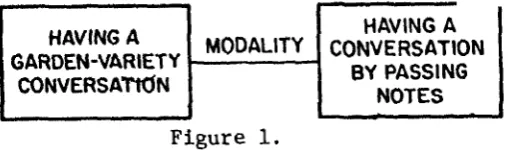
might be communicated i s face-to-face o r a l conversation. Conversations, however, do not need t o be o r a l ; it i s q u i t e possible t o maintain a l l the aspects of a conversation while writing i t down by, f o r example, passing notes. These two language experiences form a "minimal p a i r v ; t h a t i s , they a i f f e r along
o n l y one dimension. We might r e p r e s e n t t h e s i t u a t i o n g r a p h i c a l l y by l a b e l l i n g t h e l i n e c o n n e c t i n g t h e two e x p e r i e n c e s w i t h t h e dimension a l o n g which t h e y d i f f e r . The r e l e v a n t dimension i n t h i s diagram is p l p d a l i t ~ ,
[image:2.862.99.356.224.299.2]i.e.
whether a language e x p e r i e n c e is o r a l of w r i t t e n . (Modality w i l l be f u r t h e r d i s s e c t e d below. )Figure 1. I
HAVING A GARDEN-VARIETY
CONVERSATK~N
Let u s now look a t two o t h e r p a i r s o f language e x p e r i e n c e s which i l l u s t r a t e a n o t h e r dimension. Consider communicating t h e same message over t h e telephone compared t o u s i n g a t a p e o a s s e t t e . I n t h e f i r s t c a s e ,
i t
i s p o s s i b l e f o r t h e two p a r t i c i p a n t s t o i n t e r a c t , f o r t h e l i s t e n e r t o expfiess c o n f u s i o n and a s k for a d d i t i o n a l i n f o r m a t i o n , f o r t h e s p e a k e r t o monitor t h e l i s t e n e r ' s r e a c t i o w and p r o v i d e a more complete e x p l a n a t i o n . I n t h e c a s s e t t e s i t u a t i o n , t R e s p e a k e r must d e c i d e once and fora l l
how t o g i v e t h e d i r e c t i o n s w i t h o u t t h e b e n e f i t of i n t e r m e d i a t e feedback; any feedback which might occur would happen a f t e r t h e l i s t e n e r had heard t h e t a p e a l l bhe way through and would be temporally removed from t h e thncr t h e speaker composed t h e tape. I have termed t h i s dimension o f language e x p e r i a n c e i n t e r a c t i o q , a s F i g u r e 2 i l l u s t r a t e s .The o t h e r minimal p a i r i n F i g u r e 2, whi-ch a l s o i l l u s t r a t e s t h e i n t e r a c t i o n dimension, 18 communicating by l e t t e r v e r s u s communicating by a c o n v e r s a t i o n o v e r t e l e t y p e s ( w h i l e 8 t h i s i s a somewhat unusual communicative s e t t i n g , many of t h e people r e a d i n g t h i s paper have probably p a r t i c i p a t e d i n i t )
.
Here d g a i n t h e c r u c i a l d i f f e r e n c e betwee& t h e two i s t h e p o s s i b i R i t y of feedback. I n t h i s p a r t i c u l a r t a s k , f o r example, t h e s p e a k e r might want t o a s k of t h e l i s t e n e r , "Do you know t h e c o r n e r o f LewB and fair vie^?^ and base h e r f u r t h e r e x p l a n a t i o n on t h e response. Such an exchangewould be impossible i n the case of a l e t t e r
MODC\LITy
- ON THE TO A TAPE
TELEPHONE
HAVING A CONVERSATION
BY PASSING NOTES
Notiae now t h a t we can connect t h e two minimal p a i r s i n F i g u r e 2 by l i n e s l a b e l l e d n m o d a l i t y w . Reading a l e t t e r and l i s t e n i n g t o a cassette form a minimal p a i r which d i f f e r o n l y i n m o d a l i t y ; t h e same is t r u e f o r t e l e t y p e and t e l e p h o n e c o n v e r s a t i o n s . The m o d a l i t y and i n t e r a G i o n a x e s t o g e t h e r form a p l a n e i n which Me can p l a c e t h e s e f o u r language e x p e r i e n c e s .
Figure 3
r
TALKING
ON THE TELEPHONE
Other dimensions can s i m i l a r l y be added t o t h i s s p a c e , by f i r s t d i s c o v e r i n g a minimal p a i r which f o c u s e s on a p a r t i c u l a r dimension, t h e n a t t e m p t i n g t o p i n p o i n t e a c h language e x p e r i e n c e a-eady i n t h e s p a c e on t h a t dimension and f i n a l l y f i l l i n g i n t h e h o l e s which e x i s t b e c a u s e o f t h e added a x l a . As an example of' one s t e p i n b u i l d i n g t h e s p a c e , c o n s i d e r the dimension of g x t r a - l i n g u i s t i c communication, t h a t i s , c o m u n i c a t i o n by g e s t u r e s , f a c i a l q p r e u s i o n s , e t c . ?or t h e message we are c o n s i d e r i n g , g e s t u r e s would be p a r t i c u l a r l y u s e f u l t o i n d i c a t e s p a t i a l
f e a t u r e s such a s " r i g h t v and " l e f t " and t h e r e l a t i v e l o c a t i o n o f o b j e c t s ,and landmarks. None o f t h e f o u r media i n F i g u r e 3 admit t h i s t y p e o f i n t e r a c t i o n , b u t f o r e a c h o f them it is p o s s i b l e t o c o n s t r u c t a n e x p e r i e n c e which d i f f e r s from k t a l o n g o n l y t h i s new damenslon. For example, g a r d e n - v a r i e t y c o n v e r s a t i o n s d i f f e r from t e l e p h o n e c o n v e r s a t i o g s because t h e y a l l o w t h i s e x t r a dimension, and p a s s i n g n o t e s d i f f e r s from c o n v e r s i n g o v e r a t e z e t y p e l i n k i n t h e same way. We now see where t h e p a i r of language e x p e r i e n c e s i l l u s t r a t e d i n F i g u r e 1 comes i n and by adding two more nodes we g e t t h e f o l l o w i n g c m e .
INTERACTION LISTENING
TO A TAPE CASSETTE
i
nLnp
-
MODALlf Y MODALITY
CONmSING INTERACTION O&R LINKED
-
TELETYPES
+
-
i
The l a n g u a g e e x p e r i e n c e s i n t h i s s u b s p a c e d i f f e r i n t h e i r d e g r e e s o f a a t u r a l n e s s ; w r i t i n g o n t h e blackboard i n such a way a s t o a l l o w e x t r a - l i n g u i s t i c communication b u t p r o h i b i t i n t e r a c t i o n , f o r example, seems c o n t r i v e d . T h i s awkwardness i s due p r i m a r i l y t o t h e f a c t t h a t c e r t a i n d i m e n s i o n s g e n e r a l l y c o x a r y and t h a t t h e independence i m p l i e d by a d i m e n s i o n a k a n a l y s i s d o e s n i t r e a l l y h o l d . S e c i i o n 3 below d i s c u s s e s t h e s e i n t e r d e p e n d e n c i e s i n more d e t a i l .
2. TheuDimensiona o f Language E x p e r i e n c e I n a similar f a s h i o n , we c a n add more d i m e n s i o n s t o t h e space o f l a n g u a g e e x p e r i e n c e s . I have s o f a r i d e n t i f i e d e i g h t s e p a r a t e dimensions a l o n g which t h e medium o f a l a n g u a g e e x p e r i e n c e may v a r y . The d i m e n s i o n s a r e a t l e a s t semi-independent; my i n f o r m a l c r i t e r i o n f o r l i s t i n g a dimension s e p a r a t e l y waa t h e e x f s t e n c e of dome minimal p a i r of language e x p e r i e n c e s whose media diff-ed o n l y a l o n g t h a t dimension, The medium-related dimensions o f l a n g u a g e e x p e r i e n c e a r e : m o d a l i t y , i n t e r a c t i o n , e x t r a - l i n g u i s t i c communication, s p a t i a l
commonality, temporal commonality
,
c a n c r e t e n e s s o f r e f e r e n t s , s e p a r a b i l i t y o f c h a r a c t e r s and s p e c i f i c i t y o f a u d i e n c e . Below, e a c h dimension i s e x p l i c a - t e d by means of t h e q u e s t i o n one would have t o a s k a b o u t a l a n g u a g e , e x p e r i e n c e t o c o r r e c t l y p l a c e i t on t h a t dimension and additional d e t a i l s a b o u t
i t s
s u b s t r u c t u r e arrd r a m i f i c a t i o n s are g i v e n .1 . MODALITY
-
Is t h e message w r i t t e n o r spoken? Even i n t h i s seemingly s i m p l e dimensiofl a r e hidden a t l e a s t two d i f f e r e n t c h a r a c t e r i s t i c s whlch a f f e c t t h e communicative s i t u a t i o n : prosody and permanence. I w i l l W i e f l y d i s c u s s t h e s e h e r e , b u t a more e x t e n s i v e d i s c u s s i o n o f t h e components o f m o d a l i t y may be found i n S c h a l l e r t , Kleiman hRubin (1977) and S t i c h t , Beck, Hauke, Kleiman & James (1974) p r o v i d e a r e v i e w o f t h e l i t e r a t u r e c w - p a r i n g a u a l n g (comprehension o f o r a l language) and r e a d i n g .
An obvious difference between an o r a l
ut.terance
and a t e x t i s t h e availability ofp r o s o d i c c u e s . Temporal c h a r a c t e r l s t i c s o f s p e e c h such a s p a u s e s and changes i n sp9ed p r o v i d e c l u e s f o r t h e chunklng o f wmds ~ n h l a r g e r c o n s t i t u e n t s . I n g e n e r a l , p a u s e s and b r e a t h s ocTur a t s y n t a c t i c b o u n g a r i e s and a mare q u i c k l y spoken s e t o f words may i n d i c a t e a n a y ~ o s i t f v e phrask o r a n a s i d e whlch 1s n o t germane t o t h e t o p - l e v e l s t r u c t u r e o f
me
s e n t e n c e . We r e l y on $tress i n o r a l l a n g u a g e a s a n i n d i c a t o r * o f s u c h d i s c o u r s e organizingt o p i c s as g i m l n e w , c o n t r a s t and f o c u s , as w e l l a s t o a i d i n t h e disambiguation o f pronaminal r e f e r e n c e s . I n t o w t i o n i s o f t e n u9ed as a n i n d i c a t i o n o f t h e i l l o c u t i o n a r y f o r c e o f an u t t e r a n c e o r t o communicate a f f e c t i v e q u a l i t i e s o f l a n g u a g e such a s humor o r sarcasm.
While w r i t t e n t e x t c l e a r l y l a c k s t h e s e p r o p e r t i e s , it h a s aome c o m p e n s a t i n g f e a t u r e s . P u n c t u a t i o n and o t h e r t e x t u a l d e v i c e s p r o v i d e a p a r t i a l a n a l o g u e o f many p r o s o d i c f e a t u r e s , i n c l u u n g i l l o c u t i o n a r y f o r c e (
.
? ' I ),
p a u s e s ( ; ) , l ' t s ( , : ; ) , r e l a t e d s t a t e m e n t s (;) and c o n t r a s t and emphasis ( u n d e r l i n i n g and i t a l i c i z i n g ) . A w r i t t e n message a l s o p r o v i d b s t h e r e c i p i e n t w i t h c o n c r e t e l y indicates segments b o t h on t h e lower l e v e l s o f word and s e n t e n c e and on t h e more a b s t r a c t l e v e l o f p a r a g r a p h and s e c t i o n s t r u c t u r e .The second major d i s t i n c t i o n i n c l u d e d i n m o d a l i t y is t h e permanenhe of w r i t t e n t e x t i n c o n t r a s t t o t h e t r a n s i t o r y n a t u r e o f o r a l language. T h i s permanence makes p o s s i b l e v a r i 6 u s "good r e a d i n g " t e c h n i q u e s such as skimming ahead t o l o o k a t c b ~ t e r h e a d i n g s , r e - r e a d i n g a n e n t i r e p a r a g r a p h whose p o i n t became c l e a r o n l y a t t h e l a s t s e n t e n c e , o r j u s t r e - r e a d i n g a s e n t e n c e which was m i s p a r s e d t h e f i r s t t i m e around. I n o r a l l a n g u a g e s i t u a t i o n s , s u c h h e u r i s t i c s f o r d e a l i n g w i t h m i s u n d e r s t a n d i n g axle o f t e n r e p l a c e d by a n a p p e a l t o a n o t h e r ( i n d e p e n d e n t ) c h a r a c t e r i s t i c of l a n g u a g e e x p e r i e n c e s
-
i n t e r a c t i o n .2. INTERACTION
-
Are t h e p a r t i c i p a n t s a b l e t o i n t e r a c t ? I n an i n t e r a c t i v e l a n g u a g e e x p e r i e n c e , p a r t i c i p a n t s have t h e o p p o r t u n i t y t o i n d i c a t e t h a t t h e y have n o t u n d e r s t o o d a p r e v i o u s u t t e r a n c e , t h a t a pronominal o r o t h e r r e f e r e n c e i s amblguoug o r t h a t t h e y wlsh t o change t h e t o p i c . Keenan and S c h i e f f e l i n (1976) i n p a r t i c u l a r h a v e r e p r e s e n t e d t h e e s t a b l i s h m e n t o f d i s c o u r s e t o p i c a s a dynpJmic p r o c e s s which i n c l u d e s i n p u t from a l l p a r t i c i p a n t s . T h i s p o s s i b i l i t y f o r interaction means t h a t t h e r e 1s l e s s n e c e s s i t y f o r a p a r t i c i p a n t t o e n t e r t a l n and m a l n t a l & a s e t o f competing h y p o t h e s e s a b o u t t h e meaning o f some p a r t o f t h e message.3 . EXTRA-LINGUISTIC COMklUNICATION
-
Can t h e p a r t i c i p a n t s communicate v i a e x t r a - l i n g u i s t i c means which r e q u i r e v i s u a l O r t a c t i l e a4. SPATIAL COMMONALITY
-
Can t h e p a r t i c i p a n t s i n t e r p r e t s p a t i a l d e i c t i c words s u c h as l l h e r d l a n d " t h e r e H w i t h r e f e r e n c e t o their own l o c a t i o n ? One i n d i c a t i o n t h a t s i t u a t i o n s i n which t h i s c o n d i t i o n i s n o t met are difficult i s t h e well-known s i t u a t i o n i n which two p e o p l e , h a v i n g a r r a n g e d o v e r t h e t e l e p h o n e t o meet \Ivhere1', d i s c o v e r t h a t t h e y had two d i f f e r e n t p l a c e s i n mind. Because t h e l i s t e n e r had t o i n t e r p r e t t h e s p e a k e r ' s u s e o f " h e r e n r e l a t i v e t o t h e s p e a k e r ' s l o c a t i o n , i t was n e c e s s a r y f o r h e r t o know where t h e s p e a k e r w a s ; i n c o r r e c t i n f o r m a t i o n i n this4 s i t u a t i o n Can have s e r i o u s consequences. yourig c h i l d r e n may a c t u a l l y i n t e r p r e t " h e r e w and " t h e r e n r e l a t i v e t o t h e i r own p o s i t i o n , r a t h e r t h a n t h e s p e a k e r ' s . ( s e e Tanz (1976)f o r d e t a i l s 3
5. TEMPORAL COMMONALITY
-
Do t h e p a r t i c i p a n t s s h a r e a t e m p o r a l c o n t e x t which a l l o w f o r s ~ m p l e i n t e r p r e t a t i o n o f temporal d e i c t i c t e r m s such a s "nowv, " t o d a y n and " l a s t Sudday"? The c o r r e c t i n t e r p r e t a t i o n o f such words, as well a s v e r b t e n s e m a r k e r s , cmqBkes t h e r e a d e r / l i s t e n e r t o t a k e t h e t e m p o r a l p o i n t of vlew of t h e s p e a k e r / w r i t e r .6 . CONCRETENESS OF REFERENTS
-
Are t h e o b j e c t s qnd e v e n t s r e f e r r e d t o v i s u a l l y p r e s e n t f o r t h e p a r t i c i p a n t s ? I f a n o b j e c t o r e v e n t i s c o n c r e t e , many of i t s d e t a i l s a r e immediately a p p a r e n t t o t h e r e a d e r / l i s t e n e r b e a i d e s the ones l i n g u i s t i c a l l y d e s c r i b e d I n t h e message. Readxng o r h e a r i n g a b w t an o b j e c t which i s n o t p r e s e n t o f t e n r e q u i r e s remembering a p a r t i a l , i n c o m p l e t e description and t h e n r e f o r m u l a t i n g ~t as more i n f o r m a t i o n becomes a v a i l a b l e . Objects ( o r p i c t u r e s ) a l s o p r o v i d e an e x t e r n a l "memoryn f o r t h e m e x i s t e n c e and p r o p e r t i e s .7. S@ARABILITY OF CHARACTERS Are t h e dlstinctb.ions among different p e o p l e ' s
s t a t e m e n t s and p o i n t s o f vdew c l e a r l y i n d i c a t e d ? I n f a c e - t o - f a c e conversations, such d i s t i n c t i o n s a y e o b v i o u s , as e a c h person makes h i s own s t a t e m e n t s and each p o i n t o f view h a s a ~ h y s i c a l "anchorw I n r e a d i n g a p l a y , e h a r a c t e r s l l i n e s are c l e a r l y marked, a l t h o u g h t h e r e 1s no p h y s i c a l o b j e c t t m which t o atLa4h e a c h c h a r a c t e r . I n a book, t h e r e a d e r must p a n e l o u t comments, f e e l i n g s and m o t i v a t i o n s t o c h a r a c t e r s on t h e b a s i s o f mope s u b t l e c l u e s : p u n o t u a t i o n , p a r a g r a p h s t r u c t u r e and i n f e r e n c e s based on some c o n s i s t e n t model of each o f t h e c h a r a c t e r s .
8. SPECIFICITY OF AUDIENCE
-
How complete and s p e c i f i c i s the s p e a k e r 1 s model o f t h e a u d i e n c e f o r h e r meseage? Two e x t r e m e s which i l l u s t r a t e t h i s dimension are garden- v a r l e t y c o n v e r s a t i o n s i n which t h e s p e a k e r and h w r e r know e a c h o t h e r w e l l and books, which are w r i t t e n f o r wide n o n - s p e c i f i c a u d i e n c e s . I nt h e former case, r e f e r e n c e s t o s h a r e d knoQledge
are
p ~ s s i b l e , g u ~ h vas
"Theman
looked l i k e Uncle J o e
,"
w h i l eIn
t h e l a t t e r , suchaq
a t t e m p t would s u r e l y miss a l a r g e p o r t i o n of &he a a d i e n c e . To make m a t t e r s w o r s e , o f t e n a w r i t e r ( o r ? s p e a k e r ) d o e s n o t know who t h e a u d i e n c e 18 l i k e l y t o be and i n t h e case o f books which are s e v e r a l hundred y e a r s o l d , t h e i n t e n d e d a u d i e n c e d i f f e r s i ns i e n i f i c a n t ways f r o @ c u r r e n t r e a d e r s .
Now t h a t we have t h e s e e i g h t d i m e n s i o n s , g e can u s e them t o g e n e r a t e new l a n g u a g e e x p e r i e n c e s which b e g i n t o f i l l up t h e spaole. Watching a p l a y , r e a d i n g a book \SL%h p i c t u r e s , viewing a movie w i t h s u b t i t l e s , $ r e a d i n g a comic book
-
a l l t h e s e f i t i n t h e e i g h t - d i m e n s i o n a l s p a c e we have d e f i n e d . ( I n Rubin (1978)I
d i s c u s s q u i t e a number of " i n t e r m e d i a t e H l a n g u a g e e x p e r i h c e s a n d show how t h e y f i t i n t o a m u l t i - d i m e n s i o n a l s p a c e . ) HowevBr, sope areas of t h e s p a c e a r e o n l y s p a r s e l y f i l l e d . T h s e r e l a t i v e l y empty s e c t i o n s are i n d i c a t i o n s o f i n t e r a c t ; l o n s between d i m e n s i o n s ; g i v e n a p a r t i c u l a r . g o s i % i o n on one dimension, t h e c h o i c e s f o r c e r t a i n o t h e r dimensions may be s h a r p l y c o n s t r a i n e d . D e s c r i p t i o n s of some o f t h e s ei n t e r a c t i o p s f o l l o w .
I n t e r a c t i o n s Among t h e Dimensions
One f a i r l y o b v i o u s i n t e r d e p e n d e n c y is e tween s p a t i a l commonality
x t r a - l i n g u i s t i c c o m m u n i c a ~ o n . S i n c e bo
Yd
h e l y p r i m a r i l y on t h e p a r t i c i p d h t s b e i n g i n he same p l a c e , ~t is n o t s u r p r i s i n g t h a tmost
anguage e x p e r i e n c e s which e x h i b i t t h e o t e n t i a l f o r e x t r a - l i n g u ~ s t i c communication l s o a l l o w p a r t i c i p a n t s s t r a i g h t - f o r w a r d u s e f s p a t i a l d e i c t l c terms. ( I n f a c t , i n Rubin 1978), I t r e a t the two as a s i n g l e imension.) Howeuer, i n a n o t e l e f t , f o r xample, on t h e k i t c h e n t a b l e , t h e w r i t e r may
s e w " h e r e n and " t h e r e v , b u t c a n n o t u s e e s t u r e s o r f a c i a l e x p r e s s i o n s , s o t h e two
imbnsions do n o t always co-occur.
E x t r a - l i n g u i s t i c communication i3.d a l s o
most commohly found i n o r a l l a n g u a g e s i t u a t i o n s . The s i t u a t i o n w l t h t h e mosb p o t e n t i a l for combining e x t r a - l i n g u i s t i c communication w i t h a w r i t t e n message is t h a t o f two p e o p l e p a s s i n g n o t e s i n what amounts t o a w r i t t e n c o n v e r s a t i o n . Although it i s t h e o r e t i c a l l y p o s s i b l e f o r them t o p o l n t and g r i m a c e , it would be d i f f i c u l t f o r thbm t_o c o o r d i n a t e t h e s e g e s t u r e s w i t h t h e , w o r d s i n t h e w r i t t e n t e x t .
I n t e r a c t i o n and temporal commonality a l s o appear c l o s e l y l i n k e d . If t h e p a r t i c i p a n t s a r e n o t communicating i n Itreal timevi " t h a t is, i f t h e s e n d i n g and r e c e i v i n g t a k e p l a c e a t d i f f e r e n t times A t h e n l t might even s e e n i m p o s s i b l e for them t o i n t e r a c t . However, $If
F i n a l l y ,
we
note t h a t s p e c i f i c i t y of audience and interaotion havean
i n t e r e s t i n g rela6tonship. Less well-defined audiences tend t o occurn
situatiorisi n
whlch Lnteraction is d i f f i c u l , t , i f not impossible.In
l e c t u r e s , for example, the speaker has only a vague idea of the audience's b e l i e f s and i n t e r a c t i o n between them i s limited. T h i s covariance r e f l e c t st w ~
d i f f e r e n t f a c t s . One i s t h a t in a large (and therefore poorly-specified) audience, interaction is r d s t r i c t e d s i m p l y because of its s i z e . The otheri s
t h a t interaction is one device by which speakers construct b e t t e r models of t h e i r audiwces; t h u s , a laqrK of i n t e r a c t i o n would leaa to l e s s well-specif ied audiencesAn &vious question at: t h i s point i s : Why bother t o separate dimensions that are so
closely related? There are r e a l l y two answers: the f i r + t methodologicat, the second h i s t o r i c a l , I n terw of g e t t i n g a clean model
o f the compl ex tangle d'f language experiences,
i t i s b e t t e r t o postulate a large number o f dimensions and specify how they Lnteract than t o i d e n t i f y only a small number b u t t a l k about subdimensions. Having a larger number of dimensions a l s o inspires a wider range of language experiences when the process of f i l l i n g i n the space i s carried out. Without the separation of temporal commonality and i n t e r a c t ion, f ~ r example, we would have missed the s y b t l e nation of temporally attenuated interaotion.
The h i s t o r i c a l explanation derives rrom the d g i n a l motivation for t h i s work, which yas an attempt t o assess the relevance of children's early language experiences t o t h e i r learning t o read. Even i f the dimensions i d e n t i f i e d here i n t e r a c t s i g n i f i c a n t l y J each s t i l i represents a cognitive s k i l l which a child must learn in making the t r a n s i t i o n from garden-variety conversations t o reading a t e x t . In t h i s framework, i n t e r a c t i o n s among the
"
dimensions are i n t e r e s t i n g because they represent pairs of g k i l l s which the child may have t o learn together, r a t h e r than be'ing able to separate them and learn one a t a t i m e .Now t h a t we have a notion where parden-varlety dialogues f i t i n t o the framework of language experiences, i t is possible to see what k i n d s of consid8ratiom we a r c l i a b l e t o leave out i f wb focus only on conversations. While a l l of the dimensions i d e n t i f i e d above point out areas which deserve a t t e n t i o n , I want to focus here on s p e c i f i c i t y of atdience as an example of the ways our models m u s t be stretched to account for the
d i v e r s i t y of language experience.
4. Limitations and Coaxpensat ion in Language Experiences: Non-Specific Audiences
Certain language experiences present problems for the p a r t i c i p a n t s , especially i n comparison w i t h garden-variety conversations, which have many commurlication-facilitating features. Lack of s p a t i a l commonality, f o r example, poses extra d i f f i c u l t y in the
i n t e r p r e t a t i o n of a e r t a i n defkio words, and I
the abaenae of non-verbal aomuniaation
i n
telephone oonversationsmakes
exprabsfflg emotion espedially hard.I n
some ohses, ad aspect of the medium i t s q f provides compensation for the l i m i t a t i 6 n s . Written t e x t , for example, p a r t i a l l y compensates f o r i t s lack of prosodic cues t o s t r u c t u r e by its permanenre, which allows the reader t o make several attempts a t parsing and bmderstandipg the words on the page. In other oases, we ourselves take i n t o account the l i m i t a t i o n s of t h e medium by express1 ng 3ur message d i f f ~ e n t l y . I n t a l k i n gon
the phone, f o r example, we express our emotions more e x p l i c i t l y , rathar than +relying on f a c i a l expressions t o communicate thed in more s u b t l e waysAn important f a c i l i t a t i n g aspect of most garden-variety conversations i s that they take place hetween peopw who have f a i r r y good models of one another and who share a large s e t of beliyfs. (See Cohen (1977) arid Clark & Marshall (1978) f o r d e t a i l s on shared b e l i e f s . 1 The disappearance of t h i s f e G u r e i n other language experiences can caus6 d i f f i c u l t i e s which require special a t t e n t i o n from both speaker and l i s t e n e r . To get a feeling 0 the e f f e c t of an audience,
consider bh& task of explaining-the PIifference between analog and d i g i t a l computers. Talking t o a technically unsophist isated pergon makes the task hard enough, but it would be even more d i f f i c u l t i f the audience were a l a r g e number of people w i t h widely trslrying technical backgrounds. When One i s faced w i t h communicating w i t h a person about whom one knows very l i t t l e o r , worse y e t , an audience made up of many people with d i f f e r e n t 4 e l i e f s i t becomes necessary t o use several compens&ing techniques t o Bnsura t h a t the message g e t s across I w i l l descri-be below some of the h e u r i s t i c s b&h speaker/writers and l i s t e n e r / r e a d e r s use t o deal w i t h complex and poorlyspecified audiences. (From here on, I w i l l use the words "speakern and " l i s t e n e r n t o r e f e r t o speaker/writers and l i s t e n e r / r e a d e r s , respectively.)
5.
Speakers1 Heuristics for Complex Audiences The audience for an utterance may bepoorly specified in two d i f f e r e n t ways: i t may be a single person about whom the speaker has l e s s than complete knowledge or
a
group o f people, each of whom the speaker knows more, o r l e s s well. The speaker's task is t o construct- an utterance which is comprehensible t o those who perceive t h a t they a r e part of the intended audience. The following a r e techniques by which speakers may accomp1;l sht h i s task.
Jdent-e -: In somd cases, t h e z
her by name. In giving a technical t a l k Jo a large and varied audience, a speaker may analogously s e l e c t a subset of those present as
th"a
audienda f o r a particular remayk byu s i n g
a phrase like "for you l i n g u i s t s i n the audiencen. A pore subtle and i n t e r e s t i n g method for accomplishing the same goalis
t o include i n thq remark a reference which only some af t h e audience undsrstands, thereby clueing$
he others i n t o the f a o t t h a t t h e y may not g e t 1 a ~ y t h i n g out CJY the utterance. A t a @ec& conference attended by l i n g u i s t s , computer s c i e n k i s t s and psychologists, a speaker, i n answering a question from a computer s c i e n t i s t , resorted t o FRme teGhnical language ( m a t be actually said was, w T t b s EQ, not EQUAL"),
evenethough- he knew two-$birds of the audiense would be l o s t . Afterwards, he remarked t h a t he ,had also realized that it was precisely the computer s c i e n t i s t s wruu were confused about the point he was trying t o make, go t h e remark was doubly appropriate: i t' h t ~ o t e r i exa3tEy the
audience
who needed to comprehend i t ,av
It Safe: Cover the AL&UE&: If he rxalizes t h a t the audience consists of two or more- definable subgroups, a speaker may choose Yo ihclude several descriptions of the same topic, one for each s e t of people. I n addressing a n audience made up 3f computer s c i e n t i s t s and psychologists, a speaker might r e f e r t o the same concept by two d i f f e r e n t terms, e.g. Itcache memory" f o r the computer s c i e n t i s t s and "working memoryv for the psychologists. I n t h i s case, most members of the audience understand only one of the two descriptions so both a r e necessary. AslighMy dii%went s i t u a t i o n e x i s t s when a speaker makes a statement such as, "He had eyes j u s t lika- Paul Newman.. .deep, dark blue
."
Here the elaboration may be seen a s a e6mment t o those i n the audience who don't know whaL Paul Newman s eyes look l i k e . Tho& who do must r e a l i z e t h a t ,i n
some sense, the elaboration was n o u d i r e c t e d a t them since it was planned for l i s t e n e r s w i t h d i f f e r e n t knowledge. A t h i r d example of the llplay, it safffl strategy is t h i s conversation which took place in front of an audience:8 : Jerry has been studying the same thing.
M: That's r i g h t . . , t h a t q s Jerry Fodor,..T read his paper.
Had B and
M
been conversing in private, the expl'anation that the J e r r y being r e f e h e d to was Jerry Fodor would have , b e e n unnecessary, However,M
was aware thaC some people i n the a m e n c e might not be able t o figure out who was being referred t o , so he played it safe and made the reference clear. raoe -: Sometimes, the speakeris
aware t h a t an utterance may be interpreted i n two d i f f e r e n t ways, but decides that the ambiguity is acce8able or even desirable. An example from a personal l e t t e r : h he weather has been , beaut-iful.. .perfect for riding a motorcycle - i n the country." What the writerhad i n mind here Mas a particular.time she and the addressee had taken
a
motorcycle ride; she want~d toallude
t o t h a t eyent,
I f , however,h'$ didn't; remember t h e r i d e , the aentenge s t i l l communicated a cnherent, i f l e s s s p e d f i c
,
message. THe writer actually considered both of tfiese s s i b i l i t i e D and deciqed t h a t e i t h e r readi of bhe sentencewas acceptable.
P
The following
sent^^-
taken from an advertising brochure shows a d i f f e r e n t hind 6f ambiguity: "The cane s e a t s of a Mad River canoe provide excellent v e n t i l a t i o n and drainage.-'' The ad w i l l be read both by p e a l e who already know thatMad
River ibanoes have cane s e a t s and by those for whom t h i s is a,new f a c t , For the l a t t e r group, the word "canen obviously conveys new information; for theformer group, perhaps, it focuses on that aspect of the seat which
i s
relevant t o the groperties discussed. ( I use t h e word tffocuse5Nhere i n
arb informal sense, b u t it is similar t oi t s
&efn
Grosz (1977)an&
Sidner ( 19789. Again, the ambiguity e x i s t s because of the non-specificity of the audience, b u tboth r e a d i n g ~ a r e acceptawe and, i n f a c t , desirable.
flelv
o j Interaction: The standard way speakers chedk whether or not they a r e being OndersCood and modify t h e i r utterances appropriately isby interacting with the hearer. I n the Paul Neman exampdle above, the speaker oould have watched f o r signs of' ltecognition ( a smile or a nod) from the l i s t e n e r which would have made the elaboration -
-
unnecessary. I n an interactive s i t u a t i o n , the motorcycle example could have been' followed by "Do you remember t&t time?" UnfortunaBely,
languageexperiences i n which the audience is unknown
or unknowable, such as b o k s and l e c t u r e s , are often those in which interaction is d i f f i c u l t . The presence of both a s p e c i f i c a u d i d c e and inJeraction is_a w p s i t ive feedbackv s i t u a t i o n
i n
which communicat~on 19 g r e a t l y f a c i l i t a t e d . The absence of both, however, necessitates the adoption of some of the h e u r i s t i c s mentioned here-
and even then, comrnunicatio~,mav beimpaired
rhe h e u r i s t i c s identified above assume that the speaker takes the responsibility f 6 r t h e efficacy of t h e comm~nication. Speakers in7gen@al, though, can assume that they share
w i t h the l i s t e n e r c e r t a i n cammunicative principles of the type explicated by Grice
(1975). They can similarly assume $at
6.
Rearers H e u r i s t i c s f o r "Broadcastn Utteranoesm t e g r a l t o a l i s t . e n e r b s understanding of any utterance is a model of Che speaker's model of the hearer. khere there i s some mismatch &&ween t h i s model and the l i s t e n e r himself, i t may be d i f f i c u l t for him t o f i g u r e o u t what the speaker r e a l l y intended t o communicate. In language experie nces where the l i s t e n e r suspects t h a t the speaker i s broadcasting
--
that is, not being c a r e f u l abdut specifying an audience he m u s t l1"broadreceiveW, using some h e u r i s t i c s f o r deciding whether or not he should consider the remark t o be addressed t o him.h e general technique a l i s t e n e r might use is t o compare t h e intended e f f e c t of the utterance w i t h h i s current s t a t e . I f he has already f u l f i l l e d t h e e f f e c t , he can consider t h e remark t o be addressed elsewhere. Commands have c l e a r intended e f f e c t q , so
i t
is r e l a t i v e l y simple f o r a l i s t e n e r t o use t h i s h e u r i s t i c w i t h such speech a c t s . A member of a congregation who is already standing when t h e minister says "Please standu p
w i l l understand that the utterance is not meant f o r him, rather than y e l l i n g o u t , "1 already am!". Signs are another medium i n which t h i sbroadcast behavior is a p p a ~ e n t . A s5gn asking p a t i e n t s to PLEASE REGISTER WITH THE
RECEPTIONIST is c l e a r l y meant only f o r those who haven1 t already done so; i f p a t i e n t s didnl t use t h i s h e u r i s t i c , they would find themselvss i n an i n f i n l t e loop of r e g i s t e r i n g . A somewhat more complex example is the f a m i l i a r a i r p o r t hnnouncement : Extinguish a l l s w k i n g materials and have your boarding pass ready." which s e l e c t s two d i f f e r e n t subsets of t h e audience which hears i t
-
those who a r e smoking and those who do not yet have t h e i r boarding passes ready.Deciding on t h e intended e f f e c t of an utterance
is
no mean t r i c k , of coarse; the speech a c t 11 t e r a t u r e , (e.g., B u s t i n ( 19621, Searle (1969)), makes t h i s c l e a r . One i n t e r e s t i n g example of the i n t e r a c t i o n of these considerations with those of audience i s a subway sign proclaiming SMOKING IS DANGEROUSTO YOUR
HEALTH.
The intended e f f e c tmay
be seen e i t h e r a s g e t t i n g smokers t o give up t h e i r habit or a s t e l l i n g smokers and non-smokers a l i k e t h a t smoking i s not h e a l t h f u l . In the f i r s t case, the intended audience 13 smaller than i n the second.Although t h i s more r e s t r i c t e d audience i$
implied by the use o f I'youfl on the s i g n , it seems plausible t h a t the, informational e f f e c t and, t h e r e f o r e , t h e l a r g e r audience is
intended. a s well. A non-smoker s
i n t e r p r e t a t i o n of the sign is then a complex process, involving an awareness of the two possible audiences f o r the message.
F i n a l l y , and most obviously, speakers
y6
assume t h a t hearers w i l l make
use
of
pragmatic clue8 t o determine whether they a r e part of the intended audience. -A vollffybaLl player y e l l i n g "1'11 s e t wassumes
t h a t only the members O F her team w P f 1 attend t o the remark; she doesn't need t o prefacei t
with a d i r e c t address t o her teammates. Similarly, the same player c a l l i n g "You h i t m hopes t h a t the pragmatic context is strong enough t h a t the one rnrdon whois
t h e intended audience can i d e n t i f y h e r s e l f .7 .
SummaryThis admittedly b r i e f d i s c u ~ i o n of the s p e c i f i c i t y of audiences is meant t o i l l u s b r a t e the k i n d s of considerations a narrow focus on a s i n g l e language experience might overlook. It is c l e a r from j u s t these Tew examples t h a t the pracess of planning a speech a$t must U t i l i z e h e u r i s t i c s l i k e those l i s t e d above and t h a t speakers1 models of l i s t e n e r s must: contain some e x p l i c i t representation of the s i z e and s p e c i f i c i t y of the audieme. These i n s i g h t s wauld not have a r i s e n had w e r e s t r i c t e d ourselves t o
two-person conversations. The
multi-dimensional spAce developed i n t h i s
paper provides e i g h t dimensions which can provoke slmilar i n v e s t i g a t i o n s and a framework i n which t o i n t e g r a t e t h e r e s u l t s .
I would l i k e t o thank C h i p Bruce for comments an e a r l i e r versions of t h i s paper, Mitch Marcus, Barbara Grosz and A 1 Stevms f o r h e l p w i t t i examples, and Jill OIBrien f o r preparinn t h e f i n a l document.
n u s t i n ,
J.L,
go,T
u
u l h hW
o
w
Harvard Univerrrtf P r 8 ~ Cambridge
M a s s a c h b e t t s , 1962-
Clark, n e r b e r t H. and Marshall, Catherine-
f e r s c e a m . Paper
presehted a t t h e
Slaan
Workshop on Computational Aspeots of L i n g u i s t i c S t r u c t u r e and Discourse Setting. U n i v e r s i t y of Pennsylvania, t4qy 1 978Cohen, P h i l i p R.
t o
Sau;,eech &&g. PhD T h e s i s , University o f Toronto, Computer Science Department, 1978,
delaguna, G
Its
_ f m t i o nan4
&$velQ@&& Coll-ege Park, Maryland: McGrath Co., 1970 ( h e p r i n t of 1927 e d i t i o n ) .
Crbe,
Y.P,, Logick-and
Gonversation,
In
D.
Davidson and
G.
Barman(Eds
.) The_LoAicof
s,
, Encino, C a l i f o r n i a : Dickenson Publishing Company, 1975.Grosz, Barbare J. -resentation and us& o f foous
.i9
W o n u e b d e r s t u , PhD T h e s i s , Univecsity of C a l i f o r n i aa t
Berkeley, Cdmputer Scienc* Department, May 1977.Keenan, E. L S c h e f f e l i n , B. l o p i c a s a d i s c o u r a notion. In L i ( E d , j ,
a.
Itcademic P r m , 1976.Rubin, Ann D. A Theoretical laxonomy of t h e Differences Between
Oral
and Written Language. To appear i n R. S p i r o , B. Bruce and W. Brewer(Eqs*)
mar-s
i n
Read- t&g@-ehem-, H i l l s d a l e , N. J. : Lawrence Erlbaum, 1978, i n presg. Also a3 Center f o r $he Study of Reading,. Technical Report No.35,
1978.
S c h a l l e r t , D.L., Kleiman, G.M.; & Rubin, A.D. Ana1.yses of d i f f e r e n c e s between w r i t t e n and o r a l - language. Center f o r t h e S t u d y of Reading, Technical Report No. 29, A p r i l 1977.
S e a r l e , J.R. B e e c h - a c t s : . An
Essav
i n
thePNl_oso.~hv o f
-.
Cambridge : Cambridge University P r e s s , 1969.Sidner
,
"Candace L.
D ~ U t - h eDiscs_ur_se a n u e f e r e n c - e C a m ~ m n t s of
P
a
.
A 1 Memo.463,-Artificial I n t e l l i g e n c e -Laboratory, Massackiusetts I n s t i t u t e , of Technology, Cambridge, Massachusetts, 1978.S t i c h t ; Thomas G., Beck* Lawrence J., Hauke, Robert N . , Kleiman, Glenn M., and
James,
James H. -and R e a d w A D e v e l o D ~ t a TI$&&&,
guman Resources Research Organiza