The Performance of the PSO Algorithm for Solving
Unit Commitment Problem
S.Prabakaran1
1
Associate Professor, Dept. of EEE., Sri Chandrasekharendra Saraswathi Viswa Mahavidhyalaya
Abstract: This paper proposes a Particle Swarm Optimization (PSO) Algorithm to solve unit commitment problem. In this paper, the efficiency of the proposed method has been demonstrated by solving the unit commitment problem using a 24 hour scheduling horizon, for a 26 unit system. For simplicity, the shutdown cost of the generators has been taken equal to zero for every unit proposed method runs minimum number of generators possible to get the load demand satisfied so this is good for industrial applications.
Keywords: Particle Swarm Optimization, unit commitment problem, Conventional method
I. INTRODUCTION
Electric Power is an essential requirement for all facets of our life and has been recognized as a basic human need. It is the critical infrastructure on which the socio-economic development of the country depends. The growth of the economy and its global competitiveness hinges on the availability of reliable and quality power at competitive rates [42]. The demand of power in India is enormous and is growing steadily. The vast Indian power market, today offers one of the highest growth opportunities for private developers.
Our Country is endowed with a wealth of rich natural resources and sources of energy. Resources for power generation are unevenly dispersed across the country. This can be appropriately and optimally utilized to make available reliable supply of electricity to each and every household. Electricity is considered key driver for targeted 8 to 10% economic growth of India [40]. Electricity supply at globally competitive rates would also make economic activity in the country competitive in the globalized environment.
India, like many other developing countries, is a net importer of energy, more than 25 percent of primary energy needs being met through imports mainly in the form of crude oil and natural gas [43]. At the time of independence in the year 1947, total installed electricity generation capacity was 1,363 MW. It rose to 30,214 MWe in the year 1980-81, to 66,086 MWe in the year 1990-91 and to 138,730 MWe on 31st March 2003, the corresponding growth rates being 9.54%/yr, 8.14%/yr and 6.26%/yr. The average growth rate over the entire period, thus, has been an impressive 8.6%/yr [40].
The energy use in developed countries is projected to grow slowly, while it is growing very fast in the developing countries. The growth rates of the primary energy and electrical energy have been estimated as follows [41]. The rapid growth forecast for energy demand will require corresponding increases in the energy supply sectors. Energy production on the scale required is likely to result in serious environmental impacts unless steps are taken to limit these impacts on land, air and water systems [43]. It is expected that the following supply constraints will exist through to the year 2012: Energy is a vital input for the social and economic development of any country. India has been witnessing an exponential growth over the years. Large scale consumption of the non renewable commercial energy sources has resulted in environmental degradation. Hence the situation calls for proper energy planning so as to effectively leverage on the available commercial energy sources in an environment friendly manner [42]. Optimization is an art of obtaining optimum results under given circumstances. In the design, construction, and maintenance of any engineering system, engineers have to take many technological and managerial decisions at several stages [9]. The ultimate goal of all such decisions is to either maximize the desired benefit or minimize the effort or the time required [23].
II. OBJECTIVE
The main objective of this paper is formulating Particle Swarm Optimization (PSO) algorithm to solve the unit commitment problem to get an optimal solution in comparably shorter time.
III. UNIT COMMITMENT
in the unit commitment problem. Research has been focused on UC techniques with various degrees of near optimality, efficiency and ability to handle difficult constraints [23]. Exhaustive enumeration is the only technique that can find the optimal solution, because it looks at every possible solution combination. Non-heuristic methods are Dynamic programming and Branch and bound. These methods are general and flexible, but as the size of the problem increases the computation time becomes unrealistic [16].
IV. REVIEW OF EVOLUTIONARY COMPUTING TECHNIQUES
A. Genetic Algorithms (gas)
Genetic algorithms are adaptive heuristic search algorithms premised on the evolutionary ideas of natural selection and genetics [9]. The basic concepts of GAs are designed to simulate processes in natural system necessary for evolution, specifically those that follow the principles first laid down by Charles Darwin of survival of the fittest [16]. As such they represent an intelligent exploitation of a random search within a defined search space to solve a problem.
G.B. Sheble et al have solved the unit commitment problem and economic dispatch with valve point loading by Genetic algorithm method [7]. K.P. Wang et al have solved the large scale economic dispatch problem by Genetic algorithm method [10] and Chuan Ping Cheng et al have integrated Genetic algorithm with Lagrangian relaxation method to form a hybrid LRGA method for solving the unit commitment problem [25]. Since GAs are based on natural genetics, there exist strong analogies between genetic algorithm and natural genetics [29]. The strings are similar to chromosomes in biological systems, where the chromosomes are composed of genes, which may take any of several forms called “alleles”. The last of the GA operators is mutation, and is generally considered as a secondary operator. Mutation ensures that a string position will never be fixed at a certain value for all time [14, 16]. Like other stochastic methods, GAs requires a number of parameters, which are population size, probability of crossover, probability of mutation. Usually small population size, high crossover probability and low mutation probability are recommended.
B. Genetic Programming (gp)
Genetic programming is an optimization technique based on the concept of Darwinian evolution. A population of individuals, each representing a potential solution to the problem to be optimized, undergoes a process analogous to biological evolution in order to derive an optimal or at least near optimal solution [5].
A GP is an application of the GA approach designed to perform an automatic derivation of equations, logical rules or program functions. Rather than representing the solution to the problem as a string of parameters as in a conventional GA, the GP uses tree structure, the leaves of the tree or terminals represent input variables or numeric constants [4].
C. Proposed Pso Algorithm
Particle Swarm Optimization (PSO), first introduced by Kennedy and Eberhart, is one of the modern heuristic algorithms that was found to be robust in solving continuous non-linear optimization problems. PSO is an optimization tool which provides a population-based search procedure in which individuals called particles change their position with time [13]. In a PSO system particles fly around in a multi-dimensional search space. During flight, each particle adjusts its position according to its own experience and the experience of neighboring particles, making use of the best position encountered by it and neighbors [19]. In this paper, PSO algorithm is proposed which is utilized mainly to determine the optimal allocation of power among the units, which were scheduled to operate at the specific period, thus minimizing the total generation cost.
D. Problem Formulation
The general constrained optimization problem for continuous variable is defined as follows, Optimize (Maximize or Minimize) f(x)
Subjected to the constraints
g1(x) ≤0, g2 (x) ≤0, ………...gk(x) ≤0 (inequality constraints) h1(x)=0, h2(x)=0,………...hk(x)=0 (equality constraints) Bounded by xi(L) ≤ xi ≤xi(U) for i=1 to n
x is defined as [x1,x2,…….xn]ε Rn
xi(L) and xi(U) are lower and upper bound of variable xi. Thus the search space S is an n dimensional rectangle. If the solution set x satisfies all k+1 constraints of P, it is said to be feasible. When collection of feasible solution set is empty, it is said to be infeasible. Merging objective function with constraint violation functions forms the fitness function [12].
F(x) =f(x) + st / 2 [i=1 kΣ E [gi(x)]2 + j=1l Σ E[hj (x)]2]+ i=1k Σλi E [gi (x)] + j=1l ΣμjE[hj(x)] ‘E’ denotes the constraint violation error.
E [gi(x)] =max{0, gi(x)} for equality constraints and E [hj(x)]=|hj(x)| for inequality constraints.
st is the penalty factor for the equality and inequality constraint violations. λi and μi are Lagrange multipliers. So any violation of constraint will be accounted in the fitness function. The choice of st determines the accuracy and speed of convergence
V. UNIT COMMITMENT PROBLEM
To determine the units of a plant that should operate for a particular load is the problem of Unit Commitment (UC) [8].This optimization problem is large-scale, combinatorial, mixed-integer and non-linear programming problem. The optimal solution to such a complex combinatorial optimization problem can be obtained only by a global search technique. A number of conventional methods have been proposed previously for solving such a problem and each method has involved one or more difficulties, such as: A. The high computational time for medium and large scale systems may be prohibitive
B. Reliance on heuristic, hence sub optimal solutions
C. Difficulty in obtaining feasible solutions Some of these methods are: D. Priority List based methods
E. Simplex method F. Branch and Bound G. Lagrangian relaxation H. Dynamic Programming
The constraints of the UC problem, such as minimum up/down-time constraints of thermal generation units are difficult to handle in the GA since the genetic operations performed directly on the decision variables (i.e. the half-hourly on/off scheduling of the units) are prone to violating the constraints [15].
The unit commitment problem determines both the hourly start-up and shut-down schedule and power output for the generating units over a time period. Unit Commitment can bring in the economics of scope by reducing costs and increasing the operation of the units [16].
I. Objective function
The objective of unit commitment is to develop the most economical start up and shut down schedule for all the available generating units in the power station that satisfies the forecasted load demand and the unit’s operating requirements over the scheduling period [8].The objective function of the thermal UC problem is composed of the fuel and start-up cost for the generating units and can be expressed as
N Nh PC=Σ Σ [Ii(t)Fi(Pi(t))+Si(t)] (1) i=1 t=1
J. Constraints
Thermal units require crew to operate them, especially when turned on and off. A thermal unit undergoes gradual temperature changes, and this translates into a time period of few hours required to bring the unit on line [17]. As a result most of the constraints that arise in unit commitment problem are based on these restrictions on thermal unit.
K. Generating Constraints
In order to satisfy the forecasted load demand, the sum of all of the generating units on line must equal the system load over the time concern:
N
Σ Ii(t)Pi(t) = Pd(t), t = 1,2,3,……,Nh (2) i=1
where,
Pd(t) - Load demand at hour ‘t’ (MW)
L. Unit Generation Limitations
The maximum active power generation of a source is limited by thermal consideration and also minimum power generation is limited by the flame instability of a boiler. If the power output of a generator for optimum scheduling of the system is less than a pre-specified value Pmin, the unit is not put on the bus bar because it is not possible to generate that low value of power from that unit. Hence the generator power cannot be outside the range stated by the inequality i.e.
Pimin≤ Pi(t) ≤ Pimax , t =1,2,3,…..Nh (3)
, it should not be started up before a minimum down-time, i.e., (Xioff(t-1)-Tioff) * (Ii(t-1)-Ii(t)) ≥0 (5)
M. Fuel Constraints
A system in which some units have limited fuel or else have the constraints that require them to burn a specified amount of fuel in a given time, presents the most challenging problem to unit commitment problem as fuel constraints.
N. Hot Start-Up Cost
It is the start-up cost involved to bring the unit on line if it is initially at operating temperature required for scheduled turn on.
O. Cold Start-Up Cost
It is the start-up cost involved to bring the unit on line if it is initially turned OFF or at a temperature close to normal value. .
VI. EXAMPLE PROBLEM AND SIMULATION RESULT
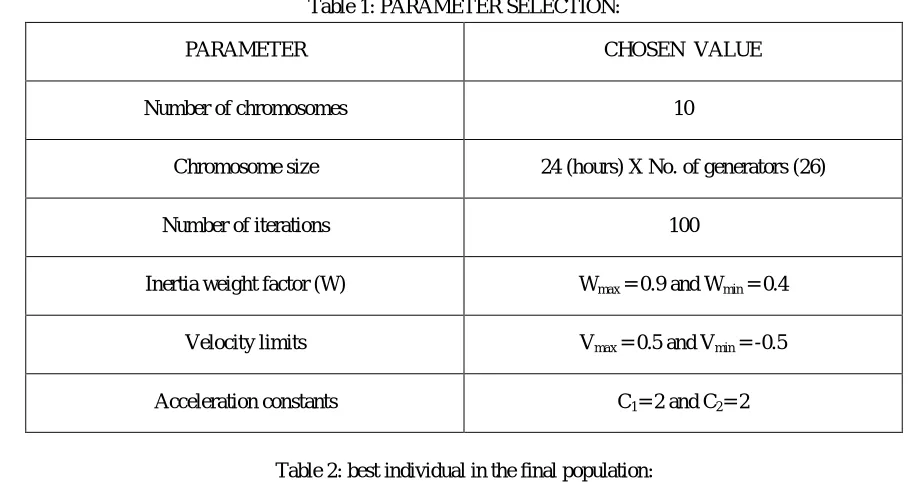
Table 1: PARAMETER SELECTION:
PARAMETER CHOSEN VALUE
Number of chromosomes 10
Chromosome size 24 (hours) X No. of generators (26)
Number of iterations 100
Inertia weight factor (W) Wmax = 0.9 and Wmin = 0.4
Velocity limits Vmax = 0.5 and Vmin = -0.5
[image:4.612.74.528.356.597.2]Acceleration constants C1= 2 and C2= 2
Table 2: best individual in the final population:
Total
Generation
Fuel Cost (S) Start-up
Cost (S) Total Cost ($)
TOTAL COST: $ 843,908.36
Hour 1 2223.00 31628.90 0 31628.90
Hour 2 2052.00 30369.38 0 30369.38
VII.CONCLUSIONS
The performance of the PSO algorithm for solving unit commitment problem has been demonstrated by solving the IEEE 26 unit system [31].
A. The PSO algorithm is capable of determining only near global optimal solution and it can be trapped in a local minimal solution region for all non-linear and combinational problems.
B. The PSO algorithm has the capability of searching the global optimal solution by fine tuning the search process. So this avoids the entrapment of the solution at local minima.
C. The PSO algorithm can effectively find the global minimum solution in comparably lesser time. D. The computational algorithm proposed effective in fining the global minimum.
Hour 4 1881.00 28848.23 0 28848.23
Hour 5 1824.00 25941.52 0 25941.52
Hour 6 1825.50 27183.00 0 27183.00
Hour 7 1881.00 27291.81 0 27291.81
Hour 8 1995.00 28869.74 0 28869.74
Hour 9 2280.00 33071.83 0 33071.83
Hour 10 2508.00 38073.62 210.00 38283.62
Hour 11 2565.00 38993.44 0 38993.44
Hour 12 2593.50 39468.44 0 39468.44
Hour 13 2565.00 38154.93 0 38154.93
Hour 14 2508.00 38556.82 0 38556.82
Hour 15 2479.50 37126.26 20.00 37146.26
Hour 16 2479.50 37022.28 0 37022.28
Hour 17 2593.50 39255.03 0 39255.03
Hour 18 2850.00 43618.24 200.00 43818.24
Hour 19 2821.50 43128.14 0 43128.14
Hour 20 2764.50 41641.11 0 41641.11
Hour 21 2679.00 40707.33 0 40707.33
Hour 22 2662.00 38374.13 0 38374.13
Hour 23 2479.50 36765.99 0 36765.99
REFERENCES
[1] Wood, A.J. and Wollenberg, B.F., “Power Generation, Operation, and Control”, John Wiley & Sons, New York, NY,1984 [2] Booker. L., “Improving search in genetic algorithms”, (Pitman, London. 1987), pp.61-7
[3] Goldberg, D., “Genetic Algorithms in Search, Optimization and Machine Learning”, Addison-Wesley, Reading, MA,1989, pp. 1-25 [4] Austin, S., "An Introduction to Genetic Algorithms," AI Expert, Vol. 5, March 1990,pp. 48-53
[5] Davis, L., Ed. (1991). “Handbook of Genetic Algorithms”. Van Nostrand Reinhold, New York,NY.David C. Walters, “Application of Genetic Algorithms in the Economic Dispatch of Power Generation”, MS Thesis, Auburn University, May,
[6] 1991.
[7] D. C.Walters and G. B. Sheble, “Genetic Algorithm Solution of Economic Dispatch with Valve Point Loading,” IEEE Transactions on Power Systems, vol. 8, August 1993, pp.1325–1332.
[8] Gerald B.Sheble,George N.Fahd,“Unit Commitment Literature Synopsis”, IEEE Transactions on Power Systems, vol.9,No.1,February 1994
[9] Bakirtzis, V. Petridis, and S. Kazarlis, “Genetic Algorithm Solution to the Economic Dispatch Problem,” IEEE proceedings on Gen., Transm. Dist., vol. 141,No. 4, July 1994, pp.377–382
[10] K.P.Wong,Y.W.Wong,“Genetic & Genetic/Simulated Annealing approaches to Economic Dispatch”, IEEE proceedings on Gen., Transm. Dist., vol. 141,No. 5, September 1994, pp. 507–513
[11] Gerald. B. Sheble, Kristin Brittig, “Refined Genetic Algorithm-Economic Dispatch Example”, IEEE Transactions on Power Systems, vol.10,No.1,February 1995,pp.117-124.
[12] Ross Baldick, “The Generalized Unit Commitment Problem”, IEEE Transactions on Power Systems, vol.10,No.1,February 1995,pp.465-475
[13] James Kennedy and Russel C. Eberhart, “Particle Swarm Optmization”, Proceedings of the IEEE International Conference on Neural Networks, Perth, Australia 1995,pp.1942-1945
[14] Bakirtzis, V.Petridis, and S.Kazarlis, “A Genetic Algorithm Solution to the Economic Dispatch Problem”, IEEE Transactions on Power Systems, vol.11,No.1,February 1996,pp.83-91.
[15] G. B. Sheble et al., “Unit Commitment by Genetic Algorithm with penalty methods and a comparison of Lagrangian Search and Genetic Algorithm Economic Dispatch example,” Int. J. Elect. Power Energy Syst., vol. 18,No. 6,1996. pp. 339–346
[16] Tim T.Maifield,Gerald B.Sheble,“Genetic-Based Unit Commitment Algorithm”, IEEE Transactions on Power Systems, vol.11, No.2,August 1996,pp.1359-1370
[17] S. O. Orero and M. R. Irving, “Large scale Unit Commitment using a Hybrid Genetic Algorithm,” Int. J. Elect. Power Energy Syst., vol. 19, No.1, pp. 45–55, 1997
[18] Williams, E. A., and Crossley, W. A., “Empirically-Derived Population Size and Mutation Rate Guidelines for a Genetic Algorithm with Uniform Crossover,” Soft Computing in Engineering Design and Manufacturing, Springer-Verlag, 1998
[19] Y. Shi and R. Eberhart, “A Modified Particle Swarm Optimizer,” Proceedings of IEEE Int. Conference on Evolutionary Computation, May 1998, pp. 69-73. [20] P. J. Angeline, “Using selection to improve Particle Swarm Optimization,” Proceedings of IEEE Int. Conference on Evolutionary Computation, May 1998,
pp. 84-89.
[21] R. C. Eberhart and Y. Shi, “Comparison between Genetic Algorithms and Particle Swarm Optimization,” Proceedings of IEEE Int. Conference on Evolutionary Computation, May 1998, pp.611–616.
[22] A.H.Mantawy,Youssef L.Abdel-Magid,Shokri Z.Selim,“Integrating Genetic Algorithms,Tabu Search and Simulated Annealing for the Unit Commitment Problem”, IEEE Transactions on Power Systems, vol.14,No.3,August 1999, pp.829-836.
[23] A.Rudolf,R.Bayrleithner, “A Genetic Algorithm for solving the Unit Commitment Problem of a Hydro-thermal Power System”, IEEE Transactions on Power Systems, vol.14,No.4,November 1999, pp.1460-1488
[24] Yuhui shi and Russel Eberhart, “Empirical Study of Particle Swarm Optimization”, IEEE Conference, 1999.
[25] Chuan-ping Cheng,Chih-Wen Liu and Chun-Chang Liu,“Unit Commitment by Lagrangian Relaxation and Genetic Algorithms”, IEEE Transactions on Power Systems vol.15,No.2,May 2000,pp.707-714
[26] H. Yoshida, K. Kawata, Y. Fukuyama, S. Takayama, and Y. Nakanishi,“A Particle Swarm Optimization for Reactive Power and Voltage Control considering Voltage Security assessment,” IEEE Transactions on Power Systems, vol.15, No.4, Nov. 2000, pp. 1232–1239
[27] T.Yalcinoz, Altun and M. Uzam, “Economic Dispatch Solution using a Genetic Algorithm based on Arithmetic Crossover”, IEEE Porto Power Tech Conference , 2001
[28] Kennedy, J. and Eberhart, R., “Swarm Intelligence”, Academic Press, 1st ed., San Diego, CA, 2001.
[29] K.S.Swarup and S.Yamashiro, “Unit Commitment solution Methodology Using Genetic Algorithm”, IEEE Transactions on power systems, vol. 17,No. 1, February 2002.
[30] Venter, G. and Sobieski, J., “Particle Swarm Optimization,” AIAA 2002-1235, 43rd AIAA/ASME/ASCE/ AHS/ASC Structures, Structural Dynamics, and Materials Conference, Denver, CO., April 2002.
[31] Zwe-Lee Gaing, “Discrete Particle Swarm Optimization algorithm for Unit Commitment”,IEEE Transactions on Power Systems,2003
[32] Nidul Sinha, Chakrabarti.R, and Chattopadhyay.P.K, “Fast Evolutionary Computing Techniques for Short-Term Hydrothermal Scheduling”, IEEE Transactions on Power Systems, Vol.18, No.1, February 2003, pp. 214-220
[33] Zwe-Lee Gaing, “Particle Swarm Optimization for solving the Economic Dispatch Considering the Generator Constraints”, IEEE Transactions on Power Systems,Vol.18, No.3, August 2003, pp. 1187-1195.
[34] Narayana Prasad Padhy, “Unit Commitment-A Bibliographical Survey”, IEEE Transactions on Power systems, vol. 19, No. 2, May 2004
[35] Ioannis G . Damousis, Anastasios G . Bakirtzis, “ A solution to the Unit-Commitment Problem using Integer-coded Genetic Algorithm”, IEEE Transactions on Power Systems, vol. 19, No. 2, May 2004
[37] M Sudhakaran, Dr S M R Slochanal, “Integrating Genetic Algorithms and Tabu Search for Emission and Economic Dispatch Problems”, IE (I) Journal –EL Vol. 86, June 2005, pp.39-43
[38] T.O.Ting and C.K. Loo, “A Novel Approach for UC Problem via an effective HPSO”, IEEE Transactions on Power Systems, Vol.21, No 1. February 2006.
[39] www.wikipedia.com
[40] World Energy Outlook - 2000 - Highlights, Page 48, International Energy Agency, Paris.
[41] R B Grover, "Nuclear Energy: Emerging Trends", CURRENT SCIENCE, Vol 78, No 10, 25 May, 2000.
[42] “Overview of Renewabie Energy Scenario in India”’ By Rangan Banerjee, Energy Systems Engineering, Lecture delivered at RENET Workshop, IIT Bombay, September 21, 2006