37
©IJRASET: All Rights are Reserved
Experimental Setup of Exhaust Gas Recirculation
System on Engine Performance Work on Biodiesel
Blend
Jagadish M. Sirase1, Dr. J.A. Hole2
1, 2
Department of Mechanical Engineering, JSPM’s RSCOE Pune-33
Abstract: Now days we use biodiesel is an alternative fuel which generate less carbon monoxide and hydrocarbon because high value of oxygen content. Also biodiesel is free from sulphur and get easily blend with diesel to form different biodiesel blends. Diesel engine has many advantages over petrol engine but on the other hand it creates adverse effects on emission control. The main aim of the present work is to reduce NOx emissions of diesel engine, for this exhaust gas recirculation is the effective way. Single cylinder four stroke water cooled diesel engine operated with byproduct of vegetable oil (Soybean Oil). With the diesel and EGR system setup we observed the performance of engine when it works with 5%EGR, 10%EGR and 15%EGR. The engine performance checked in terms of brake thermal efficiency, specific fuel consumption, and emission analysis such as oxides of nitrogen, carbon monoxide and hydrocarbon. The observations show that when biodiesel blend work with EGR NOx formation get reduced.
Keywords: By Product of vegetable oil (Soybean oil), Emission, EGR, NOx.
I. INTRODUCTION
Now day’s diesel engine is widely used in India for transportation and agricultural machines due to its higher fuel economy. As we see the cost of petrol increases, so people are largely depend on diesel engine. As the higher cost of petroleum based fuel researcher looking for alternative sources of fuel which is comparatively gives same results as diesel fuel. There are number of biodiesel having different properties and compatibility for biodiesel blend. List from them byproduct of vegetable Soybean Oil is one of the considerable alternative fuel source which have similar properties and combustion characteristics to the petroleum diesel. Many researchers report their study on vegetable oil, properties and the effect on engine performance and exhaust emission [5]. The biodiesel results reduction in unburned hydrocarbon, carbon monoxide and particulate matter. But according to analysis of heavy-duty engines only oxides of nitrogen are slightly increases [8]. The biodiesel thus produced in different blend with pure diesel at different percentage and tested in diesel engine.
A simple way to reduce NOx formation in diesel engine is to delay in injection of fuel in combustion chamber. This is effective technique but fuel consumption get slightly increases. To eliminate this problem we use Exhaust Gas Recirculation (EGR) system in which part of exhaust gas is recirculate from inlet port to combustion chamber which help in reducing NOx formation.
II. LITERATUREREVIEW
Jinlin Xue, Tony E. Grift, Alan C. Hansel et al. [1] named as “Effect of biodiesel on engine performance and emission”. The study shows effect of biodiesel on engine power, engine economy etc. The obtained results are specific fuel consumption increases due to lower heating value, particulate matter and CO reduces. The final conclusion of this study is only emission reduces rather improving economy
A. K. Agarwal et al. [3] present the report that diesel engine NOx formation is very much depending on combustion temperature. To reduce NOx formation in emission, it is necessary to control combustion temperature.
Sarvanan et al. [5] perform a test on single cylinder water cooled diesel engine with hydrogen fuel introducing EGR technique. They concluded increase in brake thermal efficiency and decrease other harmful gases including NOx.
M. K. Duraisamy et al. [4] under the title “Experimental analysis of EGR on DI diesel engine operating with biodiesel” performed test with jatropha biodiesel and found that, at 15% EGR NOx formation reduces but thermal efficiency increases.
38
©IJRASET: All Rights are Reserved
III.EXHAUSTGASRECIRCULATIONSYSTEM
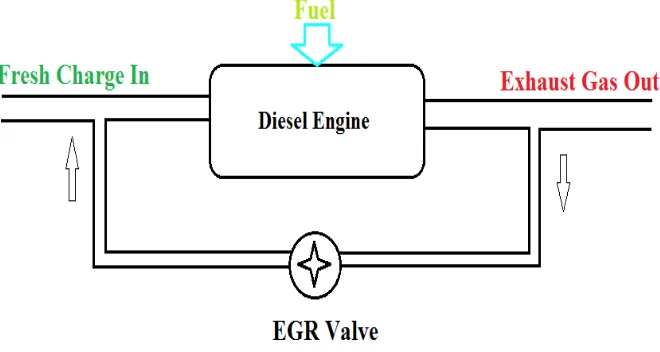
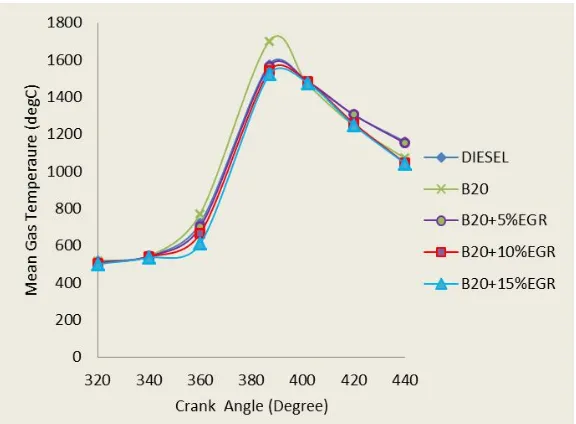
EGR is widely used in heavy duty diesel engine. In EGR system fraction quantity of hot exhaust gases are recirculate to combustion chamber through inlet manifold which help to reduce the temperature in combustion process. In diesel engine if temperature rises beyond 1500°C, NOx are formed. EGR method is beneficial to maintain that temperature 5% to 15% exhaust gas recirculates to suction inlet before combustion. Due dilution of charge inside the cylinder overall temperature get mentioned. As per the review, use of biodiesel increases the temperature due to more availability of oxygen in the charge. So to reduce the temperature EGR is beneficial.
EGR is the one the best technique to reduce NOx formation and other harmful exhaust emission like CO, HC, PM etc. When small quantity of exhaust gases enters in the combustion chamber it acts like a diluting media to the combustion mixture by which concentration of oxygen decreases inside the cylinder. The specific heat of exhaust gases is slightly higher than the fresh air, thus het capacity of fresh charge get increase, on the other hand it impacts the temperature increment for some heat release in combustion chamber. [3]
Fig.1 EGR System
IV.ADVANTAGESOFBIODIESEL
Biodiesel are the best alternative fuel for diesel. Under clean air act it is certified that biodiesel are not harmful for health. Biodiesel can easily store at atmospheric temperature and pressure. Biodiesel have better lubrication property than diesel. Biodiesel have no sulfur content so the life of engine gets increases. It may produce less PM, CO as compared with pure diesel fuel. Also biodiesel have economical and quality benefits.
V. EXPERIMENTALSETUP
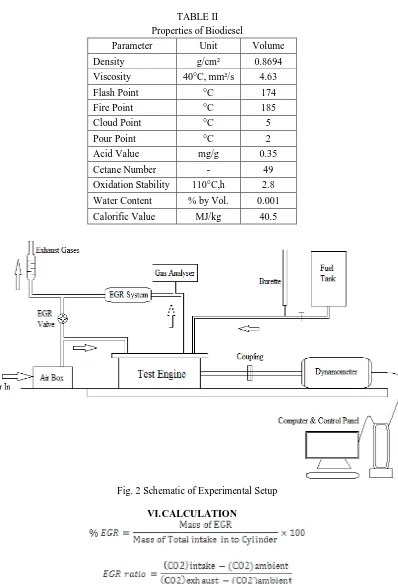
[image:2.612.147.477.242.418.2]The effect of exhaust gas recirculation on engine performance and exhaust emission was check with the help of experimental setup of a diesel engine. For investigation computerized signal cylinder four stroke water cooled diesel engine was used. Table 1 shows the technical specification of diesel engine and schematic of experimental setup is shown by figure 2. The electrical dynamometer is used to measure the power output. At the end of exhaust pipe AVL gas analyzer is located to measure exhaust emission. All the data like torque, flow of water, temperature etc. was display on control panel. A manual operated control valve is used to control known quantity of exhaust gas with air enters in combustion chamber. This valve is called as exhaust gas recirculation valve shown in figure 1.
TABLE I Engine Specification
Make Kirloskar Engine
Type Water cooled
Number of cylinder One
Bore 87.5mm
Stroke 110mm
Compression ratio 17:01
39
[image:3.612.114.512.66.650.2]©IJRASET: All Rights are Reserved
TABLE II Properties of Biodiesel
Parameter Unit Volume
Density g/cm² 0.8694
Viscosity 40°C, mm²/s 4.63
Flash Point °C 174
Fire Point °C 185
Cloud Point °C 5
Pour Point °C 2
Acid Value mg/g 0.35
Cetane Number - 49
Oxidation Stability 110°C,h 2.8
Water Content % by Vol. 0.001
Calorific Value MJ/kg 40.5
Fig. 2 Schematic of Experimental Setup
VI.CALCULATION
VII. RESULTSANDDISCUSSION
40
©IJRASET: All Rights are Reserved
A. Brake Thermal Efficiency
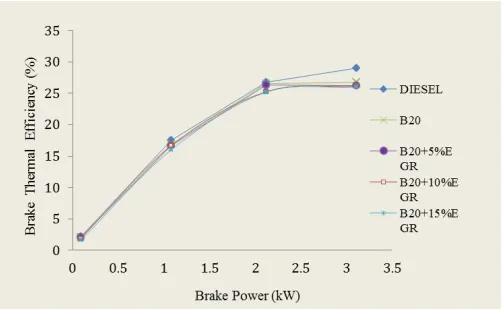
Fig.3Brake Thermal Efficiency vs. Brake Power
Figure 3 shows the behaviour of brake thermal efficiency with different brake power of diesel, biodiesel and biodiesel with EGR. From figure it is observed that brake thermal efficiency is higher when run with only diesel. As rate of EGR increases, brake thermal efficiency decreases due to decrease in heating value of biodiesel with EGR.
[image:4.612.187.439.90.245.2]B. Specific Fuel Consumption
Fig.4: Specific Fuel Consumption vs. Brake Power
Figure 4 shows the variation of Specific fuel consumption with brake power. In all cases we observed that when engine operated with diesel, the specific fuel consumption is lower. In EGR system SFC is at higher point. However at highest load of the engine SFC with 5% and 10% EGR is almost same.
[image:4.612.187.439.335.478.2]C. NOx Formation
[image:4.612.180.434.572.714.2]41
©IJRASET: All Rights are Reserved
Nitrogen oxide is mainly depending on temperature inside the combustion chamber. Figure 5 shows the variation of NOx emission with brake power of diesel, biodiesel blend and different percent of EGR. It is observed that engine emits higher NOx with biodiesel due to higher oxygen content than the diesel.
On the other hand NOx decreases with increase the percent of EGR. At the full load NOx emission for diesel and B20 is 379 ppm and 420 ppm respectively where as it reduces 15% EGR up to 310 ppm.
[image:5.612.198.452.169.345.2]D. Hydrocarbon Emission (HC)
Fig.6: Hydrocarbon vs. Brake Power
Figure 6 shows the variation of hydrocarbon emission with various brake power with diesel, biodiesel blend and with EGR at constant speed. From figure it is observed that as load on engine increases hydrocarbon emission also increases simutaniusely due to lack of oxygen content in combustion chamber.
HC emission of biodiesel is less than the diesel fuel. Finally at full load biodiesel with 15% EGR emits 7% less HC than diesel.
[image:5.612.163.451.446.658.2]E. Combustion Analysis
Fig.7: Gas Temperature vs. Crank Angle
42
©IJRASET: All Rights are Reserved
VIII. CONCLUSION
Experimental investigation of EGR system performed on single cylinder, four stroke, water cooled diesel engine which operated with biodiesel fuel with different precent of EGR. For this investigation byproduct of vegetable soyabean oil is used as blend. The final conclusion of experimental setup is given bellow
1) When engine was operated with B20 and EGR biodiesel, brake thermal efficiency decreases then diesel fuel due to decrease in heating value
2) It is observed that engine emits more NOx emission with biodiesel. But as we increase precent of EGR, the rate of NOx decreases due to decrease in temperature of combustion chamber.
3) Hydrocarbon emission rate is lower in biodiesel
IX.ACKNOWLEDGMENT
The authors would like to extend sincere gratitude towards the entire faculty of the mechanical engineering department, JSPM’s Rajarshi Shahu College of Engineering Pune.
REFERENCES
[1] Jinlin Xue, Tony E. Grift, Alan C. Hansen,” Effect of biodiesel on engine performances and emissions Renewable and Sustainable Energy Reviews 15 (2011) 1098–1116.
[2] Atadashi IM, Aroua MK, Aziz AA. High quality biodiesel and its diesel engine application: A review. Renewable and Sustainable Energy Reviews. 2010;14:1999-2008.
[3] Agrawal. A. K, Singh. S. Sinha. S. Shukla. M. K., Effect of EGR on the exhaust gas temperature and exhaust opacity in compression ignition engines. Sadhana, 29(3), (2004), 275-284.
[4] Magin Lapuerta OA, Jose´ Rodriguez-Fernandez. Effect of biodiesel fuels on diesel engine emissions. Progress in Energy and Combustion Science 2007;34:198–223.
[5] Shahid EM, Jamal Y. A review of biodiesel as vehicular fuel. Renewable and Sustainable Energy Reviews.2008;12:2484- 94.
[6] Agarwal.D, S. Sinha, A. K. Agarwal, Experimental investigation of control of NOx emissions in biodiesel – fuelled compression ignition engine, Renewable Energy, 31, (2006), 2356-2369.
[7] Saravanan.N, G. Nagarajan, K.M. Kalaiselvan, C. Dhanasekaran, An experimental investigation on hydrogen as a dual fuel for diesel engine system with exhaust gas recirculation technique. Renewable Energy, 33, (2008), 422-427.
[8] Agarwal.D, S. Sinha, A. K. Agarwal, Experimental investigation of control of NOx emissions in biodiesel – fuelled compression ignition engine, Renewable Energy, 31, (2006), 2356-2369.