High Pressure Inactivation of
Enterococcus faecium
–
modelling and verification
Aleš Landfeld
1, Jan Strohalm
1, Karel Kýhos
1, Jiřina Průchová
1, Milan Houška
1,
Pavla Novotná
1, Ljuba Schlemmerová
2, Hana Šmuhařová
2, Vladimir Špelina
2,
Pavel Čermák
3, Kveta Pavlišová
3and Pavel Měřicka
31Food Research Institute Prague, Prague, Czech Republic; 2National Institute of Public Health,
Prague, Czech Republic; 3University Hospital Hradec Kralove, Hradec Kralové, Czech Republic
Abstract
Landfeld A., Strohalm J., Kýhos K., Průchová J., Houška M., Novotná P., Schlemmerová L., Šmuhařová H., Špelina V., Čermák P., Pavlišová K., Měřička P. (2009): High pressure inactivation of Enterococcus faecium – modelling and verification. Czech J. Food Sci., 27: 134–141.
High-pressure inactivation data were obtained for model working suspensions of Enterococcusfaecium insaline solu-tions in pH range from 5.5 to 6.8, at water activity 0.99 (corresponding to the saline solution). The data were predicted for the pressure range of 450 MPa to 550 MPa, at the initial model suspension temperature 6–7°C prior to pressurising. The results indicate that E. faecium is a highly resistant organism under physiological pH values. With decreasing the substrate pH, the tolerance to the inactivation effects of high pressure decreased. The high-pressure inactiva-tion proved ineffective for the above organism in the range of physiological pH values. The values for high-pressure inactivation model were specified and the calculated parameters of high-pressure inactivation were compared to the experimental data for the working suspensions of E.faecium incow and human milks. As to cow milk, the predicted data showed some deviation from the model experimental results, while with human milk the model failed completely. High-pressure inactivation of E. faecium in human milk proved to be significantly more effective than that predicted by a model based on the saline solution.
Keywords: high pressure inactivation; Enterococcus faecium; model; verification
Milk banks in the Czech Republic continuously monitor the input and output concentrations of microorganisms in human milk. Analyses show occasional presence of the bacterium E. faecium
in the raw or processed materials. Milk banks employ the critical control point safety system (HACCP) and carry out regular analyses of human milk (Měřička et al. 2004a, b). When E. faecium
is found in a batch of pasteurised milk, the batch is discarded.
Reviriego et al. (2005) studied E. faecium iso-lated from human milk of healthy mothers. Mi-croorganisms migrate from the digestive system of the mother to the breast and milk, and then to the digestive system of the infant.
E. faecium was found in the Greek feta cheese, with a positive impact on its taste, aroma, colour, structure, and the overall sensorial perception. Physical and chemical properties, such as pH, water content, ashes, salt content in dry matter,
and fat in dry matter were not affected by the ad-dition of E. faecium strains (Sarantinopoulos
et al. 2002).
The effects of E. faecium are mostly undesirable, as some strains of the bacterium are resistant to an-tibiotics, e.g. vancomycin, ampicillin, gentamicin, erythromycin, and streptomycin (Panagea et al. 1996; Barkholt et al. 1997; Citak et al. 2005). This causes problems e.g. during the treatment of critically ill patients with burns (fever, increased counts of lymphocytes). Barkholt et al. (1997) and Rose et al. (2002) found that the use of antibiotics three months before liver transplantation greatly increases the risk of the resistance to ampicillin development in enterococcus.
The available literature on the inactivation of
E. faecium by high pressure and determination of kinetic model is rare. There are more data on ther-mal inactivation. Kornacki et al. (1992) studied thermal tolerance of E. faecium in ultrafiltered milk. The values of thermal tolerance were established for the temperature of 58°C in relation to the pro-tein content (0.4% to 8.9%) and milk fat content (0% to 11.8%). It was found that the increasing fat content increases the thermal tolerance of the microorganism, while protein concentration has a negligible effect on thermal tolerance.
The prolongation of the shelf life of food prod-ucts, i.e. decreasing microorganisms counts by a high hydrostatic pressure, is under examination as an alternative to the traditional heat pasteurisa-tion. Moerman (2005) studied the inactivation of microorganisms, aerobic and anaerobic spores in pork. A mixture prepared by stewing bits of meat, carrot, and peas (pH neutral) was inocu-lated with several strains of spore-forming and vegetative microorganisms. The samples were then subjected to a high pressure of 400 MPa for 30 min (under temperatures of 20°C and 50°C). Gram-positive cocci E. faecalis were more resistant to the pressure than e.g. Saccharomyces cerevisiae
or Escherichia coli. High pressure processing at 20°C demonstrated that treating food at neutral pH using this procedure only is insufficient.
Wuytack et al. (2003) decontaminated seeds intended for germination (nasturtium, sesame, rad-ish, and mustard) by high pressure treatment under pressures of 250, 300, 350, and 400 MPa for 15 min, at the temperature of 20°C. The germinative capac-ity of the seeds was then examined. Radish seeds proved to be most sensitive to the treatment while nasturtium seeds were the most tolerant. Nasturtium
seeds were inoculated with a suspension of seven different species of bacteria at 107 CFU/ml and
sub-jected to the pressure of 300 MPa for 15 minutes. A decrease of 2 to 6 orders of magnitude occurred in six species of bacteria, but E. faecalis was not inactivated.
Garcia-Graells et al. (2003) studied the in-activation of eight different species of bacteria in skim milk with the added lactoperoxidase-hydrogen peroxide-thiocyanate (LP) complex. LP produced no effect without the pressure treatment. Wuytack
et al. (2002) studied bacterial inactivation under high-pressure homogenisation (100–300 MPa) and the treatment with high hydrostatic pressure (200–400 MPa). They compared the resistance of five species of Gram-positive bacteria (e.g.
E. faecalis) and six species of Gram-negative bac-teria (e.g. E. coli). The tolerance to high pressure was similar with both groups.
It is apparent that the amount of the available data on high-pressure inactivation of E. faecium
is insufficient. Therefore, this work aims to fill partially the gap and determine experimentally the effects of high pressure on the inactivation of
E. faecium in model solutions. A secondary aim
was to incorporate the data into a kinetic model and start to carry out the verification of the model against the data obtained with human and cow milks inoculated with E. faecium.
MAterIAl And MetHods
Selection of microorganism, its origin, prepa-ration of the working culture and working sus-pension, conditions of incubation, obtaining
enumerable colonies. The model microorganism
selected was the Enterococcus faecium CCM 2308. Another denominations of the strain (as proof of equivalence) are e.g. ATCC 6057, NCIMB 8842 = strain 24, the original taxonomic name (until 1984) was Streptococcus faecium. The strain was isolated from cheese.
The E. faecium culture was obtained from the Czech Collection of Microorganisms (CCM) in the lyophilised form on gel discs in sterile vials, 20 discs per vial. Each disc was used following the procedure recommended by the CCM to develop a revitalised cultureon agar slant. The revitalisation took place at 37°C for the total duration of 24 hours.
agar slant into the standard liquid cultivation medium as recommended by CCM, i.e. BHIB (Brain Hearth Infusion Broth) distributed into test tubes in quantities of 9 ml. The culture was uniformly transferred from the agar slant with a full inoculating loop calibrated at 1 µl used three
times, always using a different sterile loop. The inoculated BHIB medium was incubated at 37°C for 18 h to obtain the early stationary growth phase commonly recommended and used for experiments studying lethal and sub-lethal effects on bacteria, e.g. Schlemmerová (1987).
The working suspension was prepared by inocu-lating 1 ml of the working culture grown in BHIB into 99 ml of model saline solution of selected values of pH ranging from 6.8 to 5.5 and aw = 0.99 (corresponding to NaCl concentration in the saline solution, see ISO 21807:2004). The procedure em-ployed was based on the previous experience with high growth density of E. faecium CCM 2308 and was as follows: 1 ml was taken from the mid column of the liquid culture. If high-pressure inactivation process required greater volumes of the working suspension, greater volumes of the working culture grown in BHIB were taken from the individual tubes into the mixed inoculum, which was intro-duced into correspondingly increased volume of the model solution. The working suspension was transferred into 100 ml brown PET bottles.
The reference sample, marked “witness”, was of the same type, its content being identical to those in the bottles subjected to the pressure treatment, and was subjected to the same time-temperature history during transportation and storage.
The counts of viable cells of E. faecium had to be taken before and after the inactivation treat-ment. This required series of decimal dilutions in saline solution with added peptone (internationally recommended dilution fluid, generally applicable). The next step was the distribution of a specified volume onto the surface of PCA (Plate Count Agar) plates, followed by incubation at 37°C for 24 hours. After incubation, the developed colo-nies were counted. The numbers of E. faecium
colonies were determined using the automatic colony counter BIOTRAN III obtained from New Brunswick Scientific Co. Inc., USA.
Calculation method. The calculation of the
quantity of viable E. faecium cells before and af-ter the inactivation treatment (N0 and the cor-responding N) conformed to the valid standard ČSN ISO 7218:1998, which includes the
modifi-cation of Amd. 1:2001, and specifies the general formula for the calculation of the weighted aver-age:
N = ΣC
V × [n1 + (0.1 × n2)] × d
where:
ΣC – sum of colonies from all plates chosen for the calculation of two consecutive dilutions, where at least one of the plates contains a minimum of 15 colonies
V – volume in ml inoculated onto each of the plates
n1 – number of plates chosen for the calculation of the
first selected dilution
n2 – number of plates chosen for the calculation of the
second selected dilution
d – dilution factor corresponding to the first dilution, chosen for the calculation
Each result is the mean of microbial concentra-tions of the three repeticoncentra-tions. Variability ranges in one logarithm decade. The detection limit of 100 CFU/ml was predicted by preliminary experi-ments.
Milk for model verification. For the verification, we used UHT skim milk from the dairy Kunin, Czech Republic (0.5% fat), purchased in a super-market. This product was shelf stable.
Another substrate used was human milk sup-plied by the Human milk bank of the Univesity Hospital in Hradec Kralové. Any human milk delivered from this bank is heat pasteurised and frozen. The human milk was transported and stored frozen and thawed directly one day before the experiment. Prior to use, a separate sample of the same human milk was subjected to a test of spontaneous inhibition of the introduced mi-croorganism E. faecium CCM 2308. The treated milk contained 108.777 CFU/ml immediately after
introduction of the microorganism, and nearly an identical concentration of 108.716 CFU/ml after
25 min keeping at 25°C. The milk used for the verification demonstrated therefore no sponta- neous inhibition of the microorganism.
Containers and procedure of pressure
inac-tivation. For the high-pressure treatment of the
samples, pet brown bottles (100 ml) were used with screw-on caps.
The pressure treatment of the samples was con-ducted in an isostatic press CYX 6/0103 (Zdas Company, Ždár nad Sázavou, Czech Republic); the volume of the high-pressure chamber was 2 litres, the pressure medium was potable water. The rate of the pressure increase was approxi-mately 8.3 MPa per second. The temperature of the pressure vessel in its top section was about 21.5°C. The pressure medium was replaced prior to every test. The temperature of the samples was assumed to be identical to that of the medium; the test room temperature was 18–20°C. The samples were transported into the thermal chamber and adjusted to 6–7°C in water bath (40 min) prior to the test. The water in the test chamber as well as the water in which the samples were kept prior to and after the test had the same initial temperature of 6–7°C. After the pressure treatment, the bottles containing the samples were dried and shipped back for microbiological examination. Maximum tem-perature increase of water or water solutions was approximately 15°C when compressed by 500 MPa. The effects of compression heating on inactivation of the microorganism were considered negligible with respect to the low initial temperature. The thermal exchange with the environment during the holding time was limited by equal temperatures of the samples and the pressure medium in the chamber and the chamber itself.
results And dIscussIon
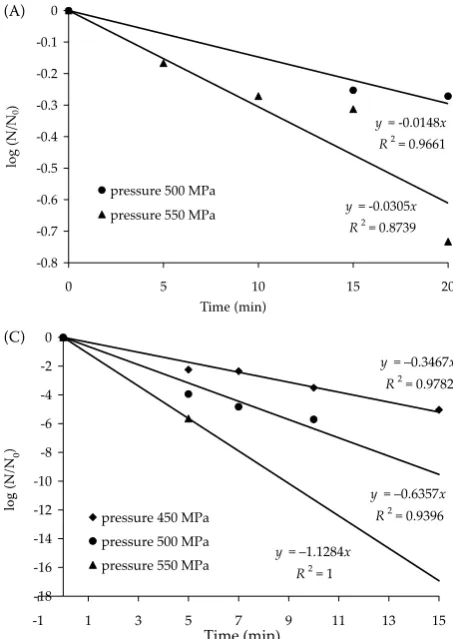
The acquired data on the effects of pressure and pressure holding time on the inactivation of Entero-coccus faecium CCM 2308 are given in Figure 1.
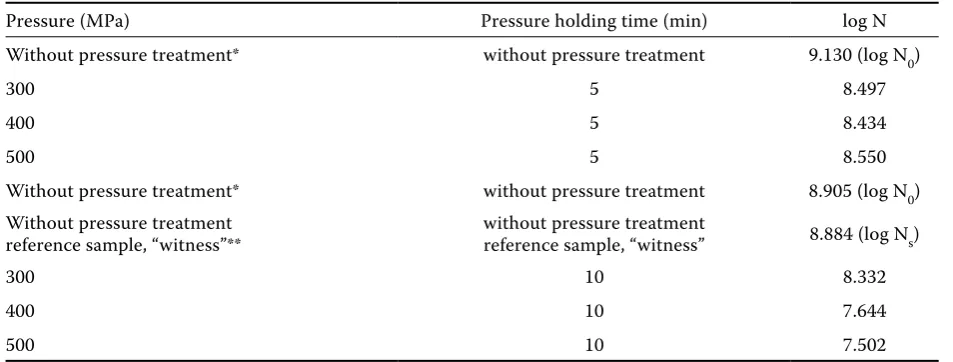
An example of numerical values received with saline solution of pH = 6.8 is given in Table 1. The analyses of the reference “witness/control” sample demonstrated that the microorganism counts remained the same under the conditions of transport between laboratories (the samples were stored in all cases at temperatures up to 16°C for a time shorter than one hour).
The initial results demonstrated that the strain
E. faecium examined was highly resistant to the pressure under physiological pH = 6.8. Therefore, the effects of decreasing pH value were subse-quently studied.
[image:4.595.61.538.553.734.2]The influence of pH and the initial temperature is apparent from the data given in Table 2. The results indicate that a decrease of pH from 6.8 to 6.4 caused negligible changes in the numbers of the microorganisms present after the high-pres-sure treatment, despite the use of rather harsh parameters, i.e. 550 MPa for 15 minutes. The working suspension temperature had no effect on the decrease of the microorganism counts at this pH. At pH = 6.0, a pronounced decrease in the microorganism counts was recorded. The influence of the initial temperature is apparent at this pH value. The initial temperatures of 15°C and 10°C provided higher inactivation rates than that obtained at the initial temperature of 20°C.
Table 1. Example of numerical results of high pressure inactivation of E. faecium in saline solution of pH = 6.8, initial temperature prior to pressurising 5–7°C
Pressure (MPa) Pressure holding time (min) log N
Without pressure treatment* without pressure treatment 9.130 (log N0)
300 5 8.497
400 5 8.434
500 5 8.550
Without pressure treatment* without pressure treatment 8.905 (log N0)
Without pressure treatment
reference sample, “witness”** without pressure treatment reference sample, “witness” 8.884 (log Ns)
300 10 8.332
400 10 7.644
500 10 7.502
Therefore, all experiments were carried out at initial temperatures below 10°C.
The results of the detailed investigation of the pressure and pressure holding time effects on the model working suspension in saline solution at pH = 6.0 are given in Figure 1B. The data listed show that the increasing pressure and duration of the treatment tend to increase the effects of the treatment. Under the harshest conditions (550 MPa for 10–15 min), no detectable
num-bers of micro-organism were found in the treated suspension despite the immense initial counts. It can be assumed that this procedure can decrease the density of E. faecium CMM 2308 by up to 9 orders of magnitude.
In order to acquire data for this manner of in-activation over the broadest possible range of parameters, another experiment was conducted with a model suspension of pH = 5.5. The results of this experiment are given in Figure 1C. The data
yȱ =ȱȬ0.0148x R2ȱ=ȱ0.9661
y ȱ=ȱȬ0.0305x R2ȱ=ȱ0.8739
Ȭ0.8 Ȭ0.7 Ȭ0.6 Ȭ0.5 Ȭ0.4 Ȭ0.3 Ȭ0.2 Ȭ0.1 0
0 5 10 15 20
Timeȱ(min)
lo
gȱ
(N
/N0
)
pressureȱ500ȱMPa pressureȱ550ȱMPa
Figure 1. High-pressure inactivation of Enterococcus
faecium CCM 2308 in working suspension in saline
solu-tion of aw = 0.99 (corresponding to NaCl concentration
in saline solution) and (A) pH = 6.8 (test B3), (B) pH = 6.0 and (C) pH = 5.5
y ȱ=ȱȬ0.4194x R2ȱ=ȱ0.974
y ȱ=ȱ–0.7126x R2ȱ=ȱ0.9993
y ȱ=ȱ–0.1741x R2ȱ=ȱ0.8961
Ȭ12 Ȭ10 Ȭ8 Ȭ6 Ȭ4 Ȭ2 0
0 2 4 6 8 10 12 14 16
Timeȱ(min)
lo
gȱ
(N
/N0
)
[image:5.595.62.289.83.403.2]pressureȱ450ȱMPa pressureȱ500ȱMPa pressureȱ550ȱMPa
Table 2. Comparison of the results for the working suspension in saline solution of pH = 6.0 and 6.4 and possible effects of different temperatures prior to pressurising
Pressure 550 MPa for 15 min Count log N E. faecium in suspension (CFU/ml)
pH = 6.0 pH = 6.4
Without pressure treatment 8.544 (log N0) 8.422 (log N0)
Without pressure treatment
reference sample, “witness” 8.306 (log NS) 8.452 (log NS)
Temperature prior to pressurising (°C)
10 5.139 7.163
15 5.778 7.236
20 7.232 7.113
(A) (B)
Time (min) Time (min)
yȱ=ȱ–0.6357x R2ȱ=ȱ0.9396
yȱ=ȱ–1.1284x R2ȱ=ȱ1
yȱ=ȱ–0.3467x R2ȱ=ȱ0.9782
Ȭ18 Ȭ16 Ȭ14 Ȭ12 Ȭ10 Ȭ8 Ȭ6 Ȭ4 Ȭ2 0
Ȭ1 1 3 5 7 9 11 13 15
Timeȱ(min)
lo
gȱ
(
N
/
N0
)
pressureȱ450ȱMPa pressureȱ500ȱMPa pressureȱ550ȱMPa
(C)
lo
g
(N
/N0
[image:5.595.67.532.608.756.2]show that the microorganism investigated is more sensitive at pH = 5.5 as compared to pH = 6.0.
evaluation of pressure inactivation data from saline solutions and development of a model
Similar to thermal inactivation, it was assumed that microorganisms die in accordance with the first order kinetics model, the integration of which gives the following equation
N = N0 exp(–k t) (1)
where:
k – inactivation rate (number per second) t – time in seconds
N, N0 – current and initial numbers of microorganisms
per ml
The conversion of the time into minutes and of the logarithm to decimal logarithm gives Dp Dp = 1/(60⋅log ek) = 0.0384/k
yielding
log N/N0 = – t/Dp (2)
where:
Dp – decimal reduction time, i.e. time in minutes required
for reducing the microorganism counts by one order of magnitude under constant pressure
The evaluation was based on the data from Fig-ure 1. As the initial concentration value N0,the numerical value predicted by the experiment with the untreated sample at each pH value was used. Each point in the figures represents three replica-tions of the enumeration.
Linear regression method of least-squares was used to plot the lines passing through the origin. The tangents of the lines and the corresponding decimal reduction times are given in Table 3. It is apparent that with increasing pressure the value of Dp decreased.
For a given pH, the linear regression was applied and parameter Zp predicted using the assumed linear dependence of log Dpon pressure p.
log Dp = A – B p (3)
where:
p – pressure (MPa)
Dp – time (min)
Introducing B = 1/Zp,, where Zp is the pres-sure increment causing a decrease of the decimal time of inactivation by one order of magnitude, the introduction of reference parameters pref and
Dp,ref, allows the conversion of theEq. (3) into the formulae
log Dp = log Dp,ref + (pref – p)/Zp (4)
Dp = Dp,ref. 10 (pref – p)/Zp (5)
Table 4 shows the resulting values of Zp. De-creasing values of pH cause a slight increase in the Zp values.
Subsequently, the correlation of the high-pressure inactivation model parameters (5) was estimated using regression to determine the relations of Zp
and of Dp,ref to pH.
The relationship between Dp,ref and pH was deter-mined by non-linear regression using a computer software Datafit (Oakdale Engineering, Oakdale, USA) as follows:
[image:6.595.63.533.103.189.2]Dp,ref = pH/(18.287 – 2.674 pH) (6).
Table 3. Values of DP as function of pressure and pH
Pressure (MPa) 450 500 550 450 500 550 400 500 550
pH (–) 5.5 5.5 5.5 6.0 6.0 6.0 6.8 6.8 6.8
Tangent –0.3467 –0.6357 –1.1284 –0.1741 –0.4194 –0.7126 –0.0143 –0.0148 –0.0305
[image:6.595.302.533.697.753.2]Dp (min) 2.9 1.6 0.9 5.7 2.4 1.4 69.9 67.6 32.8
Table 4. ZP and Dref values as a function of pH
pH ( – ) 6.8 6.0 5.5
Zp (MPa) 159.2 163.9 194.9
The relationship between Zp and pH was de-termined by linear regression using parabolic function as follows:
Zp = 44.423⋅pH2 – 573.87⋅pH + 2007.4 (7)
An overall model for high-pressure inactiva-tion valid for the pressure range of 450–550 MPa, pH = 5.5 to 6.8, and aw = 0.99 was obtained by the substitution of Eqs. (6) and (7) to Eq. (5).
The comparison of the calculated and experimen-tal values of decimal reduction time Dp is given in Figure 2. The figure shows a good agreement between the experimental and calculated values valid for saline solutions only. This shows only the data from which the model was built. Therefore, further model verification is necessary.
Model verification
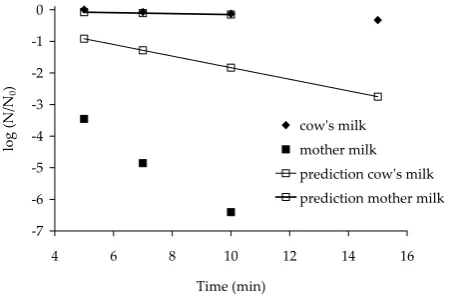
The above model, comprising Eqs. (5), (6), and (7), was used for the prediction of the decrease in microorganism counts in cow and human milks. The comparison is given in Figure 3. It is apparent that the predictions for cow milk at pH = 6.4 do not agree with the experimental data very well. The experiments showed virtually no inactivation of E. faecium.
On the other hand, in the case of human milk at pH = 6.8, the model predicts negligible levels of inactivation, while the experimental data demon-strate a decrease in microorganism counts by 6.4 orders of magnitude. A similar result was obtained for thermal inactivation of the microorganism in human milk (Špelina et al. 2007). However,
spontaneous inhibition of the microorganism in human milk was not demonstrated. It is assumed that human milk (cautiously pasteurised) may contain immunogenic substances, which may have a synergistic effect with the pressure or whose effects are amplified by the pressure.
conclusIon
The high pressure inactivation model of Entero-coccus faecium was predicted on experimental data obtained with microorganisms suspended in saline solution. An attempt at the verification of this model was done by comparing the model prediction data with the experimental data obtained with cow and human milks innoculated with the same strain of the microorganism. The model predictions disagree with the data received on real systems.
references
Barkholt L.M., Andersson J., Ericzon b.g., Palm-gren a.c., Broome u., Duraj f., Bergguist a., Her-lenius g., Nord c.e. (1997): Stool cultures obtained before liver transplantation are useful for choice of perioperative antibiotic prophylaxis. Transplant
In-ternational, 10: 432–438.
Citak S., Mendl A., Orhan S. (2005): Incidence, anti-biotic resistance and some technological properties of Enterococcus species isolated from raw milk and white
cheese samples. Archiv für Lebensmittelhygiene, 56:
80–83.
CSN ISO 7218:1998 (56 0103): Mikrobiologie potravin a krmiv – základní pravidla testování (idt ISO 7218:1996).
0 10 20 30 40 50 60 70 80
0 10 20 30 40 50 60 70
Dp,ȱexperimentȱ(min)
Dp
,ȱc
al
cu
la
te
dȱ
ȱ(m
in
)
Ȭ7 Ȭ6 Ȭ5 Ȭ4 Ȭ3 Ȭ2 Ȭ1 0
4 6 8 10 12 14 16
Timeȱ(min)
lo
gȱ
(N
/N0
)
[image:7.595.71.272.83.230.2]cowȇsȱmilk motherȱmilk predictionȱcowȇsȱmilk predictionȱmotherȱmilk
Figure 5. Comparison of experimental and calculated in-activation curves for E. faecium in milk
Figure 4. Comparison of calculated and experimental
[image:7.595.309.534.90.238.2]Modification Amd.1 from April 2003 (idt ISO 7218/ Amd.1:2001).
CSN ISO 21807 (56 0627): Mikrobiologie potravin a krmiv – určení vodní aktivity (idt ISO 21807:2004).
Garcia-Graells C., Van Opstal I., Vanmuysen S.C.M., Michiels C.W. (2003): The lactoperoxidase system increases efficacy of high-pressure inactivation of foodborne bacteria. International Journal of Food
Microbiology, 81: 211–221.
ISO 21807:2004. Microgiology of water activity. Interna-tional Organization for Standardization. Geneva. Kornacki J.L., Marth E.H. (1992): Thermal
inactiva-tion of Enterococcus faecium in retentates from ultra filtered milk. Milk, Milkwissenschaft – Milk Science
International, 47: 764–769.
Měřička P., Houška M., Landfeld A., Čermák P. (2004a): Aplikace HACCPoint v mléčné bance.In: Proceedings XIII. International conference on Hos-pital Hygiene, Brno – Congress Centre BVV, 20 May 2004 – CD-ROM.
Měřička P., Houška M., Landfeld A., Čermák P. Pavlišova K., Kokstein Z. (2004b): First Practi-cal Experiences with Application of Hazard Analy-sis Critical Control Point (HACCP) and Predictive Microbiology in Milk Bank Practice. XXI. Neonatol-ogy Days, 15-17 September 2004, In: Kokstein Z. (ed.): Neonatology Days Hradec Kralove, Abstracts of papers: 25.
Moerman F. (2005): High hydrostatic pressure inactiva-tion of vegetative microorganisms, aerobic and anaero-bic spores in pork Marengo, a low acidic particulate
food product. Meat Science, 69: 225–232.
Panagea S., Chadwick P.R. (1996): Heat tolerance of vancomycin resistant Enterococcus faecium. Journal
of Clinical Pathology, 49: 687–689.
Reviriego C., Eaton T., Martin R., Jimenez E., Fernandez L., Rodriguez, J.M. (2005): Screening of virulence determinants in Enterococcus faecium strains isolated from breast milk. Journal of Human
Lactation, 21: 131–137.
Rose C.M., Reilly K.J., Haith L.R., Patton M.L., Guilday R.J., Cawley M.J., Ackerman B.H. (2002): Emergence of resistance of vancomycin-resistant En-terococcus faecium in a thermal injury patient treated with quinupristin-dalfopristin and cultured epithelial
autografts for wound closure. Burns, 28: 696–698.
Sarantinopoulos P., Kalantzopoulos G., Tsaka-lidou E. (2002): Effect of Enterococcus faecium on microbiological, physicochemical and sensory char-acteristics of Greek Feta cheese. International Journal
of Food Microbiology, 76: 93–105.
Schlemmerová L. (1987): Stafylokoky v potravinách – Metody kultivace a hodnocení výsledků. [Ph.D. The-sis.] Institute of Hygiene and Epidemiology, Prague. Spelina V., Schlemmerova L., Landfeld A., Kyhos
K., Mericka P., Houska M. (2007): Thermal Inactiva-tion of Enterococcus faecium, Czech Journal of Food
Sciences, 25: 283–290.
Wuytack E.Y., Diels A.M.J., Michiels C.W. (2002): Bacterial inactivation by high-pressure homogenisa-tion and hydrostatic pressure. Internahomogenisa-tional Journal
of Food Microbiology, 77: 205–212.
Wuytack E.Y, Diels A.M.J, Michiels C.W. (2003): Decontamination of seeds for seed sprout production by high hydrostatic pressure. Journal of Food
Protec-tion, 66: 918–923.
Received for publication October 27, 2008 Accepted after corrections Februzry 27, 2008
Corresponding author:
Ing. Milan Houška, CSc., Výzkumný ústav potravinářský Praha, v.v.i., Radiová 7, 102 31 Praha 10-Hostivař, Česká republika