Fabrication of SUS304 Regularly Cell-Structured Material
and Their Mechanical Properties
Kanyatip Tantikom
1, Hidetaka Kanahashi
1, Shigeo Yamamoto
2and Tatsuhiko Aizawa
21
Department of Metallurgical Engineering, The University of Tokyo, Tokyo 153-8904, Japan
2Research Center for Advanced Science and Technology, The University of Tokyo, Tokyo 153-8904, Japan
The quasi-static flexural and in-plane compressive properties of SUS304 stainless steel with circular close-packed cells are studied. Micro-stainless steel tubes coated with Ni3P were selected for constructing hexagonal close-packed arrays, which are subsequently joined together to
form a cellular structure. The fabrication technique developed, involves the diffusion bonding of stacked metal tubes under the compressive stress state during heat treatment. SUS304 cell-structured materials can achieve the high specific flexural stiffness and specific flexural yield strength nearly equal to those for the dense materials. In-plane compressive properties as well as deformation behavior are also observed and discussed in this paper.
(Received February 10, 2003; Accepted June 9, 2003)
Keywords: cell-structured materials, metal honeycomb, light-weight structure, mechanical property, eco-materials, cellular solids
1. Introduction
Environmental issues related to daily human activities have become a world-wide concern. Dematerialization is now an essential movement to reduce the usage of natural resource and to improve the recyclability of product.1) The environmentally benign manufacturing and materials proces-sing search for high qualification in material performance for this dematerialization. In particular, since the main contribu-tion of CO2 emission in the transportation comes from the usage of automobiles, aircrafts or trains, the weight saving design is of great concern to reduce the fuel consumption. The light-weight cellular metal/alloys structures have be-come more prevalent in the related structural design. On the other hand, the passive safety design is also an important item for new vehicles. Hence, the advanced, cell-structured materials are promising both for light-weight and safety design of transporting media in the human society.
First, they have high stiffness and yield stress to be achieved even at the lower relative density.2,3)This feature supports the structural design base in practice. In second, they indicate relatively large compressive strains with the constant design stress. This feature leads to high-energy absorption capacity in the crash and blast amelioration systems.4–6) Theoritical stiffness and strength have been studied both for the closed-cell and open-cell materials in the literature.7–9) The Young’s modulus (E) and yield stress (y) of the closed-cell materials have linear relationship with its relative density, R. On the other hand, E andy of the open cell material are significantly reduced with decreasingR. This is because the open-cell structured materials suffer from the elasto-plastic bending together with elasto-plastic collapsing. Typical relations ofEandywithRare given by
E¼1R2ES; ð1Þ
y¼2R3=2S: ð2Þ
Here,ESandSare the Young’s modulus and yield stress of the solid material, and 1 and 2, the proper coefficients depending on the geometric configuration of cells. Owing to
the unit-cell design,10)the specific mechanical properties of cellular materials can be improved by using the regular-aligned, cellular structure. In fact, the metallic hollow-sphere materials by joining single cells achieved more excellent mechanical properties than normally predicted.11) In this research, new type of cellular materials is proposed with reference to the honeycomb-structured materials. The stain-less steel tubes of type SUS304 were selected to fabricate the tube-packed assembly by joining them into a cellular structure. This enables us to make the unit-cell design and to change the in-plane and out-of-plane stress transfer across the cells by the joining medium. Both the bending and compression test are used to evaluate the mechanical properties of fabricated cell-structured specimens.
2. Super Light Cell-Structured Material Design
In the cell-structured materials, their mechanical proper-ties, their relative density and their regularity of the structure must be well designed and controlled. The wall thickness, the cell wall material and the cell alignments are important parameters to have direct influence on the density and strength of the material. The cell wall material is responsible for various mechanical performances;e.g.hot deformation, corrosion resistance or thermal conductivity. In the present study, two parameters are selected to control the mechanical performance of cell-structured materials: unit cell structure and cell joint.
2.1 Unit cell structure
Metal tubes can be arranged with the designed regularity. For example, four tubes are aligned by the in-line pattern to fabricate the square-packed cell. Under the offset by the pitch of tube radius, the aligned tube assembly takes hexagonally-packed pattern. The hexagonally-hexagonally-packed array has six neighboring tubes located at the angular interval of =3
(triangular unit cell) while the square packed has four neighboring tubes at the angular interval of=2(quadrilateral unit cell). From the geometries, the load required to initiate
Special Issue on Growth of Ecomaterials as a Key to Eco-Society
plastic collapse of the hexagonally-packed tube array is significantly larger than that of the square-packed tube array. The collapse load for a hexagonally-packed tube array is larger than that for a similar square-packed one by a factor of 2.68 while the relative density of square-packed array is about 86% of hexagonally-packed one.12) The theoretical density () of the hexagonally-packed circular honeycomb
without geometric imperfection, is given approximately by
¼ ð2=pffiffiffi3Þðt=DÞ ð3Þ
whereDis the diameter of a unit tube and t is the thickness of cell wall.13)
2.2 Cell joint
Besides the cell configurations, the cell joint has much influence on the mechanical, thermal and electrical properties of cell-structured material. The stress transfer across the cell walls can be controlled by the joint area and the bonding media. In general, the total loading capacity of assembly can be increased by enlarging the joint area. In the hollow sphere cellular material, the stiffness of spherical cell materials is strongly affected by the radius of contact and the packing pattern, as reported by Grenestedt.14)Stresses in this kind of materials are transferred across the contact area and the properties of joined material play an important role. Among various cadidate joint materials, Ni3P alloy is employed in this study. This bonding media has superior corrosion resistance and unique stress-strain relation. Around the room temperature, it is brittle-like due to slightly low malleability. While, with increasing the operating temperature, it has significant ductility without loss of strength. In the dense matallic alloys or the metallic foam materials, the absolute strength or the specific strength decrease with increasing the holding temperature. In case when the intercell walls are joined by Ni3P to a cellular material, the assembled cellular materials might have unique mechanical response.
3. Experimental Procedures
3.1 Sample preparation
Stainless steel tube of type 304 with the diameter of 500mm and the thickness of 40mm was selected for constructing the regular hexagonally-packed array honey-combs. The tubes were cut into specimens with the length of 50 mm for bending and compressive test specimens. They were surface treated by ultrasonic cleaning in acetone for 300 s (5 min), and dipped in 3% HCl for 60 s and 10% H2SO4 solution at 333 K (60C) for 30 s, respectively. Then the tubes
were dipped in a liquid solution at 363 K (90C) for 1.8 ks
(30 min) to synthesize the amorphous surface layer by electroless nickel coating. This solution was composed of the Kanigen solution, or, distilled water with1 : 3ratio after Japan Kanigen Co., Ltd.15)This electroless deposited nickel is completely amorphous; heat treatment is required for amorphous-to-crystal transformation and precipitation hard-ening.
The stainless steel plated tubes were assembled into a hexagonal close packed arrangement in a carbon steel (S45C) box. They were jointed in vacuum furnace at 1023 K (or
750C). The box was held for 10.8 ks (3 h) to homogenize the microstructure in the bonding area. Difference in the thermal expansion coefficient between metal tubes and S45C box caused the compressive stress during heat treatment and increased the bonding stresses among the tubes to form assemblies.
3.2 Mechanical testing
The stainless steel tube assemblies were subjected to bending and compression at a quasi-static rate of 0.24 mm/ min. Mechanical tests were carried out by the universal testing machine (Autograph, Shimadzu) at room and high temperatures. Three-Point bending test was performed after JIS Z2248 standard; the span length of 26 mm. In-Plane compression test was done by the Shimadzu Servopulser testing machine, which is connected with a JEOL (JSM-5410LV) scanning electron microscope to observe the deformation behavior of micro-cell honeycombs.
4. Results and Discussion
4.1 Macrostructure of cellular materials
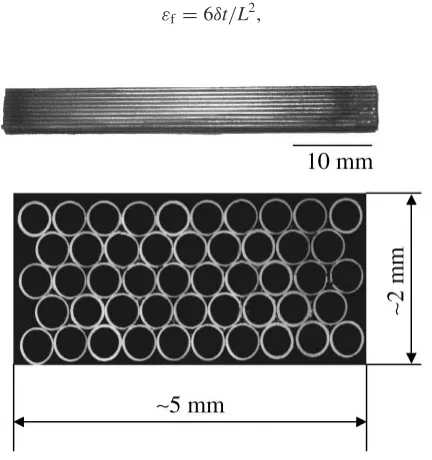
Figure 1 depicts the fabricated test specimen for bending and compression tests. Since the wall thickness is 40mm, the theoretical relative densityR(=) is given by 29%. This
value is in relatively good agreement with the experimentally measured relative density, 26%. Macrostructure of bonded area is shown in Fig. 2. Ni3P properly joined the two neighboring SUS304 tubes with the average contact angle of bonded arc (), 13.7.
4.2 Three-point bend test
The flexural stress,f is defined by
f ¼3PL=2bt2; ð4Þ
wherePis the applied load at the center of the support span in bending,L, the support span length,b, the width of specimen, andt, the thickness of specimen respectively. The bending or flexural strain,"f, was calculated by
"f ¼6t=L2; ð5Þ
[image:2.595.321.537.541.771.2]in which is the deflection of the specimen under test.16) Figure 3 shows the flexural stress-strain relationships of SUS304 dense and cell-structured materials, respectively. Both the yield stress (y) and the flexural modulus (Ef) are compared in Table 1 for the SUS304 cell-structured and dense materials. Absolute value of flexural strength for the cell-structured assembly is lower than that for dense speci-men, but the specific stiffness and specific yield strength of this material are nearly the same as the dense material. Figure 4 depicts thes-"f relations both for the SUS304 dense and cell-structured specimens. In the initial stage of elasto-plastic bending, the SUS304 cell-structured material has nearly the same specific stress-strain relationship as the solid material. Certainly the bending modulus and the yield stress decrease in proportional to the relative density, but no degradation of initial elasto-plastic behavior takes place in the present cell-structured material. For > y or "f >1%, significant plastic deformation occurs in the 304 stainless steel. In the dense material, the stress during this plastic deformation increases by work hardening. While, in the cell-structured material, local detachment occurs at the bonding medium due to brittleness of Ni3P at the room temperature, as indicated by arrows in Fig. 4. Just like the local buckling in foam material,4–6) this local detachment never leads to the total failure by the plastic deformation of tubes. In the same
Fig. 2 Macrostructure and bonded area of assemblies.
[image:3.595.65.276.73.323.2]Fig. 3 Absolute bending stress and strain relations both for the SUS304 dense and cell-structured materials.
Table 1 Flexural properties of cell-structured and dense materials.
Yield Flexural Specific yield Specific flexural Specimen stress, modulus, strength, modulus,
SUS304 y Ef y= Ef=
(MPa) (GPa) (MPam3/kg) (GPam3/kg)
Cell-structured
145 22 71.5 10.8
material
Dense material 554 101 71.1 12.9
[image:3.595.312.543.466.596.2] [image:3.595.52.549.695.787.2]manner to the plateau stress region in the metallic foam, nearly constant stress is preserved till the onset of densifica-tion. Since the malleability of Ni3P increases with the holding temperature15) and also the dynamic strain aging occurs during flexural test at low stain rate, the hot behavior deformation becomes different from the above mechanical response in the cell-structured material. Both yield strength and stiffness increased significantly. Moreover, the detach-ment zone at higher temperature becomes shorter than that at room temperature, as shown in Fig. 5.
4.3 In-plane compressive test
The in-plane, nominal compressive stress,c, is obtained by dividing the load (P) by the original, cross-sectional area of the specimen, A0. The nominal compressive strain,"c, is calculated by dividing the displacement of upper punch () by the original height of specimen (h0). Figure 6 shows the quasi-static nominal compressive stress-strain curve for the SUS304 cell-structured material. This nominal stress-strain curve is typical to the cellular solids. It has three stages in deformation: linear elastic, plastic collapse and densification regions. In the initial stage, the cellular material deforms elasto-plastically, in which stress and strain are nearly proportional with each other. The compressive yield stress and the elastic modulus are 10 MPa and 143 MPa, respec-tively. Beyond the linear region, plastic yielding takes place up to 60% in compressive strain, corresponding to the conventional cellular structures.4–6,17)A positive slope was detected in the collapse region: dc=d"c40MPa. It was slightly different from the conventional honeycomb
materi-als. This type of stress-strain behavior was also reported by Chin Jye Yu et al.18) Baumeister19) investigated the com-pressive behavior for aluminum foams, which was used as a core material in the steel sandwich. The equivalent behavior was observed when increasing the relative density of core material from 13 to 26%.
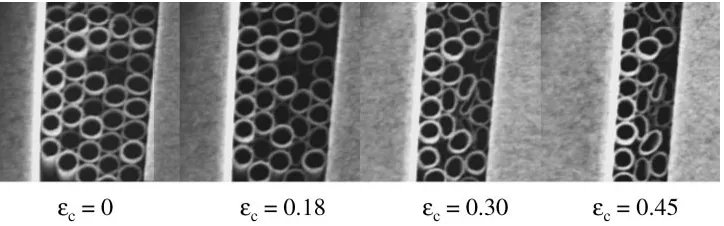
Densification region commences when the cell walls come into contact. Figure 7 depicts the sequence of deforming SUS304 cell-structured specimen during compressive test in the case when no constraining shell walls were fixed. The collapse of cells in the whole specimen occurs in a co-operative manner; the collapsed cells induced alternative collapse of adjacent cells. After the first row of cells collapsed, the cell wall was oval-shaped to induce the collapse of adjacent row by transferring stresses through the contact area. This behavior is due to stress concentration caused by the change in the geometry of the collapse cells.
5. Conclusions
The cell-structured honeycombs can be fabricated by electroless nickel plating method. High specific flexural properties can be attained by the present approach. The specific flexural yield strength is almost indifferent to the relative density when compared to solid stainless steel. Mechanical properties of this material are enhanced by operating at elevated temperature. Therefore this material can be applied and utilized for high temperature applications. Its mechanical response in the in-plane compression can be analyzed by thein-situobservation. In the similar manner to the metallic foam, the stress-strain relation is divided into
Fig. 5 Flexural stress-strain relationships of SUS304 assemblies at room temperature and 473 K.
Fig. 6 In-plane compressive stress-strain relationship of SUS304 cell-structured material.
[image:4.595.54.285.69.224.2] [image:4.595.313.540.73.214.2] [image:4.595.118.480.656.769.2]three regions. High qualification even in the compressive response can be obtained by uniform collapsing of the present cell-structured material.
REFERENCES
1) K. Yagi and K. Halada, Ecomaterials: www.mpg.de/doku/wbmaterials/ wbmaterials 228232
2) A. M. Hayes, D. L. McDowell and J. K. Cochran, Jr: Proceedings of the 2002 TMS Annual Meeting in Seattle, Washington,Processing and Properties of Lightweight Cellular Metals and Structures, (2002) pp. 223–232.
3) J. L. Clark, J. K. Cochran, T. H. Sanders and K. J. Lee: Proceedings of the 2002 TMS Annual Meeting in Seattle, Washington,Processing and Properties of Lightweight Cellular Metals and Structures, (2002) pp. 137–146.
4) H. Kanahashi, T. Mukai, Y. Yamada, K. Shimojima, M. Mabuchi, T. Aizawa and K. Higashi: Mater. Trans.42(2001) 2087–2092. 5) H. Kanahashi, T. Mukai, T. G. Nieh, T. Aizawa and K. Higashi: Mater.
Trans.43(2002) 2548–2553.
6) Y. Yamada, K. Shimojima, Y. Sakaguchi, M. Mabuchi, M. Nakamura, T. Asahina, T. Mukai, H. Kanahashi and K. Higashi: Mater. Sci. Eng.
A280(2000) 225–228.
7) A. G. Evan, J. W. Hutchinson and M. F. Ashby: Current Opinion in Solid State & Materials Science,3(1998) 288–303.
8) H. Bart-Smith, A. F. Bastawros, D. R. Mumm, A. G. Evans, D. J. Sypeck and H. N. G. Wadley: Acta Metall.46(1998) 3583–3592. 9) L. J. Gibson and M. F. Ashby:Cellular solids Structure and properties,
2nd edition, (Cambridge University Press, 1997).
10) T. Aizawa, H. Kanahashi and K. Tantikom: J. Japan Foun. Eng. Soc,74
(2002) 805–811.
11) U. Waag, L. Schneider, P. Lothman and G. Stephani: PM Special Feature MPR (2000) 29–33.
12) V. P. W. Shim and W. J. Stronge: Int. J. Mech. Sci.28(1986) 709–728. 13) S. D. Paka and S. Kyriakides: Inter. J. Solid Struc.35(1998) 239–267. 14) G. JL: J. Mech. Phys. Solids46(1998) 29–50.
15) Plating technology: http://www.kanigen.co.jp 16) Flexural Strength Test, ASTM D 790 and ISO 178.
17) Y. Chastel, E. Hudry, S. Forest and C. Peytour:Metal Foams and Porous Metal Structure, (MIT Verlag, 1999) 263–276.
18) C. J (Mike) Yu, T. D. Claar and H. H. Eifert, I. W. Hall, R. E. Franz, K. T. Leighton, D. F. Hasson: Metal Foams and Porous Metal Structure, (MIT Verlag, 1999) 347–352.