Quaternary Science Journal
Abstract: Middle and Upper Quaternary volcanic events are often diffi cult to date, in particular when miner- als suitable for 40Ar/39Ar-dating are missing. Here, we present fi rst tests of a newly developed technique to use the thermoluminescence (TL) of maar tephra and crustal xenoliths for dating the eruption event. We take into consideration that resetting of the latent geological TL of country rock fragments during eruption may be incomplete. We therefore develop the “partial heat – longest plateau” (PHLP) technique to approach the inherited TL signal at eruption. This technique can overcome TL age overestimates due to incomplete zero- ing, as is demonstrated for some eruptions in the Quaternary Eifel Volcanic Field, Germany, in the time range from 11 to 300 ka old. Although we avoid the often observed strong anomalous fading of volcanic feldspars and other volcanic minerals by using heated country rock xenoliths, we still face the problem of longer-term anomalous fading which may be responsible for apparent age underestimates. The orange-red TL emissions (RTL) of pure fi ne-grained quartz extracts from crustal xenoliths are also tested from two samples. This ap- proach needs, however, further systematic investigations into the TL characteristics of RTL.
[The partial heat – longest plateau technique: Testing TL dating of Middle and Upper Quaternary volcanic eruptions in the Eifel Area, Germany]
Kurzfassung: Vulkanische Ereignisse des mittleren und oberen Quartär sind schwer zu datieren, insbesonde- re, wenn geeignete Minerale für eine 40Ar/39Ar-Datierung fehlen. Mit diesem Artikel werden erste Tests einer neuen Anwendungsmöglichkeit der TL-Datierung an Maar-Tephra und Xenolithen präsentiert, um derartige Eruptionsvorgänge zu datieren. Hierbei wird berücksichtigt, dass ein Rückstellen des latenten geologischen TL-Signals der Gesteinsfragmente während des Eruptionsvorganges eventuell nur unvollständig erfolgte.
Aus diesem Grund wurde die „Partial heat- longest plateau-Technik (PHLP) entwickelt, um genau diesem Problem Rechnung zu tragen. Die neu entwickelte Technik kann helfen, eine Überschätzung von TL-Datie- rungen infolge der unvollständigen Rücksetzung des TL-Signals zu vermeiden. Dies wird für vulkanische Ablagerungen im Eifel-Vulkanfeld demonstriert, die eine Zeitspanne von 11 bis 300 ka umfassen. Obwohl das Problem starken anomalen Ausheilens des TL Signals vulkanischer Feldspäte und anderer vulkanischer Minerale umgangen wurde, existiert immer noch das Problem einer Unterschätzung geologischer Alter als Folge eines langfristigen anomalen Ausheilens im TL Signal. Die orange-roten TL-Emissionen (RTL) reiner feinkörniger Quarzproben aus Xenolithen wurden an zwei Proben getestet. Dieser Datierungsansatz verlangt jedoch noch weitere systematische Untersuchungen.
Keywords: thermoluminescence, anomalous fading, maar tephra, xenoliths, volcanic eruptions, dating, Eifel Volcanic Field.
* Address of authors: L. Zöller, H. Blanchard1, Steinmann-Insititut f. Geologie, Mineralogie und Paläon- tologie, Poppelsdorfer Schloss, D-53115 Bonn. E-Mail: [email protected] (corresponding author), [email protected]. 1 New adress: Steinmann-Institut für Geologie, Mineralogie und Palä- ontologie, Universität Bonn, Poppelsdorfer Schloss, 53115 Bonn.
The partial heat – longest plateau technique:
Testing TL dating of Middle and Upper Quaternary volcanic eruptions in the Eifel Area, Germany
LUDWIG ZÖLLER & HENRIK BLANCHARD*)
1 Introduction
Thermoluminescence (TL) dating has often been tested for volcanic minerals (see, e.g., FAT-
TAHI & STOKES 2003) but faces the problems of strong anomalous fading of volcanic feldspars (WINTLE 1973) or of very low TL signals from other volcanic minerals except for quartz. The latter is, however, not present in mafi c volcanic rocks unless as xenoliths derived from older country-rock in the direct vicinity of the vent.
In order to circumvent these problems, we tried to use xenoliths (cf. CHEN et al. 2001) and maar tephra derived from country-rock to date their last resetting during the volcanic activity by TL.
This approach, however, raises new problems, in
particular the degree of heating during the erup- tion (cf. GONZÁLEZ et al. 2006 and comments by DULLER 2006) and the question if, besides heat- ing, other events may reset the parent “geologi- cal” TL signal of the dated minerals.
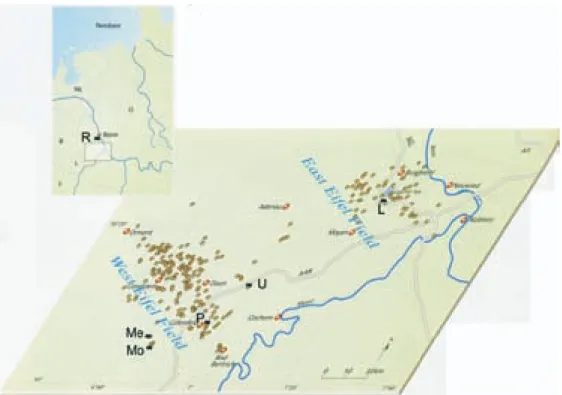
We sampled xenoliths derived from Lower Devonian silicoclastic country-rock (partly affected by metamorphism) and maar tephra from several volcanic eruptions in the Quater- nary Eifel Volcanic Field, Germany (Fig. 1), separated in two NW-SE oriented sub-fi elds, the West and the East Eifel Field (MEYER 1986, SCHMINCKE 2000, BÜCHEL et al. 2000). In the West Eifel Field phonolitic eruptions are miss- ing. Hydroclastic maar eruptions occurred in both fi elds but are more typical for the West
Fig. 1: The Quaternary West and East Eifel Volcanic Fields in the Rhenish Massive, Germany (adopted from SCHMINCKE, 2000). Studied localities shown as black rectangles: Me=Meerfelder Maar (Deudesfeld site), Mo=Mosenberg scoria cone (southernmost cone), L=Lake Maria Laach (Wingertsberg site), P=Pulvermaar (near Gillenfeld), R=Rodderberg, south of Bonn, U=Ulmener Maar.
Abb. 1: Quartäre Vulkanfelder der West- und der Osteifel, Rheinisches Schiefergebirge, Deutschland (bear- beitet nach SCHMINCKE, 2000). Schwarze Rechtecke markieren bearbeitete Lokalitäten: Me=Meerfelder Maar (Tuffgrube Deudesfeld), M=Mosenberg-Schlackenkegel (südlichster Kegel), L=Laacher See (Wingertsberg- Wand), P=Pulvermaar (bei Gillenfeld), R=Rodderberg südlich Bonn, U=Ulmener Maar.
Eifel Field where maar tephra consists of up to >90% of country rock clasts (mainly Lower Devonian slates, siltstones and quartzites or quartzitic sandstones). In some maar tephras (e.g., Meerfelder Maar) also peridotite xeno- liths from the upper mantle with diameters up to ca. 20 cm can be found which, however, were not used for dating.
The incipient observation for this study was the fi nding of a few cm to several dm thick beds of very well sorted, fi ne-grained maar tephra in the ramparts of Lake Ulmener Maar and Lake Pulvermaar in the West Eifel Field.
These tephra beds consist almost entirely of fi ne-ground Lower Devonian slate and silt- stone clasts with a clear maximum in the silt fraction and very low clay fraction. The grind- ing of the hard country-rock down to these fi ne fractions can be explained by the theory of hy- droclastic eruptions as presented by LORENZ &
ZIMANOWSKI (2000). Preliminary TL measure- ments from the polymineral fi ne-grained frac- tion (4-11)m) using the “multiple aliquot ad- ditive dose” (MAAD) protocol (WINTLE 1998, VANDENBERGHE et al. 2004) showed that the TL and the infra-red stimulated luminescence (IRSL) were totally zeroed at deposition of the two studied maar tephras (ZÖLLER et al. 2009).
This result is, however, somewhat su rprising as zeroing by light exposure in a base surge is certainly insuffi cient and it must be doubted if thermal zeroing in a hydroclastic eruption is able to completely erase the parent TL. Heat transfer in the eruption chamber of a maar during sub- surface grinding of the country-rock is probably low in a dry gas-solid mixture, although the presence of water under high pressure condi- tions, however, may increase heat transfer (pers.
comm. M. Zimanowski 2006). Nevertheless, we explored an additional possible zeroing mecha- nism: hydrostatic pressure, based on the descrip- tion of “mechanoluminescence” by BANERJEE
et al. (1999) (see also SINGHVI et al. 1994). The results are published elsewhere (ZÖLLER et al.
2009) and will not be further reported here. It was shown that hydrostatic pressure (1 GPa for 19 h) at room temperature did not signifi cantly reset the natural TL (NTL) of a Lower Devonian
slate fragment whereas hydrostatic pressure at elevated temperature (1 GPa at 150°C for 19 h) partially reset the NTL beyond the thermal draining. In the following chapters we try to develop a laboratory technique to overcome the problem of partial resetting of maar tephra or crustal xenoliths independent from the question what caused the resetting (heat transfer, friction- al heating or hydrostatic pressure).
2 Samples and sample preparation Three kinds of samples were collected for test- ing TL dating,
a) only slightly consolidated maar tephra-beds, b) crustal xenoliths extracted from maar tephra
or scoria and ash cones, and
c) a piece from Lower Devonian slate (sample no. 5) originating from the same epoch (Up- per Siegenium) as country-rock outcropping at Lake Puvermaar (for dose recovery exper- iments; the sampling locality at the northern end of the Middle Rhine Valley at Bonn- Friesdorf is far away from possible thermal overprint by Quaternary volcanism).
All samples were processed under subdued red light (diodes, 620 nm) after removal of the out- er minimum 2 mm rim using a handsaw. Hard rock samples were carefully crushed in a bench vice and with an agate mortar and sieved.
Fine-grain samples were prepared according to ZIMMERMAN (1971) and quartz coarse grain samples according to MEJDAHL (1985a) and AITKEN (1998). From two samples (13RTL and 14 RTL) fi ne-grained quartz separates were ob- tained by etching in H2SiF6 (FUCHS et al. 2005).
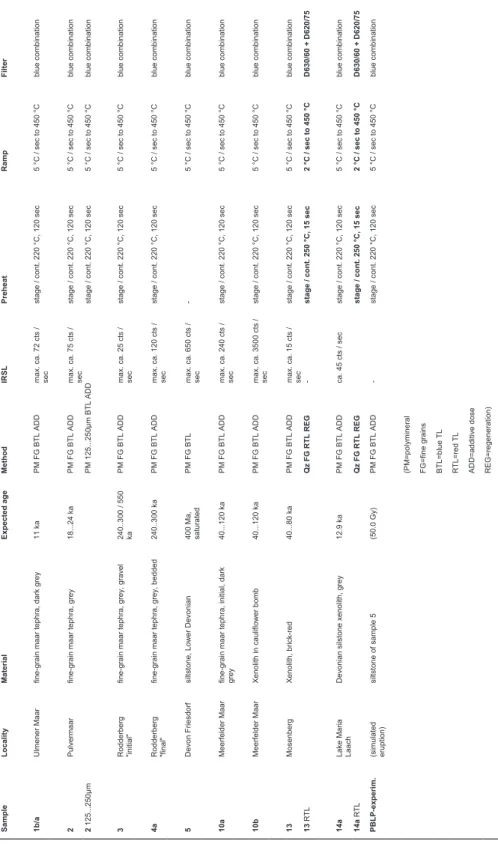
More detailed information about the samples is given in Table 1.
3 Experimental
TL and IRSL measurements were executed us- ing a Daybreak 1150 TL/IRSL reader equipped with infra-red diodes (870±30 nm), an EMI 9586Q photomultiplier (PM) and a combina- tion of four detections fi lters (BG-3, GG-400, BG-3, BG-39, “blue combination” in Table 1) in front of it. TL readout occurred at a ramp rate
SampleLocality Material Expected age MethodIRSLPreheat RampFilter 1b/a Ulmener Maar fine-grain maar tephra, dark grey 11 kaPM FG BTL ADDmax. ca. 72 cts / sec stage / cont. 220 °C, 120 sec 5 °C / sec to 450 °Cblue combination 2 Pulvermaar fine-grain maar tephra, grey 18...24 kaPM FG BTL ADDmax. ca. 75 cts / sec stage / cont. 220 °C, 120 sec 5 °C / sec to 450 °Cblue combination 2 125...250!mPM 125...250!m BTL ADDstage / cont. 220 °C, 120 sec 5 °C / sec to 450 °Cblue combination 3 Rodderberg "initial"fine-grain maar tephra, grey, gravel 240..300 / 550 ka PM FG BTL ADDmax. ca. 25 cts / sec stage / cont. 220 °C, 120 sec 5 °C / sec to 450 °Cblue combination 4a Rodderberg "final"fine-grain maar tephra, grey, bedded240..300 kaPM FG BTL ADDmax. ca. 120 cts / sec stage / cont. 220 °C, 120 sec 5 °C / sec to 450 °Cblue combination 5 Devon Friesdorfsiltstone, Lower Devonian400 Ma, saturatedPM FG BTL max. ca. 650 cts / sec - 5 °C / sec to 450 °Cblue combination 10a Meerfelder Maar fine-grain maar tephra, initial, dark grey 40...120 kaPM FG BTL ADDmax. ca. 240 cts / sec stage / cont. 220 °C, 120 sec 5 °C / sec to 450 °Cblue combination 10b Meerfelder Maar Xenolith in cauliflower bomb40...120 kaPM FG BTL ADDmax. ca. 3500 cts / sec stage / cont. 220 °C, 120 sec 5 °C / sec to 450 °Cblue combination 13 Mosenberg Xenolith, brick-red40...80 kaPM FG BTL ADDmax. ca. 15 cts / sec stage / cont. 220 °C, 120 sec 5 °C / sec to 450 °Cblue combination 13 RTL Qz FG RTL REG- stage / cont. 250 °C, 15 sec 2 °C / sec to 450 °CD630/60 + D620/75 14a Lake Maria LaachDevonian silstone xenolith, grey 12.9 ka PM FG BTL ADDca. 45 cts / sec stage / cont. 220 °C, 120 sec 5 °C / sec to 450 °Cblue combination 14a RTL Qz FG RTL REGstage / cont. 250 °C, 15 sec 2 °C / sec to 450 °CD630/60 + D620/75 PBLP-experim. (simulated eruption) siltstone of sample 5(50.0 Gy)PM FG BTL ADD- stage / cont. 220 °C, 120 sec 5 °C / sec to 450 °Cblue combination (PM=polymineral FG=fine grains BTL=blue TL RTL=red TL ADD=additive dose REG=regeneration)
Table 1: Samples, sample preparation and experimental details. Tabelle 1: Proben, Probenaufbereitung und Messparameter.
of 5°C (for blue TL) and 2°C per second (for orange-red TL, see below), respectively (see Table 1) to a maximum temperature of 450°C, whereas IRSL was recorded at room tempera- ture. For blue TL preheat of 220°C for 2 min- utes was applied (“stage and continue”, i. e. the aliquot is heated to 220° C and held there for 2 minutes, before heating continues to maximum temperature); deviating protocols for orange-red TL are mentioned in Table 1. For sub-sample 13RTL (Mosenberg volcano) the orange-red TL (RTL) of a pure quartz separate was also mea- sured using a detection fi lter combination (Oriel D630/60 + D620/75) with transmission from 570 to 685 nm (maximum from 600-660 nm;
based on manufacturer’s data). The quantum ef- fi ciency of the used PM in this wavelength range is, however, only ca. 1%. Laboratory irradiation
was performed using a 90Sr/90Y beta-source de- livering ca. 9.96 Gy/min.
The age of a sample can - simplifi ed - be calcu- lated as the radiation dose accumulated since the dated event, DE [Gy], divided by the effective dose-rate, D![Gy/a]. To determine the equiva- lent dose DE it is necessary to defi ne the plateau range, i.e. the glow curve temperature range exhibiting identical DE. In case of non-linear dose-response a simple plot of I(N+ß)/I(N) versus glow temperature (e.g., AITKEN 1985, Fig. 1.3), with I(N+ß) denoting the TL intensity of an addi- tively dosed aliquot and I(N) the TL intensity of a natural aliquot, respectively, is not justifi ed (e.g., BERGER 1991, 1994, BERGER & ANDERSON 1994).
We therefore used the DE plateau test only.
Longer-term anomalous fading tests and cor- rections (according to AUCLAIR et al. 2003, LA-
a)
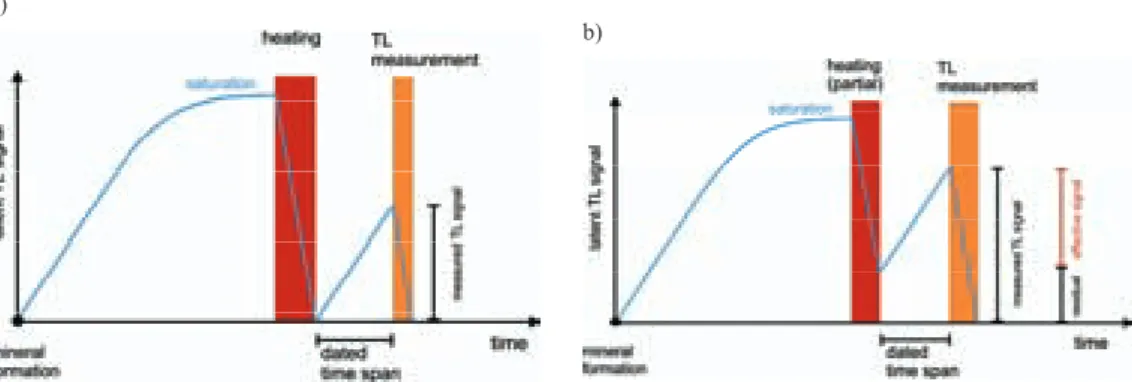
Fig 2: Principles of TL dating assuming total (a) and partial resetting (b) of the parent TL during the event to be dated. The parent TL signal acquired during the geological history of the mineral grain (geological TL) is saturated and then entirely annealed during heating (a). Subsequently, the parent TL signal accumulates again with time due to natural radioactivity of the sample and its environment. The intensity of the natural TL signal (NTL) recorded in the laboratory is a measure of the time elapsed since the last heating. If, however, the heating event did not completely erase the acquired geological TL a residual TL remains at the heating event. The NTL signal measured in the laboratory consists of TL accumulated after the heating event plus an inherited TL signal (b).
Abb. 2: Grundlagen der TL-Datierung unter Annahme vollständiger (a) und partieller Rückstellung (b) des latenten TL-Signals während des datierten Ereignisses. Das latente TL-Signal, welches im Laufe der geolo- gischen Geschichte des Mineralkorns akquiriert wurde, ist in Sättigung und wird dann während der Erhitzung völlig gelöscht (a). Danach wächst das latente TL-Signal wieder infolge der natürlichen Radioaktivität der Probe und ihrer Umgebung. Die Intensität des natürlichen TL-Signals (NTL), welches im Labor gemessen wird, ist ein Maß für die Zeit seit der letzten Erhitzung. Wurde jedoch während des Ereignisses der Erhitzung die akquirierte geologische TL nicht vollständig gelöscht, verblieb ein residuales (ererbtes) TL-Signal. Das im Labor gemessene NTL-Signal setzt sich dann aus dem seit der Erhitzung akquirierten Signal plus dem ererbten Signal zusammen (b).
b)
MOTHE et al. 2003) were not yet executed due to limited laboratory time for this pilot study.
Instead, an accelerated short term fading test (7 days storage at 70°C in the oven, see BERG-
ER 1985, 1987, 1988; ZÖLLER 1995) was per- formed on polymineral fi ne grain samples and apparent equivalent doses were corrected for short term fading: TL intensities of the high- est additive dose (N+ßmax) were measured im- mediately after irradiation and after seven days delay at 70°C. In case anomalous fading was detected and calculated as
[I(N+ßmax)-IN]/[I(N+ßmax+delay)-IN],
with I = TL-intensity in the ED plateau range, the portion I(N+ß)i-IN of all additively dosed ali- quots was recalculated by subtraction of the fading percentage, and the corrected intensities of I(N+ß)i were used for refi tting the additive dose response curve. Although there may be doubts about the general validity of extrapolated long term fading tests this discussion lies outside of the scope of the present study. We are aware, however, that further studies should also in- clude longer-term fading tests. So far, all ap- parent TL-ages obtained from the polymineral fi ne grain fraction must be regarded as mini- mum ages!
Effective internal #- and ß-dose-rates for the dated samples were calculated using thick source alpha-counting of fi ne-ground bulk sam- ples (AITKEN 1985, ZÖLLER & PERNICKA 1989) for U and Th decay chains, and by ICP-MS and AAS measurements for K. Dose conversion fac- tors given by ADAMIEC & AITKEN (1998) were applied. The * dose-rates were calculated from U, Th and K concentrations of maar tephras if homogeneity for 4+ geometry could be assumed by fi eld evidence. For xenolith samples not ful- fi lling the requirements of 4+ geometry the * dose-rate was measured on-site using a portable NaI 4-channel gamma spectrometer (Harwell).
The very small contribution of cosmic dose-rate was estimated with respect to sample depth be- low surface using the formula given by PRESCOTT
& HUTTON (1994). The a-value (alpha effi ciency, see AITKEN 1985) was taken as 0.08±0.02 for polymineral fi ne-grain samples and 0.03±0.01 for fi ne-grain quartz samples. Secular equilib- rium of U decay-chains was assumed.
4 The partial heat – longest plateau (PHLP) technique in TL dating
4.1 Partial resetting of parent TL – basic considerations
Luminescence dating is a paleodosimetric dat- ing method based on the absorption of the en- ergy of ionizing radiation by the sample with time (WAGNER 1998). A basic assumption of luminescence (TL, OSL, IRSL) dating is the complete resetting (zeroing) of the latent lumi- nescence signal at the event to be dated. Heat and light exposure are the most prominent re- setting mechanisms allowing the dating of the last heating event of a sample or the last expo- sure of its mineral grains to daylight (e.g., sedi- mentation). Incomplete resetting results in an over-estimation of DE, and, thus, an age over- estimation. It is, therefore, essential to ascertain a complete resetting at the event to be dated or to fi nd applicable corrections for the inherited residual luminescence value (Fig. 2).
For TL dating of sediments with an inherited signal at deposition, MEJDAHL (1985b, 1988) presents several so-called “partial bleach”
techniques. One of them is called the “longest plateau” technique (MEJDAHL 1988). It relies on the observation that the natural TL of quartz or feldspars consists of components exhibiting dif- ferent sensitivity to daylight. Assuming that all mineral grains of a sample saw the same light sum prior to deposition, the correct DE can be found if for different glow temperatures within the thermally stable part of the glow-curve the obtained DEs are identical (DE –plateau). This can be achieved by trying the residual TL of glow-curves from natural TL (NTL) aliquots following various light exposures. Since the advent of optical dating the longest plateau
technique after MEJDAHL, however, has been more or less abandoned.
When a sample having acquired an amount of NTL is subjected to insuffi cient (partial) heat- ing (e.g., 200 to 300°C) its TL is not totally zeroed. Glow peaks lower than or equal to the maximum heating temperature are drained completely, whereas those above the heating temperature are partially erased or even remain unaffected, depending on their peak tempera- ture and the duration of heating. A residual TL glow curve is obtained when the sample is glowed to maximum temperature (450 or 500
°C, respectively). The shape of this residual TL glow curve is in some aspects similar to the re- sidual TL after optical bleaching (see Fig. 6b) in so far as the percentage residual TL, referred to the NTL, increases with glow temperature.
In contrast to partial optical bleaching, no TL peaks for glow temperatures below the partial heating temperature are recorded. This can
even be considered as an advantage over partial optical bleaching. Thus, MEJDAHL’s approach can be modifi ed to the TL dating of partially heated rocks, sediments or soils.
4.2 A new laboratory protocol for partially heated rocks
We tried to optimize the longest plateau tech- nique for partially heated volcanogenic mate- rial such as crustal xenoliths and maar tephra.
We so far developed the following protocol:
1. Construction of a multiple aliquot additive dose-response curve (MAAD). In case a long DE plateau is observed by extrapolation to zero TL level complete resetting of the latent (geological) TL at eruption is proved and the following steps are not necessary (Fig. 2a).
2. A number of zeroed aliquots of the sample to be dated (here: 18 aliquots) are regenerated by a laboratory dose up to the estimated pre-
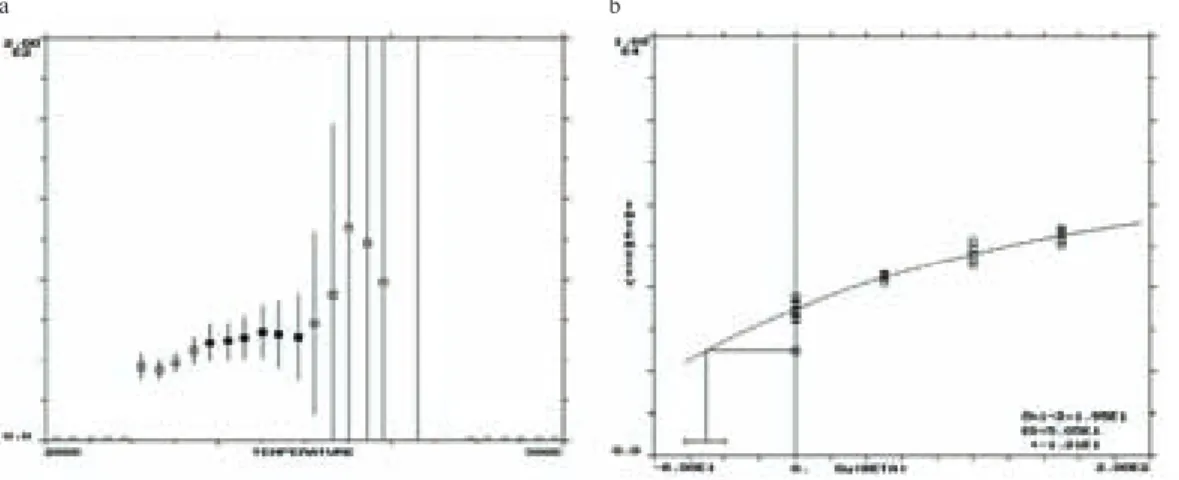
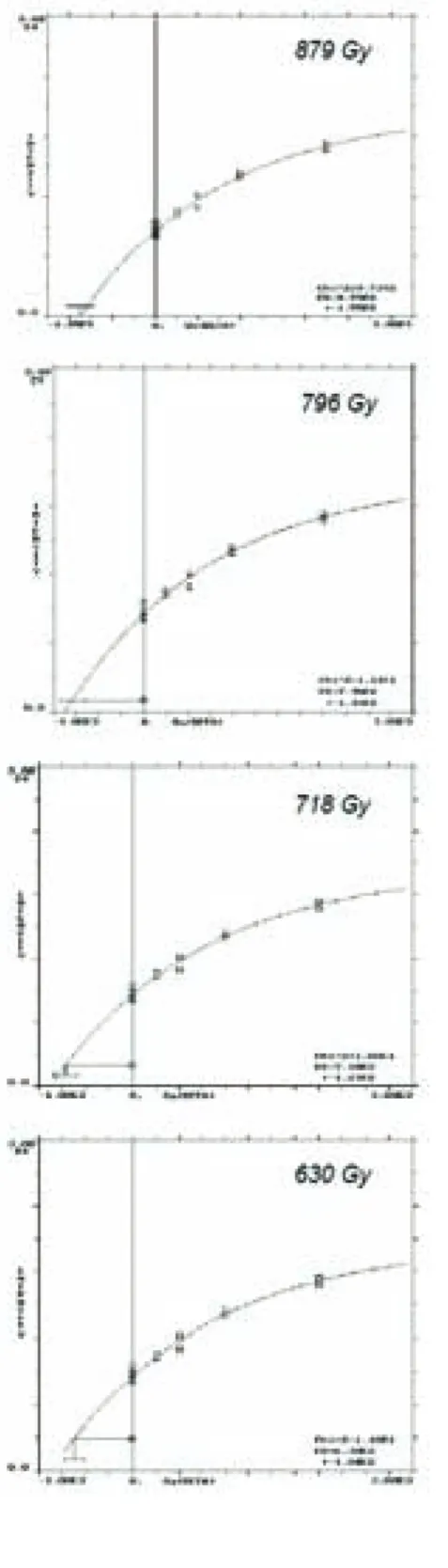
Fig. 3 a: DE-plateau of the dose recovery test. The sample 5 with geological TL in saturation was partially heated (15 min at 300°C) and then laboratory-dosed with 50 Gy. The PHLP technique recovers a dose of 50.5±12.1 Gy (see b). ´
b : Results of the PHLP technique applied to sample 5 dosed with 50 Gy after partial heating for 15 min at 300°C. The PHLP technique recovers a dose of 50.5±12.1 Gy. The longest DE-plateau is seen at the correct equivalent temperature.
Abb. 3a: DE-Plateau des Dosis-Wiederherstellungstests. Die Probe 5 mit geologischer TL in Sättigung wurde partiell ausgeheizt (15 min bei 300°C) und erhielt dann im Labor eine Dosis von 50 Gy. Die PHLP-Technik fi ndet eine Dosis von 50,5±12,1 Gy wieder (siehe b).
b : Ergebnisse der PHLP-Technik für Probe 5 mit einer Labordosis von 50 Gy im Anschluss an 15-minütiges partielles Ausheizen bei 300°C. Die PHLP-Technik fi ndet eine Dosis von 50,5±12,1 Gy wieder. Das längste DE-Plateau stellt sich bei der korrekten Äquivalenttemperatur ein.
a b
eruptive dose-level. This step is not used for regenerative dating but only to produce ali- quots suited for step 3. In the case of Lower Devonian basement the aliquots must be ir- radiated up to the saturation dose level (min- imum 2,000 Gy; a saturation dose of 2,000 to 5,000 Gy was found for our samples). To minimize irradiator time additive dosing on top of the natural dose is advised.
3. The dosed aliquots are split in 6 groups. The aliquots of each group are subjected to ther- mal pre-treatment on the hotplate of the TL reader for 5 min with temperature increments of 10K. Temperatures for one group each are held at 250, 260, 270, 280, 290 and 300 °C, respectively. By this way, 6 different residual TL levels are produced representing partial annealing of the pre-eruption TL level.
4. Extrapolation of the MAAD dose-response curve (step 1) to the various residual TL levels to obtain the parent DE for each glow temperature in the range from 280 to ca.
400°C and for each residual TL level (cf.
Figs. 5, 6a). Ideally, the plateau is expected to be the longest if the thermal pre-treatment in the laboratory matches exactly the natural conditions during and after (cooling down- period) the eruption. This will hardly be the case, and, thus, the laboratory preheat temperature yielding the longest plateau is called “equivalent temperature” (Fig. 2b).
Only for an equivalent temperature deliv- ering a residual TL resembling best or very closely the residual TL at eruption an ac- ceptable DE –plateau is obtained.
5. Ideally, dating results from two or more xe- noliths of the same eruption but yielding dif- ferent equivalent temperatures and/or dose-
rates are identical within error bars and can, thus, validate the eruption age (see section
“results”).
We designed the following dose recovery ex- periment to prove the validity of the protocol:
The partial heating of a crustal xenolith during a volcanic eruption was simulated by partial heating of a piece of sample 5 (Lower Devo- nian basement, TL in saturation) in an oven. To apply a geological “age” to the sample after the artifi cial “eruption”, a defi ned test-dose of 50.0 Gy was administered in the laboratory follow- ing the partial heating.
Detailed protocol of the PHLP dose recovery experiment:
1. Preparation of the polymineral fi ne grain fraction (4-11)m) from a Lower Devonian basement slate (50 aliquots).
2. Simulation of partial heating during a volca- nic eruption by heating the fi ne grain frac- tion in an oven at 300°C for 15 min.
3. Storage of the aliquots for >24h at room tem- perature to allow for possible charge redis- tributions.
4. Additive ß-irradiation (50 Gy) of all aliquots to simulate a geological age of the “erup- tion”.
5. Storage at 160°C for 15min in an oven to remove thermally unstable TL-peaks, then at room temperature for >24h to allow for charge redistribution.
6. Determination of the apparent DE using the MAAD protocol applying the PHLP tech- nique (Fig. 3 a, b).
7. Using the same fi ne grain material as pro- duced in the 1st step to produce the residual TL levels after incremental preheat (as de-
Sample Material Stratigraphic
position DE (Gy) Dose rate
(Gy/ka) Apparent age (ka)
3 hydroclastic maar
tephra initial series 1108 ! 355 3.70 ! 0.25 300 ! 98
4a hydroclastic maar
tephra
final series 957 ! 161 2.87 ! 0.21 334 ! 61
R4-D-1 slate xenolith strombolian series 1403 ! 141 4.37 ! 0.24 321 ! 37
"
# # #
Table 2: Summarized TL dating results from three samples of the Rodderberg volcanic complex.
Tabelle 2: Zusammengefasste TL-Datierungsergebnisse von drei Proben des Rodderberg-Vulkankomplexes.
scribed above). Laboratory regenerative ir- radiation up to the pre-eruptive dose-level is not necessary in this case as dose-saturated material without natural thermal overprint is used.
5 Results
5.1 Results of the dose recovery experiment By applying the PHLP technique as described above, the artifi cial laboratory dose was repro- duced correctly (50.5±12.1 Gy, see Fig. 3) even if within large error bars. The experiment also confi rmed the hypothesis that the extrapolation of the dose response-curve to the correct re- sidual results in a suffi ciently long DE plateau, whereas extrapolations to wrong residuals can- not yield a good plateau and result in wrong apparent DE values. The plateau must, however, cover the temperature range of the glow-curve peak relevant for dating to serve as a reliable check for the correct DE.
The newly developed PHLP technique can, thus, be expected to reliably date the eruption of partially heated crustal xenoliths. The tech-
nique was tested using maar tephra and crustal xenoliths from some Middle and Upper Qua- ternary eruptions in the West and East Eifel Volcanic Field.
5.2 Preliminary results from selected volcanic eruptions in
the Eifel Volcanic Field
We fi rst studied maar tephra beds with good to moderate age control to check if the PHLP technique delivers satisfying results for such material. The eruption age of Ulmener Maar (sample 1, Photo 1) is well constrained to ca.
11,000 cal BP by 14C-AMS dating and varve chronology (ZOLITSCHKA et al. 2000). From Pulvermaar (sample 2, Photo 2) a physical dat- ing is not yet available, but from geomorpho- logic evidence its age is assumed to fall within the last glacial maximum (LGM; LORENZ & ZI-
MANOWSKI 2000).
The apparent TL age for Ulmener Maar was calculated to 8.36 ± 1.11 ka (corrected for short term fading of ca. 13%). The TL age signifi - cantly underestimates the independent age (11 ka, ZOLITSCHKA et al. 2000), but there is no evi- Fig. 4: DE-plateau function (top) and dose response curve (bottom) for the 125-250)m fraction of sample 2 (Pulvermaar). A plateau is not obtained if total zeroing of the TL at deposition is assumed. Note that the DE shown in the fi gure is not corrected for anomalous fading.
Abb. 4: DE-Plateaufunktion (oben) und Dosis-Wirkungs-Kurve (unten) für die 125-250)m-Fraktion der Pro- be 2 (Pulvermaar). Bei Annahme vollständiger Rückstellung der TL bei Ablagerung ergibt sich kein Plateau.
Man beachte, dass der DE-Wert in der Abbildung nicht um den Betrag des anomalen Ausheilens korrigiert wurde.
Fig. 5: Results of the PHLP technique for maar tephra (sample 4) from the Rodderberg volcanic complex, apparently ca. 300 ka old. The plots demonstrate that PHLP works even for high accumulated doses of ca. 1,000 Gy (corrected) or more. Abb. 5: Ergebnisse der PHLP-Technik für die Maartephra (Probe 4) des Rodderberg Vulkan-Komplexes mit einem offensichtlichen Alter von ca. 300 ka. Die Diagramme zeigen, dass PHLP selbst für hohe akkumulierte Dosen von ca. 1 000 Gy (korrigiert) oder darüber funktioniert.
Figure 6 a
dence for age overestimation which would be expected in the case of incomplete TL-zeroing during eruption. The apparent TL age of Pul- vermaar (21.0 ± 2.95 ka, corrected for short term fading of ca. 9%) lies within the LGM as expected (LORENZ & ZIMANOWSKI 2000).
From Pulvermaar we also used the TL of the 125-250 )m fractions to check for possible grain size-dependant zeroing. This fraction consists of platy slate clasts. As shown in Fig. 4 (note that data were not corrected for fading) a DE-plateau is not obtained using extrapolation of the dose response curve to zero. This suggests that TL- zeroing of this fraction during fragmentation in the explosion chamber of the maar was not as complete as for the fi ne silt fraction.
From the Rodderberg volcanic complex (RVC) south of the city of Bonn, in a previous study
one of us (BLANCHARD 2002) dated a well- heated brick-red xenolith (Lower Devonian siltstone) extracted from scoria and obtained an apparent TL-age of 321±37 ka (sample R4-D- 1, data in PAULICK et al. 2008, Table 2). Tephra from the RVC was found in a nearby loess- paleosol section in loess attributed to the third last glaciation (BARTELS & HARD 1973, 1974), and the superposition of lapilli tephra and sco- ria on glacial loess argues for an eruption of the Strombolian series within a cold stage (prob- ably MIS 8, ca. 250 to 310 ka). PAULICK et al.
(2008) support an eruption age of the RVC of ca. 300 ka by geochemical and mineralogical methods and comparison with data given in BOGAARD & SCHMINCKE (1990). For the present study, we sampled two maar tephra beds (sam- ple 3 from the initial maar tephra and sample 4 from the fi nal maar tephra) from the RVC.
Both tephra beds are much sandier than the maar tephra beds of samples 1 and 2.
The Rodderberg maar tephra layers both exhib- it evidence of incomplete resetting by partial heating. Equivalent temperatures were found at 270°C (sample 3) and 260°C (sample 4a), re- spectively. Fig. 5 demonstrates that even in the high dose range PHLP yields satisfying results.
Short-term anomalous fading was ca. 7% for sample 3 and ca. 25% for sample 4. Effective dose-rates differ signifi cantly (3.70 and 2.87 Gy/ka, respectively), but apparent TL ages are consistent within error bars (Table 2). Howev- er, the apparent age of sample 4 in particular must be regarded with caution as the correction for short term anomalous fading may not ac- count for the total amount of fading and related age underestimation. Our results so far argue for a volcanic activity phase of the Rodderberg complex ca. 300 ka ago, but a higher age (e.g., MIS 10) cannot be precluded.
At the base of the rampart of the Meerfelder Maar (West Eifel Volcanic Field) we sampled the initial fi ne grained maar tephra in the quarry near the village Deudesfeld (sample 10a).
Based on non-consistent radiocarbon ages from organic material, BÜCHEL & LORENZ (1984) in- terpreted the highest age (28750 +2270 -1760 a BP) as a minimum age of the maar eruption.
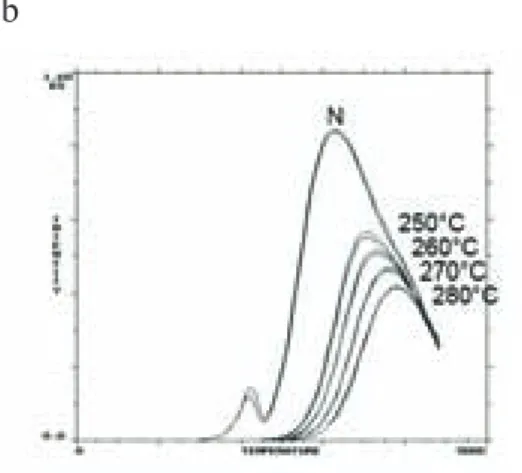
Fig. 6a: Additive dose response curve, residual TL value for 270°C equivalent temperature and DE (longest plateau) from sample 10b (peperite xenolith from Meerfelder Maar tephra).
b: NTL glow curves and TL residuals after incre- mental preheat from sample 10b (peperite xenolith from Meerfelder Maar tephra).
Abb. 6a: Additive Dosis-Wirkungs-Kurve, residu- aler TL-Wert für eine Äquivalenttemperatur von 270°C und DE (längstes Plateau) für Probe 10b (Pe- perit-Xenolith aus der Meerfelder Maar-Tephra).
b: NTL-Leuchtkurven und residuale TL nach stufen- weisem Vorheizen der Probe 10b (Peperit-Xenolith aus der Meerfelder Maar-Tephra).
b
The relatively small amount of preserved maar tephra with respect to the large crater (1700 m diameter), and the advanced aggradations of the maar lake argue for a signifi cantly higher age (Negendank, pers. comm., 2006, see also LORENZ & ZIMANOWSKI 2000). Our PHLP TL- results yielded an equivalent temperature of 270°C. Short-term anomalous fading was ca. 10%. The apparent TL (minimum) age is 69.2$14.5ka.
Our further studies concerned crustal xenoliths to verify the PHLP technique for material which was exposed to partial or even total zeroing of its parent TL. In the tephra originating from Meerfelder Maar some basaltic bombs contain- ing peridotite (up to 20 cm diameter), pyrox- ene xenocrystals and light greyish “peperite”
(LORENZ & ZIMANOWSKI 2000) with fragments of hydroclastic country rock occur. The latter bombs are also known as “caulifl ower bombs”.
A peperite extracted from a caulifl ower bomb was dated (sample 10b) using the PHLP tech- nique. The equivalent temperature was found at 270°C (Fig. 6 a). Natural TL glow curves and residuals after incremental preheat are shown in Fig. 6 b. Short term anomalous fading was ca. 5%. The apparent TL age of 80.4 $ 8.34 ka is consistent with the apparent age of sample 10a within error bars despite signifi cantly dif- ferent effective dose-rates (2.85 Gy/ka and 4.54 Gy/ka, respectively). Our results thus confi rm the much higher age of the maar eruption than previously thought: the eruption and, thus, the preserved paleovegetation remnants correlate to the Odderade interstadial (or an even older warm phase) rather than the Denekamp inter- stadial (BÜCHEL & LORENZ 1984).
Another crustal xenolith (Lower Devonian brick-red siltstone, sample 13) was extracted from the Mosenberg scoria cone from an ex- posure at the southwest foot of the volcanic hill. The Mosenberg volcanic complex (MVC) consists of several scoria cones and maars ly- ing on a SE-NW oriented fault line. The nearby Meerfelder Maar is also believed to belong to this 3 km long volcanic complex with altogeth- er seven eruptive centres (5 scoria cones and 2 maars) and 4 lava fl ows. It is believed so far
that volcanic activity shifted from SE to NW (LORENZ & ZIMANOWSKI 2000). Based on radio- carbon dating results from Meerfelder Maar and another radiocarbon age from Hinkelsmaar at the north-western end of the MVC (JUVIGNÉ
et al. 1988), the minimum age of the complex is ca. 29 ka BP, but LORENZ & ZIMANOWSKI (2000) estimate it to be considerably older. ZÖLLER
(1989) obtained a TL age of 42±3 ka from a brick-red slate xenolith found in the exposure mentioned above, but WODA (2000) dated 87$8 ka using ESR of a heated quartz pebble, and from volcanic glass LEYK & LIPPOLDT (1997) report a 40Ar/39Ar age of 81±23 ka, which is not documented in detail, however. It is pos- sible that the TL age by ZÖLLER (1989) dates a younger eruption, but undetected long-term
Fig. 7: TL glow-curves from natural and additively dosed aliquots of sample 13 (brick-red slate Xenolith from the Mosenberg scoria cone) after preheating at 220°C for 2 min. The peak-shift towards lower glow temperatures of remaining glow peaks (>220°C), re- ferred to the NTL peak, indicates metastable TL of additively dosed aliquots still present after preheat.
Abb. 7: TL-Leuchtkurven natürlicher und additiv bestrahlter Teilproben der Probe 13 (ziegelroter Schiefer-Xenolith aus dem Mosenberg-Schlacken- kegel) nach 2-minütigem Vorheizen bei 220°C. Die im Vergleich zur NTL sichtbare Verschiebung des Maximums (>220°C) additiv bestrahlter Teilproben nach Vorheizen zu niedrigeren Leuchtkurven-Tem- peraturen spricht für metastabile TL dieser Teilpro- ben, die auch nach dem Vorheizen noch präsent ist.