Measuring Readiness-to-Hand through Differences in
Attention to the Task vs. Attention to the Tool
Ayman Alzayat
1Mark Hancock
1,2Miguel A. Nacenta
31
Management Sciences,
2Games Institute
University of Waterloo, Ontario, Canada
{aalzayat,mark.hancock}@uwaterloo.ca
3
School of Computer Science
University of St Andrews, UK
[email protected]
ABSTRACT
New interaction techniques, like multi-touch, tangible inter-action, and mid-air gestures often promise to be more intui-tive and natural; however, there is little work on how to measure these constructs. One way is to leverage the phe-nomenon of tool embodiment—when a tool becomes an ex-tension of one’s body, attention shifts to the task at hand, ra-ther than the tool itself. In this work, we constructed a frame-work to measure tool embodiment by incorporating philo-sophical and psychological concepts. We applied this frame-work to design and conduct a study that uses attention to measure readiness-to-hand with both a physical tool and a virtual tool. We introduce a novel task where participants use a tool to rotate an object, while simultaneously responding to visual stimuli both near their hand and near the task. Our re-sults showed that participants paid more attention to the task than to both kinds of tool. We also discuss how this evalua-tion framework can be used to investigate whether novel in-teraction techniques allow for this kind of tool embodiment. Author Keywords
Embodied interaction; multi-touch; tangible user interfaces; tabletop displays; physical interaction, intuitiveness, natural-ness, user centric interaction.
ACM Classification Keywords
H.5.2. [Information interfaces and presentation]: User Inter-faces—Input devices and strategies.
INTRODUCTION
An important part of people’s cognitive development is to interact with the physical environment [7]. This interaction continues on a daily basis throughout life. In the physical en-vironment, many objects help us to accomplish tasks more effectively, such as paper, pencil, cooking utensils, white-boards, and even coffee mugs. However, the tools we use to
accomplish work are nowadays more and more embedded in digital environments, and our work increasingly depends on virtual artifacts, such as graphical widgets (e.g., buttons and menus) and gesture-based interaction (e.g., tapping or pinch-to-zoom on smartphones). Indeed, many of these virtual ar-tifacts have been designed to mimic physical attributes or af-ford physical-like actions [10,32], and novel interactive tech-nologies that support these physical-like actions are often re-ferred to as natural and intuitive [44].
Although several studies have looked at ways to evaluate dif-ferent types of interaction like direct touch [19], the use of the terms “natural” and “initiative” is somewhat controver-sial in HCI [15,41] and little work has been dedicated to un-derstanding these constructs. On the one hand, many re-searchers have designed interaction with the intention of cre-ating natural and intuitive techniques [11,13,14,16,21,25,29, 44], and techniques such as elicitation studies [28,31,46] and consideration of the “continuum of knowledge” in the design process [3] have allowed for the creation of gestures that are familiar, and therefore perhaps intuitive and natural. How-ever, summative evaluations of these techniques have pri-marily used performance [18] and self-reports [12] as measures. Consequently, there is a gap in our understanding of how to measure these complex, nuanced phenomena. In our work, we focus on a more direct measure of tool embod-iment using a novel measurement of attentional shift. Our novel measurement is based on the phenomenon de-scribed by Heidegger [17], Dourish [6], and Winograd and Flores [45] that, when tool use is natural and intuitive, the tool becomes “invisible” or “transparent”. When using a tool like a hammer skillfully our attention becomes focused on that task and less attention will be dedicated to the tool itself. Heidegger [17], Dourish [6], and Winograd and Flores [45] describe this phenomenon as “readiness-to-hand”. While Dourish [6] discusses many different ideas of embodied in-teraction, there is a distinction between embodiment as a general phenomenon and being embodied with a tool or an object. In our work, we investigate how tool embodiment can be used as a direct measure of readiness-to-hand.
We developed an evaluation framework that incorporates the idea of readiness-to-hand from philosophy and concepts such as sensory-motor contingency [33], change blindness [34] and inattentional blindness [24] from psychology. We applied this framework to design and conduct a study using a novel task where participants were asked to use a tool,
Permission to make digital or hard copies of all or part of this work for personal or classroom use is granted without fee provided that copies are not made or distributed for profit or commercial advantage and that copies bear this notice and the full citation on the first page. Copyrights for com-ponents of this work owned by others than the author(s) must be honored. Abstracting with credit is permitted. To copy otherwise, or republish, to post on servers or to redistribute to lists, requires prior specific permission and/or a fee. Request permissions from [email protected].
ISS '17, October 17–20, 2017, Brighton, United Kingdom © 2017 Copyright is held by the owner/author(s). Publication rights licensed to ACM.
while their attention was tested using stimuli both near the task and near the tool’s handle. Our results showed that par-ticipants’ attention was focused more on the task than on the tool, suggesting that they were experiencing tool embodi-ment with both a virtual and physical tool. We then discuss the necessary elements required to make use of our evalua-tion framework for other novel interactive technologies: the presence of a tool, an action to be performed, and stimuli to measure attention both on the tool and on the task. Other re-searchers can use our framework and guidelines to evaluate other novel technologies for tool embodiment.
RELATED WORK
In this section, we discuss several research areas that relate to tool embodiment. Tool embodiment has often been part of philosophical and psychological research with an emphasis on how using a physical tool affects the perception of the boundaries of one’s own body—the body schema.
Tool Embodiment
Psychologists have been concerned with tool use and object manipulation for a long time. In psychology and perception research, a key term during the 20th century was Gibson’s
concept of affordances [8]. Affordances refer to how the physical characteristics of a physical object (or the physical environment) provide information to the perceptual system about the actions that are possible with that object or the en-vironment [9]. Because affordances are considered key in the development and use of human skills, much of the effort in the field of HCI in the last 40 years has focused on replicating the characteristics of physical objects that constitute af-fordances into digital objects and interfaces (e.g., [8,23,32]). For example, natural user interfaces (NUIs) use tools that re-semble other tools in the physical world where skills and meaning will transfer easily from the physical world to, oth-erwise unfamiliar, digital tools [44]. Although the concept of affordances is still a useful lens to look at the design of digital artefacts [8], here we are concerned more with the ability of people to perform tasks rather than their ability to perceive the world or even their ability to become aware of the actions possible with a given object.
Performing a task requires a combination of visual percep-tion and acpercep-tion. Several studies have labeled this the “sen-sory-motor contingency”, and explain how interacting with physical objects results in skillful use of a tool to manipulate the environment [7,33]. For example, using a physical tool, like a pen, requires knowing specific physical properties of that pen (e.g., a rigid object) and a set of actions to use that pen in the world (e.g., used vertically, used on paper). This skillful use of a tool changes how we perceive our body schema [33]. Several studies have demonstrated updates in the body schema by extending personal space [4,26] and es-timating one’s arm length differently [26, 27]. In our work, we extend the concept of body schema updates to situations where a tool is used in a task. We thus concentrate our inves-tigation on understanding how using a tool can update our body schema as we complete a task and our focus changes
from the tool being used to the task at hand. We therefore looked to the phenomena of attentional and inattentional blindness—well-known effects that have been observed re-peatedly in many studies—as a means to measure shifts in attention from the tool being used to the task itself.
Attention and Inattentional Blindness
The lack of attention to details in a scene or changing ele-ments in the environment is well-known in psychology and HCI literature. Studies on lack of attention have mostly been conducted for visual perception [37]; however, some studies have considered the effects of lack of attention on haptic and auditory perception as well [2]. Change blindness (CB) oc-curs when people miss large changes in the scene after a vis-ual interruption [40]. Another lack-of-attention phenomenon similar to CB is inattentional blindness (IB). CB occurs due to a failure to notice an obvious change, whereas IB is a fail-ure to notice something unexpected while engaged in a cog-nitively demanding task. These effects hint at a mechanism in the brain that filters unwanted or unimportant objects in the visual scene when concentrating on a task [19].
In our work, we leverage CB and IB to measure lack of at-tention while a tool is being used in both physical and virtual settings. This lack of attention can be used as an indication of tool embodiment by isolating and comparing how atten-tion can shift from the tool (and figuring out how it is to be used), to the task at hand.
Current Measures for Natural User Interfaces
Natural user interfaces [44] and tangible user interfaces [21,22] are often presented as allowing people to become embodied with the digital world by providing a bridge be-tween the physical properties of objects and the virtual presentation of information, and have been measured in many different ways.
Performance measures of these technologies mostly consider speed and accuracy. Hardware has been evaluated by varying screen size [39] and display coordination effects on percep-tion of 2D graphics [43]. Software has been evaluated by looking at different aspects of the presented information on the screen, including menus [11], visualizations [29], and 2D and 3D virtual object manipulation [14,25].
Other research has considered people’s expectations when using interactive technology by eliciting user-defined ges-tures [28,31,46]. In these studies, users are shown an interac-tion, and then asked to select gestures to perform that task in an attempt to discover what is most natural or intuitive. Other studies have considered affect, task load, and motivation when using touch and tactile interaction [42]. This method-ology uses validated scales to measure the experience of us-ing an interactive system.
TOOL EMBODIMENT MEASUREMENT FRAMEWORK The aspect of forgetting a tool when skillfully using it was introduced by Heidegger in his discussion “Being and Time” in 1927. This characteristic of “invisibility” is often associ-ated with technology described as “natural” and “intuitive”. For example, when using a tool like a hammer skillfully, our attention becomes focused on the nail being hammered and the tool seems almost invisible. Heidegger [17], Dourish [6], and Winograd and Flores [45] describe this phenomenon as “ready-to-hand”. Therefore, we propose the following defi-nition for tool embodiment:
Tool embodiment is a characteristic of skilled action in which the attention shifts from the manipulation
of the tool to the goal action itself.
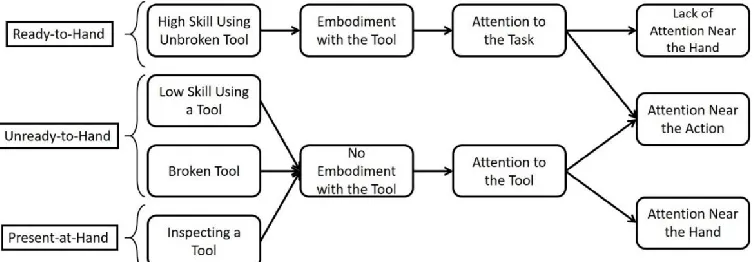
Heidegger [17] described people’s interactions with the world as skillful manipulation of the environment that con-sists of three states: ready-to-hand, unready-to-hand, and present-at-hand. Unready-to-hand describes when the tool is not functional or not working properly; attention will be fo-cused on the tool and not the task at hand. Present-at-hand describes a state where the user observes characteristics of the tool or the object like its color or shape. Finally, ready-to-hand describes when a tool becomes “invisible” during an action. This effect of invisibility shifts the user’s attention from the tool to the task at hand.
In our framework (Figure 1), we constructed a process that identifies specific elements of readiness-to-hand. We start with skillful use of a tool (Figure 1, top path), which lets the tool be integrated into the body schema, leading to tool em-bodiment. At this point, attention will be concentrated on the task, leading to a lack of attention near the hand. If a person has difficulty using a tool (e.g., due to low skill, broken tool, or tool inspection), it will not be integrated into the body schema (Figure 1, bottom paths), leading to more attention dedicated to the tool rather than the task at hand. This shift in attention is our primary indicator of tool embodiment. To measure attentional shift, we divided the tool into two sections: near the hand and near the action. When a person is performing a skillful action with the tool (i.e., ready-to-hand), attention is directed toward the task and away from
the tool. More specifically, this would lead to a lack of atten-tion near the hand (e.g., the handle of a hammer) and more attention near the action (e.g., the nail being hammered). Attentional shift from near the hand to near the action is cen-tral in understanding how interacting with a tool affects peo-ple’s perception. Previous work [1,35,36] has reported that attention near the hand is stronger when a tool or the hand is held stationary. So, if attention is shifted from near the hand to near the action that means that the process of mastering the tool has affected how attention is allocated. Winograd and Flores [45], for example, discuss how anticipation of breakdowns is imperative in the design process, as they lead to attention shifting to the interface, rather than the task at hand. Previous work, however, has not included situations where a tool is used to manipulate other objects in the envi-ronment. Our work concentrates primarily on how attention is affected during skillful use of the tool, which could indi-cate a ready-to-hand state as proposed by Heidegger [17], Dourish [6], and Winograd and Flores [45].
To verify the effects of tool embodiment and to test our framework we conducted a study using two main tool types: physical and virtual. We considered readiness-to-hand as a main indicator of tool embodiment where attention is shifted from near the hand to near the action.
STUDY DESIGN
In this study, we explore the effect of attentional shift when using both physical and virtual tools. More specifically, we concentrate on the difference between near-hand attention and near-action attention, as described in the tool embodi-ment framework (Figure 1).
Apparatus
For this study, we wanted to be able to compare two similar tools, and so created a physical and virtual version of a “wrench” tool and a “bolt” to be twisted, which were both usable on a two-dimensional surface.
[image:3.612.119.496.61.192.2]Physical Tool. The physical tool consists of several layers of cardboard foam (Figure 2b) and is similar in appearance to a monkey wrench (gas grips), but is not adjustable. The tool had two holes for the index finger and thumb to be able to move and rotate the “wrench” to fit over a square piece of Figure 1. Tool embodiment framework that decomposes the three states of interacting with a tool as proposed by Heidegger
cardboard on a pin that allows it to swivel (Figure 3), which represented a bolt.
As shown in Figure 4, two screens were used in both condi-tions. In the physical setup, we created a mock screen from cardboard foam that was firmly situated on top of a regular screen. In order to present stimuli on the tool, wired lights (Flora RGB Smart NeoPixel v2) and wires were placed in the middle layer of the tool and controlled by an Arduino board. Virtual Tool. In the virtual setup (Figure 2c), we mirrored the physical setup as closely as possible, using white circles to represent the holes for the index finger and thumb, which could be used to move and rotate the tool to fit over a virtual white square representing the “bolt” that could only rotate. The virtual tool and object were developed in Processing us-ing Java. Procesus-ing2D was used as a physics engine to take touch input and simulate movements of the tool and the ob-ject. The Simple Multitouch Toolkit1 was used to record
touch points and enable touch interactions.
Screen Setup. Two 21 inch screens were placed on a 120 cm × 60 cm table (Figure 4). The table’s surface was 65 cm above the floor. Participants were seated on a chair where it was most comfortable for them to interact with screen 1 (Fig-ure 4, a and c). Screen 1 was used to interact with either a physical or virtual tool and screen 2 provided feedback about the task. Screen 1 was placed horizontally and screen 2 was placed vertically. A keyboard was also available on the table for participants to provide input.
Task
We introduced a novel task of using either a virtual or phys-ical tool in nearly similar conditions. Participants were asked to complete a primary spelling task and a secondary stimulus task during the experiment. The primary task was intended to be the focus of attention, with the secondary task as a means to measure shifts in attention.
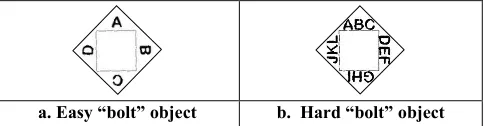
Primary Spelling Task. Participants were asked to use either a virtual (Figure 2b) or physical (Figure 2c) tool to rotate a square “bolt” object (Figure 3) until a target letter was facing upward (only clockwise rotations were allowed). In the easy
1 (http://vialab.science.uoit.ca/smt/)
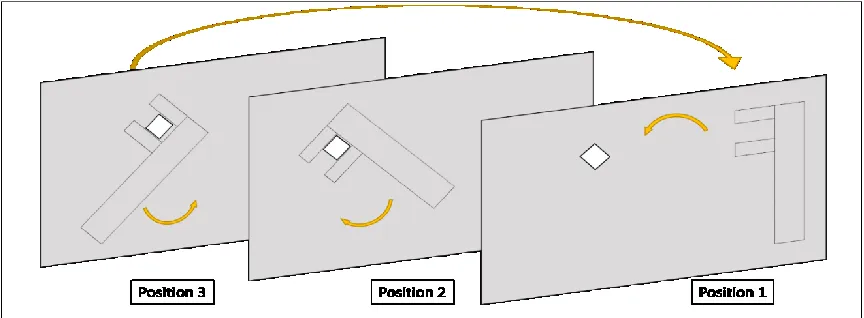
condition, the square object had 4 letters located on each cor-ner (Figure 3a) and participants were always asked to go to the “next” letter (i.e., one clockwise rotation). In the hard condition, the object had 12 letters, 3 on each corner (Figure 3b), and participants were asked to spell a four-letter word, so the next letter was determined by the next letter in that word. After each letter, participants would return to the start-ing position. Thus, as shown in Figure 5, to complete an easy task the sequence was: Position 1, Position 2, Position 3, and return to Position 1 (starting point). To complete a hard task, the sequence always started in Position 1, then had one or more repetitions of Position 2, Position 3 (to get to the right letter), before returning to Position 1 (to indicate that letter was selected).
The second (vertical) screen showed the target letter/word and, in the hard condition, a green dot was used to indicate the current letter (Figure 4b). This feedback was initiated by the experimenter, who would press a button to advance when the participant returned to position 1. In the hard task, when the required letter was already facing up (e.g., when going from “A” to “B” in “ABLE”), participants were asked to make a full rotation of the object (4 rotations). The words used in the study were: ache, bail, bike, chef, dice, file, gild, held, idle, leak (physical condition); and able, back, bide, cage, deal, face, glad, half, idea, lack (virtual condition). Participants were instructed to complete as many spelling tasks (letters/words) as they could in a 432 second interval. Secondary Stimulus Task. Participants had to report any change that occurred on the tool (Figure 2) while completing the primary task. Both tools had 8 coloured circles/lights di-vided into near-the-hand and near-the-action sections (Figure 2a)—this division was not known to participants. Partici-pants were instructed to report any changes on the tool
re-(a) (b) (c)
Figure 2. (a) The secondary task stimuli: near the hand and near the action, on (b) the physical tool, and (c) the virtual tool.
[image:4.612.83.528.61.203.2] [image:4.612.319.562.645.708.2]gardless of location. Half of the circles/lights (randomly se-lected) were a lighter purple colour and the other half a darker purple colour. The experimental system creates a change by shifting the colour from lighter to darker or vice versa. Changes took place 6 seconds apart, and only one change happened at a time. Participants were only aware that changes would occur (not how many, when, or where), and they were instructed to report changes that they noticed as soon as possible by pressing the space bar and then typing the number of the changed light and then “enter” to resume the letter/word completion task. In each condition, 36 near-hand stimuli and 36 near-task stimuli were changed (2 × 36 × 6 seconds = 432 seconds). Pressing space to report the change also paused the primary task timer.
Procedure
The experiment follows a within-participants design with two factors: tool type (physical vs. virtual) and task difficulty (easy vs. hard). We counterbalanced first by tool type, then by difficulty and so participants were assigned to one of four orders and either performed all physical trials first (both easy and hard), or all virtual trials first (both easy and hard). Fig-ure 6 shows one of four orders used by participants. A third random factor of location was also used in our analysis, but not controlled for in the study procedure.
Start (S). After participants were seated, study details were explained. Participants were reminded of the procedure after finishing each condition and wherever they needed help. Ishihara Color Blindness Test (I). Participants then com-pleted the Ishihara Color Blindness Test [20].
Tool Training (ToT). Participants were then given 10 minutes to interact with a physical (Figure 2b) or virtual tool (Figure 2c). Each participant was instructed to use their thumb and index fingers in the holes on the wrench-like tool (Figure 2) to rotate a square bolt-like object (Figure 3). Task Training (TT). Participants were given 2 minutes to use the tool and practice the main task (VE, VH, PE, PH). Virtual Condition (VE and VH). Participants interacted with a virtual tool (Figure 2c) to accomplish either an easy (VE) or hard (VH) task.
S/I
Virtual
B
Physical ToT
Easy Hard
ToT
Easy Hard
[image:5.612.57.557.55.209.2]TT VE TT VH TT PE TT PH
Figure 6. The order of trials was counterbalanced first by tool type (virtual/physical) and then by difficulty (easy/hard). This figure shows the order (1 of 4) with virtual-easy (VE) first, and
the actual tasks are highlighted in orange (VE, VH, PE, PH).
(a) (b) (c)
Figure 4. (a) The physical study setup with a participant holding the physical tool. (b) The second screen for the primary task. (c) The virtual study set up with the participants holding a virtual tool.
[image:5.612.90.522.541.700.2]Physical Condition (PE and PH). Participants were asked to interact with a physical tool (Figure 2b) to accomplish either an easy (PE) task or a hard (PH) task.
Break (B). Participants were asked if they needed a break. Although breaks at any time were allowed, longer breaks were more common (3-5 min) for a few participants. Participants
Thirty-two participants (16 female) aged 18 to 31 (Mdn = 22) took part in our study. Participants were screened for hand-edness (all reported to be right-handed), color-blindness (all passed the Ishihara Color Blindness Test [20]), and English proficiency (self-rating from 1-10; M=8.7). Participants were recruited via on-campus mailing lists, and given $15 gift cer-tificates to a local coffee establishment.
Measures
For the primary spelling task, the experimenter manually rec-orded task completion time and number of tasks completed. The number of rotations required to complete the task was computed using the letter sequence. For the secondary stim-ulus task, attentional shift was measured based on reported changes noticed by participants. A percentage of missed stimuli was used for study analysis (recorded separately for near the hand and near the action). We also recorded the tim-ing between stimuli presentation and space bar presses. Hypotheses
Our study is designed to identify an attentional shift from the tool being used toward the task being done, and so our pri-mary hypothesis is as follows:
H1: Participants will experience tool embodiment with both physical and virtual tools, which will lead to attentional shift in the secondary task from stimuli presented near the hand to stimuli presented near the primary task (the action). This ef-fect will lead to more missed stimuli and longer reaction times in the secondary task for stimuli near the hand. Based on this attentional shift, we can further investigate the degree of embodiment by looking at the size of the difference between what happens near the hand vs. near the action. Thus, our secondary hypotheses relate to the size of this at-tentional shift, measured by the difference in number of lights missed and reaction times near the hand vs. action: H2: As difficulty of the primary (spelling) task increases, participants will become more embodied with the tool, and therefore have a larger attentional shift. We expect the shift in this direction because the difficulty is cognitive and re-quires focus on the task, and no complex manipulations (e.g., as might be seen in skilled use of a musical instrument). H3: Due to its tangible, physical nature, participants will be more embodied with the physical tool and therefore have a larger attentional shift with the physical tool than the virtual. We also had a hypothesis for our primary task measure: H4: Due to being tangible/physical, we expect performance to be better when using the physical tool than the virtual one.
Study Design Decisions
As this is a first attempt to operationalize tool embodiment, a number of study design decisions we made could be ad-justed or tweaked in future studies that build on our work. In particular, our definition of tool embodiment relies on skilled use of a tool, which is difficult to replicate in a lab. We intentionally chose a wrench-like tool as we expected it to be familiar for participants so that minimal practice could lead to skilled use. We were required to make some modifi-cations to make it work in 2D for a touch-based interface, but these modifications were intended to mimic physical-like in-teraction to again be familiar. Similarly, in order to provide visual stimuli, we needed to augment and tether the physical tool, but made efforts to minimize any discomfort by having the cord be mostly hidden and lightweight. This also had the consequence that visual stimuli “near the action” were still on the tool itself, but we were careful to make stimuli at this part of the tool always be closer to the action, and therefore more likely to lead to measurable attentional shift.
RESULTS & DISCUSSION
Because the measure of primary interest in our study was the comparison between what happened near the hand and near the action in the secondary stimulus task, we report these findings first. We then report findings of the primary spelling task, followed by a correlational analysis between the num-ber of rotations in the primary task and the overall numnum-ber of missed lights in each task.
Secondary Stimulus Task
For secondary task measures (missed changes, reaction time), we performed a repeated-measures ANOVA with tool type (physical vs. virtual), difficulty (easy vs. hard), and lo-cation (near hand vs. near action) as within-participants fac-tors. We also included order as a between participants factor to enable further investigation of order effects. Bonferroni corrections were used in all post-hoc analyses.
Missed Changes
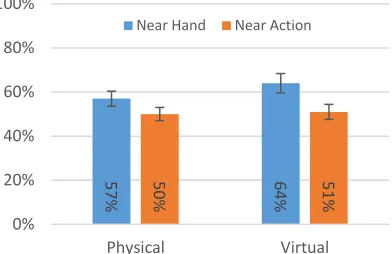
There was a significant main effect of location (𝐹1,28 = 22.9, 𝑝 < .001, 𝜂𝑝2 = .45), with participants missing more near the hand (𝑀 = 60.7%, 𝑆𝐸 = 3.7%), than near the action (𝑀 = 50.4%, 𝑆𝐸 = 3.1%). This finding supports the presence of attentional shift throughout all conditions (H1).
had similar-sized attentional shifts (i.e., differences between near-hand and near-action means), and the change in atten-tional shift is only larger for the virtual tool in the easy con-dition. We expect this is because the virtual tool generally required more effort, and so even in the easy condition, par-ticipants were more embodied with the tool (i.e., had to pay more attention to the primary task). Nonetheless, we cannot confirm H3 (larger attentional shift for physical), but this finding does provide partial support for H2 (larger attentional shift for difficult primary tasks).
There was also a significant main effect of difficulty (𝐹1,28 = 26.1, 𝑝 < .001, 𝜂𝑝2 = .48), with participants missing fewer stimuli in easy (𝑀 = 52.3%, 𝑆𝐸 = 3.4%) than in hard tasks (𝑀 = 58.8%, 𝑆𝐸 = 3.2%). This finding is unsurprising given the pattern of missed changes in the 3-way interaction, but may indicate that cognitive load was lower, leading to fewer missed lights. There were no other significant main ef-fects or interactions. In particular, there was no main effect of order, nor interactions that involved the order factor.
Reaction Time
There was a significant main effect of location (𝐹1,27 = 7.2, 𝑝 = .01, 𝜂𝑝2 = .21), as participants were slower to report changes that occurred near the hand (𝑀 = 2.16 s, 𝑆𝐸 = 0.09 s) than near the action (𝑀 = 1.93 s, 𝑆𝐸 = 0.09 s). This finding again supports the presence of attentional shift (H1). There was also a significant main effect of tool type (𝐹1,27 = 6.7, 𝑝 = .02, 𝜂𝑝2 = .20), with participants taking longer to report the stimuli in the virtual condition (𝑀 = 2.17 s, 𝑆𝐸 = 0.09 s) than in the physical condition (𝑀 = 1.92 s, 𝑆𝐸 = 0.10 s). This may again indicate that there was higher cognitive load in the virtual condition, but there were no other significant main effects or interactions (except with order, discussed below), and so this increased reaction time did not depend on whether the lights were near the hand or near the action, and thus there is no support for H2 or H3 from the reaction time analysis.
There was a significant interaction between tool type and or-der (𝐹3,27 = 3.4, 𝑝 = .03, 𝜂𝑝2 = .27). Pairwise comparisons re-vealed that, with the virtual tool, orders 2 (𝑀 = 2.5 s, 𝑆𝐸 = 0.2 s) and 3 (𝑀 = 2.6 s, 𝑆𝐸 = 0.2 s) had significantly higher reaction times than orders 1 and 4 (𝑝 < .05), but no
other pairs of orders were different (𝑝 > .99). Moreover, or-ders 1 and 4 in the virtual condition and all oror-ders in the phys-ical condition were in the range 1.8 s-2.0 s, and so it is likely orders 2 and 3 which were anomalous, and only for virtual-tool reaction times. The only pattern we can discern for these two orders is that order 2 began with virtual-hard and order 3 ended with virtual-hard, and so this particular condition may have had higher reaction times due to being either first or last. We don’t expect that this effect influenced our find-ings about location differences, but may influence reaction time findings regarding tool type, although these were al-ready inconclusive (H2 and H3 are still not supported). Primary Spelling Task
We also analyzed measures from our primary spelling task using the same RM-ANOVA, without the location factor. Since participants completed as many tasks as they could in a fixed time, the number of tasks completed and task com-pletion time are perfectly correlated. Consequently, we pre-sent findings for number of tasks only. Bonferroni correc-tions were used for post-hoc analyses.
Number of Tasks Completed
There was a significant main effect of tool type
(𝐹1,28 = 220.7, 𝑝 < .001, 𝜂𝑝2 = .89), with participants in the
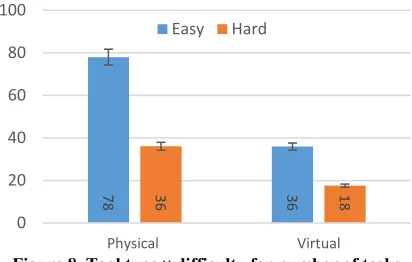
[image:7.612.326.547.48.192.2]virtual condition completing fewer tasks (𝑀 = 26.7, 𝑆𝐸 = 1.1) than in the physical condition (𝑀 = 57.2, 𝑆𝐸 = 2.7), suggesting higher performance in the physical condition (H4). The main effect of difficulty was also unsurprisingly significant (𝐹1,28 = 316.1, 𝑝 < .001, 𝜂𝑝2 = .92), with partici-pants completing more tasks in the easy condition (𝑀 = 57.1, 𝑆𝐸 = 2.5) than in the hard condition (𝑀 = 26.8, 𝑆𝐸 = 1.1). There was a significant interaction between tool type and dif-ficulty (𝐹1,28 = 144.0, 𝑝 < .001, 𝜂𝑝2 = .84). Post-hoc analyses revealed pairwise significant differences between number of tasks for easy and hard conditions for both tool types (𝑝 < .05); inspection (Figure 8) reveals that the difference was smaller for the virtual tool (18) than the physical one (42). This interaction also suggests that performance was better in the physical condition (H4).
Figure 8. Tool type × difficulty × location interaction for missed lights. Participants missed more lights near the hand in
all but the physical-easy (PE) condition. Figure 7. Tool type × location interaction for missed lights.
This result indicates the strength of the attentional shift.
51% 48% 63% 52% 62% 48% 66% 54%
0% 20% 40% 60% 80% 100%
Easy Hard Easy Hard
Physical Virtual
Near Hand Near Action
57% 50% 64% 51%
0% 20% 40% 60% 80% 100%
Physical Virtual
[image:7.612.70.266.49.176.2]There was a significant interaction between difficulty and or-der (𝐹1,28 = 11.8, 𝑝 < .001, 𝜂𝑝2 = .56). Post-hoc analysis re-vealed that the only pairwise differences were between or-ders 1 and 4 in the easy condition (p = .048) and oror-ders 2 and 3 in the hard condition (p = .04). This effect again seems to be related to when the virtual condition occurs, with the dif-ferences being exacerbated when the virtual easy is first (or-der 1) vs. last (or(or-der 4) or when the virtual hard is first (or(or-der 2) vs. last (order 3). This order effect is consistent with our hypothesis that people would perform better in the physical condition, and does not interfere with our main findings. Object Rotation Analysis
Due to the nature of our task, the number of tasks completed can be further dissected into the number of rotations per-formed within each task (i.e., to get to the subsequent se-quence of letters—1 rotation per easy task, 𝑀 = 9 rotations per hard task). Since the conditions were time-limited, the total number of rotations performed over the duration of each condition is an indication of how engaged participants were with the task. We suspected that this would be related more directly to how embodied they were with the tool, so we con-ducted a further correlational analysis using number of rota-tions as a measure, and compared this to the number of lights missed overall in the secondary task to see if there was a con-nection between this measure and attention. There was a pos-itive correlation between object rotations (𝑀 = 248.4, 𝑆𝐷 = 55.7) and total missed changes (𝑀 = 160.0, 𝑆𝐷 = 15.5), 𝑟 = .52, 𝑝 = .002, 𝑛 = 32, as shown in Figure 9.
This relationship indicates that participants tend to miss more lights as the number of rotations they complete in the primary task increases (note that there were exactly 288 light changes for each participant, as these happened at regular intervals in a fixed time interval). Because the number of rotations only relates to the primary task, it is not possible to identify a re-lationship between increased rotations and lights missed spe-cifically near the hand (to indicate attentional shift); how-ever, this finding does suggest that higher engagement may be related to attentional changes in general.
GENERAL DISCUSSION
A summary of our findings is as follows:
Overall, there were more missed lights and reaction times were higher near the hand than near the action for both
virtual and physical tools, indicating an attentional shift predicted by our framework (H1).
We expected difficult tasks to lead to a greater shift in attention (H2); however, only the physical tool followed this pattern.
We expected the physical tool to lead to a greater atten-tional shift (H3); however, this hypothesis was com-pletely unsupported, and instead, the difficulty imposed by the virtual tool led to more attentional shift even in the easy condition.
Participants performed (expectedly) better with the phys-ical tool than the virtual one.
There was a correlation between number of rotations (as a measure of engagement) and the number of lights missed, indicating a connection between engage-ment/performance and attention.
Our study provides support for the framework we have de-scribed in this paper, which we believe can be used as a new measure of tool embodiment. In particular, the paradigm we have described in this study of having a primary task with a secondary attention task can allow for the measurement of attentional shift in novel interaction techniques.
Of particular note is that our study indicated a clear perfor-mance difference between physical and virtual tools, and without our additional attentional shift measure, an experi-menter may be tempted to conclude that the virtual tool is less “intuitive” or “natural”. Our attentional shift measure can therefore augment these findings, and provides evidence that tool embodiment occurs with both. Furthermore, inter-actions between tool type × difficulty × location can help elu-cidate these performance findings and demonstrates a more nuanced story that can help explain that the virtual tool re-quires more cognitive resources, despite still providing a high level of tool embodiment.
[image:8.612.70.276.65.196.2] [image:8.612.332.539.65.202.2]To our knowledge, this work is the first to directly measure attention as evidence of Heidegger’s readiness-to-hand phe-nomenon using both physical and virtual tools. Other studies have identified Heidegger’s readiness-to-hand phenomenon using a mouse [5], in which the mouse controls a pointer on Figure 8. Tool type × difficulty for number of tasks.
Figure 9. A positive correlation between the number of rota-tions and missed lights. This result indicates how engaged
par-ticipants were with the task.
78 36 36 18
0 20 40 60 80 100
Physical Virtual
Easy Hard
0 50 100 150 200 250 300
0 100 200 300 400
M
iss
ed
Li
ght
s
the screen, but failed to link the tool directly to the person interacting with it. Our results show a direct link between tool use and being ready-to-hand, where attentional shift was observed in both physical and virtual tools.
Framework Implications for HCI
Our framework can be used to compare interactive technol-ogies as a measure of readiness-to-hand. In our study, we used direct touch and tangible interaction to manipulate the tool, but other interactive technologies could be tested in a similar way. In particular, our framework can be applied as a measure with the following elements:
The tool: a tool is an essential part of our framework. In our framework, this tool must act as an intermediary be-tween a person and the task in some way (e.g., a wrench, hammer, etc.)
The action: just holding a tool in one’s hand will not af-fect attentional shift. A tool must be used skillfully to measure attentional shift.
The stimuli: visual stimuli on the tool and near the action are also required. We recommend augmenting the tool with these stimuli in clearly separate locations, but a sim-ilar setup could also augment the “bolt” in our study with stimuli to determine attention near the action.
Limitations and Future Work
While our study provides some of the first evidence that tool embodiment can be measured independently from task per-formance, we present only two instances of a tool. Further studies could help to corroborate these findings and support more nuanced analysis involving differences in attentional shift between vastly different tool types. Moreover, tools could be tested under different circumstances, such as inten-tional tool malfunctioning, to paint a more complete picture of measures of unreadiness-to-hand and present-at-hand. The wrench-like tool used in our study was specifically de-signed to target our definition of tool embodiment—a deci-sion we took to demonstrate the utility of our framework— but future work should look at existing digital interaction techniques that leverage tools, such as pen interaction, wear-able/spatial interaction [16], multi-touch techniques [13,14] or menus [11,25]. Even with direct manipulation (e.g., pinch-to-zoom on a map), it may be worth considering attentional shift between the points of contact and the point of interest. Similarly, our protocol currently requires that a tool be aug-mented with stimuli (e.g., lights), which may prove difficult for small tools, so future work could consider other measures, such as eye tracking, to measure attention. This measure would also avoid any issues of occlusion, which in our study was not possible to measure, though we intention-ally placed lights to avoid occlusion, and the experimenter did not observe any specific instances of occlusion.
As mentioned above, our framework also relies on skilled use, which can be difficult to replicate in a lab setting. While our work focused on already-familiar wrench-like interac-tion, future work could explore more longitudinal use.
CONCLUSION
This paper presented a study that measures readiness-to-hand with different tools (physical and virtual). Results showed that participants’ attention shifts from the tool to the task at hand, indicating that they experienced tool embodiment us-ing both. We highlight how this tool embodiment framework can be applied to different technologies moving forward. ACKNOWLEDGEMENTS
We thank the Ontario Ministry of Research and Innovation and Science and the Natural Sciences and Engineering Re-search Council of Canada for funding.
REFERENCES
1. Abrams, R.A., Davoli, C.C., Du, F., Knapp, W.H. and Paull, D. Altered vision near the hands. Cognition. 107, 3 (2008), 1035–1047.
2. Auvray, M., Gallace, A., Tan, H.Z. and Spence, C. Crossmodal change blindness between vision and touch. Acta Psychologica 126, 2 (2007), 79–97.
3. Blackler, A. L., & Hurtienne, J. Towards a unified view of intuitive interaction: definitions, models and tools across the world. MMI-interaktiv, (2007), 36-54. 4. Cardinali, L., Frassinetti, F., Brozzoli, C., Urquizar, C.,
Roy, A. C., Farnè, A. Tool-use induces morphological updating of the body schema. Current Biology 19, 12 (2009), R478–R479.
5. Dotov, D.G., Nie, L. and Chemero, A. A demonstration of the transition from ready-to-hand to unready-to-hand. PLoS One. 5, 3 (2010), e9433. [7]
6. Dourish, P. Where the Action Is: The Foundations of Embodied Interaction. MIT Press, 2001.
7. Gibbs Jr, R.W. Embodiment and cognitive science. Cambridge University Press, 2005. PP66
8. Gibson, J.J. Observations on active touch. Psychological review 69, 6 (1962), 477–491.
9. Gibson, J.J. 2014. The ecological approach to visual perception: classic edition. Psychology Press 2014. 10.Gibson, J.J. and Backlund, F.A. An after-effect in haptic
space perception. Quart. J. Exp. Psychol 15, 3 (1963), 145–154.
11.Guimbretiére, F. Winograd, T. FlowMenu: combining command, text, and data entry. In Proc. UIST, ACM Press (2000), 213-216.
12.Grandhi, S. A., Joue, G., & Mittelberg, I. Understanding naturalness and intuitiveness in gesture production: in-sights for touchless gestural interfaces. In Proc. CHI 2011, ACM Press (2011) 821-824.
13.Hancock, M., Ten Cate, T. and Carpendale, S. Sticky tools: full 6DOF force-based interaction for multi-touch tables. In Proc. ITS 2009, ACM Press (2009), 133–140. 14.Hancock, M.S., Vernier, F.D., Wigdor, D., Carpendale,
tabletop interaction. In Horizontal Interactive Human-Computer Systems, TableTop (2006), 8–pp.
15.Hansen, L. K., and Dalsgaard, P. Note to self: stop call-ing interfaces natural. In Proc. AA 2015, ACM Press (2015), 65-68.
16.Harrison, C., Benko, H. and Wilson, A.D. OmniTouch: wearable multitouch interaction everywhere. In Proc. UIST 2012, ACM Press (2012), 441–450.
17.Heidegger, M. Being and time: A translation of Sein und Zeit. Suny Press, 1996.
18.Hespanhol, L., Tomitsch, M., Grace, K., Collins, A., & Kay, J. (2012, June). Investigating intuitiveness and ef-fectiveness of gestures for free spatial interaction with large displays. In Proc. PerDis 2014, ACM Press (2014).
19.Ingram, A., Wang, X. and Ribarsky, W. Towards the es-tablishment of a framework for intuitive multi-touch in-teraction design. In Proc. AVI 2012, ACM Press (2012), 66–73.
20.Ishihara, S. series of plates designed as tests for colour-blindness. (1936).
21.Ishii, H. Tangible user interfaces. CRC Press, 2007. 22.Ishii, H. The tangible user interface and its evolution.
Communications of the ACM. 51, 6 (2008), 32–36. 23.Janssen, C. What is Skeuomorphism? Available:
http://www.techopedia.com/definition/28955/skeu-omorphism. Last retrieved: Jan 2014.
24.Jensen, M.S., Yao, R., Street, W.N. and Simons, D.J. Change blindness and inattentional blindness. Wiley In-terdisciplinary Reviews: Cognitive Science 2, 5 (2011), 529–546.
25.Leithinger, D. and Haller, M. Improving menu interac-tion for cluttered tabletop setups with user-drawn path menus. TABLETOP (2007), 121–128.
26.Maravita, A. and Iriki, A. Tools for the body (schema). TRENDS in Cognitive Sciences 8, 2 (2004), 79-86. 27.McDonnell, P.M., Scott, R.N., Dickison, J., Theriault,
R.A., Wood, B. Do artificial limbs become part of the user? New evidence. Journal of Rehabilitation Research and Development 26, 2 (1989), 17-24.
28.Morris, M.R., Wobbrock, J.O. and Wilson, A.D. Under-standing users’ preferences for surface gestures. In Proc. GI, (2010), 261–268.
29.Mikulecky, K., Hancock, M., Brosz, J. and Carpendale, S. Exploring physical information cloth on a multitouch table. In Proc. ITS, ACM Press (2011), 140–149. 30.Milgram, P., Takemura, H., Utsumi, A. and Kishino, F.
Augmented reality: A class of displays on the reality-virtuality continuum. In Photonics for industrial appli-cations (1995), 282–292.
31.Nielsen, M., Störring, M., Moeslund, T. B., & Granum, E. A procedure for developing intuitive and ergonomic gesture interfaces for HCI. In International gesture workshop (2003), 409-420.
32.Norman, D. The design of everyday things: Revised and expanded edition. Basic Books (AZ), 2013.
33.O’Regan, J.K. What it is like to see: A sensorimotor the-ory of perceptual experience. Synthese 129, 1 (2001), 79–103.
34.O’Regan, J.K., Rensink, R.A. and Clark, J.J. Change-blindness as a result of “mudsplashes.” Nature 398, 6722 (1999), 34–34.
35.Reed, C.L., Betz, R., Garza, J.P. and Roberts, R.J. Grab it! Biased attention in functional hand and tool space. Attention, Perception, & Psychophysics 72, 1 (2010), 236–245.
36.Reed, C.L., Grubb, J.D. and Steele, C. Hands up: atten-tional prioritization of space near the hand. Journal of Experimental Psychology: Human Perception and Per-formance 32, 1 (2006), 166.
37.Rensink, R.A., O’Regan, J.K. and Clark, J.J. To see or not to see: The need for attention to perceive changes in scenes. Psychological science 8, 5 (1997), 368–373. 38.Rheingold, H. Virtual Reality: Exploring the Brave New
Technologies. Simon & Schuster Adult Publishing Group, 1991.
39.Ryall, K., Forlines, C., Shen, C. and Morris, M.R. Ex-ploring the effects of group size and table size on inter-actions with tabletop shared-display groupware. In Proc. CSCW, ACM Press (2004), 284–293.
40.Simons, D.J. and Levin, D.T. Failure to detect changes to people during a real-world interaction. Psychonomic Bulletin & Review 5, 4 (1998), 644–649.
41.Tractinsky, N. The Usability Construct: A Dead End? In Human-Computer Interaction (2017), 1-47.
42.Watson, D., Hancock, M., Mandryk, R.L. and Birk, M. 2013. Deconstructing the touch experience. In Proc. ITS 2013, ACM Press (2013), 199–208.
43.Wigdor, D., Shen, C., Forlines, C. and Balakrishnan, R. Perception of elementary graphical elements in tabletop and multi-surface environments. In Proc. CHI 2007, ACM Press (2007), 473–482.
44.Wigdor, D. and Wixon, D. Brave NUI world: designing natural user interfaces for touch and gesture. Elsevier, 2011.
45.Winograd, T. and Flores, F. Understanding Computers and Cognition: A New Foundation for Design, Intellect Books, 1986.