Maximising spanning subtree scores for parsing tree approximations of
semantic dependency digraphs
Natalie Schluter
Center for Language Technology University of Copenhagen
Abstract
We present a method for finding the best tree approximation parse of a dependency digraph for a given sentence, with respect to a dataset of semantic digraphs as a com-putationally efficient and accurate alterna-tive to DAG parsing. We present a training algorithm that learns the spanning subtree parses with the highest scores with respect to the data, and consider the output of this algorithm a description of the best tree approximations for digraphs of sentences from similar data. With the results from this approach, we acquire some important insights on the limits of solely data-driven tree approximation approaches to seman-tic dependency DAG parsing, and their rule-based, pre-processed tree approxima-tion counterparts.
1 Introduction
In semantic dependency parsing, the aim is to recover sentence-internal predicate argument re-lationships; structurally speaking, given a sen-tence, the objective is to recover the possibly dis-connected digraph (which represents the semantic structure of the sentence). The sparsity of digraph representations of some semantic dependency di-graph datasets (i.e., the fact that the number of edges is linear in the number of vertices), as well as the well-performing first attempts at such tree approximations from Schluter et al. (2014), Agi´c and Koller (2014), and Agi´c et al. (2015) sug-gest that tree approximations for digraph seman-tic dependency structures are a relevant avenue to the development if not the sidestepping of some computationally harder models of directed acyclic
graph (DAG) and digraph decoding (McDonald and Pereira, 2006; Martins and Almeida, 2014).
In this paper, we present a simple adaptation of the passive-aggressive perceptron training algo-rithm used in (Crammer et al., 2006; Bj¨orkelund et al., 2009) to the task of finding the parameters that describe the highest scoring tree approximations of semantic dependency digraphs, given a training corpus. The key change in the algorithm is to it-eratively minimise the error in precision between output spanning subtrees and corresponding train-ing digraph instances, allowtrain-ing therefore the algo-rithm to choose best spanning subtree approxima-tions with respect to the dataset, rather than form-ing tree approximations as a pre-processform-ing step to training as was done by Schluter et al. (2014), Agi´c and Koller (2014), and Agi´c et al. (2015).
Because we directly adapt the software used by (Bj¨orkelund et al., 2009), without increasing any computational complexity, the approach also ben-efits from a syntactic parsing algorithm optimised both practically and theoretically for efficiency, robustness, and accuracy. Supposing these natu-ral tree patterns exist in the data, the approach in-tuitively is very attractive, since it lets natural pat-terns of the data dictate tree approximations, rather than depending on either the previous knowledge of parser behaviour or anecdotal linguistic knowl-edge. Moreover, the approach promises some in-sight into the nature of the patterns inherent in the semantic digraph data, reflecting, namely, the question of the existence of unique most likely sub-tree structures in the data and why rule-based pre-processing tree approximations work so well for semantic digraph dependency parsing.
2 Previous work and motivation
In the context of the SemEval task 8 on Broad Coverage Semantic Dependency Parsing, Schluter et al. (2014) and Agi´c and Koller (2014) introduce a tree approximation definition for the semantic dependency parsing task, including a number of different approaches. Both present similar prun-ing pre-processprun-ing steps as a potential approach. Additionally, Schluter et al. (2014) present a pack-ing pre-processpack-ing step as a further approach. We discuss the approaches presented in (Schluter et al., 2014), because we adopt the parts of their pre-processing which do not remove any edges. Their approaches also outperformed that of (Agi´c and Koller, 2014) in the SemEval task.
In (Schluter et al., 2014), all digraphs were first transformed into rooted DAGs (that is, with a sin-gle root, from which all nodes are reachable), fol-lowing which the authors experimented with creat-ing the tree approximations for each of the traincreat-ing set digraphs individually as follows.
In their first approach, (Schluter et al., 2014) consider underlying undirected cycles of digraphs andprunedthese digraphs by removing from the cycle the longest edge from the node with the fewest predecessors (lowest depth) in the digraph. In their second approach, they attempt to store almost all digraph information into the graph, bypackingparallel path information, structurally corresponding to long-distance dependency re-entrancies, into a single complex edge label; these removed edges can then recovered as a post-processing step, by “expanding” the complex edge label. However, not all parallel path sets between two nodes include a path of length 1 edge; for these, an heuristic approach was taken whereby only the edge of shortest span from among all of the last edges of these paths was retained.
The result from both these approaches were trees that were used as tree approximations to training set digraphs, individually. The packing approach suffered from complex edge labels with low frequency in the training set, and which could not always be resolved fully in post-processing at test-time; as a result, this approach had relatively stable precision and recall (with respect to each other), but with lower precision than the pruning approach, which achieved high precision, but low recall. Upon carrying out this research, we posited that the lower recall of the pruning approach was caused by not accounting for the tree
approxima-tions with respect to the entire dataset, rather only with respect to a structural heuristic on individual digraphs of the training set.
The motivation for this work is therefore an at-tempt to attain similar precision to the pruning ap-proach in (Schluter et al., 2014), with similar re-call to the same authors’ packing approach, by only pruning edges, but leaving it to the parser to determine, given the training data, which edges should be pruned. The sparsity of the graphs in all three datasets (Cf. Section 4) as well as the dispar-ity in precision and recall between the approaches in (Schluter et al., 2014) (Cf. Section 5) suggests that there is room for improvement in tree approx-imation approaches to semantic dependency pars-ing for these particular datasets.
Further improvements to the pre-processing ap-proach to tree approximation parsing of semantic digraphs has been obtained by Agi´c et al. (2015). This approach was guided by both the ideas of pruning and packing: they first present a study on the types of re-entrancies displayed by the di-graph data, to discover that many of them are predictable. Such re-entrancy information needs not be packed into other labels as it is done by (Schluter et al., 2014), as this pruning is nearly 100% reversible. These observations provide fur-ther insight into the performance of the approach presented here, given its behaviour as well as the dataset used. Indeed, persistent non-tree-like structures in the training data will inhibit training algorithms from aggressively deciding on a best tree-like substructure (Cf. Section 5).
The (non-ensemble approach) state of the art on the datasets we experiment on is achieved using a second-order model with approximate digraph de-coding via alternate directions dual decomposition (Martins and Almeida, 2014; Martins et al., 2011).
3 Finding the best maximum spanning subtree approximation
As an approximate approach to finding the best scoring semantic dependency parse digraph given a training corpus of such digraphs, we present an approach to finding the best scoring semantic de-pendency spanning subtree parse, given a training corpus of semantic dependency digraphs. That is, we adopt a second-order approach to the problem of finding the best semantic dependency parse di-graph. Our original objective was to find
D∗= arg max
wherewis a weight vector,Dis a dependency di-graph andxis the input sentence. The best depen-dency digraph is the output according to a scoring functionφD—a sum over sub-factors representing
some second-order description of the dependency structure. The parameter wis obtained by some algorithm that minimises the error defined by a distance function between digraph parse D0
i and
training digraphDi.
Our aim here is to approximate D∗ by a tree
T∗, so our objective now concerns possible trees
T ∈ T; we want to find the tree that maximises the scoring functionφT for trees,
T∗ = arg max
T∈T(x)φT(w, x, T),
whereφT is composed of second-order factors de-scribing (and, practically speaking, coincides pre-cisely with the scoring functionφfrom (Carreras, 2007)). However, we obtain the parameter wby training on a dataset of dependency digraphs and carefully minimising the error between these two very different types of structures, since a tree can never contain more than|x| −1edges and there is therefore a risk of non-convergence if the wrong error measure is chosen.
We directly adapt the mate parser (Bohnet, 2010) for this modified task. To do this, we simply adjust the unregularised passive-aggressive per-ceptron algorithm implementation used in train-ing by the parser, the averaged-perceptron version of which was presented first in (Carreras, 2007), in three key ways. First, edge features are taken from entire digraphs, rather than just trees. These features, unlike in (Martins and Almeida, 2014), do not account for multiple heads in digraphs, be-cause we need to use the scoring function on trees rather than digraphs. Secondly, the error is min-imised between the original graphs and the max-imum spanning subtree implied by w. In doing so, the algorithm finds weight vectors that min-imise the error of the tree approximation of the graph. Finally, we changed the error function from(1−recall)in the original version of the mate parser to (1−precision) to avoid punishing trees for not being digraphs in the updates, and thereby prevent non-convergence.
Algorithm 1 shows the adaptation, where an in-stance is a pair(xj, Dj)ofxj, a sentence, andDj,
a dependency digraph. The algorithm begins by initialising the weight vector w to the zero vec-tor. It then extracts the features from the
train-ing set,Z :{(xj, Dj)}Nj=1 and stores them on the
hard disk, after which training is carried out using the passive-aggressive algorithm. Iteratively, it (1) reads in the features and calculates possible edge weights, (2) decodes using the second order ex-tension of the Eisner algorithm for projective de-pendency trees (Eisner, 1996) presented in (Car-reras, 2007), and then (3) tries to find a higher scoring non-projective tree by exchanging edges out of the output from (2) using the edge weights in (1). Details for the original algorithm can be found (Bohnet, 2010); however, note that in Algo-rithm 1,Tˆis a dependency tree andDjis a
depen-dency digraph. Also, error is measured in terms of precision (for Lines 13 and 14).
Algorithm 1Training(Z) // whereZ ={(xj, yj)}N
j=1is the digraph training data
1: w←0
2: forj←1toNdo
3: extract-and-store-features(xj)
4: end for 5: fori←1toIdo
6: // whereIis the number of iterations
7: forj←1toNdo 8: k←(i−1)∗N+j
9: γ←I×N−k+ 2 // passive-aggressive weight
10: A←read-features-and-calc-arrays(j,w) 11: Tˆ←predict-projective-parse-tree(A)
12: Tˆ←non-projective-approx(T , Aˆ )
13: e←∆( ˆT , Dj) // the error
14: w←update(e, γ) 15: end for
16:end for
4 The graphs and their tree-likeness
Organisers for the SemEval task 8 on Broad Coverage Semantic Dependency Parsing (SDP) (Oepen et al., 2014) proposed three different an-notations for evaluation of the task, resulting in the three semantically annotated datasets, over the same text—that is, the Wall Street Journal section of the English Penn Treebank. As in the original task, we refer to the datasets as
DM: a transformation of Flickinger et al. (2012)’s DeepBank by Miyao et al. (2014)’s system.
PAS: the predicate-argument structures of the WSJ portion of the HPSG treebank.
PCEDT: the tectogrammatical layer of annotations from the Prague Czech-English Dependency Bank (Hajiˇc et al., 2012).
and for PCEDT it is 23.33. By removing edges from digraphs to make spanning subtrees, we thus lose at most 5.7% edges, showing the general spar-sity of digraphs in these datasets and further show-ing the relevance of the tree approximation ap-proach. Agi´c et al. (2015) calculate the average treewidth of the underlying undirected graphs of SDP digraphs, to be 1.3 for DM, 1.71 for PAS, and 1.45, for PCEDT, indicating that DAG pars-ing algorithms heavily based on the more efficient tree parsing algorithms are a promising avenue for further research.
4.1 Pre-processing the graph data
In general, the digraphs amongst three datasets are disconnected. In order for the solution of finding a most likely tree approximation to make any sense, therefore, we transformed digraphs similarly to the approach taken in (Schluter et al., 2014): (1) a dummy root node is placed to the left of the in-put, (2) the top node is connected (as a child) to the dummy root node, (3) the node of highest de-gree (=indegree + outdegree) for non-singleton remaining weakly connected components is at-tached as a child of the dummy root node, and (4) all singleton weakly connected components are connected a child of the node to the left.
In most digraphs of of the three datasets, there is not any existing spanning subtree. Therefore, we carry out flow reversal for rooted DAG con-struction as a further pre-processing step. As in (Schluter et al., 2014), we created rooted DAGs during a breadth-first search of the digraph, re-versing the direction of edges when necessary, and marking the label of reversed edges (for reversibil-ity of the transformation). So, our label sets for the three datasets may at most double, which ad-mittedly increases (by a factor of 2) instance size and therefore running time.
5 Experiments and error analysis
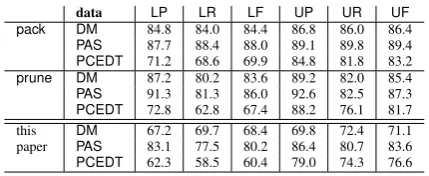
For our experiments, we used precisely the same data split as in SemEval 2014’s task 8 and the original mate parser default parameters for the modified version, with the exception that we in-creased the number of iterations to 15. The re-sults are given in Table 1. Compared with the pre-processing tree approximations from (Schluter et al., 2014), the subgraph score maximisation ap-proach performs quite poorly. The apap-proach suc-cessfully closes the gap between precision and re-call, when compared to the pruning approach in
(Schluter et al., 2014), but both precision and re-call are relatively low.
data LP LR LF UP UR UF pack DM 84.8 84.0 84.4 86.8 86.0 86.4
PAS 87.7 88.4 88.0 89.1 89.8 89.4
PCEDT 71.2 68.6 69.9 84.8 81.8 83.2
prune DM 87.2 80.2 83.6 89.2 82.0 85.4
PAS 91.3 81.3 86.0 92.6 82.5 87.3
PCEDT 72.8 62.8 67.4 88.2 76.1 81.7 this DM 67.2 69.7 68.4 69.8 72.4 71.1 paper PAS 83.1 77.5 80.2 86.4 80.7 83.6
[image:4.595.309.524.97.185.2]PCEDT 62.3 58.5 60.4 79.0 74.3 76.6
Table 1: Precision, recall and f-score over the three datasets (pack andprune results are from (Schluter et al., 2014)) .
An analysis of the pre-processing (Schluter et al., 2014; Agi´c and Koller, 2014; Agi´c et al., 2015) versus statistical (this paper) approaches may pro-vide some insight as to why. Especially Agi´c et al. (2015) show that many non-tree-like structures of the SDP data are predictable; that is, we can turn them into trees by consistently pruning edges and “understand” that they are in fact more com-plex than trees, without encoding this information into the resulting pruned tree in any way. In a post-processing step, these edges are simply re-introduced using some rules. These are edges for which it would be difficult for the passive aggres-sive algorithm that we employ to choose between, since there are virtually no structures that require only a subset of them. As a result, making a strict rule about what tree structures should be predicted as a pre-processing step results in better tree ap-proximations than the purely data-driven approach presented here.
6 Concluding remarks
References
ˇZeljko Agi´c and Alexander Koller. 2014. Pots-dam: Semantic dependency parsing by bidirectional graph-tree transformations and syntactic parsing. In
Proc of Semeval, Dublin, Ireland.
ˇZeljko Agi´c, Alexander Koller, and Stephan Oepen. 2015. Semantic dependency graph parsing using
tree approximations. InProc of IWCS, London, UK.
Anders Bj¨orkelund, Love Hafdell, and Pierre Nugues. 2009. Multilingual semantic role labeling. In
CoNLL.
Bernd Bohnet. 2010. Top accuracy and fast depen-dency parsing is not a contradiction. InProceedings of COLING, pages 89–97.
Xavier Carreras. 2007. Experiments with a
higher-order projective dependency parser. In Proc. of
CoNLL Shared Task Session of EMNLP-CoNLL, pages 957–961, Prague, Czech Republic.
Koby Crammer, Ofer Dekel, Joseph Keshet, Shai Shalev-Shwartz, and Yoram Singer. 2006. Online
passive-aggressive algorithms. JMLR, 7:551–585.
Jason Eisner. 1996. Three new probabilistic models
for dependency parsing: An exploration. In
Pro-ceedings of COLING-96, pages 340–345, Copen-hagen, Denmark.
Daniel Flickinger, Yi Zhang, and Valia Kordoni. 2012. Deep-bank. a dynamically annotated treebank of the wall street journal. In Proc. of TLT, pages 85–96, Lisbon, Portugal.
Jan Hajiˇc, Eva Hajiˇcov´a, Jarmila Panevov´a, Petr Sgall, Ondˇrej Bojar, Silvie Cinkov´a, ..., and Zdenˇek ˇZaborkrtsk´y. 2012. Announcing prague czech-english dependency treebank 2.0. InProc. of LREC, pages 3153–3160, Istanbul, Turkey.
Andr´e F. T. Martins and Mariana S. C. Almeida. 2014. Priberam: A turbo semantic parser with second or-der features. InProc of SemEval, Dublin, Ireland. Andr´e Martins, Noah A. Smith, M. A. T. Figueiredo,
and P. M. Q. Aguiar. 2011. Dual decomposition
with many overlapping components. InProceedings
of EMNLP.
Ryan McDonald and Fernando Pereira. 2006. Online learning of approximate dependency parsing algo-rithms. InProc. of EACL, pages 81–88.
Yusuke Miyao, Stephan Oepen, and Daniel Zeman. 2014. In-house: An ensemble of pre-existing off-the-shelf parsers. InProc. of SemEval.
Stephan Oepen, Marco Kuhlmann, Yusuke Miyao, Daniel Zeman, Dan Flickinger, Jan Hajiˇc, Angelina Ivanova, and Yi Zhang. 2014. Semeval 2014 task 8: Broad-coverage semantic dependency parsing. In
Proc. of SemEval, pages 63–71, Dublin, Ireland.
Natalie Schluter, Anders Søgaard, Jakob Elming, Dirk Hovy, Barbara Plank, Hector Martinez Alonso, An-ders Johanssen, and Sigrid Klerke. 2014. Copen-hagen: Tree approximations of semantic parsing
problems. InProceedings of SemEval, Dublin,