A high speed transcription interface for annotating primary linguistic
data
Mark Dingemanse, Jeremy Hammond, Herman Stehouwer, Aarthy Somasundaram, Sebastian Drude
Max Planck Institute for Psycholinguistics Nijmegen
{mark.dingemanse, jeremy.hammond, herman.stehouwer, aarthy.somasundaram, sebastian.drude}@mpi.nl
Abstract
We present a new transcription mode for the annotation tool ELAN. This mode is designed to speed up the process of creat-ing transcriptions of primary lcreat-inguistic data (video and/or audio recordings of linguistic behaviour). We survey the basic transcrip-tion workflow of some commonly used tools (Transcriber, BlitzScribe, and ELAN) and describe how the new transcription in-terface improves on these existing imple-mentations. We describe the design of the transcription interface and explore some further possibilities for improvement in the areas of segmentation and computational enrichment of annotations.
1 Introduction
Recent years have seen an increasing interest in language documentation: the creation and preser-vation of multipurpose records of linguistic pri-mary data (Gippert et al., 2006; Himmelmann, 2008). The increasing availability of portable recording devices enables the collection of pri-mary data even in the remotest field sites, and the exponential growth in storage makes it possible to store more of this data than ever before. How-ever, without content annotation for searching and analysis, such corpora are of limited use. Ad-vances in machine learning can bring some mea-sure of automation to the process (Tsch¨opel et al., 2011), but the need for human annotation re-mains, especially in the case of primary data from undocumented languages. This paper describes the development and use of a new rapid transcrip-tion interface, its integratranscrip-tion in an open source
software framework for multimodality research, and the possibilities it opens up for computational uses of the annotated data.
Transcription, the production of a written rep-resentation of audio and video recordings of communicative behaviour, is one of the most time-intensive tasks faced by researchers work-ing with language data. The resultwork-ing data is use-ful in many different scientific fields. Estimates for the ratio of transcription time to data time length range from 10:1 or 20:1 for English data (Tomasello and Stahl, 2004, p. 104), but may go up to 35:1 for data from lesser known and en-dangered languages (Auer et al., 2010). As in all fields of research, time is a most important limit-ing factor, so any significant improvement in this area will make available more data and resources for analysis and model building. The new tran-scription interface described here is designed for carrying out high-speed transcription of linguis-tic audiovisual material, with built-in support for multiple annotation tiers and for both audio and video streams.
Basic transcription is only the first step; fur-ther analysis often necessitates more fine-grained annotations, for instance part of speech tagging or morpheme glossing. Such operations are even more time intensive. Time spent on further an-notations generally goes well over a 100:1 anno-tation time to media duration ratio1 (Auer et al., 2010).The post-transcription work is also an area with numerous possibilities for further reduction of annotation time by applying semi-automated annotation suggestions, and some ongoing work
1
Cf. a blog post by P.K.Austin http://blogs.usyd.edu.au /elac/2010/04/how long is a piece of string.html.
to integrate such techniques in our annotation sys-tem is discussed below.
2 Semi-automatic transcription: terminology and existing tools
Transcription of linguistic primary data has long been a concern of researchers in linguistics and neighbouring fields, and accordingly several tools are available today for time-aligned annotation and transcription. To describe the different user interfaces these tools provide, we adopt a model of the transcription process by (Roy and Roy, 2009), adjusting its terminology to also cover the use case of transcribing sign language. According to this model, the transcription of primary linguis-tic data can be divided into four basic subtasks: 1)findlinguistic utterances in the audio or video stream, 2) segment the stream into short chunks of utterances, 3)playthe segment, and 4)typethe transcription for the segment.
Existing transcription tools implement these four steps in different ways. To exemplify this we discuss three such tools below. All three can be used to create time-aligned annotations of audio and/or video recordings, but since they have dif-ferent origins and were created for difdif-ferent goals, they present the user with interfaces that differ quite radically.
Transcriber (Barras et al., 2001) was “designed for the manual segmentation and transcription of long duration broadcast news recordings, includ-ing annotation of speech turns, topics and acoustic condition” (Barras et al., 2001, p. 5). It provides a graphical interface with a text editor at the top and a waveform viewer at the bottom. All four subtasks from the model above, FSPT, are done in this same interface. The text editor, where Seg-menting and Typing are done, is a vertically ori-ented list of annotations. Strengths of the Tran-scriber implementation are the top-to-bottom ori-entation of the text editor, which is in line with the default layout of transcripts in the discipline, and the fact that it is possible to rely on only one input device (the keyboard) for all four subtasks. Weaknesses are the fact that it does not mark an-notation ends, only beginnings,and that it treats the data as a single stream and insists on a strict partitioning, making it difficult to handle overlap-ping speech, common in conversational data (Bar-ras et al., 2001, p. 18).
BlitzScribe (Roy and Roy, 2009) was
devel-oped in the context of the Human Speechome project at the MIT Media Lab as a custom solu-tion for the transcripsolu-tion of massive amounts of unstructured English speech data collected over a period of three years (Roy et al., 2006). It is not available to the academic community, but we de-scribe it here because its user interface presents significant improvements over previous models. BlitzScribe uses automatic speech detection for segmentation, and thus eliminates the first two steps of the FSPT model, Find and Segment, from the user interface. The result is a minimalist de-sign which focuses only on Playing and Typing. The main strength of BlitzScribe is this stream-lined interface, which measurably improves tran-scription speed — it is about four times as fast as Transcriber (Roy and Roy, 2009, p. 1649). Weak-nesses include its monolingual, speech-centric fo-cus, its lack of a mechanism for speaker identi-fication, and its single-purpose design which ties it to the Human Speechome project and makes it unavailable to the wider academic community.
ELAN (Wittenburg et al., 2006) was developed as a multimedia linguistic annotation framework. Unlike most other tools it was built with multi-modal linguistic data in mind, supporting the si-multaneous display and annotation of multiple au-dio and video streams. Its data model is tier-based, with multiple tiers available for annota-tions of different speakers or different modalities (e.g. speech and gesture). Its strengths are its support for multimodal data, its handling of over-lapping speech, its flexible tier structure, and its open source nature. Its noted weaknesses include a steep learning curve and a user interface that was, as of 2007, “not the best place to work on a ‘first pass’ of a transcript” (Berez, 2007, p. 288).
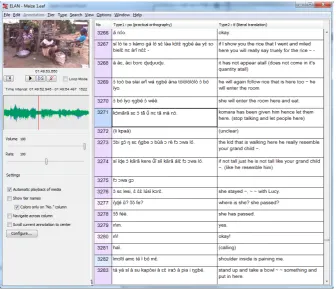
The new user interface we describe in this pa-per is integrated in ELAN as a separate “Tran-scription Mode”, and was developed to combine the strengths of existing implementations while at the same time addressing their weaknesses. Fig-ure 1 shows a screenshot of the new transcription mode.
3 Description of the interface
Figure 1: The interface of the transcription mode, showing two columns: transcriptions and the corresponding translations.
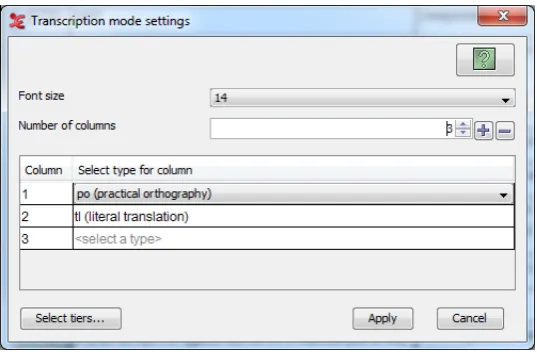
instance, the first column in Figure 1 displays all annotations of the type “practical orthography” in chronological order, colour-coding for differ-ent speakers. The second column displays cor-responding, i.e., time aligned, annotations of the type “literal translation”. Beside the annotation columns there is a pane showing the data (video and/or audio stream) for the selected utterance. Below it are basic playback parameters like vol-ume and rate, some essential interface settings, and a button “Configure” which brings up the col-umn selection dialog window. We provide an ex-ample of this preference pane in Figure 2.
The basic organisation of the Transcription Mode interface reflects its task-oriented design: the annotation columns occupy pride of place and only the most frequently accessed settings are directly visible. Throughout, the user interface is keyboard-driven and designed to minimise the number of actions the user needs to carry out. For instance, selecting a segment (by mouse or key-board) will automatically trigger playback of that segment (the user can play and pause using the Tab key). Selecting a grey (non-existent) field in a dependent column will automatically create an annotation. Selection always opens up the field
for immediate editing. Arrow keys as well as user-configurable shortcuts move to adjacent fields.
ELAN Transcription Mode improves the tran-scription workflow by taking apart the FSPT model and focusing only on the last two steps: Play and Type. In this respect it is like BlitzScribe; but it is more advanced than that and other tools in at least two important ways. First, it is agnostic to the type of data transcribed. Sec-ond, it does not presuppose monolingualism and is ready for multilingual work. It allows the dis-play of multiple annotation layers and makes for easy navigation between them.Further, when tran-scription is done with the help of a native speaker it allows for them to provide other relevant infor-mation at the same time (such as cultural back-ground explanations) keeping primary data and meta-data time aligned and linked.
anno-Figure 2: The interface of the transcription mode; the configuration dialog.
tations or to indicate them by colour-coding only; the option to keep the active annotation centered; and settings for font size and number of columns (in the ”Configure” pane). These features enable the user to customise the transcription experience to their own needs.
The overall design of Transcription Mode makes the process of transcription as smooth as possible by removing unnecessary clutter, fore-grounding the interface elements that matter, and enabling a limited degree of customisation. Over-all, the new interface has realised significant speedups for many people2. User feedback in re-sponse to the new transcription mode has been overwhelmingly positive, e.g., the members of mailing lists such as the Resource Network for Linguistic Diversity3.
4 A prerequisite: semi-automatic segmentation
As we noted in the introduction, the most im-portant step before transcription is that of seg-mentation (steps Find and Segment in the FSPT model). Segmentation is a large task that involves subdividing the audio or video stream in, possi-bly overlapping, segments. The segments each denote a distinct period of speech or any other communicative act and each segment is
com-2Including ourselves, Jeremy Hammond claims that:
“Based on my last two field work trips, I am getting my tran-scription time down below that of transcriber (but perhaps not by much) but still keeping the higher level of data that ELANs tiers provide - probably around 18-20 hours for an hour of somewhat detailed trilingual annotation.”
3www.rnld.org
monly assigned to a specific speaker. This step can potentially be sped up significantly by doing it semi-automatically using pattern recognition techniques, as pursued in the AVATecH project (Auer et al., 2010).
In the AVATecH project, audio and video streams can be sent to detection components called ‘recognisers’. Some detection compo-nents accept the output of other recognisers as additional input, next to the audio and/or video streams, thus facilitating cascaded processing of these streams. Amongst the tasks that can be per-formed by these recognisers is the segmentation of audio and video, including speaker assignment. A special challenge for the recognisers in this project is the requirement of language indepen-dence (in contrast to the English-only situation in the Human Speechome project that produced Blitzscribe(Roy et al., 2006)). The recognisers should ideally accommodate the work of field linguists and other alike researchers and there-fore cannot simply apply existing language and acoustic models. Furthermore, the conditions that are encountered in the field are often not ideal, e.g., loud and irregular background noises such as those from animals are common. Nevertheless, automatic segmentation has the potential to speed up the segmentation step greatly.
5 Future possibilities: computational approaches to data enrichment
[image:4.595.164.433.64.240.2]otherwise. Typically a morphological segmenta-tion of the words and a labelling of each individ-ual morph is required. This level of annotation is also known as basic glossing (Bow et al., 2003b; Bow et al., 2003a).
Automatically segmenting the words into their morphological parts, without resorting to the use of pre-existing knowledge has seen a wide vari-ety of research (Hammarstr¨om and Borin, 2011). Based on the knowledge-free induction of mor-phological boundaries the linguist will usually perform corrections. Above all, a system must learn from the input of the linguist, and must in-corporate it in the results, improving the segmen-tation of words going forward. However, it is well known from typological research that languages differ tremendously in their morphosyntactic or-ganisation and the specific morphological means that are employed to construct complex meanings (Evans and Levinson, 2009; Hocket, 1954).
As far as we know, there is no current morpho-logical segmentation or glossing system that deals well with all language types, in particular inflec-tional and polysynthetic languages or languages that heavily employ tonal patterns to mark differ-ent forms of the same word. Therefore, there is a need for an interactive, modular glossing sys-tem. For each step of the glossing task, one would use one, or a set of complementary modules. We call such modules “annotyzers”. They generate content on the basis of the source tiers and addi-tional data, e.g. lexical data (or learnt states from earlier passes). Using such modules will result in a speedup for the researcher. We remark that there are existing modular NLP systems, such as GATE(Cunningham et al., 2011), however these are tied to different workflows, i.e., they are not as suitable for the multimodal multi-participant an-notation process.
Currently a limited set of such functionality is available in Toolbox and FLEX. In the case of both Toolbox and FLEX the functionality is lim-ited to a set of rules written by the linguist (i.e. in a database-lookup approach). Even though the ELAN modules will offer support for such rules, our focus is on the automation of machine-learning systems in order to scale the annotation process.
Our main aim for the future is to incorporate learning systems that support the linguists by im-proving the suggested new annotations on the
bases of choices the linguist made earlier. The goal there is, again, to reduce annotation time, so that the linguist can work more on linguistic anal-ysis and less on annotating. At the same time, a working set of annotyzers will promote more standardised glossing, which can then be used for further automated research, cf. automatic tree-bank production or similar (Bender et al., 2011).
6 Conclusions
The diversity of the world’s languages is in dan-ger. Perhaps user interface design is not the first thing that comes to mind in response to this sober-ing fact. Yet in a field that increassober-ingly works with digital annotations of primary linguistic data, it is imperative that the basic tools for annotation and transcription are optimally designed to get the job done.
We have described Transcription Mode, a new user interface in ELAN that accelerates the tran-scription process. This interface offers several ad-vantages compared to similar tools in the software landscape. It automates actions wherever pos-sible, displays multiple parallel information and annotation streams, is controllable with just the keyboard, and can handle sign language as well as spoken language data. Transcription Mode re-duces the required transcription time by providing an optimised workflow.
The next step is to optimise the preceding and following stages in the annotation process. Pre-ceding the transcription stage is segmentation and speaker labelling, which we address using auto-matic audio/video recogniser techniques that are independent of the language that is transcribed. Following transcription, we aim to support basic glossing (and similar additional annotations based on transcriptions) with a modular software archi-tecture. These semi-automated steps lead to fur-ther time savings, allowing researchers to focus on the analysis of language data rather than on the production of annotations.
References
Eric Auer, Peter Wittenburg, Han Sloetjes, Oliver Schreer, Stefano Masneri, Daniel Schneider, and Sebastian Tsch¨opel. 2010. Automatic annotation of media field recordings. InProceedings of the ECAI 2010 Workshop on Language Technology for Cultural Heritage, Social Sciences, and Humanities (LaTeCH 2010), pages 31–34.
Claude Barras, Edouard Geoffrois, Zhibiao Wu, and Mark Liberman. 2001. Transcriber: Develop-ment and use of a tool for assisting speech corpora production. Speech Communication, 33(1-2):5–22, January.
Emily M. Bender, Dan Flickinger, Stephan Oepen, and Yi Zhang. 2011. Parser evaluation over local and non-local deep dependencies in a large corpus. In
Proceedings of the 2011 Conference on Empirical Methods in Natural Language Processing, pages 397–408, Edinburgh, Scotland, UK., July. Associ-ation for ComputAssoci-ational Linguistics.
Andrea L. Berez. 2007. Review of EUDICO linguis-tic annotator (ELAN).Language Documentation & Conservation, 1(2):283–289, December.
Catherine Bow, Baden Hughes, and Steven Bird. 2003a. A four-level model for interlinear text. Cathy Bow, Baden Hughes, and Steven Bird. 2003b.
Towards a general model of interlinear text. In
Proceedings of EMELD Workshop 2003: Digitizing and Annotating Texts and Field Recordings. Lans-ing MI, USA.
Hamish Cunningham, Diana Maynard, Kalina Bontcheva, Valentin Tablan, Niraj Aswani, Ian Roberts, Genevieve Gorrell, Adam Funk, Angus Roberts, Danica Damljanovic, Thomas Heitz, Mark A. Greenwood, Horacio Saggion, Johann Petrak, Yaoyong Li, and Wim Peters. 2011. Text Processing with GATE (Version 6).
Nicholas Evans and Stephen C. Levinson. 2009. The myth of language universals: Language diversity and its importance for cognitive science. Behav-ioral and Brain Sciences, 32(05):429–448.
Jost Gippert, Nikolaus P. Himmelmann, and Ulrike Mosel, editors. 2006.Essentials of language docu-mentation. Mouton de Gruyter, Berlin / New York. Harald Hammarstr¨om and Lars Borin. 2011.
Un-supervised learning of morphology. To Appear in Computational Linguistics.
Nikolaus P. Himmelmann. 2008. Reproduction and preservation of linguistic knowledge: Linguistics’ response to language endangerment. InAnnual Re-view of Anthropology, volume 37 (1), pages 337– 350.
Charles F. Hocket. 1954. Two models of grammatical description.Word 10, pages 210–234.
Chris Rogers. 2010. Review of fieldworks language explorer (flex) 3.0. In Language Documentation
& Conservation 4, pages 1934–5275. University of Hawai’i Press.
Brandon C. Roy and Deb Roy. 2009. Fast transcrip-tion of unstructured audio recordings. In Proceed-ings of Interspeech 2009, Brighton, England. Deb Roy, Rupal Patel, Philip DeCamp, Rony Kubat,
Michael Fleischman, Brandon C. Roy, Nikolaos Mavridis, Stefanie Tellex, Alexia Salata, Jethran Guinness, Micheal Levit, and Peter Gorniak. 2006. The human speechome project. In Paul Vogt, Yu-uga Sugita, Elio Tuci, and Chrystopher Nehaniv, ed-itors,Symbol Grounding and Beyond, volume 4211 ofLecture Notes in Computer Science, pages 192– 196. Springer, Berlin / Heidelberg.
Michael Tomasello and Daniel Stahl. 2004. Sam-pling children’s spontaneous speech: How much is enough? Journal of Child Language, 31(01):101– 121.
Sebastian Tsch¨opel, Daniel Schneider, Rolf Bardeli, Peter Wittenburg, Han Sloetjes, Oliver Schreer, Ste-fano Masneri, Przemek Lenkiewicz, and Eric Auer. 2011. AVATecH: Audio/Video technology for hu-manities research. Language Technologies for Dig-ital Humanities and Cultural Heritage, page 86. Peter Wittenburg, Hennie Brugman, Albert Russel,