Improved Chinese Parsing Using Named Entity Cue
Dongchen Li, Xiantao Zhang and Xihong Wu
Key Laboratory of Machine Perception and Intelligence,
Speech and Hearing Research Center,
Peking University, China
{
lidc,Zhangxt,wxh
}
@cis.pku.edu.cn
Abstract
Parsing and named entity recognition are two standalone techniques in natural language pro-cessing community. We expect that these t-wo types of annotations should provide useful information to each other, and that modeling them jointly should improve performance and produce consistent outputs. Employing more fine-grained named entity annotations helps to parse complex named entity structures correct-ly. Thus, we integrate parsing and named entity recognition in a unified framework: 1. Through a joint representation of syntactic and named en-tity structures, we annotate named enen-tity infor-mation to Penn Chinese Treebank5.0 (CTB5.0); 2. We annotate the nested structures for all nest-ed namnest-ed entities; 3. A latent annotation proba-bilistic context-free grammar (PCFGLA) model is trained on the data with joint representation. Experiment results demonstrate the mutual ben-efits for both Chinese parsing and named entities recognition tasks.
1 Why Exploit Named Entity Cue for Chinese
Parsing?
Chinese parsing and named entity recognition are t-wo basic Chinese NLP technologies. They play an important role in the Chinese information extraction, machine translation and question answering systems.
However, to the best of our knowledge, previous re-searches generally regard them as two standalone pro-cesses. One of the reasons is that the Treebank for training a parser has not been annotated with adequate named entity information. We argue that it will be beneficial to utilize named entity cue in parsing. Be-cause one of the main difficulties in parsing Chinese is
bracketing phrases with complex structure, and many complex phrases are named entities.
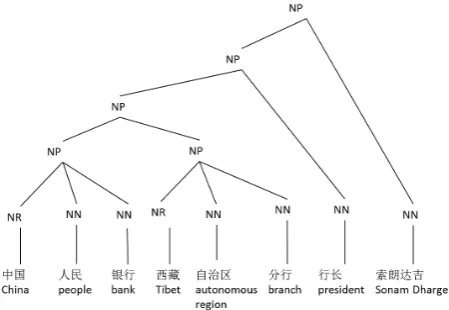
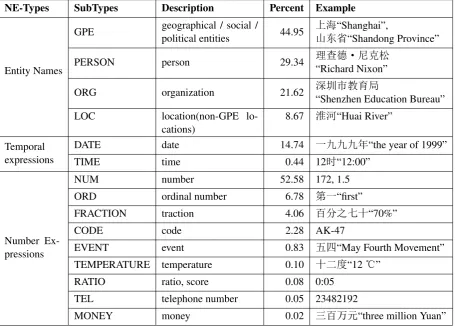
[image:1.595.302.527.425.580.2]In Chinese there are a large number of named en-tities. Named entities (NEs) can be generally divided into three types: entity names, temporal expressions, and number expressions. They are /unique identi-fiers0of entities (organizations, persons, locations), time (date, times), and quantities (monetary values, percentages). According to Chinese Treebank fifth edition (CTB5.0) (Xue et al., 2002), every sentence contains over 1.5 entity names. Table1shows the dis-tribution of these named entities in CTB5.0.
Figure 1: A named entity example with complex structures.
NE-Types SubTypes Description Percent Example
Entity Names
GPE geographical / social /political entities 44.95 þ°ìÀ“Shanghai”,Ž“Shandong Province”
PERSON person 29.34 n“Richard Nixon”#ZŽt
ORG organization 21.62 “Shenzhen Education Bureau”e½ ˜Û
LOC location(non-GPE lo-cations)
8.67 •à“Huai River”
Temporal expressions
DATE date 14.74 ˜ÊÊÊc“the year of 1999”
TIME time 0.44 12ž“12:00”
Number Ex-pressions
NUM number 52.58 172, 1.5
ORD ordinal number 6.78 1˜“first”
FRACTION traction 4.06 z©ƒÔ›“70%”
CODE code 2.28 AK-47
EVENT event 0.83 Êo“May Fourth Movement”
TEMPERATURE temperature 0.10 › Ý“12e”
RATIO ratio, score 0.08 0:05
TEL telephone number 0.05 23482192
[image:2.595.64.520.106.432.2]MONEY money 0.02 nz “three million Yuan”
Table 1: The distribution of the named entity types (#sentences = 18789)
the People’s Bank of China” is quite different, but they get the identical label NP in CTB. A parser trained on these annotations is messy and hard to discriminate these complex structures correctly. Much work has illustrated that training the parser with manually an-notated fine-grained labels and structures could help disambiguate parsing structure and improve parsing accuracy (Li, 2011;Li and Wu, 2012).
Thus, it is necessary to introduce these named enti-ties in syntactic structure and integrate their recogni-tion in the parsing process.
We integrate syntactic and named entity informa-tion in a unified framework through a joint representa-tion. We add these named entity annotations into the syntactic structures in CTB5.0, with special care for nested named entity. Then we validate our annotation-s in parannotation-sing and named entity recognition taannotation-skannotation-s. Thiannotation-s joint representation improves Chinese parsing accu-racy significantly. Furthermore, the accuracies of the named entity recognition of our joint model
outperfor-m CRF-based NER systeoutperfor-m.
The rest of this paper is organized as follows. Sec-tion2.1reviews previously established Chinese Tree-bank (Penn Chinese TreeTree-bank) and Chinese corpus annotated with named entities (OntoNotes). Section3
represents our joint representation of syntactic struc-tures and named entities. In section 4 we perform experiments to illustrate the effectiveness of our joint representation.
2 Related Work
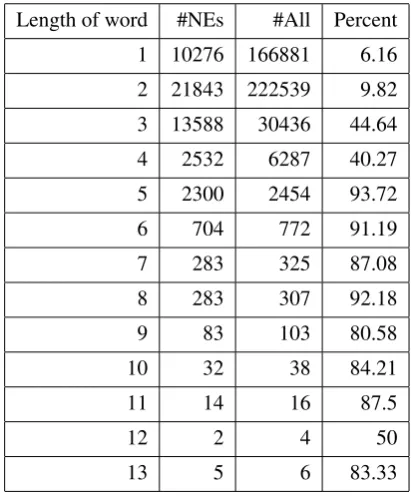
Length of word #NEs #All Percent 1 10276 166881 6.16 2 21843 222539 9.82 3 13588 30436 44.64 4 2532 6287 40.27 5 2300 2454 93.72 6 704 772 91.19 7 283 325 87.08 8 283 307 92.18
9 83 103 80.58
10 32 38 84.21
11 14 16 87.5
12 2 4 50
[image:3.595.64.270.104.353.2]13 5 6 83.33
Table 2: Statistics of NEs’ percent in different words’ length
2.1 Penn Chinese Treebank and OntoNotes
CTB is a segmented, part-of-speech tagged, and ful-ly bracketed corpus that currentful-ly has 500 thousand words (over 824K Chinese characters). There are to-tally 890 files in CTB5.0.
Parsing of Chinese is typically based on coarse part-of-speech tags and syntactic tags in CTB. In CTB, named entity phrase is simply labeled as a noun phrase (NP) without distinction of their diverse types (some of them may be labeled with an extra function tag P-N). Similarly, named entity words are simply labeled as a proper noun (NR), cardinal number (CD), ordinal number (OD) or temporal noun (NT), and they corre-spond to words in the parse trees without annotation of their internal word structure.
OntoNotes Release 4.0 (LDC2011T03) is a large, manually annotated corpus that contains various text genres and annotations (Hovy et al., 2006). It is also a corpus with annotation of entity names in Chinese. It contains 403 files which are also in CTB5.0, including the test set and development set in the standard pars-ing evaluation setup. Entity names in OntoNotes4.0 are annotated with 18 types of entity names, including PERSON, ORGANIZATION, GPE, LOC, PRODUC-T and so on.
Many named entities contain other named entities inside them. However, works on named entity recog-nition (NER) and the annotation of OntoNotes have almost entirely ignored nested entities and instead chosen to focus on the outermost entities.
2.2 Parsing
Most high-performance parsers is based on proba-bilistic context-free grammars (PCFGs). They all re-fine grammar labels to capture more syntactic char-acteristic, ranging from full lexicalization and intri-cate smoothing (Collins, 1999; Charniak, 2000) to category refinement (Johnson, 1998;Klein and Man-ning, 2003). Latent annotation probabilistic context-free grammar (PCFG-LA) method in Matsuzaki et al. (2005) andPetrov and Klein (2007) automatical-ly refines syntactic and lexical tags in an unsuvised manner, and has achieved state-of-the-art per-formance on both English and Chinese.
In recent years, there has been much work on character-level Chinese parsing. Qian and Liu (2012) trained three individual models of Chinese segmen-tation, POS tagging and Parsing separately during training, and incorporated them together in a discrim-inative framework. Zhang et al. (2013) integrated character-structure features in the joint model based on the discriminative shift-reduce parser ofZhang and Clark (2009) and Zhang and Clark (2011)Zhang and Clark (2009; 2011).
In spite of the convenience of its totally automatic learning process, the main defect of the latent factor models lies in that the training process is completely data-driven and suffers from data sparseness. To alle-viate this problem, we leverage named entity cue, in the form of explicit annotation.
2.3 Named Entity Cue in Parsing
There is a large body of work on parsing and named entity recognition (Bikel and Chiang, 2000; Sekine and Nobata, 2004; Klementiev and Roth, 2006; S-ingh et al., 2010) separately. The sequence labeling approach has been shown to perform well on the task of Chinese NER (Chen et al., 2006; Yu et al., 2008).
entity cue in character-level Chinese parsing, and fur-ther exploiting nested named entities in parsing.
Some existing work investigates the number ex-pressions in parsing. Harper and Huang (2009) ad-dressed this issue for achieving better parsing perfor-mance. Our work is not to verbalize sequences of dig-its; we annotate the entire constituent with fine label, such as DATE, NUM, TIME, FRACTION.
3 Our Approach
However, the completely data-driven state-split ap-proach is prone to overfit the training data. Be-cause the training data is always extremely sparse, and the automatically split categories might not be adequate. To improve parsing accuracy, Li (2011) manually annotated the internal structure of word-s, /citeli2012conjuncting manually annotated fine-grained labels for function words.
In our approach, all these types of named entity information are annotated to CTB5.0 through a joint representation in both word-level and character-level. Then we train a PCFG-LA parser on the corpus, and validate that named entity cue helps to improve pars-ing and NER accuracy simultaneously.
3.1 Named Entity Representation in Syntactic Tree
We argue that syntactic information and named entity information are mutual beneficial, so we enrich the annotations of the parse tree with fine-grained named entity labels to achieve the joint representation.
It is an important issue of how to define the type-s of Named entitietype-s. OntoNotetype-s Releatype-se 4.0 (LD-C2011T03) has annotated eighteen types of entity names. Some of these entity types do not occur fre-quently and are not always useful in practice, such as works of art,productandlaw, so we discard them in this study. In addition, we annotate the types of code, ratio and tel. All the named entity types are explained in Table1.
There are totally 890 files in CTB5.0, and 403 of them have already been annotated with entity names in OntoNotes4.0. The test set and development set are setup as in the standard parsing evaluation. We an-notated the left 487 files with previously mentioned types of named entities following the guideline of OntoNotes4.0.
3.2 Nested Named Entities Annotations
One of the main challenges for named entity recog-nition task is dealing with nested named entities. For example, Figure1contains nested named entities¥ I<¬Õ1Üõg£«©1“the Tibet Autonomous Region branch of the People’s Bank of China”, ¥ I<¬Õ1“the People’s Bank of China”, and ¢
Kˆ3“Sonam Dharge”. Tradition sequence label-ing methods, such as CRF, treat the text as a linear sequence and have great difficulty in handling nested named entities, if not impossible.
We adopt a novel solution to explicitly represent nested named entities naturally in the syntactic struc-ture. Nested named entities are exhaustively labelled in the syntactic tree structure, and each corresponds to one node in the tree.
Next, we will discuss the annotation process in detail. We refine the label of named enti-ties.components. As shown in Figure 1, ¥I< ¬Õ1Üõg£«©1“People.s Bank of China branch of the Tibet Autonomous Region” is labeled as “NP ORG”, and its two children in the tree are also labeled as “NP ORG”. All the words.structures are not changed; we just add a finer label to replace the original coarse label.
Further, we annotate the internal structure of a word that represents a nested named entity. There are three types of nested named entities: GPE, PERSON and temporal expression. We handle them respectively as follows.
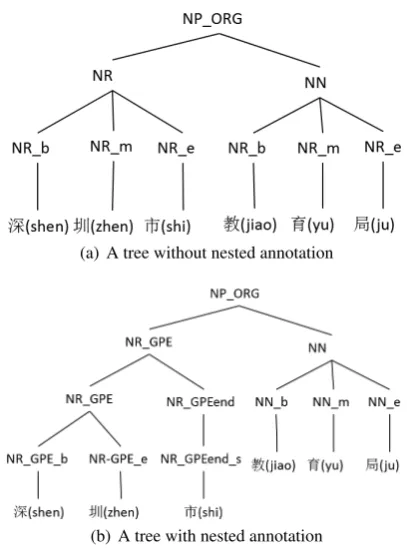
For GPE, we split the GPE name and its geograph-ical unit apart in a tree structure. This annotation style has the advantage of generalizing the common GPE composition structure. For example, e½ ˜Û“Shenzhen Education Bureau” is a ORG, but e“Shenzhen” and e½“Shenzhen city” are both GPE. The character½“city” will obtain a special la-bel.1 In this case, we get a derivation which includes GPE→GPE GPEend. The experiment results in the next section show that the parser benefits a lot from this derivation. This example is shown in Figure2.
Figure 2: An example annotation for the phrase e½ ˜Û“Shenzhen Education Bureau”
Person Name) and NR PERSONC (Chinese Person Name). It is obvious that a name containing the char-acter ‘#.is a foreign name. Using this cue, it is easy to recognize the foreign names. See Figure3for an illustration.
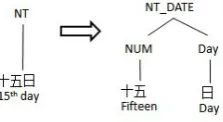
[image:5.595.299.533.258.337.2]For temporal expressions, the nested structure is bracketed into number expressions and temporal u-nit. For instance, the word ›ÊF“the 15th day in a month” will be split with›Ê-NUM andF-Day. Figure4gives a detailed example.
Figure 3: An example of annotation for the foreign name n #ZŽt“Richard Nixon”
Figure 4: An example of nested annotation for the temporal expression›ÊF“the 15th day in a month”
3.3 Our Annotation Method
The process of annotating named entity labels is as follows: Firstly, sentences also in OntoNotes (with file number from 1 to 325 and 1001 to 1078) will be se-lected, resulting in a small treebank with named entity
annotations. A PCFG-LA parser is trained on the s-mall treebank. Then the parser is used to label the rest of the sentences (with file number from 400 to 931 and 1100 to 1151). After that, the parsed sentences are manually corrected. Two persons marked the cor-rect tags to each named entity independently. Manual correction is necessary, so can we avoid the danger of low-recall. Both persons should agree on a single tag when differences occurred.
The size of our new corpus is shown in Table3.
CTB files #Files #Sens. #NE #NestedNE 1-325 403 8971 28344 1754 1001-1078
400-931 487 9778 28149 1144 1100-1151
Table 3: Statistics of the annotated corpus
3.4 Parsing Model
PCFG-LA in Petrov et al. (2006) used a hierarchi-cal state-split approach to refine the original gram-mars. Starting with the basic non-terminal nodes, this method repeats the split-merge (SM) cycle to increase the complexity of grammars. Specifically, it splits ev-ery symbol into two, and then re-merge some new subcategories which cause little or less loss in like-lihood incurred when removing it. In other words, the parser introduces latent annotations to refine the syn-tactic categories.
We employ Berkeley parser2in this study. We have re-implemented and enhance the Berkeley parser to handle Chinese character involved in nested named entity words efficiently and robustly. Especially, when the input is character not the word, we will change the strategy to deal the unknown character accordingly .
4 Experiments
In this section, we examine the effect of named entity cue in parsing Chinese. At the same time, the parser output an NER result. For the sake of comparison, here we also train a CRF model for NER as a baseline.
[image:5.595.64.271.409.475.2] [image:5.595.109.221.545.606.2]4.1 Experimental Setup
We present experimental results on Chinese Treebank (CTB) 5.0 with annotation of the named entity infor-mation. We adapted the standard data allocation and split the corpus as follows: files from CHTB 001.fid to CHTB 270.fid, and files from CHTB 400.fid to CHTB 1151.fid were used as training set. The devel-opment set includes files from CHTB 301.fid to CHT-B 325.fid, and the test set includes files CHTCHT-B 271.fid to CHTB 300.fid. All traces and functional tags were stripped.
For comparison, we also trained a baseline Berke-leyParser without the cue, and a CRF model for named entity recognition. Our CRFs were implement-ed basimplement-ed on the CRF++ package 3, and the features used were mentioned in (Wan et al., 2011).
With regard to the parser from (Petrov et al., 2006), all the experiments were carried out after six cycles of split-merge.
4.2 Evaluation Metric
Three metrics were used for the evaluation of syntac-tic parsing: precision (P), recall (R) and F1-measure (F1) which is defined as 2PR/(P+R).
In the evaluation using the EVALB parseval, the ad-ditional named entity labels are also ignored. For in-stance, the label-NP ORG.and-NR ORG.will be replaced as ’NP’ and ’NR’ separately. The internal structure of nested named entity words are discarded by rules to make the results comparable to previous work.
We tested the significance of our results using Dan Bikel’s randomized parsing evaluation comparator4, and validate the improvement in F1-measure is sta-tistically significant.
4.3 Results on Parsing
In this section, we examine the effect of joint learn-ing of syntactic structure and named entity cues for parsing.
Using the same data set setup and evaluation met-ric as the previous experiments, our parser achieves performance of 84.43 in F1-measure on the test data. Table 4lists a few state-of-the-art word-level parser performance, showing that our system is competitive
3http://crfpp.sourceforge.net/
4http://www.cis.upenn.edu/dbikel/software.html
(a) A tree without nested annotation
[image:6.595.309.513.109.385.2](b) A tree with nested annotation
Figure 5: Not nested and Nested named entity annotation in the character-level tree for (shen) e(zhen) ½(shi)
(jiao)˜(yu)Û(ju) “Shenzhen Education Bureau”
with all the others.
Experiment results show that named entity cue is useful for parsing. PCFG-LA method refines the syn-tactic categories by latent annotations, whereas, we in-troduce the fine-grained subcategorizations in the for-m of explicit annotations. The cofor-mpletely data-driven approach is prone to overfit, and the introduction of named entity cue by manual annotations is a more re-liable way than unsupervised clustering.
System P R F1 Petrov ’07 84.8 81.9 83.3 Qian’12 84.57 83.68 84.13 This paper 85.53 83.34 84.43
[image:6.595.331.498.634.705.2]4.4 Examining the Effectiveness of These Annotations for NER
The above experiments demonstrate that syntactic parsing benefits from our integrated approach. In this section, we exploit the effect on named entity recog-nition of joint learning.
For comparison to previous work, we convert word-level trees into character-word-level trees according to some rules. Then, the trained grammar has the ability to parse on characters and output syntactic structure and named entity labels. The simple rules used in this con-version are as follows:
• All part-of-speech tags in Word-level become constituent labels in character-level trees. Then a new node for each character if cerated, and we assign a new label for each new node. The new label consists of the POS tag of its word and its position in its word(’b’ for starting position, ’e’ for end position, and ’m’ for others). For exam-ple , the character “Jiao” in NN- ˜Û“Jiao Yu Ju”, will be labeled as-NNb..5
• All the characters underlying the NUM node will replace with/#NUM#0.
In Table5, we show the NER result of our joint model. In the named entity evaluation, only the named entities with the correct boundaries and the correct categories are regarded as a correct recognition.
[image:7.595.310.514.190.300.2]Model GPE PER ORG LOC CRF 86.98 88.56 48.79 67.28 Parsing+NotNested 85.61 85.63 40.63 54.73 Parsing+NestedNR 89.64 89.97 63.44 73.07
Table 5: NER F1 results using different models
There is a great performance improvement on named entity recognition, especially on the recogni-tion for ORG. On one hand, the internal structure of the named entity helps to determine the boundary of the entity. For instance, the organization phrase¥ Iu{IS©z 6r?¬“China International Cultural Exchange Association of the overseas Chi-nese” can be recognized . But the CRF model can-not capture the long-distance structure. On the other
5This rule is the same as inLuo (2003) andLi (2011)
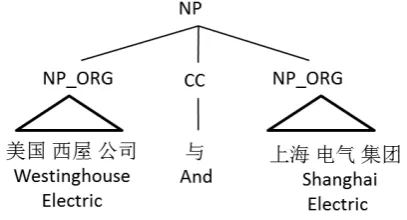
hand, the structural context in which it appears can help determine the type of the entity. As illustrated in Figure6, the structure “NP ORG CC NP ORG” is a pattern, and the noun phrases on both sides of the
†“and” should be of the same type.
Figure 6: An example parsing result on the phrase{I Ü Âúi†þ°>í8ì”Westinghouse Electric and Shanghai Electric”
5 Conclusion and Future Work
In this paper, we exploit the named entity cue in a u-nified framework for parsing. We annotate this cue in CTB5.0 through a joint representation of syntac-tic and named entity structures. Furthermore, we annotate nested named entity structure for all entity names, temporal expressions and number expression-s. A PCFG-LA parser is then trained on the corpuexpression-s. The evaluation shows that, introducing the named en-tity cue when training a parser help to recognize the complex named entity structures.
This preliminary investigation could be extended in several ways. First, it is natural to introduce other cues together, such as verbal subcategories and func-tion word subcategories. Second, we would like to adopt discriminative parsing to integrate named entity cue into parsing.
Acknowledgment
References
Daniel M Bikel and David Chiang. 2000. Two statisti-cal parsing models applied to the chinese treebank. In Proceedings of the second workshop on Chinese lan-guage processing: held in conjunction with the 38th Annual Meeting of the Association for Computational Linguistics-Volume 12, pages 1–6. Association for Com-putational Linguistics.
Eugene Charniak. 2000. A maximum-entropy-inspired parser. InProceedings of the 1st North American chap-ter of the Association for Computational Linguistics conference, pages 132–139. Association for Computa-tional Linguistics.
Aitao Chen, Fuchun Peng, Roy Shan, and Gordon Sun. 2006. Chinese named entity recognition with condition-al probabilistic models. In5th SIGHAN Workshop on Chinese Language Processing, Australia.
Michael Collins. 1999.Head-driven statistical models for natural language parsing. Ph.D. thesis, University of Pennsylvania.
Jenny Rose Finkel and Christopher D Manning. 2009a. Joint parsing and named entity recognition. In Proceed-ings of Human Language Technologies: The 2009 An-nual Conference of the North American Chapter of the Association for Computational Linguistics, pages 326– 334. Association for Computational Linguistics. Jenny Rose Finkel and Christopher D Manning. 2009b.
Nested named entity recognition. InProceedings of the 2009 Conference on Empirical Methods in Natural Lan-guage Processing: Volume 1-Volume 1, pages 141–150. Association for Computational Linguistics.
Mary Harper and Zhongqiang Huang. 2009. Chinese sta-tistical parsing.Gale Book.
Eduard Hovy, Mitchell Marcus, Martha Palmer, Lance Ramshaw, and Ralph Weischedel. 2006. Ontonotes: the 90% solution. InProceedings of the human language technology conference of the NAACL, Companion Vol-ume: Short Papers, pages 57–60. Association for Com-putational Linguistics.
Mark Johnson. 1998. Pcfg models of linguistic tree repre-sentations.Computational Linguistics, 24(4):613–632. Dan Klein and Christopher D Manning. 2003. A
pars-ing: fast exact viterbi parse selection. InProceedings of the 2003 Conference of the North American Chap-ter of the Association for Computational Linguistics on Human Language Technology-Volume 1, pages 40–47. Association for Computational Linguistics.
Alexandre Klementiev and Dan Roth. 2006. Weakly su-pervised named entity transliteration and discovery from
multilingual comparable corpora. InProceedings of the 21st International Conference on Computational Lin-guistics and the 44th annual meeting of the Association for Computational Linguistics, pages 817–824. Associ-ation for ComputAssoci-ational Linguistics.
Dongchen Li and Xihong Wu. 2012. Parsing tct with split conjunction categories. In Proceedings of the Second CIPS-SIGHAN Joint Conference on Chinese Language Processing, pages 174–178. Association for Computa-tional Linguistics and Chinese Information Processing Society of China.
Zhongguo Li. 2011. Parsing the internal structure of word-s: A new paradigm for chinese word segmentation. In ACL, pages 1405–1414.
Xiaoqiang Luo. 2003. A maximum entropy chinese character-based parser. InProceedings of the 2003 con-ference on Empirical methods in natural language pro-cessing, pages 192–199. Association for Computational Linguistics.
Takuya Matsuzaki, Yusuke Miyao, and Jun’ichi Tsujii. 2005. Probabilistic cfg with latent annotations. In Pro-ceedings of the 43rd Annual Meeting on Association for Computational Linguistics, pages 75–82. Associa-tion for ComputaAssocia-tional Linguistics.
Slav Petrov and Dan Klein. 2007. Improved inference for unlexicalized parsing. InHuman language technolo-gies 2007: the conference of the North American chapter of the Association for Computational Linguistics, pages 404–411.
Slav Petrov, Leon Barrett, Romain Thibaux, and Dan K-lein. 2006. Learning accurate, compact, and inter-pretable tree annotation. In Proceedings of the 21st International Conference on Computational Linguistics and the 44th annual meeting of the Association for Com-putational Linguistics, pages 433–440. Association for Computational Linguistics.
Xian Qian and Yang Liu. 2012. Joint chinese word seg-mentation, pos tagging and parsing. In Proceedings of the 2012 Joint Conference on Empirical Methods in Natural Language Processing and Computational Natu-ral Language Learning, pages 501–511. Association for Computational Linguistics.
Satoshi Sekine and Chikashi Nobata. 2004. Definition, dictionaries and tagger for extended named entity hier-archy. InLREC.
Xiaojun Wan, Liang Zong, Xiaojiang Huang, Tengfei Ma, Houping Jia, Yuqian Wu, and Jianguo Xiao. 2011. Named entity recognition in chinese news comments on the web. InIJCNLP, pages 856–864.
Nianwen Xue, Fu-Dong Chiou, and Martha Palmer. 2002. Building a large-scale annotated chinese corpus. In Pro-ceedings of the 19th international conference on Com-putational linguistics-Volume 1, pages 1–8. Association for Computational Linguistics.
Xiaofeng Yu, Wai Lam, Shing-Kit Chan, Yiu Kei Wu, and Bo Chen. 2008. Chinese ner using crfs and logic for the fourth sighan bakeoff. InIJCNLP, pages 102–105. Yue Zhang and Stephen Clark. 2009. Transition-based
parsing of the chinese treebank using a global discrim-inative model. InProceedings of the 11th Internation-al Conference on Parsing Technologies, pages 162–171. Association for Computational Linguistics.
Yue Zhang and Stephen Clark. 2011. Syntactic process-ing usprocess-ing the generalized perceptron and beam search. Computational Linguistics, 37(1):105–151.