On maximum spanning DAG algorithms for semantic DAG parsing
Natalie Schluter
Department of Computer Science School of Technology, Malm¨o University
Malm¨o, Sweden
Abstract
Consideration of the decoding problem in semantic parsing as finding a maxi-mum spanning DAG of a weighted di-rected graph carries many complexities that haven’t been fully addressed in the lit-erature to date, among which are its ac-tual appropriateness for the decoding task in semantic parsing, not to mention an ex-plicit proof of its complexity (and its ap-proximability). In this paper, we con-sider the objective function for the maxi-mum spanning DAG problem, and what it means in terms of decoding for semantic parsing. In doing so, we give anecdotal evidence against its use in this task. In ad-dition, we consider the only graph-based maximum spanning DAG approximation algorithm presented in the literature (with-out any approximation guarantee) to date and finally provide an approximation guar-antee for it, showing that it is anO(1
n) fac-tor approximation algorithm, where n is the size of the digraph’s vertex set.
1 Introduction
Recent research in semantic parsing has moved at-tention towards recovering labeled digraph repre-sentations of the semantic relations corresponding to the linguistic agendas across a number of theo-ries where simple tree representations are claimed not to be expressive enough to capture senten-tial meaning. As digraph structures presented in predominant semantic graph databases are mainly acyclic, the semantic parsing problem has some-times become associated with a maximum span-ning directed acyclic graph (MSDAG) decoding problem (McDonald and Pereira, 2006; Sagae and Tsujii, 2008; Titov et al., 2009), in analogy and perhaps as a generalisation of the maximum
span-ning tree decoding problem for syntactic depen-dency parsing.
The appropriateness of finding the MSDAG in decoding for semantic parsing has, however, never been fully motivated, and in fact carries more complexities than that of maximum spanning tree (MST) decoding for syntactic parsing. In this pa-per, we discuss the appropriateness of MSDAG decoding in semantic parsing, considering the pos-sible objective functions and whether they match our linguistic goals for the decoding process. Our view is that they probably do not, in general.
In addition to the problem of not being suffi-ciently synchronised with our linguistic intuitions for the semantic parsing decoding problem, the MSDAG problem itself carries with it its own complexities, which are still in the process of becoming more understood in the algorithms re-search community. McDonald and Pereira (2006) claim that the MSDAG problem is NP-hard, cit-ing (Heckerman et al., 1995); however, there is no MSDAG problem in this latter work, and no explicit reduction to any problem presented in (Heckerman et al., 1995) has been published to date. We point out that Schluter (submitted) ex-plicitly provides a linear reduction to MSDAG from the problem of finding a minimum weighted directed multicut (IDMC), showing MSDAG’s NP-hardness; this reduction also yields a result on the approximability of MSDAG, namely that it isAPX-hard. We show in this paper that the proximation algorithm presented without any ap-proximation guarantee in (McDonald and Pereira, 2006) is, in fact, aO(1
n)factor approximation al-gorithm, where nis the size of the graphs vertex set. This is not particularly surprising given the problem’sAPX-hardness.
Following some preliminaries on weighted di-graphs (Section 2), we make the MSDAG prob-lem precise through a discussion of the objective function in question and briefly question this
jective function with respect to decoding in se-mantic parsing (Section 3). Finally, we discuss the only other graph-based (approximation) algorithm in the literature and prove its approximation guar-antee (Section 4), followed by some brief conclu-sions (Section 5).
2 Preliminaries
Adirected graph (ordigraph)Gis a pair (V, E) where V is the set of nodes and E is the set of (directed)edges. E ⊂ V ×V is a set of ordered pairs of vertices. Foru, v∈V, if(u, v)∈E, then we say there is an “edge fromutov”. If there is any confusion over the digraph we are referring to, then we disambiguate by using the notationG:= (E(G), V(G)).
If all edgese∈E(G)are associated with a real number, a weightw:E(G)→R, then we call the digraph weighted. In this paper, all digraphs are weighted and weights are positive.
For a subset of edges U of a weighted di-graph, we set w(U) := Pe∈Uw(e). Simi-larly, for a weighted digraph G, we setw(G) :=
P
e∈E(G)w(e).
We denote the size of a setS, by|S|.
For G = (V, E), let u1, . . . , uk ∈ V and
(ui, ui+1) ∈ E, for each i ∈ [k−1], then we
say that there is path (also directed path, or di-path) of length(k−1)fromu1toukinG. If also
(uk, u1) ∈ E, then we say thatu1, u2, . . . , uk, u1
is acycleof lengthkinG.
A directed acyclic graph (DAG) is a directed graph with no cycles. There is a special kind of DAG, which has a special node called arootwith no incoming edges and in which there is a unique path from the root to all nodes; this is called atree. Finally, a tournament is a digraph in which all pairs of vertices are connected by exactly one edge. If, in addition, the edges are weighted, then we call the digraph aweighted tournament. 3 Objective functions for finding an
MSDAG of a digraph
We first make precise the objective function for the MSDAG problem, by considering two sepa-rate objective functions, one additive and one mul-tiplicative, over the weights of edges in the optimal solution:
D∗ := arg max
Da spanning DAG ofG X
e∈E(D)
w(e), and (1)
D∗ := arg max
Da spanning DAG ofG Y
e∈E(D)
w(e). (2)
Maximising Equation (2) amounts to concur-rently minimising the number of edges of weight less than 1 in the optimal solution and maximis-ing the number of edges of weight at least 1. In fact, if all edge weights are less than 1, then this problem reduces to finding the MST. However, the objective in semantic parsing in adopting the MS-DAG problem for decoding is to increase power from finding only MSTs. Therefore, this version of the problem is not the subject of this paper. If a graph has even one edge of weight greater than 1, then all edges of lesser weights should be dis-carded, and for the remaining subgraph, maximis-ing Equations (1) or (2) is equivalent.
Maximising Equation (1) is complex and under certain restrictions on edge weights may optimise for simply the number of edges (subject to being a DAG). For example, if the difference between any two edge weights is less than 1
|E(G)| ×w(e) for
the smallest weighted ein E(G), then the prob-lem reduces to finding the spanning DAG with the greatest number of edges, as shown by Proposition 1.
Proposition 1. LetGbe a weighted digraph, with minimum edge weightM. Suppose the difference in weight between any two edges ofGis at most
1
|E(G)|×M. Then an MSDAG forGmaximises the number of edges of any spanning DAG forG. Proof. SupposeD1, D2are spanning DAGs forG,
such that (without loss of generality)|E(D1)| =
|E(D2)|+ 1, but thatD2 is an MSDAG and that
D1 is not. We derive the following contradiction.
w(D2) = X
e∈E(D2)
w(e)
≤ |E(D2)| ·M+|E(D2)| ·
1
|E(G)|·M
< |E(D2)| ·M+M = |E(D1)| ·M
≤ X
e∈E(D2)
w(e)
= w(D1)
using Equation (1) as the objective function, and this may be inappropriate for decoding in seman-tic parsing.
3.1 Two linguistic issues of in MSDAG decoding for semantic parsing
We can identify two important related issues against linguistic motivation for the use of MS-DAG algorithms in decoding for semantic parsing. The first problem is inherited from that of the arc-factored model in syntactic parsing, and the sec-ond problem is due to MSDAGs constrained max-imisation of edges discussed above.
In the arc-factored syntactic parsing paradigm, it was shown that the MST algorithm could be used for exact inference (McDonald et al., 2005). However, one problem with this paradigm was that edges of the inferred solution did not linguisti-cally constrain each other. So, for example, a verb can be assigned two separate subject dependents, which is linguistically absurd. Use of the MS-DAG algorithm in semantic parsing corresponds, in fact, to a generalisation of the arc-factored syn-tactic parsing paradigm to semantic parsing. As such, the problem of a lack of linguistic constraints among edges is inherited by the arc-factored se-mantic parsing paradigm.
However, MSDAG decoding for semantic pars-ing suffers from a further problem. In MST de-coding, the only constraint is really that the output should have a tree structure; this places a precise restriction on the number of edges in the output (i.e.,n−1), unlike for MSDAGs. From our dis-cussion above, we know that the MSDAG prob-lem is closely related to a constrained maximisa-tion of edges. In particular, a candidate solumaximisa-tions to the problem that is not optimal in terms of to-tal weight may, however, be linguistically optimal; adding further edges to swould increase weight, but may be linguistically undesirable.
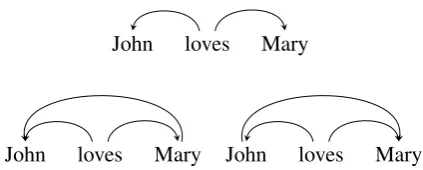
Consider the tree at the top of Figure 1, for the example John loves Mary. In decoding, this tree could be our linguistic optimal, however according to our additive objective function, it is more likely for us to obtain either of the bottom DAGs, which is clearly not what is wanted in semantic parsing.
4 Related Research and an Approximation Guarantee
The only algorithm presented to date for MSDAG is an approximation algorithm proposed by
Mc-John loves Mary
[image:3.595.311.523.67.152.2]John loves Mary John loves Mary
Figure 1: Possible spanning DAGs forJohn loves Mary.
Donald and Pereira (2006), given without any ap-proximation guarantee. The algorithm first con-structs an MST of the weighted digraph, and then greedily attempts to add remaining edges to the MST in order of descending weight, so long as no cycle is introduced. Only part of this algorithm is greedy, so we will refer to it as semi-greedy-MSDAG. Given the fact that MS-DAG is APX-hard (Schluter, submitted), the fol-lowing approximation guarantee is not surprising. Theorem 2. semi-greedy-MSDAGis anO(1
n) factor approximation algorithm for MSDAG. Proof. We separate the proof into two parts. In Part 1, we first consider an easy worst case scenario for an upper bound on the error for semi-greedy-MSDAG, without any considera-tion for whether such a graph actually exists. Fol-lowing this in Part 2, we construct a family of graphs to show that this bound is tight (i.e., that the algorithm exhibits worst imaginable behaviour for this family of graphs).
Part 1. For Ga digraph, letDbe the output of semi-greedy-MSDAGonG, andD∗be an
MS-DAG for G. The worst case is (bounded by the case) where the algorithm finds an MST T∗ for
Gbut then cannot introduce any extra edges to ob-tain a spanning DAG of higher weight, because the addition of any extra edges would induce a cycle. ForG’s nodes, we suppose that|V(G)|> 3. For edges, we suppose that all the edges in T∗ have
equally the largest weight, saywmax, of any edge in E(G), and that all other edges in E(G) have weightO(wmax). We can do this, because it gives an advantage toT∗.
We suppose also that the underlying undirected graph ofGis complete and that the true MSDAG forGisD∗ := (V(G), E(G)−E(T∗)).
con-tains every other possible edge in the graph, with the weight of every edge inD∗ being at most the
weight of the maximum weighted edge of those ofT∗(remember we are trying to favourT∗). No
other imaginable case could introduce more edges toD∗without inducing a cycle. So, for allG,
w(D∗) =O(n−1)2·wmax
2
=O(n2·w max),
and we had thatw(T∗) = w(D) = O(n·wmax).
So at very worst, semi-greedy-MSDAG finds a spanning DAGDof weight withinO(1
n)of the optimal.
Part 2. We now show that this bound is tight. We construct a family of graphsGn= (Vn, En)as follows. Vn := {v0, v1, v2, . . . , vn}, withn > 3, and we suppose thatnis even. Letc∈Rbe some constant such thatc > 3. We place the following edges inEn:
(E1) (vi, vi+1)of weightcfor alli∈ {0, . . . , n−
1}into En, creating a path from v0 tovn of lengthnwhere every edge has weightc, and
(E2) (vi, vj)of weightc−1for allj ∈ {2, i−1},
i∈ {2, . . . , n}.
So, in addition to the path defined by the edges in (E1),Gn− {v0}contains a weighted tournament
onn−1nodes, such that ifj < i, then there is an edge fromitoj.
Let us denote the MST of Gn by Tn∗ and the maximal spanning tree obtainable by semi-greedy-MSDAG, by Dn. We will show that the (unique) MSDAG ofGnis the graphD∗n that we construct below.
It is easy to see that the MSTT∗
n ofGnconsists of the edges in (E1), and that no further edges can be added toT∗
nwithout creating a cycle. So,Dn=
T∗
n.
On the other hand, we claim that there is a uniqueD∗
nconsisting of: 1. the edge(v0, v1),
2. the edges (v2i−1, v2i) for all i ∈
{1, . . . , n/2} into E(D∗
n), that is every second edge in the path described in (E1), and
3. all the edges from (E2) except for(v2i, v2i−1)
for alli∈ {1, . . . , n/2}. We can easily see thatD∗
nis at least maximal. The only edges not in D∗
n are ones that are parallel
to other edges. So, introducing any other edge from (E2) would mean removing an edge from (E1), which would decreaseD∗
n’s overall weight. Moreover, notice that introducing any other edge from (E1), say (vk−1, vk) would require remov-ing two edges (from (E2)), either(vk, vk−1) and
(vk+1, vk−1)or(vk, vk−1)and(vk, vk+1), to avoid
cycles in D∗
n, but this also decreases overall weight. We extend these two simple facts in the remainder of the proof, showing thatD∗, in
addi-tion to being maximal, is also a global maximum. We prove the result by induction on n(withn even), that D∗
n is the MSDAG for Gn. We take
n= 4as our base case.
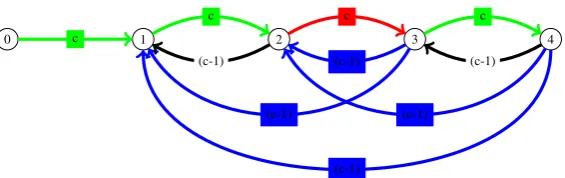
ForG4(see Figure 2),E(G4)−E(D∗4)contains
only three edges: the edge(v2, v3)of weightcand
the edges(v4, v3)and(v2, v1) of weight(c−1).
Following the same principles above, adding the edge (v2, v1) would entail removing an edge of
higher weight; the same is true of adding the edge (v4, v3). No further edges in either case could
be added to make up this difference and achieve greater weight thanD∗
4. So the only option is to
add the edge(v2, v3). However, this would entail
removing either the two edges(v3, v2)and(v4, v2)
or(v3, v2)and(v3, v4)fromD4∗, both of which
ac-tions results in lower overall weight. Now suppose D∗
n−2 is optimal (for n ≥ 6,
n even). We show that this implies D∗
n is op-timal (with n even). Consider the two sub-graphs Gn−2 and H of Gn induced by the sub-sets ofV(Gn), V(Gn−2) = {v0, . . . , vn−2} and
V(H) := {vn−1, vn} respectively (so H =
(V(H),{(vn−1, vn),(vn−1, vn)})). We are as-suming that the MSDAG ofGn−2isD∗n−2.
More-over, the MSDAG ofH is a single edge,DH :=
(V(H),{(vn−1, vn)}).
D∗
n includes the MSDAGs (D∗n−2 andDH) of these two digraphs, so for these parts ofD∗
n, we have reached an upper bound for optimality. Now we consider the optimal way to connectD∗
n−2and
DH to createDn∗.
Let C denote the set of edges in Gn which connect DH to Gn−2 and vice versa. C =
{(vn−2, vn−1)} ∪ {(un, ui) | 1 ≤ i < n} ∪
{(un−1, ui) | 1 ≤ i < n−1}. Note that the only edge from C not included in D∗
n is eC :=
(vn−2, vn−1). By the discussion above, we know
that includingeCwould mean excluding two other edges fromCof weight at least(c−1), which can-not be optimal. ThereforeD∗
0 1 2 3 4
(c-1) (c-1)
(c-1) (c-1) c c
c c
[image:5.595.159.442.59.148.2](c-1) (c-1)
Figure 2:G4, withD4∗in blue and green andT4∗in red and green.
So we have constructed a family of graphsGn wherew(Dn) =w(Tn∗) =ncand
w(D∗
n) =
n−1 X
i=0
i(c−1) + (n·c)
!
−(n2 ·c)
= n(n2−1)(c−1)−n2 ·c.
This completes the proof that
semi-greedy-MSDAG is an O
nc n(n−1)
2 (c−1)−n2·c
= O(1
n) factor ap-proximation algorithm for MSDAG.
Now let us consider the version of the state-ment of the MSDAG problem that, rather than maximising the weight of a spanning DAG D∗
of a weighted digraph G, looks to minimise the weight of the set C∗ of edges that must be
re-moved fromGin order forG−C∗ to be an
MS-DAG forG. Clearly these problems are identical. We refer to the minimisation version of the state-ment asMSDAGC, and toC∗as the complement
(inG) of the MSDAGD∗ := G−C∗. Also, let
semi-greedy-MSDAGC be the same algorithm assemi-greedy-MSDAGexcept that it outputs C∗rather thanD∗.
Using the same graphs and proof structure as in the proof of Theorem 2, the following theorem can be shown.
Theorem 3. semi-greedy-MSDAGC is an O(n) factor approximation algorithm for MSDAGC.
5 Conclusions and Open Questions This paper provides some philosophical and math-ematical foundations for the MSDAG problem as decoding in semantic parsing. We have put for-ward the view that the objective in semantic pars-ing is not in fact to find the MSDAG, however it re-mains open as to whether this mismatch can be tol-erated, given empirical evidence of MSDAG de-coding’s utility in semantic parsing. We have also
pointed to an explicit proof of theAPX-hardness (that of (Schluter, submitted)) of MSDAG and given an approximation guarantee of the only pub-lished approximation algorithm for this problem.
In particular, Schluter (submitted) provides an approximation preserving reduction from MSDAGC to IDMC. Moreover, the best known approximation ratio for IDMC isO(n1123) (Agar-wal et al., 2007), which yields a better (in terms of worst case error) approximation algorithm for MSDAGC. An interesting open problem would compare these two decoding approximation algo-rithms empirically for semantic parsing decoding and in terms of expected performance (or error) both in general as well as specifically for semantic parsing decoding.
References
Amit Agarwal, Noga Alon, and Moses Charikar. 2007. Improved approximation for directed cut problems. InProceedings of STOC, San Diego, CA.
D. Heckerman, D. Geiger, and D. M. Chickering. 1995. Learning bayesian networks: The combina-tion of knowledge and statistical data. Technical re-port, Microsoft Research. MSR-TR-94-09.
Ryan McDonald and Fernando Pereira. 2006. Online learning of approximate dependency parsing algo-rithms. InProc. of EACL, pages 81–88.
R. McDonald, F. Pereira, K. Ribarov, and J. Haji. 2005. Non-projective dependency parsing using spanning tree algorithms. In Proc. of HLT-EMNLP, pages 523–530, Vancouver, BC, Canada.
Kenji Sagae and Jun’ichi Tsujii. 2008. Shift-reduce dependency dag parsing. In 22nd International Conference on Computational Linguistics (Coling 2008), Manchester, UK.
Natalie Schluter. submitted. On the complexity of finding a maximum spanning dag and other dag parsing related restrictions.