Disease Mention Recognition with Specific Features
Md. Faisal Mahbub Chowdhury† ‡ and Alberto Lavelli‡
‡Human Language Technology Research Unit, Fondazione Bruno Kessler, Trento, Italy †ICT Doctoral School, University of Trento, Italy
{chowdhury,lavelli}@fbk.eu
Abstract
Despite an increasing amount of research on biomedical named entity recognition, there has been not enough work done on disease mention recognition. Difficulty of obtaining adequate corpora is one of the key reasons which hindered this particu-lar research. Previous studies argue that correct identification of disease mentions is the key issue for further improvement of the disease-centric knowledge extrac-tion tasks. In this paper, we present a ma-chine learning based approach that uses a feature set tailored for disease mention recognition and outperforms the state-of-the-art results. The paper also discusses why a feature set for the well studied gene/protein mention recognition task is not necessarily equally effective for other biomedical semantic types such as dis-eases.
1 Introduction
The massive growth of biomedical literature vol-ume has made the development of biomedical text mining solutions indispensable. One of the essen-tial requirements for a text mining application is the ability to identify relevant entities, i.e. named entity recognition. Previous work on biomedi-cal named entity recognition (BNER) has been mostly focused on gene/protein mention recogni-tion. Machine learning (ML) based approaches for gene/protein mention recognition have already achieved a sufficient level of maturity (Torii et al., 2009). However, the lack of availability of adequately annotated corpora has hindered the progress of BNER research for other semantic types such as diseases (Jimeno et al., 2008; Lea-man et al., 2009).
Correct identification of diseases is crucial for various disease-centric knowledge extraction tasks
(e.g. drug discovery (Agarwal and Searls, 2008)). Previous studies argue that the most promising candidate for the improvement of disease related relation extraction (e.g. disease-gene) is the cor-rect identification of concept mentions including diseases (Bundschus et al., 2008).
In this paper, we present a BNER system which uses a feature set specifically tailored for disease mention recognition. The system1 outperforms other approaches evaluated on the Arizona Dis-ease Corpus (AZDC) (more details in Section 5.1). One of the key differences between our approach and previous approaches is that we put more em-phasis on the contextual features. We exploit syn-tactic dependency relations as well. Apart from the experimental results, we also discuss why the choice of effective features for recognition of dis-ease mentions is different from that for the well studied gene/protein mentions.
The remaining of the paper is organized as fol-lows. Section 2 presents a brief description of pre-vious work on BNER for disease mention recog-nition. Then, Section 3 describes our system and Section 4 the feature set of the system. After that, Section 5 explains the experimental data, results and analyses. Section 6 describes the differences for the choice of feature set between diseases and genes/proteins. Finally, Section 7 concludes the paper with an outline of our future research.
2 Related Work
Named entity recognition (NER) is the task of lo-cating boundaries of the entity mentions in a text and tagging them with their corresponding seman-tic types (e.g. person, location, gene and so on). Although several disease annotated corpora have been released in the last few years, they have been annotated primarily to serve the purpose of re-lation extraction and, for different reasons, they
1The source code of our system is available for download
at http://hlt.fbk.eu/people/chowdhury/research
are not suitable for the development of ML based disease mention recognition systems (Leaman et al., 2009). For example, the BioText (Rosario and Hearst, 2004) corpus has no specific anno-tation guideline and contains several inconsisten-cies, while PennBioIE (Kulick et al., 2004) is very specific to a particular sub-domain of diseases. Among other disease annotated corpora, EBI dis-ease corpus (Jimeno et al., 2008) is not annotated with disease mention boundaries which makes it unsuitable for BNER evaluation for diseases. Re-cently, an annotated corpus, named as Arizona Disease Corpus (AZDC) (Leaman et al., 2009), has been released which has adequate and suitable annotation of disease mentions following specific annotation guidelines.
There has been some work on identifying dis-eases in clinical texts, especially in the context of CMC Medical NLP Challenge2 and i2b2 Chal-lenge3. However, as noted by Meystre et al. (2008), there are a number of reasons that make clinical texts different from texts of biomedical literature, e.g. composition of short, telegraphic phrases, use of implicit templates and pseudo-tables and so on. Hence, the strategies adopted for NER on clinical texts are not the same as the ones practiced for NER on biomedical literature.
As mentioned before, most of the work to date on BNER is focused on gene/protein men-tion recognimen-tion. State-of-the-art BNER systems are based on ML techniques such as conditional random fields (CRFs), support vector machines (SVMs) etc (Dai et al., 2009). These systems use either gene/protein specific features (e.g. Greek alphabet matching) or post-processing rules (e.g. extension of the identified mention boundaries to the left when a single letter with a hyphen precedes them (Torii et al., 2009)) which might not be as effective for other semantic type identification as they are for genes/proteins. There is a substantial agreement in the feature set that these systems use (most of which are actually various orthographical and morphological features).
Bundschus et al. (2008) have used a CRF based approach that uses typical features for gene/protein mention recognition (i.e. no feature tailoring for disease recognition) for disease, gene and treatement recognition. The work has been evaluated on two corpora which have been
anno-2
http://www.computationalmedicine.org/challenge/index.php
3https://www.i2b2.org/NLP/Relations/Main.php
tated with those entities that participate in disease-gene and disease-treatment relations. The reported results show F-measure for recognition of all the entities that participate in the relations and do not indicate which F-measure has been achieved specifically for disease recognition. Hence, the re-ported results are not applicable for comparison.
To the best of our knowledge, the only sys-tematic experimental results reported for disease mention recognition in biomedical literature using ML based approaches are published by Leaman and Gonzalez (2008) and Leaman et al. (2009).4 They have used a CRF based BNER system named BANNER which basically uses a set of ortho-graphic, morphological and shallow syntactic fea-tures (Leaman and Gonzalez, 2008). The system achieves an F-score of 86.43 on the BioCreative II GM corpus5 which is one of the best results for gene mention recognition task on that corpus.
BANNER achieves an F-score of 54.84 for dis-ease mention recognition on the BioText corpus (Leaman and Gonzalez, 2008). However, as said above, the BioText corpus contains annotation in-consistencies6. So, the corpus is not ideal for com-paring system performances. The AZDC corpus is much more suitable as it is annotated specifi-cally for benchmarking of disease mention recog-nition systems. An improved version of BAN-NER achieves an F-score of 77.9 on AZDC cor-pus, which is the state of the art on ML based dis-ease mention recognition in biomedical literature (Leaman et al., 2009).
3 Description of Our System
There are basically three stages in our approach – pre-processing, feature extraction and model train-ing, and post-processing.
3.1 Pre-processing
At first, the system uses GeniaTagger7to tokenize texts and provide PoS tagging. After that, it cor-rects some common inconsistencies introduced by GeniaTagger inside the tokenized data (e.g. Ge-niaTagger replaces double inverted commas with
4
However, there are some work on disease recognition in biomedical literature using other techniques such as morpho-syntactic heuristic based approach (e.g. MetaMap (Aronson, 2001)), dictionary look-up method and statistical approach (Ne´ve´ol et al., 2009; Jimeno et al., 2008; Leaman et al., 2009).
5
As mentioned in http://banner.sourceforge.net/
6
http://biotext.berkeley.edu/data/dis treat data.html
two single inverted commas). These PoS tagged tokized data are parsed using Stanford parser8. The dependency relations provided as output by the parser are used later as features. The tokens are further processed using the following general-ization and normalgeneral-ization steps:
• each number (both integer and real) inside a token is replaced with‘9’
• each token is further tokenized if it contains either punctuation characters or both digits and alphabetic characters
• all letters are changed to lower case
• all Greek letters (e.g. alpha) are replaced with
Gand Roman numbers (e.g. iv) withR
• each token is normalized using SPECIALIST lexicon tool9to avoid spelling variations
3.2 Feature extraction and model training
The features used by our system can be catego-rized into the following groups:
• general linguistic features (Table 1)
• orthographic features (Table 2)
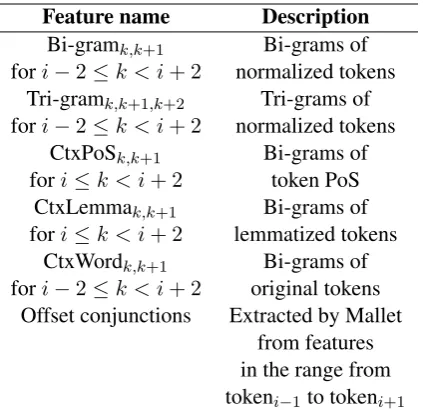
• contextual features (Table 3)
• syntactic dependency features (Table 4)
• dictionary lookup features (see Section 4)
During dictionary lookup feature extraction, we ignored punctuation characters while matching dictionary entries inside sentences. If a sequence of tokens in a sentence matches an entry in the dic-tionary, the leftmost token of that sequence is la-beled with B-DB and the remaining tokens of the sequence are labeled with I-DB. The label B-DB indicates the beginning of a dictionary match. If a token belongs to several dictionary matches, then all the other dictionary matches except the longest one are discarded.
The syntactic dependency features are extracted from the output of the parser while the general lin-guistic features are extracted directly from the pre-processed tokens. To collect the orthographic fea-tures, the original tokens inside the corresponding sentences are considered. The contextual features
8
http://nlp.stanford.edu/software/lex-parser.shtml
9http://lexsrv3.nlm.nih.gov/SPECIALIST/index.html
are derived using other extracted features and the original tokens.
Tokens are labeled with the corresponding dis-ease annotations according to the IOB2 format. Our system uses Mallet (McCallum, 2002) to train a first-order CRF model. CRF is a state-of-the-art ML technique applied to a variety of text processing tasks including named entity recogni-tion (Klinger and Tomanek, 2007) and has been successfully used by many other BNER systems (Smith et al., 2008).
3.3 Post-processing
Once the disease mentions are identified using the learned model, the following post-processing techniques are applied to reduce the number of wrong identifications:
• Bracket mismatch correction: If there is a
mismatch of brackets in the identified men-tion, then the immediate following (or pre-ceding) character of the corresponding tion is checked and included inside the men-tion if that character is the missing bracket. Otherwise, all the characters from the index where the mismatched bracket exists inside the identified mention are discarded from the corresponding mention.
• One sense per discourse: If any instance of
a character sequence is identified as a disease mention, then all the other instances of that character sequence inside the same sentence are also annotated as disease mentions.
• Short/long form annotation: Using the
algo-rithm of Schwartz and Hearst (2003),“long form (short form)”instances are detected in-side sentences. If the short form is annotated as disease mention, then the long form is also annotated and vice versa.
• Ungrammatical conjunction structure
cor-rection: If an annotated mention contains
• Short and long form separation:If both short and long forms are annotated in the same mention, then the original mention is dis-carded and the corresponding short and long forms are annotated separately.
4 Features for Disease Recognition
There are compelling reasons to believe that vari-ous issues regarding the well studied gene/protein mention recognition would not apply to the other semantic types. For example, Jimeno et al. (2008) argue that the use of disease terms in biomedical literature is well standardized, which is quite op-posite for the gene terms (Smith et al., 2008).
After a thorough study and extensive experi-ments on various features and their possible com-binations, we have selected a feature set specific to the disease mention identification which com-prises features shown in Tables 1, 2, 4 and 3, and dictionary lookup features.
Feature name Description
PoS Part-of-speech tag NormWord Normalized token (see Section 3.1) Lemma Lemmatized form charNgram 3 and 4 character n-grams
[image:4.595.312.524.61.266.2]Suffix 2-4 character suffixes Prefix 2-4 character prefixes
Table 1: General linguistic features for tokeni
Feature name Description
InitCap Is initial letter capital AllCap Are all letters capital MixCase Does contain mixed case letters SingLow Is a single lower case letter
SingUp Is a single upper case letter Num Is a number
PuncChar Punctuation character (if tokeniis
a punctuation character) PrevCharAN Is previous character
alphanumeric
Table 2: Orthographic features for tokeni
Like Leaman et al. (2009), we have created a dictionary with the instances of the following nine of the twelve UMLS semantic types from
Feature name Description
Bi-gramk,k+1 Bi-grams of
fori−2≤k < i+ 2 normalized tokens Tri-gramk,k+1,k+2 Tri-grams of
fori−2≤k < i+ 2 normalized tokens CtxPoSk,k+1 Bi-grams of
fori≤k < i+ 2 token PoS CtxLemmak,k+1 Bi-grams of
fori≤k < i+ 2 lemmatized tokens CtxWordk,k+1 Bi-grams of
fori−2≤k < i+ 2 original tokens Offset conjunctions Extracted by Mallet
[image:4.595.305.533.305.458.2]from features in the range from tokeni−1to tokeni+1
Table 3: Contextual features for tokeni
Feature name Description
dobj Target token(s) to which tokeni
is a direct object iobj Target token(s) to which tokeni
is an indirect object nsubj Target token(s) to which tokeni
is an active nominal subject nsubjpass Target token(s) to which tokeni
is a passive nominal subject nn Target token(s) to which tokeni
is a noun compound modifier
Table 4: Syntactic dependency features for tokeni.
For example, in the sentence “Clinton defeated Dole”, “Clinton” is thensubj of the target token
“defeated”.
the semantic group “DISORDER”10 from UMLS Metathesaurus (Bodenreider, 2004): (i)disease or syndrome, (ii)neoplastic process, (iii)congenital abnormality, (iv)acquired abnormality, (v)
exper-imental model of disease, (vi) injury or
poison-ing, (vii)mental or behavioral dysfunction, (viii)
pathological function and (ix) sign or symptom.
We have not considered the other three semantic types (findings, anatomical abnormality and cell
or molecular Dysfunction) since these three types
have not been used during the annotation of Ari-zona Disease Corpus (AZDC) which we have used in our experiments.
Previous studies have shown that dictionary lookup features, i.e. name matching against a
dictionary of terms, often increase recall (Torii et al., 2009; Leaman et al., 2009). However, an unprocessed dictionary usually does not boost overall performance (Zweigenbaum et al., 2007). So, to reduce uninformative lexical differences or spelling variations, we generalize and normalize the dictionary entries using exactly the same steps followed for the pre-processing of sentences (see Section 3.1).
To reduce chances of false and unlikely matches, any entry inside the dictionary having less than 3 characters or more than 10 tokens is discarded.
5 Experiments
5.1 Data
We have done experiments on the recently re-leased Arizona Disease Corpus (AZDC)11 (Lea-man et al., 2009). The corpus has detailed annota-tions of diseases including UMLS codes, UMLS concept names, possible alternative codes, and start and end points of disease mentions inside the corresponding sentences. These detailed an-notations make this corpus a valuable resource for evaluating and benchmarking text mining so-lutions for disease recognition. Table 5 shows var-ious characteristics of the corpus.
Item name Total count
Abstracts 793
Sentences 2,783
Total disease mentions 3,455 Disease mentions without overlaps 3,093 Disease mentions with overlaps 362
Table 5: Various characteristics of AZDC.
For the overlapping annotations, (e.g. “endome-trial and ovarian cancers” and “ovarian cancers”) we have considered only the larger annotations in our experiments. There remain 3,224 disease mentions after resolving overlaps according to the aforementioned criterion. We have observed mi-nor differences in some statistics of the AZDC re-ported by Leaman et al. (2009) with the statistics of the downloadable version12 (Table 5).
How-11Downloaded from http://diego.asu.edu/downloads/AZDC/
at 5-Feb-2009
12Note that
“Disease mentions (total)”in the paper of Lea-man et al. (2009) actually refers to thetotal disease mentions after overlap resolving(Robert Leaman, personal communi-cation). One other thing is, Leaman et al. (2009) mention 794
ever, these differences can be considered negligi-ble.
5.2 Results
We follow an experimental setting similar to the one in Leaman et al. (2009) so that we can com-pare our results with that of the BANNER system. We performed 10-fold cross validation on AZDC in such a way that all sentences of the same ab-stract are included in the same fold. The results of all folds are averaged to obtain the final outcome. Table 6 shows the results of the experiments with different features using the exact matching crite-rion.
As we can see, our approach achieves signif-icantly higher result than that of BANNER. Ini-tially, with only the general linguistic and or-thographic features the performance is not high. However, once the contextual features are used, there is a substantial improvement in the result. Note that BANNER does not use contextual fea-tures. In fact, the use of contextual features is also quite limited in other BNER systems that achieve high performance for gene/protein identification (Smith et al., 2008).
Dictionary lookup features provide a very good contribution in the outcome. This supports the ar-gument of Jimeno et al. (2008) that the use of dis-ease terms in biomedical literature is well stan-dardized. Post-processing and syntactic depen-dency features also increase some performance.
We have done statistical significance tests for the last four experimental results shown in Table 6. For each of such four experiments, the immediate previous experiment is considered as the baseline. The tests have been performed using the approx-imate randomization procedure (Noreen, 1989). We have set the number of iterations to 1,000 and the confidence level to 0.01. According to the tests, the contributions of contextual features and dictionary lookup features are statistically signif-icant. However, we have found that the contri-butions of post-processing rules and syntactic de-pendency features are statistically significant only when the confidence level is 0.2 or more. Since AZDC consists of only 2,783 sentences, we can assume that the impact of post-processing rules
and syntactic dependency features has been not so significant despite of some performance improve-ment.
5.3 Error analysis
One of the sources of errors is the annotations having conjunction structures. There are 94 dis-ease mentions in the data which contain the word “and”. The boundaries of 11 of them have been wrongly identified during experiments, while 39 of them have been totally missed out by our sys-tem. Our system also has not performed well for disease annotations that have some specific types of prepositional phrase structures. For ex-ample, there are 80 disease annotations having the word “of” (e.g. “deficient activity of acid beta-glucosidase GBA”). Only 28 of them are correctly annotated by our system. The major source of er-rors, however, concerns abbreviated disease names (e.g. “PNH”). We believe one way to reduce this specific error type is to generate a list of possi-ble abbreviated disease names from the long forms of disease names available in databases such as UMLS Metathesaurus.
6 Why Features for Diseases and Genes/Proteins are not the Same
Many of the existing BNER systems, which are mainly tuned for gene/protein identification, use features such as token shape (also known as word class and brief word class (Settles, 2004)), Greek alphabet matching, Roman number matching and so forth. As mentioned earlier, we have done ex-tensive experiments with various feature combina-tions for the selection of disease specific features. We have observed that many of the features used for gene/protein identification are not equally ef-fective for disease identification. Table 7 shows some of the results of those experiments.
This observation is reasonable because gene/protein names are much more complex than entities such as diseases. For example, they often contain punctuation characters (such as paren-theses or hyphen), Greek alphabets and digits which are unlikely in disease names. Ideally, the ML algorithm itself should be able to utilize information from only the useful features and ignore the others in the feature set. But practically, having non-informative features often mislead the model learning. In fact, several surveys have argued that the choice of features matter at least
as much as the choice of the algorithm if not more (Nadeau and Sekine, 2007; Zweigenbaum et al., 2007).
One of the interesting trends in gene/protein mention identification is to not utilize syntactic dependency relations (with the exception of Vla-chos (2007)). Gene/protein names in biomedi-cal literature are often combined (i.e. without being separated by space characters) with other characters which do not belong to the correspond-ing mentions (e.g. p53-mediated). Moreover, as mentioned before, gene/protein mentions com-monly have very complex structures (e.g.
PKR(1-551)K64E/K296RorRXRalphaF318A). So, it is a
common practice to tokenize gene/proten names adopting an approach that split tokens as much as possible to extract effective features (Torii et al., 2009; Smith et al., 2008). But while the extensive tokenization boosts performance, it is often diffi-cult to correctly detect dependency relations for the tokens of the gene/protein names in the sen-tences where they appear. As a result, use of the syntactic dependency relations is not beneficial in such approaches.13 In comparison, disease men-tions are less complex. So, the identified depen-dencies for disease mentions are more reliable and hence may be usable as potential features (refer to our experimental results in Table 6).
The above mentioned issues are some of the reasons why a feature set for the well studied gene/protein focused BNER approaches is not necessarily suitable for other biomedical semantic types such as diseases.
7 Conclusion
In this paper, we have presented a single CRF clas-sifier based BNER approach for disease mention identification. The feature set is constructed us-ing disease-specific contextual, orthographic, gen-eral linguistic, syntactic dependency and dictio-nary lookup features. We have evaluated our ap-proach on AZDC corpus. Our apap-proach achieves significantly higher result than BANNER which is the current state-of-the-art ML based approach for disease mention recognition. We have also ex-plained why the choice of features for the well studied gene/protein does not apply for other se-mantic types such as diseases.
13We have done some experiments on Biocreative II GM
System Note Precision Recall F-score
BANNER (Leaman et al., 2009) 80.9 75.1 77.9
[image:7.595.82.518.62.158.2]Our system Using general linguistic and orthographic features 74.90 71.01 72.90 Our system After adding contextual features 82.15 75.81 78.85 Our system After adding post-processing 81.57 76.61 79.01 Our system After adding syntactic dependency features 82.07 76.66 79.27 Our system After adding dictionary lookup features 83.21 79.06 81.08
Table 6: 10-fold cross validation results using exact matching criteria on AZDC.
Experiment Note Precision Recall F-score
(i) Using general linguistic, orthographic 82.15 75.81 78.85 and contextual features
(ii) After addingWCandBWCfeatures in(i) 82.08 75.57 78.69 (iii) After addingIsGreekAlphabet,HasGreekAlphabet 82.10 75.69 78.76
andIsRomanNumberfeatures in(i)
Table 7: Experimental results of our system after using some of the gene/protein specific features for disease mention recognition on AZDC. Here,WCandBWCrefer to the “word class” and “brief word class” respectively.
Future work includes implementation of disease mention normalization (i.e. associating a unique identifier for each disease mention). We also plan to improve our current approach by includ-ing more contextual features and post-processinclud-ing rules.
Acknowledgments
This work was carried out in the context of the project “eOnco - Pervasive knowledge and data management in cancer care”. The authors would like to thank Robert Leaman for sharing the set-tings of his experiments on AZDC.
References
Agarwal, P., Searls, D. 2008. Literature mining in sup-port of drug discovery. Brief Bioinform, 9(6):479– 492.
Aronson, A. 2001. Effective mapping of biomedical text to the UMLS Metathesaurus: the MetaMap pro-gram. InProceedings AMIA Symposium, pages 17– 21.
Bodenreider, O. 2004. The Unified Medical Language System (UMLS): integrating biomedical terminol-ogy. Nucleic Acids Research, 32(suppl 1):D267– 270, January.
Bundschus, M., Dejori, M., Stetter, M., Tresp, V., Kriegel, H. 2008. Extraction of semantic biomed-ical relations from text using conditional random fields. BMC Bioinformatics, 9:207.
Dai, H., Chang, Y., Tsai, R., Hsu, W. 2009. New challenges for biological text-mining in the next decade. Journal of Computer Science and Technol-ogy, 25(1):169–179.
Jimeno, A., Jimnez-Ruiz, E., Lee, V., Gaudan, S., Berlanga, R., Rebholz-Schuhmann, D. 2008. As-sessment of disease named entity recognition on a corpus of annotated sentences. BMC Bioinformat-ics, 9(S-3).
Klinger, R., Tomanek, K. 2007. Classical Probabilistic Models and Conditional Random Fields. Technical Report TR07-2-013, Department of Computer Sci-ence, Dortmund University of Technology, Decem-ber.
Kulick, S., Bies, A., Liberman, M., Mandel, M., Mc-Donald, R., Palmer, M., Schein, A., Ungar, L. 2004. Integrated annotation for biomedical information ex-traction. In Proceedings of HLT/NAACL 2004 Bi-oLink Workshop, pages 61–68.
Leaman, R., Gonzalez, G. 2008. Banner: An exe-cutable survey of advances in biomedical named en-tity recognition. In Proceedings of Pacific Sympo-sium on Biocomputing, volume 13, pages 652–663.
Leaman, R., Miller, C., Gonzalez, G. 2009. Enabling recognition of diseases in biomedical text with ma-chine learning: Corpus and benchmark. In Proceed-ings of the 3rd International Symposium on Lan-guages in Biology and Medicine, pages 82–89.
McCallum, A. 2002. Mallet: A machine learning for language toolkit. http://mallet.cs.umass.edu,.
[image:7.595.77.520.195.280.2]recent research. IMIA Yearbook of Medical Infor-matics, pages 128–44.
N´eveol, A., Kim, W., Wilbur, W., Lu, Z. 2009. Explor-´ ing two biomedical text genres for disease recogni-tion. InProceedings of the BioNLP 2009 Workshop, pages 144–152, June.
Nadeau, D., Sekine, S. 2007. A survey of named entity recognition and classification. Linguisticae Investi-gationes, 30(1):3–26.
Noreen, E.W. 1989. Computer-Intensive Methods for Testing Hypotheses: An Introduction. Wiley-Interscience.
Rosario, B., Hearst, M. 2004. Classifying semantic relations in bioscience texts. InProceedings of the 42nd Meeting of the Association for Computational Linguistics (ACL’04).
Schwartz, A., Hearst, M. 2003. A simple algorithm for identifying abbreviation definitions in biomedi-cal text. In Proceedings of Pacific Symposium on Biocomputing, pages 451–62.
Settles, B. 2004. Biomedical named entity recognition using conditional random fields and rich feature sets. InProceedings of the International Joint Workshop on Natural Language Processing in Biomedicine and its Applications, pages 104–107.
Smith, L., Tanabe, L., Ando, R., Kuo, C., et al. 2008. Overview of BioCreative II gene mention recogni-tion. Genome Biology, 9(Suppl 2).
Torii, M., Hu, Z., Wu, C., Liu, H. 2009. Biotagger-GM: a gene/protein name recognition system. Jour-nal of the American Medical Informatics Associa-tion : JAMIA, 16:247–255.
Vlachos, A. 2007. Tackling the BioCreative2 gene mention task with conditional random fields and syntactic parsing. InProceedings of the 2nd BioCre-ative Challenge Evaluation Workshop, pages 85–87.