Improving Classification-Based Natural Language Understanding with
Non-Expert Annotation
Fabrizio Morbini and Eric Forbell and Kenji Sagae Institute for Creative Technologies
University of Southern California Los Angeles, CA 90094, USA
{morbini,forbell,sagae}@ict.usc.edu
Abstract
Although data-driven techniques are com-monly used for Natural Language Under-standing in dialogue systems, their effi-cacy is often hampered by the lack of ap-propriate annotated training data in suffi-cient amounts. We present an approach for rapid and cost-effective annotation of training data for classification-based lan-guage understanding in conversational di-alogue systems. Experiments using a web-accessible conversational character that in-teracts with a varied user population show that a dramatic improvement in natural language understanding and a substantial reduction in expert annotation effort can be achieved by leveraging non-expert an-notation.
1 Introduction
Robust Natural Language Understanding (NLU) remains a challenge in conversational dialogue systems that allow arbitrary natural language input from users. Although data-driven approaches are now commonly used to address the NLU problem as one of classification, e.g. (Heintze et al., 2010; Leuski and Traum, 2010; Moreira et al., 2011), where input utterances are mapped automatically into system-specific categories, the dependence of such approaches on training data annotated with semantic classes or dialogue acts creates a chicken and egg problem: user utterances are needed to create the annotated training data necessary for NLU by classification, but these cannot be col-lected without a working system that users can in-teract with.
Common solutions to this problem include the use of Wizard-of-Oz data collection, where a hu-man expert hu-manually provides the functionality of data-driven modules while data is collected from users, or the use of scenario authors who attempt to anticipate user input to create an initial set of
training data. While these options offer practical ways around the training data acquisition prob-lem, they typically require substantial work from system experts and provide suboptimal solutions: data-driven approaches work best when utterances in the training data are drawn from the same distri-bution as those encountered in actual system use, but the conditions under which training data is col-lected (a human expert filling in for systems mod-ules, or a human expert generating possible user utterances) are quite different from those where users interact with the final system. High qual-ity results are often obtained through an iterative process where an initial training set is authored by a scenario designer, but NLU resources are gradually updated based on real user data over time (Gandhe et al., 2011). Although this can ulti-mately produce training data composed primarily of real user utterances, and therefore result in bet-ter performance from data-driven models, an ex-pert annotator is required to perform manual clas-sification of user utterances. This is a laborious process that assumes availability and willingness of the annotator for as long as it takes to collect enough user utterances, which may range from weeks to months or even years, depending on the size of the domain and the number and type of ut-terance categories.
The main question we address is whether an-notation by non-experts can be leveraged to speed up utterance classification and lower its cost. We present a technique that frames the annotation of training data as a human intelligence task suit-able for crowdsourcing. Although there are sim-ilarities between our technique and active learning (e.g. see (Gambck et al., 2011)), an important dif-ference is that our technique does not reduce the annotation effort by reducing the size of the data to be labeled, but by casting the annotation task into a simpler problem. This allows us to take ad-vantage of the entire data generated by the users. Through an experiment with a conversational
logue system deployed on the web, we show that a dramatic improvement in the quality of NLU can be achieved with non-expert data annotation, re-ducing the time required of an expert annotator by 70%.
2 Improving understanding with data
Our approach for creating accurate utterance clas-sifiers for NLU in conversational dialogue systems is based on a simple strategy, which we describe next in general terms. NLU is assumed to be per-formed through multiclass classification.
The first step is to create a small initial train-ing dataset T0 either through Wizard-of-Oz data
collection or by generation of utterances by a sys-tem developer or content author. This training set is used to train a NLU modelM0. Although this
model is likely to be inadequate, it allows users to interact with an initial version of the system. As input utterances are collected from real users, these utterances are annotated with their desired NLU output labels. Periodically, at timei, we add to the initial training datasetT0the annotated user
utterances accumulated up to that point. We train a new NLU modelMiusing this augmented
train-ing set,Ti.1 We also keep aside a small fraction
of utterances to test the performance of the NLU models, that is, at each timeiwe also have an eval-uation setEi and the union ofEiandTiis the
en-tire set of user utterances collected up to timei. As more utterances are added and annotated, an NLU modelMi is expected to surpass the initial model M0. In general, we replace the running NLU
model Mr whenever we have a better
perform-ing Mi model. This straightforward process can
be used to obtain increasingly more accurate lan-guage understanding, at the cost of data annotation in the form of labelling utterances with categories that are defined according to the needs of the spe-cific system and the spespe-cific domain. The cate-gories may be based on dialogue acts, e.g. (Core and Allen, 1997; Bunt et al., 2010), user informa-tion needs, e.g. (Moreira et al., 2011), or stand in for entire semantic frames, e.g. (DeVault and Traum, 2013). The technical nature of the task of categorizing utterances in schemes such as these usually means that substantial time is required of an expert annotator.
2.1 Annotation as a human intelligence task
Although the task of annotating NLU training data involves assigning categories with technical
defi-1For every timeiandjwithi < jit holds thatT i⊆Tj.
nitions to utterances, and therefore would appear to require knowledge of these technical defini-tions, in fact the task requires primarily the type of language understanding that is common to all native speakers of a given language. Our main hy-pothesis is that this annotation can be structured as a trivial task that requires no specific exper-tise, and that annotations performed this way can have a substantial impact on the quality of utter-ance classification. We define the NLU annotation task as follows.
Before annotation begins, each utterance cate-gory in the system is associated with one or more canonical utterance(s) that capture the meaning and communicative intent of that category. These canonical utterances allow for trivial generation of surface text from NLU categories by simple lookup.
Given a set of dialogues between the system and individual users, each dialogue is split into segments. Segments are typically composed of a user utterance and the preceding system ance. In cases where users produce multiple utter-ances without intervening system utterutter-ances, seg-ments may consist of a system utterance followed by consecutive user utterances, so that there is ex-actly one segment corresponding to each user ut-teranceuin the dialogue and each segment starts with a system utterance and ends withu.
Annotators work on one dialogue at a time, and within a dialogue they are presented with one seg-ment at a time, following the order in which the utterances appear in the dialogue. Assignment of a system category to the utterance targeted in a segment is a multiple choice task, involvingn
choices, one of which isnone of the above. The re-mainingn−1choices are generated automatically by running the current NLU utterance classifier on the target utterance, and generating the canonical surface realizations of each of the n−1 highest scoring categories. The annotator is then asked to choose the option containing language that means the same as the targeted utterance in the segment. The choice ofndepends on the quality of the cur-rent NLU model, and must be made to balance the length of the list of options with the expected num-ber of times the appropriate choice is not in the list of options. The more none of the above tions are performed, the less effective the annota-tion exercise will be in reducing the effort required by an annotation expert.
The utterances annotated asnone of the above
System Hello and welcome. ...
User Are you married?
System Yeah, forty-four years this September. I can’t be-lieve Linda’s stuck with me this long.
System Okay, let’s get to it. Why are you here today? User I’ve been having trouble sleeping lately. System This must be hard for you.
System Are you feeling stressed at all? User Yes, quite a bit
System So, I’ve got some questions I need to ask you, to get to know you better.
System Just double checking, you haven’t been sleeping good. Is that right?
User That’s right
System Have you been having any nightmares?
User Every once in a while, but mostly I can’t stay asleep ...
Figure 1: Excerpt of a sample interaction with a Simcoach character over the web. User input is typed into a text box on a web page.
of this procedure on how quickly user utterances are annotated as training examples for the NLU and how much expert time is saved depends on the quality of the initial classification model and the choice ofn. These are practical factors that are expected to vary greatly from one dialogue system to another. In the next section, we present one ap-plication of this procedure to an existing conversa-tional dialogue system deployed on the web, and show examples of dialogue segments and annota-tion opannota-tions.
3 Experiment
To test our hypothesis that language understand-ing can be improved with much reduced expert ef-fort, we applied the framework described above to a system that implements a conversational char-acter that talks with users about issues relating to mental and behavioral disorders and presents health care options. The system is publicly ac-cessible at http://www.simcoach.org, and receives traffic on the order of one hundred users per week. Of these, about one quarter engage the system in a meaningful dialogue with multiple turns, with the dialogues containing on average 16 user utter-ances. Because our process depends crucially on user traffic to generate data for annotation, a web-accessible system is ideally suited for it. An ex-cerpt from a typical interaction with the system is shown in Figure 1. The system and the NLU clas-sifier based on Maximum Entropy models (Berger et al., 1996) are described respectively in (Rizzo et al., 2011) and (Sagae et al., 2009).
3.1 Data collection
Starting with an initial system deployed with an NLU model trained with data generated by an au-thor attempting to anticipate user behavior, we ap-plied the approach described in section 2 to im-prove NLU accuracy over a period of approxi-mately five months. The initial accuracy of the NLU classifier was 62%, measured as the number of utterances classified correctly divided by the to-tal number of user utterances. This accuracy fig-ure was obtained only after the five months of data annotation, using the heldout set of manually an-notated dialogues.
Although the data annotation procedure as de-scribed in section 2 could in principle be per-formed continuously as user data come in, we instead performed all of our annotation in three rounds, the first consisting of approximately 2,000 user utterances, the second one month later, con-sisting of an additional 1,000 utterances. The last round, collected about two months later, contained about 2,000 utterances. We used five annotators2
working in parallel, and the average speed of each annotator exceeded 500 utterances per hour.
The total number of NLU utterance classes in the system is 378, although only 120 classes were used by annotators in all rounds of annotation to cover all of the utterances collected3. In our
an-notation exercise we set the number of multiple choice items atn= 6, including 5 choices gener-ated from categories chosen by the NLU classifier, and onenone of the abovechoice. Figure 2 shows a sample dialogue segment with the corresponding multiple choice items. During annotation, clicking on a multiple choice item advances the annotation by presenting the next segment containing a user utterance to be annotated.
3.2 Results
Of the utterances in the three rounds of data col-lection, respectively 29%, 34% and 17% were marked by annotators asnone of the above. These were given to a developer of the NLU system who assigned a category to each of them. In this ex-pert annotation step the choice is not restricted to a small set of options, and may be any of the cat-egories in the system. Given this rate of use of
2The non-expert annotators belonged to the same team
that developed the system but did not participate in the de-velopment of the NLU module and the NLU classes used in the particular dialogue system used.
3This difference is a further evidence of the difficulty of
System Okay, let’s get to it. Why are you here today? User I’ve been having trouble sleeping lately. Which of the following options correspond most closely to the last user utterance? If none of them have the same general meaning as the user utterance, select ”none of the above.”
(a) I have been in a bad mood lately (b) I have nightmares often (c) I haven’t been sleeping well (d) My family is worried about me (e) I eat too much
(f) None of the above
Figure 2: Example of a dialogue segment with cor-responding multiple choice items. The annotation task consists of choosing the item that has approx-imately the same meaning and communicative in-tent as the targeted utterance (the user utterance).
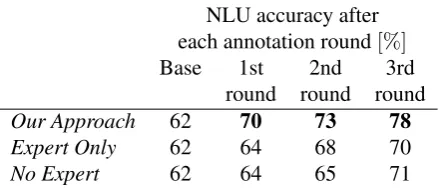
the none of the above category, the need for ex-pert annotation is not eliminated, but the amount of expert effort necessary is reduced by over 70%. The NLU classification accuracy figures ob-tained after each round of annotation are shown in Table 1. In the table,Our Approachrepresents the results obtained by the technique described here. A large improvement is observed after the first round of annotation, with a more modest improve-ment observed after the other two rounds. The ini-tial jump in accuracy after round 1 is explained by the fact that the initial model based on a sys-tem author’s expectation of what users may say to the system (approximately 3,000 utterances) is im-proved using utterances that users did in fact pro-duce in real interactions with the system. Clearly, a more well-matched distribution of utterances in the training data produces higher accuracy.
To assess the value of our approach, we com-pare it with two other reasonable experimental conditions: a baseline where only expert annota-tion is used (Expert Only), and a condition where no expert annotation is used (No Expert). The Ex-pert Onlycondition is meant to represent what can be achieved with the same workload for the expert used inOur Approach. This is achieved by random selection of user utterances to create a set with the same number of utterances set aside for ex-pert annotation inOur Approach. The expert then annotates each of these utterances to create train-ing data. For the No Expert condition, we used only utterances annotated by non-experts, leaving out completely utterances labeled as none of the
NLU accuracy after each annotation round[%]
Base 1st 2nd 3rd round round round
Our Approach 62 70 73 78
Expert Only 62 64 68 70
[image:4.595.308.528.62.157.2]No Expert 62 64 65 71
Table 1: NLU accuracy obtained using the initial training datasetT0, after one round of annotation
withT1(2,013 utterances), after two rounds of
an-notation with T2 (additional 948 utterances), and
after three rounds withT3 (additional 1806
utter-ances). Accuracy is estimated on the same heldout set of dialoguesE3 for all conditions, accounting
for roughly 10% of the annotated data.
above. Both Expert Only and No Expert condi-tions achieve significantly lower performance than the approach described here. This indicates that expert annotation is important, but also that cheap and fast non-expert annotation can provide sub-stantial improvements to NLU.
4 Conclusion
We described a framework for annotation of train-ing data by non-experts that can provide dramatic improvements to natural language understanding in dialogue systems that perform NLU through ut-terance classification. Our approach transforms the annotation NLU training data into a task that can be performed by anyone with language profi-ciency. Annotation is structured as a simple mul-tiple choice task, easily delivered over the web.
Using our approach with a conversational char-acter on the web, we improved NLU accuracy from 62% to 78% using only less than 30% of the effort it would be required of an expert to annotate data without non-expert annotation.
Acknowledgments
References
Adam L. Berger, Vincent J. Della Pietra, and Stephen A. Della Pietra. 1996. A maximum entropy ap-proach to natural language processing. Comput. Linguist., 22(1):39–71, March.
Harry Bunt, Jan Alexandersson, Jean Carletta, Jae-Woong Choe, Alex Chengyu Fang, Koiti Hasida, Kiyong Lee, Volha Petukhova, Andrei Popescu-Belis, Laurent Romary, Claudia Soria, and David Traum. 2010. Towards an iso standard for dia-logue act annotation. In Nicoletta Calzolari (Con-ference Chair), Khalid Choukri, Bente Maegaard, Joseph Mariani, Jan Odijk, Stelios Piperidis, Mike Rosner, and Daniel Tapias, editors, Proceedings of the Seventh International Conference on Lan-guage Resources and Evaluation (LREC’10), Val-letta, Malta, may. European Language Resources Association (ELRA).
Mark G. Core and James F. Allen. 1997. Coding di-alogues with the DAMSL annotation scheme. In David Traum, editor, Working Notes: AAAI Fall Symposium on Communicative Action in Humans and Machines, pages 28–35, Menlo Park, Califor-nia. AAAI, American Association for Artificial In-telligence.
David DeVault and David Traum. 2013. A method for the approximation of incremental understanding of explicit utterance meaning using predictive mod-els in nite domains. In Conference of the North American Chapter of the Association for Computa-tional Linguistics: Human Language Technologies, Atlanta, GA, June.
Bjrn Gambck, Fredrik Olsson, and Oscar Tckstrm. 2011. Active learning for dialogue act classification. InINTERSPEECH, pages 1329–1332. ISCA. Sudeep Gandhe, Michael Rushforth, Priti
Aggar-wal, and David Traum. 2011. Evaluation of an integrated authoring tool for building advanced question-answering characters. In12th Annual Con-ference of the International Speech Communication Association (InterSpeech 2011), Florence, Italy, Au-gust.
Silvan Heintze, Timo Baumann, and David Schlangen. 2010. Comparing local and sequential models for statistical incremental natural language under-standing. In Raquel Fern´andez, Yasuhiro Kata-giri, Kazunori Komatani, Oliver Lemon, and Mikio Nakano, editors,SIGDIAL Conference, pages 9–16. The Association for Computer Linguistics.
Anton Leuski and David R. Traum. 2010. Practical language processing for virtual humans. In Twenty-Second Annual Conference on Innovative Applica-tions of Artificial Intelligence (IAAI-10).
Catarina Moreira, Ana Cristina Mendes, Lu´ısa Coheur, and Bruno Martins. 2011. Towards the rapid devel-opment of a natural language understanding mod-ule. InProceedings of the 10th International
Con-ference on Intelligent Virtual Agents, IVA’11, pages 309–315, Berlin, Heidelberg. Springer-Verlag. Albert A. Rizzo, Belinda Lange, John G. Buckwalter,
E. Forbell, Julia Kim, Kenji Sagae, Josh Williams, Barbara O. Rothbaum, JoAnn Difede, Greg Reger, Thomas Parsons, and Patrick Kenny. 2011. An in-telligent virtual human system for providing health-care information and support. InStudies in Health Technology and Informatics.