1
Jordi BultenUniversity of Twente
Faculty of Behavioural, Management and Social Sciences
Master Business Administration
First supervisor: Dr. R.P.A. Loohuis MBA
Second supervisor: Ir. B. Kijl
23-08-2019
Master Thesis
2
AbstractSubstantial research has been conducted on the topic ‘servitization’. Besides,
researchers also conducted substantial research on the relationships with channel partners. However, the role of channel partners is rarely investigated in servitization literature. In order to investigate if and how the role of the existing channel partners of the focal firm will change within the process from the commissioning phase until the aftercare regarding access control systems when a servitization strategy will be implemented and how these existing channel partners can be engaged in this servitization strategy , an attempt has been made to obtain an answer to the following research question:
“What are the consequences regarding the role of the channel partner within the
process from the commissioning phase until the aftercare regarding access control systems, when Tech Solutions implements a servitization strategy, and what are the possible ways for engaging the existing channel partners in this servitization
strategy?”
Contextually driven design research has been used in order to study the research question. The research problem has been identified and analyzed. In the end, a design has been made in order to engage existing channel partners in a servitization strategy. This research presents qualitative research. The approach ‘systematic combining’ is used in this research, which is characterized by a continuous movement between an empirical world and a theoretical world and builds more on the refinement of existing theories than on inventing new ones.
It has been found that changes will occur in the activities regarding setting up the server and the configuration of the access control systems. In addition, the change from reactive customer support towards customer success management will occur. Finally, Key Account Management will be more focused on up-selling. The existing channel partners, which are responsible for setting up the servers in the current situation, will be engaged in the activities regarding setting up the server to a less extent because the transition will be made towards cloud servers. The channel partners which are responsible for the configuration of access control systems in the current situation can still be engaged in the configuration of access control systems, despite the fact that these activities seem to be required to a less extent. In the aftercare phase, the existing channel partners can be engaged to a great extent in the provision of customer success management and the related key account management focused on upselling.
This research has made both theoretical and practical contributions.
3
Contents
1. Introduction ... 6
1.1. Company ... 6
1.2. Key topic ... 6
1.2.1. Case Context ... 6
1.3. Problem description ... 9
1.4. Research goal ... 10
1.5. Research Question and Sub-questions ... 10
2. Theoretical background ... 12
2.1. Channel Partners of Tech Solutions ... 12
2.1.1. Horizontal and vertical relationships with Tech Solutions ... 12
2.1.2. Types of channel partners ... 13
2.2. Partner Levels ... 14
2.3. Importance of relationships with the external network in a servitized environment ... 14
2.4 Possible transformation of business relationships as a result of servitization ... 15
2.4.1. Impact of servitization on business relationships ... 15
2.4.2. Aims of business relationships in servitized environments ... 15
3. Methodology ... 17
3.1. Research design ... 17
3.2 Data collection ... 19
3.2.1. Problem identification ... 19
3.2.2. Problem Analysis... 19
3.2.3. Design of the solution ... 22
3.3. Methodology overview ... 23
4. Current situation ... 24
4.1. Empirical evidence ... 24
4.2. Current organizational design of the firm ... 27
4.3. Core competences of the different types of channel partners ... 28
4.3.1. Constructor ... 28
4.3.2. Man Guarding ... 30
4.3.3. Integrator ... 31
4.3.4. Installer ... 32
4.3.5. Value Added Distributor ... 32
4
4.5. The core competences of the different types of channel partners vs. currentdemand of Tech Solutions with respect to its channel partners ... 34
4.6. Activities offered to the end-user in the aftercare phase ... 38
4.6.1. Maintenance Services ... 38
4.6.2. Customer support ... 40
4.6.3. (Key) Account management ... 42
4.7. Current demand of Tech Solutions with respect to its channel partners in the aftercare phase ... 43
4.7.1. Preventive maintenance ... 43
4.7.2. Customer support ... 44
4.7.3. (Key) Account Management ... 44
4.8. Core competences of the different types of channel partners in the aftercare phase ... 44
4.8.1. Maintenance services ... 44
4.8.2. Customer Support ... 45
4.8.3. (Key) Account Management ... 46
4.9. Core competences of the different types of channel partners versus current demand of Tech Solutions with respect to its channel partners in the aftercare phase ... 46
5. Scenario ... 49
5.1. Change one: On-premise -> cloud-based server ... 49
5.2. Change two: Flexible configuration -> auto-configuration ... 50
5.3. Changes within the aftercare phase ... 51
5.3.1. Maintenance services towards operational services ... 51
5.3.2. Customer support towards customer success management ... 52
5.3.3. Account management focused on up-selling ... 53
6. Future situation ... 54
6.1. Consequences of changes in commissioning phase (change one and two) for the different types of channel partners ... 54
6.1.1. Constructors ... 54
6.1.2. Man Guarding ... 54
6.1.3. Integrator ... 55
6.1.4. Installer ... 55
6.1.5. Value Added Distributor ... 55
6.1.6. Matrix 3, 4, 5... 56
6.2. Consequences of changes in the aftercare phase (change 3) for the different types of channel partners ... 60
5
6.2.2. – Customer support towards customer success management ... 64
6.2.3. - Key Account Management focused on up-selling ... 82
7. Engagement of the channel partners in the servitization strategy ... 87
7.1 Consequences within the commissioning phase ... 88
7.1.1. Setting up the server ... 88
7.1.2. Configuration ... 89
7.2. Engagement of the different channel partners in the aftercare phase ... 91
7.2.1. Reactive customer support ... 91
7.2.2. Proactive customer support ... 92
7.2.3. Key Account management focused on upselling ... 93
8. Conclusion and Discussion ... 95
8.1. Conclusion ... 95
8.2. Discussion ... 96
8.2.1. Horizontal and vertical relationships ... 96
8.2.2. Impact of servitization on business relationships ... 97
8.2.3. Frictions and deformation in relationships with channel partners ... 97
8.3. Theoretical Contribution ... 99
8.4. Practical Contribution... 100
8.5. Limitations ... 101
8.6. Future Research ... 101
6
1. Introduction
In this introduction, the company, for which this thesis will be written, will be described. In addition, the key topic, the problem and the research goal will be explained. In the last paragraph, the research question and the related sub-questions will be presented.
1.1. Company
………
1.2. Key topic
The key topic of this research is the rarely investigated role of channel partners in a servitized environment. Where the topic ‘servitization’ and the topic ‘relationships with channel partners’ received substantial attention of researchers,
the role of channel partners in a servitized environment received little attention. In order to investigate this key topic, it will be investigated if and how the role of the existing channel partners of the focal firm will change within the process from the commissioning phase until the aftercare regarding access control systems when a servitization strategy will be implemented and how these existing channel partners can be engaged in this servitization strategy. In other words, within this research, it will be investigated whether the demand of the firm will change with respect to its existing types of channel partners, due to servitization. So, this research investigates if and how the role of the existing types of channel partners will change when the firm will offer ACaaS. The possible change in demand of Tech Solutions, and therefore the role of the existing types of channel partners, will be investigated for the process from the commissioning phase until the aftercare regarding access control systems. The aim of this research will be explained in more detail in the paragraphs ‘problem
description’ and ‘the research goal’.
So, Tech Solutions wants to offer access control as a service (ACaaS). This transition can be seen as the implementation of the servitization process. In order to determine if and how the role of the existing channel partners of Tech Solutions will change when the focal firm implements a servitization strategy and how the channel partner can be engaged in this servitization strategy, the case context first needs to become clear.
1.2.1. Case Context
In this paragraph, it will be examined what literature states about ACaaS and the servitization process.
Access Control as a Service
7
ACaaS. Therefore, the definition and reasons for SaaS will be used to determine how and why the firm wants to deliver ACaaS. SaaS can be described as a concept in which the software publisher (seller) runs and maintains all the hardware and software, possibly in cooperation with other partners, and the buyers obtain access based on a financial compensation (Choudhary, 2007). So, a business signs up to use the application hosted by the company that develops and sells the software, which unburdens1 the buyers in maintaining the software (Dubey & Wagle, 2007).When the firm wants to offer ACaaS, this will work nearly the same. There is also a separation between the hardware and software which makes offering ‘access control’ to the end-user possible. Tech Solutions can offer ACaaS, by running and maintaining all the hardware and software, possibly in cooperation with other (channel) partners. So, all the activities/tasks regarding access control will be managed for the end-user against financial compensation. The end-user obtains access to the software regarding the access control systems.
A possible reason for offering ACaaS was remarked by Godse and Mulik (2009). They stated that SaaS let organizations focus on their core business instead of support services such as IT infrastructure management and software maintenance. This means that ACaaS gives organizations the opportunity to outsource their access control activities/tasks in order to focus on their core business. So, outsourcing is a possible reason for end-users to ‘buy’ Access -Control-as-a-service. Next, it will be explained why the transition towards ACaaS can be seen as a step in the servitization process.
Servitization process
The transition towards ACaaS can be seen as a step in the servitization process. Baines, Lightfoot, and Benedettini (2009) define servitization as the innovation of organizations capabilities and processes to shift from selling products to selling integrated products and services that deliver value in use. Value in use can be described as the situation in which the customer experiences how its processes
function more efficiently and effectively with the support of the supplier’s activities
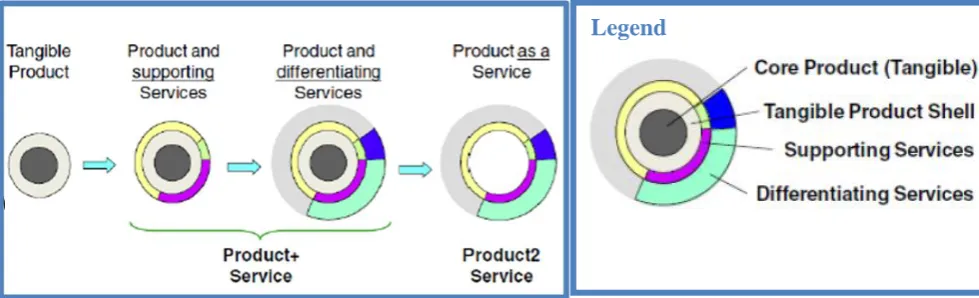
(Grönroos, 2007). It can be argued that the firm is already in the servitization process. Ducq, Chen, and Alix (2012) distinguish 4 stages in the servitization process (see figure 1).
1‘To unburden’ means that someone takes care of something for someone. In other words, ‘taking something off
someone's hands’. So, in this case, TECH SOLUTIONS takes cares of all the security management activities
8
[image:8.595.91.581.73.222.2]\
Figure 1 - The Servitization Process (Ducq, Chen, & Alix, 2012)
At the moment, the firm seems to be in-between stage two and three. The first stage is the selling of a tangible product. In the second stage, supporting services are added, i.e. maintenance and repair. So these services support the product (Ducq et al., 2012). Stage three is an evolution of stage two, it is more elaborated and by individualization of the extended product and it increases the differentiation (Wiesner, Peruzzini, Doumeingts, & Thoben, 2012). Training is an example of a differentiation service. Training could be provided to the users of the product in order to increase the efficiency of the usage. It can be noted that these types of services are merely focused on supporting the customer rather than focused on maintaining the product. The type of offering in this stage can be described as an extended product, which can be defined as an integrated offer of a product extended by services in order to provide a solution to the customer (Eschenbächer, Thoben, Hesmer, & Herter, 2011). The fourth stage visualizes the transformation towards a more service-oriented approach, whereby the value is mainly in the service content rather than in the content of the product. As can be seen in figure 1, the core tangible product has been left out in stage four. This implies/depicts a change in ownership in such a way that ownership is not transferred to the customer, but stays at the original equipment manufacturer (OEM). This stage is the highest level of servitization (Opresnik & Taisch, 2015). In this stage, the product is still part of the offering, but only the functionality of the product is sold. The ownership stays, as posed above, at the OEM and the characteristics of the product are less essential to the customer (Opresnik & Taisch, 2015). The offering in this stage is called a functional sale. Functional sale can be defined as the notion of selling the functionality rather than just the transfer of a tangible product from the manufacturer to the customer (Gupta, Wallace, & Sondheimer, 2008). In addition, it can be stated that the revenue comes purely from services, and the outcome could be regarded as the delivery of a capability and/or the selling of functionality.
Based on the interview with a business developer within the firm (Appendix 1), it can be concluded that the firm wants to reach stage 4. So, the firm wants to offer the product as a service. The main argument is that the end-user wants to be unburdened (Appendix 1). It wants to fully outsource the function ‘access control’.
As a result, end-users can focus on their core business. It is not determined yet whether the ownership of the product, the access control hardware, stays at Tech Solutions or still transfers to the end-users (Appendix 1).
9
1.3. Problem description
As argued in the previous paragraph, the firm wants to offer ACaaS. The firm does not know if and how its demand with respect to the existing types of channel partners will change due to the implementation of the servitization strategy
(Appendix 1, Appendix 2, Appendix 3). So, it will be investigated if and how the role of the existing types of channels partners will change within the process from the commissioning phase until the aftercare regarding access control systems when the firm will offer ACaaS. In order to determine if and how the role of the existing types of channel partners will change within the process from the commissioning phase until the aftercare regarding access control systems, a scenario will be described. This scenario describes in what way Tech Solutions intends to offer ACaaS. In other words, the scenario describes how the company wants to make the
above-mentioned step - to stage 4 - in the servitization process. It has been decided to create a scenario, because certain choices, which need to be made in order to make this transition, are not made by the firm yet. By describing the scenario, it can be determined what Tech Solutions requires from its existing types of channel partners when ACaaS will be offered. In doing so, it can be investigated if and how the role of the exiting types of channel partners will change when ACaaS will be offered to the end-user.
It is possible that the role of the channel partner will change. As Håkansson and Waluszewski (2011) state: “even if possibilities always exist in any industrial
structure to take out new qualities or features from a resource, this cannot be done
without work” (p. 570). In addition, Håkansson and Waluszewski (2011) remark that
“even if it is possible to utilize certain path dependency to create new solutions, this is not a smooth and easy process, working more or less automatically” (p. 570). According to Page (2006), path dependency is about “current and future states, actions, or decisions depend on the path of previous states, actions, or decisions” (p. 88). So, it can be stated that there has to be movement in order to create any change. This is supported by Håkansson and Waluszewski (2011), who state the following: “whenever there is a movement of a resource in relation to other resources, there will be friction” (p. 570). This means that there will also be other frictions in the relationship between supplier, existing types of channel partners and end-users when new paths are created. Therefore, it seems important for the firm to engage its existing types of channel partners in the servitization strategy, because it is possible that there will be some type of deformation and a possible friction when the firm wants to make a transition towards ACaaS. Based on Håkansson and Waluszewski (2011) it can be noted that the firm may need existing- and potential channel partners in order to offer ACaaS. Given the influence of path dependency, as remarked above, it is not possible to just ignore the existing channel partners and to put these channel partners aside (Håkansson & Waluszewski, 2011). To offer ACaaS, the firm might also need new channel partners. So, the firm must remain attractive for both existing- and new channel partners. Due to the fact that the research focuses on the existing channel partners and their potentially changing role, the aim of this research is to answer the question how the firm can engage its existing channel partners in its servitization strategy.
10
the aftercare, when it implements a servitization strategy and next to that, it wants to know how it is possible to engage its channel partners in its servitization strategy.1.4. Research goal
The goal of this research is to investigate if and how the role of the channel partner will change, within the process from the commissioning phase until the aftercare regarding access control systems, when the firm implements a
servitization strategy. Another research goal is that the focal firm wants to know in what way they can engage its existing channel partners in its servitization strategy, hence recommendations will be provided following the results of the study.
The outcome of the study will help the company (and possibly other firms) to better understand what are the possible consequences regarding the role of the channel partners if the firm implements a servitization strategy. The study will also portray in what way the firm can engage its channel partners in the servitization strategy.
1.5. Research Question and Sub-questions
As mentioned in the topic and the problem description, this research is about servitization and the possible change of the role of the channel partner within the process from the commissioning phase until the aftercare regarding access control systems. This paragraph presents the research questions which are designed to gain insight into the research objective. The central research question is as follows:
“What are the consequences regarding the role of the existing channel partner within the process from the commissioning phase until the aftercare regarding access control systems, when Tech Solutions implements a servitization strategy, and what are the possible ways for engaging the channel partners in this
servitization strategy?”
In order to answer this central research question the next sub-questions are formulated:
1. In what way are the roles divided between the existing channel partners and Tech Solutions within the process from the commissioning phase until the aftercare regarding access control systems, at the moment?
2. What will be the possible servitization strategy implemented by Tech Solutions within the process from the commissioning phase until the aftercare regarding access control systems?
3. What will the role of the channel partners be like within the process from the commissioning phase until the aftercare regarding access control systems, when the firm implements the servitization strategy explored in sub-question 2?
4. How can the firm engage its existing channel partners in its servitization strategy within the process from the commissioning phase until the aftercare regarding access control systems?
11
Contextually driven design research will be used in order to answer the research question and sub-questions. In order to execute this contextually driven design research, an abductive approach will be used. By conducting a value analysis between the current situation and the future situation, when ACaaS will be offered, it can be determined how the demand of Tech Solutions with regard to its existing types of channel partners will change and it can be determined to what extent this will match the core competences of the different types of channel partners. Eventually, it will be described how (certain types of) channel partners can be engaged when Tech Solutions will offer ACaaS. The concepts and the use of contextually driven design research, the abductive approach and the value analysis will be explained in detail in12
2. Theoretical background
This chapter discusses the theoretical background of this research. A short description will be given of the different relationships with channel partners, the different types of channel partners and the possible partner levels of channel partners in theoretical terms and then will be applied to the context of Tech
Solutions. Subsequently, the relevance of relationships with the external network in a servitized environment will be cited. Lastly, the possible transformation of
business relationships as a result of servitization will be discussed.
2.1. Channel Partners of Tech Solutions
To have a better insight into the role of the channel partners of Tech Solutions, the type of relationships with Tech Solutions will be analyzed and the types of channel, distinguished by Tech Solutions, will be described.
2.1.1. Horizontal and vertical relationships with Tech Solutions
The channel partners of Tech Solutions can be described as organizations which are in a mutual partnership with Tech Solutions (Christopher, Payne, & Ballantyne, 2002). This is portrayed in the Business Canvas Model (Appendix 9). The channel partners are Key Partners of Tech Solutions and also belong to the Customer Segment of Tech Solutions. In other words, they execute activities/services/tasks for Tech Solutions in order to deliver access control (Cost Structure) and they can be described as resellers because they purchase and sell the access control systems of Tech Solutions (Revenue Streams). So, channel partners are relevant to a great extent. They are not only a partner in bringing a product to the market, but without the channel partner, the access control systems would not function at all. The
channel partners ensure that the ‘semi-finished’ product, will be a solution for end -users (Appendix 2).
The channel partners have both horizontal and vertical relationships with Tech Solutions. The channel partner with the role of Key Partner, which means that they provide activities/services/tasks for Tech Solutions in order to deliver access control, can be seen as a horizontal relationship with Tech Solutions. Ring and Van de Ven (1992) state that there is a mutual dependence between actors within a horizontal relationship. The actors have to cooperate and coordinate their efforts in order to provide maximum value to the external customer. In other words, they have to form a partnership in order to best serve their customers. In addition, Leitner, Meizer, Prochazka, and Sihn (2011) state that the actors can share information, facilities or resources with the goal of reducing costs and/or improving service.
13
and collaboration to attain goals, is a relevant characteristic of buyer-seller relationships. In addition, Hakansson and Snehota (1995) note that business buyer-seller relationships provide value. In short, it can be stated that the aim of vertical relationships is to realize value for the customer and through co-creation in supply chains.2.1.2. Types of channel partners
Tech Solutions distinguishes five types of channel partners. These channel partners consist of constructors, man guarding organizations, integrators, installers, and value-added distributors. These types of channel partners can have a horizontal- and/or a vertical relationship with Tech Solutions. In this paragraph, the types of channel partners will be introduced shortly. The core businesses of the types of channel partners will be described in detail in the chapter ‘current situation’.
The first type of channel partner is the constructor. Initially, the core business of a constructor is building a building, but there is a trend in which it is becoming increasingly common that constructors deliver a building in its entirety. These construction companies fully equip the building. This means that these construction companies also place access control systems (Appendix 3).
Man guarding organizations are organizations which employ security guards in order to ensure corporate security. Initially, these organizations target manpower to provide companies with corporate security, but it is becoming increasingly common that these man guarding organizations have the role of a full-service party. In other words, they have to ensure that the whole property of companies is safe. In order to ensure this, these man guarding organizations need to have cameras, access control systems, etc. (Appendix 3).
Integrators are actually the classic channel partners of Tech Solutions. Traditionally, the integrator makes sure that many different systems are linked together. Linking these different systems is very complicated. So, they take away the problems/issues for the end-users who want to have an integrated access control system, but are not able to integrate the systems, because of the complexity (Appendix 3).
The fourth type of channel partner is the installer. In the past, installers were only responsible for the installation work. So, they simply earned cash for the number of worked hours. In addition, these installers generate a great part of their revenue through maintenance contracts. These days, it is becoming increasingly common that the installers, especially for large projects, want to offer the whole system themselves. So, installers are becoming increasingly responsible for the choice of access control systems (Appendix 3).
14
2.2. Partner Levels
In order to distinguish the channel partners, Tech Solutions established four channel partner levels (Tech Solutions, Channel Partner Programme Guide, n.d.). These partner levels consist of:
• Certified Partner
• Advanced Partner
• Expert Partner
• Alliance Partner
Partner level is based on:
1. Product knowledge (experience of Tech Solutions product projects)
2. Training certificates 3. Annual spend 4. Loyalty
This will be explained in more detail in the section ‘current situation’.
2.3. Importance of relationships with the external network in a servitized
environment
In the introduction, it was discussed that it is possible that the role of the channel partner will change when the firm wants to offer ACaaS. It was also discussed that frictions may arise in the relationship between supplier, channel partners, and end-users when new paths are created in order to offer ACaaS (Håkansson & Waluszewski, 2011). In short, there is a possibility that there will be some type of deformation and a possible friction when the firm wants to make a transition towards ACaaS. In order to investigate what the consequences regarding the role of the existing channel partners are, when Tech Solutions will offer ACaaS, theoretical evidence will be used. This theoretical evidence will be used as a theoretical background for this research and describes how the possible changes of the roles of channel partners, in general, can change when a servitization strategy will be implemented.
According to Windahl and Lakemond (2006) relationships with the external network play an essential role in servitization. In addition, Cohen, Agrawal, and Agrawal (2006) state that from the network perspective, services are more easily deployed through relational exchange and may be provided by members of the supply network. This is supported by Binder and Clegg (2007), they state that “few organizations are able to provide one-stop, systemic product-service solutions systemic product-service solutions from their own resources and so meeting this need, particularly in a complex servitized context, is typically achieved by entering into collaborative relationships where partners engage in collective activities with
15
resource base, provide integrated solutions whilst enabling manufacturers to maintain their traditional product-identity by focusing on their unique resources and core competences (Bustinza, Gomes, Vendrell-Herrero, & Baines, 2017).In conclusion, in order to successfully provide solutions/effective service deliveries, relationships with suppliers delivering such services are critical for these manufacturers (Windahl & Lakemond, 2006). In other words, an effective service delivery requires a supplier/third party in order to acquire a high degree of knowledge about a particular product and the business environments and organizations targeted (Lockett, Johnson, Evans, & Bastl, 2011; Saccani, 2014).
2.4 Possible transformation of business relationships as a result of
servitization
To analyze the possible transformation of business relationships as a result of servitization, the impact of servitization on business relationships, in general, will be discussed and the aims of having business relationships in servitized environments will be described.
2.4.1. Impact of servitization on business relationships
Vandermerwe and Rada (1988) argue that servitization will have a critical impact on the way managers think, act, and do business in the future. It will continue to make the dividing line between traditional manufacturers and service companies less clear and change some of the relationships and competitive dynamics in which business operates. Servitization will colour and shape the strategies and relationships of companies. Additionally, Johnson and Mena (2008) note that the emergence of a servitization strategy also requires companies to be engaged in multi-organizational collaborations in order to facilitate greater levels of information and knowledge exchange, and increased interdependency.Lockett et al. (2011), in their turn, describe another change of business relationships as a result of the implementation of a servitization strategy. They argue that relationships in servitized environments are characterized by increased complexity compared to the
“traditional” manufacturing supply chain.
In short, business relationships will be shaped as a result of servitization. The dividing line between traditional manufacturers and services companies will become less clear and the relationships in servitized environments will be more complex compared to the traditional manufacturing supply chain. The business relationships in servitized environments have to facilitate greater levels of information and knowledge exchange and increased interdependency.
2.4.2. Aims of business relationships in servitized environments
16
partners, such as service firms, other manufacturers and maintenance specialists, to deliver services (Baines, Lightfoot, Peppard, Johnson, Tiwari, & Shehab, 2009b). Ahvenniemi, Nenonen, and Martinsuo (2013) remark that these third parties “mayhave a crucial role in opening up or controlling a suppliers’ access to the end-users”
(p.83). For example, system integrators may have a key role as information providers of end-users’ activities towards product suppliers, or as barriers to such information
(Finne & Holmström 2013). So, information exchanges should be intense and bidirectional, providing greater knowledge of the end customers (Oliva & Kallenberg, 2003). Wan and Cleg (2013) suggested that the most effective mechanism for facilitating supply networks that support the provision of servitization is through effective management of inter-organizational relationships. Additionally, they argued that these relationships need to be more responsive and agile to be able to offer varying service solutions. In other words, by having responsive and agile inter-organizational relationships, meta-competencies and end-to-end product solutions can be created (Wan & Clegg, 2013). Lockett et al. (2011) found three things regarding business relationships in servitized environments. First, they found that if a company requires suppliers to support it in offering service solutions, they should enable these suppliers to have access to relevant information. Second, they found that higher levels of information exchange will require changes in the nature of relationships between supply chain actors. Third, and finally, that the above-mentioned information exchange and the nature of the relationship are mutually reinforcing.
17
3. Methodology
This chapter discusses the methodology and techniques applied to answer the research questions. The first paragraph discusses the research design. The second paragraph pays attention to the data collection and paragraph three presents the methodology overview.
3.1. Research design
The aim of this design research is to reconcile empirical- and theoretical evidence in order to determine what the role of the channel partner be like, within the process from the commissioning phase until the aftercare regarding access control systems, when the firm implements a servitization strategy. In addition, it will be investigated in what way the firm can engage (certain types of) its channel partners in its servitization strategy.
Contextually driven design research will be used in order to study the research question. The method proposed by S. Brinkkemper (n.d.) will be used. This research design consists of 4 stages: problem, analysis, design, and solution (see figure 1). In this research, the first 3 stages will be executed. First, the problem will be identified. In this research, it is a problem that the company does not know what the consequences can be regarding the role of their channel partners, within the process from the commissioning phase until the aftercare regarding access control systems, when it wants to offer ACaaS. The company also does not know how it can engage its existing- and new channel partners in the servitization strategy, which will be implemented when it will offer ACaaS. Second, the problem will be analyzed. So, it will be determined which are the most important consequences of servitization regarding the role of the channel partner, within the process from the commissioning phase until the aftercare regarding access control systems. This will be done by analyzing the current role of the channel partner and by determining what will change in the demand of the firm with respect to its channel partners, within the process from the commissioning phase until the aftercare regarding access control systems. Delivering access control as a service can be seen as the implementation of a servitization strategy. The determination of the current- and future role of the channel partners, within the process from the commissioning phase until the aftercare regarding access control systems, will be based on theoretical- and empirical evidence. Finally, it will be investigated how the firm can engage (certain types of) its channel partners in its implemented servitization strategy. To investigate this, both empirical and theoretical evidence will be used.
Systematic combining
As stated above, the aim of the research is to combine empirical and theoretical evidence in order to determine what the future role of the channel partner, within the process from the commissioning phase until the aftercare regarding access control systems, will be like. Empirical- and theoretical evidence will be reconciled
by using ‘systematic combining’ (Dubois & Gadde, 2002). This approach is
18
theoretical world. Dubois and Gadde (2002) describe systematic combining can as “anonlinear, path-dependent process of combining efforts with the ultimate objective of matching theory and reality” (p. 556). In addition, they state that this approach builds more on the refinement of existing theories than on inventing new ones. Dubois and Gadde (2002) state that this approach “creates fruitful cross-fertilization where new combinations are developed through a mixture of established theory and new
concepts derived from the confrontation with reality” (p. 559). Confronting theory with the empirical world is the main objective of any research (Dubois & Gadde, 2002). Dubois and Gadde (2002) argue that this confrontation is more or less continuous throughout the research process in systematic combining. They found that the researcher, by constantly going ‘back and forth’ from one type of research
activity to another and between empirical observations and theory, is able to expand his understanding of both theory and empirical phenomena.
The attempt to propose systematic combining as a proper case study
approach has been inspired by what is referred to as ‘abduction’ (Dubois & Gadde, 2002). Pierce (1931) and Kirkeby (1994) state that abduction is about investigating the relationship between ‘everyday language and concepts’. When the objective of the researchers is to discover new things — other variables and other relationships, an abductive approach is fruitful. The main concern of an abductive approach is related to the generation of new concepts and development of theoretical models, rather than confirmation of the existing theory.
Triangulation can be denoted by combining sources of evidence, while shifting between analysis and interpretation (Yin, 1994; Denzin, 1978). The main advantage of triangulation is the development of converging lines of inquiry (Yin, 1994). Dubois and Gadde (2002) state that the framework should evolve during the study because empirical observations inspire changes of the view of theory and vice versa. It is important to keep in mind that the matching processes have no obvious patterns. The efforts to match theory and reality can take a researcher in various directions. There is never one single way of matching (Dubois & Gadde, 2002).
19
3.2 Data collection
This paragraph shows how the data will be collected for the problem identification, the problem analysis and the design for solving the identified problem.
3.2.1. Problem identification
In the introduction, under paragraph ‘problem description’, the problem has been identified. This problem has been identified by conducting semi-structured interviews and conversations with employees of Tech Solutions (Appendix 1, Appendix 2, Appendix 3). Besides empirical evidence (the semi-structured interviews and conversations), theoretical evidence is also used to identify the problem. This theoretical evidence explains why the transition towards ACaaS may cause problems.
3.2.2. Problem Analysis
The problem will be analyzed by determining the current situation, the scenario which describes the changes that will be made in order to offer ACaaS and the future situation.
Current situation
The current role division between Tech Solutions and its channel partner will be analyzed by conducting semi-structured interviews and having conversations with employees of Tech Solutions. To visualize this role division, a visualization developed by a business developer of the firm will be used. This visualization portrays the whole process from the end-user request for access control systems until the aftercare regarding access control systems. This visualization is adjusted by information collected from semi-structured interviews/conversations with employees of Tech Solutions and by scientific articles obtained from literature databases such as Google Scholar and Scopus. The visualization will be used as a starting point because it seems easier/better in the communication with the employees within the firm. This seems better because employees within the department are familiar with this language/vocabulary. This makes it more likely that they can be of great added value in the determination of the current demand of Tech Solutions with respect to the channel partners. With the use of this practical visualization, developed by a business developer of the firm, the context and vocabulary of the firm are used. Therefore, it can be remarked that contextually driven design research is used.
20
that case, it will be analyzed which specific activities are executed and preferred by this type of channel partner, i.e. the strengths of the channel partners will be determined. It will be examined which customer group is served by which type of channel partner and it will also be analyzed what is offered by the different types of channel partners to these specific customer groups. Next to that, the current demand of Tech Solutions with respect to its channel partners will be analyzed. In order to determine the tasks for which a particular type of channel partner is responsible, the current demand of Tech Solutions with respect to its channel partners and the core competences of the different types of channel partners will be compared.In conclusion, the current demand of Tech Solutions with respect to its channel partners and the core competences of the different channel partners will be determined by conducting semi-structured interviews and conversations and by using the practical visualization, which is developed by a business developer of the firm. By comparing the current demand of Tech Solutions with respect to its channel partners and the core competences of the different types of channel partners, it can be determined which core competences of the five different types of channel partners match the current demand of Tech Solutions with respect to its channel partners.
Scenario
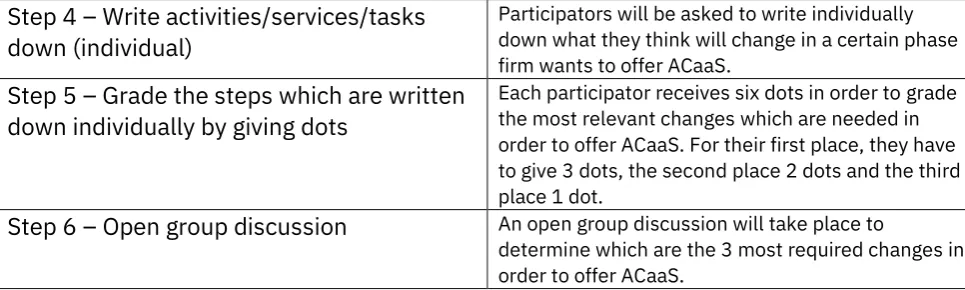
In order to determine if and how the role of the channel partner will change, within the process from the commissioning phase until the aftercare regarding access control systems, a scenario will be described. By describing this scenario, it can be determined what Tech Solutions needs from its channel partners when ACaaS will be offered. The scenario will be described by using empirical- and theoretical evidence. The empirical evidence with regard to the scenario will be gained by organizing a workshop. In this workshop, it will be determined which changes are required in order to offer ACaaS. The workshop will be attended by four employees of Tech Solutions. This group includes three business developers and one product manager of Tech Solutions. The workshop will consist of six steps.
This step-by-step plan is shown in the table below.
Step 1 - Quote
The workshop will be started with a quote. This willbe done in order to draw the attention of the participators and to get the participators in the right mood to start the workshop.
Step 2
–
Background information
Some background information will be given. It will be explained where the research is about and why the workshop is organized.Step 3
–
Explaining practical visualization
The practical visualization, developed by a business developer of the firm, adjusted by semi-structured interviews with employees of the firm andtheoretical evidence, will be explained.
Determination of the scenario - Repetition of step 4-5-6
Possible changes which occur in the sales-, engineering-, installation-, commissioning-, delivery- and
21
Step 4
–
Write activities/services/tasks
down (individual)
Participators will be asked to write individually down what they think will change in a certain phase firm wants to offer ACaaS.
Step 5
–
Grade the steps which are written
down individually by giving dots
Each participator receives six dots in order to grade the most relevant changes which are needed in order to offer ACaaS. For their first place, they have to give 3 dots, the second place 2 dots and the third place 1 dot.
Step 6
–
Open group discussion
An open group discussion will take place to [image:21.595.92.575.86.231.2]determine which are the 3 most required changes in order to offer ACaaS.
Table 1 – Step-by-step plan of the workshop
In addition, theoretical evidence will be used to explain the content of the steps that seems most necessary to be taken when the firm wants to make the transition towards ACaaS. So, it will be investigated what is written in the literature about the consequences of the steps which seem most necessary to be taken when the firm wants to make the transitions towards ACaaS or in other words when the firm wants to servitize.
Future situation
To determine the demand of Tech Solutions with respect to the channel partner when the firm wants to offer ACaaS, the influence of the scenario will be assessed. So, it will be determined what the consequences are of the changes, which will be made in order to offer ACaaS, regarding the demand of the firm with respect to its channel partners. In other words, it will be analyzed what will change for the
channel partner in the offering of its ‘product’ to its specific customer group. For
example, a certain type of channel partner offers the full-service ‘security’. For this type of channel partner, it will be analyzed what will change in the offering of the
full-service ‘security’ to its customer group. If servitization results in a better fit between the required activities for the channel partner in offering its product and the strengths of the channel partner, this would advantageous. This could mean that there is a better fit between the channel partner and its own customer group because it
becomes easier for the channel partner to offer the ‘product’ requested by the
customer group.
By organizing the workshop, sufficient information should be obtained in order to determine if and how the demand of the firm with respect to its channel partners will change when ACaaS will be offered. If necessary, the information gained through the workshop will be supplemented by conducting new individual interviews with the participators of the workshop. In addition to the above-mentioned empirical evidence, theoretical evidence will also be used. The intention of using theoretical evidence is to determine what the consequences are of the choices made within the scenario. So, the theoretical evidence will be used to determine the consequences of certain steps in the servitization process for the role division between the firm and its channel partners.
22
Solutions with regard to its channel partners and core competences of the five different types of channel partners, which have remained the same. This comparison will be made by using the practical visualization, developed by a business developer of the firm.In short, the possible new role of the channel partner will be determined by comparing the possible changed demand of Tech Solutions with regard to its channel partners and the constant core competences of the channel partner.
3.2.3. Design of the solution
The design of the solution is in line with the second aim of the research. After the problem identification and problem analysis, a design will be created in order to solve this problem. So, the design provides a way in which the problem can be dealt with. This will be done by investigating in what way the different types of channel partners can be engaged in the servitization strategy. In other words, it needs to be determined how the firm can remain/become attractive for its existing channel partners when ACaaS will be offered. Both empirical- and theoretical evidence will be used to create the design of the solution. Empirical evidence will be gained by conducting interviews. These interviews will be conducted in order to determine the view of the firm on engaging the channel partners when ACaaS will be offered. In addition, theoretical evidence will be used in order to determine what researchers remarked about the engagement of (channel) partners.
23
3.3. Methodology overview
The data collection methods of each sub-question are shown in table 2.
Research question
“What are the consequences regarding the role of the existing channel partner within the process from the commissioning phase until the aftercare regarding access control systems, when Tech Solutions implements a servitization strategy, and what are the possible ways for engaging the channel partners in this servitization strategy?”
Sub research questions
Data collection method
1.
In what way are the roles divided between the existing channel partners and Tech Solutions within the process from the commissioning phase until the aftercare regarding access control systems, at the moment?Empirical evidence:
Semi-structured interviews
Conversations
Theoretical evidence:
Visualization/model developed by a
business developer of the firm
Literature review
2.
What will be the possible servitization strategy implemented by Tech Solutions within the process from the commissioning phase until the aftercare regarding access control systems?Empirical evidence:
Workshop
Optionally supplemented by interviews
Theoretical evidence:
Literature review
3.
What will the role of the channel partners be like within the process from the commissioning phase until the aftercare regarding access control systems, when the firm implements the servitization strategy explored in sub-question 2?Based on servitization strategy explored
in sub-question 2.
Empirical evidence:
Workshop
Interviews
Theoretical evidence:
Literature review
4.
How can the firm engage its existing channel partners in its servitization strategy within the process from the commissioning phase until the aftercare regarding access control systems?Empirical evidence:
Interviews
Theoretical evidence:
Literature review
24
4. Current situation
In order to get an answer to the research question and the sub-questions, it is important to get a clearer view of the current situation regarding the division of roles between the firm and their channel partners. To get this clearer view, the organization will be introduced, the current organization design of Tech Solutions, from a theoretical perspective, will be described and the current role division between the firm and its channel partners will be visualized and described.
4.1. Empirical evidence
To get a clearer view of the division of roles between the firm and their channel partners, empirical evidence is collected. Interviews have been conducted with both a channel partner manager and a client manager of the firm. The Channel Partner Programme guide has also been used to visualize the current situation. At the moment, Tech Solutions has an international Channel Partner network of certified integrators, and only these partners can buy, install and maintain TS Access Control systems (access control system provided by Tech Solutions). They encourage lots of collaboration and there is scope to offer attractive discounts to Channel Partners. Tech Solutions also creates extra value for its partners by generating demand through direct contact with selected customers and consultants. So, together with their Channel Partners, Tech Solutions is committed for promoting, selling, and maintaining TS Access Control products and working together to strengthen our mutual market positions.
To ensure a successful collaboration between Tech
Solutions and Channel Partners, they each focus on their own specific tasks.
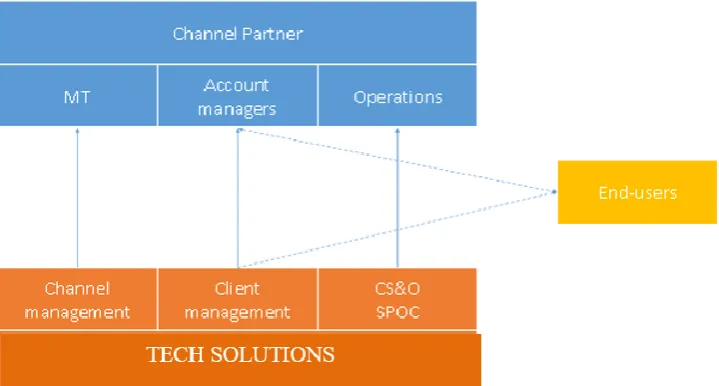
[image:24.595.101.461.534.727.2]The Channel Partner Programme describes the relationships and the division of roles between Tech Solutions, the Channel Partner and the End-users. The visualization of the relationship between Tech Solutions and its channel partners is shown in figure 3.
25
Tech Solutions encourages collaboration with the channel partner (Appendix 4, Appendix 5). To encourage the collaboration with channel partners, Tech Solutionsoffers attractive discounts to Channel Partners based on the partner’s product
knowledge, training certificates, annual spend and loyalty (Tech Solutions, Channel Partner Programme Guide, n.d.). They also create extra value for their partners by generating demand through direct contact with selected customers and consultants. So, both Tech Solutions and their Channel Partners are committed for promoting, selling, and maintaining TS Access Control products and working together to strengthen their mutual market positions.
In order to manage the triangular relationship with the Channel Partner and the end-user, Tech Solutions brought 3 functions into existence (see figure 3). The channel partner manager is in very close contact with the management team (MT) of the channel partner. He coordinates and manages the programme. The client manager supports the programme. He provides commercial training, supports the account managers of the channel partner during meetings with the end-user and is also in direct contact with the end-user. The single point of contact (SPOC) provides technical training and offers technical support for the operation department of the channel partner. This operation department installs and configures the systems of Tech Solutions for the end-user. To achieve beneficial collaborations between Tech Solutions and their channel partners, and to ensure transparency within their network, they established four different channel partner levels: Certified Partner, Advanced Partner, Expert Partner, and Alliance Partner. These levels are mainly
based on the partner’s product knowledge, training certificates, annual spend and loyalty (Tech Solutions, Channel Partner Programme Guide, n.d.).
Partner levels
The channel partners can obtain four partner levels. These partner levels consist of:
- Certified Partner - Advanced Partner - Expert Partner - Alliance Partner
Partner level is based on:
1. Product knowledge (experience of TS Access Control projects)
2. Training certificates 3. Annual spend 4. Loyalty
1. Product knowledge Certified Partner
26
Advanced PartnersAn Advanced Partner has more qualifications than a Certified Partner and is able to create extra value for customers with TS Access Control products. Through the TS Access Control training programme, an Advanced Partner has gained knowledge of additional topics. This means they are able to offer, for example, more sophisticated access control solutions or to apply graphical alarm handler and intrusion
functionality on the TS Access Control platform. Advanced Partners also have
commercially staff trained in TS Access Control to add value to end customers in the pre-sales and sales phases.
Expert Partners
An Expert Partner has built on the Advanced Partner qualifications and has
extensive knowledge of TS Access Control products. The value that Expert Partners can offer end customers is of the highest level. Expert Partners have significant experience of TS Access Control projects. This is demonstrated by a minimum annual purchase value of TS Access Control products, and means-end customers can rely on their proven expertise.
Alliance Partners
An Alliance Partner has even more qualifications than an Expert Partner, and guarantees end customers a seamless collaboration with the firm by selling TS Access Control as the sole access control product in its personal portfolio. Alliance Partners underline their commitment by being largely dependent on the sales of TS Access Control products in their operations.
2. Training certificates
The extent and level of training certificates which are achieved. These trainings are given by the personnel of the Tech Solutions.
3. Annual spend
Annual spend requirements by partner level are:
Certified
Advanced
Expert
Alliance
Annual
spend
No threshold > 50k
> 100k
> 100k
To allow for fluctuations, the annual spend is based on the average of the three preceding calendar years. If a partner has not been active for three years, the years
up to the current year will apply. To prevent the first year’s start-up phase skewing the average, we do not take the first year into account after the second year. Below is an example, to explain this principle.
Year Annual spend
(x1000) Basis Average spend (x1000) Potential level
1 50 - 0 Certified
2 100 Year 1 50 Advanced
3 300 Year 2 100 Expert/Alliance
4 500 Year 2 + 3 200 Expert/Alliance
5 700 Year 2 + 3 + 4 300 Expert/Alliance
27
4. LoyaltyPartners that are fully committed to TS Access Control have the opportunity to distinguish themselves as an Alliance Partner. To achieve the status of Alliance Partner, they must meet the following criteria:
- They must already have reached the expert level
- TS Access Control is the sole access control product within their product portfolio - At least 30% of their annual turnover is based on TS Access Control net purchase value (annual spend with the company)
- They provide quarterly insights on the project funnel and a forecast on expected orders for major projects in the subsequent quarter(s)
These requirements are assessed annually, with the percentage of the annual turnover being proved by allowing us access to financial statements.
4.2. Current organizational design of the firm
In order to get a clearer view of the current division of the roles between the firm and their channel partner, it will be portrayed how the firm is currently organized. This will be done based on the recommended organizational approach for providing solutions (Pawar, Beltagui, & Riedel, 2009).
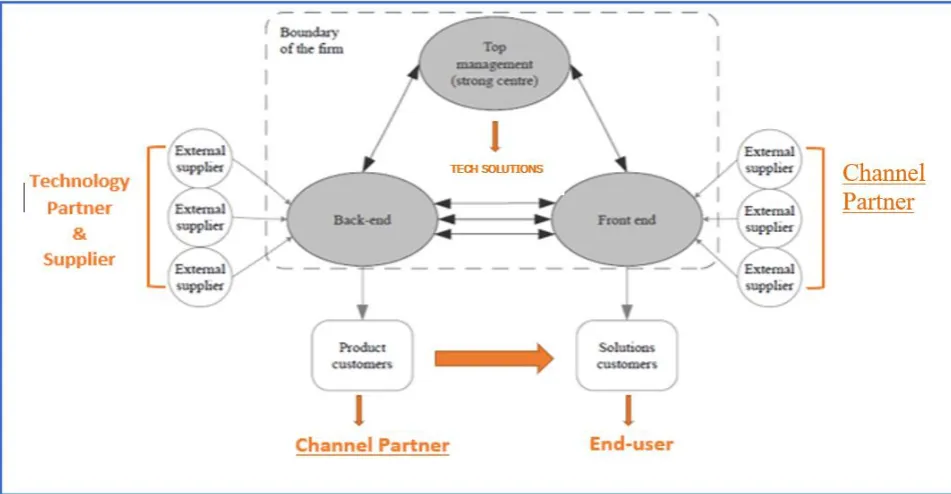
According to Pawar et al. (2009), an organization which wants to provide
solutions has to set up a “back-end” and a “front-end”(see figure 4). The back-end is responsible for the manufacturing operations. In other words, this side makes the products for direct sales to customers. The front-end is created in order to be more customer-oriented and builds customized solutions around the manufactured products.
In order to get the inputs for the back-end, the organization can rely on external suppliers. For Tech Solutions, these external suppliers consist of technology partners and suppliers (Appendix 6). The technology partners are responsible for the delivery of the core technology for the access control systems. The suppliers are also responsible for the delivery of hardware, just like the technology partners, but there is no partnership with these organizations. Contrary to technology partners, they also deliver software. In order to get the inputs for the front-end, the organization can also rely on external suppliers. These external suppliers consist of supplier consist of channel partners and installers. First, the channel partners are responsible for finding/approaching potential customers for the solutions and for the transmission of feedback from these customers. The channel partners are also product customers. They sell the access control systems to the end-user, which will be installed by the installers. Second, the installers install the access control systems for the end-users. In the case of Tech Solutions, the end-users are the solutions customers. In this research, installers will be subjected to channel partners.
In short, the external suppliers for the “back-end” are the technology partners
and the suppliers. The external suppliers for the “front-end” are the channel partners
28
4.3. Core competences of the different types of channel partners
The current role of the channel partners will be determined by dividing the channel partners in the way the company does. The company distinguishes five types of channel partners. By analyzing the business structure and the core competences of these different types of channel partners, the current role of the channel partners will be determined. It has been decided to place the market orientation, requirements, tender, and selection activities all under the same
heading, which is called ‘sales’. So, the sales phase will consist of activities
regarding sales and pre-design and installation. This has been done, because the employees within the firm (and the channel partners) see the activities with regard to market orientation, requirements, tendering and selection as sales activities.
4.3.1. Constructor
A constructor can be designated as a construction company. The classic function of a constructor is constructing buildings. A classic construction company tells a company which is interested in renting the building which has to be built that the company will be helped with window frames, doors, walls, radiators, etc., but that the company will be responsible for the systems yourself (Appendix 3). So, in this case, the interested company has to look for companies which can deliver, install, implement and maintain the access control systems.
[image:28.595.91.567.78.325.2]29
Partnership) constructions. PPP constructions can be described as a partnership where the public and private sectors collaborate for some mutual benefit(“Public-private partnerships PPP - Designing Buildings Wiki,” n.d.).
For example: a construction company builds an office for Google and then immediately delivers everything around it. A delivery in which everything is delivered and managed can be described as a Turn-Key delivery (Appendix 3). So, a construction company delivers/manages/installs air conditioning, tv screens, wifi, and also access control. In this way, the construction company gives Google the opportunity to rent an office for 30 years, for instance, and everything is managed for Google with regard to the building (facilities). The primary choice of what kind of systems will be installed is in the hands of the construction company.
So, initially, the core business of a constructor is building a building, but there is a trend in which it is becoming increasingly common that constructors deliver a building in its entirety. These construction companies fully equip the building. This means that these construction companies also place access control systems. In order to manage the access control within the building for a company, the constructor has to take care of the installation and commissioning of the access control systems, among other things. That is why such a construction company has become an interesting customer for Tech Solutions; these construction companies are responsible for a Turn-Key delivery. It can be stated that the core businesses of a constructor are still ‘building buildings’ and eventually renting buildings, but in order to provide a turn-key delivery, they have to take their responsibility for the whole process of delivering access control. So, these constructors are responsible for the whole process, from the end-user request for the access control systems until the aftercare regarding access control systems.
Given the fact that the primary choice about what kind of access control systems will be installed is in the hands of constructors, they can be relevant in the sales phase of the access control systems for Tech Solutions. The construction company has to buy access control systems, which consist of hardware and software, and they will be placed in the building of the tenant, which will be the end-user. So, the strength of the constructor is sales. In addition, the pre-design and calculation can be seen as a core competence of a constructor, because a constructor is always concerned with calculation and planning, originally (Appendix 10). Therefore, it can be noted that planning and logistics is also a core competence of a constructor. The constructors are not familiar with the configuration of the system, the setup of the server, and programming of the system (Appendix 10). So, it can be argued that they cannot manage the commissioning stage. Besides, they have to install hardware and cabling. That is not their strength and they cannot do it their selves. Therefore, they often hire another company for (a part of) the installation of hardware and cabling. They have little know-how regarding the system test, because they know where and how the hardware is placed. They are not able to provide training, because they do not know enough about (the functioning of) the systems (Appendix 10).
30
4.3.2. Man Guarding
Man guarding organizations are organizations which employ security guards in order to ensure corporate security. Initially, these organizations target manpower to provide companies with corporate security.
These days, companies want to focus on their core business instead of support services such as IT infrastructure management, software maintenance, and access control. This means that organizations want to outsource their security regarding access controls, among other things (Godse & Mulik, 2009). Therefore, it is becoming increasingly common that these man guarding organizations have the role of a full-service party. In other words, they have to ensure that the whole property of companies is safe. In order to ensure this, these man guarding organizations need to have cameras, access control systems, etc. That is quite a shift from their original offer because in the past they only employed security guards they simply earned cash for the number of worked hours.
Man guarding organizations find it interesting to have the role as a full-service provider because this makes it possible to be connected to the customers for a longer period of time. It is still possible to offer their security guards and next to that they can expand their portfolio, because they can offer more, with regard to ‘security’ to
the customers. So, for these reasons man guarding organizations want to take over
the entire service ‘security’ for companies (Appendix 3). It can be noted that the core business of the man guarding organizations is to completely relieve them of the 'security' aspect. So, they do offer a fully equipped building like the constructors, but
they ‘only’ manage the security aspect for a company. It is relevant to know that these
man guarding organizations actually do not want to install and commission the access control systems. These companies would welcome a reduction of anything that puts
them at greater risk in providing the entire service ‘security’. If the tasks which put
them at greater risk in provide the entire service ‘security’ will be reduced, the man
guarding organizations can really focus on what they are good at. The main strength of the man guarding organizations are the sales. Man guarding organizations have a strong proposition in the sales because they can offer a complete service for the end customer with regard to 'security'. It is impossible for Tech Solutions to compete with these man guarding organizations in the sales phase because Tech Solutions ‘only’
offers access control as a proposition. So, customers who are looking for an
opportunity to outsource the full ‘security’ aspect, will choose for a man guarding