Observer-Based Nonlinear Feedback Controls for
Heartbeat ECG Tracking Systems
Witt Thanom, Robert N. K. Loh
Center for Robotics and Advanced Automation, Oakland University, Rochester, USA Email: [email protected], [email protected]
Received June 10,2012; revised July 9, 2012; accepted July 16, 2012
ABSTRACT
The analysis and design of observed-based nonlinear control of a heartbeat tracking system is investigated in this paper. Two of Zeeman’s heartbeat models are investigated and modified by adding the control input as a pacemaker, thereby creating the control-affine nonlinear system models that capture the general heartbeat behavior of the human heart. The control objective is to force the output of the heartbeat models to track and generate a synthetic electrocardiogram (ECG) signal based on the actual patient reference data, obtained from the William Beaumont Hospitals, Michigan, and the PhysioNet database. The formulations of the proposed heartbeat tracking control systems consist of two phases: analy- sis and synthesis. In the analysis phase, nonlinear controls based on input-output feedback linearization are considered. This approach simplifies the difficult task of developing nonlinear controls. In the synthesis phase, observer-based con- trols are employed, where the unmeasured state variables are estimated for practical implementations. These observer- based nonlinear feedback control schemes may be used as a control strategy in electronic pacemakers. In addition, they could be used in a software-based approach to generate a synthetic ECG signal to assess the effectiveness of diagnostic ECG signal processing devices.
Keywords: Heartbeat Model; Electrocardiogram; Nonlinear Control of Biological Systems; Input-Output Feedback
Linearization; Observer-Based Nonlinear Control Systems
1. Introduction
The human heart is a complex yet robust system. One of the most important signals that are being generated dur- ing the operation of the human heart is the electrocardio- gram (ECG). It is a time-varying signal measuring the potential of the electrical activities in the cardiac tissue. A single cycle of the ECG consists of the contraction and relaxation of the heart, which is the heart pumping action. The ECG can be measured by recording the potential differences between two electrodes placed on the skin at pre-determined positions. The characteristic information extracted from the ECG can be used to assess the state of the cardiac health and potential heart problems [1,2].
The research and development of mathematical models for heartbeats or heart rhythms have been very active in the literature [3-17]. One of the important developments was accomplished by Zeeman [3], where the models captured, at least qualitatively, three essential character- istics of the cardiac dynamics: 1) a stable equilibrium; 2) a threshold for triggering the action potential; and 3) the return to equilibrium. The resulting models are a 2nd- order nonlinear ordinary differential equation (ODE) of the Liénard-type representing the heartbeat dynamics, and a 3rd-order nonlinear ODE that can be applied to the
nerve impulse. These models are based on the normal pacemaker generated by the sino-atrial (SA) node [4], which is the dominant pacemaker as compared to the slower one produced by the atrio-ventricular (AV) junc- tion. This slower pacemaker is regarded in [5] as a pas- sive conduit. In [6], the authors modified the 2nd-order ODE heartbeat system in [3] by incorporating an on-off control variable representing the pacemaker mechanism of contraction-relaxation of the heart. Reference [7] modi- fied the 3rd-order nonlinear ODE model in [3] by adding control parameters that affect the frequency of the oscil- lation to control the heart rate variability and used a neu- ral network to produce the ECG signal.
Another well-known approach to modeling the cardiac induction system is based on the van der Pol (VdP) type oscillators [8]. The idea of this approach stems from the analogy between the properties of relaxation oscillators and those of biological pacemakers. In contrast to [3], a coupled VdP oscillator assumes a more active role for the AV pacemaker, and considers the coupling effect be- tween the SA and the AV pacemakers in the normal elec- trophysiological dynamics. A study of the synchroniza- tion properties of the rhythms produced by the SA and AV nodes using two coupled VdP oscillators was inves-
tigated in [9-13]. Furthermore, reference [14] proposed a proportional feedback control algorithm to synchronize the rhythm of the SA and AV pacemakers using the model from [11,12]. Recently, Gois and Savi [15] pro- posed a heart rhythm model that consists of three coupled modified VdP oscillators with time delay. Numerical simulations were carried out to reproduce the ECG signal that could be altered by changing the coupling parame- ters. A dynamical model that generates a synthetic ECG signal, based on statistical information such as the mean, standard deviation of the heart rate, and the power spec- trum of the RR tachogram was proposed in [16]. The model does not rely on the dynamics of the heart but the ECG statistical information as a priori data to generate the signal. Reference [17] studied the synchronization between the models from [15,16] as a tracking control problem by using the model from [15] as a process plant and the ECG generated by the model from [16] as a ref- erence signal, and proposed a heart rhythm proportional controller with tracking error as one of the control parameters.
L
This paper considers the analysis and design of ob- server-based controls of the modified Zeeman’s models in [3] using the input-output feedback linearization tech- nique. A previous investigation without observers was presented in [18]. Observer-based techniques and tech- nology are motivated by the needs of practical imple- mentations: for systems with inaccessible state variables, it will be difficult to implement most control schemes requiring feedback of the inaccessible states without an observer for state estimation. An observer-based control scheme is, in general, more difficult to analyze and de- sign. The importance of the observer-based nonlinear feedback tracking control technique developed in this paper is that it may be used as a control strategy for elec- tronic pacemakers, or a software-based generation of a synthetic ECG signal for assessing the effectiveness of diagnostic ECG signal processing devices.
The paper is organized as follows. In Section 2, the dynamic model and its characteristics are investigated- phase portraits and stability analysis are conducted. Sec- tion 3 provides the fundamental of nonlinear feedback linearization control and observer theory. The results of the observer-based nonlinear tracking control systems and the simulation results are demonstrated in Section 4. The conclusions are presented in Section 5.
2. The Heartbeat Models
A cycle of the heartbeat consists of two states: diastole which is the relaxed state, and systole which is the con- tracted state. The cycle starts when the heart is in the diastolic state. The pacemaker that is located at the top of the right atrium—one of the upper chambers of the heart —triggers an electrochemical wave that spreads slowly
over the atrium. This electrochemical wave causes the muscle fibers to contract and push the blood into the ventricles—the lower chambers of the heart. The elec- trochemical wave then spreads rapidly over the ventricles causing the whole ventricle to contract into the systolic state, and pumping the blood into the lung and the arter- ies. Immediately following the systolic state, the muscle fibers relax quickly and return the heart to the diastolic state to complete one cycle of the heartbeat [6].
A mathematical model that describes the behavior of the heartbeat was developed in [3], where it was sug- gested that such a model should contain three basic fea- tures:
1) A stable equilibrium state representing diastole; 2) A threshold for triggering the electrochemical wave causing the heart to go into systole; and
3) The return of the heart to the diastolic state.
The resulting models that address the characteristics above are given below.
2.1. The 2nd-Order Nonlinear Heartbeat Model The 2nd-order nonlinear heartbeat model is given by
1
3
1 1 2
2 1
, 0
,
,
d
x x T
x x
T x
x x
(1)
x t1 represents the length of the muscle fiber, where
x t2 is a variable related to electrochemical activities, and can be measured as the potential across the mem- brane of the muscle fiber—the ECG signal; the parame- ter is a small positive constant associated with the fast eigenvalue of the system, xd is a scalar quantity
representing a typical length of muscle fiber in the dia- stolic state, and represents tension in the muscle fiber.
0
T
x
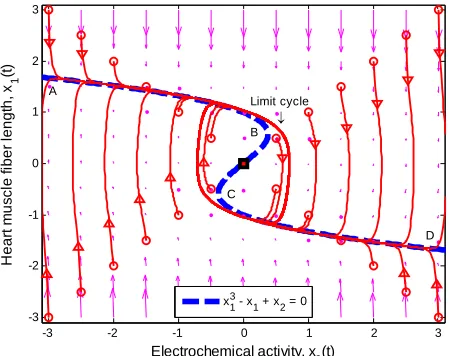
Figure 1 illustrates the phase portrait of (1) with the
initial conditions along the left and right diagonals across the 1x2 plane. The parameter values used to produce the phase portrait are 0.2, T = 1, and xd 0. The cubic line (dashed curve) represents the steady-state of the first equation in (1). When d , the equilibrium
point of the system is at the origin. All trajectories initi- ated above the cubic line, i.e., 1 1 2 direct downward toward the origin along the cubic line.
0
x
3 0,
x Tx x
3 0
x Tx x
-3 -2 -1 0 1 2 3 -3
-2 -1 0 1 2 3
Electrochemical activity, x
2(t)
H
e
a
rt
m
u
s
c
le
f
ib
e
r l
e
n
g
th
, x
1
(t)
Limit cycle A
B
C
3
2
D
[image:3.595.61.286.85.263.2]x13 - x1 + x2 = 0
Figure 1. Phase portrait of the 2nd-order heartbeat system for ε = 0.2, T = 1, xd = 0.
lows that
2
1
0
1 1
3
1 0
x T 1
1 0
T
x
A
3.62 (2)
The eigenvalues of A are given by 1 and 2 1.38
for 0.2, and therefore, the origin is unstable since both eigenvalues are real and positive.
1, T
In Figure 1, since the vector field around the segment
AB and CD always points toward the cubic line, and away from the cubic line in the BC portion, any point along the cubic line in the AB and CD segments is con-sidered to be stable whereas points along the BC section are unstable. The points B and C are important as they specify the threshold—the second basic feature (ii) of the heartbeat model mentioned earlier. These points can be computed easily by considering the eigenvalues of the matrix A in (2)
2
1,2 1 1
1
3 3
2 x T
2
2 4
x T
(3)
The condition that the real part of the eigenvalue is negative is 2 . Therefore, the system is stable
1 3x T 0
if x1 T 3 which refers to the section AB, and
1 3
x T which describes the section CD. In other words, the thresholds for switching between the diastolic and the systolic states at point B is x1 T 3, and
1 3
x T at point C.
The stable equilibrium point that represents the state of diastole can be determined by changing the value of xd
in the second equation of (1) such that it satisfies the sta- bility condition above. Figure2 displays the phase por-
trait of the system with xd 1.024. The equilibrium point is stable at (1.024, −0.0497), and qualifies to be the
-3 -2 -1 0 1 2 3
-3 -2 -1 0 1
Electrochemical activity, x
2(t)
H
ear
t
m
us
c
le f
iber
l
engt
h,
x 1
(t
)
Diastole Equilibrium
[image:3.595.310.536.86.264.2]x13 - x1 + x2 = 0
Figure 2. Phase portrait of the 2nd-order heartbeat system during diastole for ε = 0.2, T = 1, xd = 1.024.
diastolic equilibrium state, i.e., satisfies the first feature (i): a stable equilibrium.
In Figure2, all of the trajectories, regardless of their
initial condition, end up at the diastolic equilibrium point. Since the equilibrium point is stable, the system will stay at this point forever unless there is an external excitation that forces the system to a new equilibrium point. In [6], the authors modified the system by adding a control input u(t) as shown below:
3
1 1 2
2 1
1 , 0,
,
d d s
x x Tx x
u T
x x x x x
(4)
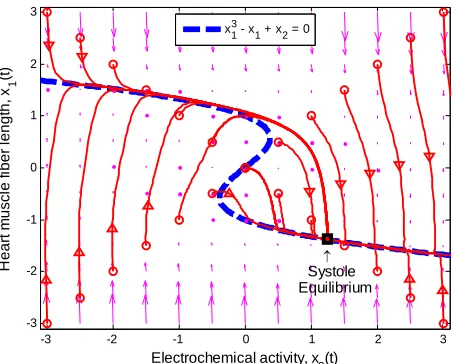
where the additional parameter xs represents a typical fiber length when the heart is in the systolic state, and represents the cardiac pacemaker control mecha- nism that directs the heart into the diastolic and the sys- tolic states. By setting the cardiac pacemaker control signal u(t) in the form of {0} and {1} (on-off controls), the equilibrium point of the system can be switched be- tween the diastolic and the systolic states. Figure 3 dis-
plays the phase portrait with s the stable
equilibrium point is located at (−1.3804, 1.25). ( )
u t
1.3804,
x
2.2. The 3rd-Order Nonlinear Heartbeat Model The 3rd-order nonlinear heartbeat model is given by
3
1 1 2 3
2 1 2
3 2
1 ,
,
2 2
1 ,
x x
x x
x x
x u
x
x x
(5)
x t1 refers to the length of the muscle fiber, where
x t2 represents tension in the muscle fiber, x t3
is related to electrochemical activities, is a positive constant, and u(t) represents cardiac pacemaker control
0L h
-3 -2 -1 0 1 2 3
-3 -2 -1 0 1 2 3
Electrochemical activity, x2(t)
H
e
ar
t m
u
s
c
le f
iber
l
en
gt
h,
x
1
(t)
[image:4.595.59.286.84.266.2] Systol Equilibr e ium x13 - x1 + x2 = 0
Figure 3. Phase portrait of the 2nd-order heartbeat system during systole for ε= 0.2, T = 1, xd = –1.3804.
signal which directs the heart into the diastolic and the systolic states.
The dynamics of the 3rd-order system are similar to those of the 2nd-order system except that the dynamic of the muscle fiber tension is taken into consideration, that is, the constant T in the 2nd-order system becomes a state variable
in the 3rd-order system.2
x t
, ,
n n
n
3. Theoretical Background
3.1. Nonlinear Input-Output Feedback Linearization
Consider a control-affine single-input single-output (SISO) nonlinear system described by
( ) ( ) , , : ( ), :
u D
y h h D
,
u y
.
n
x f x g x f g
x
n
x
(6)
where is the state vector, are the control and output, respectively; f, g are smooth vector fields in a domain D and h a smooth function in D, where D is an open set in
Given the nonlinear system in (6), our goal is to find a transformation function (diffeomorphism) z T x
T 0 0
with that transforms the nonlinear system in the x-coordinates to a linear system in the z-coordinates. One of the most important reasons for finding the transforma- tion is that the powerful linear system theory and meth- odologies can be applied once a nonlinear system has been linearized.
Differentiating the output y t
with respect to t yields
y L h
L h u
f x g x
L h x
(7)
where and g denotes the Lie deriva-
tives of with respect to and
L hf x
h x f x
g x
, re-spectively. If g x , then y
t is not a function of u t
. Continuing successive differentiation ρ times until the input u t
1
y L hf x L L hg f x u appears explicitly, we obtain
(8)
The smallest integer for which u(t) appears is re- ferred to as the relative degree. The nonlinear system in (6) is said to have a well-defined relative degree in a region DoD if
0,k
L L hg f x 0 k 1; and
1 0
L L hg f x , x Do
n
. When the relative degree is equal to the dimension of the nonlinear system, that is,
, the system is said to be fully linearizable, whereas it is only partially linearizable if n (both heartbeat systems considered in Section 4 below have
1
; hence both are partially linearizable). From (8), we define
1
v y L hf x L L hg f x u
(9)
where v(t) is a one-dimensional transformed input cre- ated by the feedback linearization process. Equation (9) yields the linearizing feedback control law [19-21]
1 1
u L h v
L L h
f
g f
x
x (10)
1 L L h x
n provided g f
To develop an overall representation of the system for the partially linearized case with
is nonsingular.
, the transforma- tion function z T x
can be expressed as
1
1 ( )
n
h
L h
f
x
ξ x
z T x
η x
x
(11)
where ξ , ηn and
, i 1, ,ni
x
are chosen such that
D D T x is a diffeomorphism in a domain o . In other words, the Jacobian matrix
associated with T x
is nonsingular, and
0,1i
i i
L n
g x g x
x
D
(12)
for all x o
v
ξ Aξ
.
The transformation (11) leads to the normal form [20]
B
0 ,
η f ξ η
1 y
, (13)
, (14)
Cξ
1 , ,
(15)
A B and 1
where C are in con-
0 1 0 0
0 0 1 0
,
0 0 0 0 1
0 0 0 0 0
A B 0 1 0 0 , 0 0 1 0 T C
t 0ξ t0
Equation (13) represents the external dynamics, while (14) is referred to as the internal dynamics of (6). Setting
in (14) for all yields
0 0,
η f η (16)
which represents the zero dynamics for (6). The stability of the zero dynamics in (16) is an important issue in de-signing a controller. A system whose zero dynamics are asymptotically stable in the domain of interest is called a minimum phasesystem. The local asymptotic stability of the zero dynamics is, clearly, the necessary and sufficient conditions for the local asymptotic stability of the feed- back linearized system described in (13)-(15) [21,22]. In the case that the zero dynamics are unstable in the region of interest, the system is known as a non-minimum phase system. Generally, a system of this type cannot be used for state-feedback control system design because some of the state variables will escape to infinity. In this case, the stabilization of the unstable zero dynamics needs to be considered, if possible.
3.2. Asymptotic Output Tracking
Let the control objective be steering the output y t
to a desired reference signal y tr
y t y
. This gives rise to an output tracking control problem. Defining the output tracking error as r , the main objective
is to force
such that
0
te t
e t y t y tr
r r
y v y
as . It follows that
t
e y
r
v y
(17) A suitable tracking control law for the transformed input v(t) is given by
Ke
1
(18)
where e e e e e1 T , K
A A BK
A
is the constant gain matrix to be determined such that
cl is Hurwitz, that is, all of the eigenvalues
of cl lie in the open left-haft complex plane. Combi-
nation of (18) and (10) yields the nonlinear tracking con- trol law
1 1
u L
L L h
f g f x
h yr
x Ke
n
(19)
3.3. Observer for Normal Form
The design of observer-based nonlinear control system is
addressed in this section to provide real-time estimates of the inaccessible dynamical states required for the imple- mentation of control laws. It is well-known that a Luen- berger observer for a nonlinear control system based on input-output feedback linearization when exists, since the transformed system in the z-coordinates is in linear controllable canonical form. However, this is not true for the normal form, i.e., when n, because the internal dynamics (14) are unobservable by the chosen output y h
x [19,20]. Nonetheless, by applying the results of [23,24], we will show that an observer for such systems may be possible. Without loss of generality, we assume that the normal form (13)-(15) has the equilib- rium point at the origin. First, we linearize the normal form given by (13) and (14) in the following partitioned form:
11 12 21 22 1 ( ) , 0 0 , 0 , o o o o y v z Bz A q z
C
ξ ξ
η q ξ η
η
C
A A B
A A z n n (20)
n1o
where Ao , Bon1, Co1n, q z ,
z is given in (11), and where
11 12 21 0,0 0,0 0 0 0,0 0, 2 0 2 , , , , , , , ,v v
ξ η ξ η
ξ η
ξ
A
η ξ η
A B A B
f f A A ξ η (21)
0,0 0,00 21 22
,
, ,
,
, , .
v v
vv
q f A ξ A
ξ η ξ η
ξ η ξ
η η
η
ξ η
ξ ξ η
(22)
Equation (20) is in a standard linear system with q zo
being considered as a disturbance vector. If
A Co, o
1 TT T T n T
o o o o o
rank n
is an observable pair, that is,
C A C A C (23)
and the term q z
is Lipschitz so that there exists a Lipschitz constant such that
ˆ 2 ˆ2q z q z z z (24)
o
D D
for all z in a region , then an observer for (20) can be formulated as
ˆ oclˆ ov o ˆ y
z A z B q z L
1
n
(25)
L
where the gain matrix
A A LC
is determined in such a way that ocl o o is Hurwitz.
Now, let the estimation error associated with (20) and (25) be defined by z
t z
t zˆ t . We need to showthat converges to zero asymptotically. It follows from (20) and (25) that
t z
ˆo o
q ocl A z
z z q z
TV
(26)
Consider a Lyapunov candidate function
z z Pz
ocl
(27) where P is a real symmetric positive definite matrix and is the solution of the Lyapunov equation
T ocl
A P PA Q
ˆ 2 q zo q zo .
q z q zo
(28) with Q a positive definite symmetric matrix. It follows that
T TV z z Qz z P (29)
Since is Lipschitz, so is . Substituting (24) into (29) yields
22 2 2
T
V z z Qz P z
(30)
Since min
2 2
T
z Qz Q z , it follows that
22 2 2
min
V z Q P z
(31)
is negative definite, provided min
, so that the estimation error as t . 22
Q P
t 0z
Finally, with reference to (11), the observer given by (26) can be expressed in the x-coordinates as
v
ˆ
y x
1 ˆ
ˆ ˆ
ˆ ocl o o
T x
x A T x T L
x B q
(32)
4. Application to the Heartbeat Systems
We apply the theoretical results above to develop an ob- server-based nonlinear tracking control for the heartbeat systems (4) and (5). First, we consider the 2nd-order heartbeat system (4), with y t
x t2
as the outputmeasurement (recall that x t2 can be measured as the potential across the membrane of the muscle fiber).
Differentiating the output with respect to t yields
d d s
1
y x x x x u
1 (33)
where u(t) appears, hence the relative degree is . The diffeomorphism T is given by
2 1x
h x
x t
x
2
x z T x
x (34)
where 1 satisfies (12). Equation (34) shows that the original system in (4) is already in a normal form when the output is chosen as y t x t
2
. We note that (34) reveals that x t1
and x t
d s
are the internal and external dynamics, respectively. Rewriting (4) using (34) yields the normal form
d x x u (35) x
3
1 T
.
y
(36)
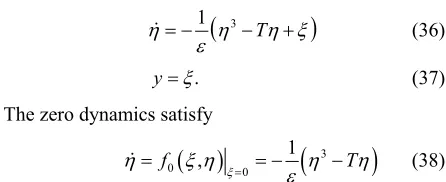
The zero dynamics satis
(37) fy
3
0 1 0 ,
f T
(38) There are three equilibrium points for (38)
: 0,
T
. We need to analyze the stability of the zero dy- na
rem [
mics. Applying the Lyapunov indirect stability theo- 19] to (38), the Jacobian matrices at the origin and
T
are given by
2
0 3 T
1
1 T
A
(39)
2
T2,3 1
2 3
T
T A
(40)
Since T and are positive constants, it follo 0
A and A 3 0
ws that
1 2, , hence the equilibrium point at the origin is unstable and the equilibrium points at
T are totically stable. In other words, re- gardless of the unstable equilibrium at the ori
te of the zero dynamics will end up at either the point
asymp
gin, the steady-sta
T
or T depending on the initial condition. As a result, the zero dynamics are asymptoti- cally s erefo -order heartbeat system is a minimum-phase system.
[image:6.595.316.539.84.175.2]To proceed to the output tracking control design, we let the tracking error b
table. Th re, the 2nd
e e t
y t
y tr
where
2
y t x t . Using (18), the transformed input v(t) is given by
v Ke yr (41)
where K = 100 is obtained by placi
–100 of the complex plane. Consequently, the linearizing ng the real pole at s = feedback control law according to (19) is given by
1
1
r d
d s
Ke y x
u x
x x
(42)
The development of an observer is accomplis rewriting (35)-(37) in the form of (20) as:
hed by
( 3
) ,
1 0 1
1 0 ,
o
o o
o
v T
y
0 1 1 0
q z
z B
z
A
C z
(43)
where
d d s
v x x x u. It follows that
A Co, o
in (43) is observable, and the term o
Lipschi server for (43) is give by
q z is locally
© 20 ICA 1312
bas
at system is
Copyright 12 SciRes.
, th
(25) where the gain matrix L
225 0
T is cho- sen by placing the observer poles at s
120, 100
of the complex plane. Finally ed track- ing control law for the 2nd-order hea
given by
e observer-rtbe
normal form is written as
1 d
1 ˆ
r r
d s
K y y
u y
2nd-order heartb
2
x
x (44)
The simulation of the eat contro tem
x x
l sys- (4) with the output y t x t and t
real discret
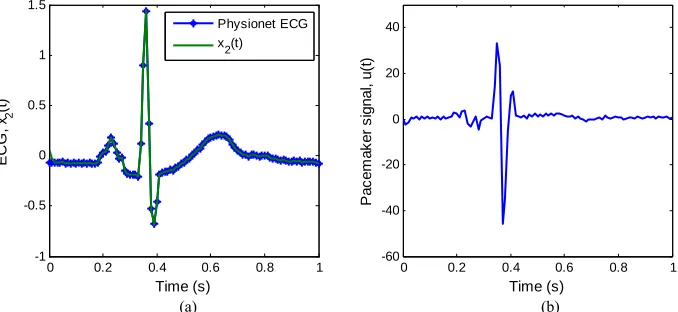
he control law (44) was conducted using MATLAB. Figure4 dis-
plays the tracking result of e ECG data from PhysioNet database [25]. In Figure 4(a), the output
2
x t converges and tracks the ECG reference signal very well. Figure 4(b) displays the pacemaker signal or
ntrol law described in (44).
Figure5 demonstrates the result of the observer in the
x-coordinates along with the estim the co
on errors. The initial ati
condition of
x x1, 2
is
0.3, 0.01
, and that of the estimated states
x xˆ ˆ1, 2
is (0, 0). Both estimated states converge quickly to the real states, especially x t2
. [image:7.595.310.541.86.246.2]Finally, the multiple pulses ECG signal is illustrated in
Figure 6.
Next, consider the 3rd-order heartbeat system (5) with
3
y t x t as the output m Differentiating th
The
easurement.
1 e output with respect to t yields
2 1
y x u (45) relative degree is . We o
btain the transfor- mation function
312
1 1
2 2
x x h
x
x z T x x x
(46)
which also shows that the original system (5) is already in a normal form when the
output is y t x t3
. Note2 1 u,
that 1
x x1
t , and 2
x x t2
satisfy (12). The(47)
3
1 1 1 2
1 ,
2 2 1 2 ,2
(48)
y
(49) .
(50) The zero dynamics are given by
3
1 1 1 2
2 1 2 2
1 ,
2 .
(51)
There are two equilibrium points associated with (51): the origin, and
1, 2
= (1,–1). Applying the Lyapunov indirect stability theorem [19] to the latter equilibrium point yields
2
1 2 1
1
(1, 1)
2 2 2 2
1 1 2 1
3
A . (52)
Re i 0, 1, 2 i where i
It follows that re-
presents the eigenvalue; hence, matrix 1 is Hur- witz. Therefore, the equilibrium point at (1, –1) is as- ymptotically stable. Next, consider the equilibrium point at the origin
th
i A
2
1 2 1
2
(0,0)
1 1 0 0
2 2
2 2
3
A
A
(53)
The eigenvalues of 2 are 0 and –2. Since one of the eigenvalues is zero, we cannot draw the stability conclu- sion by the Lyapunov indirect stability theorem. How- ever, using the application of the center manifold theory [19] to determine the stability of the equilibrium point at the origin by analyzing a reduced-order system—a sys- tem whose order is exactly equal to the number of the
1.5
0 0.2 0.4 0.6 0.8 1
-1 -0.5 0 0.5 1
Physionet ECG
Time (s)
EC
G
, x
2
(t
)
x
2(t)
40
20
0
-20
-40
-60
0 0.2 0.4 0.6 0.8 1
Time (s)
P
a
c
em
a
k
er
s
ignal,
u(
t)
[image:7.595.131.470.561.717.2](a) (b)
0 0.2 0.4 0.6 0.8 1 -1.5
-1 -0.5 0 0.5
Time (s)
M
u
s
c
le
f
ib
e
r le
ngth,
x 1
(t
) x1(t)
Estimated x(t)
1
0 0.2 0.4 0.6 0.8 1 -0.4
-0.3 -0.2 -0.1 0 0.1
Time (s)
E
s
ti
m
a
ti
o
n
e
rr
o
r
x 1
(t
)
1.5
0 0.2 0.4 0.6 0.8 1 -1
-0.5 0 0.5 1
Time (s)
EC
G
, x2
(t
)
x
2(t)
Estimated x2(t)
0.05
0.04
0.03
0.02
0.01
0
-0.01
0 0.2 0.4 0.6 0.8 1 Time (s)
E
s
ti
m
a
ti
o
n
e
rr
o
r x
2
(t
[image:8.595.135.459.86.337.2])
Figure 5. Observer simulation results and the estimation errors.
0 2 4 6 8
-1.1 -1 -0.9 -0.8 -0.7 -0.6 -0.5 -0.4 -0.3
Time (s)
M
u
s
c
le
fi
b
e
r
le
n
g
th
, x
1
(t)
0 2 4 6 8
-1 -0.5 0 0.5 1 1.5
Time (s)
EC
G
, x2
(t
[image:8.595.318.529.539.707.2])
Figure 6. ECG signal produced by the 2nd-order heartbeat tracking system. alues of A2 wit
brium point at the origin is asymptotically stable. eigenv
quili
h zero real part, we found that the e
This conclusion is illustrated by the phase portrait of the zero dynamics (51) as shown in Figure 7. All trajectories
with initial condition 10 converge to the origin. We conclude that the normal form system in (47)-(50) is a minimum-phase system
We proceed to the output tracking control design. Since the relative degree
n
.
in this case is the same as in the 2
2 r 2
Similar to the 2nd-order case, the normal form can be expressed in the form of (20) as
d-order case, the transformed control law v(t) is of the same form as in (41). Subsequently, the tracking control law is given by
x 1
Ke y 1u v x (54) (47)-(50)
-3 -2 -1 0 1 2 3
-3 -2 -1 0 1 2 3
2
1 (0,0)
(1,-1)
1 1
2 2
0 0 1 1
0 0
1
0 2 2
1 0 0
0 0
.
o o
o
v
y
3 1 1 2
( ) 1
0
0
o
q z
(55) e
B z A
C z
z
wher v 1 u. It follows that
A Co, o
in (55) is an vable pair q zo
is locally Lipschitz. us, the obse given by (25) where the
2310
T is obtained by plac-
35, 30, 22
s
2
ˆ 1 r
ux K y y
obser Th gain ma
, and t rver f
85
he term or (55) is
11545 trix L
ing the observer poles at of the complex plane. Finally, the observer-based tracking con- trol law for the 3rd-order heartbeat system is given by
(56)
The simulation result for the ECG tracking is shown in
Figure 8(a) with the control pacemaker signal displays
in Figure 8(b). The results show an effective output
[image:9.595.59.285.86.188.2]tracking of the discrete ECG data from the William Beaumont Hospitals, Michigan.
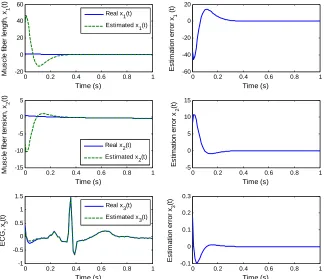
Figure 9 displays the real and estimated state of
1 t to 3
x x t including their estimation errors. It shows that the estimated states converge quickly to the
1.5
0 0.2 0.4 0.6 0.8 1 -1
-0.5 0 0.5 1
EC
G
Time (s)
, x
3
(t
)
WBH ECG data x
3(t)
100
50
0
-50
-100
-150
0 0.2 0.4 0.6 0.8 1
P
a
ce
ma
k
e
r si
g
n
a
l,
u
(t
)
Time (s) (a) (b)
[image:9.595.137.461.261.407.2]lation heartbeat system. (a) ECG tracking; (b) Pacemaker signal.
Figure 8. ECG tracking simu results for the 3rd-order
0 0.2 0.4 0.6 0.8 1 -20
0 20 40 60
M
u
s
c
le
fi
b
e
r
le
n
g
th
, x 1
(t
Time (s) Real x1(t)
)
Estimated x1(t)
20
0
-20
-40
-60
0 0.2 0.4 0.6
E
s
tim
a
tio
n
e
rr
o
r x
1
(t)
Time (s)
0.8 1
5
0 0.2 0.4 0.6 0.8 1 -15
-10 -5 0
M
us
c
le
f
iber
t
e
ns
ion,
x 2
(t)
Time (s) Real x
2(t)
Estimated x2(t)
15
0 0.2 0.4 0.6 0.8 1 -5
0 5 10
s
tim
a
tio
n
e
rr
o
r
x 2
(t
)
E
Time (s)
0 0.2 0.4 0.6 0.8 1 -1
-0.5 0 0.5 1 1.5
ECG
, x
3
(t
)
Time (s) Real x3(t)
Estimated x
3(t)
0 0.2 0.4 0.6 0.8 1 -0.1
0 0.1 0.2 0.3
E
s
ti
m
a
ti
o
n
e
rro
r
x3
(t
)
[image:9.595.137.461.437.716.2]Time (s)
Figure 9. Observer simulation results and estimation error for the 3rd-order heartbeat system.
0 2 4 6 8 0.2
0.4 0.6 0.8 1 1.2 1.4 1.6
M
u
s
c
le
fi
be
r l
ength
, x 1
(t
)
Time (s)
0 2 4 6 8
-1.5 -1 -0.5 0 0.5
M
u
s
c
le
fi
ber
tens
io
n, x
2
(t
)
Time (s)
0 1 2 3 4 5 6 7 8
-1 1.5
1
0.5
0
-0.5
EC
G
, x
3
(t
[image:10.595.142.454.83.390.2])
Figure 10. ECG signal produced by the 3rd-order heartbeat tracking system. real states with asymptotically stable error dynamics.
Finally, Figure 10 illustrates the multiple pulses ECG
signal created by the 3rd-order heartbeat tracking system.
5. Conclusion
We applied the nonlinear control system theory, based on input-output feedback linearization and observer theory, to a model for the biological heartbeat systems. Two Zeeman models were chosen in this study as they not only describe the heartbeat, but also offer direct biophy- sical relationship to the dynamic variables. The two models were modified by incorporating a control input into the systems, thereby creating two interesting control- affine SISO nonlinear systems. We showed that the re- sulting heartbeat models are minimum-phase systems suitable for the design of output tracking control laws; these control laws were also used to generate synthetic ECG signals. In addition, an observer was applied to es- timate the unknown variables in the transformed coordi- nates. The simulation results show that the observer- based tracking control laws effectively force the outputs of the systems to track the real ECG data from the PhysioNet database (Figure 4), and William Beaumont
F
6. Acknowledgements
The authors wish to acknowledge the support of an Oak- land University-Beaumont Hospital multidisciplinary re- search grant for biomedical engineering research under the Oakland University-William Beaumont School of Medicine. We would also like to thank Dr. Robert Hammond of the William Beaumont Hospitals, Royal Oak, MI, for providing a set of ECG data used in the simulation studies; Dr. Bradley Roth of the Department of Physics, and Dr. Edward Gu of the Department of Electrical and Computer Engineering, both at Oakland University, for their valuable comments and suggestions.
REFERENCES
[1] N. Kannathal, C. M. Lim, U. R. Acharya and P. K. Sa- dasivan, “Cardiac State Diagnosis Using Adaptive Neuro- Fuzzy Technique,” Medical Engineering & Physics, Vol. 28, No. 8, 2006, pp. 809-815.
doi:10.1016/j.medengphy.2005.11.011 Time (s)
[2] L. Y. Shyu and W. Hu, “Intelligent Hybrid Methods for ECG Classification—A Review,” Journal of Medical and Biological Engineering, Vol. 28, No. 1, 2007, pp. 1-10.
uations for the Heartbeat
eoretical Biology, Vol. 4, 1972, pp. 8-67.
Hospitals, Michigan ( tr
igure 8), with asymptotic stable
acking error. Other biomedical engineering applications of Zeeman’s models are under consideration.
[3] E. C. Zeeman, “Differential Eq and Nerve Impulse,” Towards a Th
Physiology,” Nature, Vol. 410, 2001, pp. 277-284.
doi:10.1038/35065745
he Relationship among Cardiac Pacemak-[5] M. Vassalle, “T
ers: Overdrive Suppression,” Circulation Research, Vol. 41, No. 3, 1977, pp. 269-277.
doi:10.1161/01.RES.41.3.269
[6] D. S. Jones and B. D. Sleeman, “Differential Equations and Mathematical Biology,” Chapman & Hall/CRC, Lon- don, 2003.
[7] N. Jafarnia-Dabanloo, D. C. McLernon, H. Zhang, A. Ayatollahi and V. Johari-Majd, “A Modified Zeeman Model for Producing HRV Signals and Its Application to ECG Signal Generation,” Journal of Theoretical Biology, Vol. 244, No. 2, 2007, pp. 180-189.
doi:10.1016/j.jtbi.2006.08.005
[8] B. van der Pole and J. van der Mark, “The Heart Beat Considered as a Relaxation-Oscillation and an Electrical Model of the Heart,” Philosophical Magazine Series 7, Vol. 6, No. 38, 1928, pp. 763-775.
[9] B. J. West, A. L. Goldberger, G. Rovner and V. Bhargava, “Nonlinear Dynamics of the Heartbeat, the AV Junction: Passive Conduit or Active Oscillator?” Physica D: Non- linear Phenomena, Vol. 17, No. 2, 1985, pp. 198-206.
doi:10.1016/0167-2789(85)90004-1
[10] C. R. Katholi, F. Urthaler, J. Macy Jr. and T. N. James, “A Mathematical Model of Automaticity in the Sinus ased on Weakly Coupled Re-Node and AV Junction B
laxation Oscillators,” Computers and Biomedical Re- search, Vol. 10, No. 6, 1977, pp. 529-543.
doi:10.1016/0010-4809(77)90011-8
[11] M. G. Signorini, S. Cerutti and D. D. Bernardo, “Simula- tion of Heartbeat Dynamics: A Nonlinear Model,” Inter- national Journal of Bifurcation and Chaos, Vol. 8, No. 8, 1998, pp. 1725-1731. doi:10.1142/S0218127498001418
[12] D. D. Bernardo, M. G. Signorini and S. Cerutti, “A Model of Two Nonlinear Coupled Oscillators for the Study of Heartbeat Dynamics,” International Journal of Bifurca- tion and Chaos, Vol. 8, No. 10, 1998, pp. 1975-1985.
doi:10.1142/S0218127498001637
[13] A. M. dos Santos, S. R. Lopes and R. L. Viana, “Rhythm
Synchronizatio on of Coupled van
der Pol Oscilla eartbeat,” Physica
n and Chaotic Modulati tors in a Model for the H
A: Statistical Mechanics and Its Applications, Vol. 338, No. 3-4, 2004, pp. 335-355.
doi:10.1016/j.physa.2004.02.058
[14] M. E. Brandt, G. Wang and H. T. Shih, “Feedback Con- trol of a Nonlinear Dual-Oscill
furcation Control, Vol. 293, 20ator Heartbeat Model,” 03, pp. 715-718. Bi-
” Chaos, Solitons and Fractals, Vol. 41, No. [15] S. R. F. S. M. Gois and M. A. Savi, “An Analysis of Heart Rhythm Dynamics Using a Three-Coupled Oscil- lator Model,
15, 2009, pp. 2553-2565.
doi:10.1016/j.chaos.2008.09.040
[16] P. E. McSharry, G. D. Clifford, L. Tarassenko and L. A. Smith, “A Dynamical Model for Generating Synthetic Electrocardiogram Signals,” IEEE T
medical Engineering, Vol. 50, N
ransactions on Bio-
o. 3, 2003, pp. 289-294.
doi:10.1109/TBME.2003.808805
[17] M. J. Lopez, A. Consegliere, J. Lorenzo and L. Garcia, “Computer Simulation and Method for Heart Rhythm Control Based on ECG Signal Reference Tracking,”
21-27.
er, 1997.
WSEAS Transactions on Systems, Vol. 9, No. 3, 2010, pp. 263-272.
[18] W. Thanom and R. N. K. Loh, “Nonlinear Control of Heartbeat Models,” Journal on Systemics, Cybernetics and Informatics, Vol. 9, No. 1, 2011, pp.
[19] H. K. Khalil, “Nonlinear Systems,” 3rd Edition, Prentice Hall, Upper Saddle River, 2002.
[20] A. Isidori, “Nonlinear Control Systems,” Springer-Verlag, New York, 1995.
[21] M. A. Henson and D. E. Seborg, “Nonlinear Process Con-trol,” Prentice Hall, Upper Saddle Riv
[22] C. I. Byrnes and A. Isidori, “Asymptotic Stabilization of Minimum Phase Nonlinear Systems,” IEEE Transactions on Automatic Control, Vol. 36, No. 10, 1991, pp. 1122- 1137. doi:10.1109/9.90226
[23] G. Ciccarella, M. Dallamora and A. Germani, “A Luen- berger-Like Observer for Nonlinear Systems,” Interna- tional Journal of Control, Vol. 57, No. 3, 1993, pp. 537- 556. doi:10.1080/00207179308934406
[24] N. H. Jo and J. H. Seo, “Input Output Linearization Ap- proach to State Observer Design for Nonlinear System,”
IEEE Transactions on Automatic Control, Vol. 45, No. 12, 2000, pp. 2388-2393. doi:10.1109/9.895580
[25] A. L. Goldberger, L. A. N. Amaral, L. Glass, J. M. Hausdorff, P. Ch. Ivanov, R. G. M
Moody, C. K. Peng and H. E.
ark, J. E. Mietus, G. B. Stanley, “PhysioBank, PhysioToolkit, and PhysioNet,” Circulation, Vol. 101, No. 23, 2000, pp. e215-e220.
doi:10.1161/01.CIR.101.23.e215