Can Fluency Predict Problem Solving Behavior in Knowledge-lean
Puzzles?
Peter Riezebos
P. (Peter) Riezebos BSc S0135348
Bachelor of Science thesis Instructie, Leren & Ontwikkeling
Department of Behavioural Sciences (Psychology), University of Twente January 2014
Samenvatting
Deze studie onderzoekt de relatie tussen de executieve functie van fluency en probleemoplossend vermogen in zogenaamde knowledge-lean puzzels. Fluency wordt ook wel aangeduid als cognitieve flexibiliteit, dan wel effectief strategiegebruik. De verwachting is dat hoog fluente participanten beter zijn in het aanpassen van leerstrategieën wanneer de taak dit noodzakelijk maakt, en meer succesvol in het genereren van relevante hypothesen tijdens het probleemoplossende proces. Fluency is daarmee naar verwachting een effectieve voorspeller van zowel flexibiliteit in het gebruik van probleemoplossende strategieën, als in hypothesegeneratie, en is naar verwachting effectiever in het voorspellen van resultaten dan andere dominant gemeten executieve functies, zoals werkgeheugen en inhibitie.
Deze studie werd uitgevoerd op locatie bij de East China Normal University (ECNU) in Shanghai, China. Dataverzameling werd gerealiseerd door middel van een experiment waarin scores op knowledge-lean puzzels en executieve functie tests (Figure Fluency Test, Word Fluency Test, Colour Word Interference Test, en WISC-getallenreeksen) aan elkaar werden gerelateerd. Respondenten (n = 53) zijn allen student (gemiddelde leeftijd = 19.3 jaar, SD = 1.07, n = 53, 18 mannen en 35 vrouwen).
Figuurfluency voorspelt succes op de probleemoplossende taak, F (1, 51) = 5.568, p = .022, R2 = 0,081 mede door een verhoogd gebruik van de experimentruimte, F (1, 51) = 17,623, p <.001, R2 = .242, dit blijkt een effectieve voorspeller van succes in probleem oplossen in knowledge-lean puzzels. Tenslotte voorspelt figuurfluency de uniciteit in succesvolle oplossingen, F (1, 51) = 9.412, p = .003, R2 = .156. Hoogfluente participanten geven meer originele, succesvolle oplossingen.
Abstract
This study investigates the relation between the executive function of fluency and problem solving ability in knowledge-lean puzzles. Fluency is also referred to as cognitive flexibility or effective strategy use. It is expected that highly fluent learners are better able to adapt learning strategies when needed, and are more successful in generating relevant hypotheses during the problem solving process. Fluency thus is to be an effective predictor of both flexibility in strategy use and hypothesis generation ability, and is to be more effective in predicting these results than other dominantly measured executive functions such as working memory and inhibition.
The fieldwork of this study was conducted on location at the East China Normal University (ECNU) in Shanghai, China (2012). Data gathering was executed by means of an experiment in which computerized knowledge-lean puzzles and executive function tests (Figure Fluency Test, Word Fluency Test, Colour Word Interference Test, and WISC-digit span) were related and evaluated. Participants (n=53) are all undergraduate students (mean age = 19.3 years, SD = 1.07, n = 53, 18 men and 35 woman).
Figure fluency predicts success in the problem solving task, F (1, 51) = 5.568, p = .022, R2= .081 partly due to more elaborate use of the experiment space, F (1, 51) = 17.623, p < .001, R2= .242, which shows to be an effective predictor of problem solving success in knowledge-lean puzzles. Finally, figure fluency predicts uniqueness in successful solutions, F (1, 51) = 9,412, p = .003, R2= .156. Highly fluent participants provide more original successful solutions.
Table of Contents
Introduction ... 5
Method ... 8
Participants ... 8
Materials ... 8
Fluency ... 8
Inhibition ... 8
Working memory ... 9
Problem solving ... 9
Procedure ... 10
Results ... 12
Discussion ... 15
Introduction
Recent developments in the field of education address the importance of adaptive instruction in the classroom (Jonassen & Grabowski, 2012). Individuals differ in their learning, and thus in their educational needs (Fischer & Daley, 2006; Fischer et al., 2010). Still, most of the global educational systems share knowledge in a static manner and therefore fail to address individual learning preferences (Fischer & Daley, 2006; Fischer et al., 2010). Individuality in learning requires attention and with restricted instruction time and limited means in the classroom, the question that comes to mind is how to guide learners effectively and efficiently. Accepting the urge for adaptive instructions demands specific guidelines in order to shape this instruction. Which learner characteristics are diagnostic in performance and behavior has to be determined. Developments in the field of the cognitive neurosciences may assist in identifying relevant learner characteristics and may provide insight as to how and why these characteristics are predictive of learner ability and behavior. Although some scholars argue that using insights from this field have not yet matured enough to be used to explain concrete learner behavior (Bruer, 1997; Klahr, 2011), evidence to the contrary has been reported as well (Goldstein & Naglieri, 2014; Van Klink, Eysink & De Jong, Submitted).
Fluency is considered the cognitive flexibility, or shifting, which enables us to think creatively (Rabbitt, 2007). Literature described this flexibility as the mental ability to switch between thinking about two or more different concepts simultaneously. Fluency is defined as the ability to adapt easily and use strategies effectively (Goldstein & Naglieri, 2014). Scott (1962) defined cognitive flexibility as “the readiness with which the person's concept system changes selectively in response to appropriate environmental stimuli.” According to Jurado & Rosselli (2007), inhibition reflects the individual ability to inhibit stimuli and behavior. It functions as a restraint on an otherwise natural and spontaneous thoughts and/or actions. In learning it enables learners to focus on relevant information (the data presented) by suppressing irrelevant information (e.g., prior beliefs). Working memory is defined as a hypothetical limited capacity system that provides the temporary storage and manipulation of information that is necessary for performing a wide range of cognitive activities (Baddely, 2012).
Studies investigating the relation between the EF and learning can be divided into two categories: first, studies focusing on enhancing learning by training the EF; second, studies using EF to identify strengths and weaknesses, with the goal to use these learner characteristics to choose the most effective learning strategy. Application of the second approach strives towards using adaptive instruction and matching it with learner characteristics. Although this line of research seems promising, some scholars point out that, in order to be able to use insights from the field of neuropsychology to enhance learning, concrete cognitive models which predict concrete learner behavior based on learner characteristics are essential (Klahr, 2011). These models have not yet been reported.
important in our investigation because fluency is defined as the ability to adapt easily and use strategies effectively. We expect that, when faced with a set of problems in which the use of one dominantly applied strategy does not work (such as trying to remember all options), learners with high fluency scores, are better able to deal with this challenge (ineffective strategy-use) by adapting their learning strategy. Knowledge lean problems provide the opportunity to investigate this hypothesis. In this study we therefore will investigate problem solving in isomorphic knowledge lean problems, and relate outcomes to executive function test scores. We will use puzzles for which strategy changes are needed in order to succeed and expect to find that fluent learners will score better due to adaptive capacity. In order to differentiate between high fluency scores and other executive function scores (discriminant validity), inhibition and working memory will be measured as well.
In addition to the expectation that fluent learners are better able to adapt when faced with ineffective learning strategies, we expect that highly fluent learners are better able to organize the problem solving process by means of effective hypotheses generation during problem solving. Because fluency is related to creativity and originality (Milgram & Arad, 1981; Milgram, 1983; Shaw & Demers, 1986; Runco & Charles, 1993; Runco & Chand, 1994; Runco & Illies & Eisenman, 2005) it is expected that highly fluent learners are better able to come up with multiple hypotheses. Learners often hold on to one (initial) hypothesis during problem investigation, even when results do not support this hypothesis (De Jong & Van Joolingen, 1998). It is expected that fluent learners are better able to adapt both strategies and held hypotheses during the problem solving process, thus leading to better results.
Method
The fieldwork of this study was conducted on location at the East China Normal University (ECNU) in Shanghai, China. During five consecutive weeks in fall 2012, data gathering was executed by means of an experiment and executive function testing.
Participants
The respondents are all undergraduate students at the East China Normal University. A total of 53 students (mean age = 19.3 years, SD = 1.07, n = 53, 18 men and 35 woman) voluntarily participated in the study.
Materials
Five different tests were used in this experiment. Four tests were used to measure executive functioning reflecting fluency (word- and figural-), inhibition and working memory. The fifth test is a problem-solving task based on a knowledge-lean puzzle principle, designed for this experiment.
Fluency
Fluency was administered using the Word Fluency Test (WFT) and the non-verbal Figure Fluency test (FFT) (Ruff, Light, Parker, & Levin, 1997). Both measure the ability to rapidly produce a particular kind of response based on a given stimulus. The WFT measures verbal fluency by addressing the participants’ ad hoc knowledge of a certain semantic category. Two categories – animals and professions – were administered, each provided with a sixty-seconds time limit (Tombaugh, Kozak & Rees, 1999). The FFT addresses the participants’ cognitive ability to produce unique patterns. This non-verbal test reflects figural fluency. The participant is asked to produce as many unique patterns as possible. He or she is given a restricted timeframe to connect five dots using only straight lines. The number of correct unique patterns determines the score.
Inhibition
Working memory
WM was measured using the Digit Span subtest of the Wechsler Intelligence Scale for Children (Wechsler, 1991). The backward scores were administered. Scores on the 'backward' (Digit-BW) items are most indicative of working memory capacity (Baron, 2004) because this score relies on the ability to manipulate the information kept in memory. The test scores used in analyses represent raw test scores on Digit-BW (number of items correct).
Problem solving
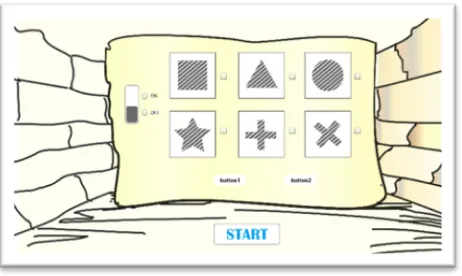
[image:9.595.184.415.353.491.2]We explore problem solving in the context of knowledge-lean puzzles. In these puzzles prior knowledge is not relevant and objects and rules are clear (Robertson, 2008). In order to measure problem solving in a knowledge-lean context, we developed a computerized puzzle. This task, (see Figure 1) describes a ‘cave quest’ in which the participants are confronted with a cave door which leads to the sought after treasure.
Figure 1. The cave experiment reflecting the problem solving task in the experiment
Note: solution subtask 1: off, star, triangle, cross, button 1; solution subtask 2: off, square, plus, circle, button 1; solution subtask 3: every solution that contains a star, plus and cross.
need to press the ‘start’ button to see whether the door will open. Three subsequent doors have to be opened in order to find the treasure (3 subtasks).
The task has a time limit of ten minutes per subtask in which participants can experiment with different combinations (experimenting phase). This refers to the strategies in knowledge-lean puzzling. The results of this experimenting are registered in the program log files and are scored afterwards on both correctness (scored 0 if the door did not open, and 1 if the door did open), and uniqueness (based on whether a the entered combination was entered before: 1 for each unique correct answer). In addition, the total number of experiments conducted was scored as well. In order to assess whether highly fluent learners are better able to organize the problem solving process by means of effective hypotheses generation, we scored a ‘hypothesis generation’-measure 0, 1 or 3. Participants needed to formulate a hypothesis before each experiment (prior to each possible solution). Non-related hypothesis scores 0 – this ranges from writing non-existing words, notating numbers and/or a non-task related statement – and a hypothesis that reflected the learning task is awarded 1 point. These hypotheses are characterized by modestly targeted statements, which are task-related and focused on an outcome. Further, hypotheses that both reflected the learning task and provided a clear goal-directed solution and/or predicting value are rewarded 3 points.
The first two subtasks contain one possible solution: a complex combination of all the accessible buttons. In the third subtask each combination results in success when at least the lower three abstract buttons are selected. This way the participants are enabled in providing a wide range of successful solutions. The uniqueness in successful answering is measured in the third task in order to discriminate between individuals who are more successful due to increased tries versus individuals who are more successful due to creativeness by deploying more original answering.
Procedure
Results
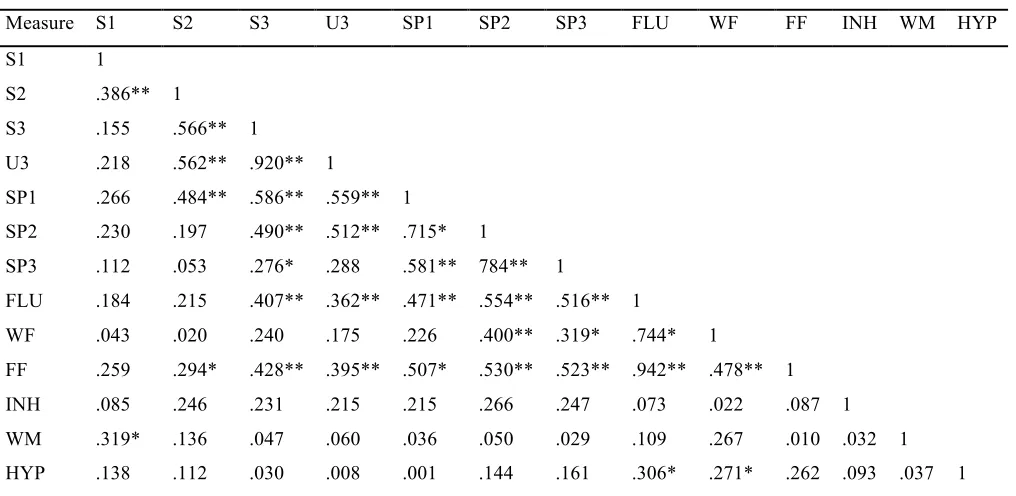
[image:12.595.47.555.454.702.2]The main research question of this study addressed the predicting ability of the executive functions on problem solving in knowledge-lean puzzles. The executive functions measured in this study are fluency, working memory and inhibition. Fluency is suggested to influence problem solving ability in knowledge-lean puzzles. Both working memory and inhibition are expected to have no predicting ability. Fluency is measured both individually (WFT/FFT) and combined (FLU =WFT+FFT). The combined score is a summing up of both fluency (WFT/FFT) measures and is used due to general factor desirability – as with the other executive functions. As table 1 shows, the found correlations indicate strong relations between fluency and task results. Working memory provides a significant correlation on task success in the first task. No further significant effects on working memory are shown by the results. Inhibition does not show any significant effect in all subtasks. Fluency does persistently show significant correlations. Especially figure fluency, as expected given the visual nature of the task. In the first and second task there is low ‘space’ for fluency. The results show that the number of tries has a positive effect on successfulness and that this is achieved by unique (original) answering.
Table 1
Correlations of the experimenting on fluency, working memory and inhibition
Measure S1 S2 S3 U3 SP1 SP2 SP3 FLU WF FF INH WM HYP
S1 1
S2 .386** 1
S3 .155 .566** 1
U3 .218 .562** .920** 1
SP1 .266 .484** .586** .559** 1
SP2 .230 .197 .490** .512** .715* 1
SP3 .112 .053 .276* .288 .581** 784** 1
FLU .184 .215 .407** .362** .471** .554** .516** 1
WF .043 .020 .240 .175 .226 .400** .319* .744* 1
FF .259 .294* .428** .395** .507* .530** .523** .942** .478** 1 INH .085 .246 .231 .215 .215 .266 .247 .073 .022 .087 1 WM .319* .136 .047 .060 .036 .050 .029 .109 .267 .010 .032 1 HYP .138 .112 .030 .008 .001 .144 .161 .306* .271* .262 .093 .037 1
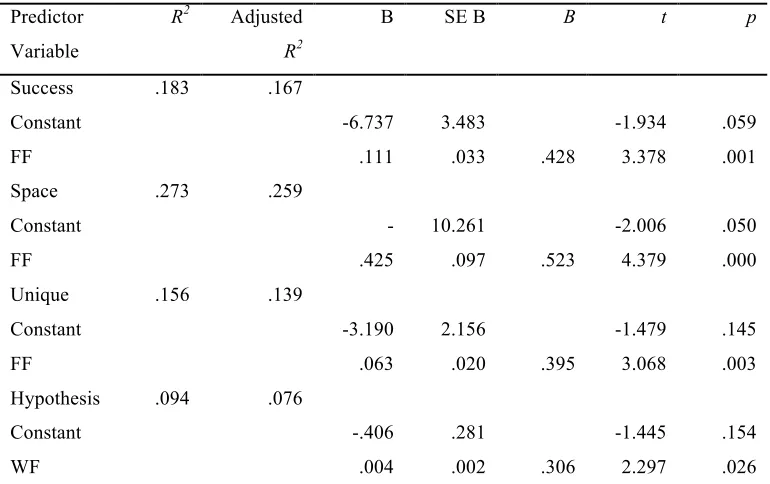
In determining the causality of the correlations multiple regression analyses were run to predict task success and hypothesizing by fluency, word fluency, figure fluency, inhibition and working memory.
Table 2
Multiple (stepwise) regression analysis Predictor
Variable
R2 Adjusted
R2
B SE B B t p
Success .183 .167
Constant -6.737 3.483 -1.934 .059
FF .111 .033 .428 3.378 .001
Space .273 .259
Constant - 10.261 -2.006 .050
FF .425 .097 .523 4.379 .000
Unique .156 .139
Constant -3.190 2.156 -1.479 .145
FF .063 .020 .395 3.068 .003
Hypothesis .094 .076
Constant -.406 .281 -1.445 .154
WF .004 .002 .306 2.297 .026
B: un-standardized beta coefficient, SE B: standard error, β: standardized beta coefficient, WF: Word Fluency Test, FF: Figure Fluency Test; Success: success in subtasks; Space: utilization experiment space; Unique: unique correct solutions; Hypothesis: hypothesis generation scores.
Discussion
In this study we investigated the relation between the executive function of fluency and problem solving in knowledge-lean puzzles. It was expected that highly fluent learners are better able to adapt learning strategies when needed, and are more successful in generating relevant hypotheses during the problem solving process. We therefore expected to find that fluency is an effective predictor of both flexibility in strategy use and of hypothesis generation, leading to better results. We also expected that fluency is more effective in predicting these results than other dominantly measured executive functions (working memory and inhibition).
Our results show that fluency is correlated moderately to high, to the number of experiments conducted in all 3 subtasks. Inhibition and working memory are not significantly correlated to the number of experiments conducted. This indicates that highly fluent participants were more active during the experimenting phase. Furthermore, highly fluent participants demonstrate better hypothesizing, reflected in a moderate correlation between fluency scores and hypothesis generation, although this does not result in risen success in problem solving or increased originality.
Results further demonstrate that highly fluent participants score better at subtasks 2 and 3, as compared to little fluent participants (moderate correlations between fluency scores and both ‘good’, and ‘unique good’ answers for both subtasks). For subtask 1, participants with high working memory scores conducted better results. These findings indicate that for the first task, relying on working memory helped solving the task, but for task 2 and 3 this strategy proved less successful. This can be explained because the task was developed to challenge working memory capacity in the many experiments that could be conducted. Highly fluent participants dominantly scored on the 2nd and 3rd subtask. This may be explained because of altered strategy use between subtask 1 and 2, when confronted with the realization that the task exceeded working memory capacity. Highly fluent learners were better able to change their strategy to tackle this problem, thus leading to more success in the subsequent subtasks.
References
Anderson, V. A. (1998). Assessing executive functions in children: Biological, psychological, and developmental considerations. Neuropsychological Rehabilitation, 8, 319-349. doi:10.1080/713755568
Anderson, P. (2003). Assessment and development of executive function during childhood. Child Neuropsychology, 8, 71-82. doi:10.1076/chin.8.2.71.8724
Baddeley, A. (2012). Working Memory: Theories, Models, and Controversies. Annual Review Psychology, 1, 1-29. doi:10.1146/annurev-psych-120710-100422
Banich, M. T. (2009). Executive Function: The Search for an Integrated Account. Current Directions in Psychological Science, 2, 89-94. doi:10.1111/j.14678721.2009.01615.x
Baron, I. S. (2004). Neuropsychological evaluation of the child. New York: Oxford University Press.
Best, J. R., Miller, P. H., & Jones, L. L. (2009). Executive functions after age 5: Changes and correlates. Developmental Review, 29, 180-200. doi:10.1016/j.dr.2009.05.002
Blakemore, S. J. (2012). Imaging brain development: The adolescent brain. Neuroimage, 61, 397- 406. doi:10.1016/j.neuroimage.2011.11.080
Bruer, J. T. (1997). Education and the brain: A bridge too far. Educational Researcher, 26(8), 4-16.
Chan, R. C. K., Shum, D., Toulopoulou, T., & Chen, E. Y. H. (2008). Assessment of executive functions: Review of instruments and identification of critical issues. Archives of Clinical Neuropsychology, 2, 201-216. doi:10.1016/j.acn.2007.08.010202 De Jong, T., & Van Joolingen, W. R. (1998). Scientific discovery learning with computer
Delis, D. C., Kaplan, E., & Kramer, J. H. (2008a). Color-word interference test (H. Op den Buysch, I. Noens & I. van Berckelear-Onnes, Trans.). Amsterdam: Harcourt Test Publishers.
Delis, D. C., Kaplan, E., & Kramer, J. H. (2008b). Trail-making test (H. Op den Buysch, I. Noens & I. van Berckelear-Onnes, Trans.). Amsterdam: Harcourt Test Publishers. Garon, N., Bryson, S. E., & Smith, I. M. (2008). Executive function in preschoolers: a review
using an integrative framework. Psychological Bulletin, 134, 31-60. doi:10.1037/0033-2909.134.1.31
Fischer, K. W., & Daley, S. (2006). Connecting cognitive science and neuroscience to
education: Potentials and pitfalls in inferring executive processes. In L. Meltzer (Ed.), Understanding executive function: Implications and opportunities for the classroom (pp. 55-72). New York: Guilford.
Fischer, W. K., Goswami, U., Geake, J. (2010). The future of educational neuroscience. Mind, Brain & Education, 4, 68-80. doi:10.1111/ j.1751-228X.2010.01086.x
Goldstein, J. A., & Naglieri, S. (2014). Handbook of executive functioning. doi:10.1007/978-1-4614-8106-5
Homack, S., Lee, D., & Riccio, C. A. (2005). Test review: Delis-Kaplan executive function system. Journal of clinical and experimental neuropsychology, 27, 599-609.
doi:10.1080/13803390490918444
Jonassen, D. H., & Grabowski, B. L. (2012). Handbook of individual differences in learning and instruction. New York: Taylor & Francis group.
Jurado, M. B., & Rosselli, M. (2007). The elusive nature of executive functions: A review of our current understanding. Neuropsychology Review, 17, 213-233.
Klahr, D. (2011). Has the pendulum stopped swinging at last? Paper presented at the SREE fall conference, Washington, D.C.
Klink, van M., Eysink, T. H. S., & de Jong. Evaluating Data Reading Ability in Elementary School Children Using an Executive Function Framework. Child Development
(submitted).
Klink, van M., Eysink, T. H. S., & de Jong. Building bridges: how the executive functions can guide adaptive instruction during inquiry (in preparation).
Milgram, R. M., & Arad, R. (1981). Ideational fluency as a predictor of original problem solving. Journal of Educational Psychology, 73(4), 568-572.
Milgram, R. M. (1983). Validation of ideational fluency measures of original thinking in children. Journal of Educational Psychology, 75(4), 619-624.
Miyake, A., Friedman, N. P., Emerson, M. J., Witzki, A. H., Howerter, A., & Wager, T. D. (2000). The unity and diversity of executive functions and their contributions to complex ‘‘frontal lobe” tasks: A latent variable analysis. Cognitive Psychology, 41, 49-100. doi:10.1006/cogp.1999.0734
Pennington, B. F. (2002). Development of psychopathology: Nature and nurture. New York, NY: The Guilford Press.
Rabbitt, P. (2007). Methodology of frontal and executive function. New York: Psychology Press.
Runco, M. A., & Charles, R. E. (1993). Judgments of Originality and Appropriateness as Predictors of Creativity. Personality and Individual Differences, 15(5), 537-46. Runco, M. A., & Chand, I. (1994). Problem finding, evaluate thinking, and creativity. In M.A. Runco, M. A., Illies, J. J., & Reiter-Palmon, R. (2005). Explicit instructions to be creative and
original: A comparison of strategies and criteria as targets with three types of
Scott, W A (1962). Cognitive complexity and cognitive flexibility. American Sociological Association, 25, 405-414.
Shaw, G. A., & DeMers, S. T. (1986). The relationship of imagery to originality, flexibility and fluency in creative thinking. Journal of Mental Imagery, 10, 65-75.
Tombaugh, T. N. (2004). Trail making test a and b: Normative data stratified by age and education. Archives of Clinical Neuropsychology, 19, 203-214.
Wechsler, D. (1991). Manual for the Wechsler scale of children's intelligence-iii. New York: Psychological Corporation.
Welsh, M. C., Friedman, S. L., & Spieker, S. J. (2005). Executive Functions in Developing Children: Current Conceptualizations and Questions for the Future. In D. Philips & K. McCartny (Eds.), Handbook of Early Childhood Development. London: Blackwell. Zimmerman, C. (2007). The development of scientific thinking skills in elementary and