Knowledge Generation in
Ā
yurveda: Methodological Aspects
S N Venugopalan Nair*and Darshan Shankar**
(Received 30 April 2015; revised 30 November 2015)
Abstract
The wise consider the entire universe as their preceptor (Caraka Sahitā CS.Vi.14). Knowledge generation in Āyurveda has followed mainly four types of siddhānta (theory) viz. 1. śarvatantra siddhānta
(the theory which is accepted by all śāstrā-s), 2. pratitantra siddhānta (the theories not in any other śāstrā-s:), 3. adhikaraa siddhānta (from the related topics and theories) and 4. abhyupagama siddhānta
(unproven and not fully tested theories). These siddhānta-s were debated among groups of scientists and students of various schools of thought. The methods of such discourses are guided by 44 rules of logic, ‘vādamārga’ (CS. Vi.8.26) to justify propositions. The Āyurvedic texts are formulated based on the 32 criteria (Suśruta Sahita; SS.Utta.65) and 36 criteria by Caraka (CS.Si.43) known as tantra-yukti in order to ensure rigour. Āyurveda considers knowledge of whole cannot be obtained by knowing its parts.
Key words: Āyurveda, Darśana, Knowledge, Logic, Tantrayukti, Vādamārga.
* Associate Professor, Trans Disciplinary University, Institute of Trans Disciplinary Health Sciences and Technology, FRLHT, 74/2, Jarakabande Kaval, Post Attur, via Yelahanka, Bangalore 64; Email: [email protected]
**Vice Chancellor, Trans Disciplinary University, Institute of Trans Disciplinary Health Sciences and Technology, FRLHT.
1. INTRODUCTION
Āyurvedic knowledge has a long history in the country, most part of which is lost due to its being part of old oral tradition. Some of the oral traditions of ancient times, the Vedic brāhmaic and the heterodox, have survived, thanks to their sacred nature. What we know as the history of Āyurveda is mainly based on sahitā-s mainly of Suśruta and Caraka, generally dated to the period between 6th century BC and 2nd century AD.
Ācarya Ātreya is the first known author of an Āyurvedic medical treatise, the Ātreya sahitā. It is believed that Caraka made his Sahitā largely based on Ātreya’s work. What emerges as striking is the methodological rigour that his Sahitā
exhibits. We seek to discuss generation of Āyurvedic knowledge, its logical structure, dialectical procedure.
2. GENERATION OF AYURVEDIC KNOWLEDGE
Caraka says that the entire world is the teacher to the intelligent and foe to the unintelligent. Knowing this well, with proper attention, one should listen even to an unfriendly person. ‘Purucōyamlōkasammita’: ‘Human being is a microcosm of the physical and biological world’ (CS. Vi.8.14). All entities in the universe are there in the person and vice versa. Intuitive knowledge is distinct from the methodologically realised knowledge that overcomes the distinction between the knower and the known. It is the perfect knowledge, while all other knowledge is incomplete and imperfect in so far as it does not bring about identification between the subject and the object.
sets of information are strung out as if along a thread. This is like a thread which holds together beads or flowers in a garland. The knowledge thus preserved is in a condensed form, very precise and free of repetitions, enabling its remembrance and retrieval on demand relatively easy. Subsequently all this was codified and systematised in the form of written texts, namely sahitā-s (the compendia). Both the modes had followed the poetic genre for the organisation of knowledge. Āyurvedic texts start with a chapter known as
sūtra-sthāna which explains the fundamental features and principles of the knowledge they embody by way of the philosophy, logic and concepts. The systematised texts of the sahitā
tradition also followed the same style of precision. Naturally at a later stage this necessitated commentaries involving explanations (bhāya), annotations (vārtika) and redactions ( prati-samskaraa). The compilation of pre-existing orally transmitted knowledge had led to generation of new knowledge through empirical observation and theoretical deduction. Caraka mentions about acquisition of empirical knowledge about medicinal plants, from the tribal people (CS.1:120). The codification and systematisation of inherited knowledge had the pressure of pedagogic needs on them. It appears that sahitā-s were the works of ācārya-s who were practitioners and teachers of the gurukūla tradition of education under which the pupils stayed with the teacher’s family. This tradition of knowledge transmission had given birth to several lineages of teachers and pupils, namely the guru-śiya parampara-s in different domains of knowledge such as Veda, Yoga, Āyurveda etc. In certain regions this tradition has survived to the present times among certain communities of hereditary association with such domains of knowledge. Caraka underlines the primacy of practical knowledge. Vāgbhaa mentions three phases viz., adhīti (learning),
bodha (understanding), ācaraa (practising) and
pracāraa(propagating) of the knowledge (ASM. 1:28).
In Āyurveda the basic knowledge is the knowledge about the knowable object, padārtha vijñāna. The knowledge of the material, its practical context and the observation of results are fundamental to the generation of Āyurvedic knowledge. In Āyurveda, padārtha vijñāna is extended into a holistic understanding with theoretical foundations and logical arguments emphasizing practical relevance. Sahitā-s of Āyurveda hold this knowledge as eternal (śāśvata) and without beginning (anādi) because it deals with properties of entities of a universal nature (svabhāva sasiddha lakcaatvāt ) which has permanent (bhāva svabhāva nityatvāt ) characters (CS. 30: 27).
3. DIALECTICAL PROCEDURE (VA–DAMA–RGA)
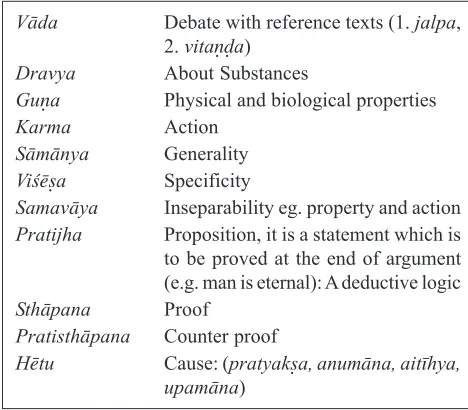
[image:2.612.314.548.543.748.2]As in the case of any other stream of knowledge in traditional India, Āyurveda also had followed Vādamārga (dialectical procedures) based on Nyāya siddhānta for improving and entrenching and its knowledge (CS. Vi.8: 26). Vāda mārga-s are procedures and focal points of the debate used in intellectual discussions of any subjects of importance. Its focal points are given below in table 1.
Table 1.Procedures and Focal Points of Debates used in Intellectual Discussion
Vāda Debate with reference texts (1. jalpa, 2. vitaa)
Dravya About Substances
Gua Physical and biological properties
Karma Action
Sāmānya Generality
Viśēa Specificity
Samavāya Inseparability eg. property and action
Pratijha Proposition, it is a statement which is to be proved at the end of argument (e.g. man is eternal): A deductive logic
Sthāpana Proof
Pratisthāpana Counter proof
In the process of defining the concept of health, the siddhānta (theory) about the svastha
(healthy individual) the parameters (3 doa-s, 7 body tissues, mind and ātma etc.) are discussed in detail on the basis of Vādamārgā-s by the group of scientists on the basis of theoretical and practical understanding of the subject. The health is defined by Suśruta as follows:
“samadōa samāgniśca samadhā tu-malakriyā|
prasannātmēndriya manā svastha ityabhidhīyatē||
[SS.15/10]
Human being is considered to be completely healthy only when the body constituents namely tridoa-s (vāta, pitta, kapha),
dhātu-s (seven body tissues), effluents like three
mala-s (essential waste products), pañcendriya (5 sense organs), manas (mind) and ātma (soul) are all in equilibrium / contentment stage.
4. LOGIC OF A–YURVEDIC KNOWLEDGE
(TANTRA-YUKTI)
It appears that the codification and systematisation of Āyurvedic knowledge into
sahitā-s were influenced by the a-darśana-s, the six schools of thought (Nyāya, Vaiśeika,
Sānghya, Yoga, Pūrvamīmāmsā, and
Uttaramīmāmsā), the exact chronology of which is not known. There is a preponderance of the methods of the Nyāya school in the constitution of Āyurvedic knowledge. Its structure and the pattern of the organisation of knowledge is based on the logical constructs of the Nyāya thought. Gautama’s influence is explicit in the logical procedures adopted in the sahitā-s by Suśruta and Caraka.
5. LOGICAL REASONING OF NYA–YA (GAUTAMA
600 BC) ON PROOF OF KNOWLEDGE
The term tantra-yukti means the logical plan of knowledge constitution. This enables Dānta Example
Upanaya Leading towards truth
Nigamana Inference
Uttara Rejoinder, asserts disparity between cause and effect:
Siddhānta Theoretical conclusion: (universal as well as specific generalisation) Śabda Dristārtha (observable meaning),
Adristārtha (unobservable meaning),
Satya (truth), Anruta (false)
Pratyaka Direct perception : (Mind, sensory experience)
Anumāna Inference: Logical conclusion based on reason
Aitīhya Verbal Testimony: Āptopadēsa, Veda
(Pure reason)
Aoupamya Analogy
Samśaya Doubt
Prayojana Purpose
Savyabhicāra Exceptional statements
Jijñāsā Enquiry
Vyavasāya Determination
Arthāpatti Implied meaning
Sambhava Origin or source
Anuyojya Imperfect statement
Ananuyojya Perfect statement
Anuyoga Question
Pratyanuyoga Further question
Vākyadoa Flaws of speech: (insufficient, superfluous, meaningless, wrong and contradictory)
Vākyapraśamsā Excellence of speech
Chhalam Quibbling
Ahetu Fallacy (no reason): (of common cause, of doubt, of analogy)
Atītakālam Delayed in time
Upālambha Adjoining factors:
Parihāra Amendment
Pratijñāhāni Abandonment of proposition
Abhanunjā Acceptance
Hetvantaram Fallacy of reason
Arthāntaram Differential meaning, Confusion
expansion of knowledge, elucidation of its meaning (semantics) and systematic exposition of its subject matter (thesis). It provides the focal points of logical statements and deductive procedures for the constitution of solid knowledge. One can scan a systematised body of knowledge using the prescriptions of tantra-yukti and gauge its intellectual depth, authenticity and applicability. Sahitā-s of Āyurveda represent the
constitution of knowledge based on the logical parameters stipulated by tantra-yukti. According to Caraka, a person well versed in the postulates of tantra-yukti can ascertain the logic of systematised knowledge in any of intellectual domains (CS.Si. 12.47). The sahitā-s of Caraka and Suśruta have the following postulates of
tantra-yukti as their basic constituents:
Sl Caraka Si.41 Suśruta.Utta.65 Meaning
1 Adhikaraa Adhikaraa Subject matter, with authority,
2 Yoga Yoga Union, unification
3 Hētvartha Hētvartha Extension of argument, logical argument 4 Padārtha Padārtha Word meaning / about knowable objects
5 Pradēsa Pradēsa Partial enunciation
6 Uddēśa Uddēśa Concise statement, objective
7 Nirdēśa Nirdēśa Amplification
8 Vākyaśēa Vākyaśēa Supply of missing parts of words or sentences, remainder 9 Prayojana Prayojana Objectives
Pramāa Proof
Anuhāva Experiential
Smti Memory
Prama Valid
Aprama Invalid
Prama Valid
Aprama Invalid
Pratyaka Anumāna
Inference ComparisonUpamāna TestimonySābda
Samsaya Doubt
Savikalpa Nirvikalpa Hetva-abhasa Fallaciers
Vaidika of Veda
Tarka Argument
Laukika
Ordinary extraordinaryAlaukika
Sensory
Mānasa
Sāmānya Generality
Njana Lakana Experience
Yogaja Extra sensory
Svārtha for onself
Paratha for others
Purvā-vat effect from cause
Seśavat Cause-from-effect
Samanyato driśtavat Uniformity of co
existence
10 Upadēśa Upadēśa Authoritative instructions, the scope
11 Apadēśa Apadēśa Reasoning a statement
12 Atidēśa Atidēśa Indication, extrapolation
13 Arthāpatti Arthāpatti Implication, inference
14 Niraya Niraya Decision, conclusion
15 Prasanga Prasanga Restatement, case illustration
16 Ekānta Ekānta Categorical statement, the sole meaning 17 Anekānta Anekānta Compromising statement, multimeaning 18 Apavarga Apavarja Exceptions
19 Viparyaya Viparyaya Reconfirmation with other opposite statement, the contradiction 20 Pūrvapaka Pūrvapaka Amplification of earlier statement, earlier premises
21 Vidhāna Vidhāna Correct interpretation, methodology 22 Anumata Anumata Confession, consent
23 Vyākhyāna Vyākhyāna Explanation, commentary
24 Saśaya Saśaya Doubt
25 Atīta-avēkaa Atikranta-vēkaa Retrospective statement, back reference 26 Anāgata- atīta- Anāgata- atīta- reference, foretelling
avēkaa avēkaa
27 Sva-samjña Sva-sanga Use of technical terms, terminology
28 Ūhya ūhya Deduction
29 Samuccaya Samuccaya Specification, group statement 30 Nidarśana Nidarśana Illustration
31 Nirvācana Nirvācana Citation of analogy, definition 32 Samyoga Niyoga Injunction, commandment 33 Vikalpa Vikalpa Option, alternative
34 Pratyutsāra - Rebuttal
35 Uddhāra - Reaffirmation
36 Sambhava - Possibility
Caraka emphasizes that all biological events are based on cause and effect relationships.
“vikārah prakrtiścaiva dvayam sarvam samāsatah.
tad hetu-vaśagam hetor abhāvannanu vartate.”
There are three types of causes: 1)
Samavāyi kāraa, 2) Asamavāyi kāraa 3) Nimitta kāraa. For example, the relationship with doa
and health or diseases is Samavāyi kāraa. The relationship with excessive eating which increases
kapha is Asamavāyi kāraa, the relationship with other factors increasing the kapha while taking the food is Nimitta kāraa. In another context, the threads that constitute a cloth are samavāyi
kāraa, the colour of cloth is Asamavāyi kāraa, and the process of the person or tools for making the cloth is Nimitta kāraa. The cause and effect is explained in detail in Āyurveda. An external factor or an infection is always considered as a
Nimitta kāraa. According to Tarka-sagraha of
Annambhaa (1876) on establishing causation, explains that “vyāptiviśia pakadharmatā
jnānam parāmarśah” this Pakadharmata is used to establish cause and effect relationship.
6. VALIDATION STRATEGIES
experiential validation are central to Āyurvedic knowledge and practice. Proof of knowledge accepted by Āyurvedic ācārya-s is four-fold viz.,
pramāa viz., pratyaka (direct sensory perception), anumāna (inference), yukti
(experimental reasoning) and āptopadēśa
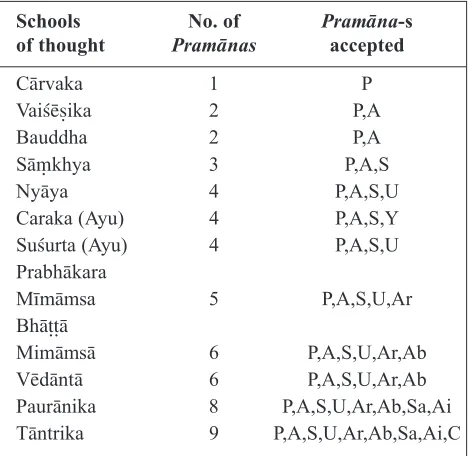
(testimony of the Veda or the final knowledge). The pattern of classification and recognition of the proof of knowledge followed by various schools of thought as seen in the Āyurvedic texts is shown below:
repository of medicinal plants and it is estimated around 6500 species (FRLHT database) and Āyurveda has incorporated more than 1500 species. This nomenclature information was been further updated with additional synonyms given to plant names by the authors of lexicons or
nighau-s in later periods. The source of such knowledge was obtained through (CS.Sū.1:120) goatherds, cowherds, and other foresters who are acquainted with names and forms of medicinal plants. The ethno-medical information of medicinal plants is being updated to pharmacopoeia based on “rasa-pañcaka” studies carried out by experts. The term rasa-pañcaka
stands for the pharmacological action of drugs based on Āyurvedic parameters like Rasa, gua, vīrya, vipāka and prabhāva. These parameters are sufficient for an Āyurvedist to understand the action and efficacy of medicinal plants at an in vivo level.
Great importance is attached to the Āyurvedic tradition of assessing the safety and efficacy of a medicinal substance in a realistic manner: “mriyante mākikāh prāśya kāka kāma
svaro bhavet”. The Aānga Hdayam
recommends testing of the toxicity by administering substances to animals. Caraka states that even if the identity of a drug is known and if it is used improperly it may cause ill effects:
“prayōgo śamayēt vyādhim yō anyam anyam udīrayēt,
nāsau viśuddha śuddhastu śamayēt yō na kōpayēt”.
CS.Ni.8:23
[image:6.612.64.298.314.542.2]A typical definition of a good drug or treatment is not that which achieves its intended target by curing the disease but one that does not cause unintended side effects by creating another disease (CS.Ni.8:23). A safe intervention depends upon various factors like condition of the patient, stage of the disease or prognosis of the diseases and other psychosomatic factors during and after at the time of intervention.
Table 2. Proof of Knowledge followed by Various School of Thoughts
Schools No. of Pramāna-s
of thought Pramānas accepted
Cārvaka 1 P
Vaiśēika 2 P,A
Bauddha 2 P,A
Sākhya 3 P,A,S
Nyāya 4 P,A,S,U
Caraka (Ayu) 4 P,A,S,Y
Suśurta (Ayu) 4 P,A,S,U
Prabhākara
Mīmāmsa 5 P,A,S,U,Ar
Bhāā
Mimāmsā 6 P,A,S,U,Ar,Ab
Vēdāntā 6 P,A,S,U,Ar,Ab
Paurānika 8 P,A,S,U,Ar,Ab,Sa,Ai
Tāntrika 9 P,A,S,U,Ar,Ab,Sa,Ai,C
P-Pratyaka (direct), A-Anumāna (inference), S-Śābda / āptopadesa (testimony), U-Upamāna (comparison), Y-Yukti
(empirical), Ar-Arthāpatti (implied knowledge), Ab-Abhāva
(absence), Sa-Sambhava (incidence), Ai-Aitihya (event), C
-Chea (presentations)
Āyurvedic domain of knowledge has potentials to contribute towards 1) Prakti: genetic classification of human beings and personalized medicine for better health and well-being 2) Disease diagnosis and treatment methods which include a-kriyakā (six stages of diseases progression) 3) Rasāyana interventions for managing chronic diseases and rejuvenation 4) Role of metals and mineral based medicine (nanoparticle and metallo-proteins) in management of health and diseases 5) Surgical interventions and allied approaches 6)
Pañcakarma (five purificatory measures) for health and diseases 7) Knowledge of chrono-biology which links up with systemic functions and environmental, geographical and seasonal changes. 8) Customized drug design 9) Āyurvedic nutraceuticals for healthy life.
7. THEORY (SIDDHA–NTA)
Caraka defines a siddhānta (theory) as follows:
siddhānta nāma ya parīkakair bahuvidham parīkya /
hētubhiśca sādhitvā sthāpayatē niraya
sa siddhānta //
CS. Vi.8
The word siddhānta is a confirmed judgmental conclusion based on a hypothesis tested using various ways and means with sufficient results. This method is almost equal to that of hypothetico-deductive reasoning, which is central to modern scientific knowledge production. In Ayurveda no siddhānta is considered complete and unchanging, which is another basic attribute of scientific approach. There are four types of siddhānta-s mentioned in traditional Indian texts of knowledge as listed below: 1) Sarvatantra siddhānta, (the theory that is accepted by all śāstrā-s) as exemplified by the theory of five fundamental elements (pañcamahābhūta), accepted by all in connection with structure of a material; 2) Pratitantra
siddhānta (the theory that is not there in any other
śāstrā-s) exemplified by the theory of the origins of six tastes (a-rasa), unique to Āyurvedic works, which explains dhātu pariāma
(transformation of body tissues in a sequential order) in Āyurvedic texts; 3) Adhikaraa siddhānta (the theory that seeks relation to other theories proved elsewhere) exemplified by the theory of karma, which appears in Āyurveda in relation to the definition of purua (man), jani
(birth) and mtyu (death); 4) Abhyupagama siddhānta (unproven and not fully tested theories) exemplified by the theory of topics unknown and undecided;
8. HOLISTIC KNOWLEDGE
Ācāryā-s of Āyurveda consider the world as their great teacher. Suśruta insists on the importance of a philosophical approach and a comprehensive view of the phenomenal world that consists of the inherent nature (svabhāva), the supreme consciousness (īśvara), the time (kāla), the accidental (yadcchā), the destiny (niyati), and the transformation (pariāma) as the fundamentals of the phenomenal world (SS.1: 8). This implies that mere analytical approach alone will not do to comprehend nature. The knowledge of the whole cannot be acquired from the knowledge of its parts.
jñānāvayavēna ktsnē jñēyē
vijñānamutpadyatē…..
ēvamavayavēna jñānasya krtsnē jñēyē
jñānamabhimanyamānā pariskhalanti CS.Vi.7.4
evident while explaining the genetic makeup of a person (prakti), action of compound formulations (yoga) and administration of medicine. Caraka, the legendary physician explains “yōgamāsām tu yō vidyāt dēśakālōpapāditam, puruam puruam vīkya sa jñēyō bhiaguttamai:” He was very insightful about administering medicines in accordance with their region and the kāla and
prakti of each person individually. These imply the consideration of the habitation and the mode of procurement of medicinal plants. Caraka says that the action of a compound formulation varies from the action of its ingredients, i.e., the activity of a whole cannot be fully explained in terms of the activity of the ingredients. The argument is that one should examine the synergic effect of the substance as a whole for better understanding as made explicit in: “tada yuktē hi samudāyē
samudāya prabhava tatvamēva upalabhya dravya vikāra tatvam avyavasyēt” (CS.Vi.3.12).
9. CONCLUSION
Holistic approach is fundamental to the methodological aspects of the generation of Ayurvedic knowledge. ‘Man as a whole’ is the approach of Āyurveda: “puruōyam lōkasammitā:” It insists on the primacy of human relationship with the environment. There is need for a unified theory of health and its investigation premises: “ēā parīka nāsti anyathā sarvam parīkyatē (CS.Sū.11-26). This constitutes the guiding principle of investigation about Ayurvedic knowledge. Its methodology of knowledge generation distinct for the primacy of empirical knowledge (padārtha-j–āna), dialectical procedure (vādamārga), logical structure ( tantra-yukti), and theory (siddhānta) is drawn from
different schools of Indian thoughts especially the
Nyāya, Sāmkhya and Vaiśeika systems. This eclectic approach is integrated by the strong conviction about the ultimate ontological unity between the knower and the known or the subject and the object.
BIBLIOGRAPHY
Balasubramanian, A.V. Concept of Health and Disease, LSPSS-CIKS, Chennai, 1993.
Caraka Sahitā of Caraka, Shree Gulabkunverba Ayurvedic Society, Jamnagar, 1949.
Caraka Sahitā of Caraka, Edited and translated by P.V. Sharma, Vol I,II, Chaukambha Orientalia Publications, Varanasi, 1998.
Kannan, K.S. The Theoretical Foundations of Ayurveda
(2014), IAIM-FRLHT, Foundation for Revitalisation of Local Health Traditions, Bangalore. 2011. Krishnamurthi, K.H. A Source-book of Indian Medicine,
D.K. Publishers, New Delhi, 1991.
Manohar, Ram. Evidence and Clinical Research for Ayurveda from India, European Journal of Integrative Medicine, Vol. 2.4 (2010): 170-171.
Mishra, Y.C. Padārtha Vij–ana. Chaukhambha Sanskrit Bhawan, Varanasi, 2005.
Nagel, Ernest. The Structure of Science, Macmillan India, New Delhi, 1979.
Radhakrishnan, S. The Principal Upanishads, Harper Collins publishers, India, New Delhi, 1994.
Shankar, Darshan and Unnikrishnan, P.M. Challenging Indian Medical Heritage, CEE & Foundation books Pvt. Ltd., 2004.