MASTER THESIS
MAKING COMMUNICATION
VISIBLE: USING NETWORK
ANALYSIS TO DIAGNOSE
COMMUNICATION
PROBLEMS
L. E. Molenkamp
COMMUNICATION STUDIES
MASTER CORPORATE COMMUNICATION
EXAMINATION COMMITTEE
Prof. Dr. M. D. T. de Jong Drs. H. M. Tempelman
DOCUMENT NUMBER
-
1
Making communication visible: using network analysis to diagnose
communication problems
L. E. Molenkamp
University of Twente, Enschede, The Netherlands
Purpose – The aim of this research is to identify the contribution of network analysis as a communication
audit method for diagnosing communication problems and predicting organizational identification.
Design/Methodology/Approach – A network analysis was conducted within the communication
department of a cooperation of municipalities in the Netherlands. Data were collected by using sociometric questioning and a communication climate questionnaire.
Findings – On the one hand, network analysis has proven to be a useful communication audit method for
diagnosing communication problems, since it offers the possibility to measure multiple communication networks extensively and in-depth. On the other hand, network variables have proven to be insufficient predictors for organizational identification.
Originality/value – Earlier research stated that future communication audits should focus more on the
extent to which various techniques involved contribute to the diagnosis of communication problems in organizations. This has been done by adding a communication climate questionnaire to this communication audit. The added value of this research lies in the evaluation of the contribution of network analysis as a communication audit method and the fact that it is now known that network variables are not good predictors for organizational identification.
Keywords – Communications, Internal Communication, Communication Audit, Communication Climate,
Reciprocity of Communication, Network Analysis, Communication Monitoring, Communication Alignment, Municipal Authorities.
Paper type – Research paper.
Introduction
The role of organizational communication is an important factor in understanding the value of intangible organizational assets (Ritter, 2003:50). A better quality of communication within organizations is linked to higher levels of performance and service (Tourish and Hargie, 2009), generating communication capital (Malmelin, 2007) and social capital (Lee, 2009). This indicates how important it is for managers to be able to assess internal communication. Many well established tools developed in the 1970’s are still used, such as the Communication Satisfaction Questionnaire (CSQ), the ICA Audit and, for example, the Critical Communication Experience Survey (Downs and Adrian, 2004). Already in 1974, Roberts and O’Reilly indicated that the communication literature concerned with human behavior in organizations suggests additional aspects of communication that should be given greater attention in behavioral organizational research. Those included communication overload (Porat and Haas, 1969) and satisfaction with one’s communication (Lawler, Porter, and Tenenbaum, 1968; Lawson, 1965). Since communication is a process rather than a static variable, it is one of the most difficult organizational variables to measure. Therefore, communication is one of the most interesting organizational phenomena to investigate precisely because it is so complex and multifaceted.
2 Kapferer, 1972), the practice of sociometry (Moreno, 1951) and more mathematical models and theory such as graph theory (Harary, Norman, and Cartwright, 1965; Rapoport, 1957). Lately, the communication method ‘network analysis’ has proven to be relevant to non-profit organizations as schools (Zwijze-Koning and De Jong, 2009) as well as for profit organizations (Zwijze-Koning and De Jong, 2014). Today, the method is widely used by scholars from various research areas to map the relationships between people in societies, organizations, and other groups (ibid.). Positions in a network reveal who controls, facilitates, or inhibits the flow of information, and who has similar information needs or uses. The social network analysis provides tools for the information professional which can help in the identification, diagnosis, and active modification of information routes (Haythorntwaite, 1996).
In 2005, Zwijze-Koning and De Jong stated that systematic research is needed in comparing the various data collection techniques available for network analysis. Both within-method research and between-method research will be relevant. Such studies should focus on the similarities and differences between the methods and on the extent to which they might complement each other in practice. Furthermore, these authors have indicated that research is needed for linking network characteristics to other organizational communication measures, such as communication satisfaction and identification with the organization. This type of research may generate valuable theoretical insights into factors affecting organizational communication quality and employee satisfaction and may also be used to explore the predictive and construct validity of network data. As Zwijze-Koning and De Jong (2005:2) stated: ‘’methodological discussions concerning communication audits should focus more on the extent to which the various techniques involved contribute to the diagnosis of communication problems in an organization’’.
The aim of this research is to identify the contribution of network analysis to diagnose communication problems and to predict organizational identification. This will be done by performing a network analysis and a communication climate questionnaire. This article answers the following research question:
- To what extent is it possible to diagnose communication problems and predict organizational
identification by performing a network analysis?
Case
3 reasons for this uncertainty was that there were no clear communication structures. The overall opinion was that internal communication processes should be as good as possible in order to work together successfully and realize the highest possible extent of efficiency. However, through (role) ambiguity, physical distance, technology mediated communication and almost continuously changing roles, the employees indicated that internal communication had become a serious topic for management and employees. As addressed in the previous section, this was the main reason to investigate and monitor the organizational communication climate.
Theoretical framework
The following section will present a clarification of the variables. Since this research investigates the contribution of a research method, the method itself will be presented in the method section. The remaining variables, organizational networks and organizational identification, will be introduced here.
Social networks in organizations
Organizational networks are social networks relating to a specific organization (Contractor, Wasserman, and Faust, 2006). These social networks consist of a set of actors and one or more relations between the actors. The network perspective is flexible in its applicability to different kinds of actors and to different kinds of relations. Actors may be any kind of meaningful social unit, including individuals, collective entities, firms, organizations, and divisions within organizations (Contractor et al., 2006). The relations may be any kind of linkage between those actors, including formal role relations, affective expressions (friendship, respect), social interactions, workflows, transfers of material resources (money, goods), to name only a few (ibid.). This social network approach to organizations is entirely fitting, since, as O’Reilly observes, ‘’Organizations are fundamentally relational entities’’ (1991:446). Nohria (1992:4) elaborated on this by stating that ‘’All organizations are in important respects social networks and need to be addressed and analyzed as such’’. By using this network perspective, organizational researchers have been able to explain variance in these traditional organizational outcomes as, for example, individual satisfaction, performance, job exit, group structure, performance, and organizational innovation (Brass, Galaskiewicz, Greve, and Tsai, 2004).
In this research, the social networks within the organization of the cooperation of Dutch municipalities will be mapped and researched. People who are central to one of these networks are called
role stars (Brass, 1995), whereas liaisons link two or more groups to which they do not belong.
4
Organizational Identification
Organizational Identification is an individual’s perception of unity with an organizational identity of the perceived oneness of organizational members with their organization (Ashforth and Mael, 1989). Strongly identified individuals ‘’possess similar attributes and share common issues with their group members’’ (Carmeli, Gilat, and Waldman, 2007:978). This leads to intra-group cohesion among employees and a positive attitude towards their organization (Ashforth and Mael, 1989). Members identifying with their organization are more likely to become integrated in the collective as well. This process is called member
adjustment and is defined as ’’the extent to which an employee becomes integrated or fits in with his or
her organization’s professional and social system’’ (Carmeli et al., 2007:978).
In 2001, Smidts, Pruyn, and Van Riel stated that there are two different underlying mechanisms regarding to organizational identification: categorization and enhancement. The self-categorization is likely to occur when members perceive their organization to possess characteristics they value (Dutton, Dukerich, and Harquail, 1994; Meyer and Herscovitch, 2001). Self-categorization needs are fulfilled through the reception of useful and adequate information about the central, enduring and distinctive (CED) characteristics of the organization and individual organizational role (Bartels, Pruyn, De Jong, and Joustra, 2007). On the other hand, the self-enhancement mechanism is based on pride; individuals increase their self-esteem and strongly identify with their organization when they believe outsiders consider their organization to possess a positive and distinguishing external image (De Roeck and Delobbe, 2012). The self-categorization mechanism which is based on the fulfillment of the central, enduring and distinctive characteristics of the organization, is for the present research conceptualized as
internal identification. The self-enhancement mechanism which is based on pride, is in this research conceptualized as external identification. By using the literature in this way, the different constructs for measuring organizational identification are theoretically founded. This means that the questionnaire to be used focuses on the same perspectives as the stated literature in order to measure the correct constructs.
Method
Participants
The participants in this research are all employees of the communications department of the earlier mentioned cooperation of municipal authorities. In total, 42 employees were asked to participate. Due to a variety of reasons like maternity leave, serious illness or the fact that some employees were hired by the organization short before the start of the research, these employees have indicated that they are not willing to cooperate in this research. The total amount of participants therefore was 34 (N=34). This means that nearly 81% of the entire communications department cooperated with this research. Those 34 employees represent the communications department as follows; 26% of the respondents represent team red, 21% of the respondents represent team yellow, 15% represent team purple and 32% of the respondents represent team green. The last group, 6% of the respondents, are situated in the management team. Finally, 94% of the respondents have a contract for an indefinite period of team. The other 6% of the respondents possess a temporary contract. Altogether, the sample is representative for the communications department because 81% of the population cooperated in the research.
Instrument
5 respondents to indicate the frequency of their contacts with other members of the organization (Zwijze-Koning and De Jong, 2005). Contacts can, for example, be analyzed with regard to duration, type of exchange, medium used and importance. Respondents were asked to react to the statement ‘’during a typical workday, I usually communicate about work-related matters with the following people through the following channels’’ (Goldhaber, 1993:363). All answers together led to the different networks within the organization.
The first part of the data collection form contained explanation of the form and instructions about how the participants should fill it out. In the second section, the participants had to indicate with whom they had contact since the reorganization in May 2013 whereby it was made sure that all interactions that consisted merely of greetings were excluded from this research. Furthermore, the participants had to indicate about which topics they communicated with their colleagues: work issues about daily projects, other work issues, experiences as employee in the department and private issues. These pre-structured categories were developed in this way because it was estimated that all communication between employees from this department will be about one of these four topics, which have proven to be correct. Participants moreover had to fill out how often they communicated with each other, this was quantified by a number and an indication of an exact period. The exact period was quantified as follows: three times a week became 3W, four times a month became 4M, etcetera. The participants also needed to indicate by means of which medium they had contact: e-mail, telephone, conference or face-to-face. These four categories were also pre-structured and chosen with regard to the estimation that all communication between employees from this department will be in one of these ways. The resulting networks were visualized and several network measures were calculated using the UCINET package (Borgatti, Everett, and Freeman, 2002).
6
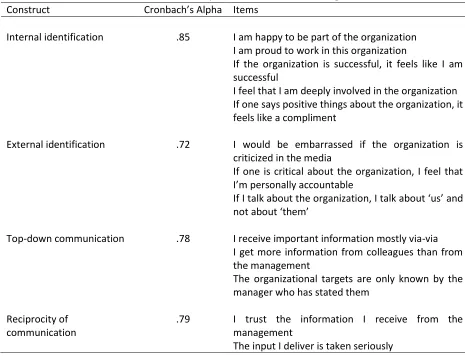
Table 1. Overview of constructs, Cronbach’s Alpha and the items measuring the construct.
Procedure
Data collection was performed from the 25th of September 2013 until the 7th of December 2013. The
management requested the employees to cooperate with the research, which they did. After the data collection period, seven interviews with employees were held in order to interpret the results. These interviews were held with one manager and six people from the four different teams. Employees from a variety of functions, ages and sexes were interviewed. This distribution was chosen in order to retrieve interpretations of the results from all possible perspectives. During these interviews, the anonymized visualizations of the networks were shown, and subsequently, the employees provided their explanation of these visualizations. The interviews resulted in clarification on some of the outcomes and therefore greatly contributed to the quality of the research. By using their interpretations and explanations some findings (such as outliers) were exemplified.
Analysis
The network data were analyzed using the software-package UCINET (Borgatti, Everett, and Freeman, 2002) and visualized by means of NETDRAW, the network visualization package that comes with UCINET. At first, an actor-by-actor matrix for each type of network was drawn in Microsoft Excel. All filled out values, like 3W, 2D, 4M and so on, were valued on a list. The lowest amount of contact within a professional relationship which was filled out, was 1Y, this was valued with a ‘1’ in the Microsoft Excel matrix. After 1Y came 2Y which was valued with a ‘2’ in the matrix, and so on. In the end, the most intense
Construct Cronbach’s Alpha Items
Internal identification .85 I am happy to be part of the organization I am proud to work in this organization
If the organization is successful, it feels like I am successful
I feel that I am deeply involved in the organization If one says positive things about the organization, it feels like a compliment
External identification .72 I would be embarrassed if the organization is criticized in the media
If one is critical about the organization, I feel that I’m personally accountable
If I talk about the organization, I talk about ‘us’ and not about ‘them’
Top-down communication .78 I receive important information mostly via-via I get more information from colleagues than from the management
The organizational targets are only known by the manager who has stated them
Reciprocity of communication
.79 I trust the information I receive from the management
7 relationship which was filled out was 10W, which was valued by ‘23’. These values had direct influence on the thickness of relationship lines in the drawn visualization of the network. By using the Microsoft Excel matrix, the above explained network variables degree, closeness and betweenness could be calculated (appendix A).
Afterwards, the results of the sociometric questioning part were analyzed, using two different perspectives. On the one hand this analysis has been made based on the entire visualized network, without making distinctions in communication subjects or ways of communicating. On the other hand this analysis has been made based on the eight individual networks, four for the communication subjects and four for the ways of communicating. Furthermore, the results of the communication climate questionnaire were analyzed. By performing this step, it became possible to analyze the results on a more in-depth level to find out if the four constructs of the communication climate questionnaire can be predicted by the variables of the network analysis. In the end, it became possible to address the research question stated.
Results
The results of the network analysis including the communication climate questionnaire are now known. Those results will be presented as follows: first on network level, followed by the results on individual level and finally the results per communication manner. Afterwards, the regression results will be presented.
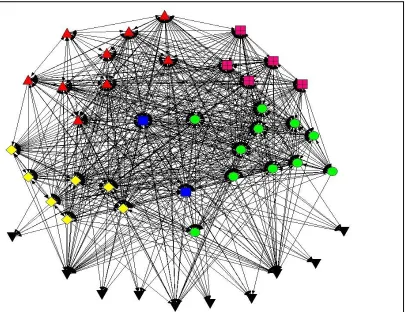
[image:8.612.72.477.359.671.2]
8
Networks
The above presented Figure 1 shows the overall network of the communications department. A single line within a network means that an employee indicated communicating with this particular colleague on a regular basis. When the line has an arrow pointing in both directions, the relationship is claimed to be reciprocal. In figure 1 and appendices B to I the teams are marked with colors and figures to see the differences more clearly. The blue (squares) team consists of two people, they are the managers. The employees who correspond with the black (down triangle) are managers from other departments, such as for example IT, human resources and facility services. The fact that there is a bigger spread within the red (upper triangle) and yellow (diamond) team is logically explicable since the team members individually are stationed in different municipalities. This physical distance led to less face-to-face communication and less communication about personal issues. No significant differences were found in amount of relationships within the teams, this is supported by the density of the networks in which also no significant differences were found. Based on the same calculations, no role stars, liaisons, bridges, gatekeepers or isolates appeared to be present in these networks. Furthermore, clear results were retrieved with regard to communication problems, such as blockages or communication overload. It has proven to be the fact that these problems are not significantly present within the communication networks of the organization. However, there are some remarkable results. In the overall network as well as in the specific networks per subject and per communication manner (see Appendices B – I), it is obvious to see that the team members are communicating most of the time with colleagues from their own team. Taking a closer look at the network in which the communication about experiences as an employee (appendix D)and
private subjects (appendix E) are visualized, a huge share of the teams are still communicating with colleagues from the same team. This is remarkable since the given fact that the composition of the teams changes from time to time. So, all employees know each other and can contact anyone they want to talk about their experiences as an employee and their personal life, stories and questions. Furthermore, there are two teams who are communicating more with each other than with other teams; the green (circles) and purple (square including plus) team. This is clarified by the fact that they are physically working in the same building, whereas the other teams are working at other locations. A few years ago, these two intensive communicating teams were one team. This specific history and shared location may be a clarification for the close relations between these teams.
Individual
On an individual level, it is remarkable that one of the managers has a more marginal position in several network visualizations than one would expect, especially in the communication network about
experiences as an employee (appendix D). The two managers both have two teams to supervise, as soon
as one manager has a less central role, it appears that the other manager automatically gets a more central role. In practice this might mean that the manager with a central role is more trusted or involved in conversations about a variety of subjects. Furthermore, one individual has sometimes an odd position in the networks. This becomes clear when a look is taken in the green (circle) team in figure 1 and appendices D, F and H. This outlier was logically explicable due to the fact that this team member was transferred recently to another team. Due to this transfer, his or her relationships in the workplace are still intense with his or her former direct colleagues.
Communication manner
9 communication. The second most-used way of communication is the conference, followed by face-to-face communication and contact through phone. In all ways of communicating the above presented results are still applicable, so the green and purple team still communicate more with each other and the other teams are somewhat at distance. In case of for example the face-to-face communication this is logical, since the location of the teams differ as well as the history: two of the teams were a few years ago all together within one team. The relationships which occurred at that time, may still be present in today’s practice.
Another explanation of the fact that there is more e-mail contact comes from the fact that the organization introduced the alternative working strategies. In the case of this organization, this means that employees are free to work where they want. A consequence of this freedom is that employees are keeping in touch by means of e-mail. However one would then also expect a high degree of communication through phone, this has proven to be not the case.
Regression
In order to go more in depth and find more information, the communication climate questionnaire from Smidts et al. (2001) was used. As stated in the method section, the questionnaire measured internal
identification, external identification, top-down communication and reciprocity of communication.
Afterwards, regression analyses were performed in order to find out which variables predicted the variance in the constructs. Table 2 shows the regression results of the impact of the variables on internal identification. First of all, this table shows that the communication climate (top-down communication and reciprocity of communication) predicts 20% of the variance in internal identification. The network variables degree, closeness and betweenness predict 23% of the variance in internal identification. This table also shows the fact that the communication climate partially has a significant effect on employees’ internal identification, since top-down communication has proven to be significant (β = -0.41; p < .05). The remaining part of the communication climate (reciprocity of communication) has not had a significant effect on employees’ internal identification. The same counts for the network variables, these have not proven to be significant predictors of the variance in the construct internal identification. This result itself is not convincing enough to answer the research question, but it can be stated that the network variables are not a significant predictor of internal identification.
10
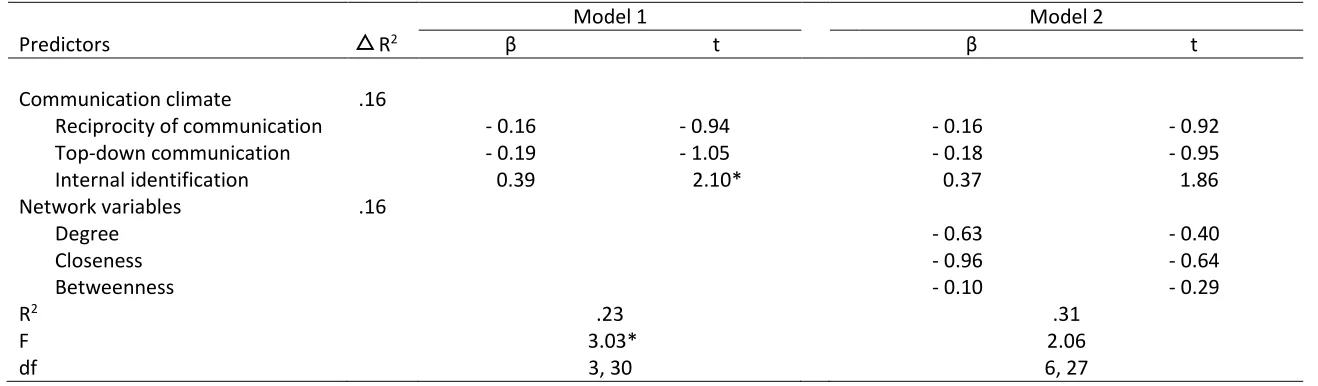
Table 2. Regression for impact of communication climate and network variables on internal identification.
Note. * p < .05.
Table 3. Regression for impact of communication climate and network variables on external identification.
Note. * p < .05
Model 1 Model 2
Predictors R2 β t β t
Communication climate
Reciprocity of communication Top-down communication .20 0.27 - 0.41 1.74 - 2.63* 0.16 - 0.24 0.96 - 1.38 Network variables Degree Closeness Betweenness .23 - 0.40 - 0.15 0.54 - 0.27 - 0.10 1.82
R2 .25 .35
F 5.21* 3.00*
df 2, 31 5, 28
Model 1 Model 2
Predictors R2 β t β t
Communication climate
Reciprocity of communication Top-down communication Internal identification .16 - 0.16 - 0.19 0.39 - 0.94 - 1.05 2.10* - 0.16 - 0.18 0.37 - 0.92 - 0.95 1.86 Network variables Degree Closeness Betweenness .16 - 0.63 - 0.96 - 0.10 - 0.40 - 0.64 - 0.29
R2 .23 .31
F 3.03* 2.06
[image:11.792.68.727.324.517.2]11
Conclusion
Since there was found a research gap in earlier research towards communication within organizations, this study aimed at identifying the contribution of network analysis to diagnose communication problems and to predict organizational identification. Based on the case and method the results are now known and with help of these results the research question will be answered: ‘To what extent is it possible to diagnose communication problems and predict organizational identification by performing a network analysis?’
Based on the performed research, network analysis as such has proven to be a very useful method for diagnosing communication problems. The power of this method lies in the fact that it measures communication networks very extensively and in-depth. Clear examples of this depth are the several communication topics and ways of communicating which were used in the present research. It became possible to investigate not only how the communication networks within the department look when communicating about four different work related and non-work related topics, but also how the communication networks are depicted when looking at e-mailing or conferencing behavior. Combining these variables offered insight in which methods are mostly used for internal communication in this organization. The added value of this combination lies in the fact that the communication problems to be diagnosed do not per se have to concern the communication topics. It might be the case that there is good communication about all work related and non-work related topics, but too much information is exchanged through e-mail. Another example of the depth of this communication audit method lies in the fact that it will be possible to find possible communication blockages or communication overload within the network, when networks are to be visualized. Network roles, such as role stars, liaisons, bridges, isolates and gatekeepers (Brass, 1995), will be identified by using a network analysis. The visualization of the communication networks offered interesting insights, such as centrality of certain individuals and intensity of cooperation between different individuals and teams. The best example of the added value of the visualization of the networks to diagnose communication problems, is the situation in which one manager appeared to have a very marginal position in some networks.
Even in cases where a network analysis would not offer the necessary information for diagnosing communication problems, the method can be merged with a variety of other research designs. This can for example be done by questionnaires, which for example would help to research communication experiences. An example of this is adding a communication climate questionnaire (Smidts et al., 2001) to the research, to find out if the results from the questionnaire support the results of the network analysis. Thus, it can be stated that using network analysis as a communication audit method offers a very good possibility to diagnose communication problems, since its nature is identifying communication networks and the network’s characteristics.
12
Discussion
In this study the strength and weaknesses of the network analysis as a communication audit method have been researched. This has been done by visualizing multiple communication networks of the communication department within an organization where after several network measures were calculated and the complete set of results was analyzed. During the entire process, the aim was to identify the contribution of a network analysis to diagnose communication problems and to predict organizational identification. This study has shown that this method can make an important contribution to the evaluation of an organization’s internal communication system. Since this specific organization was raised a few years ago and in the last years they already had to cope with a reorganization and other organizational problems, this communication audit method proved to be useful for a first measure of the quality of internal communication.
This method might also be very useful as a monitoring tool for the management to trace possible (internal) communication problems at an early stage. Management and employees may not always be able to oversee the risks involved in certain crucial communication-related roles, or to evaluate the strengths and weaknesses of the communication system beyond their individual perceptions. The possibility to do this is offered when performing a network analysis on a regular basis, which uncovers various communication characteristics and makes it possible to perform relevant measurements. The results can indicate if and where employees are outside certain (communication) networks or can indicate employees who form a blockage in the communication flows.
Apart from the conclusion about the contribution of network analysis in general, this study also shows the importance of studying different types of communication networks within (departments of) organizations. The visualization of several networks makes it possible to study the extent to which individuals communicate differently in a variety of networks and with the possibility of communicating in several manners. This adds to the general knowledge of individual (internal) communicative behavior within organizations or departments from organizations. Also, this adds to the general knowledge of individual (internal) communicative behavior in organizations where the alternative working strategies are introduced. Since the expansion of technology mediated communication it is expected that our classic ways of communicating will shift towards more modern communication ways (Neufeld, Wan, and Fang, 2010). In this specific research this has been shown by the fact that communication via e-mail constitutes the largest share of communication in this specific department, future developments might have their impact on the communicative landscape within (departments of) organizations.
This study is an attempt to empirically investigate the contribution of network analysis as a communication audit and as a predictor for organizational identification. Furthermore, differences in use of communication manners within organizations were found during this research. An important limitation is the relatively small number of cases, which can be a danger to the reliability of this research. When interpreting the results of a network analysis, the unit of analysis ranges from the organization as a whole to individual respondents. All these respondents are employees of the communications department of one organization, which is a limitation to the generalizability of the specific network results. The fact that network analysis offers a good possibility for diagnosing communication problems is however generalizable to a variety of other organizations; this method has proven to be useful for further research towards communication problems within organizations.
13 communicating need more research to form a solid body of conclusions and recommendations for organizations. Special interest may occur for alternative working strategies, since these might possibly have a great impact on the future landscape of communications (Neufeld et al., 2010). Also extensive research in use of (internal) social media within organizations might be very interesting for the nearby future. The influence of such developments on the general communications landscape offer a variety of possible starting points for future research. Based on the findings in this research, it may be argued that the method network analysis deserves a more central position on the palette of communication audit techniques.
References
Ashforth, B. E., & Mael, F. A. (1989). Social identity and the organization. Academy of Management Review, 14(1), 20 – 39.
Bartels, J., Pruyn, A. T. H., De Jong, M. D. T., & Joustra, I. (2007). Multiple organizational identification levels and the impact of perceived external prestige and communication climate. Journal of
Organizational Behavior, 28(2), 173 – 190.
Borgatti, S. P., Everett, M. G., & Freeman, L. C. (2002). UCINET for Windows: Software for social network
analysis. Harvard, Cambridge, MA: Analytic Technologies.
Borgatti, S. P., Everett, M. G., & Johnson, J. C. (2013). Analyzing social networks. London, United Kingdom: Sage.
Bott, E. (1957). Family and social network: Roles, norms, and external relationships in ordinary urban
families. London, United Kingdom: Tavistock.
Brass, D. J. (1995). A social network perspective on human resources management. Research in Personnel
and Human Resources Management, 13(1), 39 – 79.
Brass, D. J., Galaskiewicz, J., Greve, H. R., & Tsai, W. (2004). Taking stock of networks and organizations: A multilevel perspective. Academy of Management Journal, 47(6), 795 – 817.
Carmeli, A., Gilat, G., & Waldman, D. A. (2007). The role of perceived organizational performance in organizational identification, adjustment and job performance. Journal of Management Studies, 44(6), 972 – 992.
Contractor, N. S., Wasserman, S., & Faust, K. (2006). Testing multitheoretical, multilevel hypotheses about organizational networks: An analytic framework and empirical example. Academy of Management Review, 31(3), 681 – 703.
De Roeck, K., & Delobbe, N. (2012). Do environmental CSR initiatives serve organizations’ legitimacy in the oil industry? Exploring employees’ reactions through organizational identification theory. Journal of Business Ethics, 110(4), 397 – 412.
14 Dutton, J. E., Dukerich, J. M., & Harquail, C. V. (1994). Organizational images and member identification.
Administrative Science Quarterly, 39(2), 239 – 263.
Goldhaber, G. M. (1993). Organizational communication. Dubuque, United States of America: Brown & Benchmark.
Harary, F., Norman, R. Z., & Cartwright, D. (1965). Structural models: An introduction to the theory of
directed graphs. New York, United States of America: Wiley.
Haythornthwaite, C. (1996). Social network analysis: An approach and technique for the study of information exchange. School of Library and Information Science, 18(4), 323 – 342.
Kapferer, B. (1972). Strategy and transaction in an African factory. Manchester, United Kingdom: Manchester University Press.
Lawler, E., Porter, L., & Tenenbaum, A. (1968). Manager’s attitudes toward interaction episodes. Journal
of Applied Psychology, 52(6), 432 – 439.
Lawson, E. (1965). Change in communication nets, performance, and morale. Human Relations, 18(2), 139 – 147.
Lee, R. (2009). Social capital and business and management: Setting a research agenda. International
Journal of Management Reviews, 11(3), 247 – 273.
Malmelin, N. (2007). Communication capital: Modelling corporate communications as an organizational asset. Corporate Communications: An International Journal, 12(3), 298 – 310.
Meyer, J. P., & Herscovitch, L. (2001). Commitment in the workplace: Towards a general model. Human
Resource Management Review, 11(3), 299 – 326.
Mitchell, J. C. (1969). Social networks in urban situations: Analysis of personal relationships in central
African towns. Manchester, United Kingdom: Manchester University Press.
Moreno, J. L. (1951). Sociometry, Experimental method and science of society. New York, United States of America: Beacon House.
Neufeld, D. J., Wan, Z., & Fang, Y. (2010). Remote leadership, communication effectiveness and leader performance. Group Decision Negotiation, 19(3), 227 – 246.
Nohria, N. (1992). Is a network perspective a useful way of studying organizations? In N. Nohria & R. G. Eccles (Eds.), Networks and organizations: Structure, form, and action. Boston, United States of America: Harvard Business School Press.
O’Reilly, C. A. (1991). Organizational behavior. Where we’ve been, where we’re going. Annual Review of
Psychology, 42(1), 427 – 458.
Porat, A., & Haas, J. (1969). Information effects on decision-making. Behavioral Science, 14(2), 98 – 104.
15 Ritter, M. (2003). The use of balanced scorecards in the strategic management of corporate
communication. Corporate Communications: An International Journal, 8(1), 44 – 59.
Roberts, K. H., & O’Reilly, C. A. (1974). Measuring organizational communication. Journal of Applied
Psychology, 59(3), 321 – 326.
Smidts, A., Pruyn, A. H., & Van Riel, C. B. M. (2001). The impact of employee communication and perceived external prestige on organizational identification. Academy of Management Journal, 49(5), 1051 – 1062.
Tourish, D., & Hargie, O. (2009). Communication and organizational success. In O. Hargie, & D. Tourish (Eds.), Auditing organizational success. London, United Kingdom: Routledge.
Zwijze-Koning, K.H., & De Jong, M. D. T. (2005). Auditing information structures in organizations: A review of data collection techniques for network analysis. Organizational Research Methods, 8(4), 429 – 453.
Zwijze-Koning, K.H., & De Jong, M. D. T. (2009). Auditing management practices in schools: Recurring communication problems and solutions. International Journal of Educational Management, 23(3), 227 – 236.
Zwijze-Koning, K.H., & De Jong, M. D. T. (2014). Network analysis as a communication audit instrument: Uncovering communicative strengths and weaknesses within organizations. Journal of Business and
Technical Communication (accepted for publication).
16
Appendix A – Calculated network variables
Node Degree (in+out)1 Closeness2 Betweenness3
1 26 60.000 15.814
2 10 76.000 2.355
3 23 63.000 3.783
4 11 80.000 0.000
5 26 60.000 8.524
6 20 66.000 3.918
7 21 65.000 3.575
8 12 74.000 0.683
9 17 69.000 3.780
10 20 66.000 4.559
11 24 62.000 7.819
12 15 71.000 2.232
13 41 45.000 122.759
14 25 61.000 6.441
15 18 68.000 1.889
16 34 52.000 82.985
17 14 72.000 1.464
18 27 59.000 18.296
19 21 65.000 3.960
20 34 52.000 42.623
21 20 66.000 7.498
22 20 66.000 4.374
23 28 58.000 19.452
24 22 64.000 5.546
25 26 60.000 14.387
26 14 72.000 1.289
27 34 52.000 71.535
28 34 52.000 29.880
29 23 63.000 8.352
30 25 61.000 7.161
31 21 65.000 4.763
32 26 60.000 12.290
33 28 58.000 11.107
34 19 67.000 2.396
1 Degree (in+out) is the amount of incoming and outgoing relationships mentioned.
2Closeness can be regarded as a measure of how long it will take to spread information from one to all other
nodes sequentially. In the classic definition of the closeness centrality, the spread of information is modeled by the use of shortest paths.
3 Betweenness centrality quantifies the number of times a node acts as a bridge along the shortest path between
17
Appendix B – Communication within projects
18
Appendix D – Communication about experiences as an employee
19
Appendix F – Communication through e-mail
20