BACHELOR THESIS
INDUSTRIAL ENGINEERING AND MANAGEMENT
TOWARDS AN IMPROVED PRODUCTION
PLANNING AND CONTROL METHODOLOGY
WITHIN BENCHMARK ELECTRONICS
22 September 2014
Student name: Dirk Jonkman
Student number: s1005391
University of Twente
Department of Management and Governance
Supervisors University of Twente
[1] Dr. Peter Schuur
[2] Dr. Hans Heerkens
1
Preface
In the context of completing my Bachelor Industrial Engineering and Management at the University of Twente, I
performed a research at Benchmark Electronics regarding production planning and control approaches. The period
leading up to this opportunity was a hectic period. The opportunity of writing my bachelor thesis at ING on the M&A
department was cancelled in a very advanced state. During a very short and intensive period of finding a new opportunity
I contacted Ronald Rikmanspoel. I met Ronald during a study project I had done some years ago at Power Packer. I
remembered Ronald for his deep understanding of supply chain management and his critical views. After I contacted
Ronald to see if he could help me to find an opportunity in supply chain management at Power Packer he offered me an
opportunity at his current employer: Benchmark.
Although my time frame to perform this research was, to put it mildly, quite uncommon. But not many days later the
contracts were signed. After a period of trying to find where I could be of value and what my deliverable was going to be
things got clearer and my research scope was defined. My goal became to assist on further developing and setting up a
methodology to perform a capacity planning. Capacity planning at Benchmark is still in its infancy stage and at the time
provisionally approaches were applied to generate insight in capacity plans and design production plans. During my
internship a lot of managerial changes have taken place. Some reorganization regarding the supporting staff in the
production planning had been done. A lot of new supply chain staff was brought in, including Marc Bakker who was
brought in to focus on setting up a capacity requirements planning and produce according production plans. Marc has
gained his thorough understanding of production planning during his time at VDL, and can be seen as one of the better
planners around.
I want to thank Ronald in particular for giving me the opportunity for an internship at Benchmark Electronics. I have had
great time working with him and enjoyed our conversations and discussions on various topics regarding the research. His
critical view and thoughtful ideas have really been of great value to me. Even though my ideas were often very abstract
and conceptual, and thus not directly applicable to practice, he always welcomed them. This has been a great motivation
for me during this project.
Someone who also deserves to be thanked is Jana Pejchinovska, who operates as a manufacturing engineer at
Benchmark. She received my ideas with great enthusiasm and was one of the internal ambassadors of my research. I also
want to thank her for her critical remarks on my work.
Furthermore, I would also like to thank dr. Peter Schuur for his enthusiasm and great support form an academic
perspective. I have had several meetings to discuss my progress, but we often ended up discussing everything there was.
He has been a great motivator in bringing my academic ideas and models into practical use and getting me to focus on a
2
My appreciation also goes to dr. Hans Heerkens who is my thesis co-assessor. Hans joint at the very last moment of the
research project, nevertheless his comments were very valuable. From a methodological perspective he provided me with
thoughts that spurred me to further improve the report, and to rethink some aspects of the research.
It has become a comprehensive report, which I wrote with great pleasure. The main goal of this report is to provide
Benchmark with new insights on how to precede on planning their production and in particular their capacity resources.
The ideas in this report contradict in many ways with the current vision on how to manage the production planning and
control process. I hope this report can be an eye-opener and that the ideas will help Benchmark to improve the PPC
process further.
Sincerely,
Dirk Jonkman
3
Table of Contents
PREFACE ... 1
TABLE OF CONTENTS ... 3
MANAGEMENT SUMMARY ... 5
1. INTRODUCTION ... 7
1.1 INTRODUCTION TO BENCHMARK ELECTRONICS ... 7
1.2 BACKGROUND ON THE RESEARCH PROJECT ... 8
1.3 PROBLEM IDENTIFICATION ... 10
1.4 RESEARCH SCOPE, PRECONDITIONS AND ASSUMPTIONS... 12
1.5 DELIVERABLES ... 14
1.6 DESIRED SITUATION ... 14
1.7 SUMMARY ... 14
2. RESEARCH MODEL AND METHODOLOGY...15
2.1 RESEARCH GOAL ... 15
2.2 RESEARCH MODEL AND METHODOLOGY ... 15
2.3 SUMMARY AND FURTHER OUTLINE OF THE REPORT ... 17
3. LITERATURE REVIEW: DEFINING THE SITUATION ...18
3.1INTRODUCTION TO PRODUCTION PLANNING AND CONTROL ... 18
3.1.1 The environment and typology ... 19
3.1.2 The production planning and control approaches ... 23
3.2INTRODUCTION TO SYSTEM THEORY ... 25
3.3SUMMARY ... 28
4. DESCRIBING AND ASSESSING THE CURRENT SITUATION...29
4.1DESCRIBING THE CURRENT SITUATION ... 29
4.1.1 The environment ... 29
4.1.2 The production planning approach [meta control] ... 30
4.1.3 The production planning method [controlling body] ... 31
4.1.4 Production [controlled system] ... 32
4.2IDENTIFYING CAUSES FOR THE CONTROLLING PROBLEM ... 33
4.2.1 Controlling aspects of the controlled system ... 34
4.2.2 Controlling ability of the controlling body ... 35
4.3SUMMARY ... 37
5. LITERATURE REVIEW: FINDING SOLUTIONS ...39
5.1ERP SYSTEMS IN THE BENCHMARK ENVIRONMENT ... 39
5.2ADDING CONTROL TO THE CONTROLLING BODY ... 41
5.2.1 Selecting the appropriate control method ... 42
5.2.2 An introduction to the selected control method ... 43
5.2.3 Disadvantages and reservation on the selected method ... 45
5.2.4 Improving the selected method ... 46
5.2.5 Information processing needs of the selected method ... 47
4
5.4SUMMARY ... 49
6. CONCEPTUAL MODEL AND PRACTICAL FRAMEWORK ...51
6.1CONSTRUCTION OUR CONCEPTUAL MODEL ... 51
6.1.1 Protection from external uncertainties and dynamics ... 52
6.2TRANSLATING THE CONCEPTUAL MODEL ... 52
6.2.1 Production planning ... 52
6.2.2 Suspension mechanism / pool principle ... 54
6.2.3 Production control ... 56
6.3IMPLEMENTATION STRATEGY, ISSUES AND ROADMAP ... 58
6.3.1 Implementation strategy ... 58
6.3.2 Implementation issues ... 59
6.3.3 Implementation roadmap ... 60
6.4SUMMARY ... 60
7. CONCLUSION AND RECOMMENDATIONS ...61
7.1CONCLUSIONS ... 61
7.2RECOMMENDATIONS ... 61
8. DISCUSSION ...64
BIBLIOGRAPHY ...65
APPENDIX ...68
APPENDIX A–UNCERTAINTIES IDENTIFIED ... 68
5
Management summary
At Benchmark Electronics business is soaring and large customer orders are received, and Benchmark corporate indicated
it wants to improve its European footprint by expanding business in Almelo. Due to the increasing number of customer
orders the workload in the production process significantly and lead to Benchmark needing to focus more on managing
their capacity resources. In the past Benchmark was only focused on its material requirements planning [MRP], because
long lead times and high quality standards of production parts are the main constraint on their production planning. But
due to the new flow of incoming production orders also capacity is becoming a game-breaking constraint. To manage this
new constraint Benchmark started applying capacity planning techniques by expanding the use of their ERP system from
just MRP applications to MRP II modules.
Though Benchmark started on planning their capacity resources and control its production process, Benchmark still
experiences difficulty on transforming their aggregated production planning and transform it into a detailed planning. This
leads to lots of rescheduling actions and on-time-delivery dates not being met. Furthermore managing and controlling the
work orders on the production floor is hard due to lack of insight in the production status and due to the fact that the
production plan is adjusted and priorities changing on a daily basis. One of the main reasons for these problems is the
absence of relevant and accurate information on many variables in the ERP system. Due to this production cannot be
controlled using the system, and lots of human interference and actions are needed to control it.
The problems stated above are widely recognized in the literature on production planning and control. Lots of companies,
mainly small and medium sized companies, experience similar problems. The purpose of this research is to identify the
underlying causes of the problems, and develop a conceptual model based on suggestions in academic literature
regarding production planning and control systems that will help solve these problems. This led to the following (main)
research question that needed to be answered;
‘’Which logistical concept model can Benchmark Electronics use best to improve production planning and control manageability and on-time-delivery performance, and which recommendations (based on this model) can we make regarding changes that Benchmark needs to make?’’
In this research we focused mainly on the Surface-Mounting-Device and Hand-mounting part of the production, and less
on the box build and clean room departments. After reviewing the literature and analyzing the current Benchmark
situation three causes for the problems regarding the production planning and controlling were identified. [1] The first is
that there is a misfit between the production planning environment and the production planning and control method
used to control the system. [2] The second is that Benchmark is making their production planning unnecessarily complex
by fragmenting the process, by splitting the process and manage these parts independently. [3] And the third reason is
the use of ERP for every aspect of the process, which makes managing the process very labor intensive.
Based on these suggestions from the literature a conceptual model is constructed, which is presented in chapter 6, that
6
workload control approach should be used to plan production capacity and control the production process. This approach
conceptualizes the job shop as a queuing system, and focuses on controlling the lengths of these queues.
In this report an attempt is made to transform the conceptual model in a production planning and control methodology
and a set of associated heuristics and rules. The theory of constraints is used to replace the sophisticated heuristics from
the workload control concept, to make the concept more applicable to Benchmark. Though a lot of research has been
performed on the concept of workload control, academic professionals have to do some sufficient research to bring
theory closer to practice.
The applicability of the workload control concept in the Benchmark environment is proven. A challenge for Benchmark
regarding implementation is that no detailed roadmap is available in the literature. Lots of research regarding parameter
setting still needs to be done. However this does not mean that implementation can be started. Regarding
implementation we propose the following first steps that should be taken by Benchmark.
[1] Benchmark supply chain management needs to decide whether or not they want to adapt their production planning
and control approach. Top management support is one of the key factors for successful implementation. Support from
top management can be achieved by focusing on the improvements that can be achieved by implementing workload
control. For better understanding the link between the well know philosophy lean manufacturing and workload control
need to be emphasized. We advise Benchmark Electronics to find other companies that have already implemented the
concept, so the concept is clear and implications are known.
[2] If Benchmark is willing to change this approach we advise an external consultant that helps to implement the
presented approach. It is a major change within the Benchmark production planning and control approach, that requires a
lot of effort from the Benchmark staff. The process of implementation takes around 2-4 years, and no implementation
roadmap is available. This makes it very hard for Benchmark to successfully implement the proposed model. Some
general implementation issues from other cases are gathered and mentioned in section 6.3.
[3] Get control over the work-in-progress levels by planning the main bottlenecks in the system. The provided conceptual
model can help Benchmark to further improve the production process, but is not able to solve the imbalance between
production in- and outflow of orders. Therefore this imbalance should be resolved, this should be done based on
information that is accurate, and can be done using simple tools in Excel. More detailed methodology for this is presented
in section 6.2.3.
Further recommendations are made regarding how the production planning and control processes should be managed.
Even if Benchmark decides not to change their current approach some useful recommendations and suggestions are
7
Chapter 1
1. Introduction
This report is written in the context of completing my Bachelor Industrial Engineering and Management at the University
of Twente. We have performed a research at Benchmark Electronics on their production planning and control approach.
In this first chapter we will first present an introduction to Benchmark Electronics. We then, in section 1.2, give some
background to the research project and define our problem statement in section 1.3. After this we define our research
scope and discuss assumptions and preconditions underlying this research in section 1.4. The deliverables of our research
are stated in section 1.5. In section 1.6 we present the desired situation and a summary of this chapter in section 1.7.
1.1
Introduction to Benchmark Electronics
Benchmark Electronics Inc. [Benchmark], formerly named Electronics Inc., began operations in 1979 and was incorporated
in 1981. The company is a worldwide provider of integrated electronic manufacturing services. The plant in Almelo, which
is currently the European headquarters, was an originally a subsidiary of Philips N.V. After a period of takeovers,
demergers and partnerships, Benchmark Electronics eventually took over the Almelo plant. Benchmarks’ mission is being
the solution provider of choice for high technology original equipment manufacturers, anticipation their needs and rapidly
delivering comprehensive value-creating solutions during the entire product life cycle by providing; innovative design
engineering services, optimized global supply chain and logistics solutions, world-class manufacturing and after-market
support. The organization currently employs 12,000 employees at eighteen plants world-wide, of which two are located in
Europe. The Almelo plant currently has approximately around 300 employees who together focus primarily on the
development and production of high-end electronic products (Benchmark, 2012).
Benchmark Electronics Inc. provides services to original equipment manufacturers [OEMs] of computers and related
products for business enterprises, medical devices, industrial control equipment for aerospace and defense, testing and
instrumentation and telecommunication equipment. In Almelo the focus lies the development and production of test-
and measurement equipment. Benchmark offers customers comprehensive and integrated design and manufacturing
services form initial product design to volume production including direct order fulfillment and post-deployment services.
There manufacturing and assembly operations include printed circuit boards and subsystem assembly, box build and
8
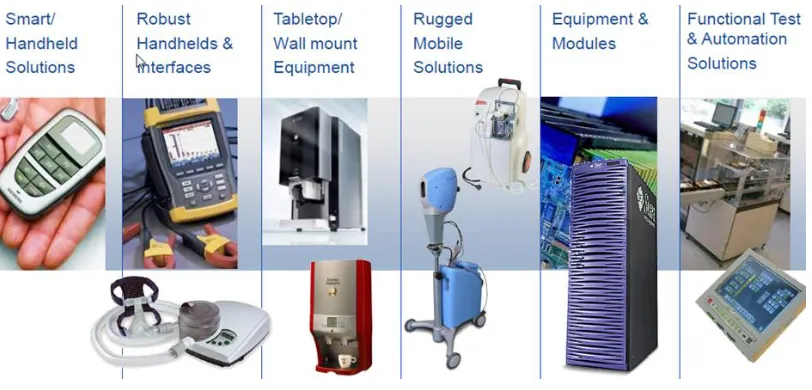
Figure 1: Samples of various Benchmark products
A distinctive service from Benchmark Electronics Inc. is their product feedback system [PFS], which offers their customers
traceability services by closely monitoring and captures every production step. This system is already implemented at
many other Benchmark plants, but in Almelo the company just recently began implementing the PFS. Benchmark is
supplier to almost thirteen customers, three of the major customers include Thales, Airbus and ASML. At Benchmark
operations is very customer orientated, which leads to separately managed operations. This approach has some adverse
consequences as we show in section 4.2.1.
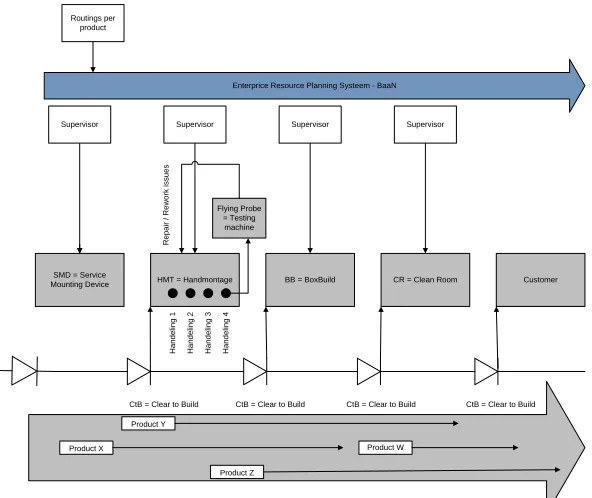
In the production process of Benchmark Almelo1 four major departments can be distinguished, these include: the Surface-Mounting-Device [SMD]-lines, the Hand-Mounting [HMT] department, the Box Build [BB] department and the Clean
Room [CR]. All four departments all have their own supervisor which is responsible for the order execution at their
department. A more detailed description on these production steps is omitted, but relevant aspects are discussed in our
assessment of the current situation in section 4.1.
1.2
Background on the research project
At the time of writing this report there are a lot of interesting developments taking place at Benchmark. The first one is
that business is soaring and large customer orders2 are received (e.g. Thales Hengelo). This development is further reinforced by Benchmark corporate that indicates it wants to improve its European footprint by expanding business in
Almelo. This leads to an increasing number of customer orders, which significantly increases the workload in the
production process. Therefore Benchmark Almelo needs to increase its focus on managing their capacity resources. In the
past Benchmark was only focused on its material requirements planning [MRP], because long lead times and high quality
standards of production parts were the only constraint on their production planning. But due to the new flow of incoming
production orders1 also capacity is becoming a game-breaking constraint in some departments. To manage this new
1
We refer to Benchmark Almelo by using Benchmark in the rest of this report.
2
9
constraint Benchmark started applying capacity planning techniques by expanding the use of their ERP system from just
MRP applications to MRP II modules. A lot of new staff is hired to help managing the increasing number of customer
orders and setting up the MRP II modules in the ERP system.
A second development is that Benchmark started with the implementation of the Product Feedback System [PFS], which
is already implemented at other production facilities of the Benchmark Corporation [see section 1.1]. The PFS is primarily
intended for traceability possibilities to diagnose causes of production errors, which is necessary due to regulation but
also to improve quality. The system tracks each product throughout the whole production process. Each production step
is monitored and data on which workers performed which the task, at what time, with what tools is collected. Though the
system is intended for traceability purposes it has also interesting implication for controlling the production process.
The link between both developments is that due to the increasing workload Benchmark is experiencing some problems
regarding the control of their production process. Due date performance is lacking, and work-in-progress levels are
increasing. The planners at Benchmark need accurate information on the status of work-in-progress orders on the
production floor in order to control the process and take controlling measures like for instance revising order due dates.
Currently no accurate information of the status of various production orders on the floor is available, but the PFS will
generate this information. Since the system provides almost real time information on the status of the production orders.
This information thus makes the production process less opaque and more transparent, and by that it helps planners in
making more informed decisions. For instance if yield or repair issues occur a planner needs to know they occur, since
both heavily have big influence on due date delivery performance. Currently the planners do not receive accurate
information timely on yield and repair issues and therefore the order due date is not revisited in time and customer
orders are delivered late.
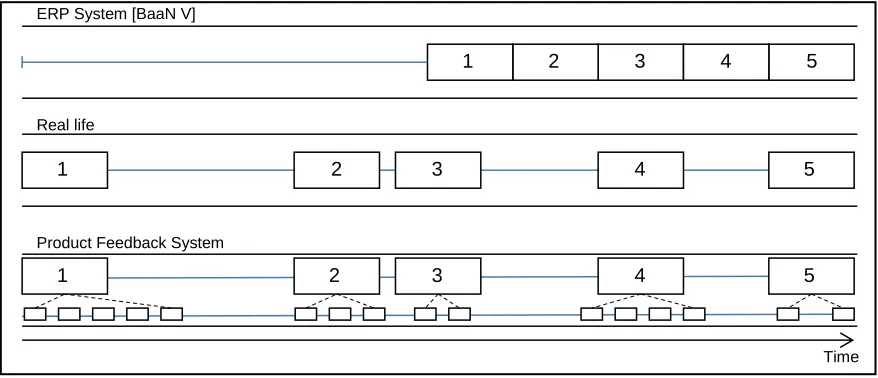
To provide some further inside in why the system is currently opaque we describe another aspect of this opaqueness is
some more detail. For a planner the period between the starting and completion date of an order is a black box. This is
[image:10.612.87.526.513.702.2]caused by the way the ERP system is equipped, we illustrate this in a sketchy way in figure 2.
Figure 2: Representation of routing design in Baan V vs. Real Case
1 2 3 4 5
1 2 3 4 5
ERP System [BaaN V]
Real life
Product Feedback System
Time
10
In figure 2 the boxes represent actual production steps at various workstations, the blue lines in between represent
waiting (queuing) times. Since Benchmark does not control or in any way restricts the queuing times to a maximum they
fluctuate over time [this is be explained more thoroughly in section 4.1.4]. This makes them hard to predict which is why
Benchmark chose to set the production steps directly behind each other in the ERP and a fictive lead time is put in front of
the production steps. This fictive lead time in the ERP system tells production planner to release an order in time so the
due date can be met, this is called backward planning. As can be seen the fixed lead time aligns to throughput period by
generating the same expected starting and expected completion date of an order. But the system does not tell when each production step should be executed. The implementation of PFS reports production steps complete and thus provide
planners with more accurate information. However there are still some problems that are not solved with the PFS. Let us
look at the two main problems that are not solved by the product feedback system.
One of the problems is the absence of a reference framework for planners to determine whether an order is behind
schedule. According to the ERP system all production steps should be executed at the very last moment, without any
waiting time between the steps. A planner might now know which steps were completed when, but he cannot determine
if this according plan since the ERP system does not provide a realistic production plan [see figure 2]. Therefore a planner
does not know if he must act until the due date is reached or if almost all production steps are completed. Because
possible deviations are much easier to observe since the uncertainty and variety converges when more production steps
are completed or if the due date is reached.
The second problem is also causes by the current design of the ERP system and relates to capacity planning. Capacity on
the aggregated level is planned on a weekly basis. But because most of the throughput times are more than one week at
most departments, some production steps are therefore executed in a week in which the system did not account for it.
Let us illustrate this with a fictive example. Suppose a product with five production steps is scheduled with a due date of
Friday in week 2. Then the ERP system will plan all the production steps on Friday [the sum of the production times is in
almost any case less then one day] and thus planning all capacity demand in week 2. But due to the fixed lead time of one
week the first production steps are executed in week 1. But in this week no capacity for this product was accounted for.
This can be problematic when some machines are already planned to produce at maximum capacity, and these
unaccounted orders also need to be processed. Or when this happens to large production orders pushing the capacity
demand levels over the capacity available. Both these cases are present in the Benchmark leading to capacity issues that
the ERP system itself does not accounted for.
1.3
Problem identification
In this section we first explain why we chose to focus our attention on changing the production planning and control
approach. We then show why this is the appropriate choice by looking at what problems can be expected according to the
literature when using the current approach in the Benchmark situation. We then comment on the presence of these
problems in the Benchmark situations based on our interviews with various actors in the production planning and control
11
In the previous section we talked a lot about solving opaqueness problems and inaccurate information on the status of
production order. This would imply that we need to address an information problem, which was how Benchmark views
the problems. We were therefore initially assigned to become a member of the PFS implementation team. Our main focus
was to design the product feedback system so it could effectively be used by the various planners at Benchmark to set
revised due dates. For the system to do this, integration was needed between the ERP system and the PFS. The PFS
reports even the slightest production step, but all this information might not be necessary and could cause an information
overload. Our focus was to determine which steps in production should be reported back to the ERP system. However
there are three reasons why we chose not to focus on solving this information problem but chose to improve the current
production planning and control instead so it could operate with the information currently available.
The first reason is that main purpose for Benchmark at this moment is managing their capacity resources more closely by
generating a capacity. To generate a capacity plan you need to know three things. First you need to know how much
capacity is available in a certain period. And second you need to know which products need to be processed in that
certain period. And thirdly you need to know the processing times of the various products. We deem it impossible for
Benchmark to reach a state of perfect information. Because at Benchmark the products are often changed, and the
current system needs vast amounts of information per product. But also because some information like queuing times
cannot be determined since they fluctuate heavily over time, and therefore are uncertain. It is therefore not possible for
Benchmark to accurately produce a capacity plan with the current approach. Berry et al. (1982) suggest that execution of
the master production schedule is handicapped because adequate capacity has not been planned at individual
departments or work centers. Since Benchmark does not and cannot adequately plans is capacity this should based on the
suggestion by Berry et al. (1982) that Benchmark is having trouble executing their master production schedule according
to plan.
The second reason is that in the literature the applicability of ERP systems in the production planning and control
environment of Benchmark [described in section 4.1] is questioned. We present the major conclusions here, but we
discuss this in more detail in section 5.1. Betrandt & Muntslag (1993) concluded that many engineer-to-order firms have
tried to implement MRP II systems, however, with little or no success. Because the production control concept underlying
ERP cannot be used in these situations, since ERP is in fact a deterministic production control system that cannot function
in a stochastic environment. Also Koh & Saad (2005) concluded that uncertainty disturbs production plans of SMEs in the
manufacturing sector, which plan and schedule their production using MRP, MRP II and ERP systems. As we show in
chapter 4 Benchmark falls in the categories of small and medium sized companies and has strong engineer-to-order
characteristics. Based on this we should expect a lot of effort and techniques being applied to compensate for the
uncertainties. Ho et al. (1995) developed a framework to dampen the system nervousness caused by these uncertainties.
There framework suggests safety stocks, safety lead-time, safety capacity and rescheduling to tackle uncertainties. Also
the use of firefighting approaches was identified by Koh & Saad (2005) in delivering critical orders timely. Most of these
methods are widely applied at Benchmark. So rather than to compensate we should focus on finding a more robust
12
The third reason is that controlling the system in a situation of perfect information is still done in a reactive way. Since
planners can only act when the problems that are already there which, as explained earlier, is only known in a very
advanced state because of the absence of a reference framework. So controlling measures might be taken based on
better information, but it does not prevent production issues to occur. In this research we aim for a proactive approach of
managing the production planning and control processes.
In the literature some suggestions were made regarding problems that Benchmark might have. Based on interview with
various actors we identified some problems, which are in line with the suggestion from the literature. The two main
problems identified were:
[1] While Benchmark is doing a lot of effort putting together an achievable aggregated production plan, they are having a hard time to transform it into an executable detailed planning that could be met.
[2] The production planning needs to be revised often (almost on a daily basis), but could not be done based on good information.
According to various actors in the production planning and control process the first problem is caused by the absence of a
thorough capacity check when sales orders are accepted. Within Benchmark there is the tendency to always accept
customer orders, without performing an aggregated capacity check. At the time of the research provisionally methods
were applied, but these were primarily used to get insight in the capacity problems. But not to take actions based on
them, let alone solve them. That the absence of a thorough capacity check leads to problems with executing the master
production schedule was brought up by Berry et al. (1982). So performing capacity checks is expected to improve the
executing of the master production plan, but for making it possible to adequately perform capacity checks changes need
to be made to the system.
According to the actors, the second problem is caused by uncertainty or dynamics. In section 3.1.1.3 we further describe
these uncertainties and dynamics. Benchmark tries to tackle these uncertainties with the use of safety lead times and
rescheduling efforts. The use of safety stocks is not an appropriate measure for Benchmark because there is some liability
risk associated with it technique. Since the number of incoming order exceeded maximum capacity, safety capacity is also
no option. This is in line with what we expect based on the suggestions from the literature of Koh & Saad (2006) and
Bertrandt & Muntslag (1993). So based on this we should also reconsider the use of an ERP approach at Benchmark.
Now we have clarified why we chose to not to address the informational problem and justified the choice to focus on
improving the production planning and control approach instead. We have addressed the problems that Benchmark
experiences and linked them to the current production planning and control approach. In the next section we discuss the
research scope, preconditions to the research and assumptions underlying our research.
1.4
Research scope, preconditions and assumptions
Within production planning and control literature the vast majority of capacity planning concepts are based on the
13
term on a detailed level (Wortman et al., 1996). Production planning is mostly done based on three levels [see figure 3], in
this report we address all elements but we focused on the following components; master planning, rough-cut capacity
planning, capacity planning, scheduling / sequencing.
We chose to address multiple levels in the production planning and control hierarchy because in our view only addressing
one level does not lead to the desired effect since it is highly dependent on how processes are structured at higher levels.
And consistency between levels is an important concern (Wortman et al., 1996). To adequately address the problems all
levels should be examined and the various levels should be aligned. Furthermore we chose to focus our attention on
capacity planning and capacity resource management since this is fairly new to Benchmark and no adequate framework is
[image:14.612.142.470.235.420.2]present on how to manage these new functions.
Figure 3: the three levels of the production planning and control hierarchy (Jonnson & Mattson, 2003)
In chapter 6 we present our new logistical conceptual model and we make some recommendations based on this new
approach in chapter 7. Also a preliminary implementation roadmap is presented, which comprises some of the first steps
management should take. What this report not addresses are the implementation issues that might arise. Since the
literature only addresses the general and not the specifics we expect some problems when actual implementation is
executed. Solving these issues requires some further research.
Underlying this report there are some assumption. For one we assumed that Benchmark is not going to change its
environment and all the factors it comprehends. This means that we need to find an approach that can operate within the
current Benchmark environment. Therefore an acceptable solution for us cannot be to keep using ERP and change
Benchmark to a make-to-stock company, although a good fit between ERP and Make-to-Stock has been confirmed by
Bertrandt & Muntslag (1993) and Stevenson et al. (2005). The second assumption is that Benchmark is willing to radically
change its current production planning and control system. The approach that we recommend requires some major
changes within the Benchmark situation.
There are three preconditions for the system that we propose in chapter 6. [1] The first is that Benchmark indicated that it
14
binding instruction from Benchmark corporate and second is because Benchmark is not able to organize all processes
belonging to material purchasing without the ERP system. [2] The second is that the system should be able to function in
the current Benchmark environment. So no additional information should be needed, and the system is able to manage
and absorb the dynamics and uncertainties in the Benchmark environment. And [3] the third is that the system should be
easy to understand and to manage. This precondition is also suggested by Land & Gaalman (2009), since complexity has a
negative effect on implementation success.
1.5
Deliverables
In this section we will shortly present a list of the deliverables of this report. This report delivers;
o a new vision and new insights in the do’s and don’ts for Benchmark regarding the improvement of their production planning and control process;
o a logistical conceptual model to design the production planning and control process with a practical translation to the Benchmark situation [which is described in section 6.2];
o a preliminary roadmap for implementation comprising the first steps towards implementation;
1.6
Desired situation
In the desired situation the production is effectively controlled, and thus meets all preconditions for effective control
which are defined in section 3.2. As is further illustrated in section 3.2 this starts with the controlling body having the
capacity to process all information needed to control the system. Since we deem it to be impossible to gather all the
information to control the current system effectively, we chose to change the system. The system that we are going to
construct should meet all three preconditions stated at the end of section 1.4. In the situation of effective control the
planners can proactively manage the workload on the production floor, and the production plan disturbance is managed
in a systematic way. This is expected to lead to Benchmark meet their on-time-delivery targets.
1.7
Summary
In this chapter we have presented a background on Benchmark Electronics as a company and also on the research project
that we performed. We have defined a problem statement in which we justified our choice to improve the production
planning and control concept. We did this by showing that the problems, we would expect based on suggestions in the
literature regarding the use of ERP in an Engineer-to-Order of SMEs, are present at Benchmark. Furthermore we have
clarified what this report comprises and what is does not, and presented a list of the deliverables. In the next chapter we
15
CHAPTER 2
2. Research model and methodology
I
n this chapter we aim to set our research goal [2.1] and construct the research model [2.2] that we are going to use to reach the stated goal. After the model is completed it should be clear what our strategy is, what questions need to beanswered and how we are going to answers them.
2.1
Research goal
As we concluded in section 1.2 and 1.3 Benchmark is currently experiencing problems with their production planning and
control process. Our goal is to assist Benchmark in solving these problems. We can do this by delivering the deliverables
stated in section 1.5. The main purpose is to come up with a logistical conceptual model, the other deliverables are
merely based on / a product of the proposed model. Based on this we have formulated the following main research
question:
‘’Which logistical concept model can Benchmark Electronics use to improve production planning and control manageability and on-time-delivery performance, and which recommendations can we make regarding changes that Benchmark needs to make?’’
In the next section we set out the model that we use to answer this main research question.
2.2
Research model and methodology
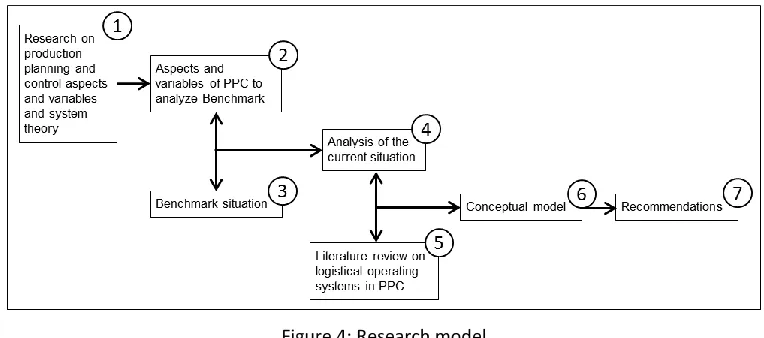
To answer the main research question we build a research model based on the ideas of Verschuren & Doorewaard (2007),
which is presented below [figure 4]. In this section we describe the research model and derive our sub-research questions
that help us to answer the main research question. We do this by walking through research model starting from the left
hand side and work our way to the recommendations.
We first execute a small preliminary research (1) to construct the glasses through which we are going to look when
assessing and analyzing the current situation at Benchmark. In the problem statement we saw that Benchmark has
troubles with controlling its production planning and control processes. This preliminary research comprises two main
topics. The first is the identification of production planning and control aspects and variables that help us to better
describe the situation. The second is introducing system theory which helps us to identify problems regarding the
controlling problems. The system theory offers a framework to describe the processes in an abstract way and provides
16
[1] ‘‘What does production planning and control include, what aspects are relevant from a production planning and control perspective and what variables influence production planning and control process?’’
[2] ‘’How can current situations be described form a system theory perspective, and what suggestions does it provide for effectively controlling systems?’’
The research method used to answer these questions is executing a literature review. After answering this question we
have insight in all the aspects and variables of production planning and control [PPC] (2), and know how we can describe
[image:17.612.114.496.206.375.2]the current system using a system theoretical approach.
Figure 4: Research model
With these insights we analyze and review (4) the current situation (3) using a system theoretical approach and the
production planning and control aspects and variables from our analysis (2). We describe the current methodology
applied at Benchmark and identify the underlying causes to the problems described earlier based on the preconditions
that are presented to us in the first literature review. The questions we have formulated for this section include:
[3] ‘’What is the current situation at Benchmark described in terms of the aspects and variables identified in sub question two?’’
[4] ‘’What is causing the problems regarding production planning and control that Benchmark is experiencing, based on the preconditions stated by the system theory?’’
Questions 3 is being answered by interviewing various actors by using systematic questionnaires in the production
planning and control process and combining their sometimes conflicting views based on our own judgment. The
preconditions for question 4 were assessed by our own analysis and judgment of the situation complemented by views of
the actors.
After we thoroughly analyzed the current situation we perform an in depth literature review (5). Were the first literature
review was focused on analyzing the current situation, this review aims to find solutions to the identified causes in
answering question 4. Furthermore it provides us with recommendation/suggestions regarding structuring the production
17
logistical conceptual model that Benchmark can use to manage the production planning and control process. We have
formulated the following questions that we need to answer from our literature review:
[5] Which of the identified problems have been recognized by researchers and what possible solutions are presented in the literature?’’
[6] ‘’Given the situation and typology of the PPC environment of Benchmark and the preconditions stated in section 1.4, which logistical management system will provide the best fit?’’
Based on our findings in the literature we are able to answer our main research question. In order to provide the
deliverables stated in section 1.5 we construct our logistical conceptual model (6), and translate it in a practical
methodology and according heuristics and rules. Based on this model we provide recommendations (7) to Benchmark on
organizing their production planning and control processes.
2.3
Summary and further outline of the report
In this chapter we have constructed our research model based on the research goal we defined at the beginning of this
chapter. In the research model we have described what our research strategy is, which questions need to be answered
and what methods are going to be used to answer them. We now present the further outline of this report. In chapter 3
we conduct our first literature review were we identify the key aspects and variables of the production planning and
control process, as well as an introduction to system theory. In chapter 4 we describe the current Benchmark situation as
we have stated in section 2.2. In chapter 5 we present our second literature review were we aim to find solutions for the
identified causes to the problems Benchmark experiences. In chapter 6 we have presented our conceptual model and the
translation of this model into a methodology and associated set of heuristics and rules. But we also present a preliminary
roadmap towards implementation. In chapter 7 we present our conclusions and our recommendations. And in chapter 8
18
Chapter 3
3. Literature review: defining the situation
The aim of this chapter is to construct the glasses through which we are going to look when assessing and analyzing the
current situation at Benchmark in the next chapter. This literature research focuses on two aspects. The first is the
identification of production planning and control aspects and variables that help us to better describe the situation. The
second is introducing system theory to identify problems regarding the controlling problems. The questions that we are
going to answer at the end of this chapter include:
[1] ‘‘What does production planning and control include, what aspects are relevant from a production planning and control perspective and what variables influence production planning and control process?’’
[2] ‘’How can current situations be described form a system theory perspective, and what suggestions does it provide for effectively controlling systems?’’
The outline of this chapter is as follows; first we present an introduction to the theory on production planning and control
[3.1]. We define production planning and control, but also identify all key aspects and other variables that are related to
production planning and control. In section 3.2 we introduce the basics of a system theoretical approach towards
business processes. We end this chapter with a summery on our findings by answering our stated research questions in
section 3.3.
3.1 Introduction to production planning and control
A useful introduction that clarifies what production planning and control includes and what purposes it has is presented
by Stevenson et al. (2005); typical functions of a production planning and control system include planning material
requirements, demand management, capacity planning and the scheduling and sequencing of jobs. The key purposes of
such functions include:
o Reducing work in progress;
o Minimize shop floor throughput time;
o Minimize lead times;
o Lower stockholding costs;
o Improve responsiveness to changes in demand and;
o Improve delivery data adherence.
These are important objectives, and choosing the right PPC system is hence a crucial strategic decision. Determining the
19
of many software producers to suggest that an approach is universally appropriate. The latter is implied by a lack of
indication of the type of company that could hope to gain wide applicability of the particular approach. However, through
aiming for such wide applicability it is inevitable that industry-specific planning and control needs are not adequately met
given that manufacturing environments are diverse in terms of characteristics such as levels of customizations offered,
shop floor configuration, production volumes, and the way in which demand is met (Stevenson et al., 2005). From the
above we concluded that it is important to make the right choice when PPC approach is concerned. The ability to
accommodate customization is a key test of applicability of the PPC approaches. This fit between PPC methods and
environments has been examined by Stevenson et al., (2005) and Jonsson & Mattsson (2003). The latter also presented a
list of variables they deemed relevant from a production planning and control perspective. In their article Koh & Saad
(2006) also discuss the influences of uncertainty on production planning and control. In the following sections we explore
and discuss the aspects of production planning and control as identified above; environment, approach and influencing
variables.
Based on these finding we conclude that we have to focus on aligning the production planning and control environment
and the production planning and control approach. The identification of which methods is applicable in the Benchmark
situation is presented in section 5.2.1, based on the work of Stevenson et al., (2005). But first let us look at variable of
production planning and control environments [3.1.1], and the methods that are currently applied in managing and
controlling production [3.1.2].
3.1.1 The environment and typology
As stated above, the manufacturing environment is [among other characteristics] characterized by the way demand is
met (also customization) and the shop floor configuration. We [1] first elaborate on the way demand is met and [2] then
we will then zoom in on the shop floor configuration. Thereafter we take a closer look at the variables deemed relevant
from a production planning and control perspective by Jonsson & Mattsson (2003).
3.1.1.1 How demand is met
Some manufacturing companies deliver from finished goods inventories as reaction on customers’ orders; Make-To-Stock
(MTS). Others however manufacture only in response to customers’ orders; Make-To-Order (MTO) (Amaro et al., 1999). A
general taxonomy framework is presented by Hill (1993); he presented the following five3 categories:
[1] Design-to-order – new product response where companies design and manufacture a product to meet the specific needs of a customer.
[2] Engineer-to-order – changes to standard products are offered to customers and only made to order. Lead-times include the relevant elements of engineering design and all manufacturing.
[3] Make-to-order – concerns manufacturing a standard product (any customization is nominal and does not increase total lead-times) only on receipt of a customer order or against an agreed schedule or call-off.
3
20
[4] Assemble-to-order – components and sub-assemblies have been made to stock. On receipt of an order (or against an agreed schedule or call-off) the required parts are drawn from work-in-progress/component inventory and assembled to
order.
[5] Make-to-stock – finished goods are made ahead of demand in line with sales forecasts. Customer’s orders are met from inventory.
These various categories all vary in terms of their customer-order-decoupling-point [COPD], the stage at which a product
is linked to a specific customer order (Olhager, 2003). An earlier COPD means that an increasing degree of customization
[image:21.612.108.503.214.363.2]being offered. We have presented a graphical representation of the concept below.
Figure 5: Graphical representation of the Order-Penetration-Point (Stevenson et al., 2005)
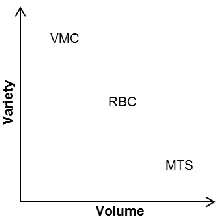
A more in depth approach on environmental classification [MTO specific] is presented by Stevenson et al., (2005). They
further specify the MTO type by making the following classification; Repeat Business Customizers (RBC) and Versatile
Manufacturing Companies [VMC]. A RBC provides customized products on a continuous basis over the length of a
contract. Goods are customized but may be made more than once permitting small degree of predictability. The VMC
market is more complex requiring more sophisticated solutions where each order is completed for individually and high
variety of producing with variable demand are manufactured in small batches with little repetition. When plotting these
types against a volume and variety scale you get the figure below.
Figure 6: classifications based on volume vs. variety (Stevenson et al., 2005)
As we explain in more detail in chapter 4, Benchmark cannot be placed in one particular category. There is between
customers and even within customers the presence of products that fall in various categories. The typologies in the
[image:21.612.251.362.533.643.2]21
3.1.1.2 Shop floor layout
The second aspect to describe the production planning and control environment is the shop floor configuration.
Stevenson et al., (2005) considered four shop floor configurations these include;
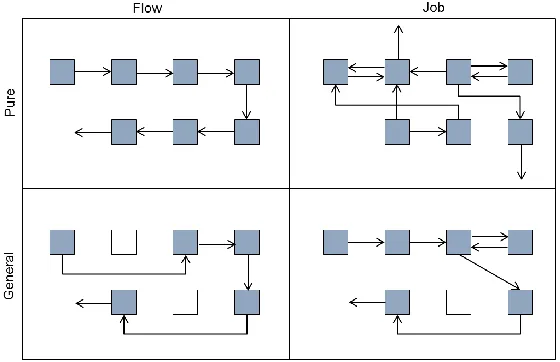
[1] Pure Flow Shop [PFS4] [2] General Flow Shop [GFS] [3] General Job Shop [GJS] [4] Pure Job Shop [PJS]
The key difference between the job shop and the flow shop is the direction of material flow:
[1] Pure Flow Shop - in a Pure Flow Shop work travels in one direction through a sequence of work centers in a strict order.
[2] General flow shop - in a general flow shop work still travel in one direction but jobs are allowed to visit a subset of work centers, permitting limited customization, relevant to RBC.
[3] General Job Shop - the general jobs shop is defined as providing for multi-directional routing, but with a dominant flow direction.
[4] Pure Job Shop - pure Job Shop routing sequences are random; jobs can start and finish at any work center allowing complete freedom and customization.
We have made an attempt on presenting a graphical representation of the various shop floor layouts [figure 5]. Though it
is not possible to represent every form in an exact way, we hope you get a feeling for routing variations from the
[image:22.612.168.448.470.651.2]representation below.
Figure 7: Graphical representation of shop floor layouts
4
22
However, shop configuration is unlikely to lie at one of the extremes (Portioli, 2002). This is also the case in the
Benchmark environment. Though in some parts in the production processes can by typified as a general flow shop, other
parts show more similarities with the general job shop layout. This will be discussed in more detail in section 4.1.4.
Based on the literature there are two main aspects to typify a production planning and control environment namely based
on how demand is met [the customer-order-penetration-point] and the shop floor layout. Let us now look at some more
variables to better grasp the specifics of the Benchmark situation.
3.1.1.3 Variables to describe environmental dynamics and uncertainties
Now that we have identified the main components regarding the environmental typology, namely how demand is met
and shop floor layout, we now focus on some detailed variables regarding the uncertainty and dynamics of an
environment. As we stated in the problem identification, these aspects disturb the production planning. We therefore are
going to take a closer look at these dynamics and uncertainties. Variables that help describe and better understand the
uncertainty and dynamic of an environment have been identified by Jonsson & Mattsson (2003). These variables are
related to the product, the demand and the manufacturing process, note that some variables related to the demand and
the manufacturing process are already addressed:
The following product related variable are considered critical from a planning and control perspective:
o BOM complexity. The number of levels in the bill of material and the typical number of items on each level.
o Product variety. The existence of optional product variants.
o Degree of value added at order entry. The extent to which the manufacturing of the products is finished prior to receipt of customer order.
o Proportion of customer specific items. The extent to which customer specific items are added to the delivered product, e.g. the addition of accessories.
o Product data accuracy. The data accuracy in the bill of material and routing file
o Level of process planning. The extent to which detailed process planning is carried out before manufacture of the product.
The demand-related variables characterize demand and material flow from a planning perspective. The following
variables are considered critical:
o P/D ratio. The ratio between the accumulated product lead time and the delivery lead time to the customer.
o Volume/frequency. The annual manufactured volume and the number of times per year that products are manufactured.
o Type of procurement ordering. Order by order procurement or blanket order releases from a delivery agreement.
o Demand characteristics. Independent or dependent demand.
o Demand type. Demand from forecast, calculated requirements or from customer order allocation.
o Time distributed demand. Demand being time distributed or just an annual figure.
23
o Inventory accuracy. Accuracy of stock on hand data.
The third group of environmental variables characterizes the manufacturing process form a planning perspective. The
following variables are included in this group:
o Manufacturing mix. Homogeneous or mixed products from a manufacturing process perspective.
o Shop floor layout. Functional, cellular or line layout.
o Batch size. The typical manufacturing order quantity.
o Through-put time. Typical manufacturing through-put times.
o Number of operations. Number of operations in typical routings.
These variables are used in chapter 4 to better understand and describe the dynamics and uncertainties in the Benchmark
situation. A better understanding of the dynamics and uncertainties helps us to assess the model we constructed
regarding to which extent it can cope with the identified dynamics and uncertainties.
3.1.2 The production planning and control approaches
Now that we have identified the various aspects of the production planning and control we now address the production
planning and control approaches. During the last century a lot of production-planning approaches have been developed.
They can be characterized as a pure pull, pure push or a hybrid form. Before we present examples of these methods let us
first take a closer look and the concept of push and pull. For this we use the following definition presented by Hopp &
Spearman (2004) to define push and pull. A pull production system is one that explicitly limits the amount of work in process that can be in the system. By default, this implies that a push production system is one that has no explicit limit on the amount of work in process that can be in the system. Harrison et al., (2005) suggest that a push based system should be used for products with small demand uncertainty, as the forecast will provide a good direction on what to produce and
keep in inventory, and also for products with high importance of economies of scale in reducing costs. And that a pull system is suggested for products with high demand uncertainty and with low importance on economies of scale. Below we present five of the most popular production planning methods [categorized in push, hybrid or pull], that are being
used in today’s manufacturing environment.
3.1.2.1 PUSH systems
[1] Material Requirements Planning (MRP)5. The Material Requirements Planning is a periodic push-based system designed for complex production planning environments. MRP is one of the widely used packages due to its universalistic
approach (Stevenson et al., 2005). But Bertrand & Muntslag (1993) recognized that the use of MRP in some cases is not
successful. They argue that the underlying assumptions for the approach often result in problematic issues regarding the
functionality of MRP/MRPII. Company size has been identified as important in implementation strategy and success. It
may be possible, to an extent, to tailor the design of MRP systems to the needs of MTO companies; however this would
5
24
further add to the expense. The capital investment and the impact on SMEs of a failed ERP implementation strategy may
be a barrier to entry for ERP into some SME dominated markets.
3.1.2.2 HYBRID systems
[2] Workload Control. Workload control (WLC) is one of the few concepts that has been designed specifically for SMEs production on receipt of a customer order, and has been extensively researched (Land, 2004). According to this concept,
SMEs require simple PPC frameworks that are structured along the main decision points in the flow of orders, i.e. order
acceptance, release, and dispatching. Besides, robustness is regarded as an important requirement for the PPC approach
in SMEs (Land & Gaalman, 2009). Despite its applicability, the wide range of WLC concepts varying in sophistication and
performance in different shop conditions does however add an extra dimension to the system selection problem. Further
research on parameter setting and other aspects is still required.
3.1.2.3 PULL Systems
[3] Constant-Work-In-Progress (CONWIP). CONWIP is a continuous shop floor release methods. Cards regulate the flow of work, but are not ‘ part number specific’ instead they are ‘job number specific’ staying with a product or batch through
the whole length of the process, making it more manageable method when there is high variety. Though CONWIP is
highlighted as an approach of greater applicability to the MTO industry than Kanban, it is again questionable whether the
hierarchical control system can provide the necessary control at the customer enquiry, job entry and job release stage.
[4] Theory of Constraints. The theory of Constraints is a bottleneck-oriented concept. The approach was developed based on Optimized Production Technology, and is now more commonly known as the Drum-Buffer-Rope (DBR) approach.
Under this philosophy, the production process is scheduled to run in accordance with the needs of the bottleneck(s), as
the bottleneck (constraint resource) determines the performance of the whole production system. A research from Mabin
& Balderstone (2003) shows that companies benefit from lead-time reduction, cycle time reduction and increased
revenue.
[5] KANBAN. KANBAN is a card-based production system that aims to cut inventory and flow times, where the start of one jobs is signaled by the completion of another. There are many variations but in its simplest form, cards are part number
specific. Determining the number of Kanban cards is a major strategic decision, balancing WIP, flow times and utilization.
Kanban needs continuous flow or large batches, a limited number of parts, few set ups and low demand variability to be
an effective system (Stevenson et al., 2005). It is clear that Kanban cannot cater for the routing variability and lack of
repetition predominant in MTO manufacturing.
Now we have looked at the two main aspects in selecting an applicable approach namely, the environmental typology and
the selected approach. We have identified various aspects of an environment and have looked at the most widely used
25
3.2 Introduction to system theory
For identifying the problems regarding controlling the process of production planning and control we use, as stated
earlier, the system theory. The reasons we chose to approach the production planning and control process as a system is
one because it helps us to describe the processes in an abstract way to place it more easily in a literary context. And
second because it presents a clear set of conditions that need to be met for effective control. Furthermore approaching
the problem as a system helps Benchmark to see a process of change rather than snapshots when viewing the production
planning and control process as a system (Senge, 1994) when they start implementation.
Before we present a further introduction we need to make an important note. Describing the Benchmark situation in an
abstract and generalized way this leads to the ignorance of specific characteristics of the Benchmark environment. This,
on the one hand, makes it easier for us to place it in a literary context, since theory only addresses the general and not
the specific situation. But on the other hand will lead to some [practical and implementation] issues when we translate
the conceptual model to the framework of methods, heuristics and rules that can be applied Benchmark [chapter X].
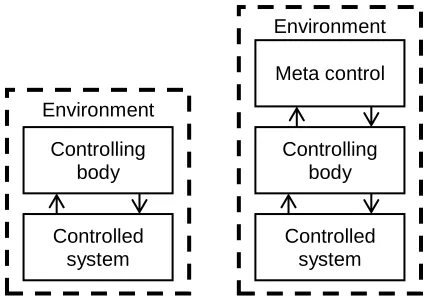
For the introduction on system theory we use the work of de Leeuw (1994). In its most simplistic form a controlling
situations can be presented by a controlling body [CB] and a controlled system [CS] within an environment. In case the
controlling system is in fact also a controlling body meta control is added to the situation. In case of production planning
an effective planning requires a good planning and a good organization of the planning process. We have presented the
[image:26.612.199.417.403.555.2]two types of controlling situations in figure 8.
Figure 8: Basic representation of systems (de Leeuw, 1994)
When applying the controlling theory it is required to make a sharp distinction between the controlling aspect of the CS
and the controlling ability of the CB. The controlling aspects relate to the solvability of the controlling task, and controlling
ability relates to the capacity of the controlling body. If a CB does not meet the preconditions for effective control the
control is likely to fail. The preconditions for effective control are presented below:
[1] Objectives. In any controlling situations there should be an evaluation mechanism to measure the effects of controlling measures. If this evaluation mechanism is not available no effective governing of the controlled system is possible.
Meta control
Controlled system Controlling
body
Controlled system Controlling
body Environment